
After school Objectives Understand the different level of

After school
Objectives • Understand the different level of courses available post 16. • Understand the difference between A levels and Further Education (FE) qualifications. • Know about the routes into university from A levels and FE. • Routes into apprenticeships and employment from A levels and BTEC.
Fact: Young people are required to participate in learning or training until they are 18, by law.
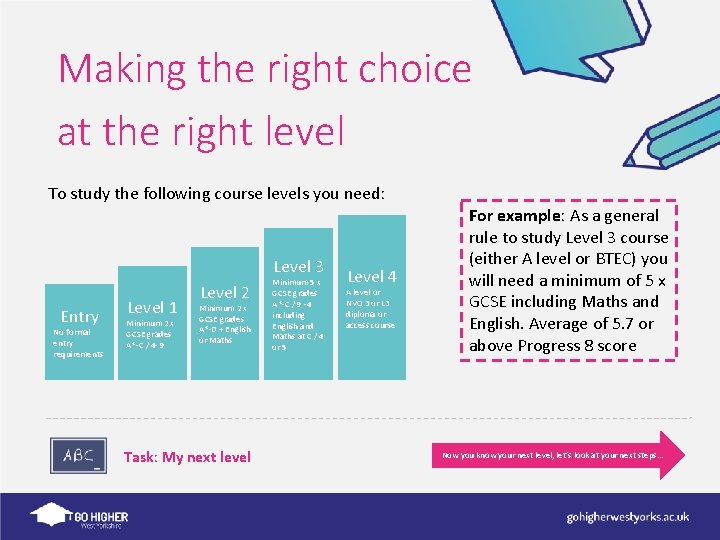
Making the right choice at the right level To study the following course levels you needː Level 3 Entry No formal entry requirements Level 1 Minimum 2 x GCSE grades A*-C / 4 - 9 Level 2 Minimum 2 x GCSE grades A*-D + English or Maths Taskː My next level Minimum 5 x GCSE grades A*-C / 9 -4 including English and Maths at C / 4 or 5 Level 4 A level or NVQ 3 or L 3 diploma or access course For exampleː As a general rule to study Level 3 course (either A level or BTEC) you will need a minimum of 5 x GCSE including Maths and English. Average of 5. 7 or above Progress 8 score Now you know your next level, let’s look at your next steps…
What are my options after GCSE? A levels Further Education Apprenticeships
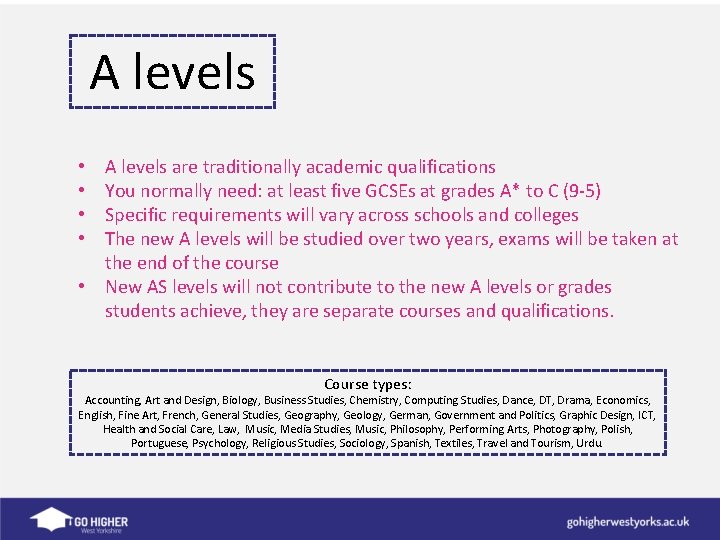
A levels are traditionally academic qualifications You normally need: at least five GCSEs at grades A* to C (9 -5) Specific requirements will vary across schools and colleges The new A levels will be studied over two years, exams will be taken at the end of the course • New AS levels will not contribute to the new A levels or grades students achieve, they are separate courses and qualifications. • • Course typesː Accounting, Art and Design, Biology, Business Studies, Chemistry, Computing Studies, Dance, DT, Drama, Economics, English, Fine Art, French, General Studies, Geography, Geology, German, Government and Politics, Graphic Design, ICT, Health and Social Care, Law, Music, Media Studies, Music, Philosophy, Performing Arts, Photography, Polish, Portuguese, Psychology, Religious Studies, Sociology, Spanish, Textiles, Travel and Tourism, Urdu.
“ “ True or false? A levels are studied over two years.
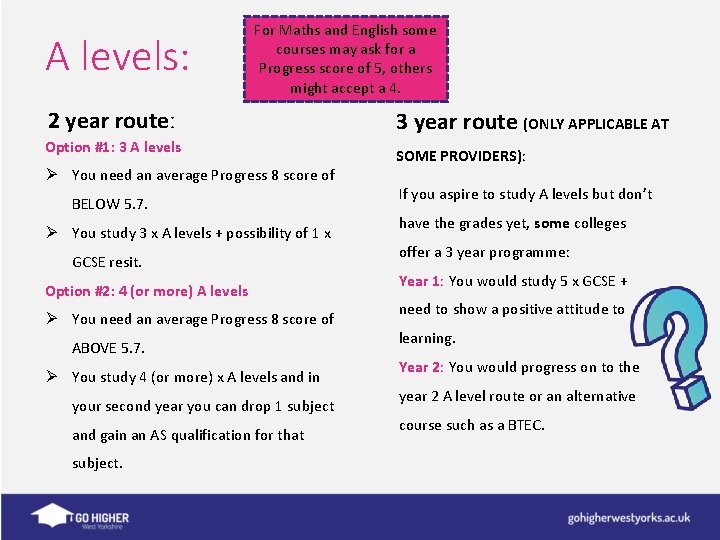
A levels: For Maths and English some courses may ask for a Progress score of 5, others might accept a 4. 2 year routeː Option #1: 3 A levels Ø You need an average Progress 8 score of BELOW 5. 7. Ø You study 3 x A levels + possibility of 1 x GCSE resit. Option #2: 4 (or more) A levels Ø You need an average Progress 8 score of ABOVE 5. 7. Ø You study 4 (or more) x A levels and in your second year you can drop 1 subject and gain an AS qualification for that subject. 3 year route (ONLY APPLICABLE AT SOME PROVIDERS)ː If you aspire to study A levels but don’t have the grades yet, some colleges offer a 3 year programmeː Year 1ː You would study 5 x GCSE + need to show a positive attitude to learning. Year 2ː You would progress on to the year 2 A level route or an alternative course such as a BTEC.
Further Education BTEC, NVQ, CERT, Diplomasː Combine practical learning with subject and theory content. There are over 2, 000 BTEC qualifications across 16 sectors – they are available from entry level.

Further education: Level 3 BTEC have the similar entry requirements as A levels (as they are both a Level 3 qualification) and they are taught as a 2 -year course. Likewise there is sometimes an option to resit Maths OR English GCSE alongside studying a Level 3 qualification. Example BTECː 3 Entry IT Certificate Business Award Taskː Course Bingo This is the same as completing A levels 1 Diploma in Business & Retail 2 Diploma in Business Studies BTEC fasttrack diploma in Business Studies 95% of universities and colleges in the UK accept BTEC students, including competitive universities from the Russell Group.
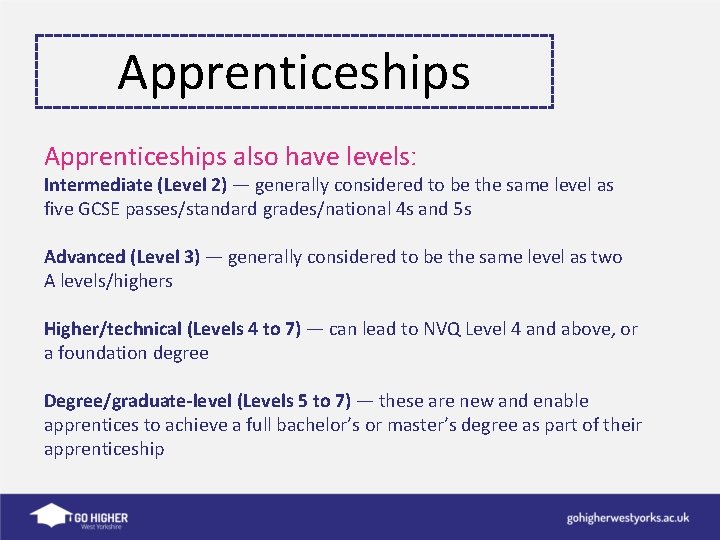
Apprenticeships also have levelsː Intermediate (Level 2) — generally considered to be the same level as five GCSE passes/standard grades/national 4 s and 5 s Advanced (Level 3) — generally considered to be the same level as two A levels/highers Higher/technical (Levels 4 to 7) — can lead to NVQ Level 4 and above, or a foundation degree Degree/graduate-level (Levels 5 to 7) — these are new and enable apprentices to achieve a full bachelor’s or master’s degree as part of their apprenticeship
What are the differences A levels Further Education Apprenticeships Taskː Differences
Making the next step matter After successfully completing your Level 3 course you will be able to progress on to university, college, apprenticeship or employment. Exercise – Plot your path Useful linksː https: //university. which. co. uk/a-level-explorer https: //www. ucas. com/what-are-my-options https: //www. gov. uk/education/apprenticeships-traineeships-and-internships Search your local qualification providers

Thank you
- Slides: 15