
After School Education and Safety ASES Program Prop
- Slides: 32
After School Education and Safety (ASES) Program – Prop 49 Sandra Mc. Brayer, CEO The Children’s Initiative Dennis Petrie, Deputy Director Workforce Services Branch Employment Development Department
What is Proposition 49/ASES? o Proposition 49 was passed by the voters of California in November, 2002. o The initiative, sponsored by Arnold Schwarzenegger, changed the name of the state’s after school program to the After School Education and Safety (ASES) program, and triggered an increase in annual funding from $121 million up to $550 million. 2
Who Can Apply for ASES Funding? o All California elementary, middle, and junior high schools are eligible for to participate o There is a priority for schools with 50% FRPM o Any City, County may apply with the approval of, and in partnership with, an LEA. o The program is open to all students who attend a participating school without regard to income. 3
How are the Funds Distributed? o Current legislation provides for competitive grants of $112, 000 per eligible elementary school and $150, 000 per eligible middle/junior high school. o Upon award and with acceptance of full funding an elementary school must serve 83 students per day and middle schools must serve 111 students per day o Formula= $7. 50 per day, per student for 180 school days per year 4
Flow of Money o California Department of Education. After School Partnership Office o Local LEA (can be a County Office of Education or school district) o If determined by local LEA can flow to Community Based Organization to provide services and/or run the program 5
What Do Programs Provide? o Funded schools have agreed to provide the following: n Educational and enrichment components n Physically and emotionally safe environment n Integration with core school day n Collaboration with community n Opportunities for physical activity n Nutritious snack n Fiscal accountability and match verification n Required evaluation data on all participating students 6
When Do Programs Operate? It is the intent of the Legislature that: o o o All programs must operate every school day (all five days) from dismissal until 6: 00 pm and at least 15 hours per week. Elementary students are intended to participate every day, for the full range of hours. Middle/junior high school students are intended to participate for a minimum of three days/nine hours per week. 7
Staffing Requirements o Staff members who directly supervise pupils must meet the minimum requirements for an instructional aide set by the district o Site supervisors must be approved by the school principal o Programs must maintain a staff to student ratio of 1: 20 8
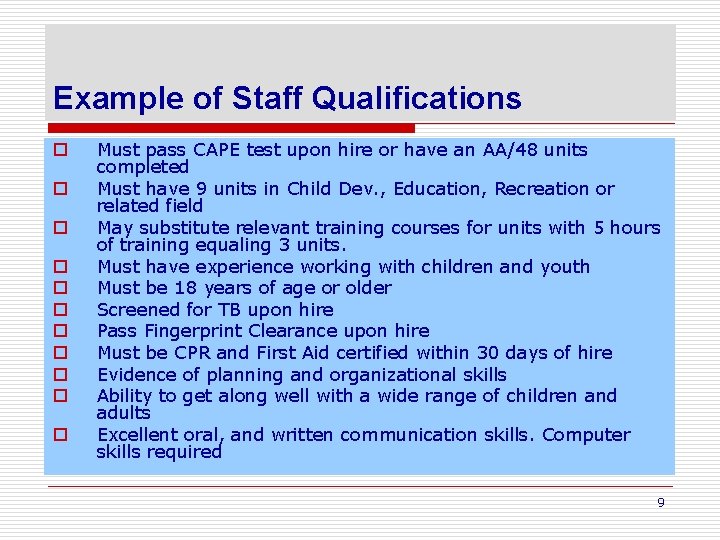
Example of Staff Qualifications o o o Must pass CAPE test upon hire or have an AA/48 units completed Must have 9 units in Child Dev. , Education, Recreation or related field May substitute relevant training courses for units with 5 hours of training equaling 3 units. Must have experience working with children and youth Must be 18 years of age or older Screened for TB upon hire Pass Fingerprint Clearance upon hire Must be CPR and First Aid certified within 30 days of hire Evidence of planning and organizational skills Ability to get along well with a wide range of children and adults Excellent oral, and written communication skills. Computer skills required 9
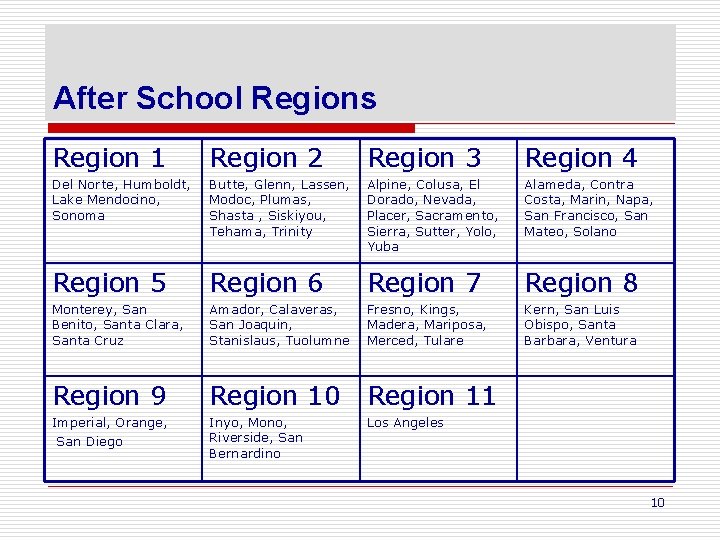
After School Regions Region 1 Region 2 Region 3 Region 4 Del Norte, Humboldt, Lake Mendocino, Sonoma Butte, Glenn, Lassen, Modoc, Plumas, Shasta , Siskiyou, Tehama, Trinity Alpine, Colusa, El Dorado, Nevada, Placer, Sacramento, Sierra, Sutter, Yolo, Yuba Alameda, Contra Costa, Marin, Napa, San Francisco, San Mateo, Solano Region 5 Region 6 Region 7 Region 8 Monterey, San Benito, Santa Clara, Santa Cruz Amador, Calaveras, San Joaquin, Stanislaus, Tuolumne Fresno, Kings, Madera, Mariposa, Merced, Tulare Kern, San Luis Obispo, Santa Barbara, Ventura Region 9 Region 10 Region 11 Imperial, Orange, San Diego Inyo, Mono, Riverside, San Bernardino Los Angeles 10
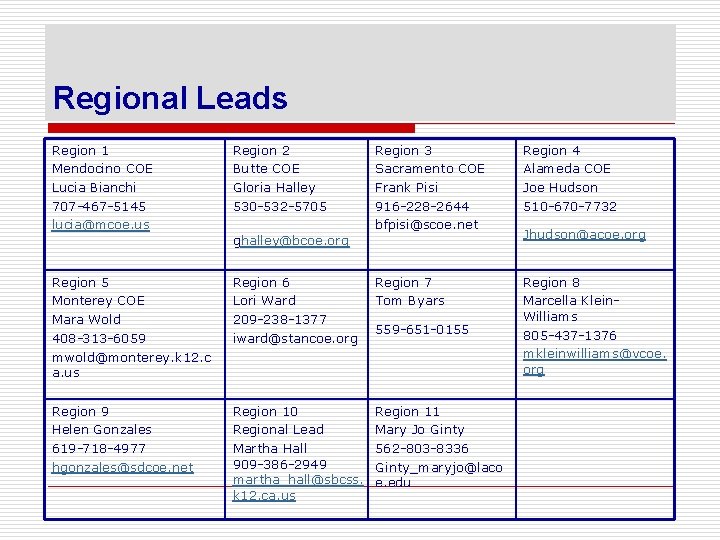
Regional Leads Region 1 Mendocino COE Lucia Bianchi 707 -467 -5145 lucia@mcoe. us Region 2 Butte COE Gloria Halley 530 -532 -5705 Region 3 Sacramento COE Frank Pisi 916 -228 -2644 bfpisi@scoe. net Region 4 Alameda COE Joe Hudson 510 -670 -7732 Region 8 Marcella Klein. Williams 805 -437 -1376 mkleinwilliams@vcoe. org ghalley@bcoe. org Region 5 Monterey COE Mara Wold 408 -313 -6059 mwold@monterey. k 12. c a. us Region 6 Lori Ward 209 -238 -1377 iward@stancoe. org Region 7 Tom Byars Region 9 Helen Gonzales 619 -718 -4977 hgonzales@sdcoe. net Region 10 Regional Lead Martha Hall 909 -386 -2949 martha_hall@sbcss. k 12. ca. us Region 11 Mary Jo Ginty 562 -803 -8336 Ginty_maryjo@laco e. edu 559 -651 -0155 Jhudson@acoe. org
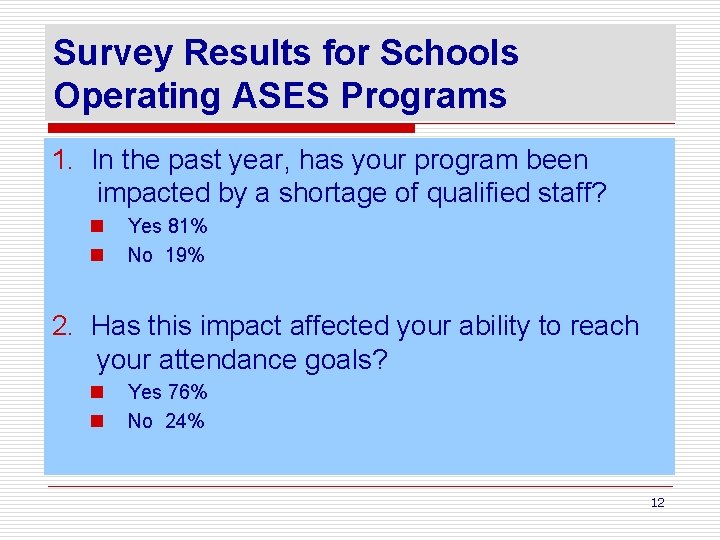
Survey Results for Schools Operating ASES Programs 1. In the past year, has your program been impacted by a shortage of qualified staff? n n Yes 81% No 19% 2. Has this impact affected your ability to reach your attendance goals? n n Yes 76% No 24% 12
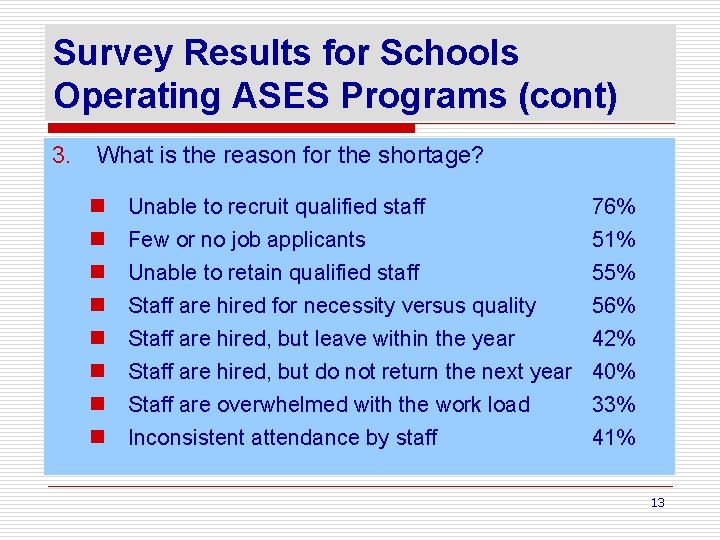
Survey Results for Schools Operating ASES Programs (cont) 3. What is the reason for the shortage? n n n n Unable to recruit qualified staff Few or no job applicants 76% 51% Unable to retain qualified staff Staff are hired for necessity versus quality Staff are hired, but leave within the year Staff are hired, but do not return the next year Staff are overwhelmed with the work load Inconsistent attendance by staff 55% 56% 42% 40% 33% 41% 13
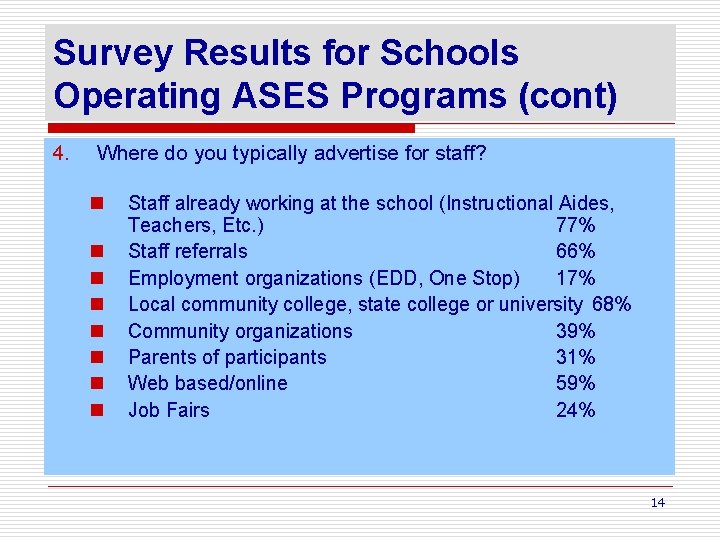
Survey Results for Schools Operating ASES Programs (cont) 4. Where do you typically advertise for staff? n n n n Staff already working at the school (Instructional Aides, Teachers, Etc. ) 77% Staff referrals 66% Employment organizations (EDD, One Stop) 17% Local community college, state college or university 68% Community organizations 39% Parents of participants 31% Web based/online 59% Job Fairs 24% 14
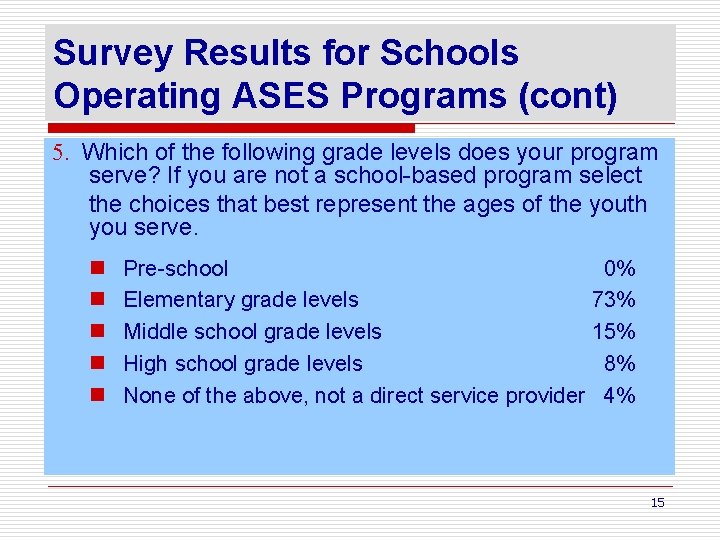
Survey Results for Schools Operating ASES Programs (cont) 5. Which of the following grade levels does your program serve? If you are not a school-based program select the choices that best represent the ages of the youth you serve. n n n Pre-school 0% Elementary grade levels 73% Middle school grade levels 15% High school grade levels 8% None of the above, not a direct service provider 4% 15
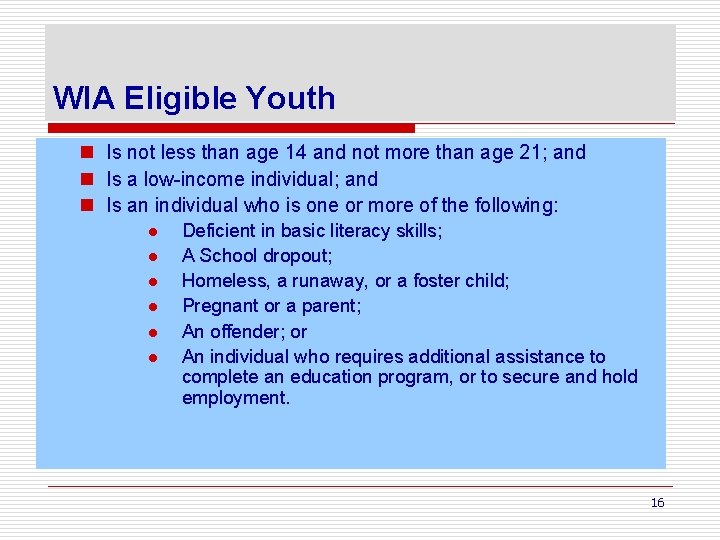
WIA Eligible Youth n Is not less than age 14 and not more than age 21; and n Is a low-income individual; and n Is an individual who is one or more of the following: ● Deficient in basic literacy skills; ● A School dropout; ● Homeless, a runaway, or a foster child; ● Pregnant or a parent; ● An offender; or ● An individual who requires additional assistance to complete an education program, or to secure and hold employment. 16
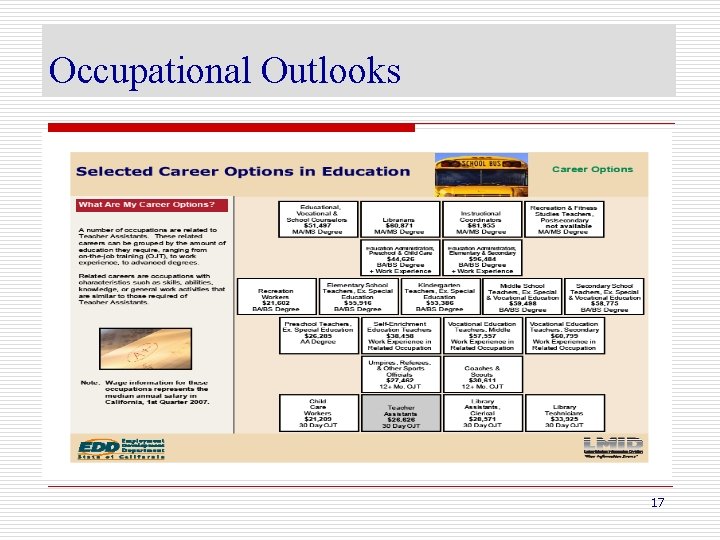
Occupational Outlooks 17
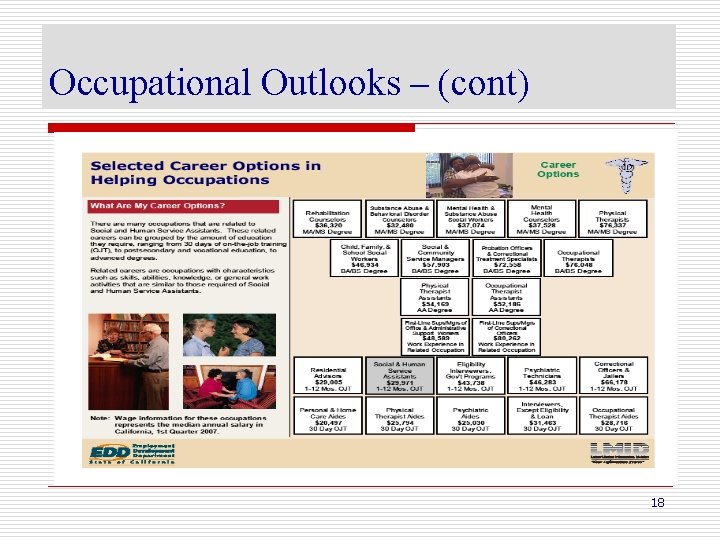
Occupational Outlooks – (cont) 18
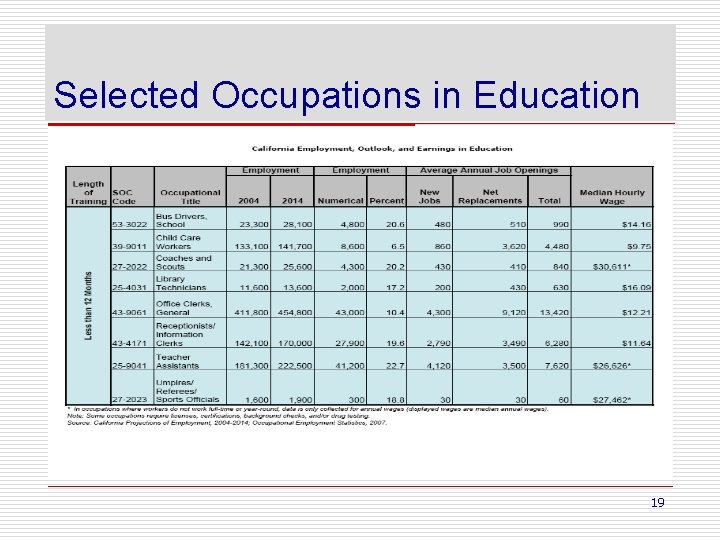
Selected Occupations in Education 19
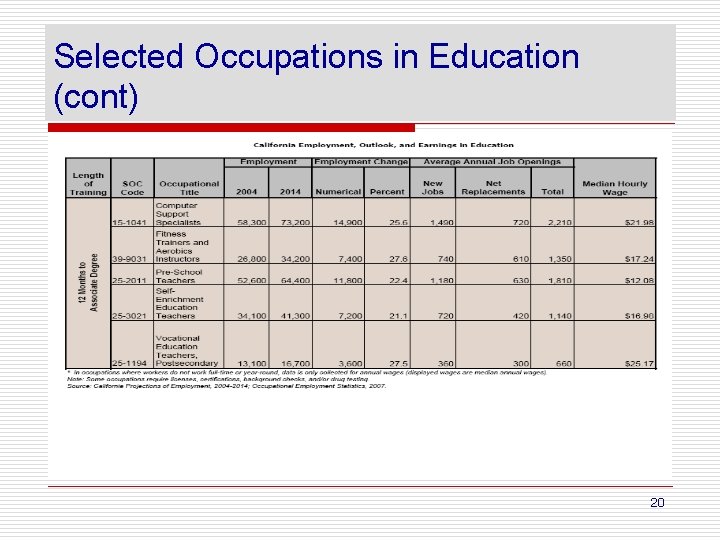
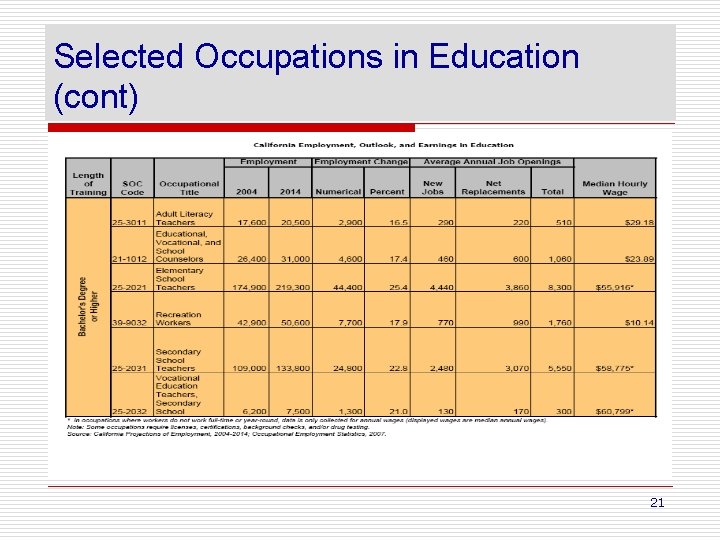
Selected Occupations in Education (cont) 20
Selected Occupations in Education (cont) 21
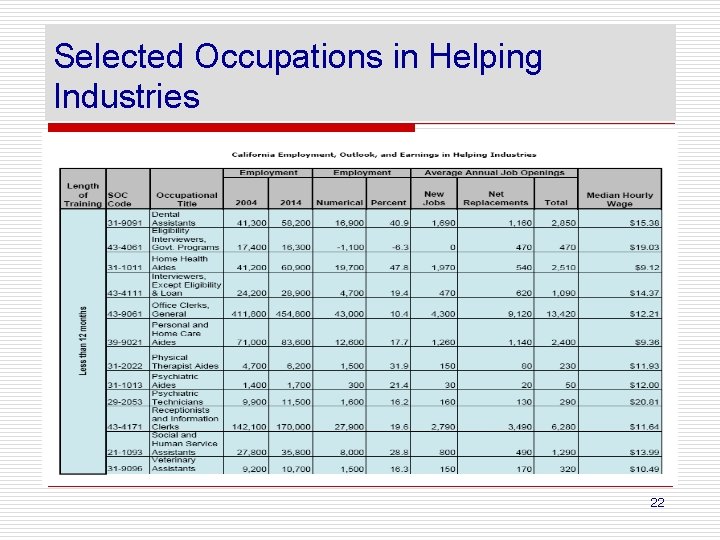
Selected Occupations in Helping Industries 22
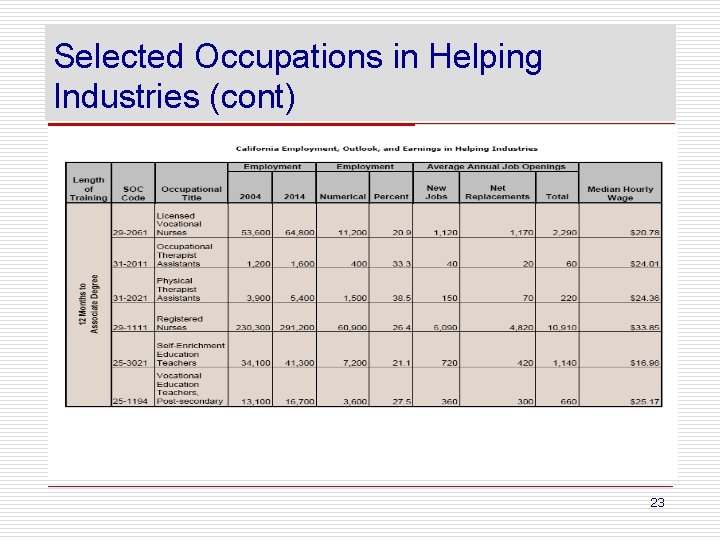
Selected Occupations in Helping Industries (cont) 23
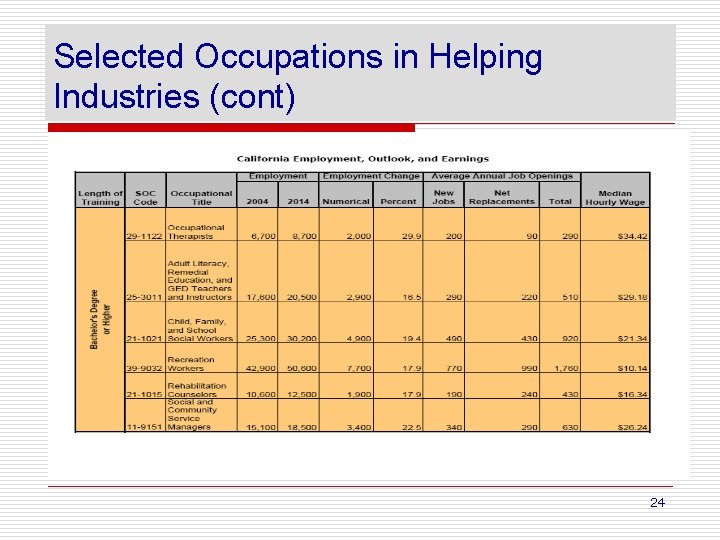
Selected Occupations in Helping Industries (cont) 24
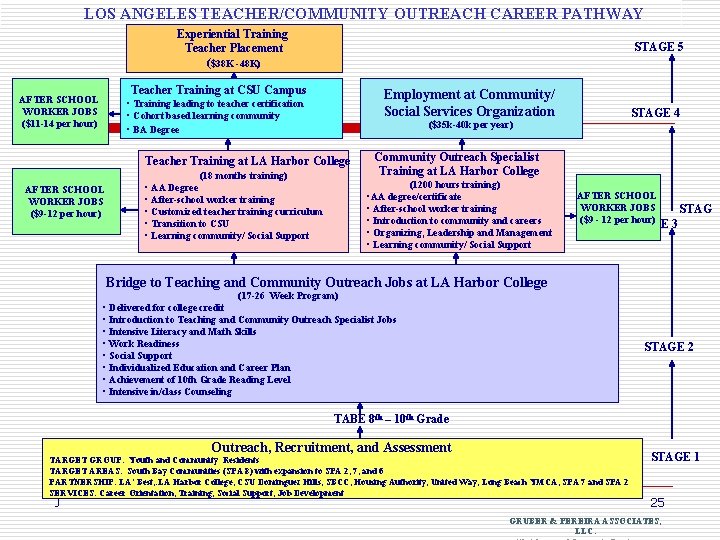
LOS ANGELES TEACHER/COMMUNITY OUTREACH CAREER PATHWAY Experiential Training Teacher Placement ($38 K -48 K) STAGE 5 Teacher Training at CSU Campus AFTER SCHOOL WORKER JOBS ($11 -14 per hour) Employment at Community/ Social Services Organization • Training leading to teacher certification • Cohort based learning community • BA Degree Teacher Training at LA Harbor College AFTER SCHOOL WORKER JOBS ($9 -12 per hour) (18 months training) • AA Degree • After-school worker training • Customized teacher training curriculum • Transition to CSU • Learning community/ Social Support STAGE 4 ($35 k-40 k per year) Community Outreach Specialist Training at LA Harbor College (1200 hours training) • AA degree/certificate • After-school worker training • Introduction to community and careers • Organizing, Leadership and Management • Learning community/ Social Support AFTER SCHOOL WORKER JOBS ($9 - 12 per hour) STAG E 3 Bridge to Teaching and Community Outreach Jobs at LA Harbor College (17 -26 Week Program) • Delivered for college credit • Introduction to Teaching and Community Outreach Specialist Jobs • Intensive Literacy and Math Skills • Work Readiness • Social Support • Individualized Education and Career Plan • Achievement of 10 th Grade Reading Level • Intensive in/class Counseling STAGE 2 TABE 8 th – 10 th Grade Outreach, Recruitment, and Assessment TARGET GROUP: Youth and Community Residents TARGET AREAS: South Bay Communities (SPA 8) with expansion to SPA 2, 7, and 6 PARTNERSHIP: LA’ Best, : LA Harbor College, CSU Dominguez Hills, SBCC, Housing Authority, United Way, Long Beach YMCA, SPA 7 and SPA 2 SERVICES: Career Orientation, Training, Social Support, Job Development J STAGE 1 25 GRUBER & PEREIRA ASSOCIATES, LLC.
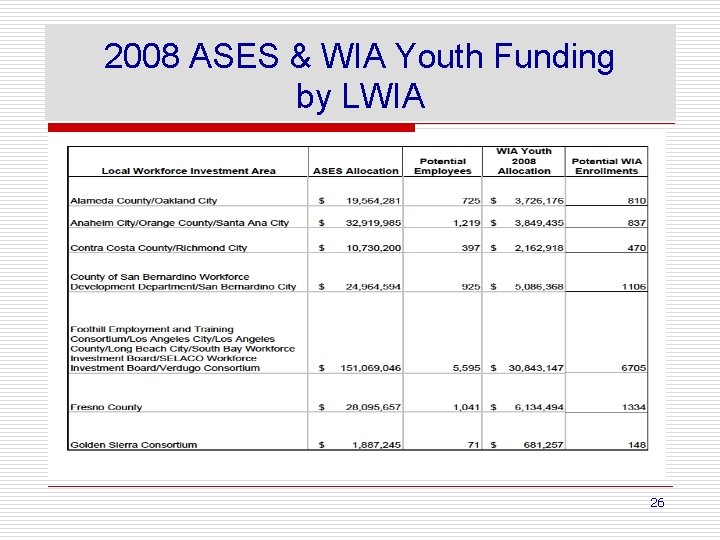
2008 ASES & WIA Youth Funding by LWIA 26
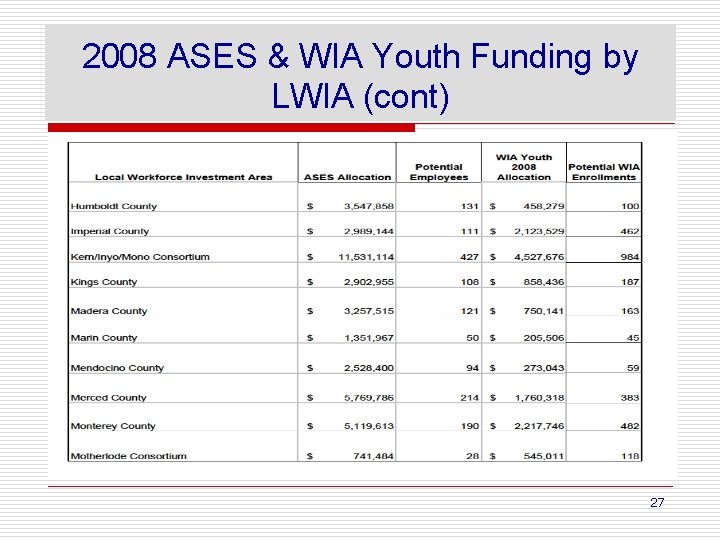
2008 ASES & WIA Youth Funding by LWIA (cont) 27
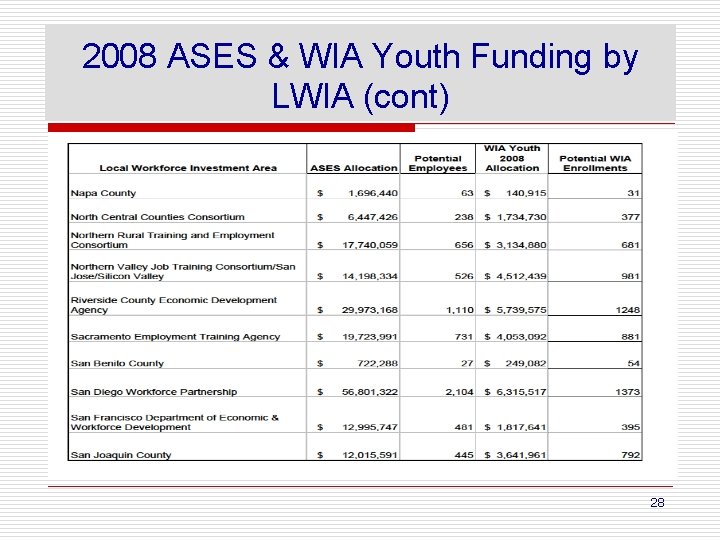
2008 ASES & WIA Youth Funding by LWIA (cont) 28
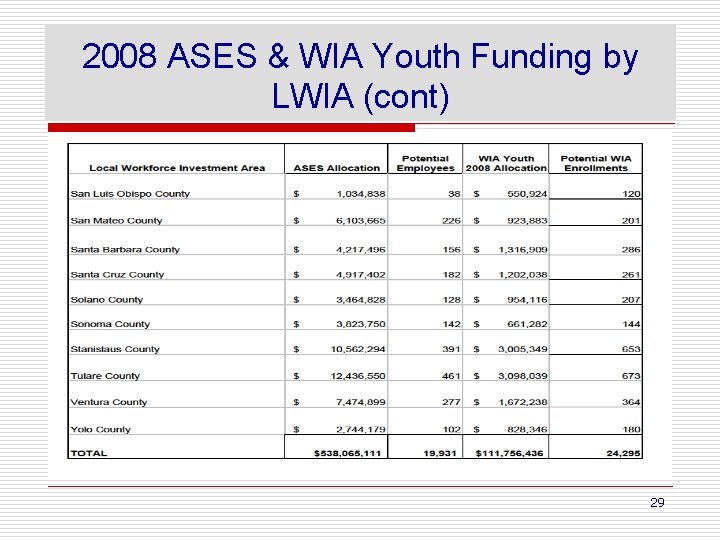
2008 ASES & WIA Youth Funding by LWIA (cont) 29
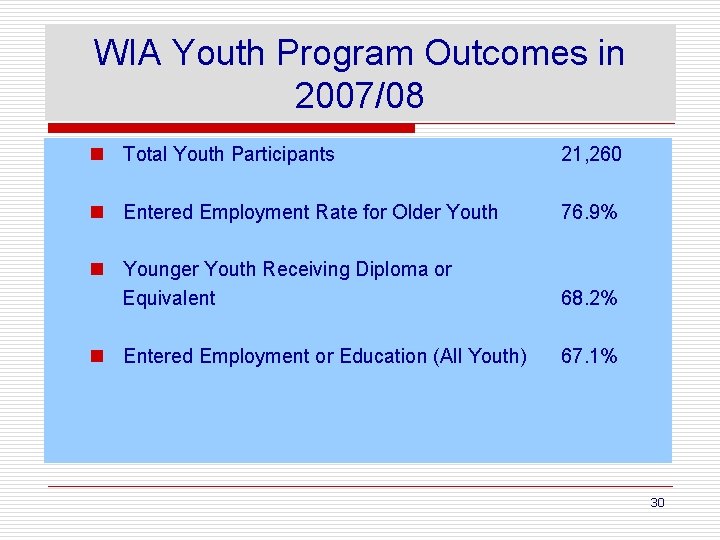
WIA Youth Program Outcomes in 2007/08 n Total Youth Participants 21, 260 n Entered Employment Rate for Older Youth 76. 9% n Younger Youth Receiving Diploma or Equivalent 68. 2% n Entered Employment or Education (All Youth) 67. 1% 30
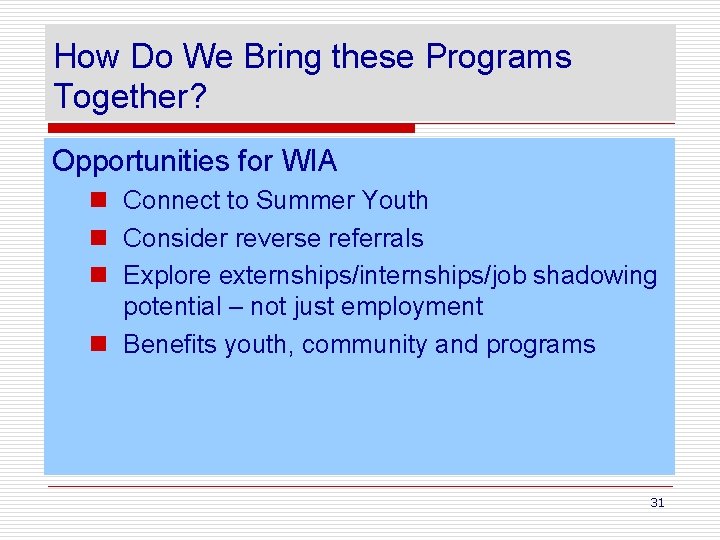
How Do We Bring these Programs Together? Opportunities for WIA n Connect to Summer Youth n Consider reverse referrals n Explore externships/internships/job shadowing potential – not just employment n Benefits youth, community and programs 31
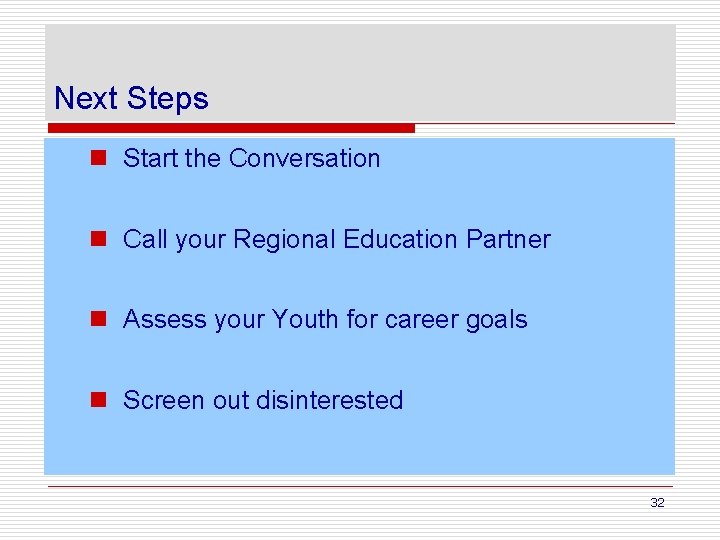
Next Steps n Start the Conversation n Call your Regional Education Partner n Assess your Youth for career goals n Screen out disinterested 32