
After a suit is brought to the Court
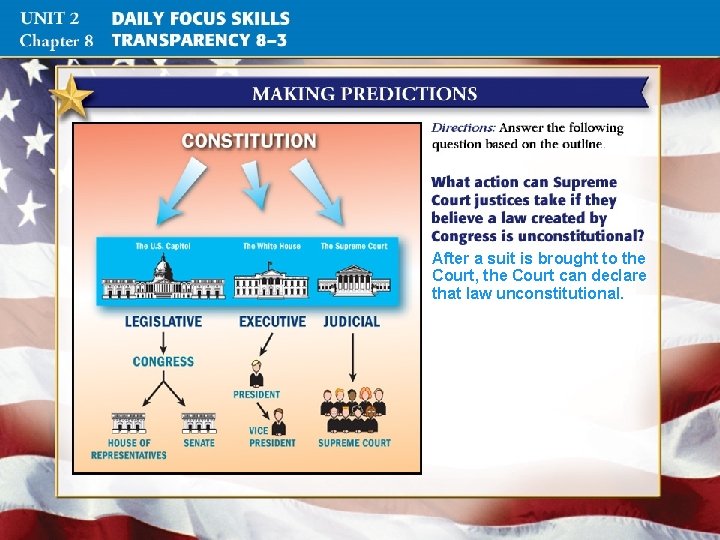
After a suit is brought to the Court, the Court can declare that law unconstitutional.
The US Supreme Court C&E
EQs • Who serves as Supreme Court justices? • What are the powers of the Supreme Court?
Key Terms • Constitutional • judicial review
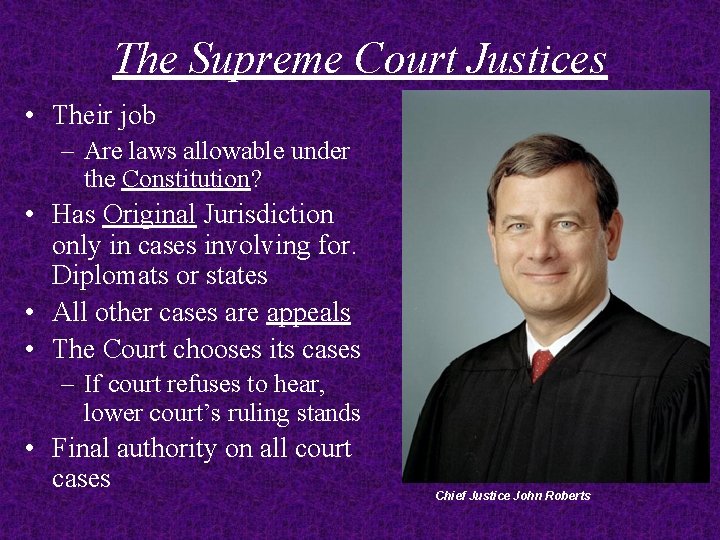
The Supreme Court Justices • Their job – Are laws allowable under the Constitution? • Has Original Jurisdiction only in cases involving for. Diplomats or states • All other cases are appeals • The Court chooses its cases – If court refuses to hear, lower court’s ruling stands • Final authority on all court cases Chief Justice John Roberts
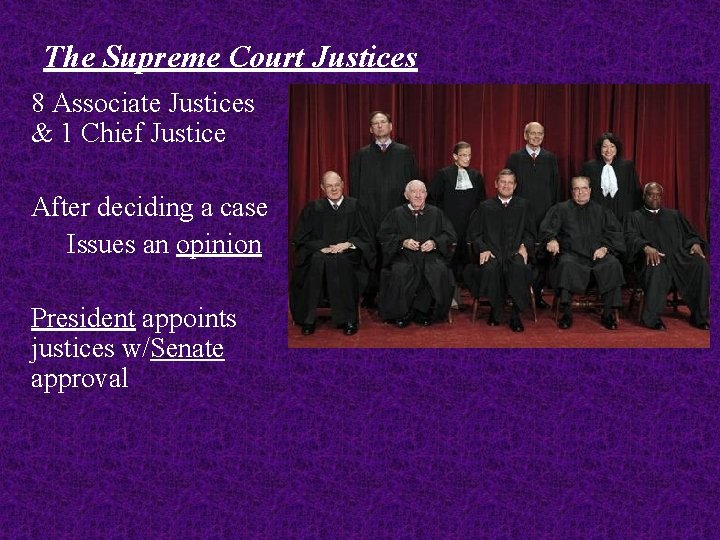
The Supreme Court Justices 8 Associate Justices & 1 Chief Justice After deciding a case Issues an opinion President appoints justices w/Senate approval
Why might the Senate reject a president’s nominee for Supreme Court justice? • Throughout history, the Senate has rejected many presidential nominees to the Supreme Court because of doubts about the qualifications or the legal philosophy of the persons nominated.
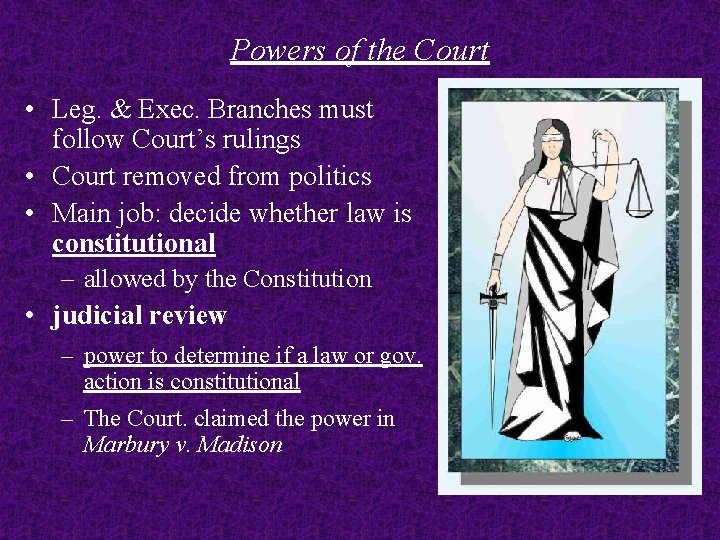
Powers of the Court • Leg. & Exec. Branches must follow Court’s rulings • Court removed from politics • Main job: decide whether law is constitutional – allowed by the Constitution • judicial review – power to determine if a law or gov. action is constitutional – The Court. claimed the power in Marbury v. Madison
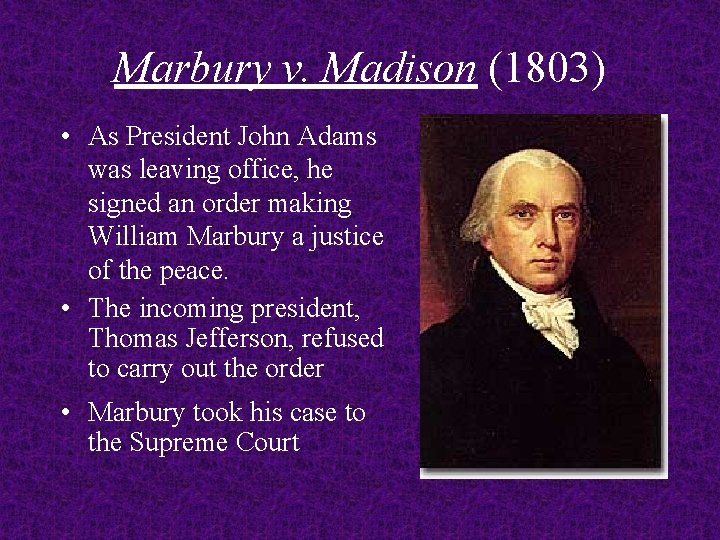
Marbury v. Madison (1803) • As President John Adams was leaving office, he signed an order making William Marbury a justice of the peace. • The incoming president, Thomas Jefferson, refused to carry out the order • Marbury took his case to the Supreme Court
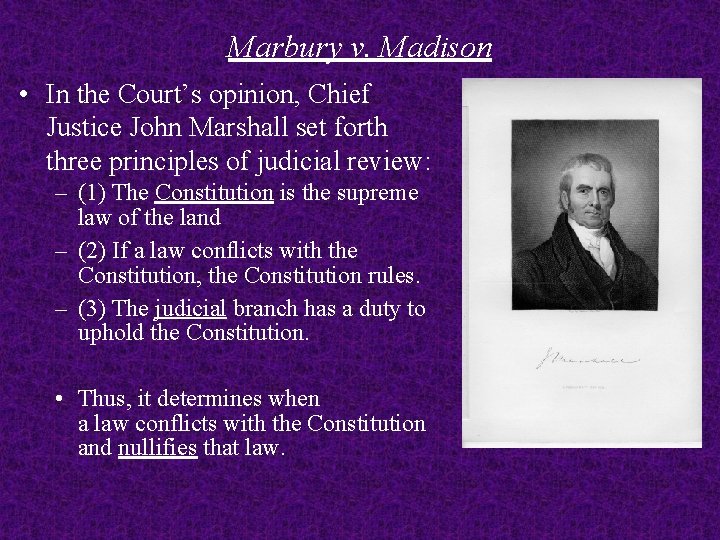
Marbury v. Madison • In the Court’s opinion, Chief Justice John Marshall set forth three principles of judicial review: – (1) The Constitution is the supreme law of the land – (2) If a law conflicts with the Constitution, the Constitution rules. – (3) The judicial branch has a duty to uphold the Constitution. • Thus, it determines when a law conflicts with the Constitution and nullifies that law.
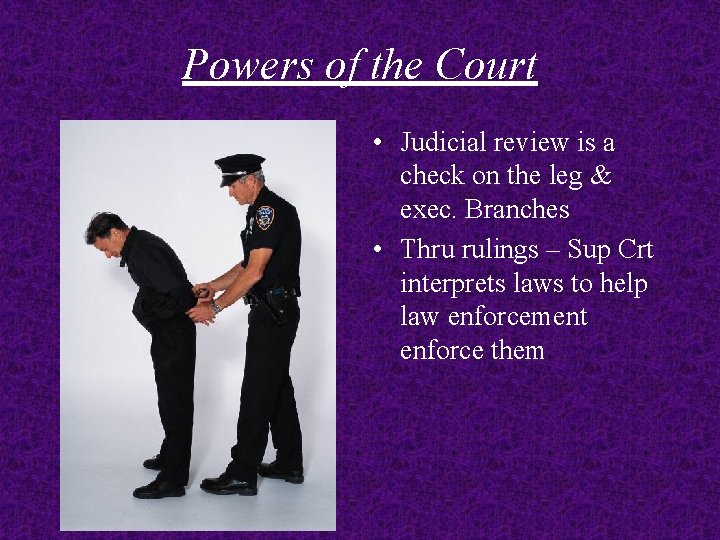
Powers of the Court • Judicial review is a check on the leg & exec. Branches • Thru rulings – Sup Crt interprets laws to help law enforcement enforce them
Why is the power of judicial review an important part of the system of checks and balances? By declaring acts of Congress or executive orders unconstitutional, the Supreme Court can check the actions of the legislative and executive branches of government to keep them from straying too far from the Constitution when they make and carry out laws.
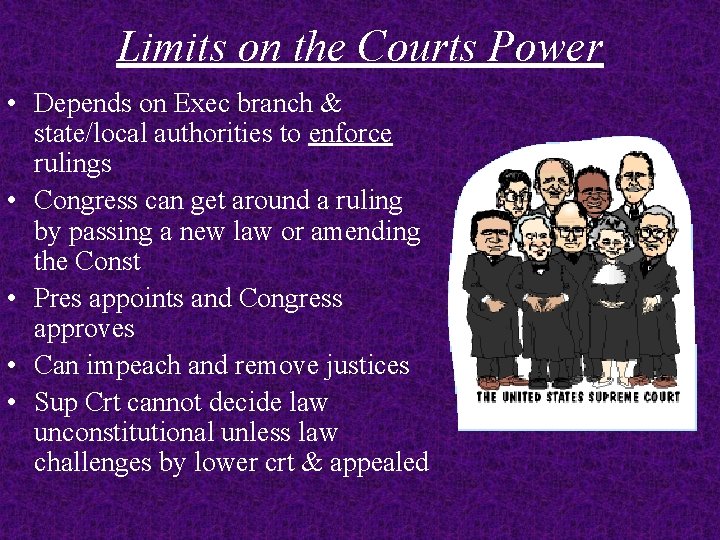
Limits on the Courts Power • Depends on Exec branch & state/local authorities to enforce rulings • Congress can get around a ruling by passing a new law or amending the Const • Pres appoints and Congress approves • Can impeach and remove justices • Sup Crt cannot decide law unconstitutional unless law challenges by lower crt & appealed
What did the case Worcester v. Georgia illustrate about the power of the Supreme Court? This case illustrated that the Court must depend on the executive branch to carry out its decisions. In this case, President Jackson refused to enforce the Court’s decision. Because most citizens agreed with him, no public pressure forced him to uphold the decision.
- Slides: 14