
AFROCUBAN Dance Style Salsa Presented by Anna Carinne
AFRO-CUBAN Dance Style: Salsa Presented by: Anna, Carinne, Marvin, Ngan and Nicolas
WHO DANCES? The Afro-Cuban Salsa or “Salsa Cubana” has been present in the Latin music scene since the 1990 s. Cuba is the only country in the Spanish Caribbean that celebrates and nurtures pridefully the African-Derived roots and culture. One can clearly hear the African influence in the style of the percussion and how the Afrocentric nature of the music has been revered across the world. There is no religious meaning this Afro-Cuban Sala dance; it is all social, and entertaining. It is originally a collective dance, however on certain occasion performer emphasis it as a performance as well. It is an extreme sexual and sensual dance, performing by all dancers, without ages, gender or any sort of appropriation restrictions. The Afro-Cuban Salsa can perform by any dancer from any gender group. However, couple dancers are mostly the preferable one will seen performing/dancing the Afro-Cuban Salsa. On some rare occasion, during public festival and events, group of dancers performing Afro. Cuban Salsa as a group in middle of the street of Havana, Cuba to recreate, entertain, and most of the time “para gozar y disfrutar la vida” It is a very rhythmic, sexual and sensual. CITE: http: //jazzuary. fm/afro-cuban-dance-the-rumba-salsa-and-timba/
DANCE MOVEMENT There is no western or European posture in the Afro-Cuban Sala. The performers mostly use body to body during the sexual and sensual moves. They changes positions frequently, and turn around on various occasions. Their friendly facial expression match to the ambiance, and the atmosphere of the performance. The ladies used their charming bodies to express their emotions and the passion for the dance; the males are excited and passionate as well. Both dancers, use some fine shoes and classical clothing to perform this particular Afro-Cuban Salsa. They use space to move, and they are very structure. Dancer follow the rhythm to turn around, to moves in particularly their wrist, hips, and foot. All the moves are made on very rhythmical manner, with sensual and sexual motion. CITE: http: //jazzuary. fm/afro-cuban-dance-the-rumba-salsa-and-timba/
Dance space, costume and sound � � � Salsa dance socials are commonly held in night clubs, bars, casino, ballrooms, restaurants, and outside, especially when part of an outdoor festival. Salsa costumes feature simple designs. Salsa costume for men features loose and brightly colored shirts. Pants should be tight to allow the dancer to execute sophisticated dance moves and be control of his dancing partner. Female dress patterns exude more versatile patterns than males’ costumes. Traditional female costumes feature more details like fine embroidery and intricate patterns. They can wear skirts or dress. Ladies shoes for salsa dancing always have heels. Music: hip-hop, r &b, gospel, jazz, soul. For salsa, there are four types of clave rhythms, the 3 -2 and 2 -3 Son claves being the most important, and the 3 -2 and 2 -3 Rumba claves. Most salsa music is played with one of the Son claves, though a Rumba clave is occasionally used, especially during Rumba sections of some songs. As an example of how a clave fits within the 8 beats of a salsa dance, the beats of the 2 -3 Son clave are played on the counts of 2, 3, 5, the "and" of 6, and 8. Culturally, salsa is danced as an interplay between male and female gender and feeling the music (Sabor) as its main ingredients. Much of the interplay casino style dancing is based on the broader Afro-Caribbean cultural context with emphasis on sexual interplay, teasing and everyday experience. Dancers usually doesn't sing Specific instruments are congas, bongo, and timbales
Cultural Changes � � � Salsa dance styles was popularized in the 1970 s. Dancing Casino is an expression of popular social culture; Many Cubans consider casino a part of their social and cultural activities centering on their popular music. The origins of the name Casino are casinos deportivos, the dance halls where a lot of social dancing was done among the better off, white Cubans during the mid-20 th century and onward. Salsa emerged from New York City in the mid-1970 s, then spread throughout Latin America and the Western Hemisphere. The music had already been going strong in the city for several decades prior to the use of the label salsa. The next Cuban "dance craze" to hit the United States was the chachachá. The chachachá originated in the Cuban charanga bands, but was adopted by the horn-based groups in New York. By the early 1960 s, there were several charanga bands in New York, led by future salsa icons Johnny Pacheco, Charlie Palmieri, and Ray Barretto. The U. S. embargo against Cuba (1962) halted the two-way flow of music and musicians between Cuba and the United States.
Cultural Changes Continue. . � � � By the mid-1960 s, a hybrid Nuyorican cultural identity emerged, primarily Puerto Rican but influenced by many Latin cultures as well as the close contact with African Americans. 1966, Johnny Colón claims that "Boogaloo Blues" sold over four million copies domestically. By the end of the 1960 s though, the Latin music establishment shut down boogaloo airplay and the movement fizzled out. Some of the young boogaloo artists, like Willie Colón, were able to transition into the next phase—salsa. In 1975 New York, DJ and conga drummer, Roger Dawson created the "Sunday Salsa Show" over WRVR FM which became one of the highest rated radio shows in the New York market with a reported audience of over a quarter of a million listeners every Sunday (per Arbitron Radio Ratings). Ironically, although New York's Hispanic population at that time was over two million, there had been no commercial Hispanic FM. From New York, salsa quickly expanded to Puerto Rico, the Dominican Republic, Colombia, Nicaragua, Venezuela, and other Latin American countries. The number of salsa bands, both in New York and elsewhere, increased dramatically, as did salsaoriented radio stations and record labels. 1970 s, Willie Colón introduced the Cuatro, a rural Puerto Rican plucked string instrument, as well as some songs with jazz, rock, and Panamanian and Brazilian music influences. 1973, Larry Harlow, a band leader and arranger for Fania Records, modernized salsa by adding an electric piano.
Discrimination, stereotypes, bigotry and legislation suppression � � � Cigars, Castro, and casinos. At various points in the 20 th century, theses three words were synonymous with Caribbean nation of Cuba. As a result, these concepts were used to define the Cuban Americans who were born in the United States. Racism in Cuba was just as bad as it was in the United States. Afro-Cubans are more prone to being questioned by the police about their business and to provide identification. Many Afro-Cubans have experienced racism, but agree that today they rarely experienced racism situations. Cuban Americans hold a unique place in American society, as an ethnic/nationalist group that is equally part of Latin America, the Caribbean, and North America. (Muscato 2018)
Dance evolution and culture celebrations � � Southern Florida is home to many Afro-Cubans who practice their Cuban celebrations and are involved in American culture. Cuban musicians jumped into the growing waves of Latin Jazz and Salsa. Many established footholds in America music and entertainment industries. Mainstreaming Latin sounds and ideas into the American culture for the first time. (Muscato 2018)
Contribution to American Culture The Afro-Cuban contributed a new sound of Latin music to the American culture. Their music genre introduced Americans to a Latin sound with African roots. The music genre is the result of an important part of Latino history in the U. S. and impacted the country's history as a whole. It represents a period of transition as immigrants started building a new identity based on their reality of “The American Dream”. (Santiago 2016)
History Context African Roots: q q q Spanish imported African slaves to Cuba until 1880’s. By 1840’s slaves constituted half of Cuba’s population. The physical and emotional intensity of Cuban music comes from African ritual cults and rhythm. In contrast, there is almost no influence from the Pre-Hispanic tribes https: //www. youtube. com/watch? v=Ht. JKDvh. A 7 YM
ORIGIN The origins of salsa date back to the 1900’s in Eastern Cuba, where musical elements and rhythms from various styles were combined. Here are the two main styles: Ø Son Cubano: Son is the predominant musical force in Cuba and the symbol of the island. Ø Afro-Cuban Rumba: It has roots in Afro-Cuban religion, but its modern repertoire is secular.
STURCTURE q Son Cubano, there are two parts: An opening verse followed by a montuno section in which the improvisinger is answered by a chorus. Ø Sones are centered upon a clave rhythm. Ø q Afro-Cuban Rumba divides into three main dances: The Guaguancó, a flirtatious couple dance. Ø Yambú, a slower couple dance. Ø Columbia, an acrobatic solo male dance. Ø
RUEDA TRANSITION � � Rueda de Casino was developed in Havana, Cuba. Pairs of dancers form a circle with dance moves called out by one person. Rueda Miami originated in the 1980 s from Miami, is a formal style with many rules based on a mix, and is a hybridization of Rueda de Cuba & North American dance styles, with some routines reflecting American culture (e. g. Coca-Cola, Dedo, Adios) which is not found in the traditional Cuban-style Rueda.
DIFFERENT SALSA STYLES � � Afro-Latino style: This style is very popular kind of salsa in the Caribbean, Puerto Rico, Haiti and Cuba. It pretty much involves the same dancing as most versions of the salsa, but has a little bit of twist added to it. It’s given its own identity because of the African language used in some of their songs. Colombian-Cali style: The elements of Cali-Style Salsa were strongly influenced by dances to Caribbean rhythms which preceded salsa, such as Pachanga and Boogaloo. The central feature is the footwork which has quick rapid steps and skipping motions.
Traditions and dance evolution from acculturation � � � Primary evolution from Mambo era was introduced to New York due to influx of migrating dissidents from all the Caribbean and other Latin migrants during Pre/Post Cuban Revolution in the 1950 s and 1960 s. At this time, the music and dance was called “Mambo”. The most famous dancer during this era was Puerto-Rican descendant Pedro "Cuban Pete" Aguilar. Secondary evolution during the late 1970 s, Latin Puerto Rican migrants, contributed a lot to the New York salsa development during the "Nu. Yorican" era of Héctor Lavoe which greatly popularized salsa and modern Latin music throughout the world. The following video will demonstrate the instruments played in Salsa. Instruments from different cultures have been acculturated in Salsa from the Afro-Cubans and other cultures. https: //youtu. be/i 3 HWUJI 7 Bag
Social & Economic Suppress in Place Today Yes, there are social and economic structures still in place today that suppress Afro – Cuban. For example, Miami, Florida is home to many Afro-Cubans. In a recent Miami-Dade County Black Affairs Board, a panel gathered to discuss their experiences of “how people view them as Black or not Black, Cuban or not Cuban. ” (Guniss) Afro-Cubans experience marginalization, are questioned for identification and are ridiculed if they date a white Cuban, this is an example of social suppression given by the members of the panel. An economic suppression example is how Afro-Cubans are markedly poorer and have very limited work opportunities. Sadly, Afro –Cuban women are treated the worse. In Cuba, they are at the bottom of the food chain, sexualized and are not encouraged to learn skills. (Guniss) Works Cited: Guniss, Carolyn. "The Miami Times. " 4 2 2015. 1 12 2018.
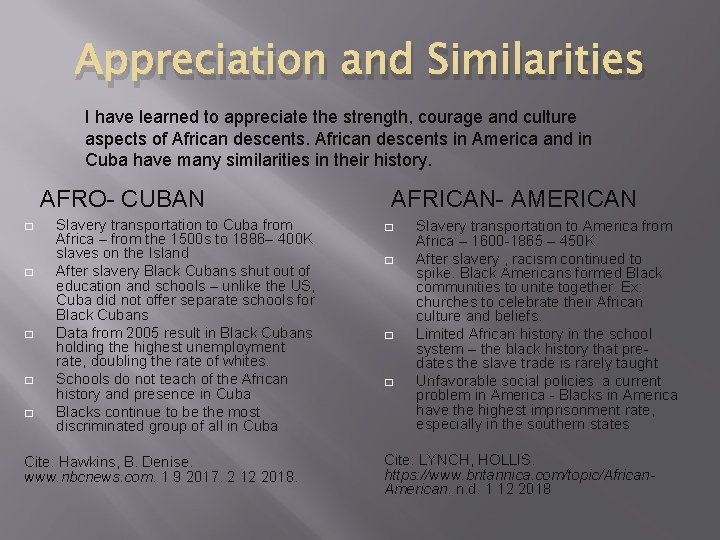
Appreciation and Similarities I have learned to appreciate the strength, courage and culture aspects of African descents in America and in Cuba have many similarities in their history. AFRO- CUBAN � � � Slavery transportation to Cuba from Africa – from the 1500 s to 1886– 400 K slaves on the Island After slavery Black Cubans shut of education and schools – unlike the US, Cuba did not offer separate schools for Black Cubans Data from 2005 result in Black Cubans holding the highest unemployment rate, doubling the rate of whites. Schools do not teach of the African history and presence in Cuba Blacks continue to be the most discriminated group of all in Cuba Cite: Hawkins, B. Denise. www. nbcnews. com. 1 9 2017. 2 12 2018. AFRICAN- AMERICAN � � Slavery transportation to America from Africa – 1600 -1865 – 450 K After slavery , racism continued to spike. Black Americans formed Black communities to unite together. Ex: churches to celebrate their African culture and beliefs. Limited African history in the school system – the black history that predates the slave trade is rarely taught Unfavorable social policies a current problem in America - Blacks in America have the highest imprisonment rate, especially in the southern states Cite: LYNCH, HOLLIS. https: //www. britannica. com/topic/African. American. n. d. 1 12 2018
Citation Ø Ø Ø http: //jazzuary. fm/afro-cuban-dance-the-rumba-salsa-and-timba/ Muscato, Christopher. Cuban Americans: History, Culture & discrimination. Study. com. 28 Nov. 2018, www. study. com/academy/lesson/Cubanamericans-history-culture-discrimination. html Santigao, Charlene. “Salsa Dancing: an Overlooked Cultural Constituent of Lationo Culture in Arizona. ” 14 Sept. 2016. www. statepress. com/article/2016/09/spopinion-sala-dancing-Hispanicheritage-mouth. https: //www. youtube. com/watch? v=Vh. MHALSw_ug http: //latino. si. edu/virtualgallery/sabor/Salsa. Research. Resources/articles/T he%20 History%20 of%20 Salsa%20 Dancing 2. htm http: //www. dancefacts. net/dance-history/history-of-salsa/ Cesar Miguel Rondon, El Libro de la Salsa. http: //www. salsagente. com/history-of-salsa-music-dance/ Guniss, Carolyn. "The Miami Times. " 4 2 2015. 1 12 2018. Hawkins, B. Denise. www. nbcnews. com. 1 9 2017. 2 12 2018. LYNCH, HOLLIS. https: //www. britannica. com/topic/African-American. n. d. 1 12 2018.
- Slides: 18