
AfroCaribbean Poetry Pen Rhythm Year 8 Poetry Anthology
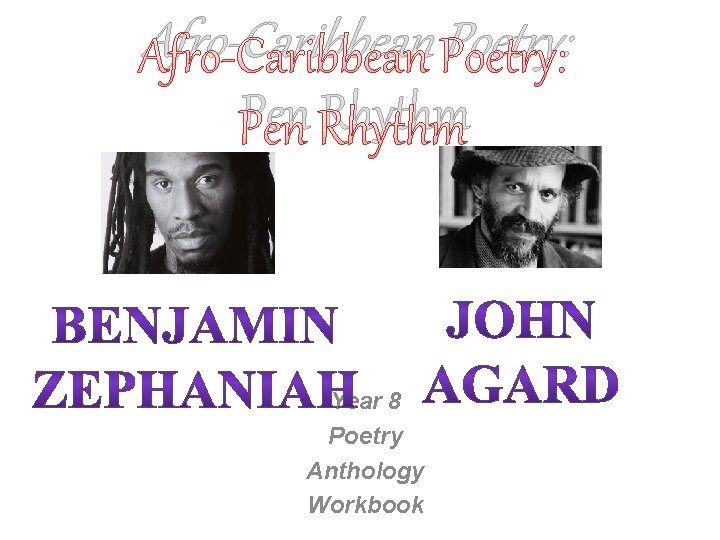
Afro-Caribbean Poetry: Pen Rhythm Year 8 Poetry Anthology Workbook
Contents Luv Song The Tourists are Coming The Vegans The British No Problem Pets Control For Sale Urdu Poets I Love Me Mudder & Mother to Son Poetry Jump-Up Listen Mr. Oxford Don John Agard’s poetry
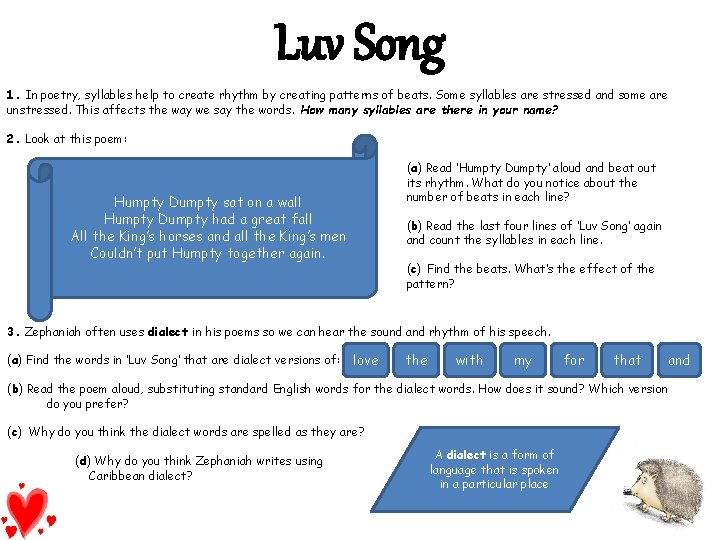
Luv Song 1. In poetry, syllables help to create rhythm by creating patterns of beats. Some syllables are stressed and some are unstressed. This affects the way we say the words. How many syllables are there in your name? 2. Look at this poem: (a) Read ‘Humpty Dumpty’ aloud and beat out its rhythm. What do you notice about the number of beats in each line? Humpty Dumpty sat on a wall Humpty Dumpty had a great fall All the King’s horses and all the King’s men Couldn’t put Humpty together again. (b) Read the last four lines of ‘Luv Song’ again and count the syllables in each line. (c) Find the beats. What’s the effect of the pattern? 3. Zephaniah often uses dialect in his poems so we can hear the sound and rhythm of his speech. (a) Find the words in ‘Luv Song’ that are dialect versions of: love the with my for that and (b) Read the poem aloud, substituting standard English words for the dialect words. How does it sound? Which version do you prefer? (c) Why do you think the dialect words are spelled as they are? (d) Why do you think Zephaniah writes using Caribbean dialect? A dialect is a form of language that is spoken in a particular place
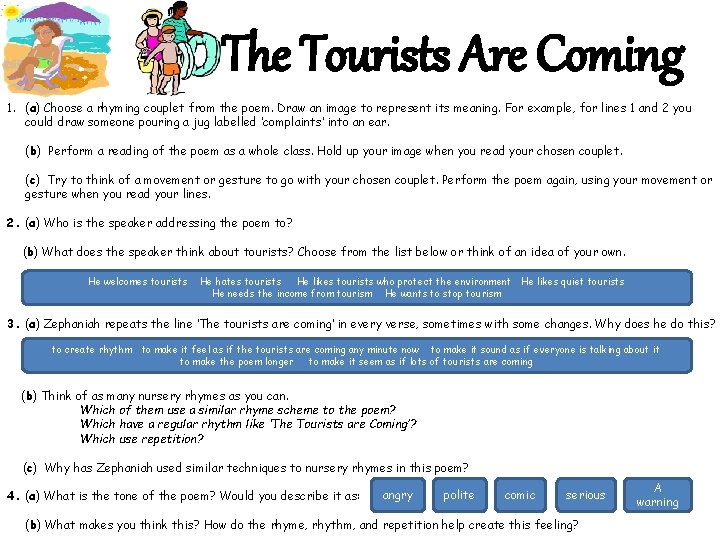
The Tourists Are Coming 1. (a) Choose a rhyming couplet from the poem. Draw an image to represent its meaning. For example, for lines 1 and 2 you could draw someone pouring a jug labelled ‘complaints’ into an ear. (b) Perform a reading of the poem as a whole class. Hold up your image when you read your chosen couplet. (c) Try to think of a movement or gesture to go with your chosen couplet. Perform the poem again, using your movement or gesture when you read your lines. 2. (a) Who is the speaker addressing the poem to? (b) What does the speaker think about tourists? Choose from the list below or think of an idea of your own. He welcomes tourists He hates tourists He likes tourists who protect the environment He likes quiet tourists He needs the income from tourism He wants to stop tourism 3. (a) Zephaniah repeats the line ‘The tourists are coming’ in every verse, sometimes with some changes. Why does he do this? to create rhythm to make it feel as if the tourists are coming any minute now to make it sound as if everyone is talking about it to make the poem longer to make it seem as if lots of tourists are coming (b) Think of as many nursery rhymes as you can. Which of them use a similar rhyme scheme to the poem? Which have a regular rhythm like ‘The Tourists are Coming’? Which use repetition? (c) Why has Zephaniah used similar techniques to nursery rhymes in this poem? 4. (a) What is the tone of the poem? Would you describe it as: angry polite comic serious (b) What makes you think this? How do the rhyme, rhythm, and repetition help create this feeling? A warning
The Vegans 1. Read the poem, and work out the rhyme scheme for verses 1, 2, 3 and 4. 2. Some of the rhymes in this poem rhyme exactly: trying and buying, for example. Some do not rhyme completely: perfect and worth it, for example. These are called half-rhymes. (b) Find three examples of half-rhyme in the poem. (c) Why do you think Zephaniah chose to use half-rhyme in the poem? Which do you think is the best one? Why? (d) Choose two rhyming couplets the poem. Use a thesaurus to help you rewrite the last word, keeping the meaning but losing the rhyme. What difference have you made on the effect of the lines? (e) Below is verse 5 of ‘The Vegans’, with some gaps. Choose some words to complete the poem. All these ____ share ______ for what they wear, They check their shopping trolleys And what goes in their ______ They are not all one _______ And it seems they live all over. You see there are _______ Why these people are _______ 3. Listen to someone reading the whole poem aloud. (a) Describe the effect of the rhyme. Try using some of these words to describe it: lyrical musical balanced bouncy comical 4. (a) Sum up the whole poem in one sentence. You can use words or phrases from the poem. (b) How do you think the poet feels or thinks about the people in the poem? (c) What tone of voice should someone reading the poem use? (d) How does the rhyme in the poem help create this mood or tone?
Assess Your Progress The Vegans Bronze Silver Gold I can refer to the shape of the poem on the page. I can find the rhymes in the poem. I can explain how the poet has used rhyme and rhythm in the poem. I know what the poet I can explain what the thinks about poem is about. food/animals. I can explain, using examples, how the speaker feels about food/animals.
The British 1. Look at the statement in the table below. Which statements match your understanding of what the poet is saying in “The British”. Find lines from the poem to support these statements. Statement Is the poet saying this in the poem Line in the poem supporting this. All people deserve to be treated equally It takes time for people to live in harmony We have to work at getting along with all kinds of people. Throughout history the population has changed Everyone is equal It’s exciting to live in a multicultural society The poet is passionate about justice and equality. 2. The Romans, Angles, Saxons, Jutes and Normans all came to Britain hundreds of years ago. What point do you think the poet is making by including them in the poem?
The British: Level 3. The poem is written like a recipe: – What words and other features in “The British” make the poem like a recipe? – Why has the poet chosen to write this poem like this? Use the sentence prompts beneath • • Zephaniah wants to show that Britain has become a multicultural society so he The poem is set out like a recipe. It starts with: The words ‘stir vigorously’ make me think that When he uses the words ‘melting pot’ Zephaniah wants us to think Zephaniah uses the word ‘blend’ to suggest When he writes ‘And turn up the heat’ Zephaniah could mean that____ When he says ‘And enjoy’ Zephaniah means that _______ Commenting on the writer’s point of view 3 I know what the poem is about. 4 I can comment on the writer’s point of view. 5 I can comment on the writer’s point of view and give some explanation of his viewpoint using examples from the poem to support my ideas. 4. Re-read the note at the end of the poem: Why has the poet included this. Was it because… -Sometimes recipes carry a warning -It allows his to express his ideas forcefully -He wants to reinforce his message -Write a paragraph to explain your answer. You can use the following structure: -Make your point: I think that Zephaniah included the note and the warning at the end of the poem because… -Use a quote from the poem as evidence -Write a sentence or two explaining how your evidence supports that point. - PEER ASSESS: Use the grid opposite to level your partners work.
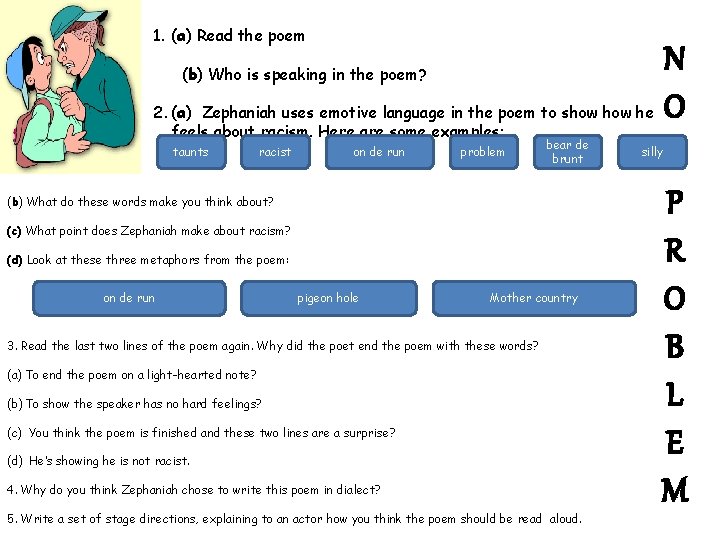
1. (a) Read the poem N O (b) Who is speaking in the poem? 2. (a) Zephaniah uses emotive language in the poem to show he feels about racism. Here are some examples: taunts racist on de run problem bear de brunt (b) What do these words make you think about? (c) What point does Zephaniah make about racism? (d) Look at these three metaphors from the poem: on de run pigeon hole Mother country 3. Read the last two lines of the poem again. Why did the poet end the poem with these words? (a) To end the poem on a light-hearted note? (b) To show the speaker has no hard feelings? (c) You think the poem is finished and these two lines are a surprise? (d) He’s showing he is not racist. 4. Why do you think Zephaniah chose to write this poem in dialect? 5. Write a set of stage directions, explaining to an actor how you think the poem should be read aloud. silly P R O B L E M
Pets Control 1. (a) List the different groups of animals mentioned in the poem (b) Describe the ways in which these different groups are treated? 2. (a) There is a question at the end of the poem. Why do you think Zephaniah does this> (b) What is your answer to Zephaniah’s question? 3. When we write about poetry, it’s useful to have a structure we can remember to record our ideas. Try using SMILE, which means: S tructure and form – how the poem is written, set out on the page and how this links to M eaning – what the poem is about and what makes you think that I magery – the use and effects of simile, metaphor and personification L anguage – words and phrases which you think are important, powerful or puzzling E xplain your ideas – use words or phrases to support your ideas Your Thoughts ‘Pets Control’ Structure and form The short lines like ‘…’ make me think… Meaning Imagery ‘we kicked de animals out. ’ The word ‘kicked’ made me feel… Language (pick out key words/phrases) Explain your own ideas, likes and dislikes about the poem My favourite line is ‘…’. The poet seems to be saying that… (b) Read the poem again. Use a table like the one below to record your ideas. 4. (a) Using notes from your table, develop detailed sentences explaining your thoughts about the poem. Make a point, use an example and then explain your idea. Look at your partner’s sentences from the activity above. Work out which is the point, which is the example and which is the explanation. Check that each does the job it shoud.
For Sale 1. (a) What point is the speaker making in the poem? (b) Why does the poet use a chorus (c) What is your response to the poem? 2. Look at these words and phrases taken from the poem: no flowers (a) Think of two categories into which you could sort all these words and phrases. What does this suggest about the point the poet is making? sale dissolved gone deal bet sell bargain get lost (b) Write down three positive statements from the poem. Write a sentence or two explaining why you think the poet chose to include them. (c) Write down three negative statements from the poem. Write a sentence or two explaining why you think the poet chose to include them. 3. The poem mentions some familiar characters from stories and rhymes: Little Bo Beep, Jack Horner, Donald Duck, Paddington Bear and The Owl and the Pussycat. What do you know about these characters? 4. Read the last two lines of the poem. (a) Who is the speaker talking to? (b) Why do they ask for a meal? (c) How do you know this? 5. The seller in the poem makes some surprising statements, such as: enjoy yourself as you get poorly, I promise you will find no trees. Explain what you find surprising about these lines. 6. Write three questions to help someone explore the poem. Try to use questions that will help them think about the decisions the poet took when writing the poem. They could begin: (a) Why has Benjamin Zephaniah…? (b) What is the effect of…?
(b) What is Zephaniah trying to say about Urdu poets? 2. (a) Write down two metaphors that are commonly used. A metaphor is used to suggest that one thing is like another thing. It says that one thing is another – your room is a tip Poets use metaphor to create vivid images. In his poem, Zephaniah saysthat Urdu poets (b) What do these metaphors suggest? bring glory to the bazaars, hope to the pavements, libraries to the mind. (c) Why do you think Zephaniah chose these metaphors? (d) Try to rewrite these three lines without using metaphors. Assess your progress Poetic techniques Bronze I can identify some imagery. Urdu Poets A simile is used to compare one thing with another using the worlds ‘like’ or ‘as’ – they fight like cat and dog or she’s as cool as a cucumber 1. (a) Find the simile in the first stanza of ‘Urdu poets. ’ Silver Gold I can identify imagery and comment imagery and make on what it means. comments about its effectiveness.
I Love Me Mudder & Mother to Son 1. (a) In line 3 of his poem, Zephaniah says that he and his family expected the streets to be paved wid gold. What do you think they expected England to be like? (b) Zephaniah uses dialect in this poem. Find two examples and explain what effect each of them has. (c) In the second verse, almost every line begins in the same way. Why do you think the poet chose to do this, and what effect does it have? (d) Try to imagine how the poem would sound if someone read it aloud. What do you notice about the rhythm of the poem, and what effect does this have? (e) Zephaniah says he loves his mother. What other feelings does he have towards her? (f) What do you notice about the three verses of the poem? Sum up what each verse is about. What do you notice about the order of the verses? 2. (a) Who is speaking in ‘Mother to Son’ (b) In Hughes’ poem, the mother compares her life to stairs. What do you think she means when she says her life aint been no crystal stair? (c) The following quotations all suggest something about Hughes’ mother’s life. Complete a table like the one below: Quotation It had tacks in it And places with no carpet on the floor I’se been a climbin’ on And sometimes goin’ in the dark What this quotation suggests about the mother’s life Suggests there have been hard things for her to face
Poetry Jump. Up John Agard is a powerful performer of his own poetry. He is well known for writing poems that work well when read aloud. 1. (a) Watch the ‘Poetry Jump-up’ video. - http: //www. youtube. com/watch? v=k 9 g. A 8 hzmsbo – Discuss the elements of the poem as a performance. How important is the rhythm? How does his performance emphasise it? How important is rhyme? What do you notice about the way he uses it? How much repetition does he use (of words and whole phrases or lines)? In what ways does he use sound to make a strong impact? You should think about techniques such as alliteration, assonance (when the same vowel sounds are repeated), onomatopoeia (words that imitate the sound they make, like ‘crash’). How do his voice, facial gestures and body language contribute to the performance? How do the graphics and use of images on the video contribute to the performance?
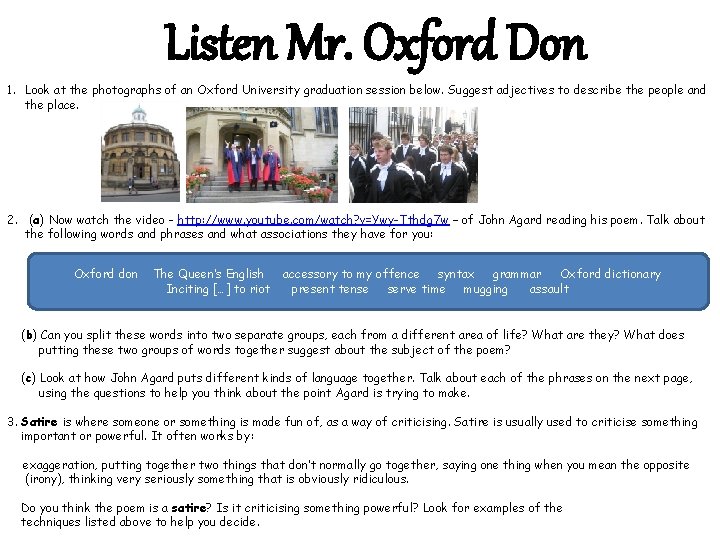
Listen Mr. Oxford Don 1. Look at the photographs of an Oxford University graduation session below. Suggest adjectives to describe the people and the place. 2. (a) Now watch the video - http: //www. youtube. com/watch? v=Ywy-Tthdg 7 w – of John Agard reading his poem. Talk about the following words and phrases and what associations they have for you: Oxford don The Queen’s English Inciting […] to riot accessory to my offence syntax grammar Oxford dictionary present tense serve time mugging assault (b) Can you split these words into two separate groups, each from a different area of life? What are they? What does putting these two groups of words together suggest about the subject of the poem? (c) Look at how John Agard puts different kinds of language together. Talk about each of the phrases on the next page, using the questions to help you think about the point Agard is trying to make. 3. Satire is where someone or something is made fun of, as a way of criticising. Satire is usually used to criticise something important or powerful. It often works by: exaggeration, putting together two things that don’t normally go together, saying one thing when you mean the opposite (irony), thinking very seriously something that is obviously ridiculous. Do you think the poem is a satire? Is it criticising something powerful? Look for examples of the techniques listed above to help you decide.
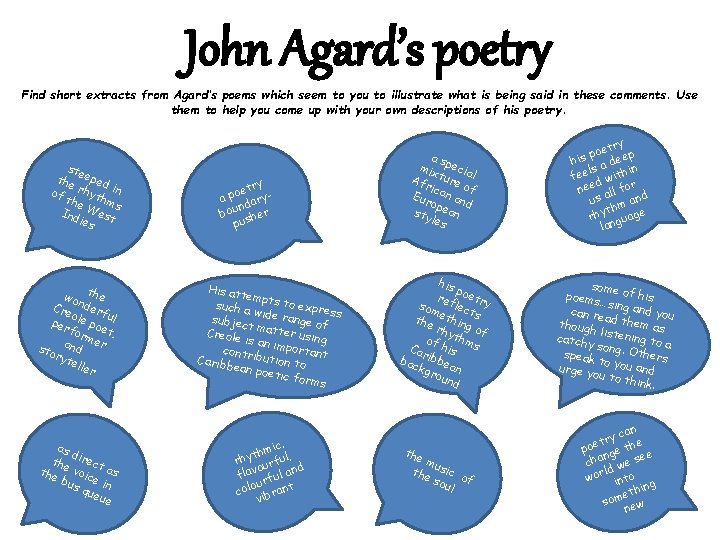
John Agard’s poetry Find short extracts from Agard’s poems which seem to you to illustrate what is being said in these comments. Use them to help you come up with your own descriptions of his poetry. ste the eped of rhyth in the ms Ind West ies y etr a po daryn bou sher pu won the Cre derf u o per le poe l for t me , a r sto nd ryt elle r His at tempt s to e such a wide r xpress an subjec t matt ge of er Creole is an im using portan contri t b u t i Caribb o ean po n to etic fo rms as d the irect the voic as bus e in que ue , mic , h t rhy urful o d flav rful an u colo ibrant v as mix pecia Afr ture l of ic Eur an an d op sty ean les his p ref oetry som lec t the ethin s rhy g of of thms Car his bac ibbea kgr n oun d the mu the sic o sou f l y etr p o p his a dee ls in fee d with nee all for us m and th rhy guage lan some o f his poems …sing and yo can re u a though d them as li catchy stening to a song. O th speak to you ers and urge y ou to t hink. n y ca e r t poe ge th e n cha we se ld wor into g thin e m so ew n
- Slides: 16