
Africas Women Agrarian Employment and Exporting Barriers The
Africa’s Women Agrarian Employment and Exporting Barriers: The Impact of Non-Tariff Measures, Infrastructure and Education Fatima Olanike Kareem University of Kassel, Germany. Olayinka Idowu Kareem Phillips-Universitaet Marburg, Germany IEA – YASP 2017
Structure Introduction Background of the study Literature review Methodology & data Results Outlook Structure • • • Introduction Some Theories Method Results Conclusion
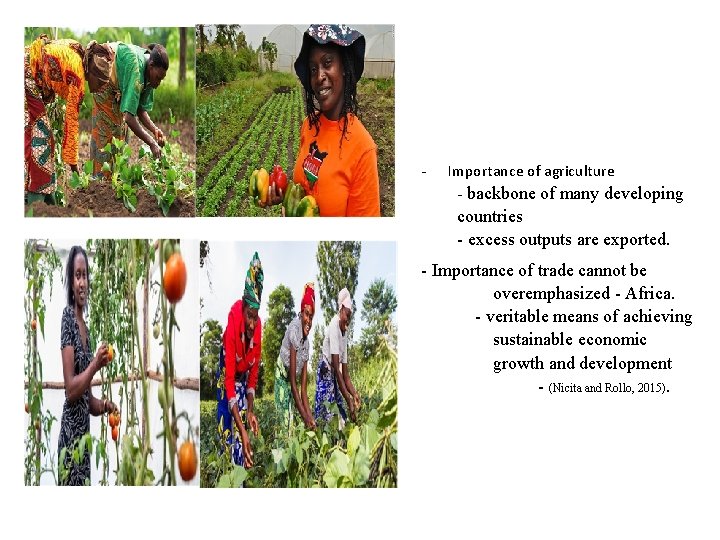
- Importance of agriculture - backbone of many developing countries - excess outputs are exported. - Importance of trade cannot be overemphasized - Africa. - veritable means of achieving sustainable economic growth and development - (Nicita and Rollo, 2015).
Structure Introduction Background of the study Literature review Methodology & data Results Outlook Introduction • Increasing Importance of NTBs in international trade – More important is food safety regulations. – Powerful tool for consumers’ health and safety (WTO, 1999) • Impacts can be trade prohibiting or enhancing v Trade restrictive Effects: Trade costs effects – Huge cost of compliance: e. g SSA 124%; L A 44% of firms’ sales – Constraint trade, contrasting labour v Trade Promoting: Demand enhancing effects – Catalyst to export success, increasing employment generation • Yet, trade has been less favourable to women – This relates to exiting gender specific obstacles and inequality of opportunities – Obstacles are: land tenure system, limited credit, poor time-saving infrastructure, and more importantly - inequality in education and training.
Structure Introduction Background of the study Literature review Methodology & data Results Outlook Introduction… • Relatedly to the last constraint is their lack of technical expertise to comply with standards (Fontana and Paciello, 2009) • Women are more disadvantaged to comply due: – Preference to train men (Kabeer, 2012) – Gender segregation into less technical jobs – Time and mobility constraints • Thus, trade enhancing effects of standards might not triple down to them. • Trade inhibiting effects of standards might be felt more by them – E. g. due to the lack of access to credits, land rights, etc.
Structure Introduction Background of the study Literature review Methodology & data Results Outlook Objectives • …. unclear how the employment enhancing effects and employment inhibiting effects of standards would affect women. • Our aim: ⁻ The effect of food safety measures on gender gap in agricultural employment. ⁻ Investigate the extent to which existing gender obstacles contributes to gender gap in agricultural employment. .
Structure Introduction Background of the study Literature review Methodology & data Results Outlook Motivation • Previous studies investigated the implications on trade liberalization, tariff cuts (Kucera et al, 2012; Bhattacharya et al, 2008). • Export expansion on agricultural, manufacturing or total employment (Tejani and Milberg, 2010; Maertens and Verhofstadt, 2013) • GAP: Gender impacts on NTMs under-researched – Recognision by UNCTAD – capacity building since 2015 • Gender impacts of FSS on the agricultural sector is still unclear • Why is it important? – Gender equality can stimulate growth and development (UN Trade and Development Board, 2009) – Increases women control of resources, increases children‘s education, health and nutritional outcomes, increases overall human captial development (Urdy et al, 1995) 7
Structure Introduction Background of the study Literature review Methodology & data Results Outlook Conceptual Framework • New evidences are needed to understand the phenomenon and for targeted policy intervention to achieve economic development. • We address this gap by analysing the impacts of EU food safety standards on gap between women and men employment in the agricultural sector. • The EU Because: – Strictest standards in the world – Imports a third of third countries‘ exports – Africa‘s largest trading partners, so trade policies would have implications on its trading partners. 8
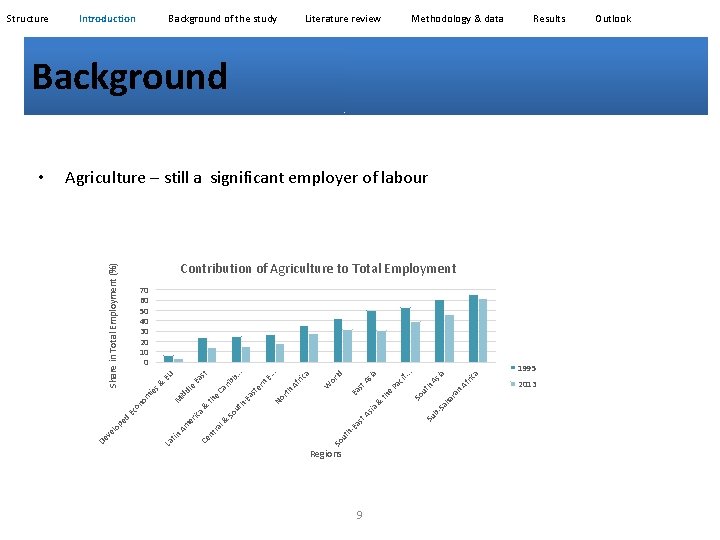
Structure Introduction Background of the study Literature review Methodology & data Results Outlook Background Agriculture – still a significant employer of labour Share in Total Employment (%) Contribution of Agriculture to Total Employment st Ea hut So 9 b- a ric Af Sa ha So ra ut n h cif As ia . . . 1995 Su ia & th e Ea s A s ut So Ce nt ra l & Regions Pa t A sia ld or W ca fri No rth A n h- Ea st e Ca th & ica er A m er rib Ea e dl id M tin La E. b. . . st U E s & ie om on E c ed . . 70 60 50 40 30 20 10 0 op ve l De • 2013
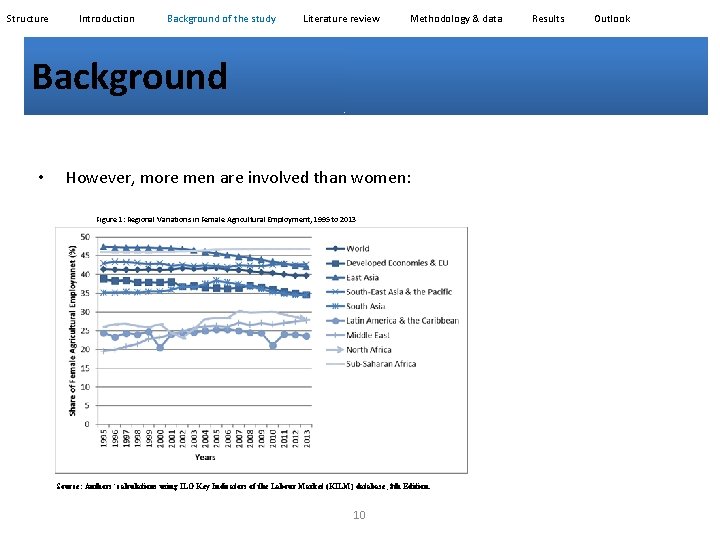
Structure Introduction Background of the study Literature review Methodology & data Results Outlook Background • However, more men are involved than women: Figure 1: Regional Variations in Female Agricultural Employment, 1995 to 2013 Source: Authors’ calculations using ILO Key Indicators of the Labour Market (KILM) database, 8 th Edition. 10
Structure Introduction Background of the study Literature review Methodology & data Results Outlook Background • Gender Gap • Significant Differences between men and women • Males are usually employed or more available than female – Heavy care burden, career interruption – Norms about unsuitability of some jobs (Wamboye and Seguino , 2015; Kabeer, 2012 ) 11
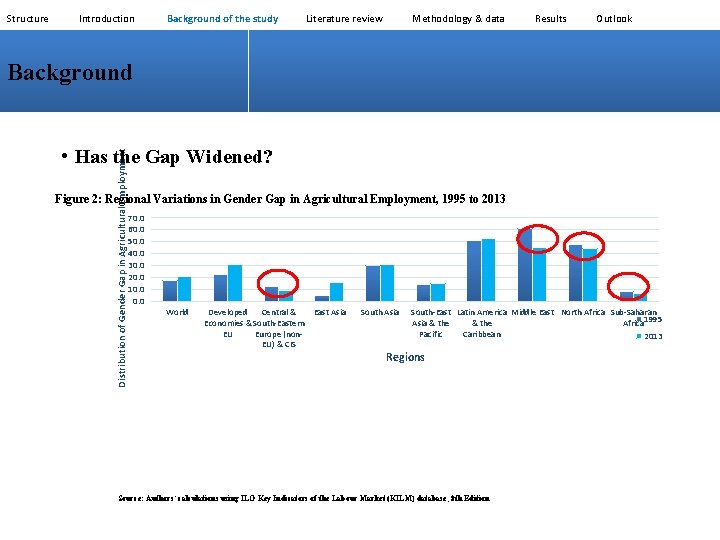
Structure Introduction Background of the study Literature review Methodology & data Results Outlook Distribution of Gender Gap in Agricultural Employment (%) Background • Has the Gap Widened? Figure 2: Regional Variations in Gender Gap in Agricultural Employment, 1995 to 2013 70. 0 60. 0 50. 0 40. 0 30. 0 20. 0 10. 0 World Developed Central & East Asia Economies & South-Eastern EU Europe (non. EU) & CIS South Asia South-East Latin America Middle East North Africa Sub-Saharan Asia & the Africa 1995 Pacific Caribbean 2013 Regions Source: Authors’ calculations using ILO Key Indicators of the Labour Market (KILM) database, 8 th Edition
Structure Introduction Background of the study Literature review Methodology & data Results Outlook Background • What is Causing the observed Gap? • • Can it be attributed to food safety standards? -Maybe 13
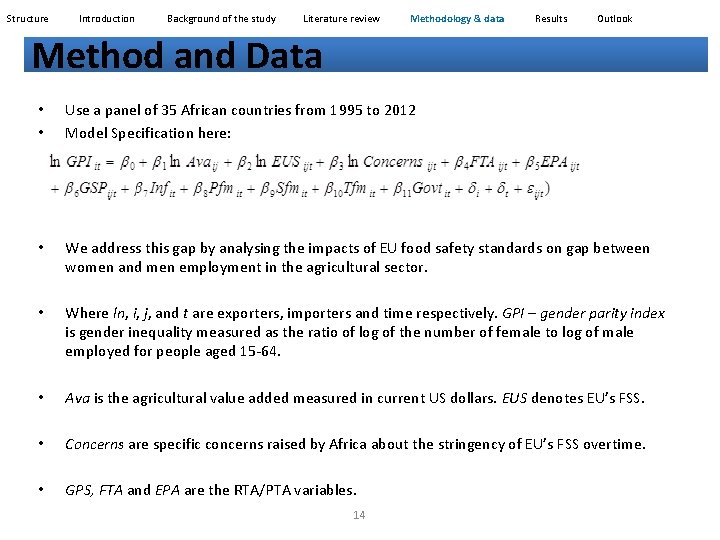
Structure Introduction Background of the study Literature review Methodology & data Results Outlook Method and Data • • Use a panel of 35 African countries from 1995 to 2012 Model Specification here: • We address this gap by analysing the impacts of EU food safety standards on gap between women and men employment in the agricultural sector. • Where ln, i, j, and t are exporters, importers and time respectively. GPI – gender parity index is gender inequality measured as the ratio of log of the number of female to log of male employed for people aged 15 -64. • Ava is the agricultural value added measured in current US dollars. EUS denotes EU’s FSS. • Concerns are specific concerns raised by Africa about the stringency of EU’s FSS overtime. • GPS, FTA and EPA are the RTA/PTA variables. 14
Structure Introduction Background of the study Literature review Methodology & data Results Outlook Results • Infra are the % of a country’s population that have access to improved sanitation facilities and water sources. • Pfm, Sfm and Tfm are controls for gender gaps in education. Govt is the effective govt gender policy. • New evidences are needed to understand the phenomenon and for targeted policy intervention to achieve economic development. • The EU Because: Potential endogeneity – TSLS – Valid Instruments: Total labour force, labour force/total population 15
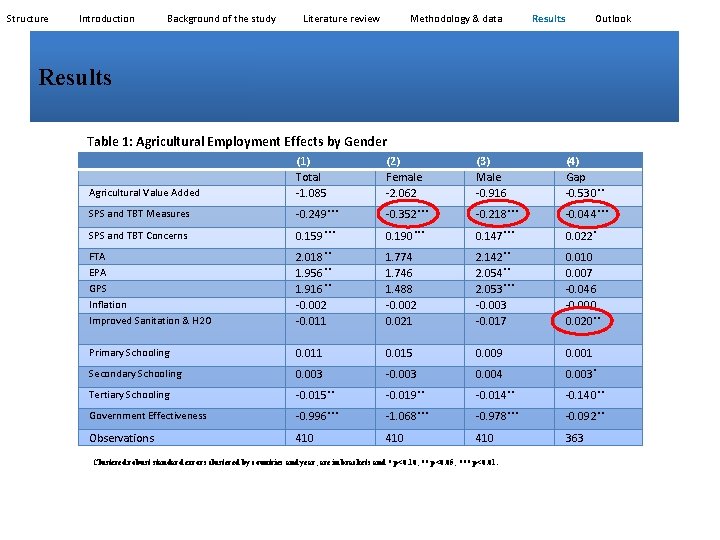
Structure Introduction Background of the study Literature review Methodology & data Results Outlook Results Table 1: Agricultural Employment Effects by Gender Agricultural Value Added (1) Total -1. 085 (2) Female -2. 062 (3) Male -0. 916 (4) Gap -0. 530** SPS and TBT Measures -0. 249*** -0. 352*** -0. 218*** -0. 044*** SPS and TBT Concerns 0. 159*** 0. 190*** 0. 147*** 0. 022* FTA EPA GPS Inflation Improved Sanitation & H 2 O 2. 018** 1. 956** 1. 916** -0. 002 -0. 011 1. 774 1. 746 1. 488 -0. 002 0. 021 2. 142** 2. 054** 2. 053*** -0. 003 -0. 017 0. 010 0. 007 -0. 046 -0. 000 0. 020** Primary Schooling 0. 011 0. 015 0. 009 0. 001 Secondary Schooling 0. 003 -0. 003 0. 004 0. 003* Tertiary Schooling -0. 015** -0. 019** -0. 014** -0. 140** Government Effectiveness -0. 996*** -1. 068*** -0. 978*** -0. 092** Observations 410 410 363 Clustered robust standard errors clustered by countries and year, are in brackets and * p<0. 10; ** p<0. 05; *** p<0. 01.
Structure Introduction Background of the study Literature review Methodology & data Results Outlook Results Observations • In general, what we observed FSS are employment reducing effects – Huge investment costs, poor level of domestic standards (Markus, et al. , 2005) • Women are more affected. Why? – Differences in capacity to fulfil EU requirement (Fontana and Paciello, 2009) – Face more financial constraint. – Differences in technical know how or education (Kabeer, 2012) • To what extent is the observed difference contributing to gender parity/disparity? 17
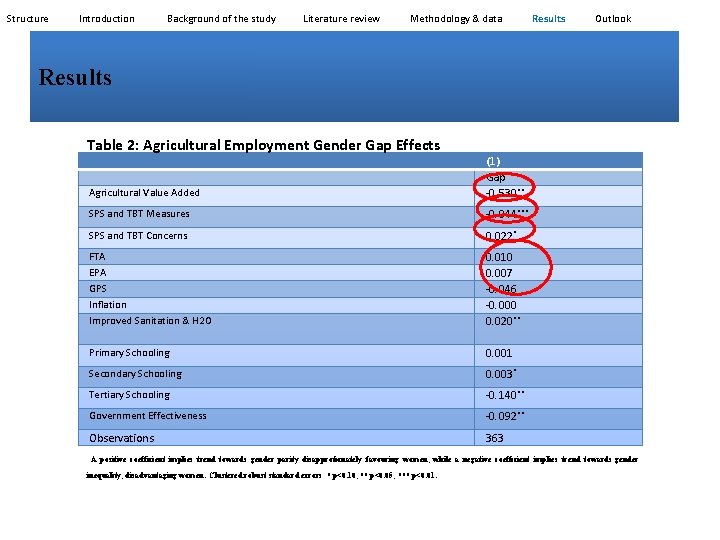
Structure Introduction Background of the study Literature review Methodology & data Results Outlook Results Table 2: Agricultural Employment Gender Gap Effects Agricultural Value Added (1) Gap -0. 530** SPS and TBT Measures -0. 044*** SPS and TBT Concerns 0. 022* FTA EPA GPS Inflation Improved Sanitation & H 2 O 0. 010 0. 007 -0. 046 -0. 000 0. 020** Primary Schooling 0. 001 Secondary Schooling 0. 003* Tertiary Schooling -0. 140** Government Effectiveness -0. 092** Observations 363 A positive coefficient implies trend towards gender parity disapprotionately favouring women, while a negative coefficient implies trend towards gender inequality, disadvantaging women. Clustered robust standard errors * p<0. 10; ** p<0. 05; *** p<0. 01.
Structure Introduction Background of the study Literature review Methodology & data Results Outlook Robustness Checks • Our first paramount concern is to see whether countries with ‘outlier gender parity index’ are the one driving our results, – particularly the results that shows that SPS and TBT concerns is increasing equality. In other words, is parity achieved in some years driving the results • A second relates to if the results are driven by the choice of our measure of the dependent variable. • First concern: excluded observations where female employment > male employment. • Second concern: construction of another dependent variable – Previously used F/M. Now we implemented another relative measure – (F-M)/F (UNCTAD, 2015) 19
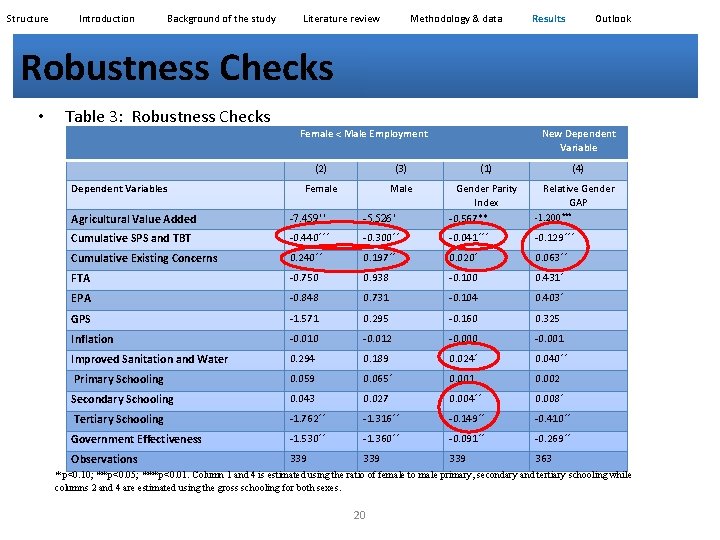
Structure Introduction Background of the study Literature review Methodology & data Results Outlook Robustness Checks • Table 3: Robustness Checks Female < Male Employment Dependent Variables New Dependent Variable (2) (3) (1) (4) Female Male Relative Gender GAP -1. 200*** Agricultural Value Added -7. 459** -5. 526* Gender Parity Index -0. 567** Cumulative SPS and TBT -0. 440*** -0. 300** -0. 041*** -0. 129*** Cumulative Existing Concerns 0. 240** 0. 197** 0. 020* 0. 063** FTA -0. 750 0. 938 -0. 100 0. 431* EPA -0. 848 0. 731 -0. 104 0. 403* GPS -1. 571 0. 295 -0. 160 0. 325 Inflation -0. 010 -0. 012 -0. 000 -0. 001 Improved Sanitation and Water 0. 294 0. 189 0. 024* 0. 040** Primary Schooling 0. 059 0. 065* 0. 001 0. 002 Secondary Schooling 0. 043 0. 027 0. 004** 0. 008* Tertiary Schooling -1. 762** -1. 316** -0. 149** -0. 410** Government Effectiveness -1. 530** -1. 360** -0. 091** -0. 269** Observations 339 339 363 * p<0. 10; ** p<0. 05; *** p<0. 01. Column 1 and 4 is estimated using the ratio of female to male primary, secondary and tertiary schooling while columns 2 and 4 are estimated using the gross schooling for both sexes. 20
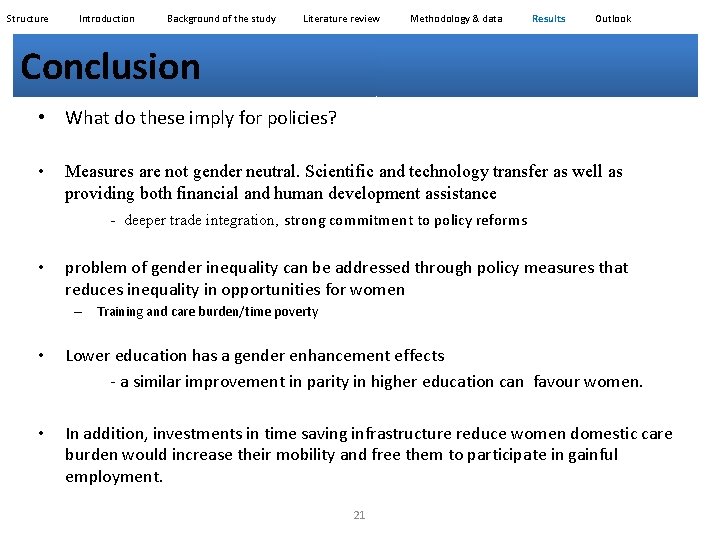
Structure Introduction Background of the study Literature review Methodology & data Results Outlook Conclusion • What do these imply for policies? • Measures are not gender neutral. Scientific and technology transfer as well as providing both financial and human development assistance - deeper trade integration, strong commitment to policy reforms • problem of gender inequality can be addressed through policy measures that reduces inequality in opportunities for women – Training and care burden/time poverty • Lower education has a gender enhancement effects - a similar improvement in parity in higher education can favour women. • In addition, investments in time saving infrastructure reduce women domestic care burden would increase their mobility and free them to participate in gainful employment. 21
Thank you
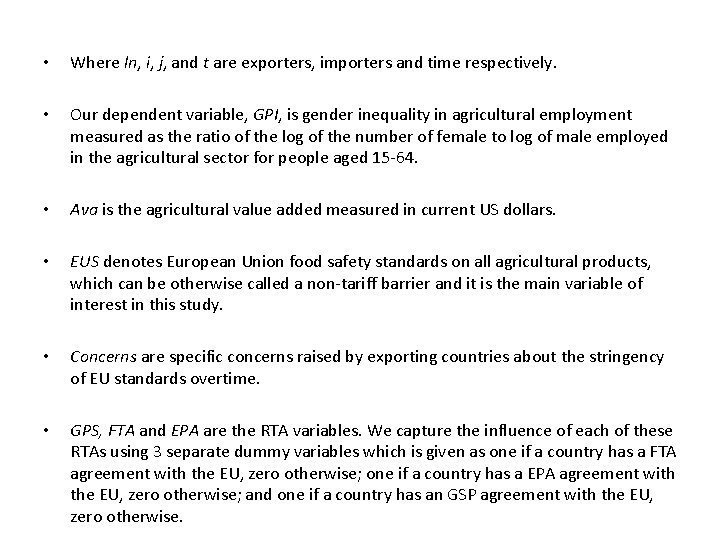
• Where ln, i, j, and t are exporters, importers and time respectively. • Our dependent variable, GPI, is gender inequality in agricultural employment measured as the ratio of the log of the number of female to log of male employed in the agricultural sector for people aged 15 -64. • Ava is the agricultural value added measured in current US dollars. • EUS denotes European Union food safety standards on all agricultural products, which can be otherwise called a non-tariff barrier and it is the main variable of interest in this study. • • Concerns are specific concerns raised by exporting countries about the stringency of EU standards overtime. GPS, FTA and EPA are the RTA variables. We capture the influence of each of these RTAs using 3 separate dummy variables which is given as one if a country has a FTA agreement with the EU, zero otherwise; one if a country has a EPA agreement with the EU, zero otherwise; and one if a country has an GSP agreement with the EU, zero otherwise.
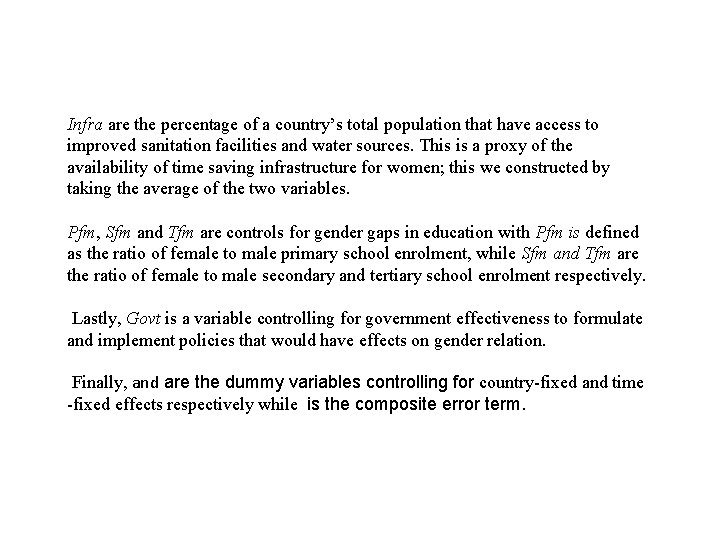
Infra are the percentage of a country’s total population that have access to improved sanitation facilities and water sources. This is a proxy of the availability of time saving infrastructure for women; this we constructed by taking the average of the two variables. Pfm, Sfm and Tfm are controls for gender gaps in education with Pfm is defined as the ratio of female to male primary school enrolment, while Sfm and Tfm are the ratio of female to male secondary and tertiary school enrolment respectively. Lastly, Govt is a variable controlling for government effectiveness to formulate and implement policies that would have effects on gender relation. Finally, and are the dummy variables controlling for country-fixed and time -fixed effects respectively while is the composite error term.
Gender Parity Index is gender inequality in agricultural employment measured as the ratio if the log of the number of female to log of male employed in the agricultural sector for people aged 15 -64. Others have also used Relative Gender Gap as a measure of difference between female and male outcomes. So I used it as a robustness check. Formally, the formula is given as: Female are number of female employed in the agricultural sector, respectively. Male are number of male employed in the agricultural sector, respectively.
- Slides: 25