
African Swine Fever ASF Prevention Training Korea Pork

- Slides: 26
African Swine Fever (ASF) Prevention Training Korea Pork Producers Association Korea Pork Board Korea Association of Swine Veterinarians
Table of Contents 1. Understanding of African Swine Fever (ASF) 2. Risk factors of ASF outbreak and the outbreak pathway 3. Duty of Han Don farms 2
1. Understanding of African Swine Fever (ASF) 3
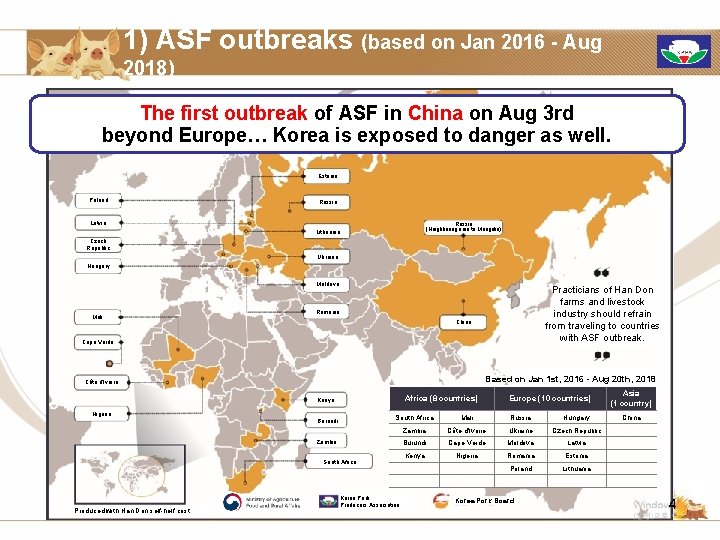
1) ASF outbreaks (based on Jan 2016 - Aug 2018) The first outbreak of ASF in China on Aug 3 rd beyond Europe… Korea is exposed to danger as well. Estonia Poland Russia Latvia Russia (Neighboring area to Mongolia) Lithuania Czech Republic Ukraine Hungary Moldova Mali Practicians of Han Don farms and livestock industry should refrain from traveling to countries with ASF outbreak. Romania China Cape Verde Based on Jan 1 st, 2016 - Aug 20 th, 2018 Côte d'Ivoire Africa (8 countries) Kenya Nigeria Burundi South Africa Mali Zambia Burundi Kenya South Africa Produced with Han Don self-helf cost. Korea Pork Producers Association Europe (10 countries) Russia Hungary Côte d'Ivoire Ukraine Czech Republic Cape Verde Moldova Latvia Nigeria Romania Estonia Poland Lithuania Korea Pork Board Asia (1 country) China 4
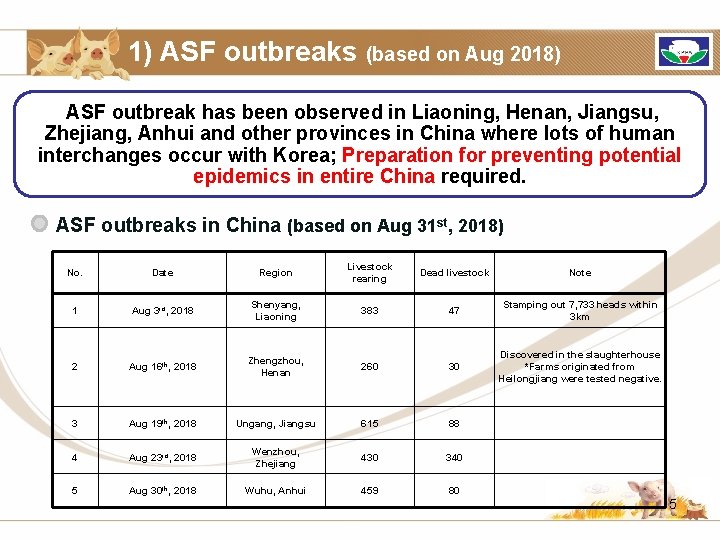
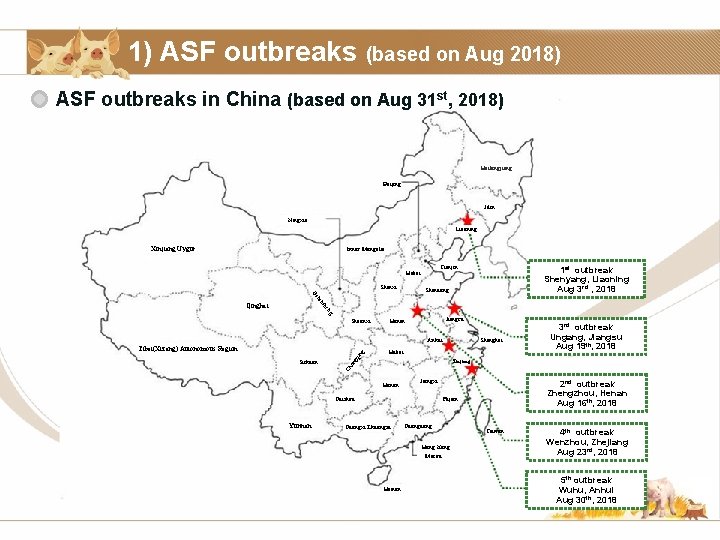
1) ASF outbreaks (based on Aug 2018) ASF outbreak has been observed in Liaoning, Henan, Jiangsu, Zhejiang, Anhui and other provinces in China where lots of human interchanges occur with Korea; Preparation for preventing potential epidemics in entire China required. ASF outbreaks in China (based on Aug 31 st, 2018) No. Date Region Livestock rearing Dead livestock Note 1 Aug 3 rd, 2018 Shenyang, Liaoning 383 47 Stamping out 7, 733 heads within 3 km 2 Aug 16 th, 2018 Zhengzhou, Henan 260 30 Discovered in the slaughterhouse *Farms originated from Heilongjiang were tested negative. 3 Aug 19 th, 2018 Ungang, Jiangsu 615 88 4 Aug 23 rd, 2018 Wenzhou, Zhejiang 430 340 5 Aug 30 th, 2018 Wuhu, Anhui 459 80 5
1) ASF outbreaks (based on Aug 2018) ASF outbreaks in China (based on Aug 31 st, 2018) Heilongjiang Beijing Jilin Ningxia Liaoning Xinjiang Uygur Inner Mongolia Tianjin Hebei Shanxi 1 st outbreak Shenyang, Liaoning Aug 3 rd , 2018 ns Ga Shandong Shaanxi Henan g ng he us Qinghai Hubei Jiangsu Anhui on Zhejiang Ch Sichuan Shanghai gq in Tibet(Xizang) Autonomous Region 3 rd outbreak Ungang, Jiangsu Aug 19 th, 2018 Hunan Jiangxi Fujian Guizhou Yunnan 2 nd outbreak Zhengzhou, Henan Aug 16 th, 2018 Guangxi Zhuangzu Guangdong Hong Kong Macau Hainan Taiwan 4 th outbreak Wenzhou, Zhejiang Aug 23 rd, 2018 5 th outbreak Wuhu, Anhui Aug 30 th, 2018 6
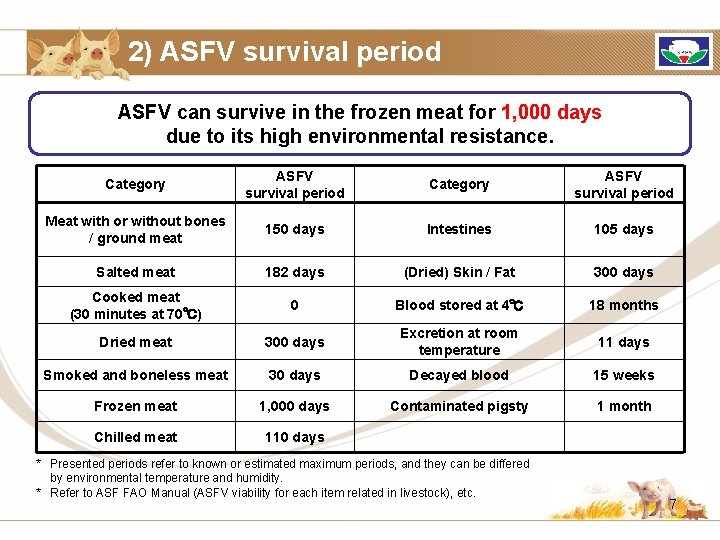
2) ASFV survival period ASFV can survive in the frozen meat for 1, 000 days due to its high environmental resistance. Category ASFV survival period Meat with or without bones / ground meat 150 days Intestines 105 days Salted meat 182 days (Dried) Skin / Fat 300 days Cooked meat (30 minutes at 70℃) 0 Blood stored at 4℃ 18 months Dried meat 300 days Excretion at room temperature 11 days Smoked and boneless meat 30 days Decayed blood 15 weeks Frozen meat 1, 000 days Contaminated pigsty 1 month Chilled meat 110 days * Presented periods refer to known or estimated maximum periods, and they can be differed by environmental temperature and humidity. * Refer to ASF FAO Manual (ASFV viability for each item related in livestock), etc. 7
2. Risk factors of ASF outbreak and the outbreak pathway 8
1) Risk factors of outbreak • (Pork products) Illegal carrying of pork and pork processed goods by tourists who visited the countries of outbreak and residents of such countries. • (Leftover foods) Spread of viruses from the contaminated leftover foods originated in ships and airplanes. • (Wild boars) Spread of viruses due to the direct and indirect contact with infected wild boars movement. • (Vectors) Spread of viruses through vectors, for instance, soft ticks. • (Others) Inflow of viruses by people who visited the countries of outbreak. 9
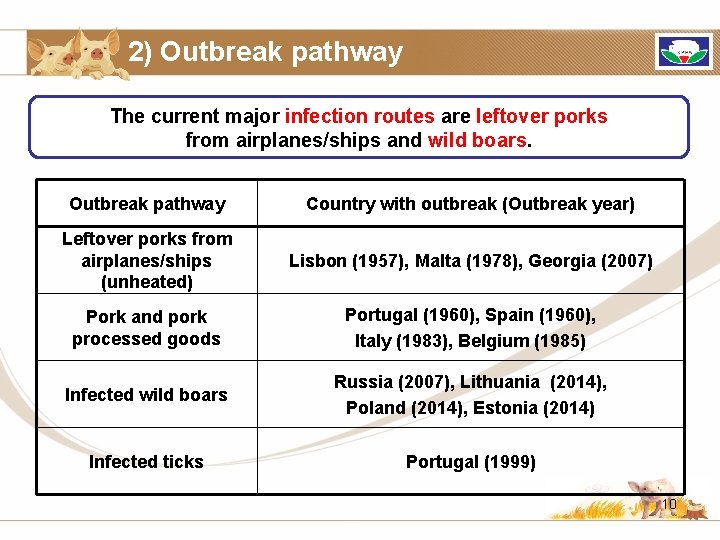
2) Outbreak pathway The current major infection routes are leftover porks from airplanes/ships and wild boars. Outbreak pathway Country with outbreak (Outbreak year) Leftover porks from airplanes/ships (unheated) Lisbon (1957), Malta (1978), Georgia (2007) Pork and pork processed goods Portugal (1960), Spain (1960), Italy (1983), Belgium (1985) Infected wild boars Russia (2007), Lithuania (2014), Poland (2014), Estonia (2014) Infected ticks Portugal (1999) 10
3. Duty of Han Don farms 11
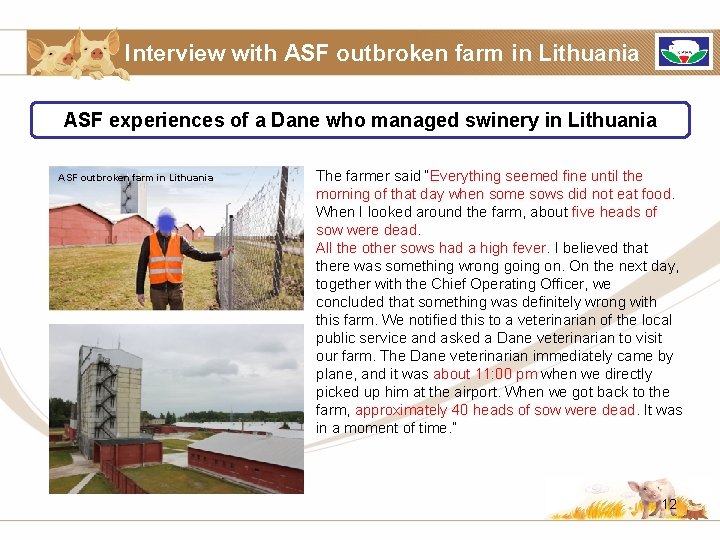
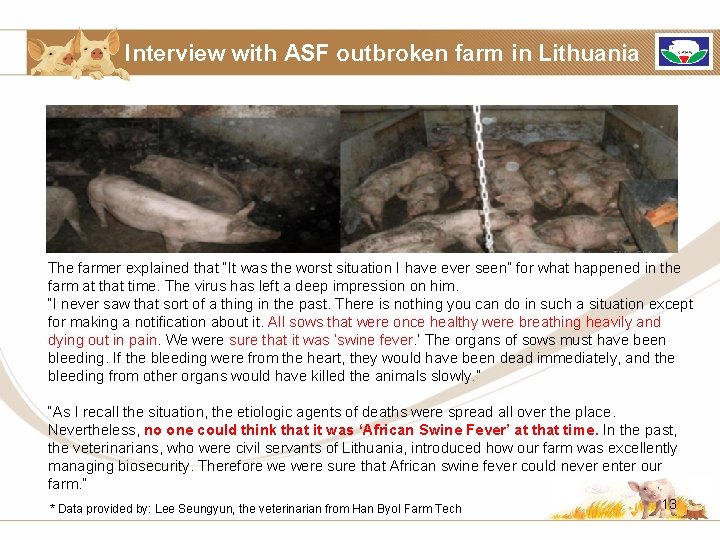
Interview with ASF outbroken farm in Lithuania ASF experiences of a Dane who managed swinery in Lithuania ASF outbroken farm in Lithuania The farmer said “Everything seemed fine until the morning of that day when some sows did not eat food. When I looked around the farm, about five heads of sow were dead. All the other sows had a high fever. I believed that there was something wrong going on. On the next day, together with the Chief Operating Officer, we concluded that something was definitely wrong with this farm. We notified this to a veterinarian of the local public service and asked a Dane veterinarian to visit our farm. The Dane veterinarian immediately came by plane, and it was about 11: 00 pm when we directly picked up him at the airport. When we got back to the farm, approximately 40 heads of sow were dead. It was in a moment of time. ” 12
Interview with ASF outbroken farm in Lithuania The farmer explained that “It was the worst situation I have ever seen” for what happened in the farm at that time. The virus has left a deep impression on him. “I never saw that sort of a thing in the past. There is nothing you can do in such a situation except for making a notification about it. All sows that were once healthy were breathing heavily and dying out in pain. We were sure that it was ‘swine fever. ’ The organs of sows must have been bleeding. If the bleeding were from the heart, they would have been dead immediately, and the bleeding from other organs would have killed the animals slowly. ” “As I recall the situation, the etiologic agents of deaths were spread all over the place. Nevertheless, no one could think that it was ‘African Swine Fever’ at that time. In the past, the veterinarians, who were civil servants of Lithuania, introduced how our farm was excellently managing biosecurity. Therefore we were sure that African swine fever could never enter our farm. ” * Data provided by: Lee Seungyun, the veterinarian from Han Byol Farm Tech 13
1) Prompt report if high fevers and deaths increase The most important roles of farms are having early detection and making rapid reports. Immediately report if an increase of high fever and deaths of livestock with unknown causes are observed! - Report calls for suspicious farms (Quarantine Agency) 1588 -9060/4060 - All farmers and workers must be fully aware of the major symptoms of ASF and perform regular clinical inspections! 14
2) Understanding of the major symptoms for early detection There a variety of clinical manifestations depending on the pathogenicity of infected viruses, and they are mostly identified as acute and subacute. <Acute> - Livestock may suddenly die within 1 -4 days without showing - particular clinical manifestations. Immediately report if the sudden increase in livestock deaths with unknown causes. 15
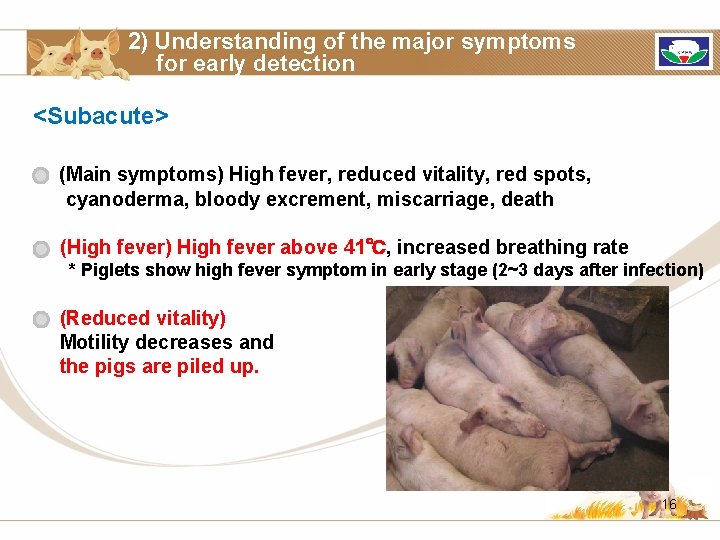
2) Understanding of the major symptoms for early detection <Subacute> (Main symptoms) High fever, reduced vitality, red spots, cyanoderma, bloody excrement, miscarriage, death (High fever) High fever above 41℃, increased breathing rate * Piglets show high fever symptom in early stage (2~3 days after infection) (Reduced vitality) Motility decreases and the pigs are piled up. 16
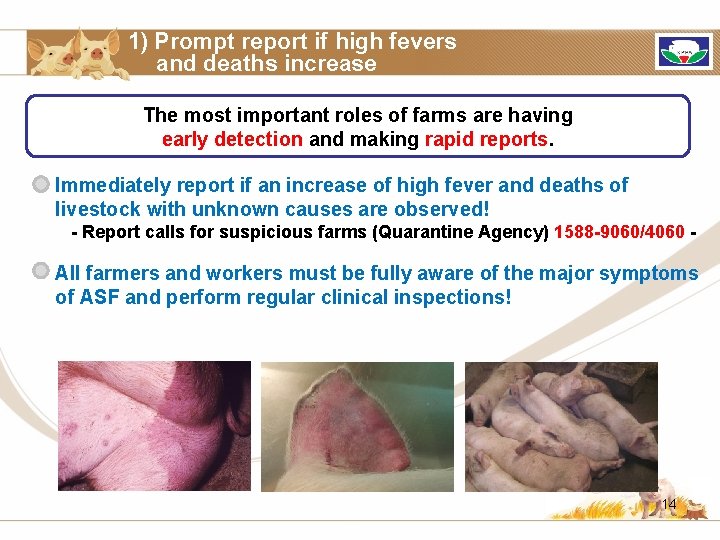
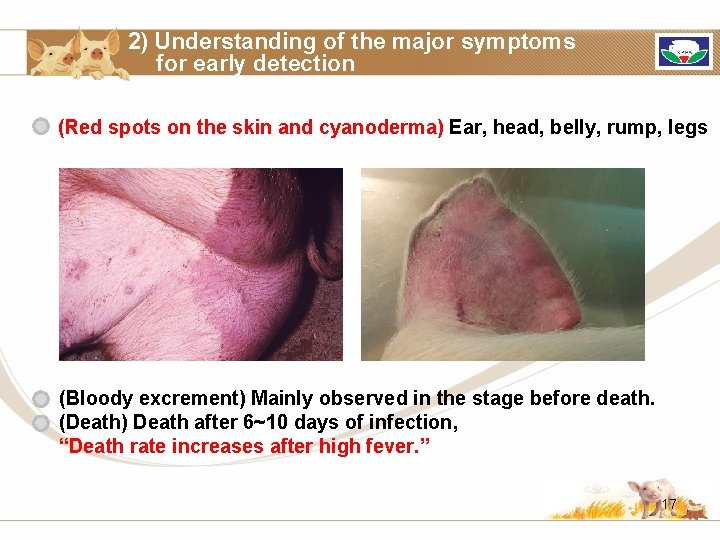
2) Understanding of the major symptoms for early detection (Red spots on the skin and cyanoderma) Ear, head, belly, rump, legs (Bloody excrement) Mainly observed in the stage before death. (Death) Death after 6~10 days of infection, “Death rate increases after high fever. ” 17
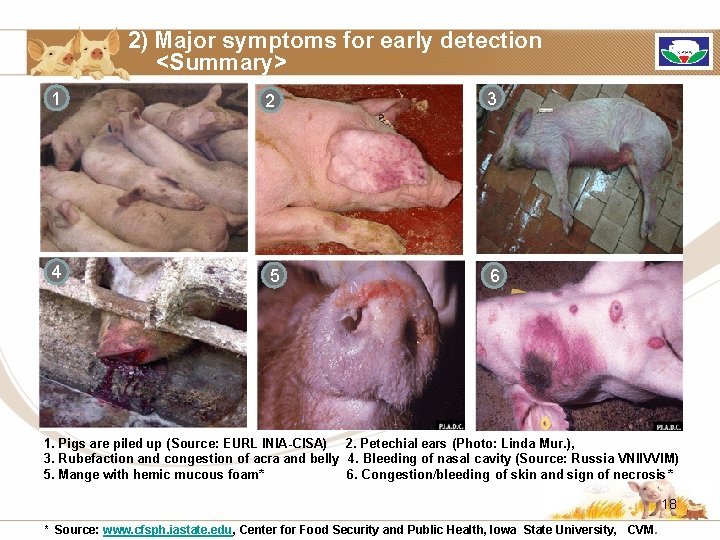
2) Major symptoms for early detection <Summary> 1 2 3 4 5 6 1. Pigs are piled up (Source: EURL INIA-CISA) 2. Petechial ears (Photo: Linda Mur. ), 3. Rubefaction and congestion of acra and belly 4. Bleeding of nasal cavity (Source: Russia VNIIVVIM) 5. Mange with hemic mucous foam* 6. Congestion/bleeding of skin and sign of necrosis* 18 * Source: www. cfsph. iastate. edu, Center for Food Security and Public Health, Iowa State University, CVM.
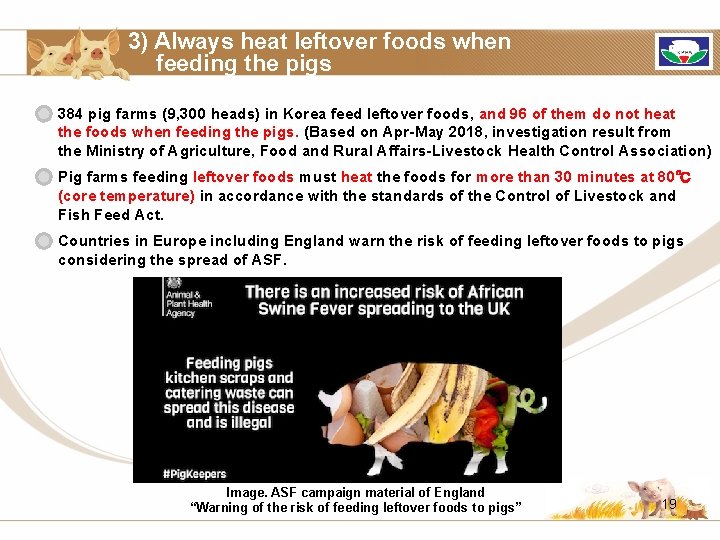
3) Always heat leftover foods when feeding the pigs 384 pig farms (9, 300 heads) in Korea feed leftover foods, and 96 of them do not heat the foods when feeding the pigs. (Based on Apr-May 2018, investigation result from the Ministry of Agriculture, Food and Rural Affairs-Livestock Health Control Association) Pig farms feeding leftover foods must heat the foods for more than 30 minutes at 80℃ (core temperature) in accordance with the standards of the Control of Livestock and Fish Feed Act. Countries in Europe including England warn the risk of feeding leftover foods to pigs considering the spread of ASF. Image. ASF campaign material of England “Warning of the risk of feeding leftover foods to pigs” 19
4) Quarantine compliances when visiting overseas Visiting countries with ASF outbreak including China is prohibited. - If unavoidably visiting such countries, visiting of farms and livestock markets is strictly prohibited. Approved countries for traveling: (Countries without ASF, AI, and foot-and-mouth disease outbreaks) Singapore, Japan, Western Europe, Northern Europe, etc. (Countries with ASF outbreak) 19 countries in Africa/Europe/Asia after Jan 1 st, 2016 (OIE Standards) Africa (8 countries) Europe (10 countries) Asia (1 country) South Africa, Zambia, Burundi, Kenya, Mali, Côte d'Ivoir, Cape Verde, Nigeria Russia, Ukraine, Moldova, Romania, Poland, Hungary, Czech Republic, Latvia, Estonia, Lithuania China Bringing livestock products to Korea such as meat, ham, and sausage sold in the travel sites is strictly prohibited. 20
4) Quarantine compliances when visiting overseas Maintain a high level of personal hygiene (taking a shower, etc. ) right after returning to Korea. Do not enter livestock farming facilities for five days. Immediately wash the clothes and shoes you wore during the trip. Report and disinfect yourself when entering the country with infectious disease in domestic animals outbreaks (including layover). - Violation may charge the fee of 5, 000 KRW or less. 21
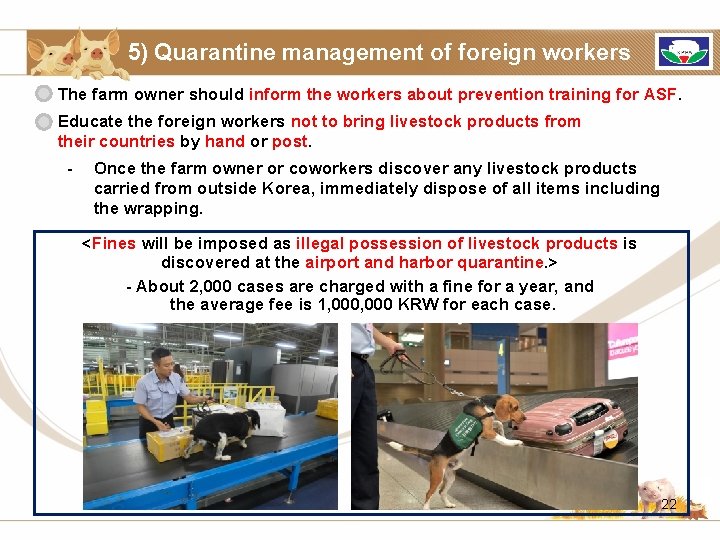
5) Quarantine management of foreign workers The farm owner should inform the workers about prevention training for ASF. Educate the foreign workers not to bring livestock products from their countries by hand or post. - Once the farm owner or coworkers discover any livestock products carried from outside Korea, immediately dispose of all items including the wrapping. <Fines will be imposed as illegal possession of livestock products is discovered at the airport and harbor quarantine. > - About 2, 000 cases are charged with a fine for a year, and the average fee is 1, 000 KRW for each case. 22
5) Quarantine management of foreign workers Process of the quarantine management of foreign workers who visited their homeland - (Overseas sojourn) Prohibition on visiting livestock farms and markets in their homeland. - (Before departure) Self-inspection and dispose of livestock products possessions by workers before boarding on the airplane. - (Right after the entry) Report to the quarantine agency at the airport or harbor and proceed with disinfection. - (In Korea) Separate preparation of lodging instead of the lodging in the farm (recommended). Immediate washing of the clothes and shoes worn during the trip right after coming back to Korea. Thorough individual hygiene management such as taking a shower. Prohibition on visiting the farm for five days. When returning to the farm, the manager should recheck the hygiene conditions and possession of livestock products. 23
5) Quarantine management of foreign workers Compliance details of foreign workers about the quarantine within the farm - Prohibition on ordering the homeland’s livestock products (meat, meat products, etc. ) by mail to Korea. - Prohibition on bringing the meat bought outside the farm on weekends or holidays. - Before returning to your farm after weekends or holidays, be sure to wash the hands if you met the managers of other farms. - Prohibition on inviting the workers from other farms to the farm you are working at. - Prohibition on visiting other farms. 24
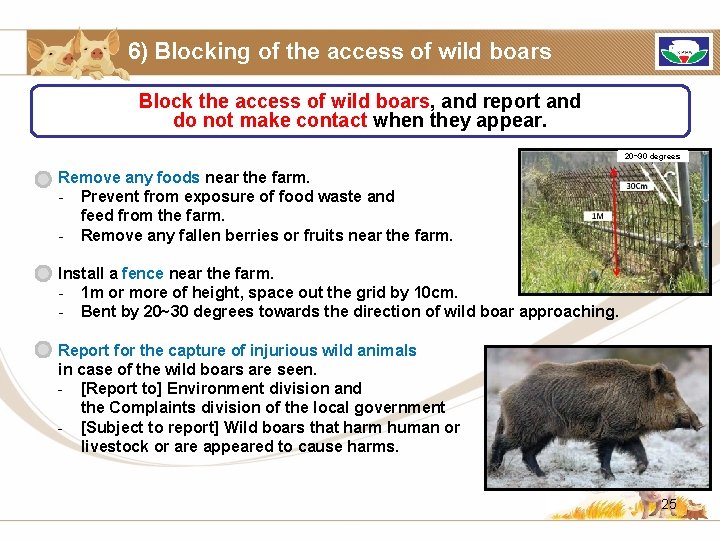
6) Blocking of the access of wild boars Block the access of wild boars, and report and do not make contact when they appear. 20~30 degrees Remove any foods near the farm. - Prevent from exposure of food waste and feed from the farm. - Remove any fallen berries or fruits near the farm. Install a fence near the farm. - 1 m or more of height, space out the grid by 10 cm. - Bent by 20~30 degrees towards the direction of wild boar approaching. Report for the capture of injurious wild animals in case of the wild boars are seen. - [Report to] Environment division and the Complaints division of the local government - [Subject to report] Wild boars that harm human or livestock or are appeared to cause harms. 25
Thank you. 26