
African Societies African Cultural Characteristics Common features Concept

- Slides: 17
African Societies
African Cultural Characteristics • Common features • Concept of king • Society arrange in age groups and kinship divisions – Sub-Saharan Africans descended from people who lived in southern Sahara during “wet period” – Migrated south where cultural traditions developed – Kingship • Kings ritually isolated
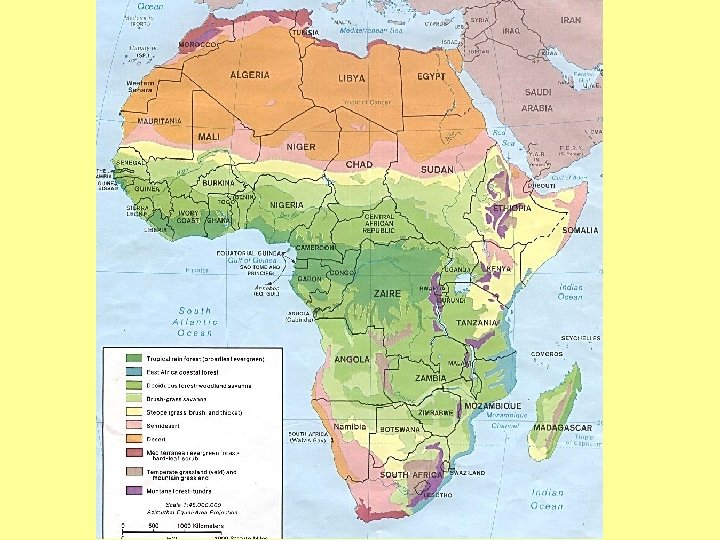
Sub-Saharan Africa: A Challenging Geography • Large area with many different environmental zones and many geographical obstacles to movement – Sahara Desert—North Africa • World's largest desert – Maghreb—northwest Africa • Coastlands and Atlas Mountains of Morocco, Algeria, and Tunisia – Sahel—belt of grasslands south of Sahara – Sudan—just below the Sahel – Guinea—rainforests • Along Atlantic coast from Guinea to Nigeria – Congo—rainforest region of Congo River Basin – Great Lakes—series of five lakes
Early East Africa • Egyptians and Sabaeans – Egypt referred to the area as Punt • Documentary evidence of trade between Egypt and Punt • Products were spices, gold, ivory, animals, slaves – Semitics in Southern Yemen & East Africa • Created dams, terraced agriculture • Cities connected by trade to SW Asia • Specialize in gold, frankincense, myrrh
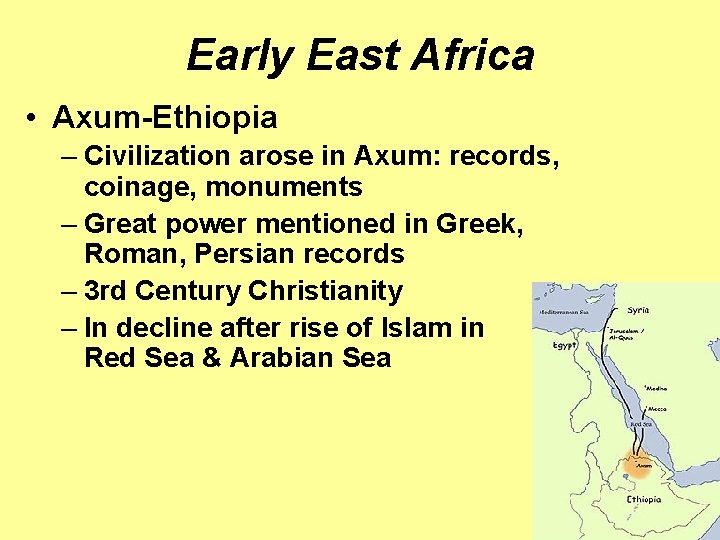
Early East Africa • Axum-Ethiopia – Civilization arose in Axum: records, coinage, monuments – Great power mentioned in Greek, Roman, Persian records – 3 rd Century Christianity – In decline after rise of Islam in Red Sea & Arabian Sea
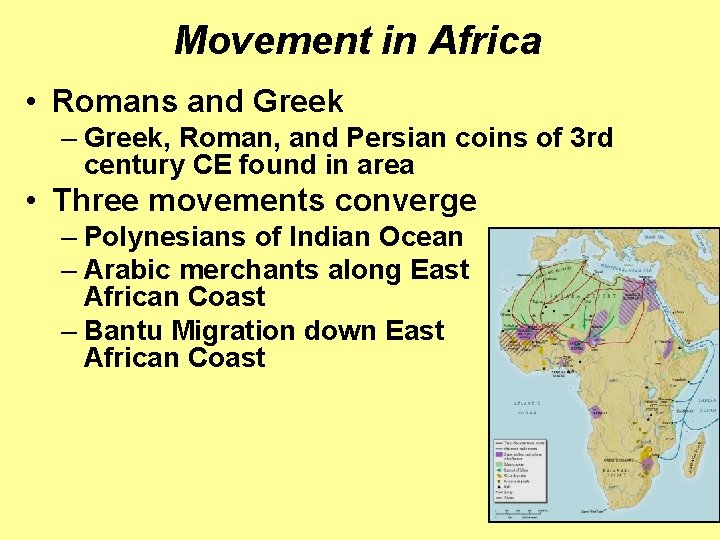
Movement in Africa • Romans and Greek – Greek, Roman, and Persian coins of 3 rd century CE found in area • Three movements converge – Polynesians of Indian Ocean – Arabic merchants along East African Coast – Bantu Migration down East African Coast
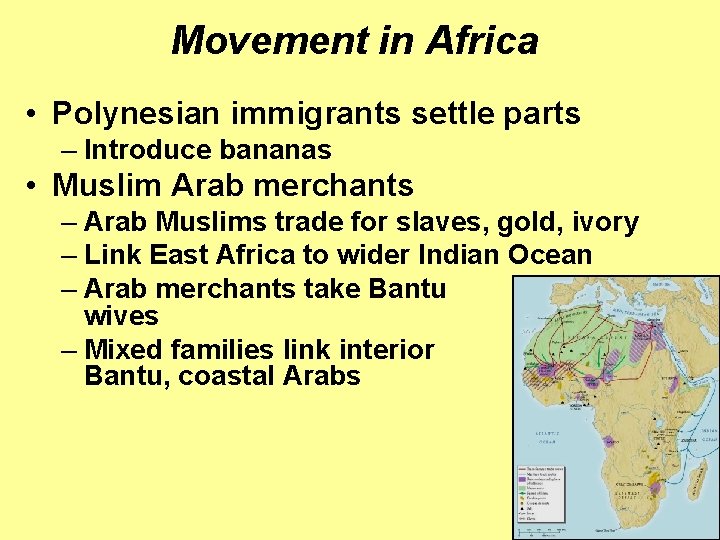
Movement in Africa • Polynesian immigrants settle parts – Introduce bananas • Muslim Arab merchants – Arab Muslims trade for slaves, gold, ivory – Link East Africa to wider Indian Ocean – Arab merchants take Bantu wives – Mixed families link interior Bantu, coastal Arabs
Advent of Iron and Bantu Migrations • Sub-Saharan agriculture • Origins north of equator • Spread southward • Iron-working also began north of equator and spread southward • Reached southern Africa by 800 c. e.
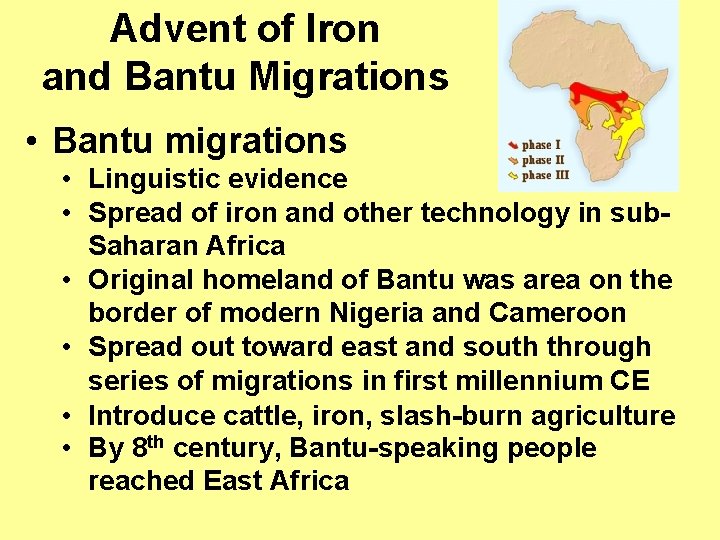
Advent of Iron and Bantu Migrations • Bantu migrations • Linguistic evidence • Spread of iron and other technology in sub. Saharan Africa • Original homeland of Bantu was area on the border of modern Nigeria and Cameroon • Spread out toward east and south through series of migrations in first millennium CE • Introduce cattle, iron, slash-burn agriculture • By 8 th century, Bantu-speaking people reached East Africa
El Zanj: The Swahili • 30 -40 separate city-states along East African coast • "Swahili" used by early Arabs, means "coast“ • By 1 st century BCE Arab and Indian traders • Brought bananas, cloves, cinnamon and pepper • Left with gold, ivory and slaves • Spoke African language enriched with Arabic and Persian vocabulary • 8 th Century CE • Settlement Arabs from Persian Gulf • Small settlements of Indians
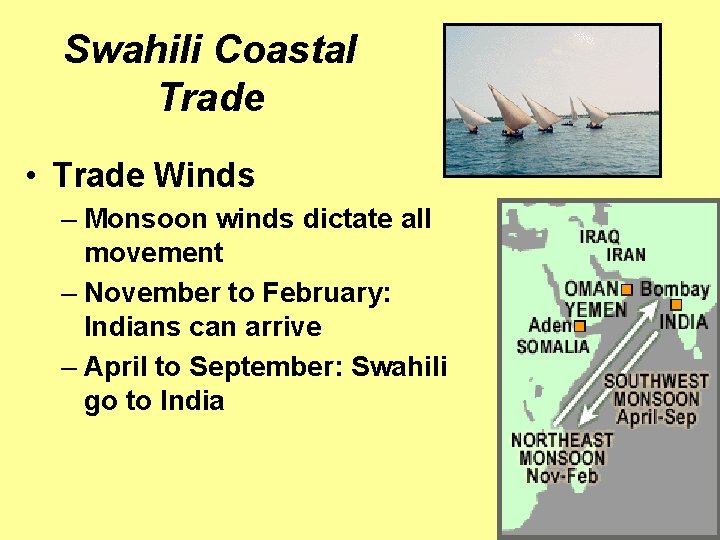
Swahili Coastal Trade • Trade Winds – Monsoon winds dictate all movement – November to February: Indians can arrive – April to September: Swahili go to India
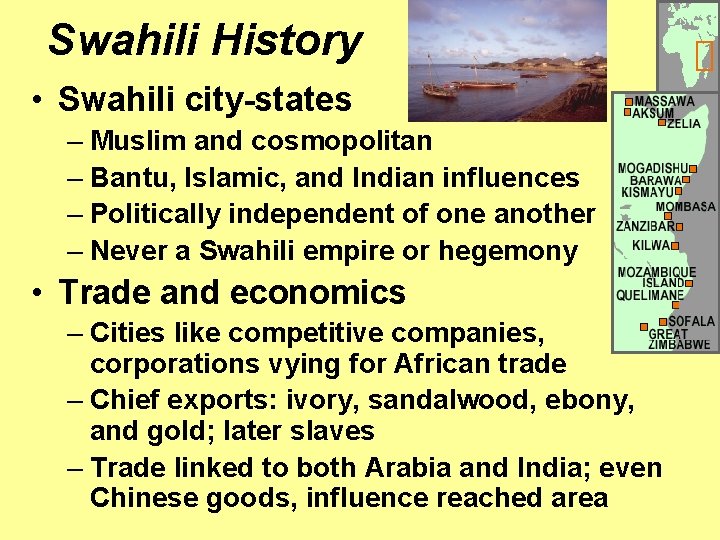
Swahili History • Swahili city-states – Muslim and cosmopolitan – Bantu, Islamic, and Indian influences – Politically independent of one another – Never a Swahili empire or hegemony • Trade and economics – Cities like competitive companies, corporations vying for African trade – Chief exports: ivory, sandalwood, ebony, and gold; later slaves – Trade linked to both Arabia and India; even Chinese goods, influence reached area
Swahili History • Social construct – – – Arabs, Persians were significant players Cities were run by nobility that was African in origin Below nobility: commoners, resident foreigners Large group of artisans, weavers, craftsmen Slavery was actively practiced • 16 th century – Advent of Portuguese trade disrupted trade routes, made commercial centers obsolete – Portuguese allowed natives no share in African trade – Began conquering Islamic city-states along eastern coast • Late 17 th century – Oman conquered Portuguese cities along coast – Area controlled by Omani sultanate for another 200 years – Cotton, cloves, plantation agriculture thrived and used slaves for labor
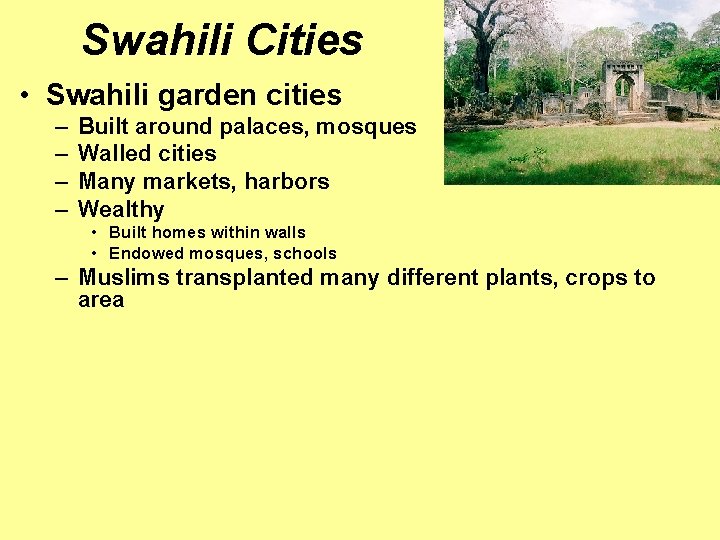
Swahili Cities • Swahili garden cities – – Built around palaces, mosques Walled cities Many markets, harbors Wealthy • Built homes within walls • Endowed mosques, schools – Muslims transplanted many different plants, crops to area
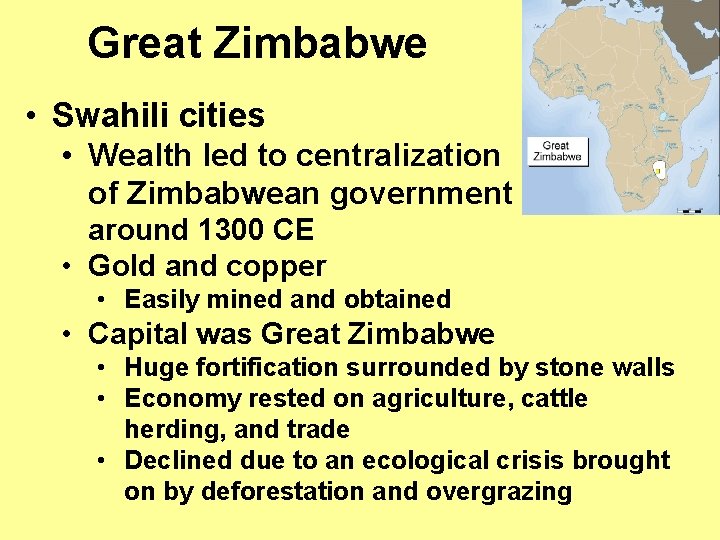
Great Zimbabwe • Swahili cities • Wealth led to centralization of Zimbabwean government around 1300 CE • Gold and copper • Easily mined and obtained • Capital was Great Zimbabwe • Huge fortification surrounded by stone walls • Economy rested on agriculture, cattle herding, and trade • Declined due to an ecological crisis brought on by deforestation and overgrazing
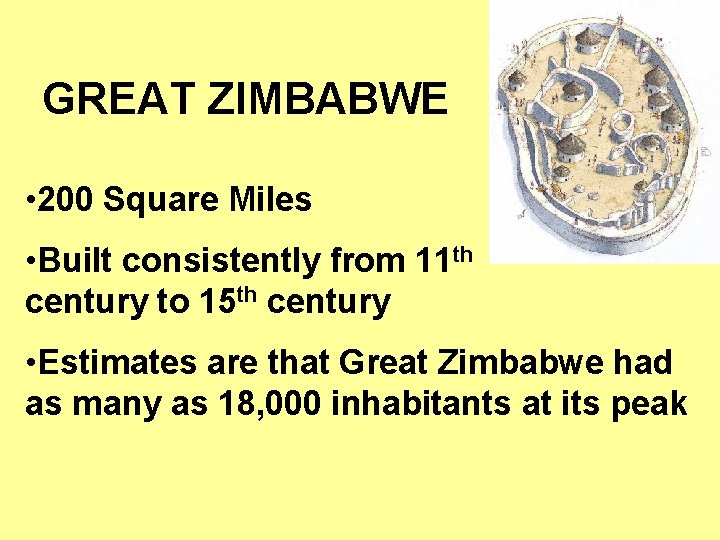
GREAT ZIMBABWE • 200 Square Miles • Built consistently from 11 th century to 15 th century • Estimates are that Great Zimbabwe had as many as 18, 000 inhabitants at its peak