
African language families and their structural properties Sonja
![References • • • African language families. 2008. [O] Available: http: //encarta. msn. com/media_461520382_761565449_1_1/African_Language_Families.](https://slidetodoc.com/presentation_image_h2/5c57a5c523dd4bd074f86ee247c10c36/image-29.jpg "References • • • African language families. 2008. [O] Available: http: //encarta. msn. com/media_461520382_761565449_1_1/African_Language_Families.")
- Slides: 30
African language families and their structural properties Sonja Bosch Department of African Languages University of South Africa boschse@unisa. ac. za Workshop: Language Technologies for African Languages, EACL, Athens, Greece. March 31 2009.
Goal of the workshop • to provide a forum to meet and share the latest developments in the field of language technologies for African languages; • to attract linguists who specialise in African languages and who would like to leverage the tools and approaches of computational linguistics; • to attract computational linguists who are interested in learning about the particular linguistic challenges posed by African languages.
Overview of tutorial • Introduction - Video: The History of Mankind • Four African Phyla - History of division - Main characteristics • Africanisms • Discussion/Interaction
Introduction Aim of tutorial • to give an overview of the complex language situation on the African continent, not only regarding the vast variety of languages spoken, but also regarding the classifications of languages; • to create an awareness of a few of the characteristic structural properties of some of the African languages; • to hopefully inspire as many researchers as possible to get involved with language technology research in African languages.
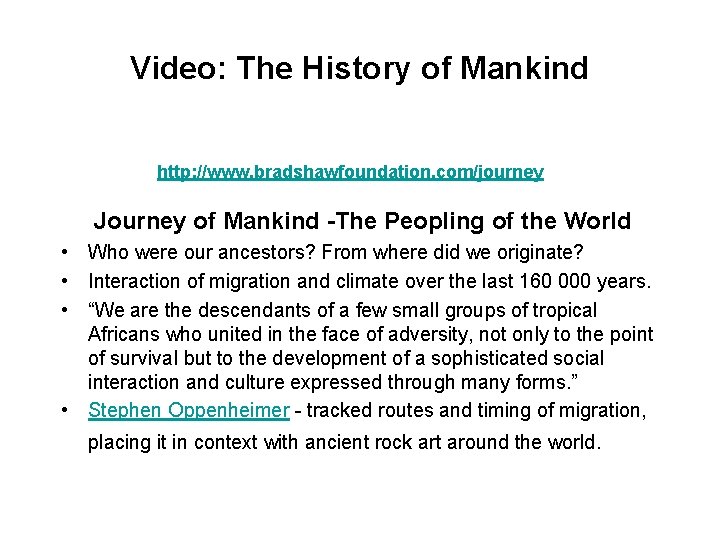
Video: The History of Mankind http: //www. bradshawfoundation. com/journey Journey of Mankind -The Peopling of the World • Who were our ancestors? From where did we originate? • Interaction of migration and climate over the last 160 000 years. • “We are the descendants of a few small groups of tropical Africans who united in the face of adversity, not only to the point of survival but to the development of a sophisticated social interaction and culture expressed through many forms. ” • Stephen Oppenheimer - tracked routes and timing of migration, placing it in context with ancient rock art around the world.
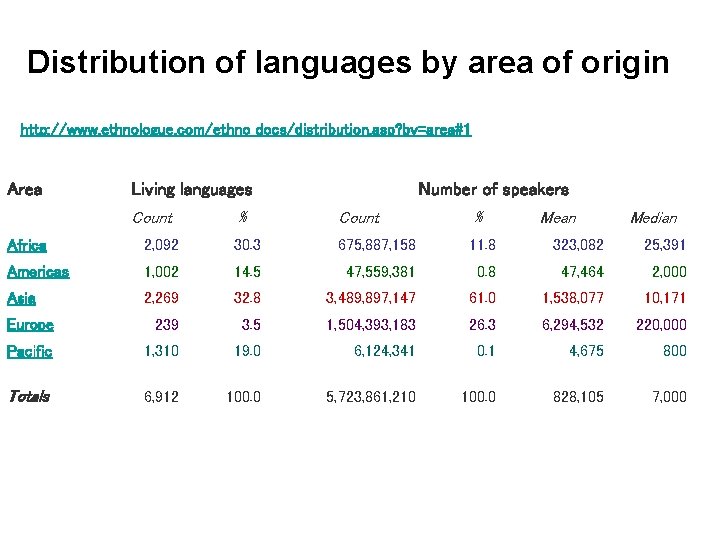
Distribution of languages by area of origin http: //www. ethnologue. com/ethno_docs/distribution. asp? by=area#1 Area Living languages Count Number of speakers % Count % Mean Median Africa 2, 092 30. 3 675, 887, 158 11. 8 323, 082 25, 391 Americas 1, 002 14. 5 47, 559, 381 0. 8 47, 464 2, 000 Asia 2, 269 32. 8 3, 489, 897, 147 61. 0 1, 538, 077 10, 171 Europe 239 3. 5 1, 504, 393, 183 26. 3 6, 294, 532 220, 000 Pacific 1, 310 19. 0 6, 124, 341 0. 1 4, 675 800 Totals 6, 912 100. 0 5, 723, 861, 210 100. 0 828, 105 7, 000
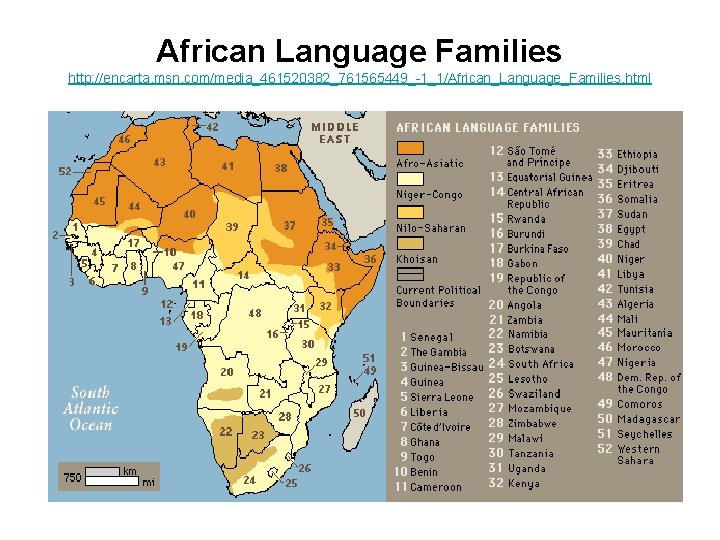
African Language Families http: //encarta. msn. com/media_461520382_761565449_-1_1/African_Language_Families. html
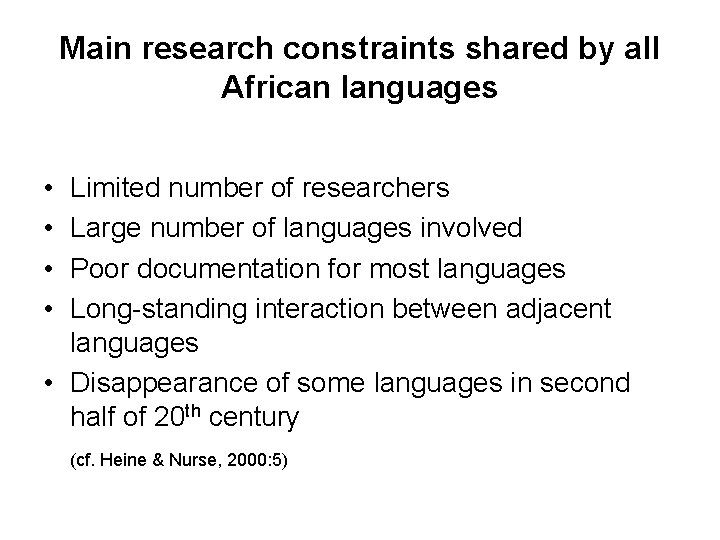
Main research constraints shared by all African languages • • Limited number of researchers Large number of languages involved Poor documentation for most languages Long-standing interaction between adjacent languages • Disappearance of some languages in second half of 20 th century (cf. Heine & Nurse, 2000: 5)
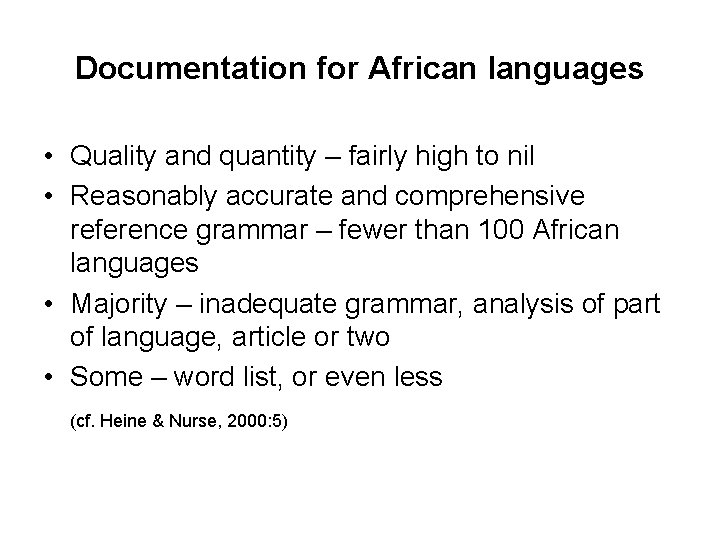
Documentation for African languages • Quality and quantity – fairly high to nil • Reasonably accurate and comprehensive reference grammar – fewer than 100 African languages • Majority – inadequate grammar, analysis of part of language, article or two • Some – word list, or even less (cf. Heine & Nurse, 2000: 5)
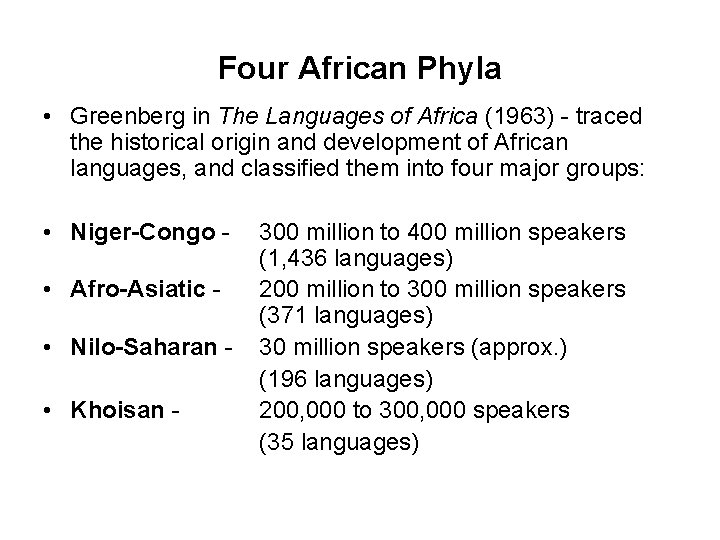
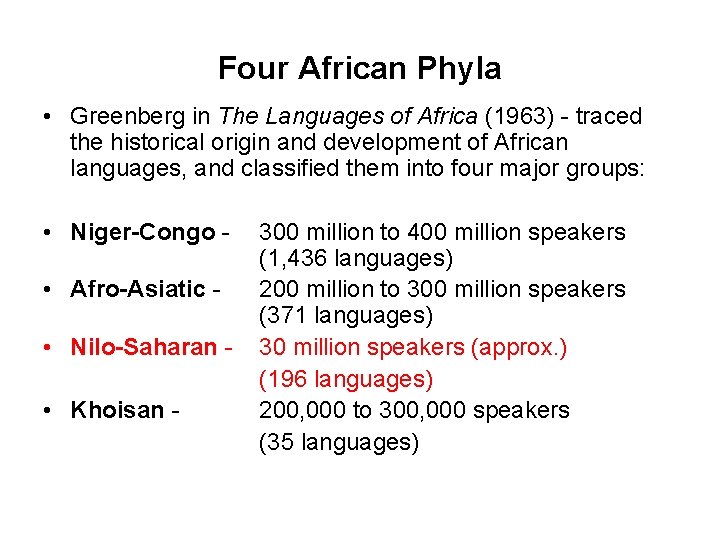
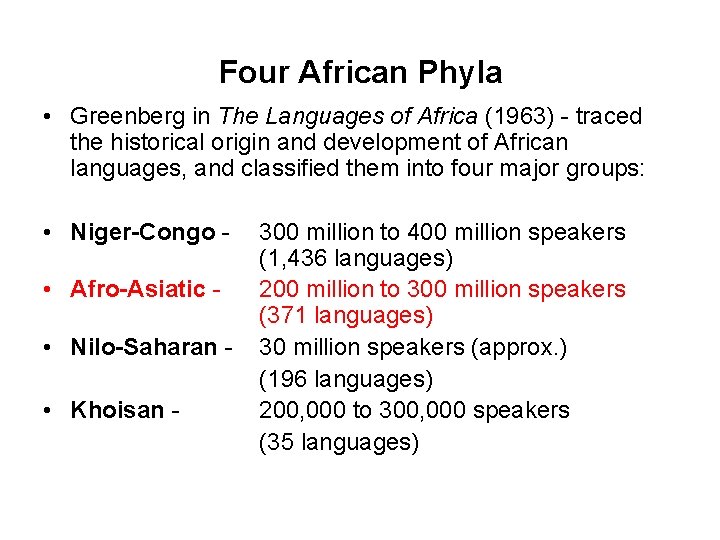
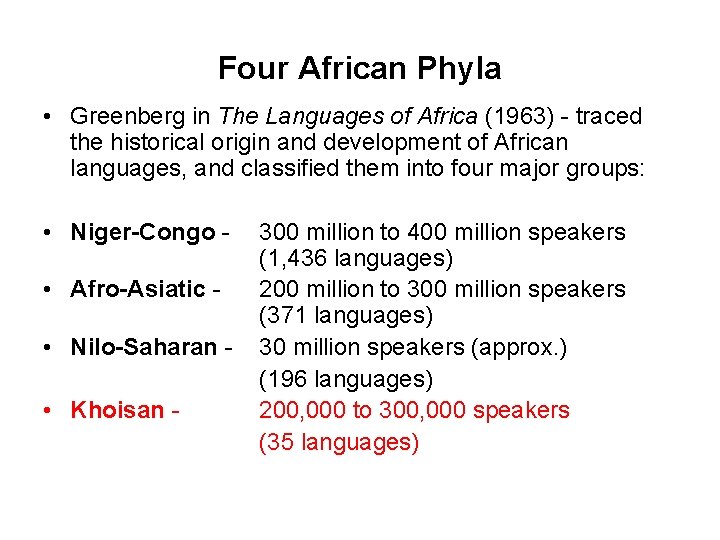
Four African Phyla • Greenberg in The Languages of Africa (1963) - traced the historical origin and development of African languages, and classified them into four major groups: • Niger-Congo • Afro-Asiatic • Nilo-Saharan • Khoisan - 300 million to 400 million speakers (1, 436 languages) 200 million to 300 million speakers (371 languages) 30 million speakers (approx. ) (196 languages) 200, 000 to 300, 000 speakers (35 languages)
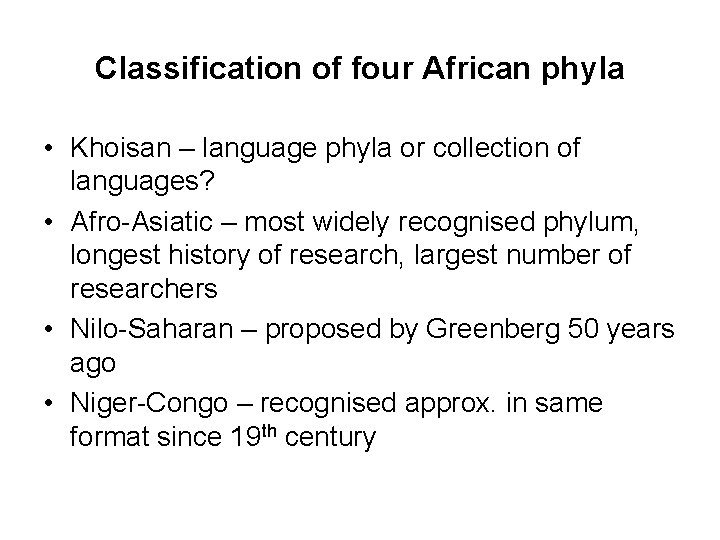
Classification of four African phyla • Khoisan – language phyla or collection of languages? • Afro-Asiatic – most widely recognised phylum, longest history of research, largest number of researchers • Nilo-Saharan – proposed by Greenberg 50 years ago • Niger-Congo – recognised approx. in same format since 19 th century
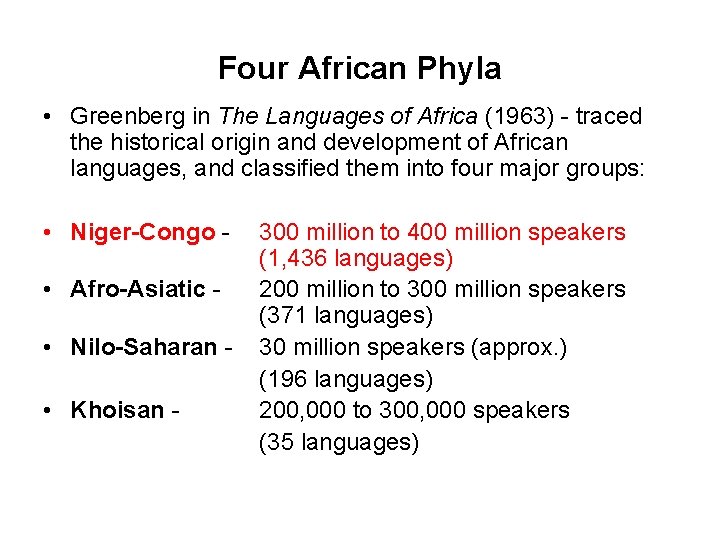
Four African Phyla • Greenberg in The Languages of Africa (1963) - traced the historical origin and development of African languages, and classified them into four major groups: • Niger-Congo • Afro-Asiatic • Nilo-Saharan • Khoisan - 300 million to 400 million speakers (1, 436 languages) 200 million to 300 million speakers (371 languages) 30 million speakers (approx. ) (196 languages) 200, 000 to 300, 000 speakers (35 languages)
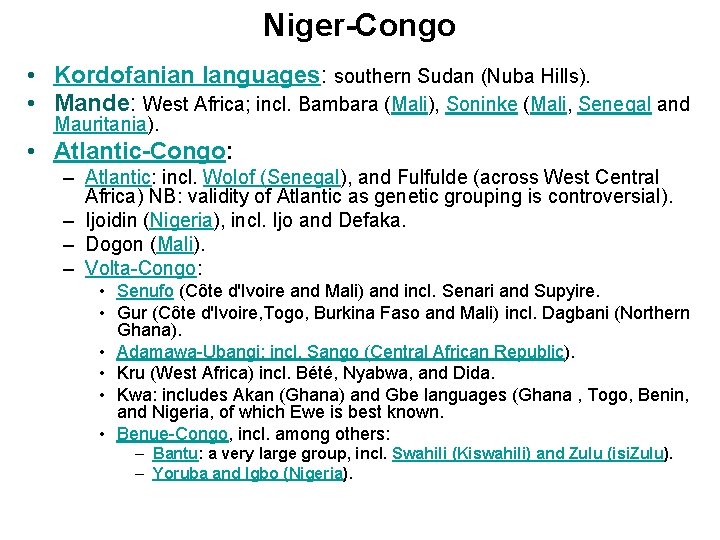
Niger-Congo • Kordofanian languages: southern Sudan (Nuba Hills). • Mande: West Africa; incl. Bambara (Mali), Soninke (Mali, Senegal and Mauritania). • Atlantic-Congo: – Atlantic: incl. Wolof (Senegal), and Fulfulde (across West Central Africa) NB: validity of Atlantic as genetic grouping is controversial). – Ijoidin (Nigeria), incl. Ijo and Defaka. – Dogon (Mali). – Volta-Congo: • Senufo (Côte d'Ivoire and Mali) and incl. Senari and Supyire. • Gur (Côte d'Ivoire, Togo, Burkina Faso and Mali) incl. Dagbani (Northern Ghana). • Adamawa-Ubangi: incl. Sango (Central African Republic). • Kru (West Africa) incl. Bété, Nyabwa, and Dida. • Kwa: includes Akan (Ghana) and Gbe languages (Ghana , Togo, Benin, and Nigeria, of which Ewe is best known. • Benue-Congo, incl. among others: – Bantu: a very large group, incl. Swahili (Kiswahili) and Zulu (isi. Zulu). – Yoruba and Igbo (Nigeria).
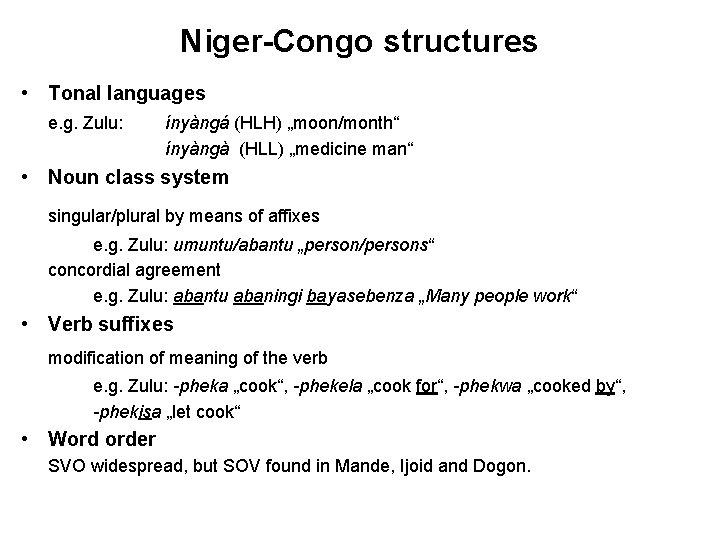
Niger-Congo structures • Tonal languages e. g. Zulu: ínyàngá (HLH) „moon/month“ ínyàngà (HLL) „medicine man“ • Noun class system singular/plural by means of affixes e. g. Zulu: umuntu/abantu „person/persons“ concordial agreement e. g. Zulu: abantu abaningi bayasebenza „Many people work“ • Verb suffixes modification of meaning of the verb e. g. Zulu: -pheka „cook“, -phekela „cook for“, -phekwa „cooked by“, -phekisa „let cook“ • Word order SVO widespread, but SOV found in Mande, Ijoid and Dogon.
Four African Phyla • Greenberg in The Languages of Africa (1963) - traced the historical origin and development of African languages, and classified them into four major groups: • Niger-Congo • Afro-Asiatic • Nilo-Saharan • Khoisan - 300 million to 400 million speakers (1, 436 languages) 200 million to 300 million speakers (371 languages) 30 million speakers (approx. ) (196 languages) 200, 000 to 300, 000 speakers (35 languages)
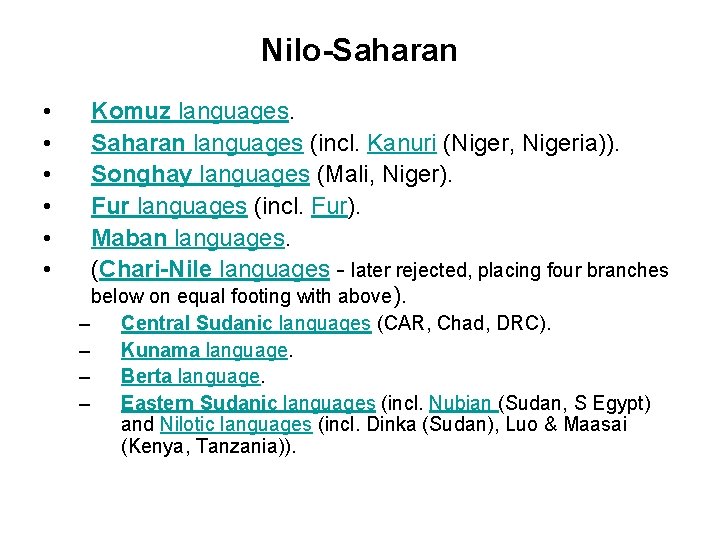
Nilo-Saharan • • • Komuz languages. Saharan languages (incl. Kanuri (Niger, Nigeria)). Songhay languages (Mali, Niger). Fur languages (incl. Fur). Maban languages. (Chari-Nile languages - later rejected, placing four branches below on equal footing with above). – – Central Sudanic languages (CAR, Chad, DRC). Kunama language. Berta language. Eastern Sudanic languages (incl. Nubian (Sudan, S Egypt) and Nilotic languages (incl. Dinka (Sudan), Luo & Maasai (Kenya, Tanzania)).
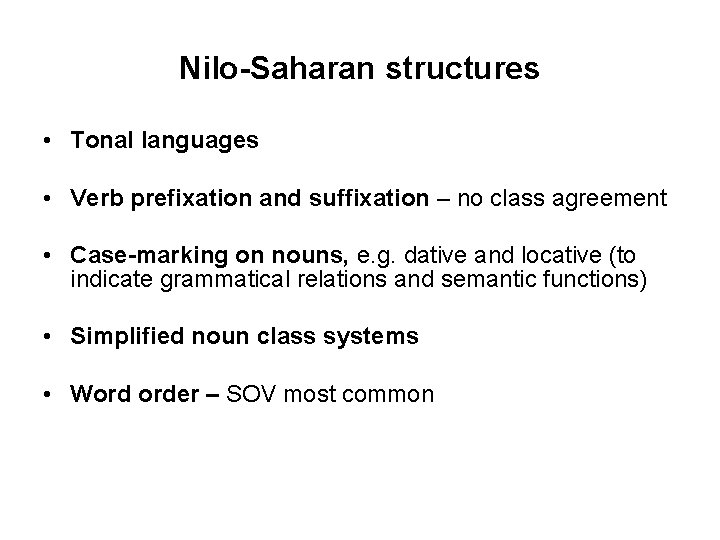
Nilo-Saharan structures • Tonal languages • Verb prefixation and suffixation – no class agreement • Case-marking on nouns, e. g. dative and locative (to indicate grammatical relations and semantic functions) • Simplified noun class systems • Word order – SOV most common
Four African Phyla • Greenberg in The Languages of Africa (1963) - traced the historical origin and development of African languages, and classified them into four major groups: • Niger-Congo • Afro-Asiatic • Nilo-Saharan • Khoisan - 300 million to 400 million speakers (1, 436 languages) 200 million to 300 million speakers (371 languages) 30 million speakers (approx. ) (196 languages) 200, 000 to 300, 000 speakers (35 languages)
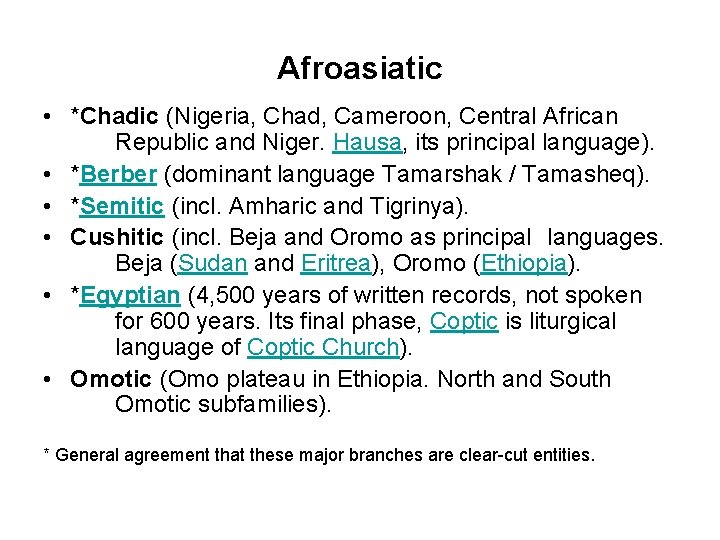
Afroasiatic • *Chadic (Nigeria, Chad, Cameroon, Central African Republic and Niger. Hausa, its principal language). • *Berber (dominant language Tamarshak / Tamasheq). • *Semitic (incl. Amharic and Tigrinya). • Cushitic (incl. Beja and Oromo as principal languages. Beja (Sudan and Eritrea), Oromo (Ethiopia). • *Egyptian (4, 500 years of written records, not spoken for 600 years. Its final phase, Coptic is liturgical language of Coptic Church). • Omotic (Omo plateau in Ethiopia. North and South Omotic subfamilies). * General agreement that these major branches are clear-cut entities.
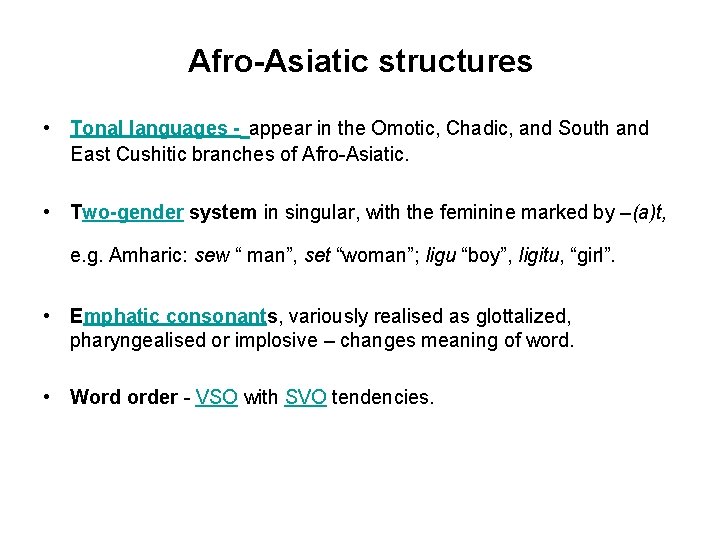
Afro-Asiatic structures • Tonal languages - appear in the Omotic, Chadic, and South and East Cushitic branches of Afro-Asiatic. • Two-gender system in singular, with the feminine marked by –(a)t, e. g. Amharic: sew “ man”, set “woman”; ligu “boy”, ligitu, “girl”. • Emphatic consonants, variously realised as glottalized, pharyngealised or implosive – changes meaning of word. • Word order - VSO with SVO tendencies.
Four African Phyla • Greenberg in The Languages of Africa (1963) - traced the historical origin and development of African languages, and classified them into four major groups: • Niger-Congo • Afro-Asiatic • Nilo-Saharan • Khoisan - 300 million to 400 million speakers (1, 436 languages) 200 million to 300 million speakers (371 languages) 30 million speakers (approx. ) (196 languages) 200, 000 to 300, 000 speakers (35 languages)
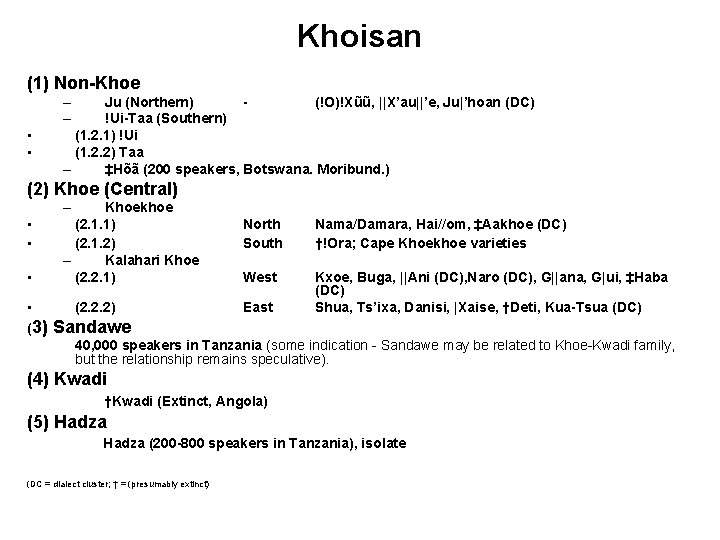
Khoisan (1) Non-Khoe – – • • Ju (Northern) (!O)!Xũũ, ||X’au||’e, Ju|’hoan (DC) !Ui-Taa (Southern) (1. 2. 1) !Ui (1. 2. 2) Taa – ‡Hõã (200 speakers, Botswana. Moribund. ) (2) Khoe (Central) – • • (3) Khoekhoe (2. 1. 1) (2. 1. 2) – Kalahari Khoe (2. 2. 1) (2. 2. 2) North South Nama/Damara, Hai//om, ‡Aakhoe (DC) †!Ora; Cape Khoekhoe varieties West Kxoe, Buga, ||Ani (DC), Naro (DC), G||ana, G|ui, ‡Haba (DC) Shua, Ts’ixa, Danisi, |Xaise, †Deti, Kua-Tsua (DC) East Sandawe 40, 000 speakers in Tanzania (some indication - Sandawe may be related to Khoe-Kwadi family, but the relationship remains speculative). (4) Kwadi †Kwadi (Extinct, Angola) (5) Hadza (200 -800 speakers in Tanzania), isolate (DC = dialect cluster; † = (presumably extinct)
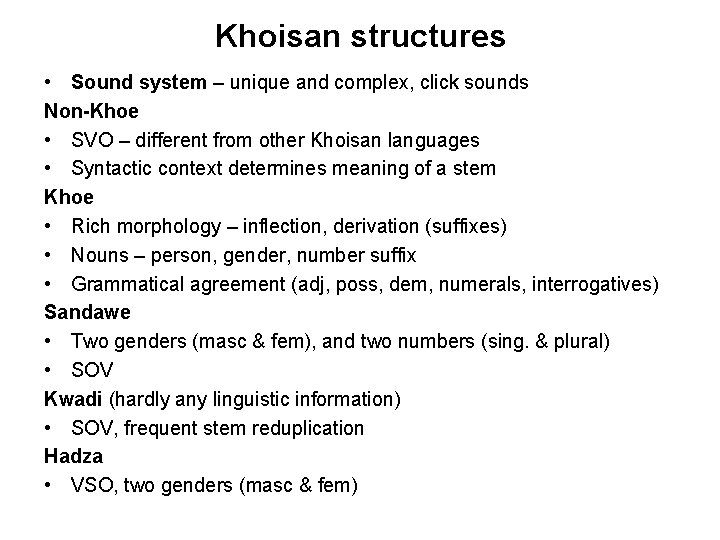
Khoisan structures • Sound system – unique and complex, click sounds Non-Khoe • SVO – different from other Khoisan languages • Syntactic context determines meaning of a stem Khoe • Rich morphology – inflection, derivation (suffixes) • Nouns – person, gender, number suffix • Grammatical agreement (adj, poss, dem, numerals, interrogatives) Sandawe • Two genders (masc & fem), and two numbers (sing. & plural) • SOV Kwadi (hardly any linguistic information) • SOV, frequent stem reduplication Hadza • VSO, two genders (masc & fem)
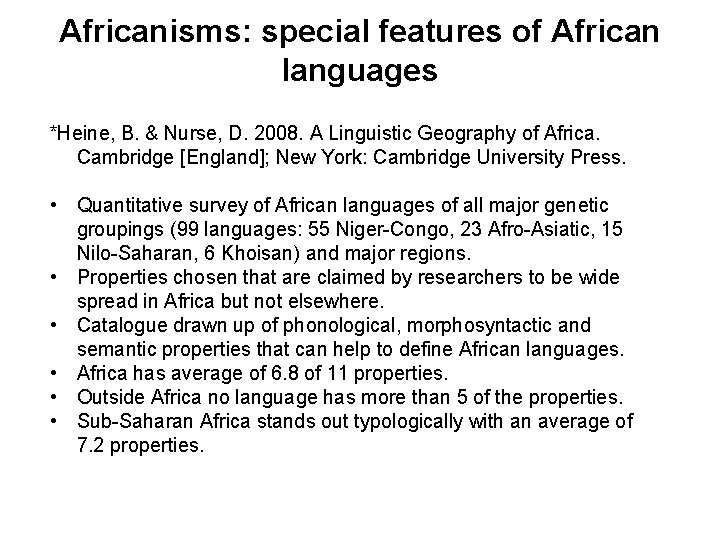
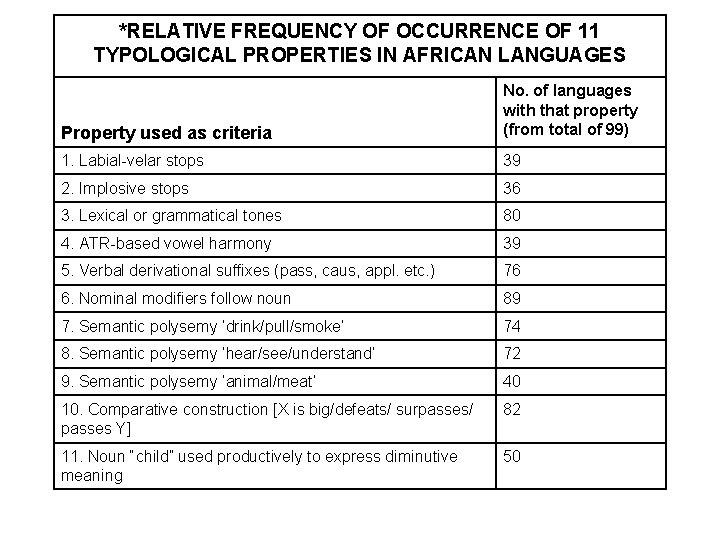
Africanisms: special features of African languages *Heine, B. & Nurse, D. 2008. A Linguistic Geography of Africa. Cambridge [England]; New York: Cambridge University Press. • Quantitative survey of African languages of all major genetic groupings (99 languages: 55 Niger-Congo, 23 Afro-Asiatic, 15 Nilo-Saharan, 6 Khoisan) and major regions. • Properties chosen that are claimed by researchers to be wide spread in Africa but not elsewhere. • Catalogue drawn up of phonological, morphosyntactic and semantic properties that can help to define African languages. • Africa has average of 6. 8 of 11 properties. • Outside Africa no language has more than 5 of the properties. • Sub-Saharan Africa stands out typologically with an average of 7. 2 properties.
*RELATIVE FREQUENCY OF OCCURRENCE OF 11 TYPOLOGICAL PROPERTIES IN AFRICAN LANGUAGES Property used as criteria No. of languages with that property (from total of 99) 1. Labial-velar stops 39 2. Implosive stops 36 3. Lexical or grammatical tones 80 4. ATR-based vowel harmony 39 5. Verbal derivational suffixes (pass, caus, appl. etc. ) 76 6. Nominal modifiers follow noun 89 7. Semantic polysemy ‘drink/pull/smoke’ 74 8. Semantic polysemy ‘hear/see/understand’ 72 9. Semantic polysemy ‘animal/meat’ 40 10. Comparative construction [X is big/defeats/ surpasses/ passes Y] 82 11. Noun “child” used productively to express diminutive meaning 50
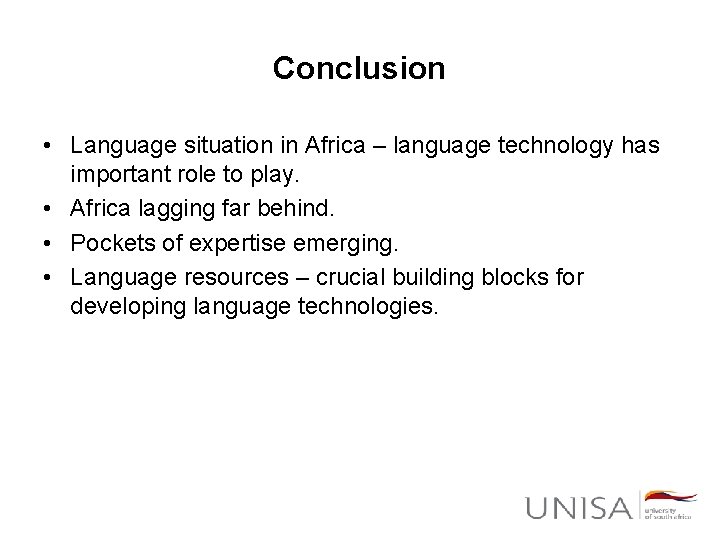
Conclusion • Language situation in Africa – language technology has important role to play. • Africa lagging far behind. • Pockets of expertise emerging. • Language resources – crucial building blocks for developing language technologies.
Recommended Reading Greenberg, J. H. The languages of Africa. Bloomington: Indiana University, 1963. Heine, B. & Nurse, D. 2000. African languages : an introduction. Cambridge [England]; New York: Cambridge University Press. Heine, B. & Nurse, D. 2008. A Linguistic Geography of Africa. Cambridge [England]; New York: Cambridge University Press.
• • • Siyabonga! Ke a leboga! Nkosi! Ndi a livhuwa! Thank you!
References • • • African language families. 2008. [O] Available: http: //encarta. msn. com/media_461520382_761565449_1_1/African_Language_Families. html. Accessed on 30 March 2009. Aikhenvald, Alexandra Y. / R. M. W. Dixon. 2001. Areal Diffusion and Genetic Inheritance: Problems in Comparative Linguistics. Oxford: Oxford University Press. Alexandre, P. 1972. An Introduction to languages and Language in Africa. London, Ibadan, Nairobi: Heinemann. Ethnologue. 2005. [O] Available: http: //www. ethnologue. com/ethno_docs/distribution. asp? by=area#1 Accessed on 30 March 2009. Gourt the home of all knowledge. Sa. [O] Available: http: //articles. gourt. com/en/language%20 family Accessed on 30 March 2009. Greenberg, J. H. . The languages of Africa. Bloomington: Indiana University, 1963. Heine, B. & Nurse, D. 2000. African languages : an introduction. Cambridge [England] ; New York : Cambridge University Press. Heine, B. & Nurse, D. 2008. A Linguistic Geography of Africa. Cambridge [England] ; New York : Cambridge University Press. Oppenheimer, S. 2003. Journey of Mankind. [O] Available: http: //www. bradshawfoundation. com/journey. Accessed on 30 March 2009.
Language endangerment in Africa • Brenzinger, M. Language death: factual and theoretical explorations with special reference to East Africa. Berlin: Mouton de Gruyter, 1992. • Brenzinger, M. Endangered languages in Africa. Köln: Köppe, 1998. • Mous, M. “Loss of linguistic diversity in Africa”. In: Janse, M. and S. Tol (eds. ). Language Death and Language Maintenance. Amsterdam: John Benjamins, 2003. • Sommer, G. “A survey on language death in Africa”. In: M. Brenzinger (ed. ). Language death: factual and theoretical explorations with special reference to East Africa. Berlin/New York: Mouton de Gruyter, 1992, 301 -407. • Wurm, S. (ed. ). Atlas of the World’s Languages in Danger of Disappearing. Paris: UNESCO Publishing, 2001.