
Africa Rainforest Desert and Savanna Sahara Desert The
- Slides: 28
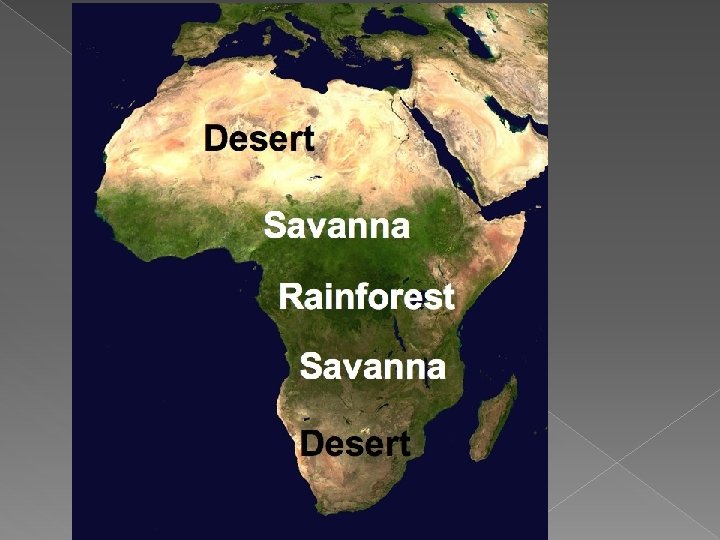
Africa Rainforest, Desert, and Savanna
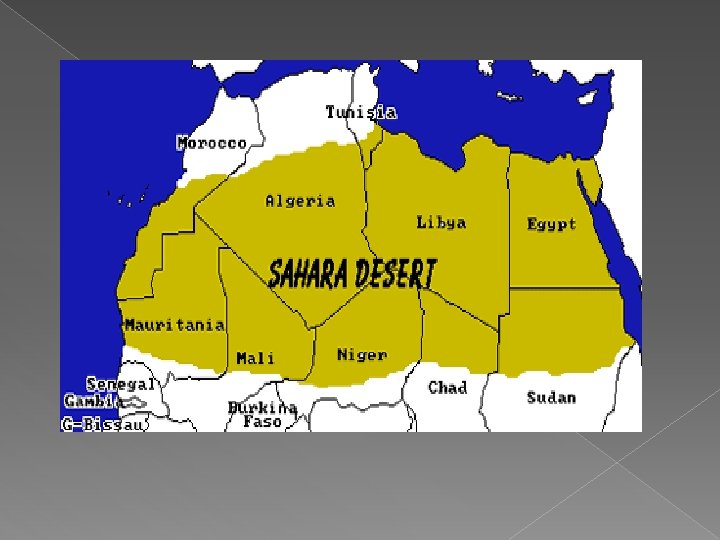
Sahara Desert The Sahara desert is the largest desert in the world stretching for 3, 600 miles. � The Sahara is covered with sand rock, towering sand dunes, vast rock formations, and ancient salt depressions with little greenery or fresh water. � 25% of the desert is covered with huge towering sand dunes, some up to 1, 000 feet high. � These sand dunes are constantly shifting, reforming, and moving across the desert, driven on by the winds that have been reshaping the face of the Sahara for thousands of years. �
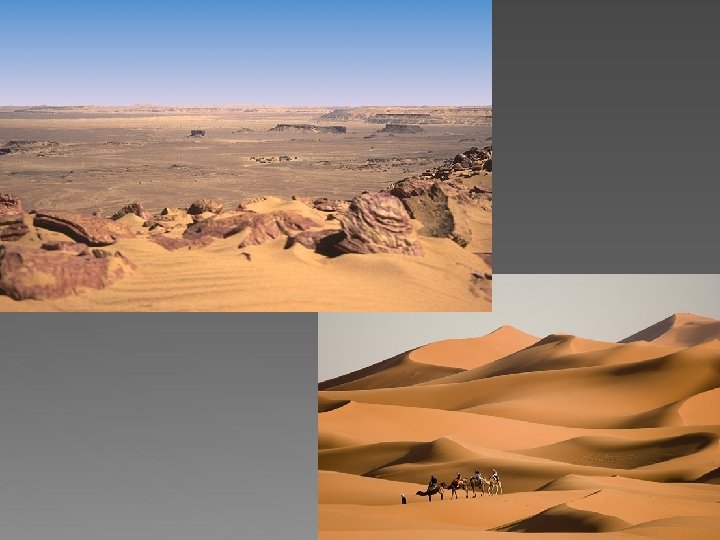
Sahara Desert � Most of the Sahara is not just sand dunes. The area has large expanses of flat land covered by gravel and dotted with rock formations. � This landscape can only be found in an environment, like the Sahara, where wind slowly erodes away rock and sand, creating some of the most unique (and really cool) geologic formations on the planet.
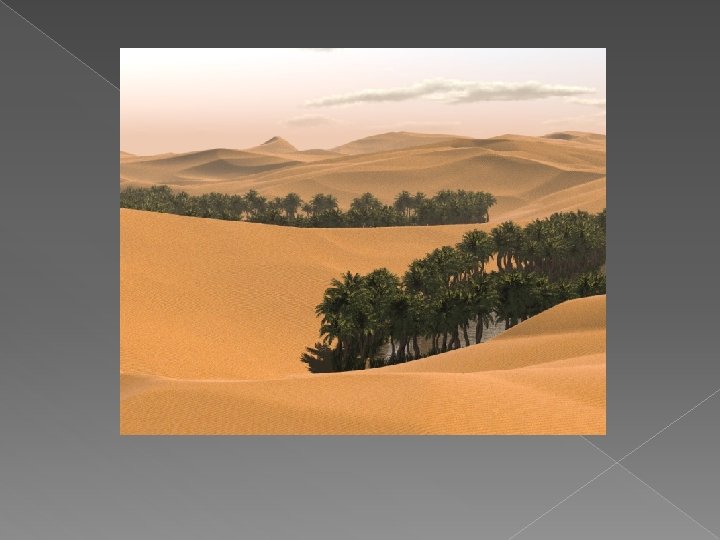
Sahara Desert The Sahara didn't always look like it does today. Millions of years ago this region was at the bottom of a vast sea. Marine fossils from mollusk shells to aquatic dinosaur bones can be found all over the desert. � For tens of thousands of years, the Sahara got much more rainfall than it does today. During this time the landscape was crossed by rivers and dotted with trees and scrub grasses. �
Life in the Sahara The people and animals that inhabit this region are tough and adaptable to harsh conditions with little fresh water and plenty of heat and sand. � The vast Sahara acts as a natural barrier to human movement that has created two distinct Africas. � Ninety-eight percent of North Africans live in cities along the Mediterranean Sea or in Egypt along the Nile River. These people speak Arabic, practice the religion of Islam, and identify themselves (and have a similar skin tone) as Arabs. �
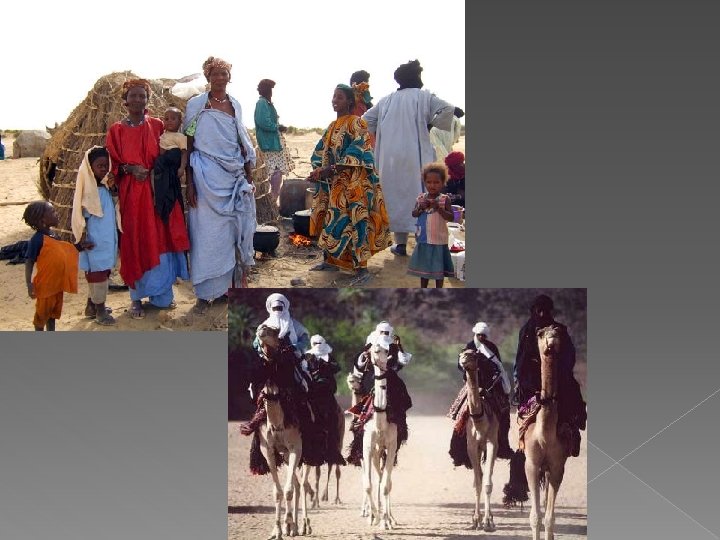
Life in the Sahara A small number of nomadic North Africans continue a lifestyle and culture that, for hundreds of years, has seen little change. � One of these Berber groups are called the Tuareg. They live as nomads, herding their goats and camels according to the season in search of water and fresh grass. � The dryness of the Sahara allows for only a small number of people to live here. Currently, about 2. 5 million people live in a land that covers 3 million square miles, about 1 person per mile- the lowest density of people anywhere on earth. �
Life in the Sahara The Tuareg nomadic lifestyle depends on a few things for survival: � � � 1. Goats and camels are the life of the tribe. Goat and camel milk tea are staples of every meal. 2. Having few easily transportable goods is necessary for a people who move at least twice a year. In areas where permanent water is not available, the Tuareg live in camel skin tents. 3. A strong bond based on family is needed to keep the tribe alive and is the most important relationship a Tuareg has. 4. When visiting a Tuareg camp, strangers are greeted with a mix of suspicion and warmth. It is a huge dishonor to refuse a stranger or for a stranger to refuse food that is offered. 5. Islam and a strong relationship with Allah are central to Tuareg life.
If it's so hot in a desert, why are they always wearing so much clothing? In the desert, the lack of trees and vegetation causes the temperatures to swing dramatically from 130°F in the summer sun to 50°F at night. The people who live in such harsh climates must cover their bodies to avoid severe sun burn and heat exhaustion. � Sudden dust storms can pop up without warning, which is why the Tuareg cover their faces. �
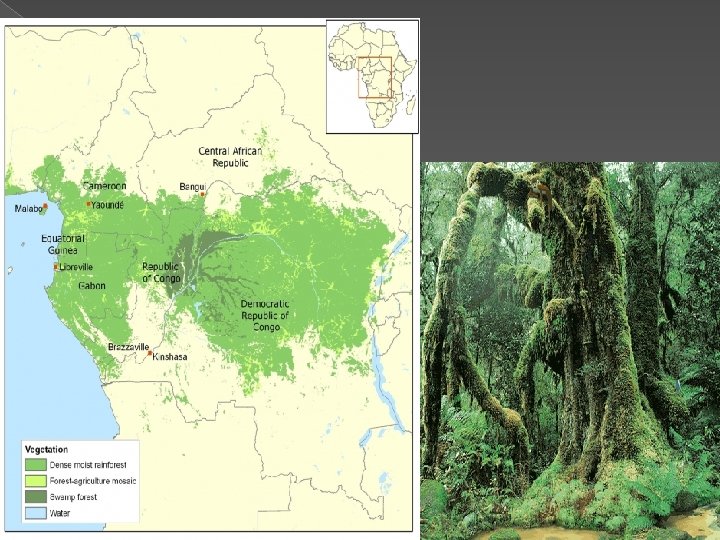
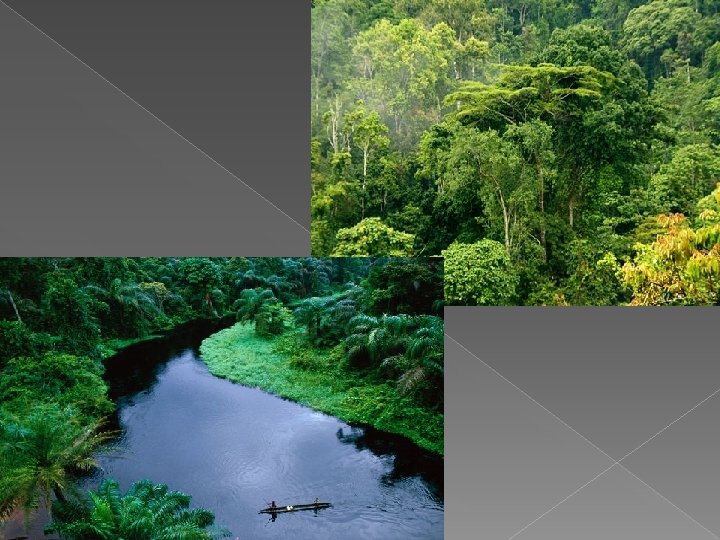
The Congolese Rainforests The Democratic Republic of the Congo lies along the equator and has a climate that is warm year round with plenty of rainfall. � The huge Congo River, the 3 rd longest river in Africa, flows through the region and is fed by hundreds of smaller rivers. � Tropical rainforests grow in abundance in the northern half of the country. These rainforests provide many natural resources that helps to support the people who live here. � The forests provide timber, like mahogany and teak. These are both rare and expensive woods that are often used in furniture making. Tropical plants also provide medicines, rubber, and tropical fruits. �
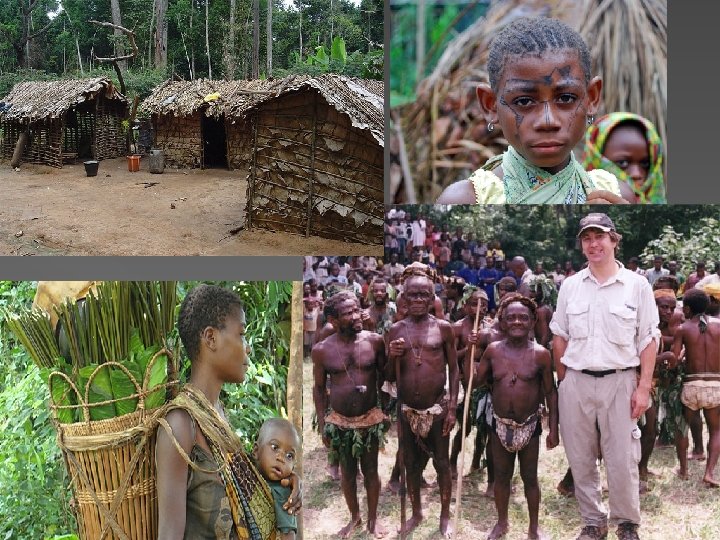
Life in the Rainforest Bambuti, also called Mbuti, are a group of Pygmies that are nomadic hunters and gatherers living in small groups of from 10 to 100 individuals. � Bambuti pygmies are the smallest people in the world, with the Bambuti men only 4. 5 feet tall. � The tropical rainforest provides their basic needs— food, fresh water from innumerable streams and springs, firewood, and clothing—which they supplement through trade with agriculturalists. � They make huts simply by forming a beehiveshaped frame of sticks covered with leaves. A group lives in a camp for up to a month and then abandons it. �
Life in the Rainforest � Bambuti technology is limited to the necessities of a hunting-and-gathering economy. They sometimes hunt small animals with bow and arrow, but usually use nets and spears to capture and kill game. � The Bambuti have no chiefs or any formal councils of elders; they settle their problems and disputes by general discussion.
Savanna The Serengeti is a vast undulating plain stretching 11, 583 sq. miles, from Kenya's Maasai-Mara game reserve south across the border to encompass Tanzania's Serengeti National Park. Other rolling grass savannas run through the Sahel region, and can also be found in Southern Africa along side the Namib desert. � Annual Savanna rainfall fluctuates between 20 to 47 inches. A short rainy season kicks off in November as the wildebeest migrate south. In March and May, longer rains come and the wildebeest return north. � The Savanna has a semi-arid climate. Temperatures are moderate all year long, with highs in the mid to upper 80 s and lows in the 60 s. �
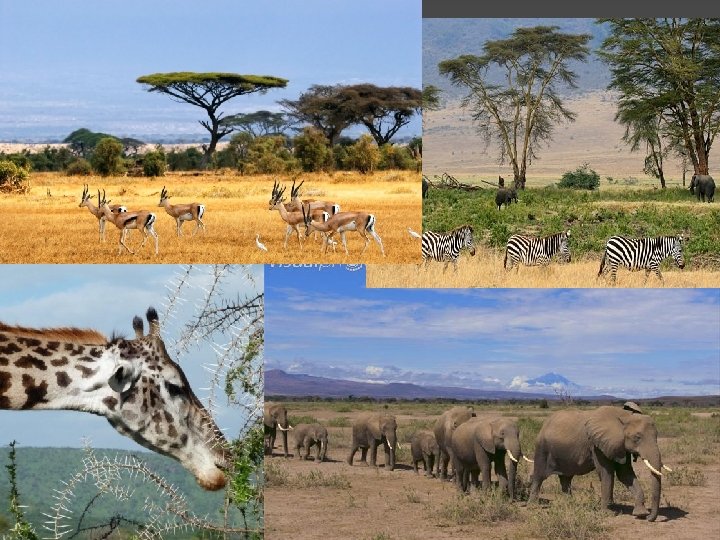
Savanna vegetation means grass. For much of the African savanna's wildlife, grass is the key to survival. � Most savannas are dominated by grasses of varying species, depending on the area's rainfall and top soil conditions. � Many savanna regions are also dotted with hardy trees like the drought-resistant acacia and the water-conserving baobab. Both have specially designed root systems that allow them to make the most of what little water the region has to offer. �
Savanna Africa's savannas stretch like seas of grass across the dry rolling plains. Once all home to migratory populations of wildebeest, elephant and wandering rhino, savanna wildlife is now limited to roaming the confines of game reserve areas. � Of the many African savannas, the Serengeti is most well known for its vast herds of wildebeest, gazelle and zebras. � African elephants are the world's largest land animals. They stand just under 9 ft. tall and tip the scales at over 13, 000 lbs. Elephants live up to 50 years, and go through six sets of teeth during their life. Most live in large, extended family units that can range from six to 70 individuals. �
Savanna African lions live on the open plains. They live in small family units that move with a larger group of up to 40 members. Females do all the hunting, and usually team up when stalking prey. These large, tawny colored felines weigh between 260 lbs. for a heavy female to 575 lbs. for a full-grown male. � Wildebeest are one of the most distinctive groups on the Serengeti. Each year, over 1 million wildebeest travel in a circular migration according to seasonal rains across the Serengeti plains. Some stand about 4 to 6 ft. high and weigh between 350 and 600 lbs. � Smaller, and less abundant than the wildebeest, the Topi , or antelope, is commonly found on the Serengeti plains' grassy savannas and stands from 3 to 4 feet tall. �
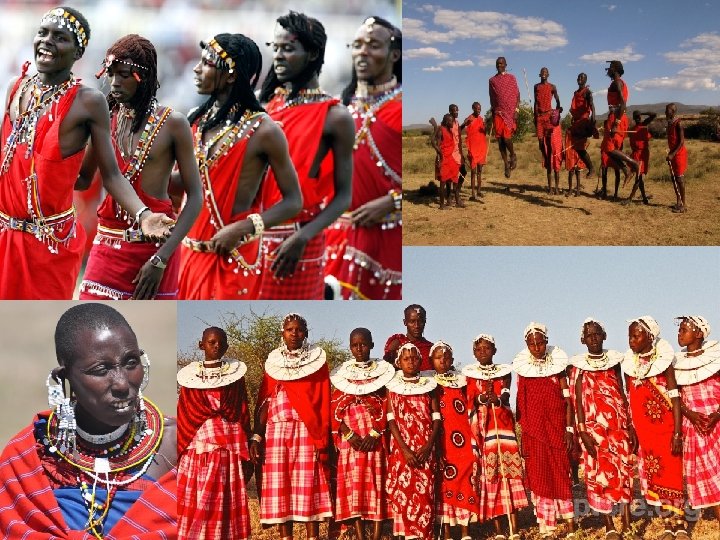
Life on the Savanna Maasai live on the savanna in East Africa. All Masai wear large hoops in their pierced ears. � Maasai are fully nomadic, wandering in groups throughout the year and existing almost entirely on the meat, blood, and milk of their herds. � Their kraal, consisting of a large circular thornbush fence around a ring houses, holds four to eight families and their herds. �
Life on the Savanna The Masai depend on their cattle for many parts of their life: � They drink cow's milk and blood as a sacred drink � They use the cows' dung to cover and seal their homes � They don't slaughter their cattle for food; but if a cow is killed, then the horns are used for containers; the hides are used to make shoes, clothing, ropes, and bed coverings; and the hooves and bones are made into ornmanets.
Life on the Savanna The basic institution of social integration, however, is the system of age-sets. � Under this system, groups of the same age are initiated into adult life during the same openinitiation period; the age-class thus formed is a permanent grouping, lasting the life of its members. � They move up through a hierarchy of grades, each lasting approximately 15 years, including those of junior warriors, senior warriors, and junior elders, until they become senior elders authorized to make decisions for the tribe. �