
Africa 2017 54 countries 16 landlocked 30 Huge



- Slides: 64
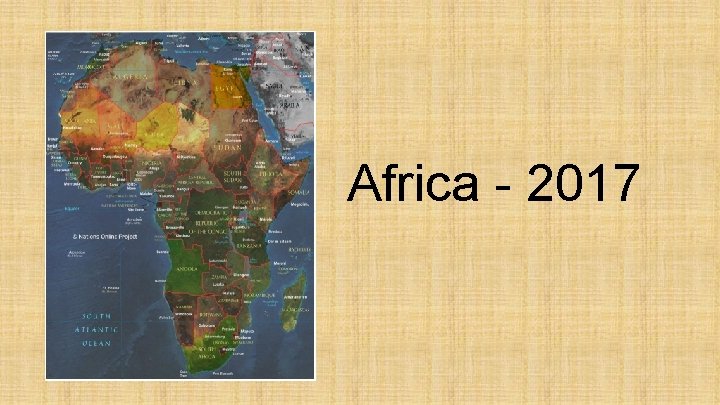
Africa - 2017
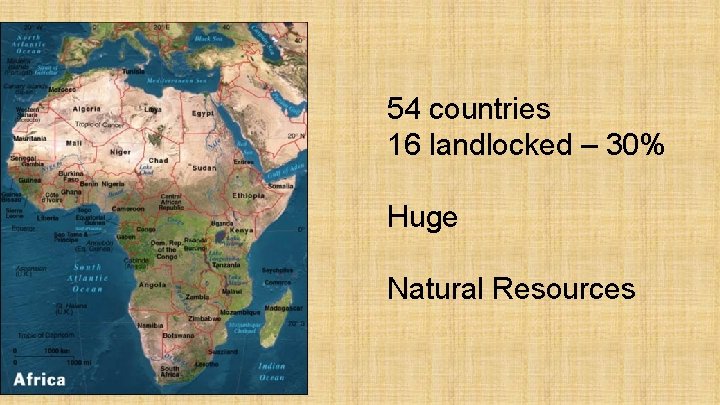
54 countries 16 landlocked – 30% Huge Natural Resources
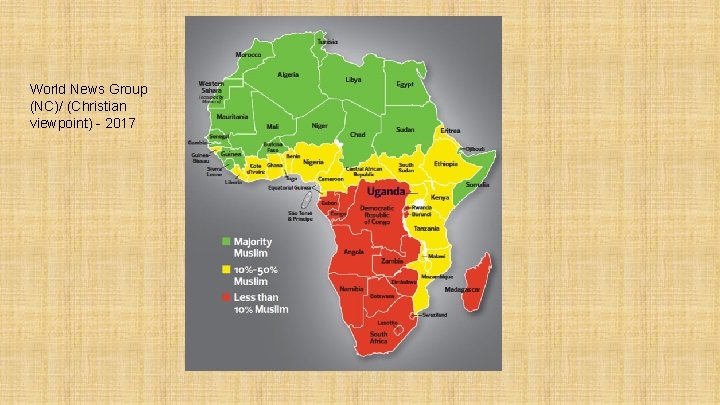
World News Group (NC)/ (Christian viewpoint) - 2017
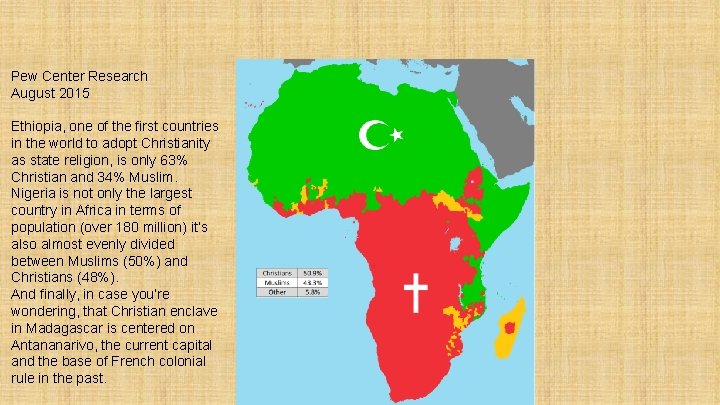
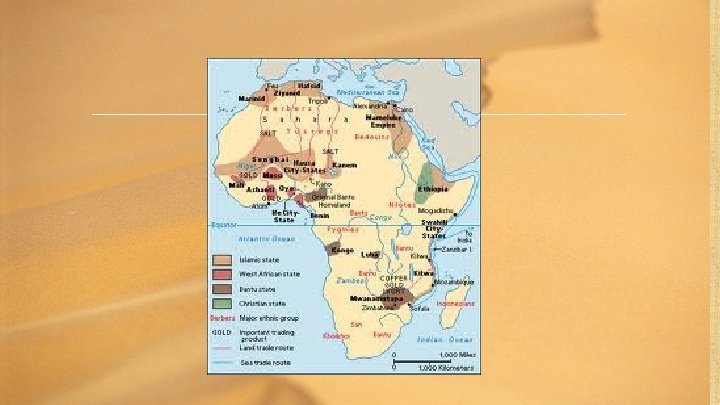
Pew Center Research August 2015 Ethiopia, one of the first countries in the world to adopt Christianity as state religion, is only 63% Christian and 34% Muslim. Nigeria is not only the largest country in Africa in terms of population (over 180 million) it’s also almost evenly divided between Muslims (50%) and Christians (48%). And finally, in case you’re wondering, that Christian enclave in Madagascar is centered on Antananarivo, the current capital and the base of French colonial rule in the past.
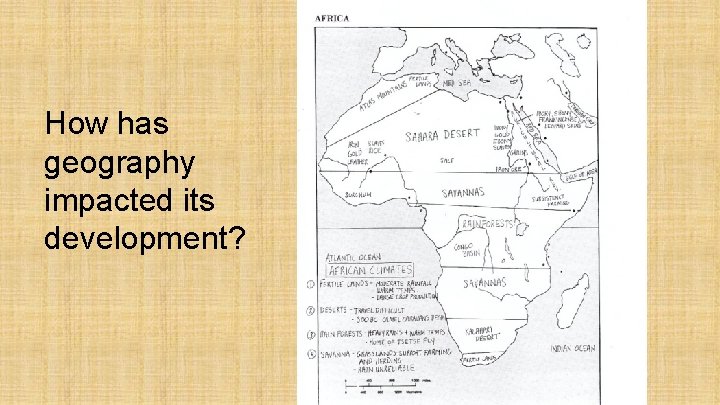
How has geography impacted its development?
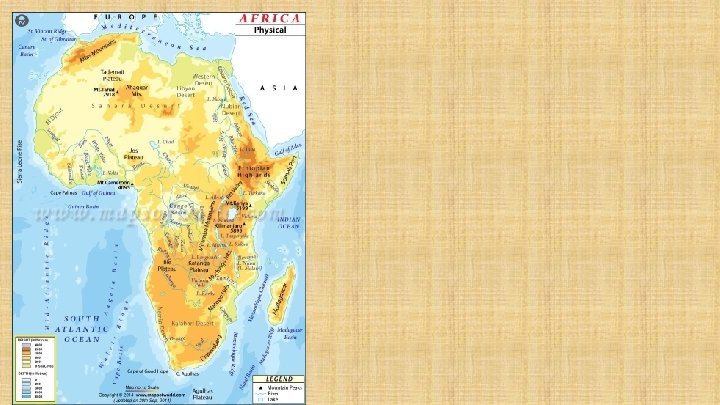
Africa’s Climate Zones: Desert Sahara ______ in the North and Kalahari in the Largest: South _________. 40% Desert covers ________% of Africa Farming Dry – travel is difficult, _________ is impossible
How did Geography affect Africa’s development? Africa’s earliest people were nomads. What are nomads? Other early Africans learned to raise a variety of animals for food. herders These were called __________, and they drove their animals to find water _________ and good pastures.
Early Societies in Africa Family __________ was very important Family unit often included grandparents, aunt, uncles, and cousins – known as Extended _________ family Families that shared common ancestors sometimes formed _________ clans
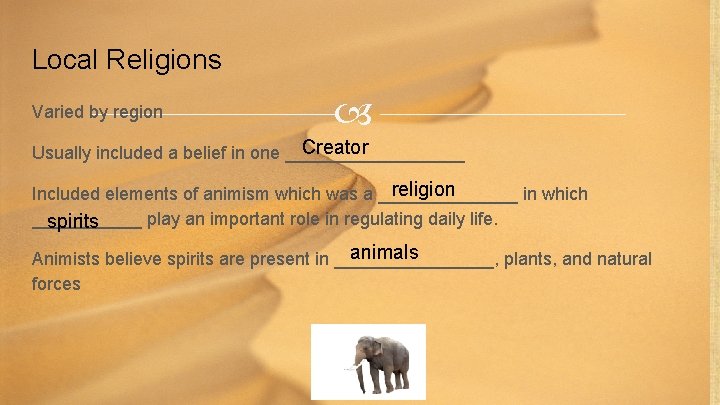
Local Religions Varied by region Creator Usually included a belief in one _________ religion Included elements of animism which was a _______ in which ______ play an important role in regulating daily life. spirits animals Animists believe spirits are present in ________, plants, and natural forces
Keeping a History languages Few African societies had written ________ griots Storytellers called _________ shared the history and literature of a culture.
Cool Down How did Africa’s geography impact its development?
Early Societies in Africa Nok, Djenne-Djeno, Bantu
Warm up: How did the beginning of agriculture (farming) change the way that Africans lived?
West African Iron Age iron People in Southern Africa were able to make _______ as early as 500 BC. Why is the ability to make iron important?
The Nok Culture Africa’s earliest known culture Nigeria Lived in what is now ______________ between 500 BC and AD 200. First West African people to make iron. hunting Made tools for farming and weapons for ____________.
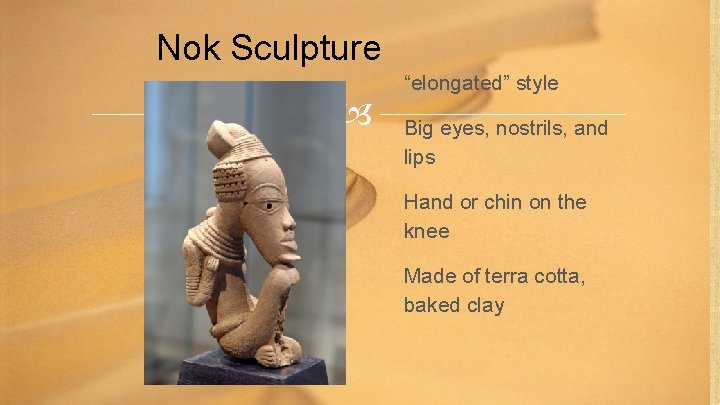
Nok Sculpture “elongated” style Big eyes, nostrils, and lips Hand or chin on the knee Made of terra cotta, baked clay
Djenne-Djeno Cities began to develop between 600 BC and 200 BC. 50, 000 Djenne-Djeno had __________residents. pottery Traded their rice, fish, and _________for copper, gold, and salt. Became a bustling trade center.
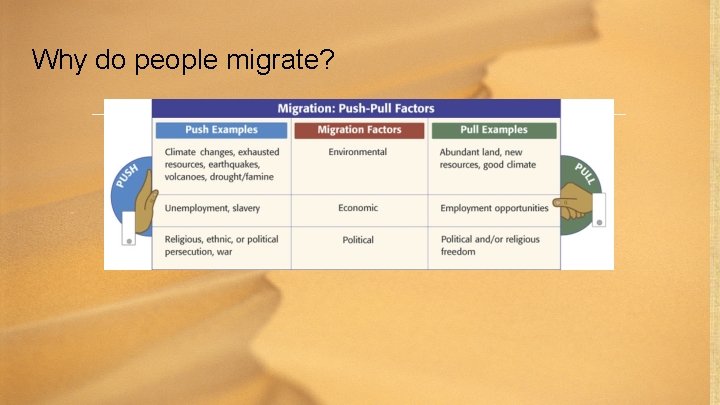
Why do people migrate?
Who were the Bantu? nomadic Farmers and ________ herders Ironworkers Farming techniques forced them to move every few years. Their farming techniques were called “slash-and-burn” agriculture. What is “slash-and-burn” agriculture? cattle As they moved into the savannahs, they began to raise _________. banana They eventually learned to cultivate new crops, like the ________.
Why did the Bantu Migrate? savanna Moved eastward into ___________ - learned to cultivate crops Agriculture --> more food --> more people Overpopulation --> need to migrate expanding Sahara was _______to the south. Bantu people had to move southward, looking for locations with iron ore and hardwood forests.
Effects of Migration The lands the Bantu migrated to were not always unpopulated --> sometimes led to war ideas Bantu peoples exchanged ________ with the people they joined, creating unique cultures and traditions. technology Passed on ____________. unifying Spread the Bantu language, which helped have a ____________ influence on the continent.
How did Cool Down: early African peoples adapt to their environment?
How does the coming of Islam impact Africa? Arabs 641 – _____conquer Egypt Growth of trade and commerce causes Islam to spread
Eastern City States and Southern Empires
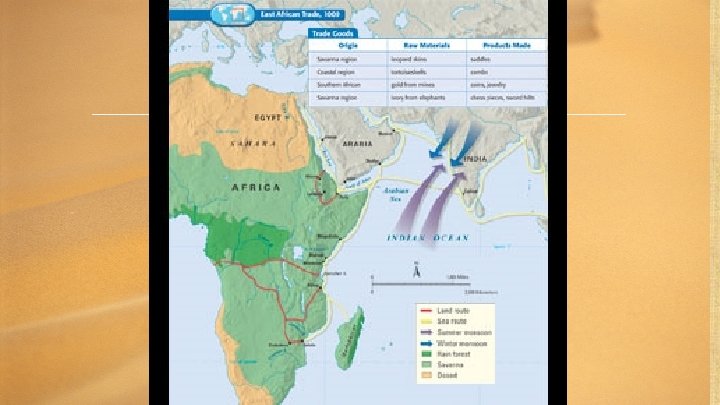
Warm up: What are monsoons and why were they important?
Setting the Stage ___________ developed an extensive trade network as early as the 3 rd century AD. Other trade cities began to flourish on the east coast as well – why might that be?
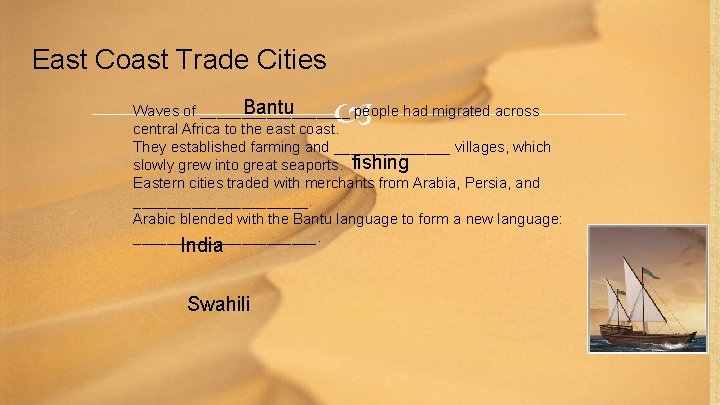
East Coast Trade Cities Bantu Waves of _________ people had migrated across central Africa to the east coast. They established farming and _______ villages, which slowly grew into great seaports. fishing Eastern cities traded with merchants from Arabia, Persia, and ___________. Arabic blended with the Bantu language to form a new language: ___________. India Swahili
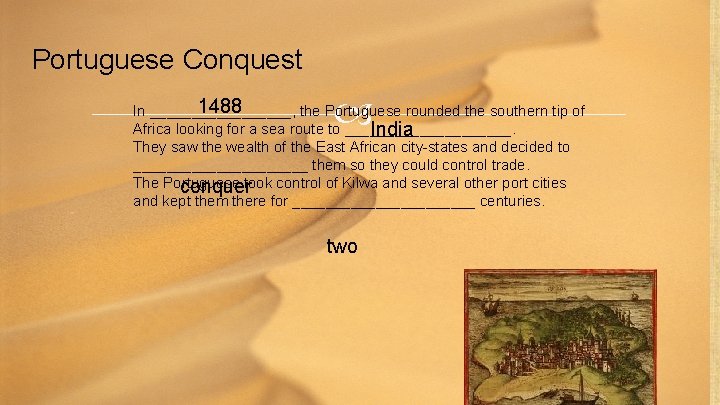
Portuguese Conquest 1488 In _________, the Portuguese rounded the southern tip of Africa looking for a sea route to __________. India They saw the wealth of the East African city-states and decided to ___________ them so they could control trade. The Portuguese conquertook control of Kilwa and several other port cities and kept them there for ___________ centuries. two
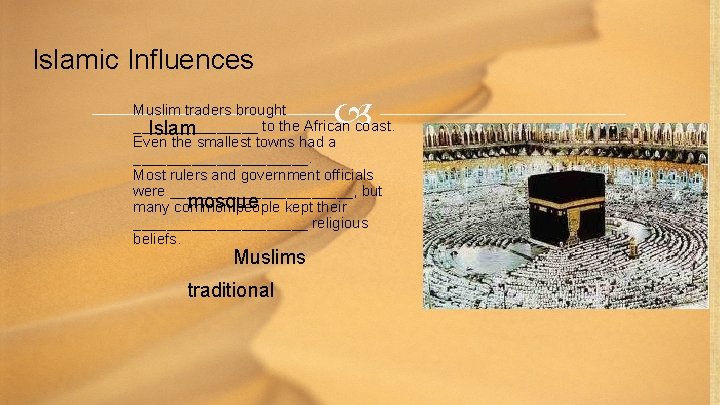
Islamic Influences Muslim traders brought ________ to the African coast. Islam Even the smallest towns had a ___________. Most rulers and government officials were ___________, but mosque many common people kept their ___________ religious beliefs. Muslims traditional
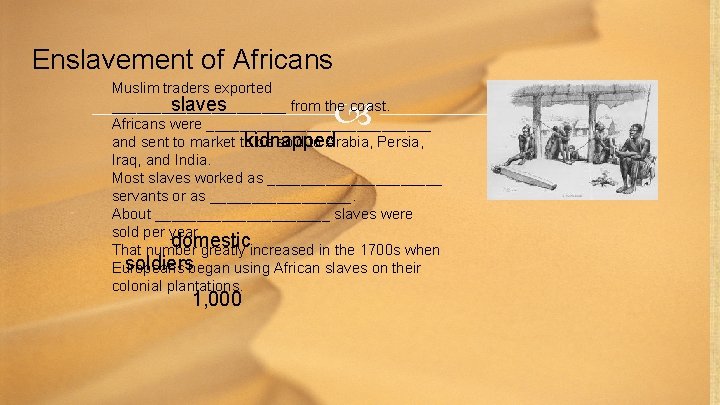
Enslavement of Africans Muslim traders exported slaves ___________ from the coast. Africans were ______________ and sent to market to be sold to Arabia, Persia, kidnapped Iraq, and India. Most slaves worked as ___________ servants or as _________. About ___________ slaves were sold per year. domestic That number greatly increased in the 1700 s when soldiersbegan using African slaves on their Europeans colonial plantations. 1, 000
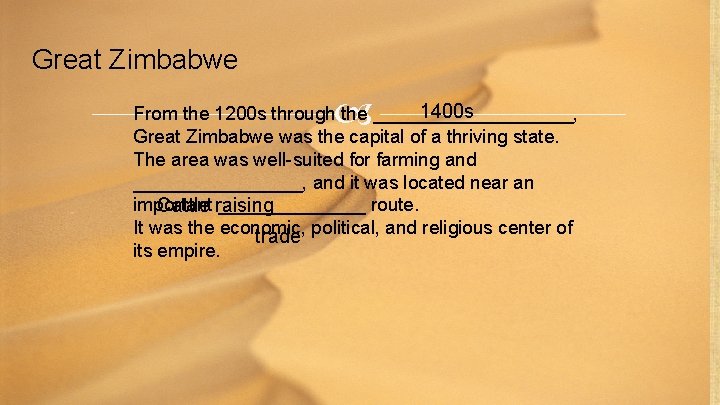
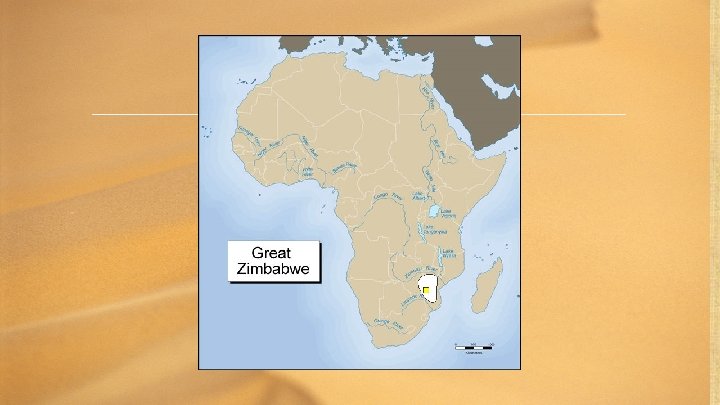
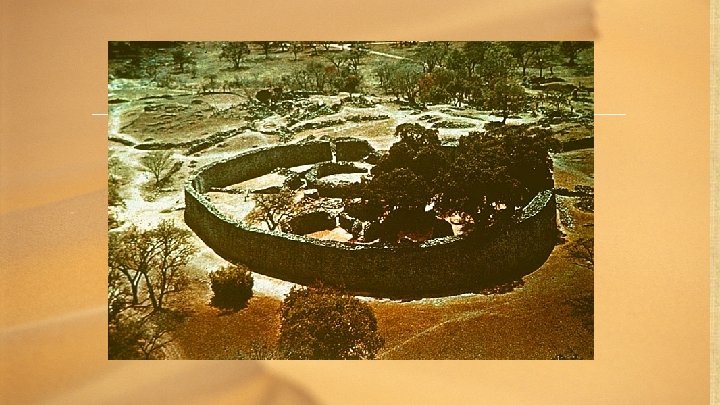
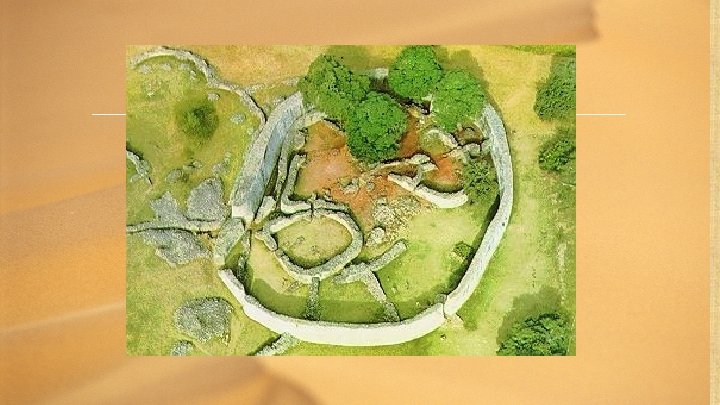
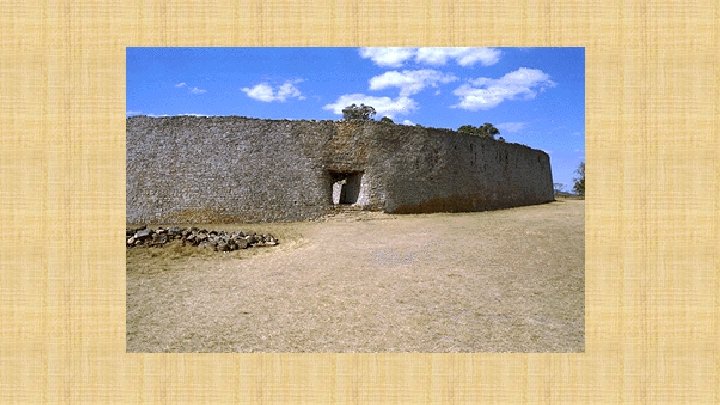
Great Zimbabwe 1400 s From the 1200 s through the __________, Great Zimbabwe was the capital of a thriving state. The area was well-suited for farming and ________, and it was located near an important _______ route. Cattle raising It was the economic, trade political, and religious center of its empire.
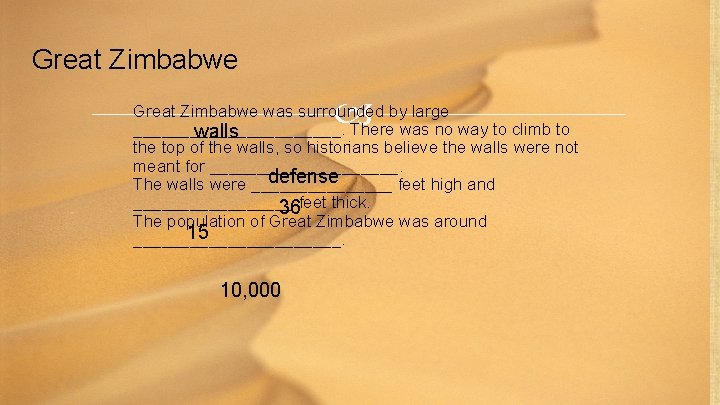
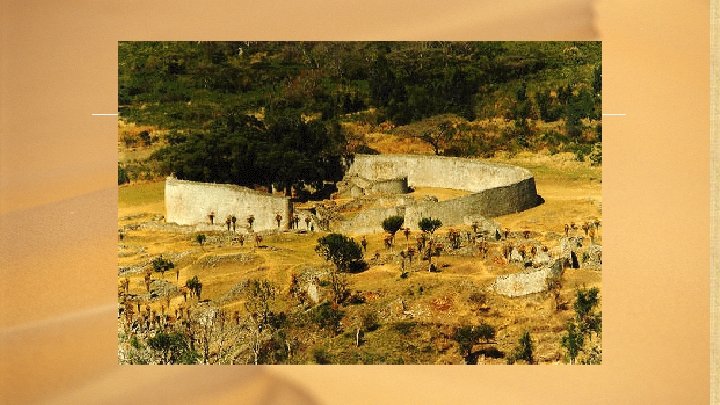
Great Zimbabwe was surrounded by large ___________. There was no way to climb to walls the top of the walls, so historians believe the walls were not meant for __________. defense The walls were ________ feet high and _________ 36 feet thick. The population of Great Zimbabwe was around 15 ___________. 10, 000
What happened to Great Zimbabwe? No one is quite sure why the settlement was abandoned. Some people think cattle had worn out the ____________. grasslands Farming might have worn out the soil, and people had used up the available salt and __________. Because its natural resources were used up, the land could no longer support a large population. timber
Ghana
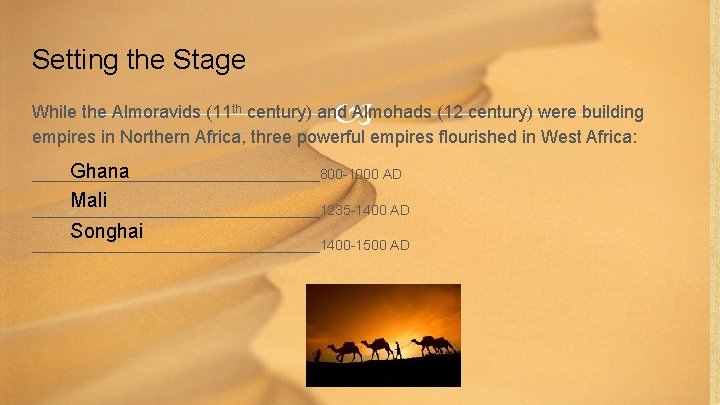
Setting the Stage While the Almoravids (11 th century) and Almohads (12 century) were building empires in Northern Africa, three powerful empires flourished in West Africa: Ghana ___________________800 -1000 AD Mali ___________________1235 -1400 AD Songhai ___________________1400 -1500 AD
The Empire of Ghana 3 rd In the ________ century AD, African nomads revolutionized trade camels across the Sahara by using ___________. Trade routes This allowed new ____________ to develop across West Africa. GHANA became an important trading power, growing rich by taxing _________ the goods traders passed through their territory.
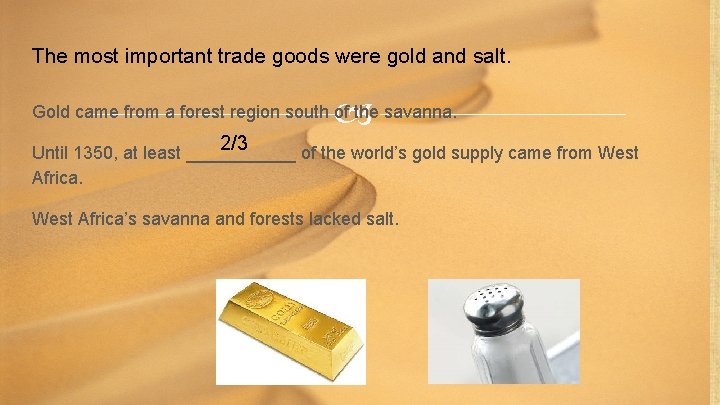
The most important trade goods were gold and salt. Gold came from a forest region south of the savanna. 2/3 Until 1350, at least ______ of the world’s gold supply came from West Africa’s savanna and forests lacked salt.
Why is salt important? preserve Helps _________ food flavor Helps _________ food Necessary part of human diet Savanna Sahara had an abundance of salt, but ____________ had none.
West African Trade Arab traders from the north crossed the desert loaded down with salt. African traders brought gold north from the forest regions. exchanged Merchants met in trading cities, where they _______goods. taxing Officials in Ghana made money by ________ trade. weighed They also made sure all traders ________ goods fairly, and provided bandits protection from ________.
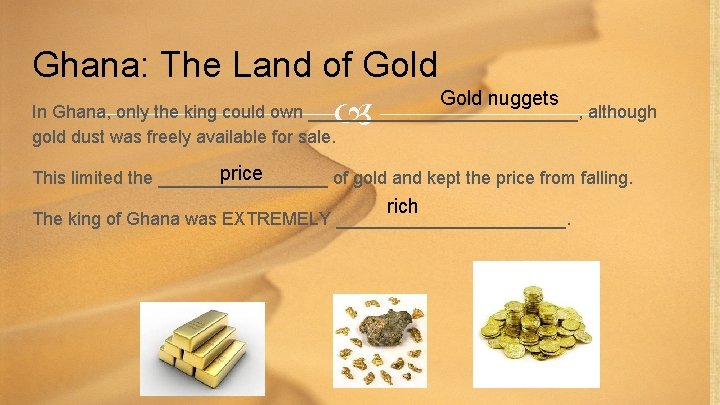
Ghana: The Land of Gold nuggets In Ghana, only the king could own ______________, although gold dust was freely available for sale. price This limited the _________ of gold and kept the price from falling. rich The king of Ghana was EXTREMELY ____________.
The Influence of Islam merchants and traders settled south of the Sahara and introduced Muslim ________ faith their _______ there. rulers Eventually, Ghana’s ________ converted to Islam. animistic However, many common people stayed with their ________ belief system. Much of the population never converted to Islam. Some who did combined their new old beliefs with _____ ones.
The Influence of Islam literacy The spread of Islam encouraged the growth of __________ in Africa, Qur’an so people could read the ___________. Almoravids In 1076, the Muslim ________ of North Africa conquered Ghana. They did not stay long in Ghana, but the war badly disrupted the gold-salt ___________ trade, and Ghana never regained its power.
Closing Questions: Why did Ghana rise to power? Why did Ghana’s power eventually decline?
Mali and Songhai
The Beginnings Ghana Founded after the collapse of _____ Sundiata First King: _________ king Mansa: _________ Became rich through control of gold and salt trade Mansa Musa Greatest emperor: ________
The Emperor’s Hajj Mecca in 1324. The emperor Mansa Musa made a hajj to _____ He had converted to Islam and based his system of justice on the _______. Qur’an His hajj took over a year and was an outrageous show of his wealth and power ______.
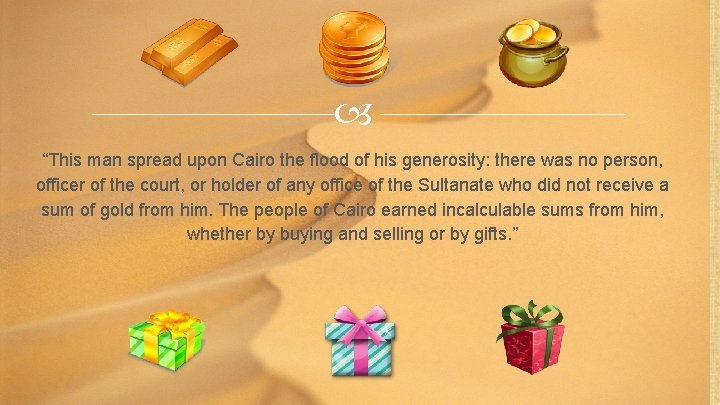
“This man spread upon Cairo the flood of his generosity: there was no person, officer of the court, or holder of any office of the Sultanate who did not receive a sum of gold from him. The people of Cairo earned incalculable sums from him, whether by buying and selling or by gifts. ”
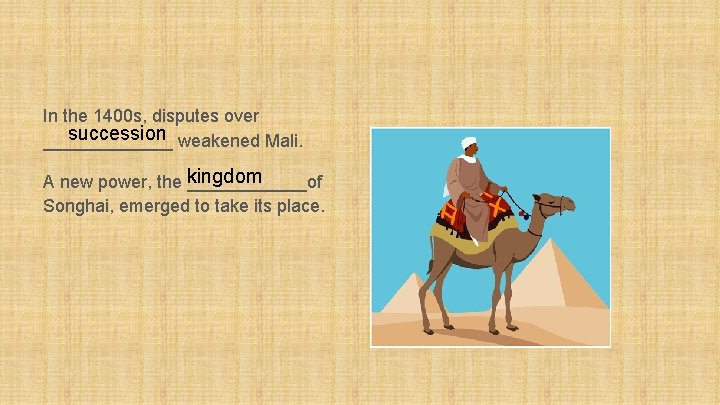
In the 1400 s, disputes over succession weakened Mali. _______ A new power, the kingdom ______of Songhai, emerged to take its place.
The Beginning Emerged in 1450 Gao Capital city: _________ largest The soldier-king Sunni Ali created the ______ state that had ever existed in West African He did not practice Islam, but instead followed traditional ______ religious beliefs.
A Muslim Dynasty Soon after _________’s death, Askia Mohammed created a Muslim Sunni Ali dynasty. territory and improved the government. He expanded Songhai’s _______ He separated the government into different departments, each with officials to supervise them. This type of government is called a __________. bureaucracy
Mansa Musa Askia Mohammed made a Like _______, pilgrimage to Mecca. poets Scholars and _______ from Muslim lands flocked to Gao. mosques and schools for the study of the He built _______ Qur’an _______.
By the 1400 s, Timbuktu had become a great center of learning _______. “Here are great store of doctors, judges…and other learned men, that are bountifully maintained at the king’s cost and charges. And hither are brought various manuscripts of books from North Africa, which are sold for more money than any other merchandise. ”
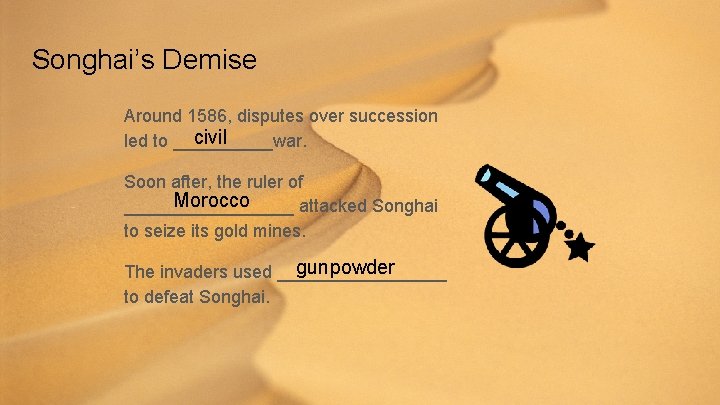
Songhai’s Demise Around 1586, disputes over succession civil led to _____war. Soon after, the ruler of Morocco _________ attacked Songhai to seize its gold mines. gunpowder The invaders used _________ to defeat Songhai.