
AFFINITY CHROMATOGRAPHY AND IMMUNOADSORPTION Introduction Specificity Ligand Immunological

- Slides: 8
AFFINITY CHROMATOGRAPHY AND IMMUNOADSORPTION
Introduction • Specificity • Ligand • Immunological action, control of a metabolic process, hormone action, catalytic breakdown of a substrate, or membrane transport • Nucleic acids, enzymes, transport proteins, antibodies, hormonereceptor proteins, drug-binding proteins, neurotransmitter proteins, and many others.
Chromatographic Media (1) they are physically and chemically stable under most experimental conditions, (2) they are relatively free of nonspecific adsorption effects, (3) they have satisfactory flow characteristics, (4) they are available with very large pore sizes, and (5) they have reactive functional groups to which an appropriate ligand may be attached
The Immobilized Ligand • Ligand must display a strong, specific, but reversible interaction with the desired macromolecule and it must have a reactive functional group for attachment to the matrix
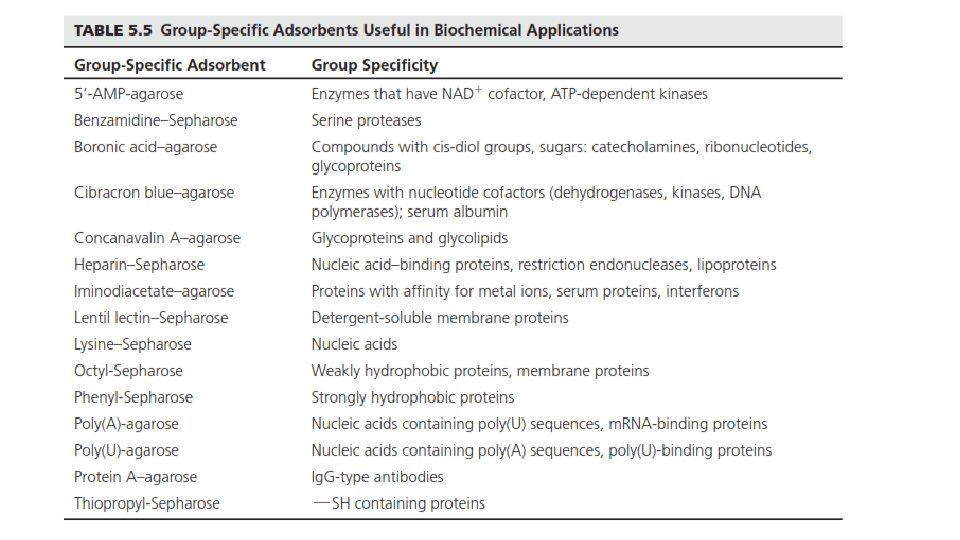
Attachment of Ligand to Matrix (1) activation of the functional groups on the matrix, and (2) joining of the ligand to the functional group on the matrix. • Cyanogen Bromide-Activated Agarose • 6 -Aminohexanoic Acid (CH)-Agarose and 1, 6 -Diaminehexane (AH)Agarose • Carbonyldiimidazole (CDI)-Activated Supports • Epoxy-Activated Agarose • Group-Specific Adsorbents
Immunoadsorption • Purification of antigens
Experimental Procedure for Affinity Chromatography • Similar procedure • Buffer p. H or Ionic Strength • Affinity Elution • Chaotropic Agents