
Affine StructurefromMotion A lot of frames 1 I
- Slides: 12
Affine Structure-from-Motion: A lot of frames (1) I S P
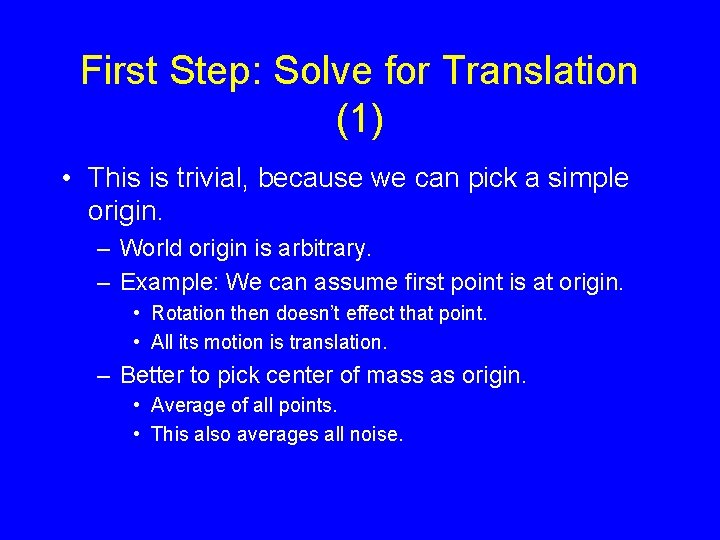
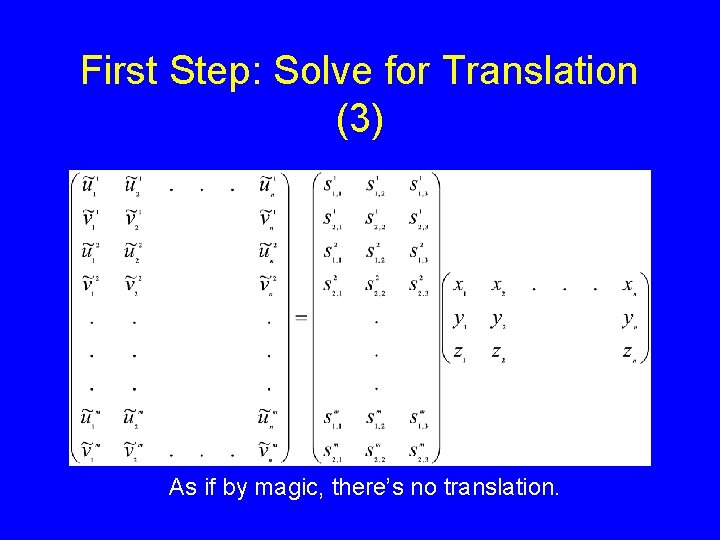
First Step: Solve for Translation (1) • This is trivial, because we can pick a simple origin. – World origin is arbitrary. – Example: We can assume first point is at origin. • Rotation then doesn’t effect that point. • All its motion is translation. – Better to pick center of mass as origin. • Average of all points. • This also averages all noise.
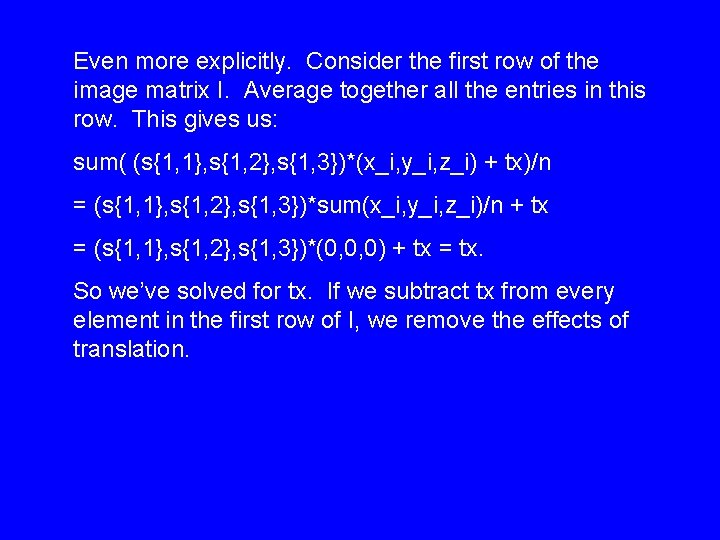
Even more explicitly. Consider the first row of the image matrix I. Average together all the entries in this row. This gives us: sum( (s{1, 1}, s{1, 2}, s{1, 3})*(x_i, y_i, z_i) + tx)/n = (s{1, 1}, s{1, 2}, s{1, 3})*sum(x_i, y_i, z_i)/n + tx = (s{1, 1}, s{1, 2}, s{1, 3})*(0, 0, 0) + tx = tx. So we’ve solved for tx. If we subtract tx from every element in the first row of I, we remove the effects of translation.
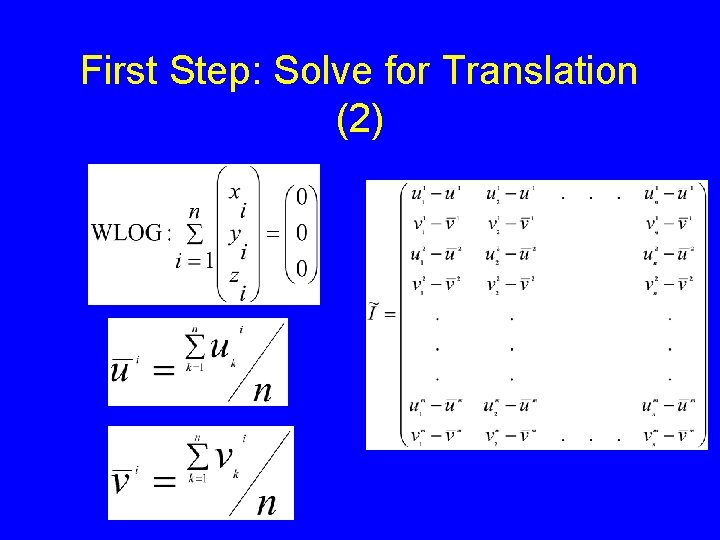
First Step: Solve for Translation (2)
First Step: Solve for Translation (3) As if by magic, there’s no translation.
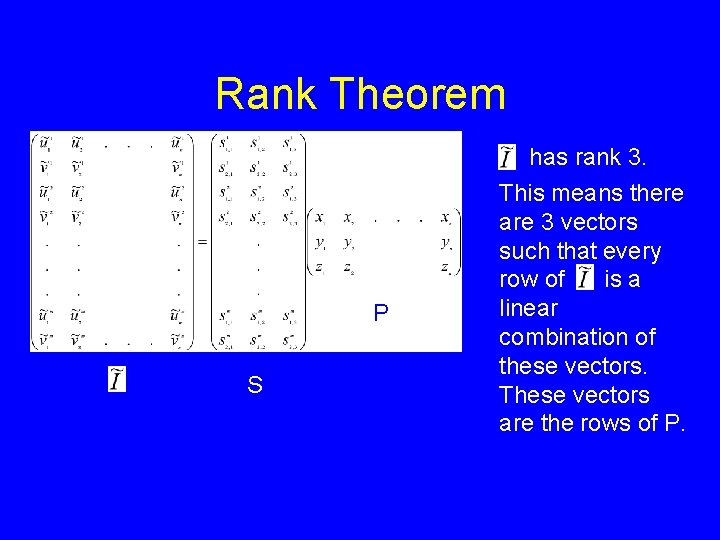
Rank Theorem P S has rank 3. This means there are 3 vectors such that every row of is a linear combination of these vectors. These vectors are the rows of P.
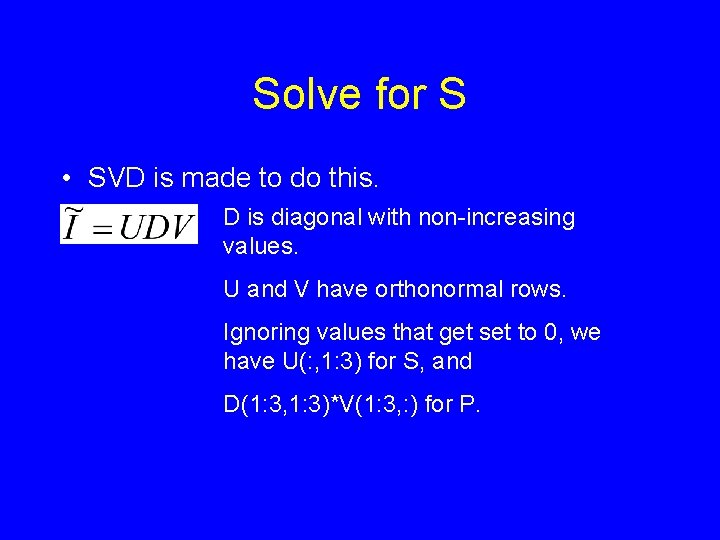
Solve for S • SVD is made to do this. D is diagonal with non-increasing values. U and V have orthonormal rows. Ignoring values that get set to 0, we have U(: , 1: 3) for S, and D(1: 3, 1: 3)*V(1: 3, : ) for P.
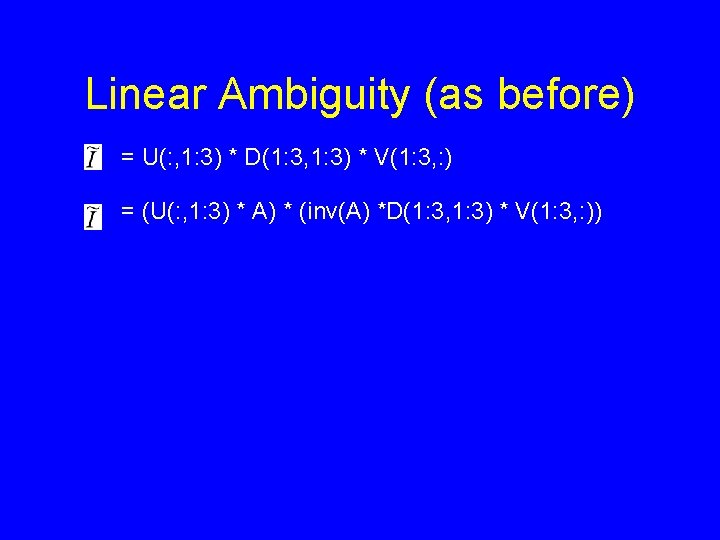
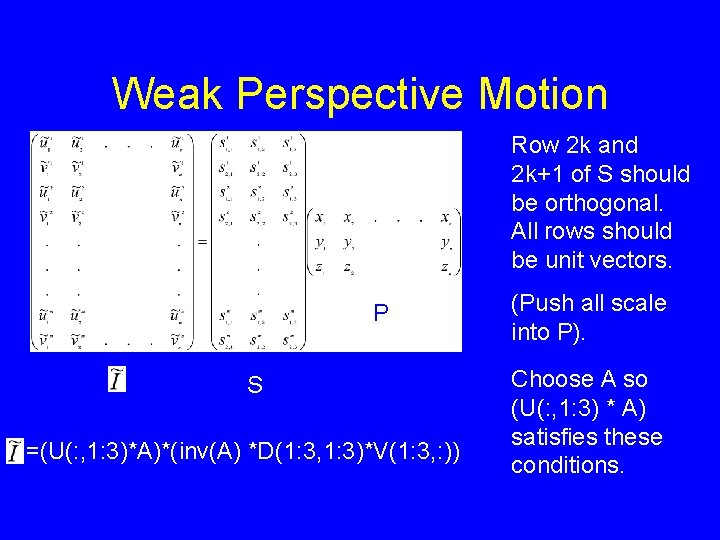
Linear Ambiguity (as before) = U(: , 1: 3) * D(1: 3, 1: 3) * V(1: 3, : ) = (U(: , 1: 3) * A) * (inv(A) *D(1: 3, 1: 3) * V(1: 3, : ))
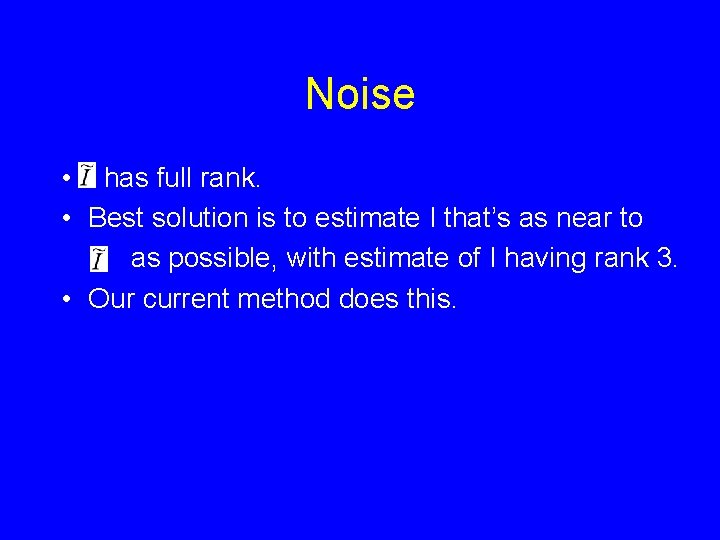
Noise • has full rank. • Best solution is to estimate I that’s as near to as possible, with estimate of I having rank 3. • Our current method does this.
Weak Perspective Motion Row 2 k and 2 k+1 of S should be orthogonal. All rows should be unit vectors. P S =(U(: , 1: 3)*A)*(inv(A) *D(1: 3, 1: 3)*V(1: 3, : )) (Push all scale into P). Choose A so (U(: , 1: 3) * A) satisfies these conditions.
Related problems we won’t cover • Missing data. • Points with different, known noise. • Multiple moving objects.
Final Messages • Structure-from-motion for points can be reduced to linear algebra. • Epipolar constraint reemerges. • SVD important. • Rank Theorem says the images a scene produces aren’t complicated (also important for recognition).