
Affective Factores in FLL Affective Factors in FLL
- Slides: 6
Affective Factores in FLL
Affective Factors in FLL l l Learning a language means adding a new layer to your own personality Your whole being is involved and affected. Feelings play an important role in learning, particularly in learning a new language. It is not the same to learn in l l a L 2 context or a FL context.
Affective factors in FLL l l Anxiety Self-esteem Self-efficacy and attribution Motivation
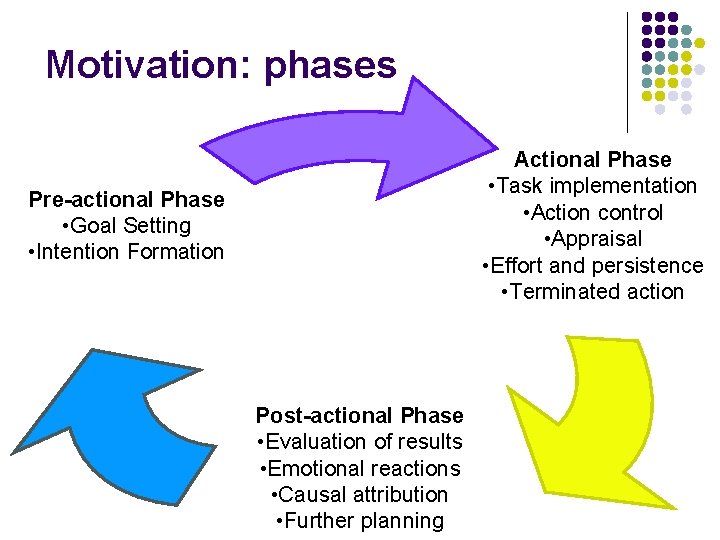
Motivation: a dynamic model l Motivation is an internal state of the individual influenced by needs and/or beliefs which generate an interest and desire to achieve a goal, and moves the individual to attain it with a continued effort.
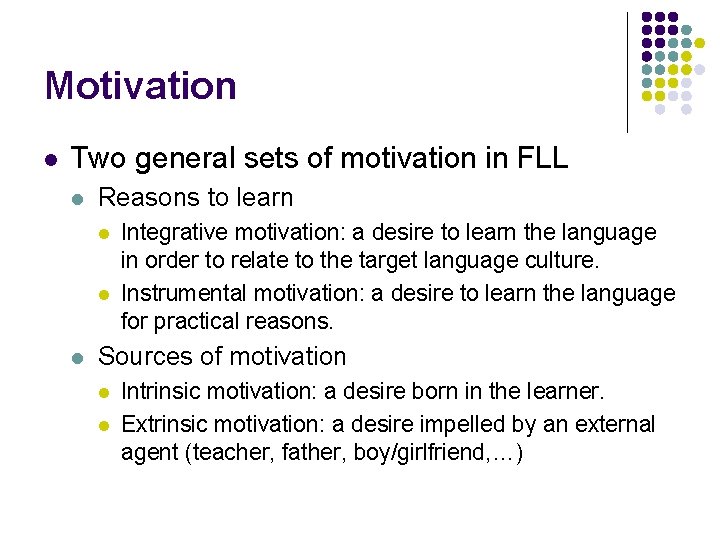
Motivation l Two general sets of motivation in FLL l Reasons to learn l l l Integrative motivation: a desire to learn the language in order to relate to the target language culture. Instrumental motivation: a desire to learn the language for practical reasons. Sources of motivation l l Intrinsic motivation: a desire born in the learner. Extrinsic motivation: a desire impelled by an external agent (teacher, father, boy/girlfriend, …)
Motivation: phases Actional Phase • Task implementation • Action control • Appraisal • Effort and persistence • Terminated action Pre-actional Phase • Goal Setting • Intention Formation Post-actional Phase • Evaluation of results • Emotional reactions • Causal attribution • Further planning