
AFCEA Europe June 2010 Interoperability Revisited NATO Industrial
AFCEA Europe – June 2010 “Interoperability Revisited” “NATO Industrial Advisory Group (NIAG) and its Role in Interoperability” Frans Picavet The NIAG - “Supporting Alliance Capability Development and Enhancing Interoperability” 1
What is the NIAG ? • A high-level consultative and advisory body of senior industrialists of NATO member countries, acting under the NATO Conference of National Armaments Directors, with the aims of: – providing a forum for the exchange of views on industrial, technical, economic, management and other relevant aspects of research, development and production of armaments equipments within the Alliance; – providing industry’s advice on how to foster government-toindustry and industry-to-industry armaments co-operation within the Alliance; – providing assistance in exploring opportunities for international collaboration. 2
What NIAG offers “High level consultancy advice” – Trans-Atlantic Defence Industrial Cooperation – The contribution of Industry to Capability Development in NATO – Government-Industry Partnerships – Industrial support beyond traditional boundaries – The Industrial Contribution to Achieving Interoperability Technology advice – Pre-feasibility studies of TECHNOLOGIES – Technology Solutions for INTEROPERABILITY – Questions addressed by studies: – – What do future technologies offer ? What is the current state-of-the art ? What is practical, achievable, cost effective ? How can we make systems interoperable ? 3
NIAG Technical Studies Contributions to NATO Interoperability C 3 and ISR • Software Defined Radio – achieving interoperability. • Data Links – Alternative Tactical Data Links. – UAV Data links for high intensity operations. • ISR – NATO ISR Interoperability architecture. – Use of digital video broadcast for ISR data links. • Networks – NEC infrastructures for dissemination of ISR data to field commanders. – New technologies for network based still imagery access and exchange services. 4

NIAG Technical Studies Contributions to NATO Interoperability Land Systems • Soldier Systems - communications interoperability • Urban warfare: – Surveillance & Reconnaissance Data Fusion - Monitoring and Tracking for Situation Awareness in Urban Areas • Ground Based Air Defence Systems - integration and interoperability • Artillery: – Reducing collatoral damage from artillery projectiles – Replacing cluster ammunition for area offence • Military Vehicles - auxiliary power systems requirements 5
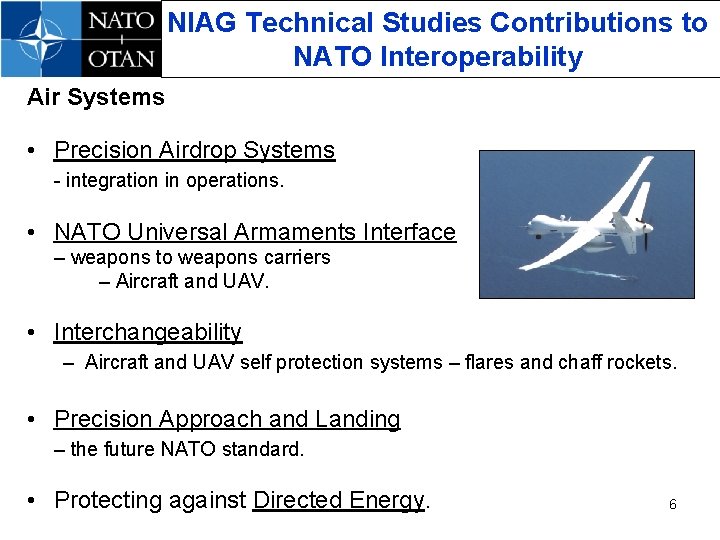
NIAG Technical Studies Contributions to NATO Interoperability Air Systems • Precision Airdrop Systems - integration in operations. • NATO Universal Armaments Interface – weapons to weapons carriers – Aircraft and UAV. • Interchangeability – Aircraft and UAV self protection systems – flares and chaff rockets. • Precision Approach and Landing – the future NATO standard. • Protecting against Directed Energy. 6
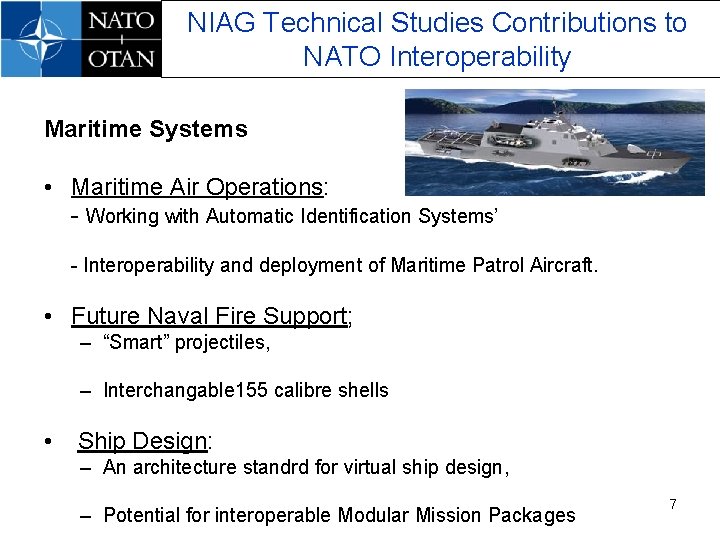
NIAG Technical Studies Contributions to NATO Interoperability Maritime Systems • Maritime Air Operations: - Working with Automatic Identification Systems’ - Interoperability and deployment of Maritime Patrol Aircraft. • Future Naval Fire Support; – “Smart” projectiles, – Interchangable 155 calibre shells • Ship Design: – An architecture standrd for virtual ship design, – Potential for interoperable Modular Mission Packages 7
The NIAG Perspective • Interoperability in the NATO context stretches over a broad canvass. • Achieving interoperability requires many contributors, including defence industries. • Basic principles: – Generate interface solutions for integration of systems nations’ currently own This also allows Industry to offer short term solutions without excessive constraints – Think commercial and open standards/ architectures where possible 8
The Industrial Challenge • Choosing the Business Model. – For Industry, proprietary solutions, at first sight, offer more contract control …and money. But – – Business comes from meeting the customer needs, and – Less costly solutions based on commercial and/or open standards which offer interoperability can have competitive advantage. 9
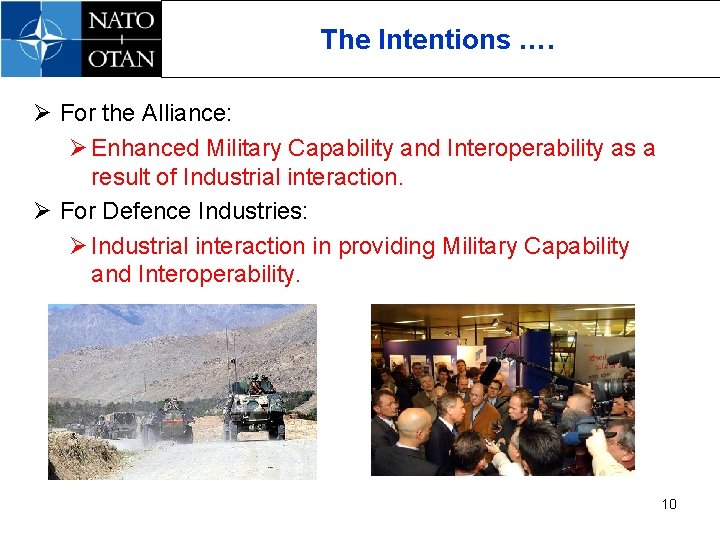
The Intentions …. Ø For the Alliance: Ø Enhanced Military Capability and Interoperability as a result of Industrial interaction. Ø For Defence Industries: Ø Industrial interaction in providing Military Capability and Interoperability. 10
- Slides: 10