
AF Project Cycle and Approval Process Manila the


- Slides: 35
AF Project Cycle and Approval Process Manila, the Philippines 19 -21 March 2012
Financing criteria • Funding provided on full adaptation costs basis of projects and programmes to address the adverse effects of climate change • AF will finance projects/programmes whose principal and explicit aim is to adapt and increase climate resilience • Projects/programmes have to be concrete: discussion on definition on-going
Financing criteria (2) • Accommodation of different country circumstances: no prescribed sectors or approaches • Focus on vulnerable communities • All projects/programmes must include a knowledge component • Temporary country cap: USD 10 million • Temporary cap for MIE share of funds: 50%
Prerequisites for proposing project • Recipient country/countries eligibility • Proposed by an accredited Implementing Entity (NIE / RIE / MIE) • Proposal and access modality endorsed by the Designated Authority (DA) • Country/ies did not receive funds up to country cap • Proposal has to meet project review criteria
Financing Windows • Parties may undertake adaptation activities under the following categories: a) Small-size projects and programmes (proposals requesting up to $1 million); and b) Regular projects and programmes (proposals requesting over $1 million).
Project/Programme Proposals • For projects/programmes larger than USD 1 M, a choice of a one step (full proposal) or two step process (concept approval and project/programme document) • For small-scale projects (below USD 1 M) one-step process • NIE proponents can get Project Formulation Grant for developing endorsed concepts to full proposals • Deadline for proposals 9 weeks before AFB meetings
Project Concept Required Content • All concept content areas also apply to fullydeveloped project documents – more information is required at that stage • Country Eligibility – Country should be party to the Kyoto Protocol – Country should be a developing country particularly vulnerable to the adverse effects of climate change (all non-Annex I countries qualify)
Project Concept Required Content (2) • Project Justification – The project endorsed by the government through its Designated Authority – The project / programme supports concrete adaptation actions to assist the country in addressing the adverse effects of climate change and builds in climate change resilience: description of activities
Project Concept Required Content (3) • Project Justification (continued) – The project / programme provides economic, social and environmental benefits, with particular reference to the most vulnerable communities, including gender considerations – Cost-effectiveness of the project / programme: comparison to other possible interventions
Project Concept Required Content (4) • Project Justification (continued) – The project / programme consistence with national sustainable development strategies, national development plans, poverty reduction strategies, national communications or adaptation programs of action, and other relevant instruments – The project / programme meets the relevant national technical standards: EIA, building codes
Project Concept Required Content (5) • Project Justification (continued) – The project does not duplicate / overlap with activities funded through other funding sources – The project / programme has a learning and knowledge management component to capture and feedback lessons – The project / programme has been developed through a consultative process involving all stakeholders, including vulnerable communities and women
Project Concept Required Content (6) • Project Justification (continued) – The project / programme provides justification for the funding requested on the basis of the full cost of adaptation – The project / programme aligned with the AF results framework – The sustainability of the project/programme outcomes taken into account when designing the project
Full Proposal Additional Content • Implementation Arrangements – Adequate arrangements for project management – Measures for financial and project risk management – Arrangements for monitoring and evaluation clearly defined, including a budgeted M&E plan – A project results framework included. Relevant targets and indicators disaggregated by gender
Full Proposal Additional Content (2) • Information accrued during project development – Results of consultative process with stakeholders – Results of preparatory assessments, if any – More detailed information on all technical and operational aspects of the project • Disbursement schedule • Relevant additional documents as annexes
Provisions on project budget • The requested project funding must be within the cap of the country: currently USD 10 M • The Implementing Entity management fee must be at or below 8. 5 per cent of the total project/ programme budget before the fee • The project/programme execution costs must be at or below 9. 5 per cent of the total project/ programme budget before the fee
Important steps in project development • Acquiring adequate information about the adaptation challenge and other factors • Ensuring alignment with national strategies and plans • Avoiding overlap with other similar projects • Ensuring alignment with AF results framework • Adequate consultations with vulnerable communities and women (for full proposal)
Key Decisions Adoption of the following strategic decisions: • Results Based Management (RBM) and Strategic Results Framework • M & E framework and guidelines for final assessment • Strategic framework for knowledge management • Project Formulation Grant
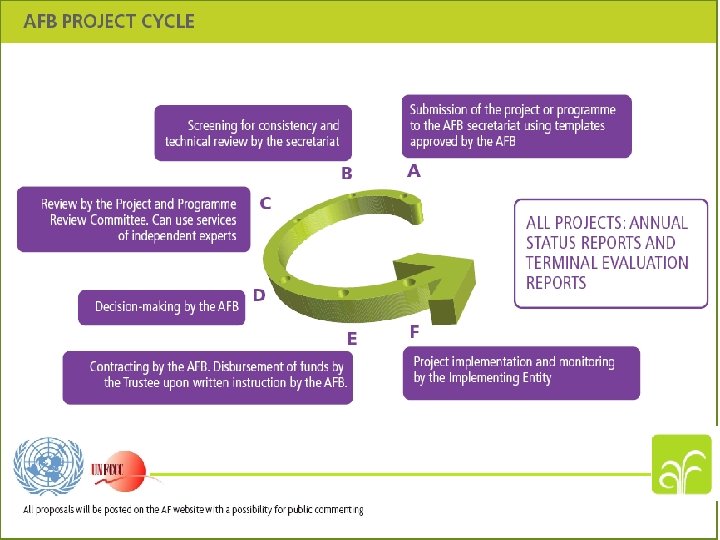
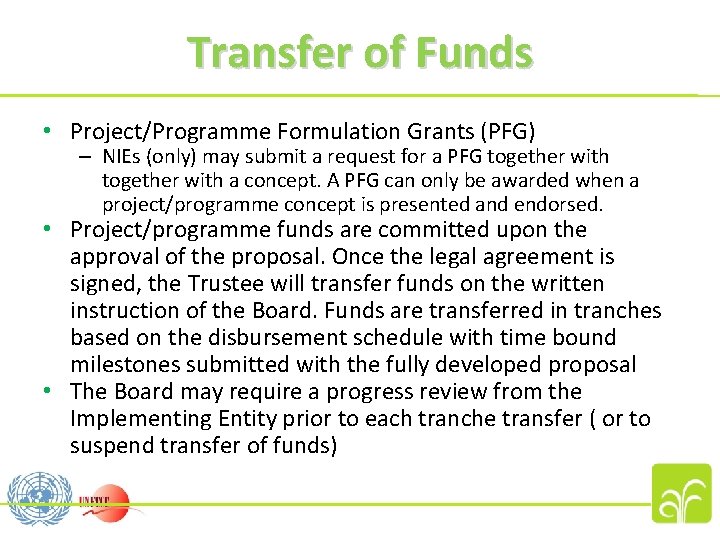
Transfer of Funds • Project/Programme Formulation Grants (PFG) – NIEs (only) may submit a request for a PFG together with a concept. A PFG can only be awarded when a project/programme concept is presented and endorsed. • Project/programme funds are committed upon the approval of the proposal. Once the legal agreement is signed, the Trustee will transfer funds on the written instruction of the Board. Funds are transferred in tranches based on the disbursement schedule with time bound milestones submitted with the fully developed proposal • The Board may require a progress review from the Implementing Entity prior to each tranche transfer ( or to suspend transfer of funds)
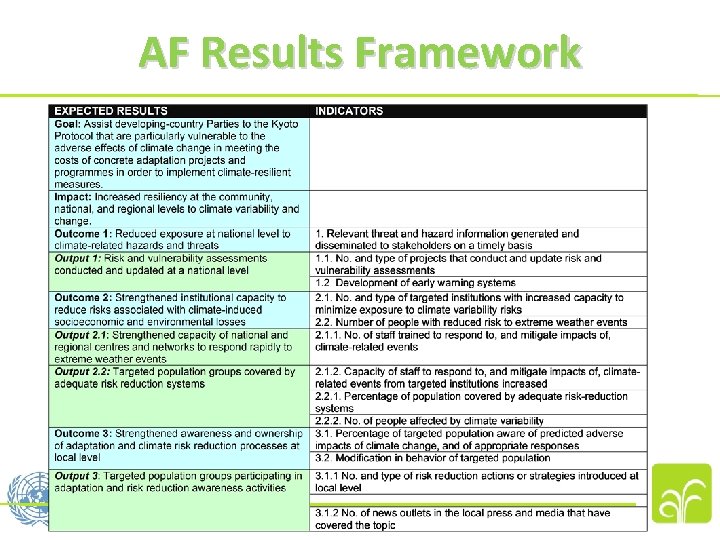
AF Results Framework
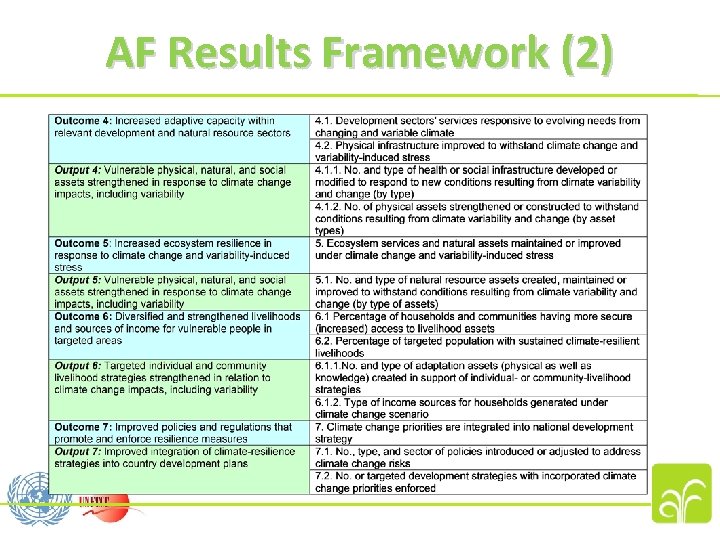
AF Results Framework (2)
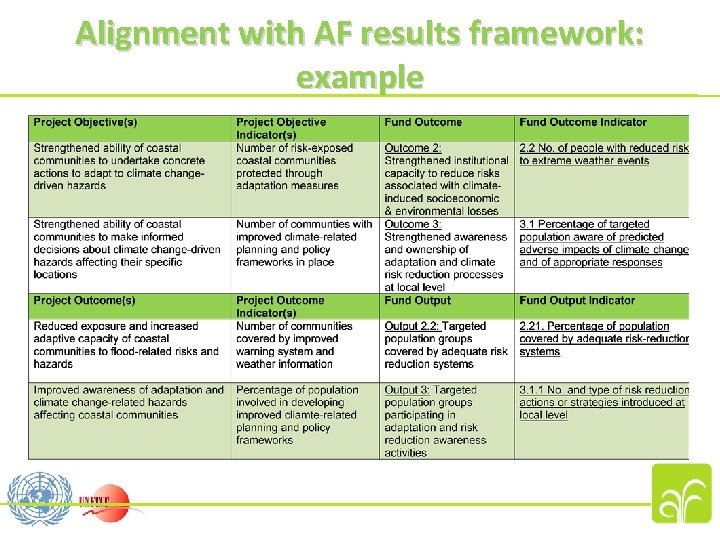
Alignment with AF results framework: example
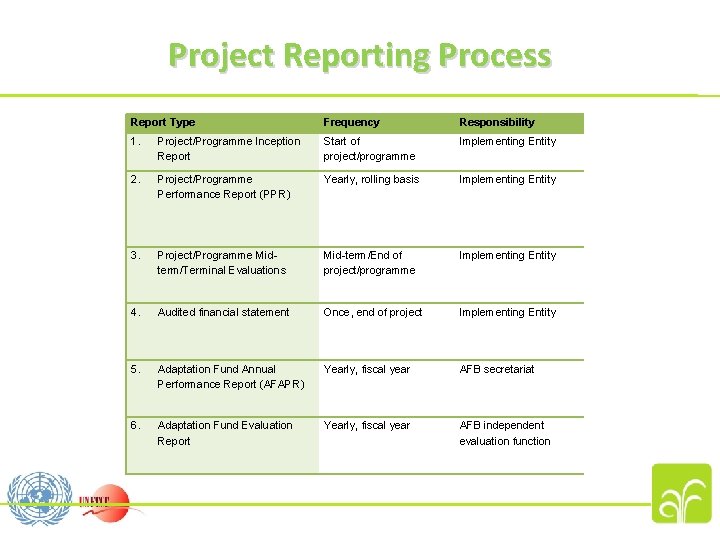
Project Reporting Process Report Type Frequency Responsibility 1. Project/Programme Inception Report Start of project/programme Implementing Entity 2. Project/Programme Performance Report (PPR) Yearly, rolling basis Implementing Entity 3. Project/Programme Midterm/Terminal Evaluations Mid-term/End of project/programme Implementing Entity 4. Audited financial statement Once, end of project Implementing Entity 5. Adaptation Fund Annual Performance Report (AFAPR) Yearly, fiscal year AFB secretariat 6. Adaptation Fund Evaluation Report Yearly, fiscal year AFB independent evaluation function
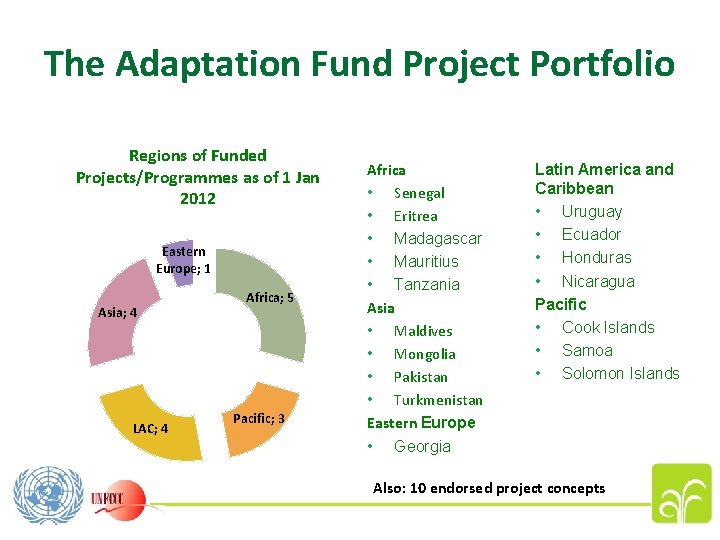
The Adaptation Fund Project Portfolio Regions of Funded Projects/Programmes as of 1 Jan 2012 Eastern Europe; 1 Asia; 4 LAC; 4 Africa; 5 Pacific; 3 Africa • Senegal • Eritrea • Madagascar • Mauritius • Tanzania Asia • Maldives • Mongolia • Pakistan • Turkmenistan Eastern Europe • Georgia Latin America and Caribbean • Uruguay • Ecuador • Honduras • Nicaragua Pacific • Cook Islands • Samoa • Solomon Islands Also: 10 endorsed project concepts
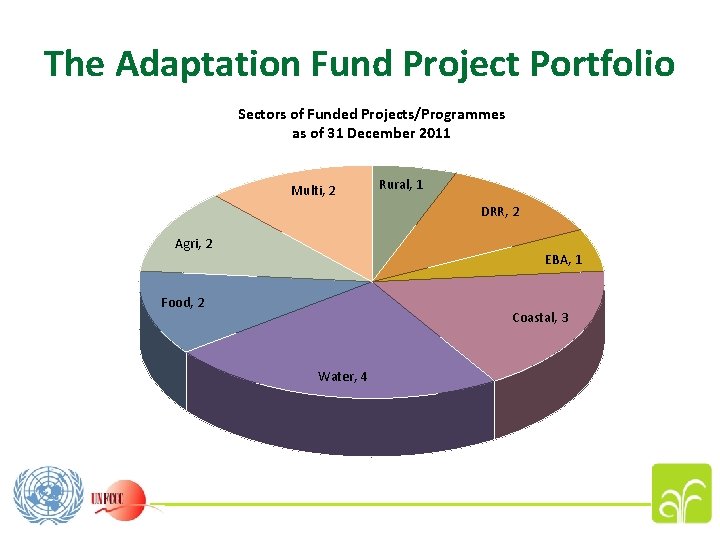
The Adaptation Fund Project Portfolio Sectors of Funded Projects/Programmes as of 31 December 2011 Multi, 2 Rural, 1 DRR, 2 Agri, 2 EBA, 1 Food, 2 Coastal, 3 Water, 4
ANALYSIS OF CURRENT PORTFOLIO AND PIPELINE
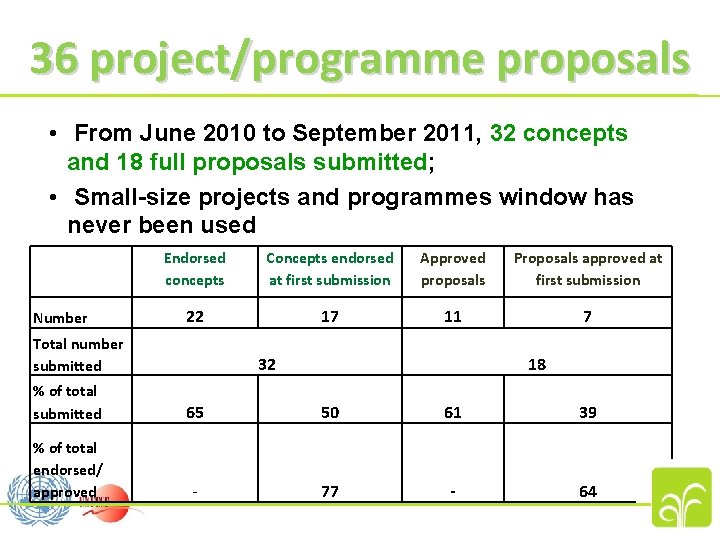
36 project/programme proposals • From June 2010 to September 2011, 32 concepts and 18 full proposals submitted; • Small-size projects and programmes window has never been used Number Endorsed concepts Concepts endorsed at first submission Approved proposals Proposals approved at first submission 22 17 11 7 Total number submitted 32 18 % of total submitted 65 50 61 39 % of total endorsed/ approved - 77 - 64
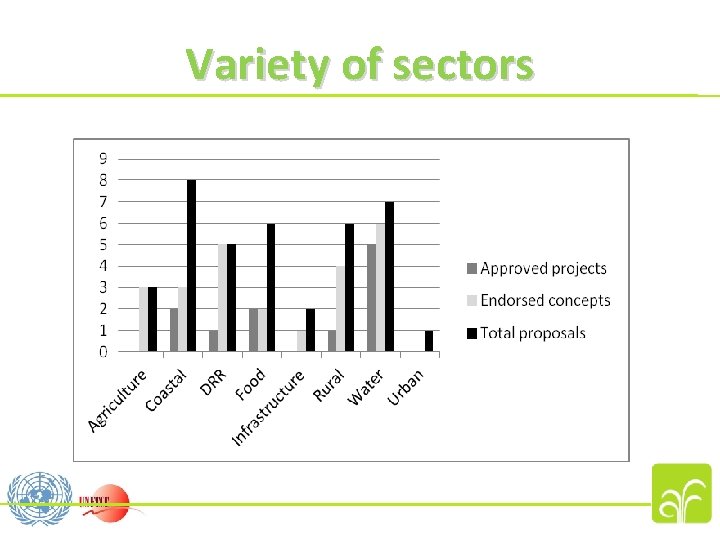
Variety of sectors
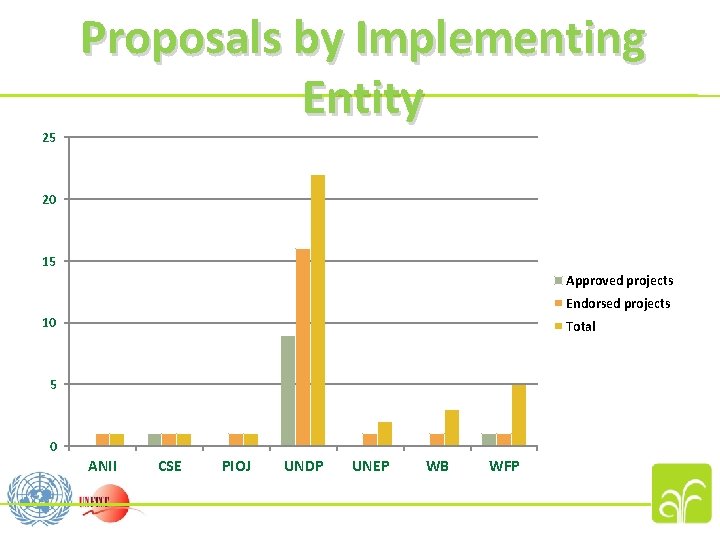
25 Proposals by Implementing Entity 20 15 Approved projects Endorsed projects 10 Total 5 0 ANII CSE PIOJ UNDP UNEP WB WFP
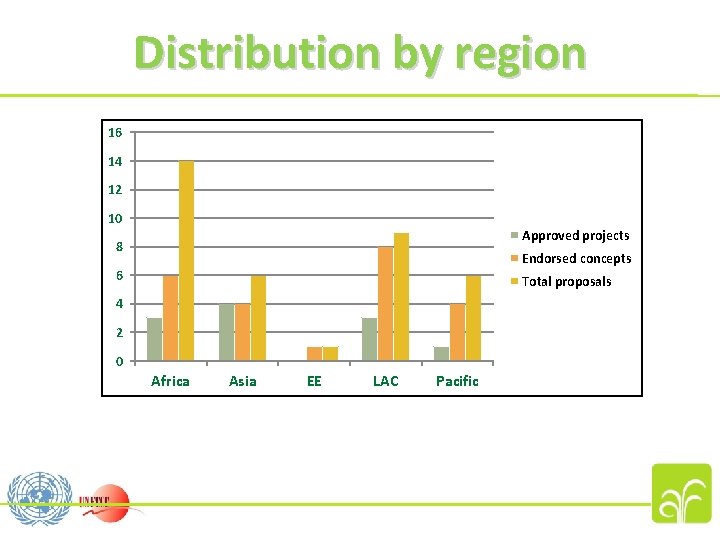
Distribution by region 16 14 12 10 Approved projects 8 Endorsed concepts 6 Total proposals 4 2 0 Africa Asia EE LAC Pacific
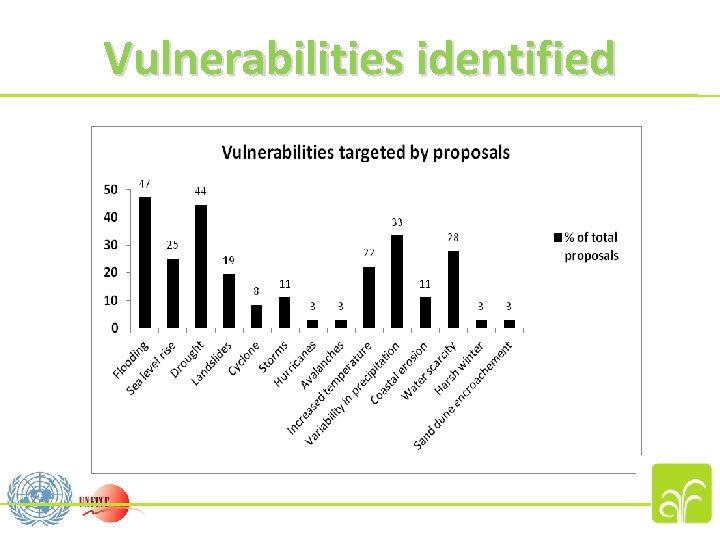
Vulnerabilities identified
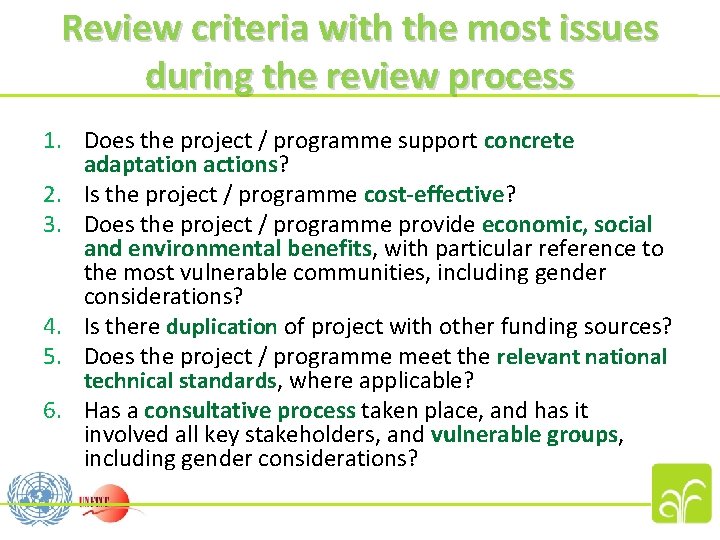
Review criteria with the most issues during the review process 1. Does the project / programme support concrete adaptation actions? 2. Is the project / programme cost-effective? 3. Does the project / programme provide economic, social and environmental benefits, with particular reference to the most vulnerable communities, including gender considerations? 4. Is there duplication of project with other funding sources? 5. Does the project / programme meet the relevant national technical standards, where applicable? 6. Has a consultative process taken place, and has it involved all key stakeholders, and vulnerable groups, including gender considerations?
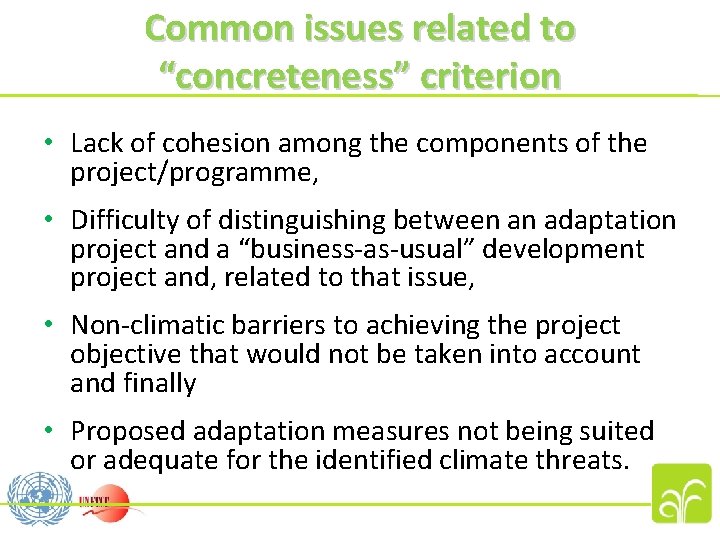
Common issues related to “concreteness” criterion • Lack of cohesion among the components of the project/programme, • Difficulty of distinguishing between an adaptation project and a “business-as-usual” development project and, related to that issue, • Non-climatic barriers to achieving the project objective that would not be taken into account and finally • Proposed adaptation measures not being suited or adequate for the identified climate threats.
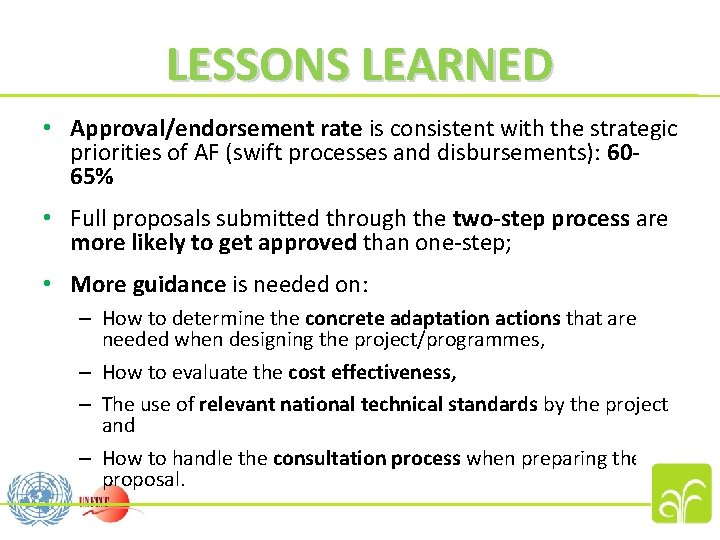
LESSONS LEARNED • Approval/endorsement rate is consistent with the strategic priorities of AF (swift processes and disbursements): 6065% • Full proposals submitted through the two-step process are more likely to get approved than one-step; • More guidance is needed on: – How to determine the concrete adaptation actions that are needed when designing the project/programmes, – How to evaluate the cost effectiveness, – The use of relevant national technical standards by the project and – How to handle the consultation process when preparing the proposal.
LESSONS LEARNED (2) • NIEs have a very low share of the proposals submitted; – More NIEs are being accredited; – Accreditation Toolkit; – Cap of 50% on MIEs. • UNDP = 63% of all proposals submitted; – Only 4 out of 9 MIEs have submitted proposals: lack of experience, interest, or willingness to give NIEs their chance? – Need for more guidance on AF projects/programmes review criteria?