
AF Life Cycle Management Center Providing the Warfighters

- Slides: 25
AF Life Cycle Management Center Providing the Warfighter’s Edge Specification and Validation of Navigation Data Business Rule Yauwu Tang AFLCMC/HBAG (MITRE) 29 August 2013 Distribution Statement A: Approved for public release; unclassified; unlimited distribution Case Number: MITRE 13 -2522 and AFLCMC 66 ABG-2013 -0241. Integrity - Service - Excellence
Introduction Providing the Warfighter’s Edge § ARINC-424 provides civil standards for preparation of navigation databases (Nav. Data); Nav. Data loaded into Flight Management Systems (FMS) § § ARINC 424 includes data base schema and business rules AIXM is next generation civil navigation data standard § AIXM schema provides syntax rules but not business rules Free format business rule specifications are error prone (imprecise and ambiguous) § Formal machine readable/executable method to specify business rules defined in ARINC 424 and validate data using AIXM syntax rules will: § Ensure precise and unambiguous business rule specification § Ensure consistent data validation at all stages of data chain process § © 2013 -The MITRE Corporation. All rights reserved. Integrity - Service - Excellence 2
Introduction (concluded) Providing the Warfighter’s Edge § Schematron Standard selected from the following candidates § § § SBVR (Semantic Business Vocabulary and Business Rules) § A formal natural language to specify business rule § Relative easy to use § Adapted by Eurocontrol § But it is not machine readable and executable XML Schema Version 1. 1 § Provide limited assertion validation (borrowed from Schematron) Schematron § Provide “assertion” and “report” validation rules for a given “context” Human and machine readable § Can be enhanced with human readable descriptions § § Provide free format text on failed assertion and successful report § Enable domain specific diagnostic (error) messages Human readable descriptions can be extracted and shown to subject matter expert for review § Provides pointer from implementation to requirement (i. e. , traceable requirements) § © 2013 -The MITRE Corporation. All rights reserved. Integrity - Service - Excellence 3
Overview Providing the Warfighter’s Edge § This demonstration shows how Schematron can be used to implement and validate ARINC 424 business rules for terminal procedures using AIXM syntax rules § § Schematron is an ISO standard lan guagefor making as ser tions about the pres ence or ab sence of pat terns in XML doc u ments Technical Approach Using XSLT to embed all data § Using “Context” to specify applicable data elements § Using XPath 1. 3 for math calculation including trigonometry § § ARINC 424 rules analyzed § § Schematron could be used to validate most ARINC 424 business rules Five business rules from ARINC 424 Attachment 5 will be demonstrated in this presentation © 2013 -The MITRE Corporation. All rights reserved. Integrity - Service - Excellence
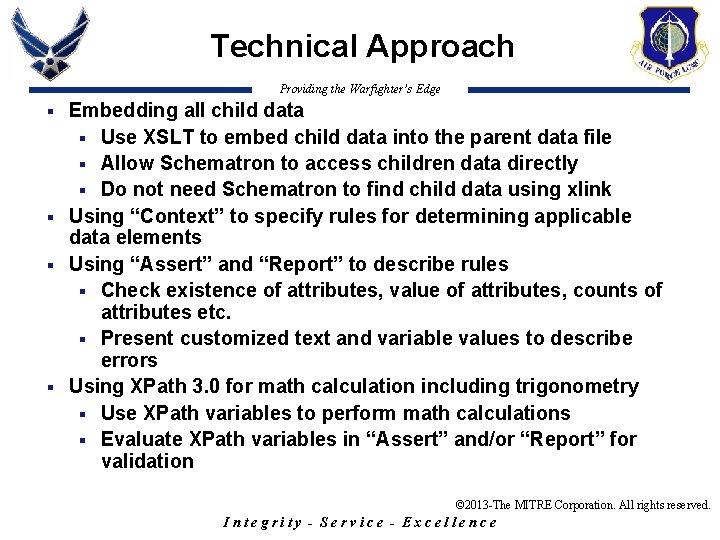
Technical Approach Providing the Warfighter’s Edge Embedding all child data § Use XSLT to embed child data into the parent data file § Allow Schematron to access children data directly § Do not need Schematron to find child data using xlink § Using “Context” to specify rules for determining applicable data elements § Using “Assert” and “Report” to describe rules § Check existence of attributes, value of attributes, counts of attributes etc. § Present customized text and variable values to describe errors § Using XPath 3. 0 for math calculation including trigonometry § Use XPath variables to perform math calculations § Evaluate XPath variables in “Assert” and/or “Report” for validation § © 2013 -The MITRE Corporation. All rights reserved. Integrity - Service - Excellence
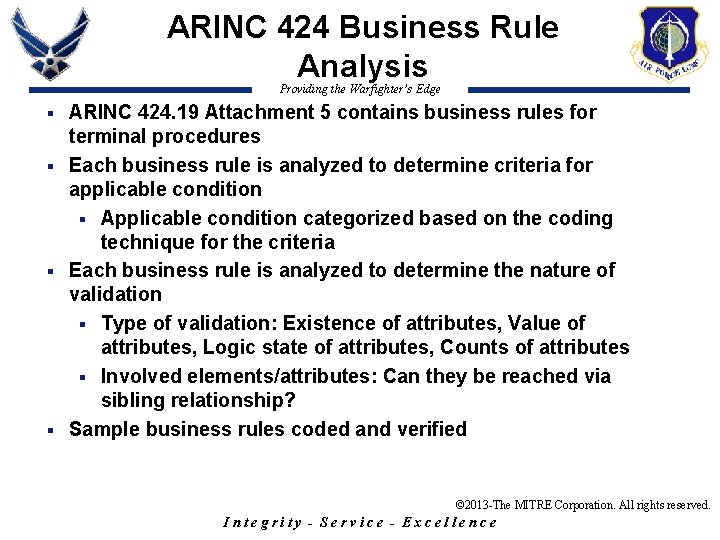
ARINC 424 Business Rule Analysis Providing the Warfighter’s Edge ARINC 424. 19 Attachment 5 contains business rules for terminal procedures § Each business rule is analyzed to determine criteria for applicable condition § Applicable condition categorized based on the coding technique for the criteria § Each business rule is analyzed to determine the nature of validation § Type of validation: Existence of attributes, Value of attributes, Logic state of attributes, Counts of attributes § Involved elements/attributes: Can they be reached via sibling relationship? § Sample business rules coded and verified § © 2013 -The MITRE Corporation. All rights reserved. Integrity - Service - Excellence
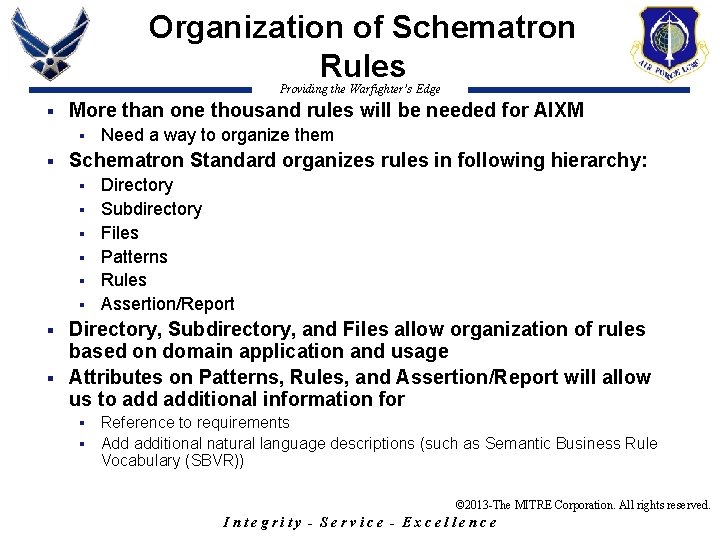
Organization of Schematron Rules Providing the Warfighter’s Edge § More than one thousand rules will be needed for AIXM § § Need a way to organize them Schematron Standard organizes rules in following hierarchy: § § § Directory Subdirectory Files Patterns Rules Assertion/Report Directory, Subdirectory, and Files allow organization of rules based on domain application and usage § Attributes on Patterns, Rules, and Assertion/Report will allow us to additional information for § § § Reference to requirements Add additional natural language descriptions (such as Semantic Business Rule Vocabulary (SBVR)) © 2013 -The MITRE Corporation. All rights reserved. Integrity - Service - Excellence
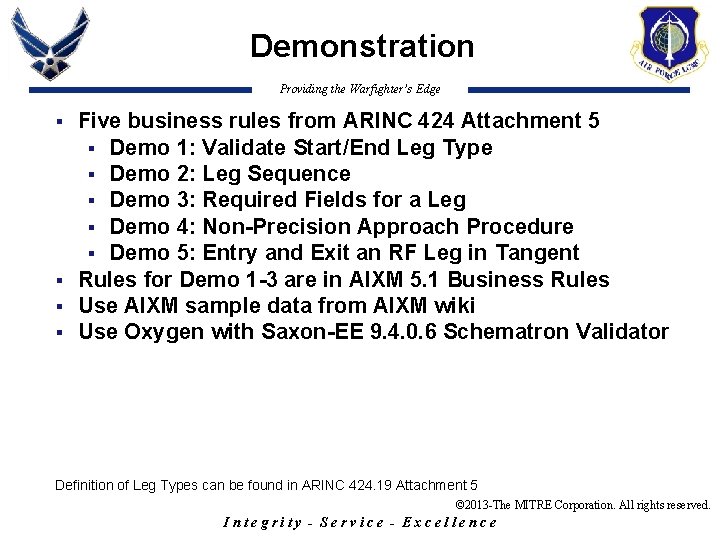
Demonstration Providing the Warfighter’s Edge Five business rules from ARINC 424 Attachment 5 § Demo 1: Validate Start/End Leg Type § Demo 2: Leg Sequence § Demo 3: Required Fields for a Leg § Demo 4: Non-Precision Approach Procedure § Demo 5: Entry and Exit an RF Leg in Tangent § Rules for Demo 1 -3 are in AIXM 5. 1 Business Rules § Use AIXM sample data from AIXM wiki § Use Oxygen with Saxon-EE 9. 4. 0. 6 Schematron Validator § Definition of Leg Types can be found in ARINC 424. 19 Attachment 5 © 2013 -The MITRE Corporation. All rights reserved. Integrity - Service - Excellence
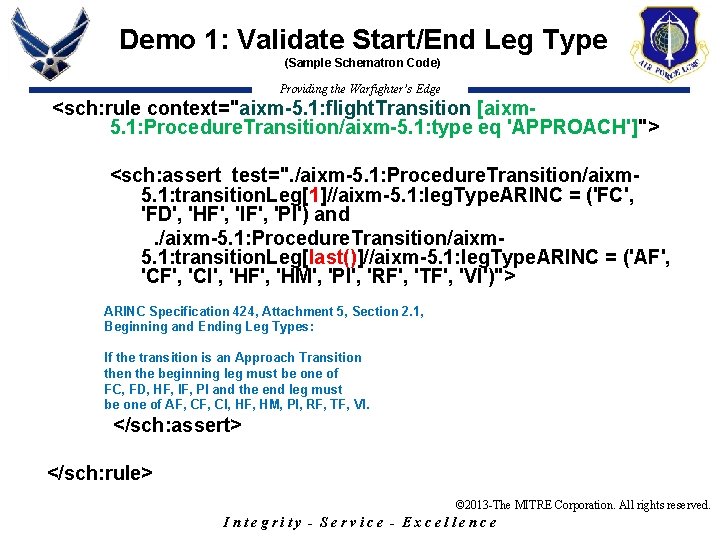
Demo 1: Validate Start/End Leg Type Providing the Warfighter’s Edge § ARINC 424. 19 Attachment 5 Section 1. 2 © 2013 -The MITRE Corporation. All rights reserved. Integrity - Service - Excellence
Demo 1: Validate Start/End Leg Type (Sample Schematron Code) Providing the Warfighter’s Edge <sch: rule context="aixm-5. 1: flight. Transition [aixm 5. 1: Procedure. Transition/aixm-5. 1: type eq 'APPROACH']"> <sch: assert test=". /aixm-5. 1: Procedure. Transition/aixm 5. 1: transition. Leg[1]//aixm-5. 1: leg. Type. ARINC = ('FC', 'FD', 'HF', 'IF', 'PI') and. /aixm-5. 1: Procedure. Transition/aixm 5. 1: transition. Leg[last()]//aixm-5. 1: leg. Type. ARINC = ('AF', 'CI', 'HF', 'HM', 'PI', 'RF', 'TF', 'VI')"> ARINC Specification 424, Attachment 5, Section 2. 1, Beginning and Ending Leg Types: If the transition is an Approach Transition the beginning leg must be one of FC, FD, HF, IF, PI and the end leg must be one of AF, CI, HF, HM, PI, RF, TF, VI. </sch: assert> </sch: rule> © 2013 -The MITRE Corporation. All rights reserved. Integrity - Service - Excellence
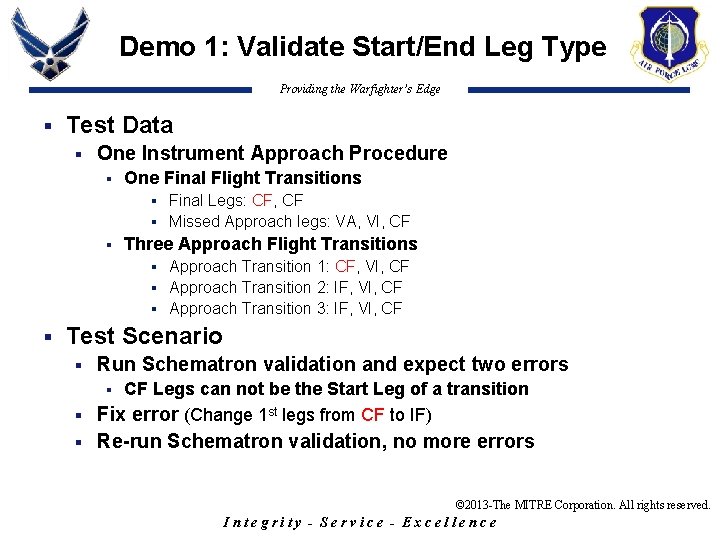
Demo 1: Validate Start/End Leg Type Providing the Warfighter’s Edge § Test Data § One Instrument Approach Procedure § One Final Flight Transitions Final Legs: CF, CF § Missed Approach legs: VA, VI, CF § § Three Approach Flight Transitions Approach Transition 1: CF, VI, CF § Approach Transition 2: IF, VI, CF § Approach Transition 3: IF, VI, CF § § Test Scenario § Run Schematron validation and expect two errors CF Legs can not be the Start Leg of a transition § Fix error (Change 1 st legs from CF to IF) § § Re-run Schematron validation, no more errors © 2013 -The MITRE Corporation. All rights reserved. Integrity - Service - Excellence
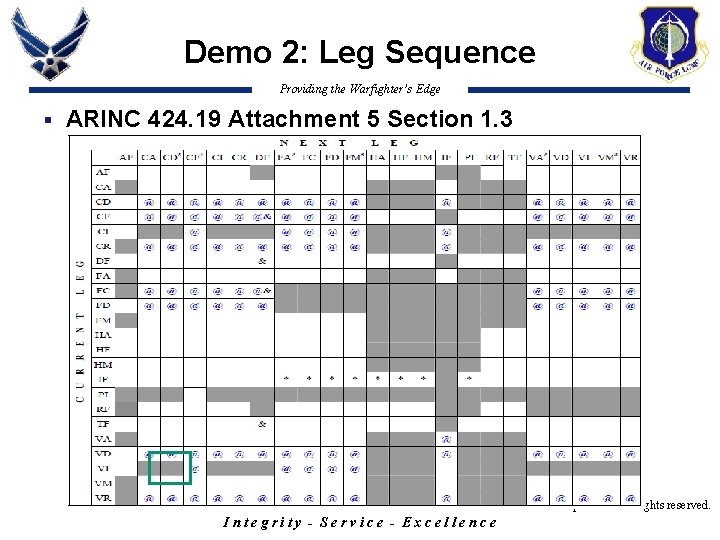
Demo 2: Leg Sequence Providing the Warfighter’s Edge § ARINC 424. 19 Attachment 5 Section 1. 3 © 2013 -The MITRE Corporation. All rights reserved. Integrity - Service - Excellence
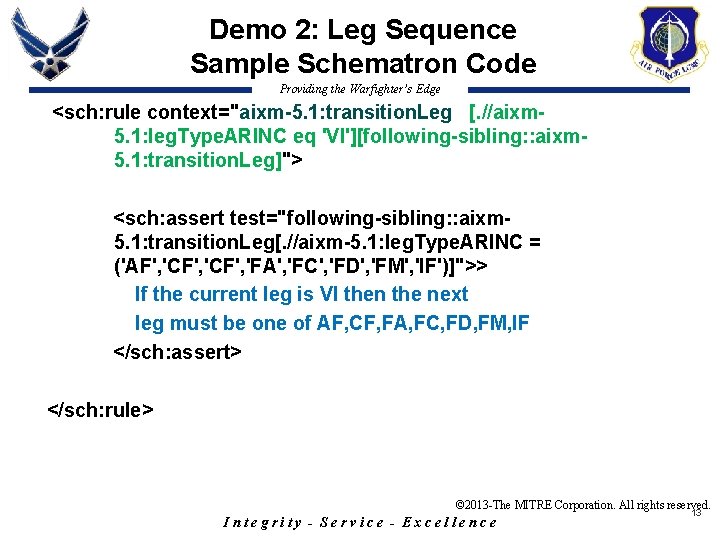
Demo 2: Leg Sequence Sample Schematron Code Providing the Warfighter’s Edge <sch: rule context="aixm-5. 1: transition. Leg [. //aixm 5. 1: leg. Type. ARINC eq 'VI'][following-sibling: : aixm 5. 1: transition. Leg]"> <sch: assert test="following-sibling: : aixm 5. 1: transition. Leg[. //aixm-5. 1: leg. Type. ARINC = ('AF', 'CF', 'FA', 'FC', 'FD', 'FM', 'IF')]">> If the current leg is VI then the next leg must be one of AF, CF, FA, FC, FD, FM, IF </sch: assert> </sch: rule> © 2013 -The MITRE Corporation. All rights reserved. Integrity - Service - Excellence 13
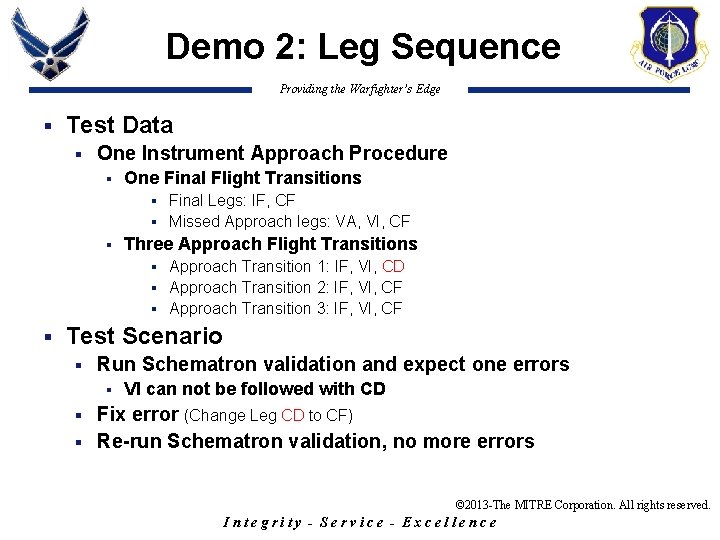
Demo 2: Leg Sequence Providing the Warfighter’s Edge § Test Data § One Instrument Approach Procedure § One Final Flight Transitions Final Legs: IF, CF § Missed Approach legs: VA, VI, CF § § Three Approach Flight Transitions Approach Transition 1: IF, VI, CD § Approach Transition 2: IF, VI, CF § Approach Transition 3: IF, VI, CF § § Test Scenario § Run Schematron validation and expect one errors § VI can not be followed with CD Fix error (Change Leg CD to CF) § Re-run Schematron validation, no more errors § © 2013 -The MITRE Corporation. All rights reserved. Integrity - Service - Excellence
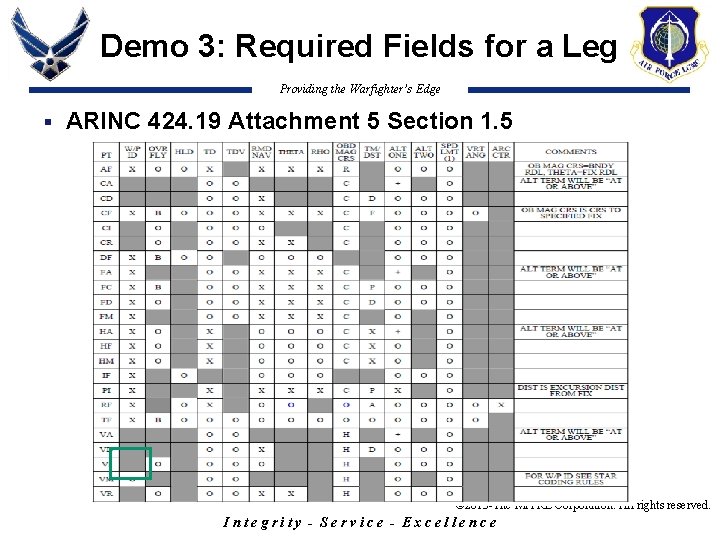
Demo 3: Required Fields for a Leg Providing the Warfighter’s Edge § ARINC 424. 19 Attachment 5 Section 1. 5 © 2013 -The MITRE Corporation. All rights reserved. Integrity - Service - Excellence
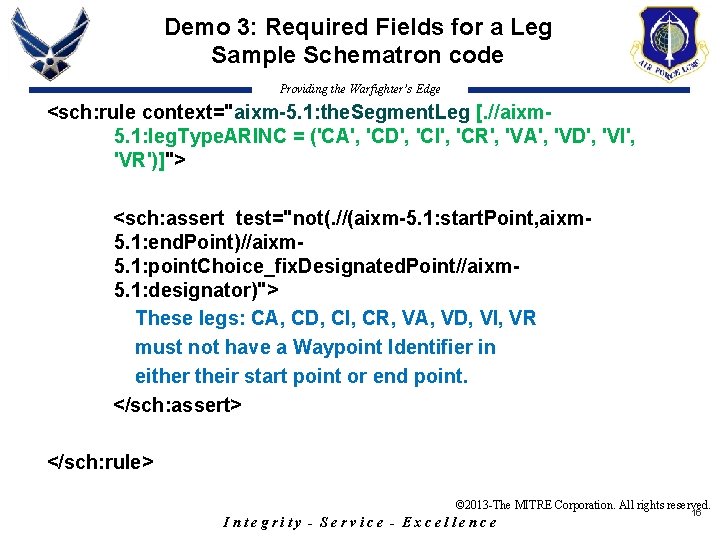
Demo 3: Required Fields for a Leg Sample Schematron code Providing the Warfighter’s Edge <sch: rule context="aixm-5. 1: the. Segment. Leg [. //aixm 5. 1: leg. Type. ARINC = ('CA', 'CD', 'CI', 'CR', 'VA', 'VD', 'VI', 'VR')]"> <sch: assert test="not(. //(aixm-5. 1: start. Point, aixm 5. 1: end. Point)//aixm 5. 1: point. Choice_fix. Designated. Point//aixm 5. 1: designator)"> These legs: CA, CD, CI, CR, VA, VD, VI, VR must not have a Waypoint Identifier in either their start point or end point. </sch: assert> </sch: rule> © 2013 -The MITRE Corporation. All rights reserved. Integrity - Service - Excellence 16
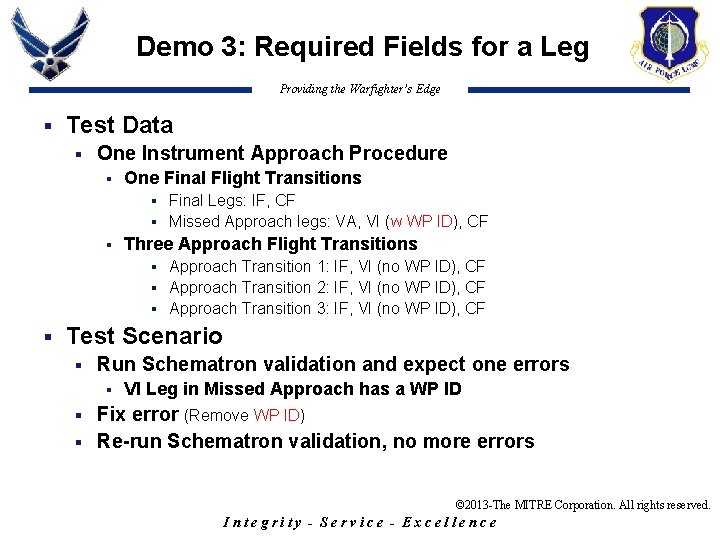
Demo 3: Required Fields for a Leg Providing the Warfighter’s Edge § Test Data § One Instrument Approach Procedure § One Final Flight Transitions Final Legs: IF, CF § Missed Approach legs: VA, VI (w WP ID), CF § § Three Approach Flight Transitions Approach Transition 1: IF, VI (no WP ID), CF § Approach Transition 2: IF, VI (no WP ID), CF § Approach Transition 3: IF, VI (no WP ID), CF § § Test Scenario § Run Schematron validation and expect one errors § VI Leg in Missed Approach has a WP ID Fix error (Remove WP ID) § Re-run Schematron validation, no more errors § © 2013 -The MITRE Corporation. All rights reserved. Integrity - Service - Excellence
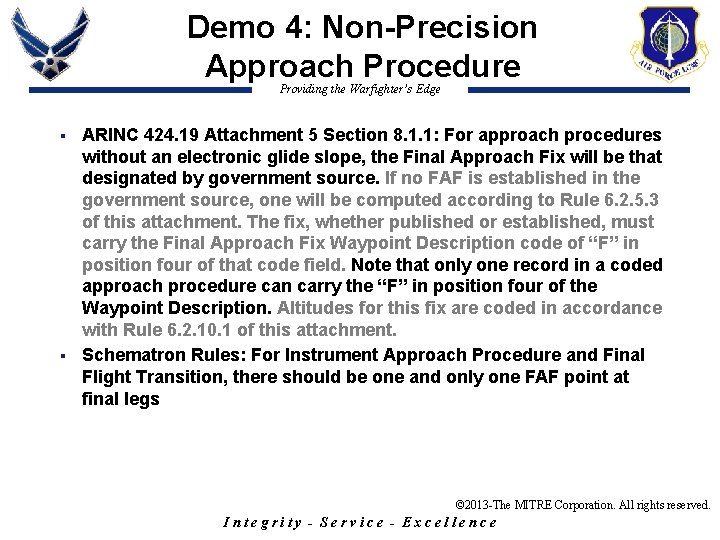
Demo 4: Non-Precision Approach Procedure Providing the Warfighter’s Edge ARINC 424. 19 Attachment 5 Section 8. 1. 1: For approach procedures without an electronic glide slope, the Final Approach Fix will be that designated by government source. If no FAF is established in the government source, one will be computed according to Rule 6. 2. 5. 3 of this attachment. The fix, whether published or established, must carry the Final Approach Fix Waypoint Description code of “F” in position four of that code field. Note that only one record in a coded approach procedure can carry the “F” in position four of the Waypoint Description. Altitudes for this fix are coded in accordance with Rule 6. 2. 10. 1 of this attachment. § Schematron Rules: For Instrument Approach Procedure and Final Flight Transition, there should be one and only one FAF point at final legs § © 2013 -The MITRE Corporation. All rights reserved. Integrity - Service - Excellence
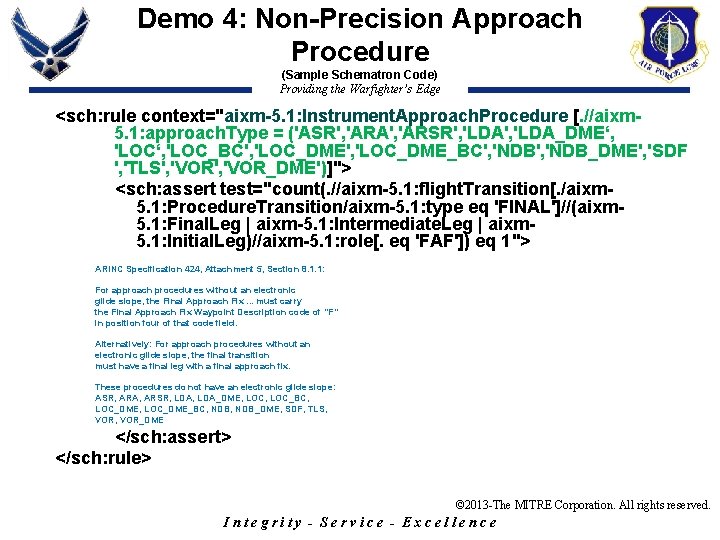
Demo 4: Non-Precision Approach Procedure (Sample Schematron Code) Providing the Warfighter’s Edge <sch: rule context="aixm-5. 1: Instrument. Approach. Procedure [. //aixm 5. 1: approach. Type = ('ASR', 'ARA', 'ARSR', 'LDA_DME‘, 'LOC_BC', 'LOC_DME_BC', 'NDB_DME', 'SDF ', 'TLS', 'VOR_DME')]"> <sch: assert test="count(. //aixm-5. 1: flight. Transition[. /aixm 5. 1: Procedure. Transition/aixm-5. 1: type eq 'FINAL']//(aixm 5. 1: Final. Leg | aixm-5. 1: Intermediate. Leg | aixm 5. 1: Initial. Leg)//aixm-5. 1: role[. eq 'FAF']) eq 1"> ARINC Specification 424, Attachment 5, Section 8. 1. 1: For approach procedures without an electronic glide slope, the Final Approach Fix. . . must carry the Final Approach Fix Waypoint Description code of "F" in position four of that code field. Alternatively: For approach procedures without an electronic glide slope, the final transition must have a final leg with a final approach fix. These procedures do not have an electronic glide slope: ASR, ARA, ARSR, LDA_DME, LOC_BC, LOC_DME_BC, NDB_DME, SDF, TLS, VOR_DME </sch: assert> </sch: rule> © 2013 -The MITRE Corporation. All rights reserved. Integrity - Service - Excellence
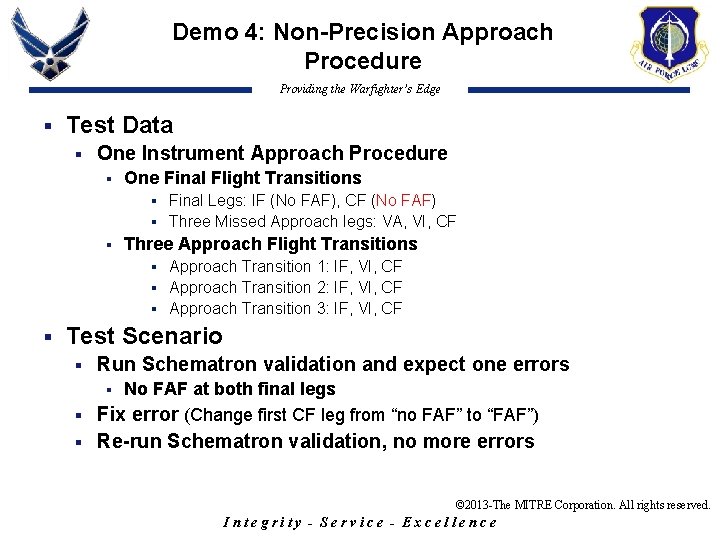
Demo 4: Non-Precision Approach Procedure Providing the Warfighter’s Edge § Test Data § One Instrument Approach Procedure § One Final Flight Transitions Final Legs: IF (No FAF), CF (No FAF) § Three Missed Approach legs: VA, VI, CF § § Three Approach Flight Transitions Approach Transition 1: IF, VI, CF § Approach Transition 2: IF, VI, CF § Approach Transition 3: IF, VI, CF § § Test Scenario § Run Schematron validation and expect one errors No FAF at both final legs § Fix error (Change first CF leg from “no FAF” to “FAF”) § § Re-run Schematron validation, no more errors © 2013 -The MITRE Corporation. All rights reserved. Integrity - Service - Excellence
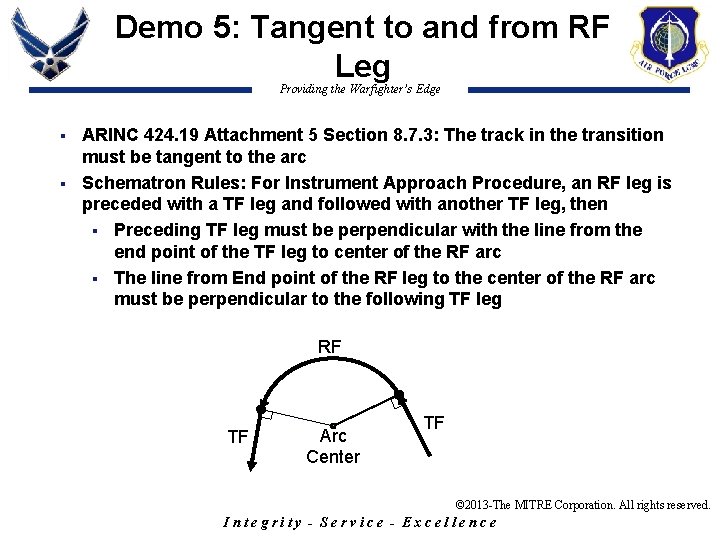
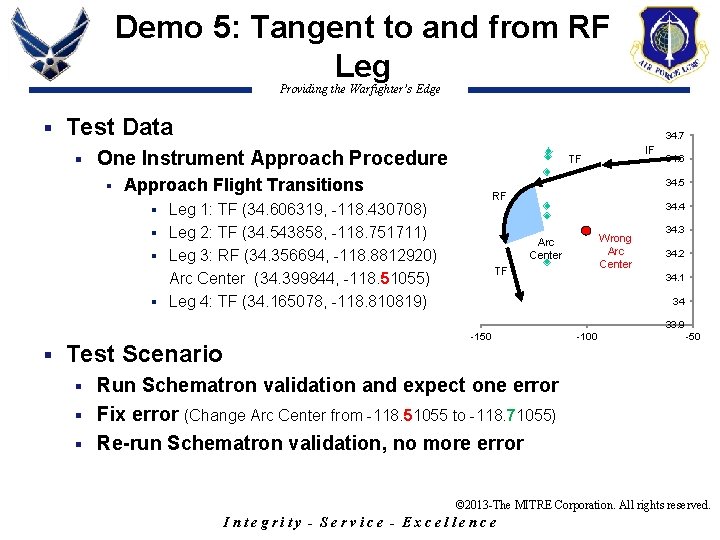
Demo 5: Tangent to and from RF Leg Providing the Warfighter’s Edge ARINC 424. 19 Attachment 5 Section 8. 7. 3: The track in the transition must be tangent to the arc § Schematron Rules: For Instrument Approach Procedure, an RF leg is preceded with a TF leg and followed with another TF leg, then § Preceding TF leg must be perpendicular with the line from the end point of the TF leg to center of the RF arc § The line from End point of the RF leg to the center of the RF arc must be perpendicular to the following TF leg § RF TF Arc Center TF © 2013 -The MITRE Corporation. All rights reserved. Integrity - Service - Excellence
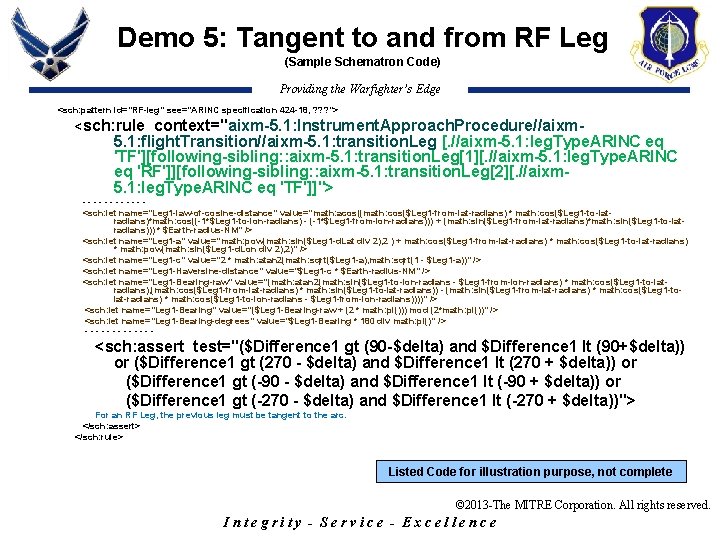
Demo 5: Tangent to and from RF Leg (Sample Schematron Code) Providing the Warfighter’s Edge <sch: pattern id="RF-leg" see="ARINC specification 424 -18, ? ? ? "> <sch: rule context="aixm-5. 1: Instrument. Approach. Procedure//aixm 5. 1: flight. Transition//aixm-5. 1: transition. Leg [. //aixm-5. 1: leg. Type. ARINC eq 'TF'][following-sibling: : aixm-5. 1: transition. Leg[1][. //aixm-5. 1: leg. Type. ARINC eq 'RF']][following-sibling: : aixm-5. 1: transition. Leg[2][. //aixm 5. 1: leg. Type. ARINC eq 'TF']]"> ------<sch: let name="Leg 1 -law-of-cosine-distance" value="math: acos((math: cos($Leg 1 -from-lat-radians) * math: cos($Leg 1 -to-latradians)*math: cos((-1*$Leg 1 -to-lon-radians) - (-1*$Leg 1 -from-lon-radians))) + (math: sin($Leg 1 -from-lat-radians)*math: sin($Leg 1 -to-latradians))) * $Earth-radius-NM" /> <sch: let name="Leg 1 -a" value="math: pow(math: sin($Leg 1 -d. Lat div 2), 2 ) + math: cos($Leg 1 -from-lat-radians) * math: cos($Leg 1 -to-lat-radians) * math: pow(math: sin($Leg 1 -d. Lon div 2), 2)" /> <sch: let name="Leg 1 -c" value="2 * math: atan 2(math: sqrt($Leg 1 -a), math: sqrt(1 - $Leg 1 -a))" /> <sch: let name="Leg 1 -Haversine-distance" value="$Leg 1 -c * $Earth-radius-NM" /> <sch: let name="Leg 1 -Bearing-raw" value="(math: atan 2(math: sin($Leg 1 -to-lon-radians - $Leg 1 -from-lon-radians) * math: cos($Leg 1 -to-latradians), (math: cos($Leg 1 -from-lat-radians) * math: sin($Leg 1 -to-lat-radians)) - (math: sin($Leg 1 -from-lat-radians) * math: cos($Leg 1 -to-lon-radians - $Leg 1 -from-lon-radians))))" /> <sch: let name="Leg 1 -Bearing" value="($Leg 1 -Bearing-raw + (2 * math: pi())) mod (2*math: pi())" /> <sch: let name="Leg 1 -Bearing-degrees" value="$Leg 1 -Bearing * 180 div math: pi()" /> ------- <sch: assert test="($Difference 1 gt (90 -$delta) and $Difference 1 lt (90+$delta)) or ($Difference 1 gt (270 - $delta) and $Difference 1 lt (270 + $delta)) or ($Difference 1 gt (-90 - $delta) and $Difference 1 lt (-90 + $delta)) or ($Difference 1 gt (-270 - $delta) and $Difference 1 lt (-270 + $delta))"> For an RF Leg, the previous leg must be tangent to the arc. </sch: assert> </sch: rule> Listed Code for illustration purpose, not complete © 2013 -The MITRE Corporation. All rights reserved. Integrity - Service - Excellence
Demo 5: Tangent to and from RF Leg Providing the Warfighter’s Edge § Test Data § 34. 7 One Instrument Approach Procedure § IF TF Approach Flight Transitions 34. 6 34. 5 RF Leg 1: TF (34. 606319, 118. 430708) § Leg 2: TF (34. 543858, 118. 751711) § Leg 3: RF (34. 356694, 118. 8812920) Arc Center (34. 399844, 118. 51055) § Leg 4: TF (34. 165078, 118. 810819) 34. 4 § Wrong Arc Center TF 34. 3 34. 2 34. 1 34 33. 9 § Test Scenario 150 100 50 Run Schematron validation and expect one error § Fix error (Change Arc Center from 118. 51055 to 118. 71055) § Re-run Schematron validation, no more error § © 2013 -The MITRE Corporation. All rights reserved. Integrity - Service - Excellence
Conclusion Providing the Warfighter’s Edge § Benefits of using Schematron for AIXM business rules § It is precise § It can be used to validate actual data (no software development) § It is understandable by domain expert § Can be enhanced with embedded SBVR or plain text rules © 2013 -The MITRE Corporation. All rights reserved. Integrity - Service - Excellence
Recommendation Providing the Warfighter’s Edge § Recommend to include as part of AIXM business rules § Start with ARINC 424 Rules © 2013 -The MITRE Corporation. All rights reserved. Integrity - Service - Excellence 25