
Aesops Fables What are Fables a short story

Aesop’s Fables

What are Fables? • “a short story, typically animals as characters, conveying a moral” • 4 characteristics: Allegory, Moral or Lesson, Personification, and Illustration of Human Characteristics • Aesop’s Fables are very short, yet are very valuable

Allegory • “a story that can be interpreted to reveal a hidden meaning, typically a moral one” • Allegories have two parts: surface narrative/story )literal) and underlying meaning • Literal: what happens in the story; the plot • Underlying meaning: deeper symbolism that is in the literal; conveys the moral

Moral • “a lesson, usually one that is concerning what is right and what is wrong” • the message the story/fable is trying to convey • Examples of morals: tell the truth, think then act, respect others • The moral or lesson is stated in the last sentence of Aesop’s Fables, but are not straightforward. They require thinking and explaining
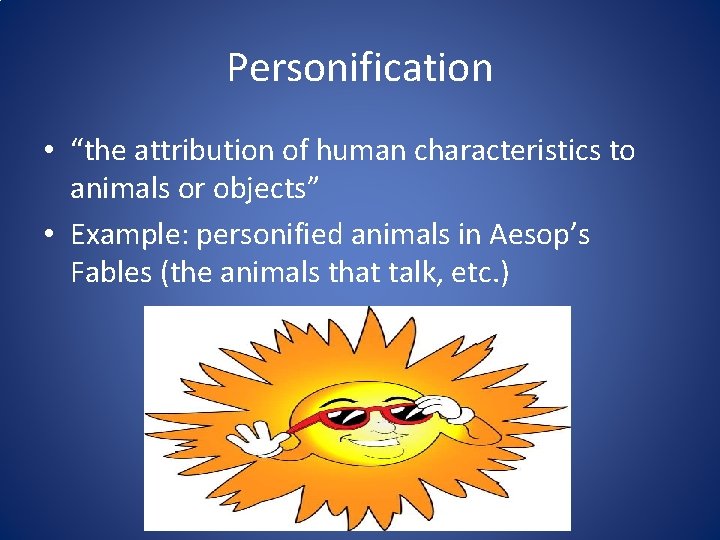
Personification • “the attribution of human characteristics to animals or objects” • Example: personified animals in Aesop’s Fables (the animals that talk, etc. )
Illustrate Human Characteristics • aspect of Personification • Vices (bad) and Virtues (good)
Graphic Organizers • “use words and phrases to highlight key points, and symbols and arrows to represent relationships” • Example: Concept Pattern Organizers
Concept Pattern Organizers • Organize info around a word or phrase with characteristics connected by arrows • Step 1: Write the name of the Fable • Step 2: Draw a circle around the name, then four arrows going towards different corners of the page • Step 3: Draw a box and the end of each arrow. You should have four boxes. Label each box as “Allegory”, “Moral or Lesson” , “Personified Animals”, and “Illustrate Human Characteristics” • Step 3: Draw more arrows out of each box to label the different aspects of Fables (virtues, vices, literal, underlying, etc. )
Example of Concept Pattern Organizer • This example uses one graph for multiple fables. For your own graphs, create one graph per fable for now • http: //www. peecworks. org/peec_resear ch/I 01795 EFA. 3/ (page 77)

Example using “The Lion and the Mouse” Allegory: -literal: Lion decides to not eat a Mouse after the Mouse tells the Lion he will help him one day. Lion is caught by hunters and the Mouse frees him by biting through the ropes. -underlying: do not judge someone by their size, every one is different and has different talents. Moral/Lesson: “Little friends may prove great friends”. Personified animals: the Lion and the Mouse, : the Lion and Mouse talk, the Mouse addresses the Lion as “King”, Illustrate Human Characteristics: -Vices: Judgement, Cruelness -Virtues: Friendship, Caring/Compassion (use this info to create graphic on whiteboard)

YOUR TURN • Individually read the following of Aesop’s Fables: “The Dog and the Wolf”, “The Wolf in Sheep’s Clothing”, and “The Hares and the Frogs”. Take notes on the 4 aspects of Fables • With a partner, create ONE GRAPHIC FOR EACH FABLE. Refer to the Fable graphic on the board for help or ask questions!

Homework • Go to this link for all of Aesop’s Fables http: //historyworld. org/Aesops_Fables_NT. pdf • Choose three more Fables (that we not done in class) and create a graphic organizer using the Content Pattern graphic like we have done in class
- Slides: 12