
Aesops Fables A fable is a story with
Aesop’s Fables. A fable is a story with a moral.
Aesop was a writer from Ancient Greece, who is thought to have lived around 600 years BC. He is credited with having written a number of wellknown fables. Accounts of his life often refer to him having been a slave, who gains his freedom through the strength of the advice he gives to his masters however, it is not certain whether he actually existed at all. Aesop is generally credited as the author of a collection of fables. The fables generally communicate some kind of moral message, often through the depiction of animals, who speak or otherwise take on human characteristics. Read the four fables on the next few slides.
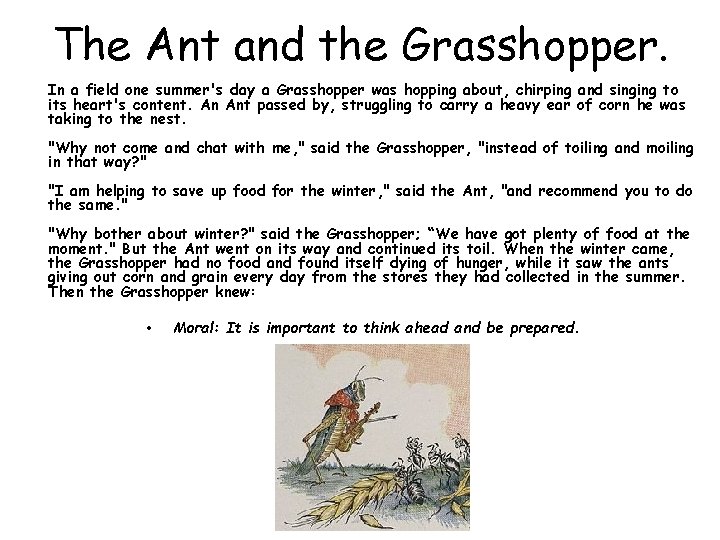
The Ant and the Grasshopper. In a field one summer's day a Grasshopper was hopping about, chirping and singing to its heart's content. An Ant passed by, struggling to carry a heavy ear of corn he was taking to the nest. "Why not come and chat with me, " said the Grasshopper, "instead of toiling and moiling in that way? " "I am helping to save up food for the winter, " said the Ant, "and recommend you to do the same. " "Why bother about winter? " said the Grasshopper; “We have got plenty of food at the moment. " But the Ant went on its way and continued its toil. When the winter came, the Grasshopper had no food and found itself dying of hunger, while it saw the ants giving out corn and grain every day from the stores they had collected in the summer. Then the Grasshopper knew: • Moral: It is important to think ahead and be prepared.
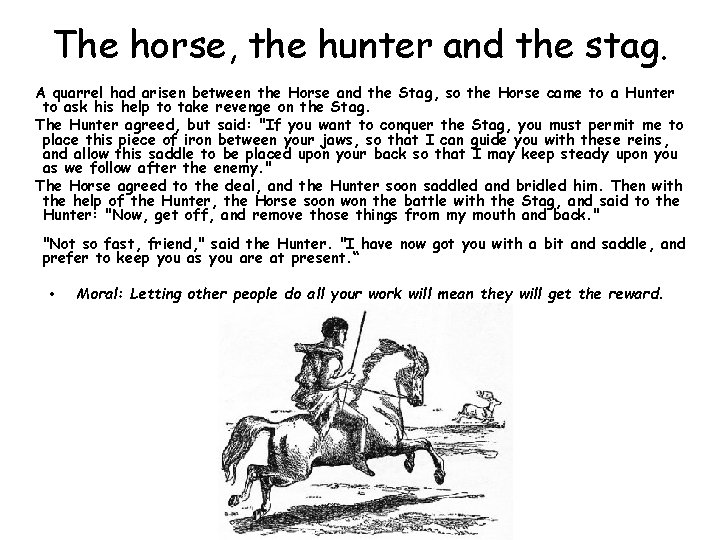
The horse, the hunter and the stag. A quarrel had arisen between the Horse and the Stag, so the Horse came to a Hunter to ask his help to take revenge on the Stag. The Hunter agreed, but said: "If you want to conquer the Stag, you must permit me to place this piece of iron between your jaws, so that I can guide you with these reins, and allow this saddle to be placed upon your back so that I may keep steady upon you as we follow after the enemy. " The Horse agreed to the deal, and the Hunter soon saddled and bridled him. Then with the help of the Hunter, the Horse soon won the battle with the Stag, and said to the Hunter: "Now, get off, and remove those things from my mouth and back. " "Not so fast, friend, " said the Hunter. "I have now got you with a bit and saddle, and prefer to keep you as you are at present. “ • Moral: Letting other people do all your work will mean they will get the reward.
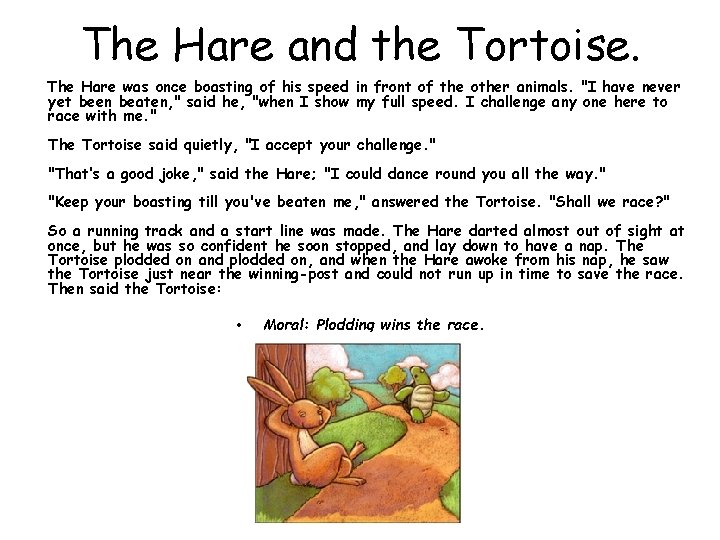
The Hare and the Tortoise. The Hare was once boasting of his speed in front of the other animals. "I have never yet been beaten, " said he, "when I show my full speed. I challenge any one here to race with me. " The Tortoise said quietly, "I accept your challenge. " "That’s a good joke, " said the Hare; "I could dance round you all the way. " "Keep your boasting till you've beaten me, " answered the Tortoise. "Shall we race? " So a running track and a start line was made. The Hare darted almost out of sight at once, but he was so confident he soon stopped, and lay down to have a nap. The Tortoise plodded on and plodded on, and when the Hare awoke from his nap, he saw the Tortoise just near the winning-post and could not run up in time to save the race. Then said the Tortoise: • Moral: Plodding wins the race.
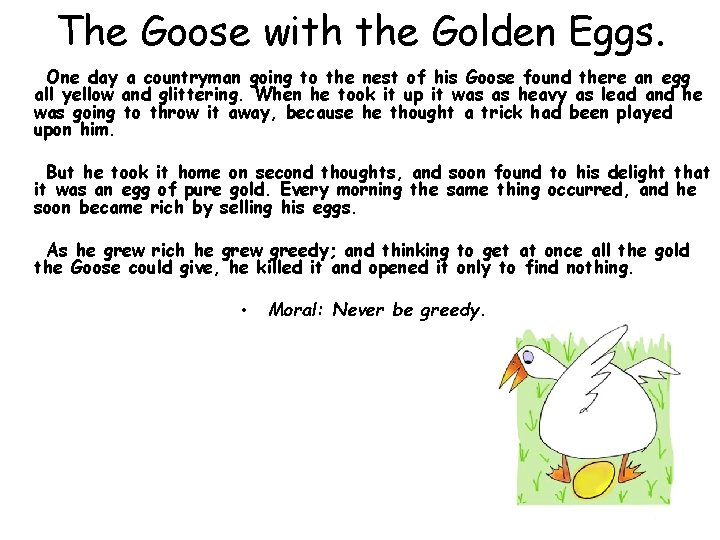
The Goose with the Golden Eggs. One day a countryman going to the nest of his Goose found there an egg all yellow and glittering. When he took it up it was as heavy as lead and he was going to throw it away, because he thought a trick had been played upon him. But he took it home on second thoughts, and soon found to his delight that it was an egg of pure gold. Every morning the same thing occurred, and he soon became rich by selling his eggs. As he grew rich he grew greedy; and thinking to get at once all the gold the Goose could give, he killed it and opened it only to find nothing. • Moral: Never be greedy.
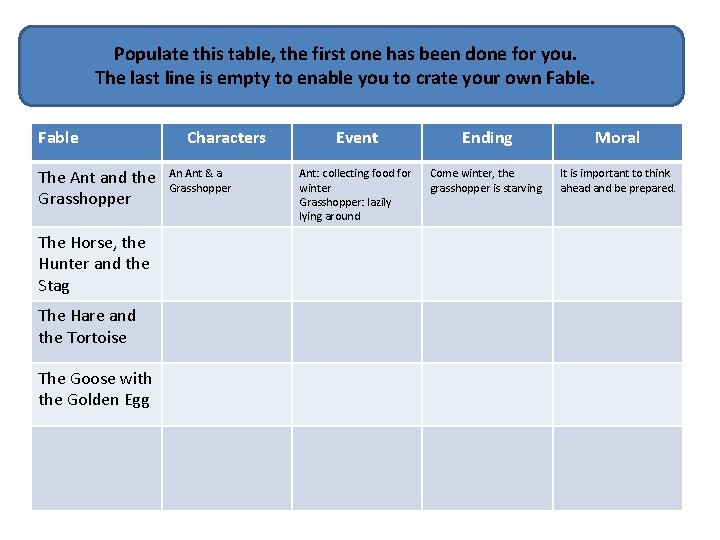
Populate this table, the first one has been done for you. The last line is empty to enable you to crate your own Fable The Ant and the Grasshopper The Horse, the Hunter and the Stag The Hare and the Tortoise The Goose with the Golden Egg Characters An Ant & a Grasshopper Event Ending Moral Ant: collecting food for winter Grasshopper: lazily lying around Come winter, the grasshopper is starving. It is important to think ahead and be prepared.
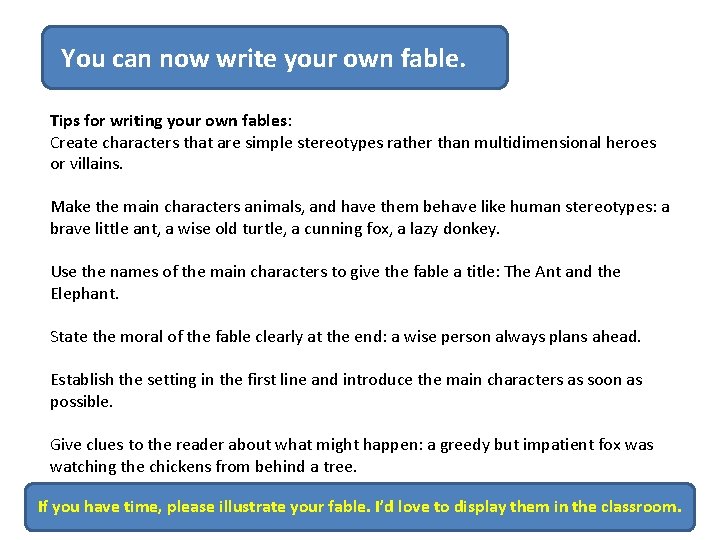
You can now write your own fable. Tips for writing your own fables: Create characters that are simple stereotypes rather than multidimensional heroes or villains. Make the main characters animals, and have them behave like human stereotypes: a brave little ant, a wise old turtle, a cunning fox, a lazy donkey. Use the names of the main characters to give the fable a title: The Ant and the Elephant. State the moral of the fable clearly at the end: a wise person always plans ahead. Establish the setting in the first line and introduce the main characters as soon as possible. Give clues to the reader about what might happen: a greedy but impatient fox was watching the chickens from behind a tree. If you have time, please illustrate your fable. I’d love to display them in the classroom.
- Slides: 8