
AES PARIS 2016 Engineering Brief EB 3 5
AES PARIS 2016 Engineering Brief EB 3 -5 Non-intrusive Rumble Filtering by VLF Crossfeed with High Filter Slopes Douglas Self 1
The Problem ● Vinyl disc replay gives rise to large amplitudes of subsonic noise. ● This tends to peak significantly around 8 – 12 Hz due to cartridge/arm resonance. ● This is only an octave away from 20 Hz, the bottom of the RIAA specification. A quite sophisticated conventional filter is required. ● The subsonic noise results mostly from vertical stylus movement so the electrical signals are in antiphase 2
Stereo crossfeed ● Stereo crossfeed at low frequencies cancels anti-phase signals, but in-phase signals unaffected. ● Usually low frequency sounds are panned to the centre, for trackability and to make use of both stereo amps. ● Therefore the bass response is unaffected by stereo crossfeed. 3
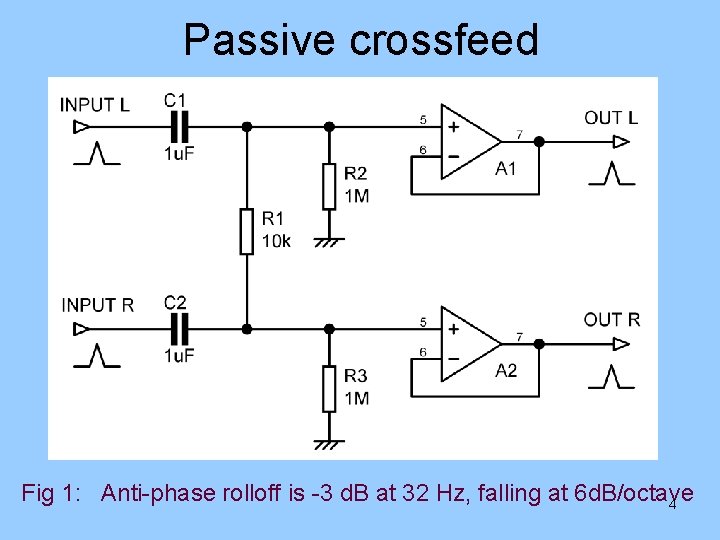
Passive crossfeed Fig 1: Anti-phase rolloff is -3 d. B at 32 Hz, falling at 6 d. B/octave 4
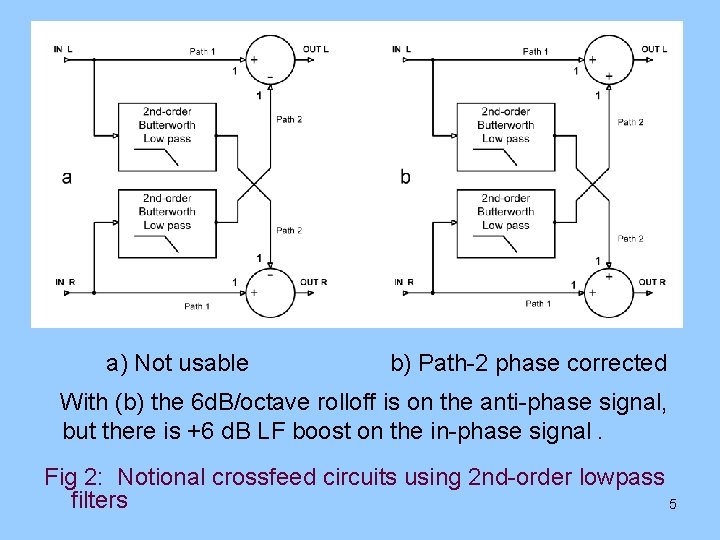
a) Not usable b) Path-2 phase corrected With (b) the 6 d. B/octave rolloff is on the anti-phase signal, but there is +6 d. B LF boost on the in-phase signal. Fig 2: Notional crossfeed circuits using 2 nd-order lowpass filters 5
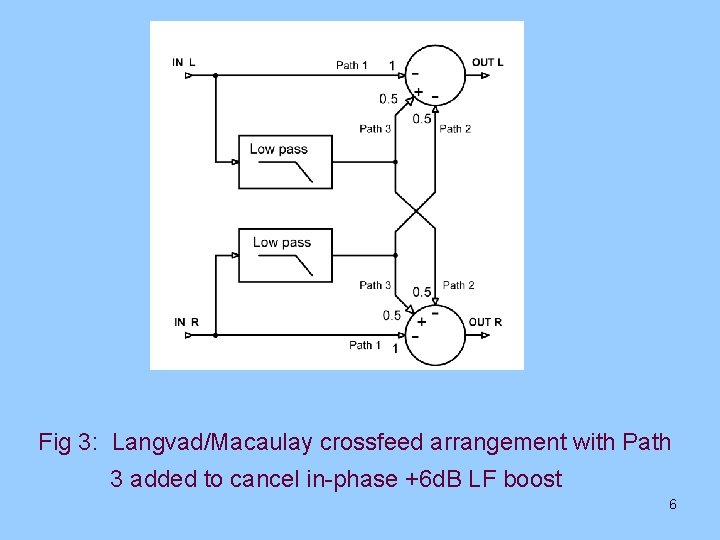
Fig 3: Langvad/Macaulay crossfeed arrangement with Path 3 added to cancel in-phase +6 d. B LF boost 6
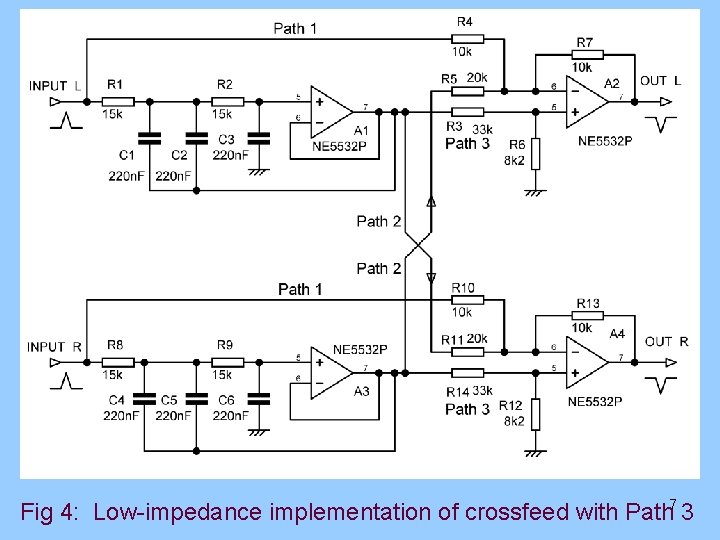
Fig 4: Low-impedance implementation of crossfeed with Path 7 3
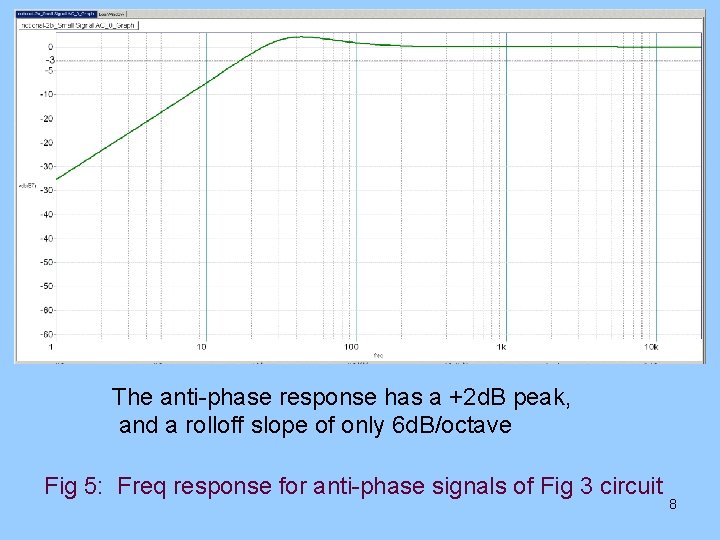
The anti-phase response has a +2 d. B peak, and a rolloff slope of only 6 d. B/octave Fig 5: Freq response for anti-phase signals of Fig 3 circuit 8
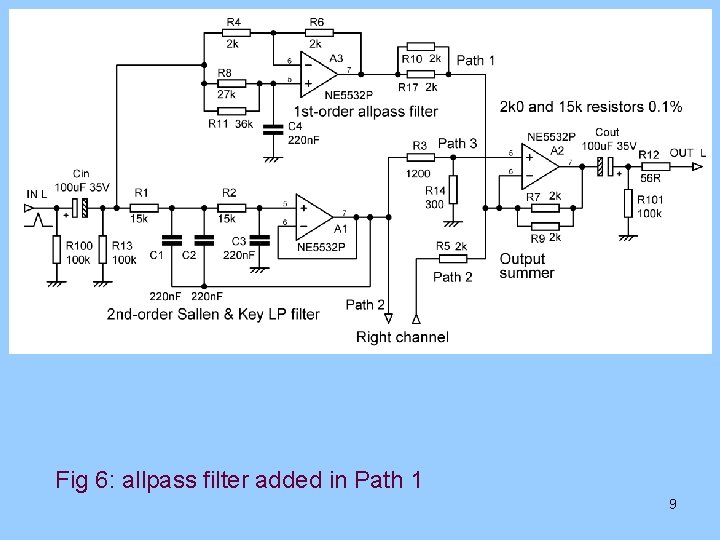
Fig 6: allpass filter added in Path 1 9
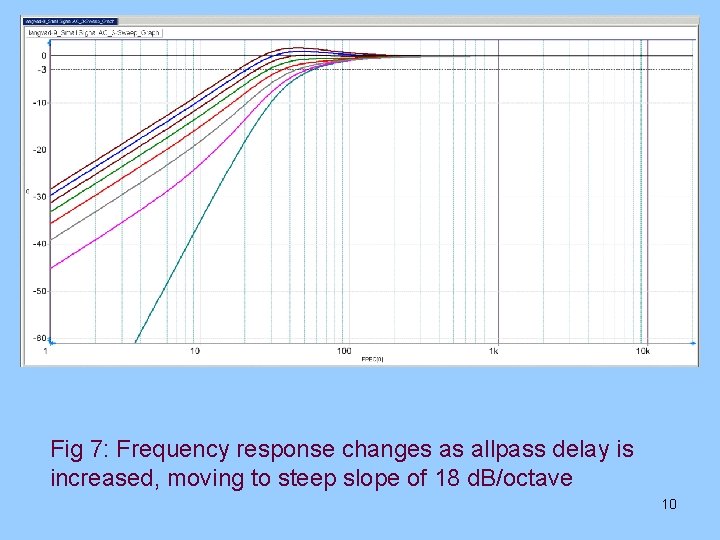
Fig 7: Frequency response changes as allpass delay is increased, moving to steep slope of 18 d. B/octave 10
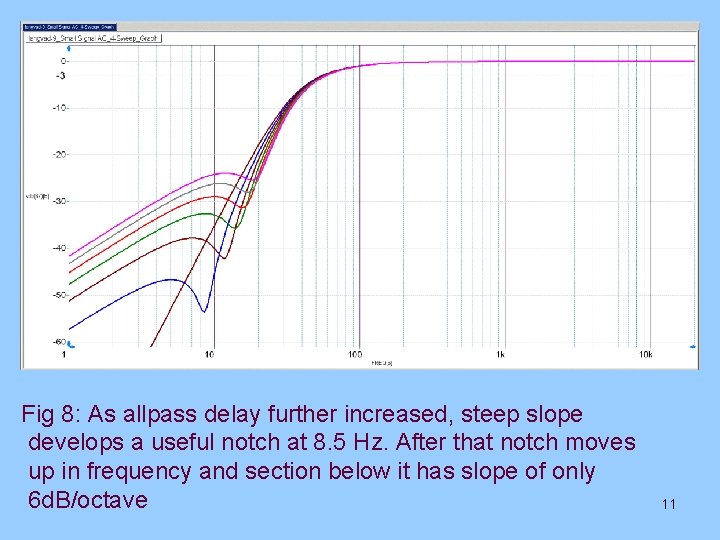
Fig 8: As allpass delay further increased, steep slope develops a useful notch at 8. 5 Hz. After that notch moves up in frequency and section below it has slope of only 6 d. B/octave 11
• Note that the steepest slope is 18 d. B/octave, not the 12 d. B/octave that would be expected from the 2 nd-order lowpass filter. • The steepest slope is also 18 d. B/octave when 3 rd and 4 th-order lowpass filters are used. However, these filters give deeper notches at 8. 5 Hz. 12
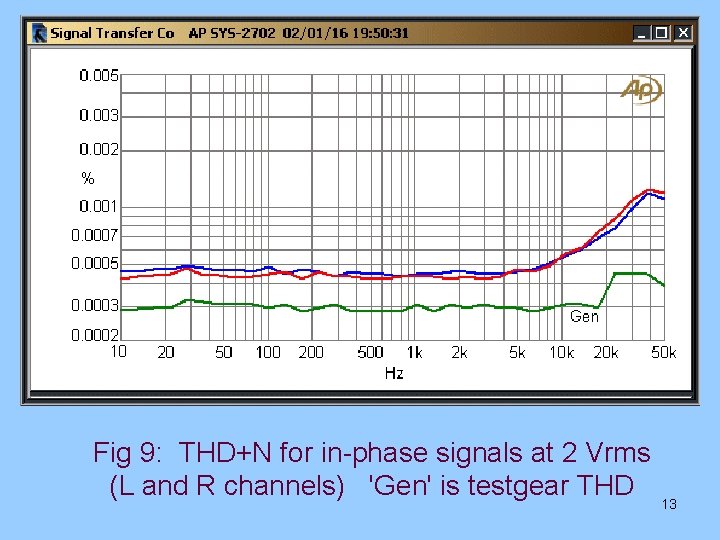
Fig 9: THD+N for in-phase signals at 2 Vrms (L and R channels) 'Gen' is testgear THD 13
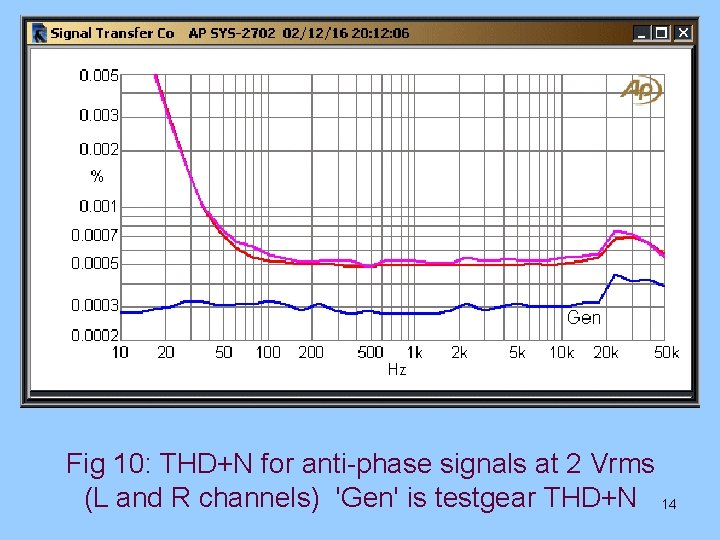
Fig 10: THD+N for anti-phase signals at 2 Vrms (L and R channels) 'Gen' is testgear THD+N 14
Awkward resistor values Three possible solutions: • One E 96 resistor. (1 x. E 96) Stock problems • Two E 24 resistors in parallel. (2 x. E 24) On average 3 times more accurate in setting nominal value than 1 x. E 96. • Three E 24 resistors in parallel. (3 x. E 24) On average 30 times more accurate in setting nominal value than 1 x. E 96. More resistors mean lower effective tolerance. 15

AES PARIS 2016 Engineering Brief EB 3 -5 Non-intrusive Rumble Filtering by VLF Crossfeed with High Filter Slopes drgself@dsl. pipex. com douglas-self. com 16
- Slides: 16