
Aersp 401 A Spacecraft Propulsion Subsystem rocket science
Aersp 401 A Spacecraft Propulsion Subsystem (rocket science in 15 minutes)
Spacecraft Propulsion Subsystem • Uses of onboard propulsion systems – Orbit Transfer • LEO to GEO • LEO to Solar Orbit – Drag Makeup – Attitude Control – Orbit Maintenance
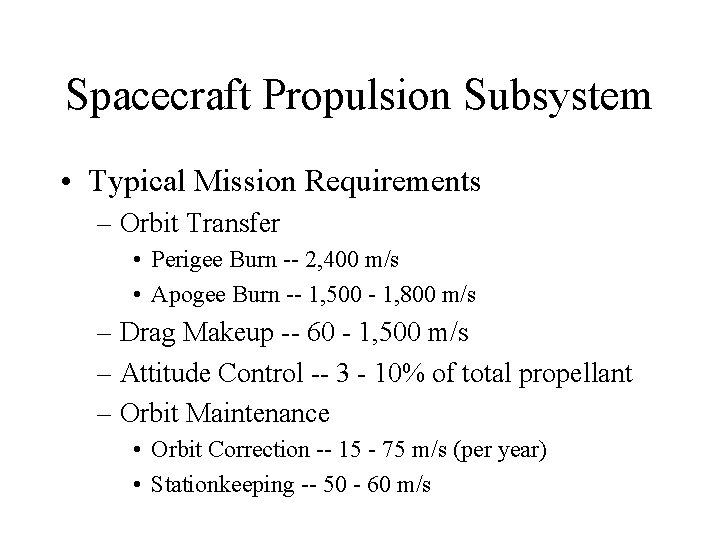
Spacecraft Propulsion Subsystem • Typical Mission Requirements – Orbit Transfer • Perigee Burn -- 2, 400 m/s • Apogee Burn -- 1, 500 - 1, 800 m/s – Drag Makeup -- 60 - 1, 500 m/s – Attitude Control -- 3 - 10% of total propellant – Orbit Maintenance • Orbit Correction -- 15 - 75 m/s (per year) • Stationkeeping -- 50 - 60 m/s
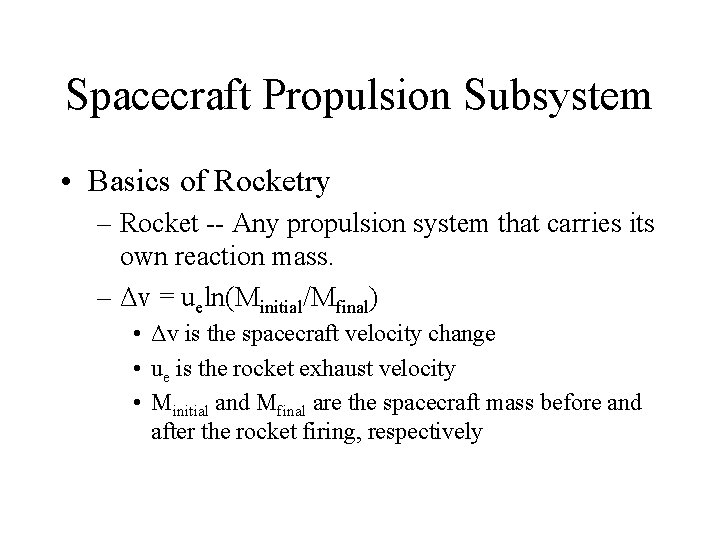
Spacecraft Propulsion Subsystem • Basics of Rocketry – Rocket -- Any propulsion system that carries its own reaction mass. – Δv = ueln(Minitial/Mfinal) • Δv is the spacecraft velocity change • ue is the rocket exhaust velocity • Minitial and Mfinal are the spacecraft mass before and after the rocket firing, respectively
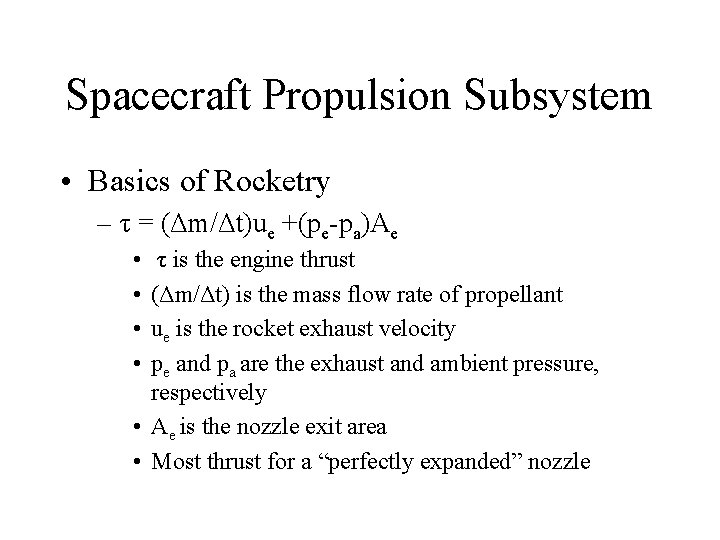
Spacecraft Propulsion Subsystem • Basics of Rocketry – τ = (Δm/Δt)ue +(pe-pa)Ae • • τ is the engine thrust (Δm/Δt) is the mass flow rate of propellant ue is the rocket exhaust velocity pe and pa are the exhaust and ambient pressure, respectively • Ae is the nozzle exit area • Most thrust for a “perfectly expanded” nozzle
![Spacecraft Propulsion Subsystem • Basics of Rocketry – ueq = ue + [(pe-pa)/(Δm/Δt)]Ae •](http://slidetodoc.com/presentation_image_h2/e2320d144d3f00e8df58781642e68f7f/image-6.jpg "Spacecraft Propulsion Subsystem • Basics of Rocketry – ueq = ue + [(pe-pa)/(Δm/Δt)]Ae •")
Spacecraft Propulsion Subsystem • Basics of Rocketry – ueq = ue + [(pe-pa)/(Δm/Δt)]Ae • ueq is the “equivalent exhaust velocity” • ueq = ue for a perfectly expanded nozzle – τ = (Δm/Δt)ueq – Isp = ueq/g • Specific impulse is a measure of thrust per propellant mass flow rate • g is always gravity at Earth’s surface, not local
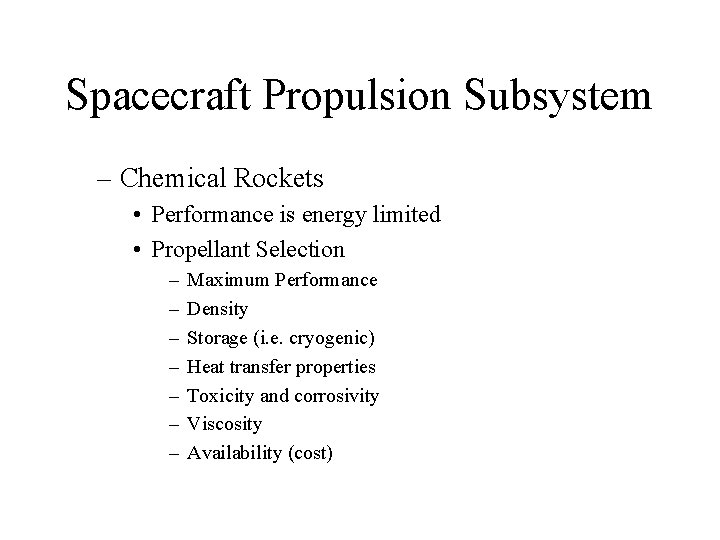
Spacecraft Propulsion Subsystem – Chemical Rockets • Performance is energy limited • Propellant Selection – – – – Maximum Performance Density Storage (i. e. cryogenic) Heat transfer properties Toxicity and corrosivity Viscosity Availability (cost)
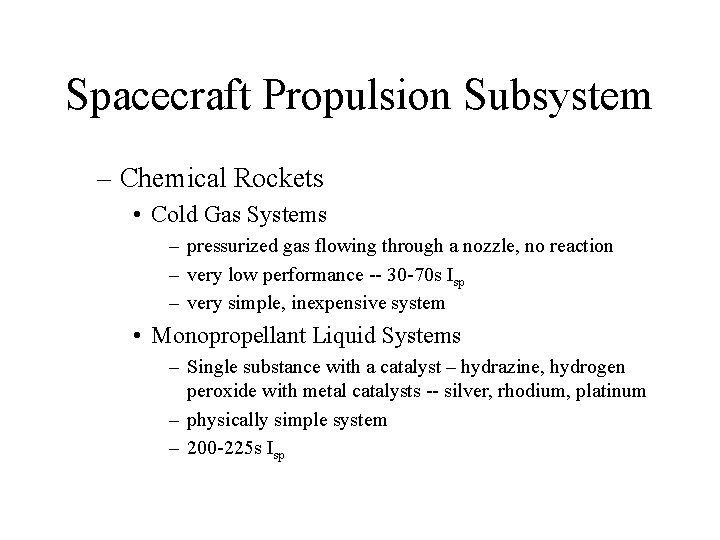
Spacecraft Propulsion Subsystem – Chemical Rockets • Cold Gas Systems – pressurized gas flowing through a nozzle, no reaction – very low performance -- 30 -70 s Isp – very simple, inexpensive system • Monopropellant Liquid Systems – Single substance with a catalyst – hydrazine, hydrogen peroxide with metal catalysts -- silver, rhodium, platinum – physically simple system – 200 -225 s Isp
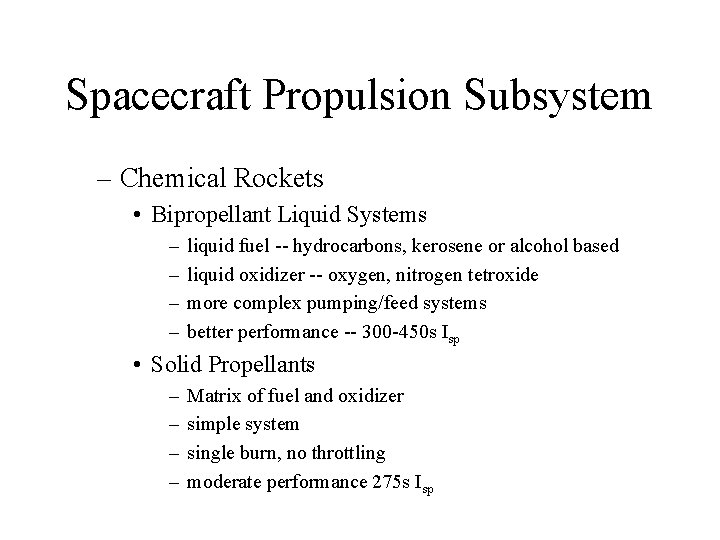
Spacecraft Propulsion Subsystem – Chemical Rockets • Bipropellant Liquid Systems – – liquid fuel -- hydrocarbons, kerosene or alcohol based liquid oxidizer -- oxygen, nitrogen tetroxide more complex pumping/feed systems better performance -- 300 -450 s Isp • Solid Propellants – – Matrix of fuel and oxidizer simple system single burn, no throttling moderate performance 275 s Isp
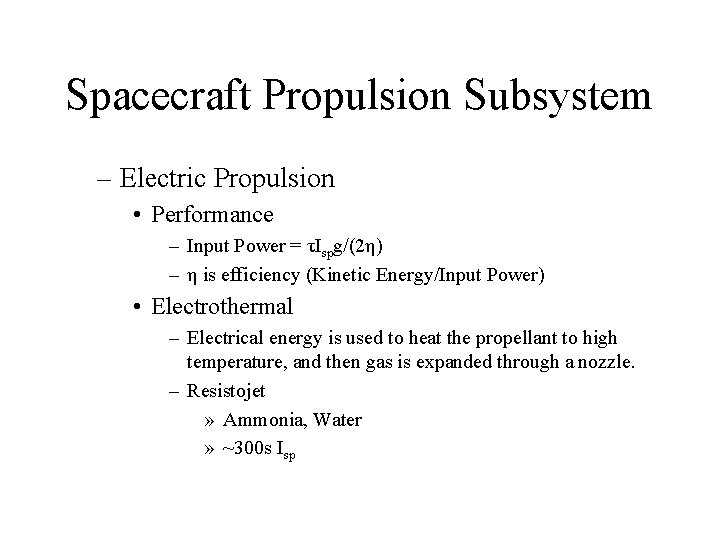
Spacecraft Propulsion Subsystem – Electric Propulsion • Performance – Input Power = τIspg/(2η) – η is efficiency (Kinetic Energy/Input Power) • Electrothermal – Electrical energy is used to heat the propellant to high temperature, and then gas is expanded through a nozzle. – Resistojet » Ammonia, Water » ~300 s Isp
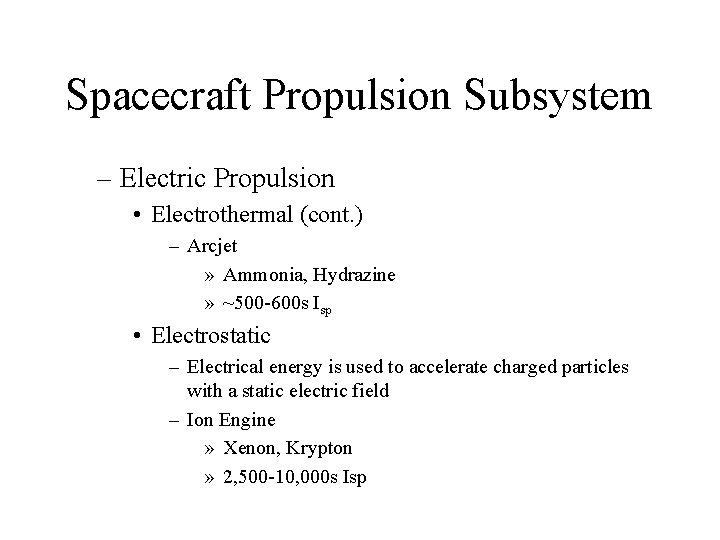
Spacecraft Propulsion Subsystem – Electric Propulsion • Electrothermal (cont. ) – Arcjet » Ammonia, Hydrazine » ~500 -600 s Isp • Electrostatic – Electrical energy is used to accelerate charged particles with a static electric field – Ion Engine » Xenon, Krypton » 2, 500 -10, 000 s Isp
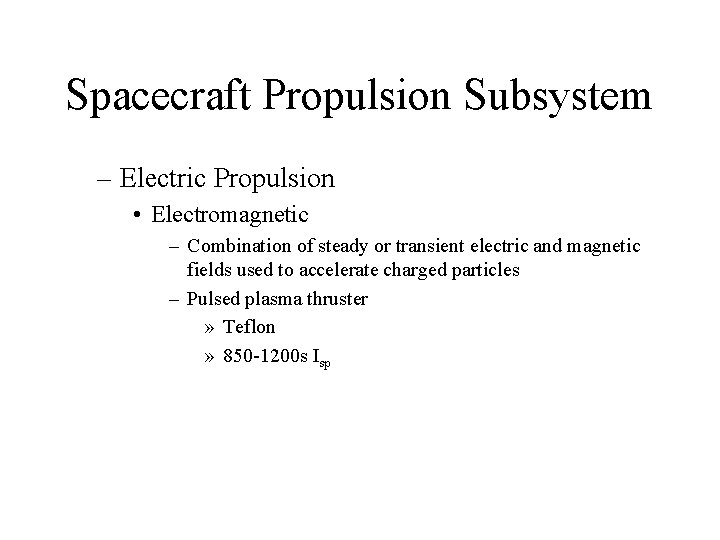
Spacecraft Propulsion Subsystem – Electric Propulsion • Electromagnetic – Combination of steady or transient electric and magnetic fields used to accelerate charged particles – Pulsed plasma thruster » Teflon » 850 -1200 s Isp
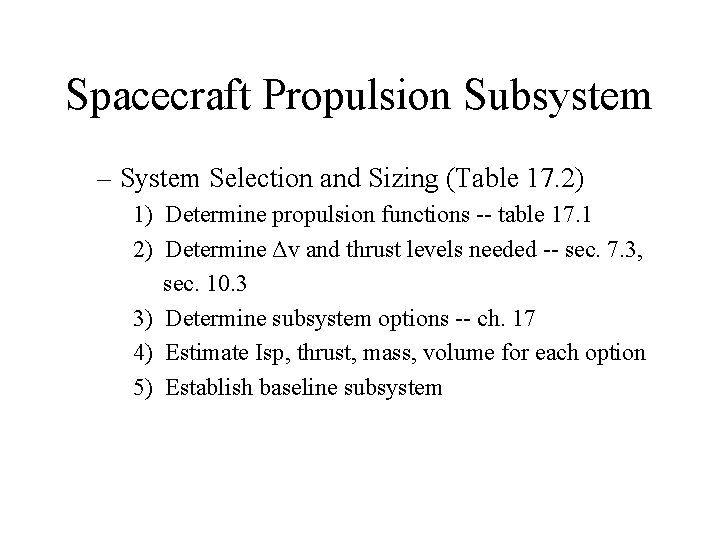
Spacecraft Propulsion Subsystem – System Selection and Sizing (Table 17. 2) 1) Determine propulsion functions -- table 17. 1 2) Determine Δv and thrust levels needed -- sec. 7. 3, sec. 10. 3 3) Determine subsystem options -- ch. 17 4) Estimate Isp, thrust, mass, volume for each option 5) Establish baseline subsystem
Spacecraft Propulsion Subsystem – References • Hill and Peterson, Mechanics and Thermodynamics of Propulsion • Sutton, Rocket Propulsion Elements • Micci and Ketsdever, eds. , Micropropulsion for Small Spacecraft. • Aersp 430, 530
- Slides: 14