
Aerospace Modeling Tutorial Lecture 2 Basic Aerodynamics Greg
Aerospace Modeling Tutorial Lecture 2 – Basic Aerodynamics Greg and Mario February 2, 2015
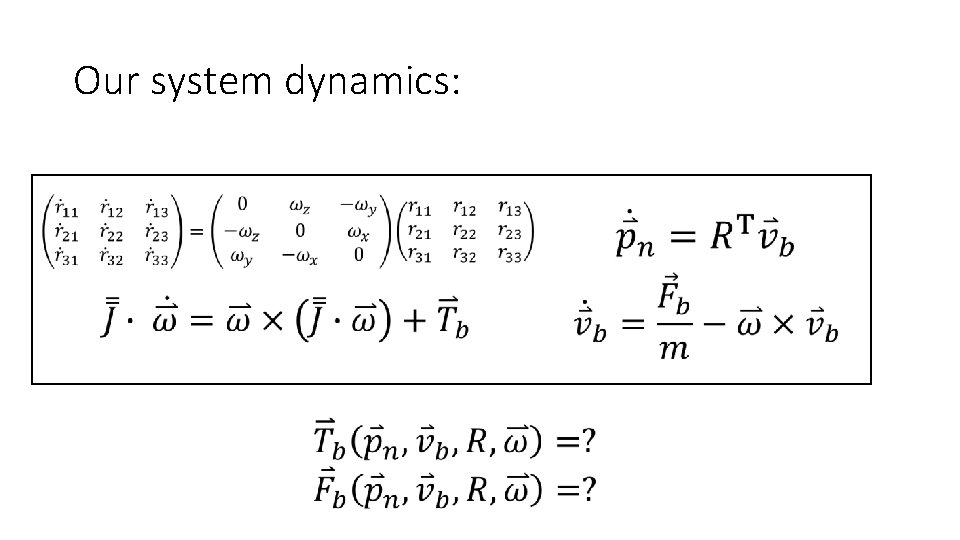
Our system dynamics:
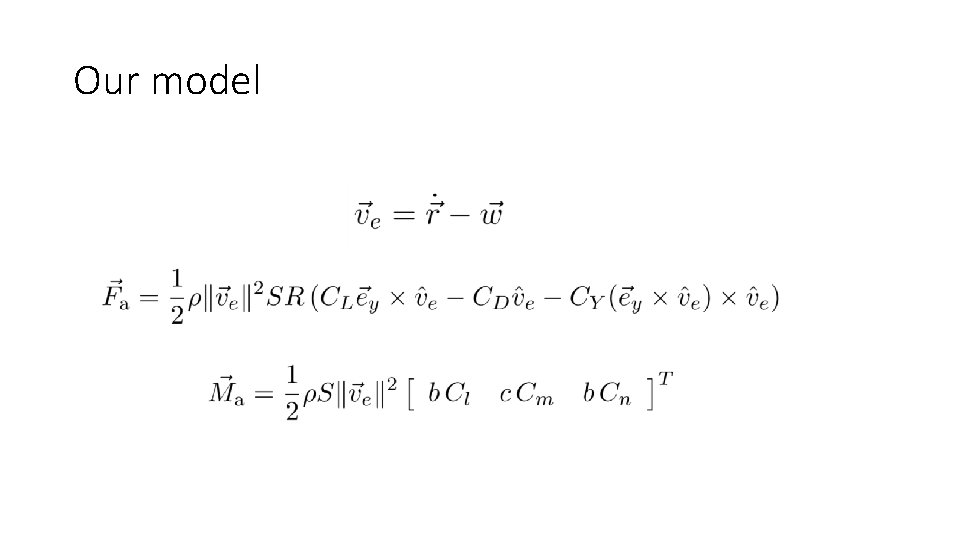
Our model
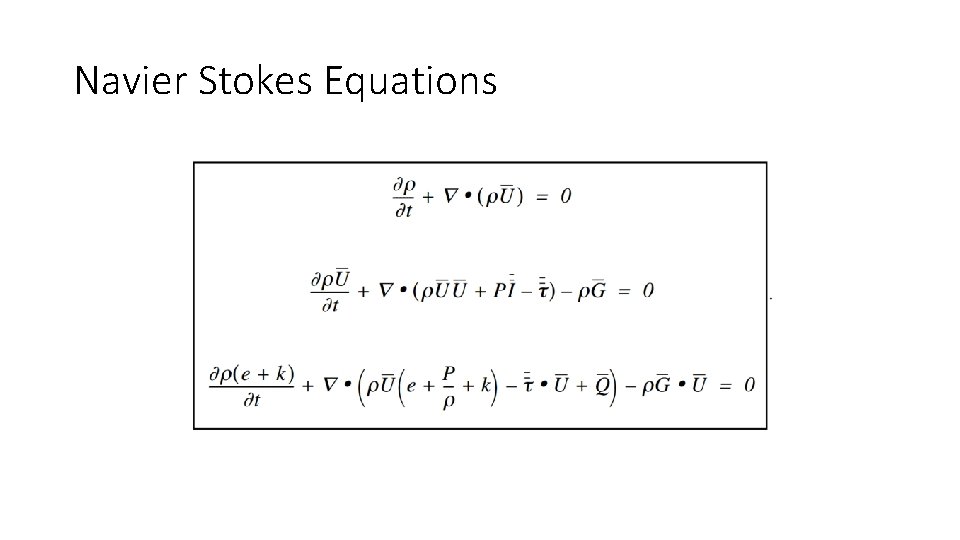
Navier Stokes Equations
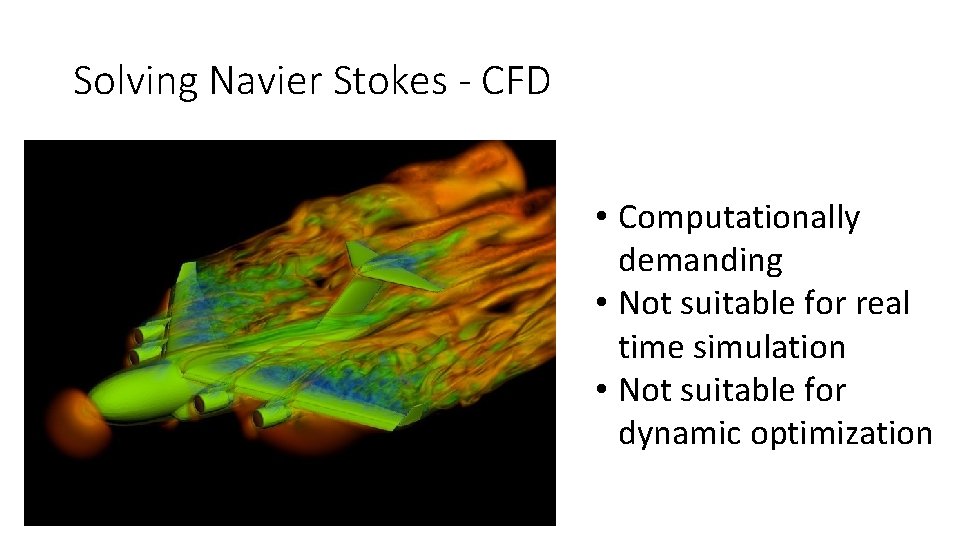
Solving Navier Stokes - CFD • Computationally demanding • Not suitable for real time simulation • Not suitable for dynamic optimization
How to simplify things?
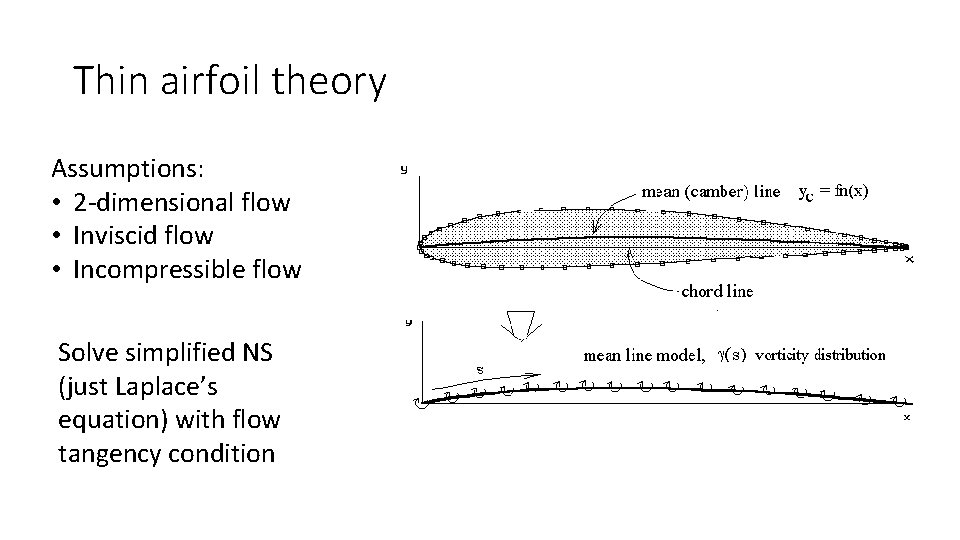
Thin airfoil theory Assumptions: • 2 -dimensional flow • Inviscid flow • Incompressible flow Solve simplified NS (just Laplace’s equation) with flow tangency condition

Thin airfoil theory Advantages: • Easy to compute • Fits well to data Drawbacks: • Predicts 0 drag • Real wings aren’t 2 -dimensional
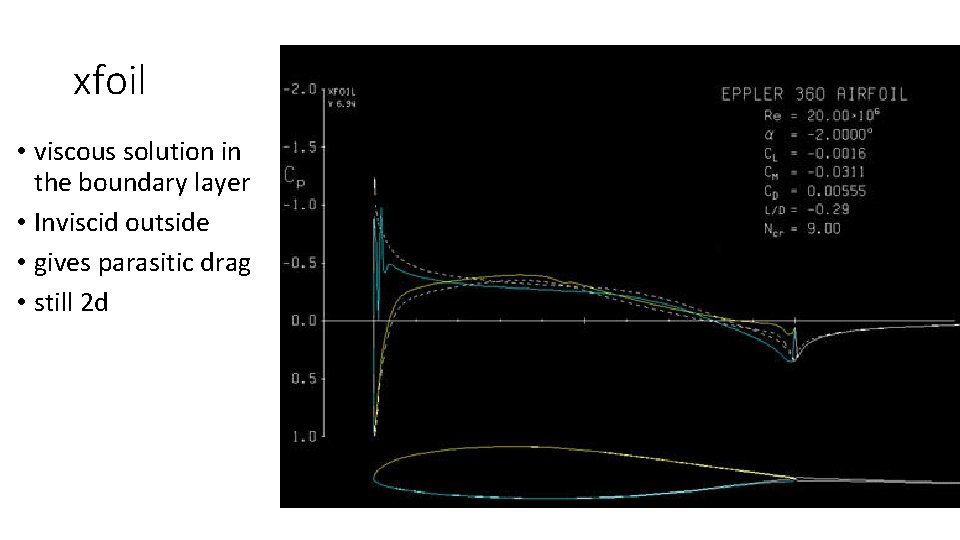
xfoil • viscous solution in the boundary layer • Inviscid outside • gives parasitic drag • still 2 d
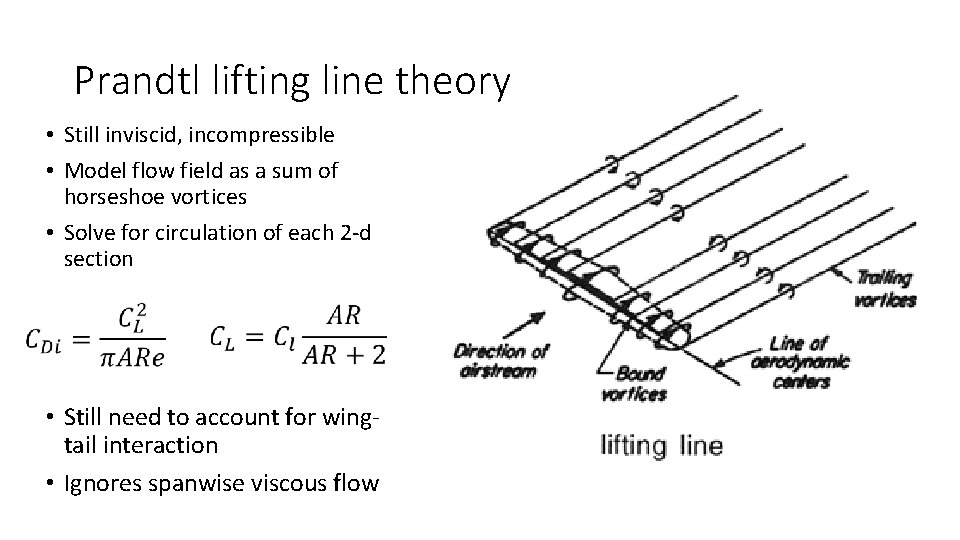
Prandtl lifting line theory • Still inviscid, incompressible • Model flow field as a sum of horseshoe vortices • Solve for circulation of each 2 -d section • Still need to account for wingtail interaction • Ignores spanwise viscous flow
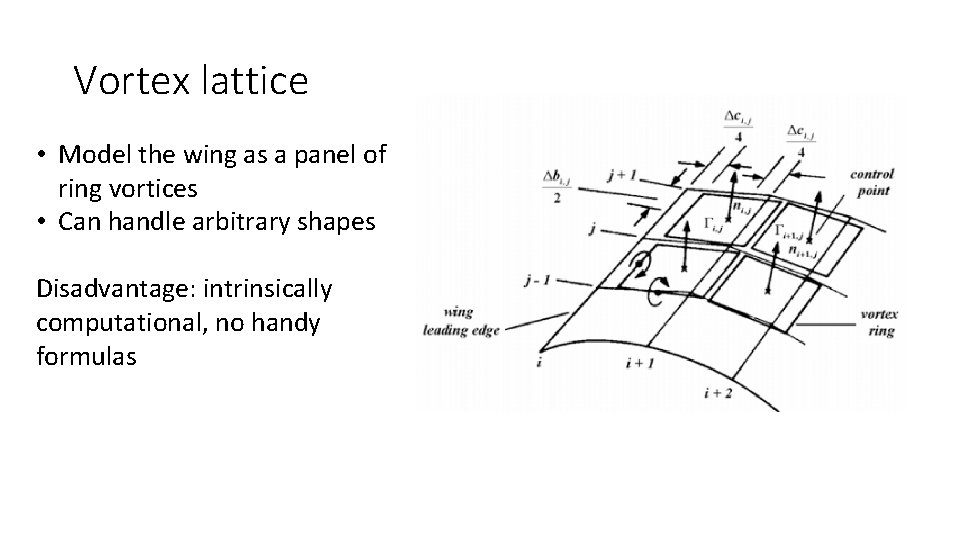
Vortex lattice • Model the wing as a panel of ring vortices • Can handle arbitrary shapes Disadvantage: intrinsically computational, no handy formulas
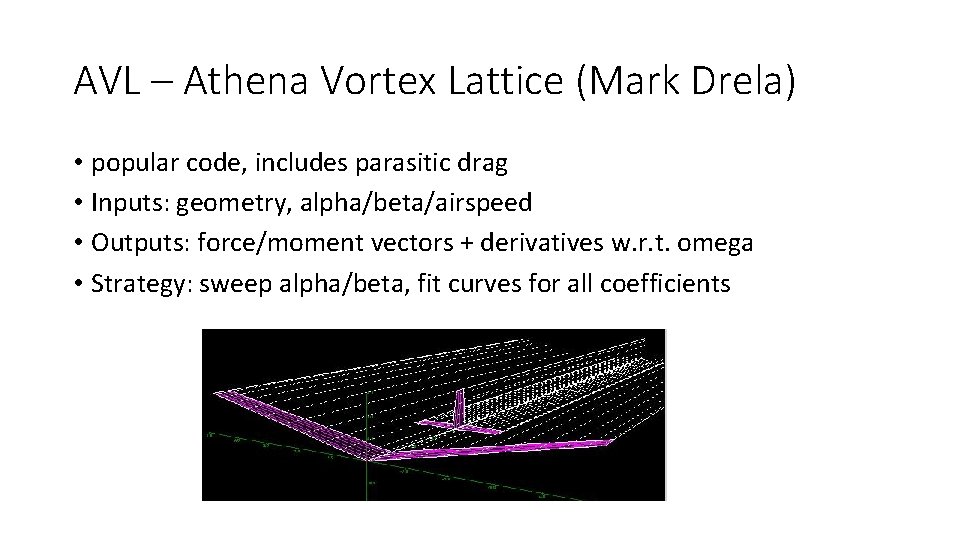
AVL – Athena Vortex Lattice (Mark Drela) • popular code, includes parasitic drag • Inputs: geometry, alpha/beta/airspeed • Outputs: force/moment vectors + derivatives w. r. t. omega • Strategy: sweep alpha/beta, fit curves for all coefficients
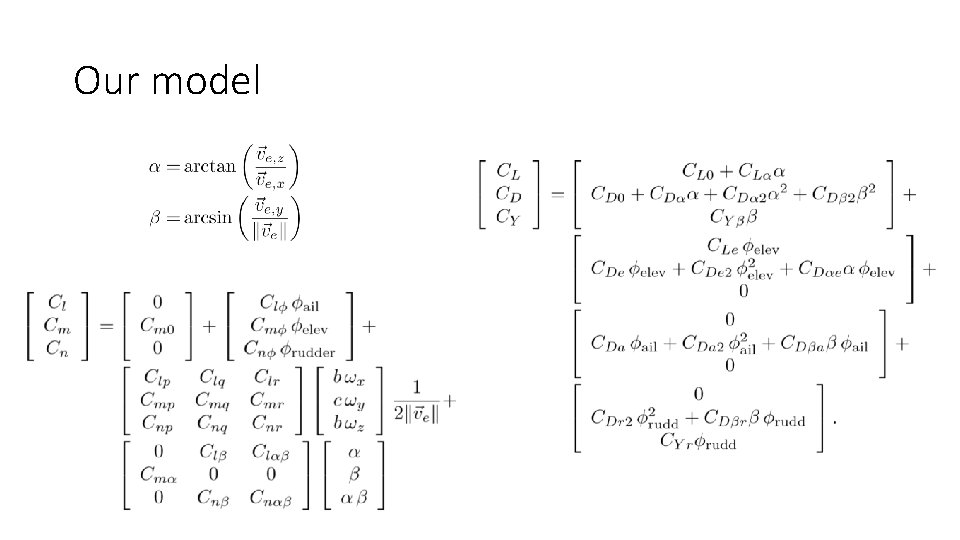
Our model
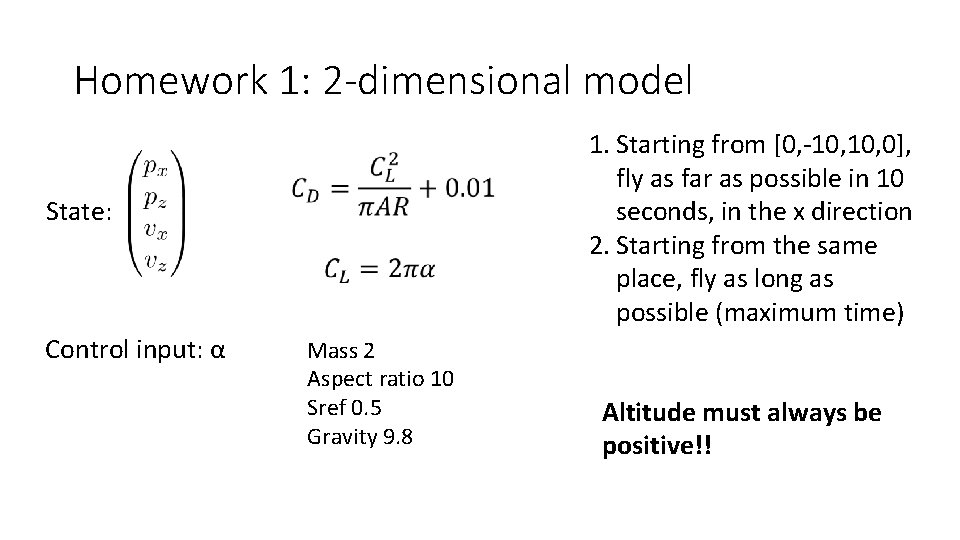
Homework 1: 2 -dimensional model State: Control input: α Mass 2 Aspect ratio 10 Sref 0. 5 Gravity 9. 8 1. Starting from [0, -10, 0], fly as far as possible in 10 seconds, in the x direction 2. Starting from the same place, fly as long as possible (maximum time) Altitude must always be positive!!
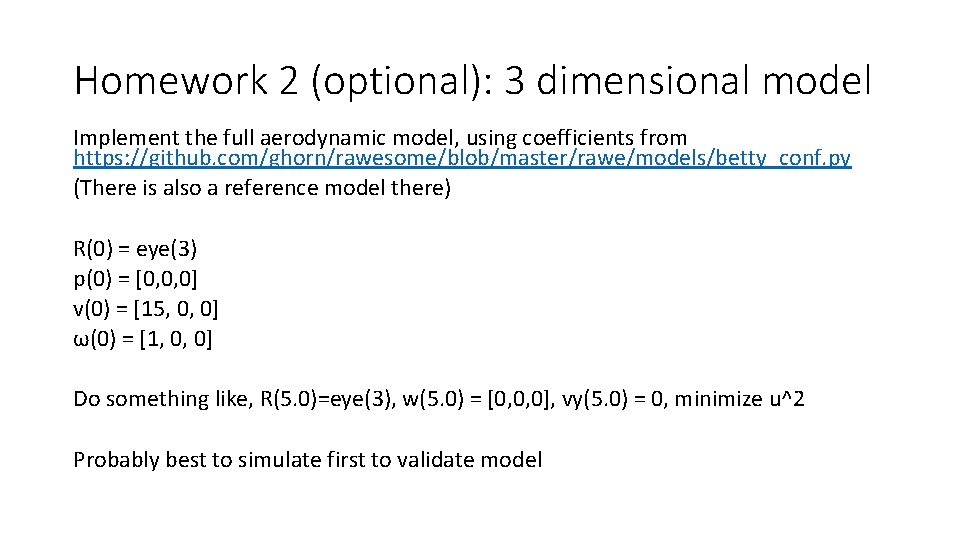
Homework 2 (optional): 3 dimensional model Implement the full aerodynamic model, using coefficients from https: //github. com/ghorn/rawesome/blob/master/rawe/models/betty_conf. py (There is also a reference model there) R(0) = eye(3) p(0) = [0, 0, 0] v(0) = [15, 0, 0] ω(0) = [1, 0, 0] Do something like, R(5. 0)=eye(3), w(5. 0) = [0, 0, 0], vy(5. 0) = 0, minimize u^2 Probably best to simulate first to validate model
- Slides: 15