
AEROSPACE DIMENSIONS SPACE ENVIRONMENT Module 5 Chapter 2


- Slides: 23
AEROSPACE DIMENSIONS SPACE ENVIRONMENT Module 5 – Chapter 2 STARS Based on Aerospace Dimensions Second Edition issued September 2010
LEARNING OUTCOMES - Define star Define nebula Describe the life cycle of a star Interpret a Hertzsprung Russell diagram
IMPORTANT TERMS Black hole– a region in space where no radiation is emitted. Constellation – A grouping of stars, named after mythical figures and animals. Light year – the distance light travels in one Earth year. Magnitude – measure of the brightness of a star. Nebula – giant cloud of gas and dust Parsec – distance equal to 3. 26 light years Pulsar – pulsating star that flashes electromagnetic emissions in a set pattern Star – a body of hot gases
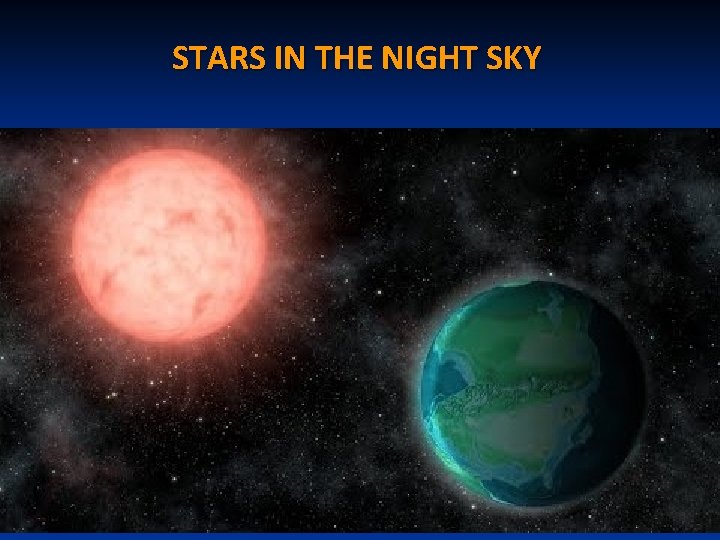
STARS IN THE NIGHT SKY • Star is a huge mass of hot gases. • Produces light as byproduct of nuclear reactions • Planet and Moons reflect this light, do not create It • Closest Star is Proxima Centauri • 4. 2 light years away • Cannot see with naked eye, and only from Southern Hemisphere • May host our closest potential Earth-like planet What’s the brightest star we can see?
STARS IN THE NIGHT SKY
MEASURING DISTANCES In what units do we measure distances to stars? • Light year – distance light can travel in one Earth year • One Light Year = Approximately 32, 000 round trips to the sun • Parsec – 3. 26 light years Why can some stars farther away be seen and closer ones cannot? It’s due to their BRIGHTNESS and DISTANCE from Earth.
MEASURING BRIGHTNESS • Magnitude – measure of brightness of a star. • Higher number indicates dimmer star. • Which is brighter? Magnitude 1. 1 or 2. 1? • Some stars can have a NEGATIVE magnitude. What does that mean? • Two types of Magnitude – Apparent & Absolute • Apparent magnitude is brightness as viewed from Earth • Absolute magnitude is brightness from 10 parsecs away Our Sun has an apparent magnitude of -26. 72 Do you think the Absolute magnitude will be higher or lower? Absolute Magnitude of Sun = 4. 8!
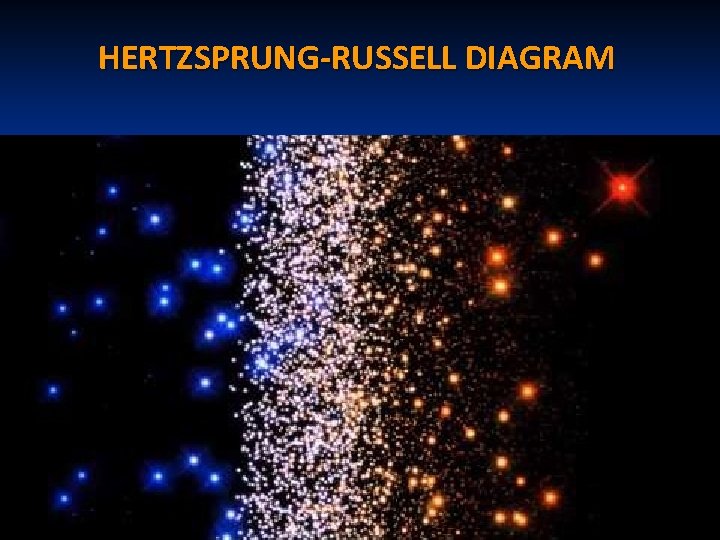
HERTZSPRUNG-RUSSELL DIAGRAM • Named after two astronomers who independently developed the first type of diagram in the early 1900 s. Plots stars according to their absolute magnitude and surface temperature Shows where stars are in their life cycle Surface Temperature classified into letters. OUR SUN – CLASS G
HERTZSPRUNG-RUSSELL DIAGRAM
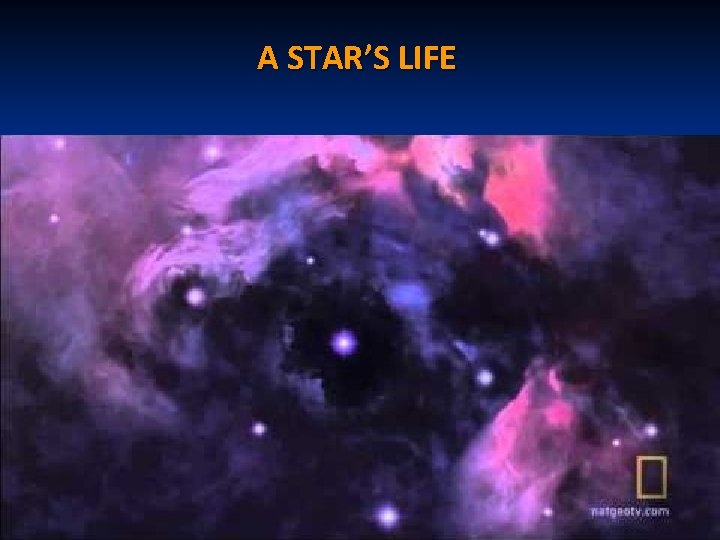
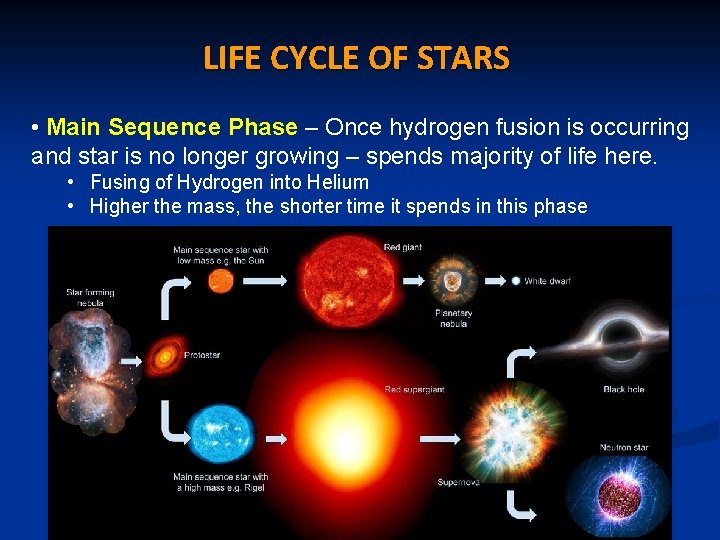
A STAR’S LIFE • Galaxies contain large clouds called nebulae that are spread throughout the galaxy. • Mostly Hydrogen and Helium • Occur where stars are forming, have exploded, or are shdding their outer layers toward the ends of their lives • Dark Nebula – Clouds that have not yet formed into stars • Bright Nebula – Studded with stars and have brilliant colors • Crab Nebula – Remnants of supernova stars that have exploded • As star begins to form, clumps of gases and dust come together • • • Gravity brings in and holds the gases together Gravity pulls inward and pressure drives outward creating balance The intense heat releases energy in form of light and heat Fusion of Hydrogen into Helium When fuel is gone, balance towards gravity and star begins to die
A STAR’S LIFE
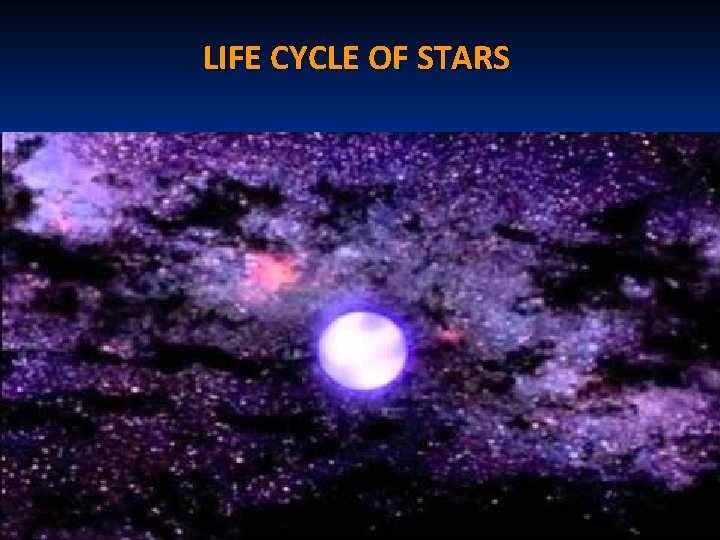
LIFE CYCLE OF STARS • Protostar – ball-shaped material within a nebula that could become a star. 1) Clumps of gas and dust come together at a central gravitational point 2) Disk of gas and dust surrounding protostar spins 3) Gravity draws in more clumps, generating heat 4) Higher pressures lead to nuclear fusion (1 MM Kelvin) 5) Over long period of time becomes a star if core gets dense and hot enough for Hydrogen fusion. (10 MM Kelvin) 6) Hydrogen fuses into Helium and protostar becomes star 7) How long it lives depends on mass of new star Kelvin – a temperature scale based on absolute zero. Used by scientists and researchers.
LIFE CYCLE OF STARS
LIFE CYCLE OF STARS • Main Sequence Phase – Once hydrogen fusion is occurring and star is no longer growing – spends majority of life here. • Fusing of Hydrogen into Helium • Higher the mass, the shorter time it spends in this phase
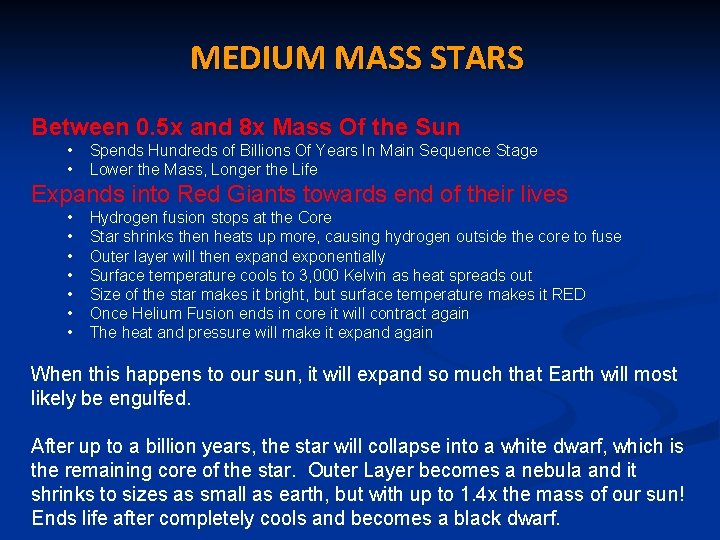
MEDIUM MASS STARS Between 0. 5 x and 8 x Mass Of the Sun • • Spends Hundreds of Billions Of Years In Main Sequence Stage Lower the Mass, Longer the Life Expands into Red Giants towards end of their lives • • Hydrogen fusion stops at the Core Star shrinks then heats up more, causing hydrogen outside the core to fuse Outer layer will then expand exponentially Surface temperature cools to 3, 000 Kelvin as heat spreads out Size of the star makes it bright, but surface temperature makes it RED Once Helium Fusion ends in core it will contract again The heat and pressure will make it expand again When this happens to our sun, it will expand so much that Earth will most likely be engulfed. After up to a billion years, the star will collapse into a white dwarf, which is the remaining core of the star. Outer Layer becomes a nebula and it shrinks to sizes as small as earth, but with up to 1. 4 x the mass of our sun! Ends life after completely cools and becomes a black dwarf.
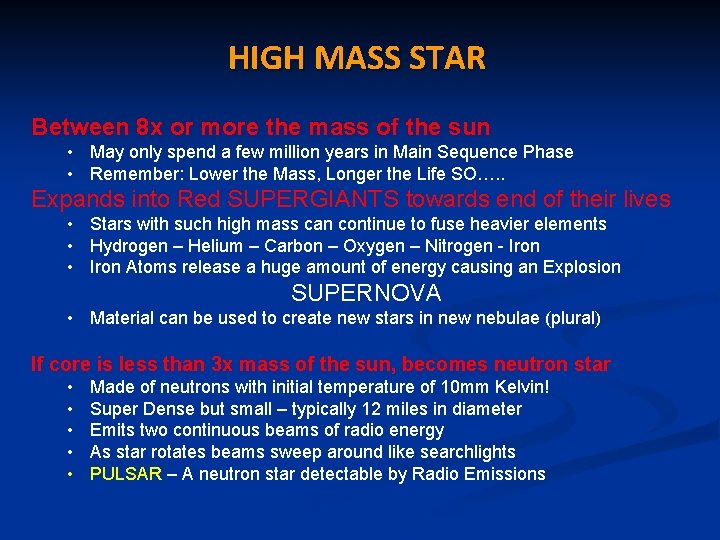
HIGH MASS STAR Between 8 x or more the mass of the sun • May only spend a few million years in Main Sequence Phase • Remember: Lower the Mass, Longer the Life SO…. . Expands into Red SUPERGIANTS towards end of their lives • Stars with such high mass can continue to fuse heavier elements • Hydrogen – Helium – Carbon – Oxygen – Nitrogen - Iron • Iron Atoms release a huge amount of energy causing an Explosion SUPERNOVA • Material can be used to create new stars in new nebulae (plural) If core is less than 3 x mass of the sun, becomes neutron star • • • Made of neutrons with initial temperature of 10 mm Kelvin! Super Dense but small – typically 12 miles in diameter Emits two continuous beams of radio energy As star rotates beams sweep around like searchlights PULSAR – A neutron star detectable by Radio Emissions
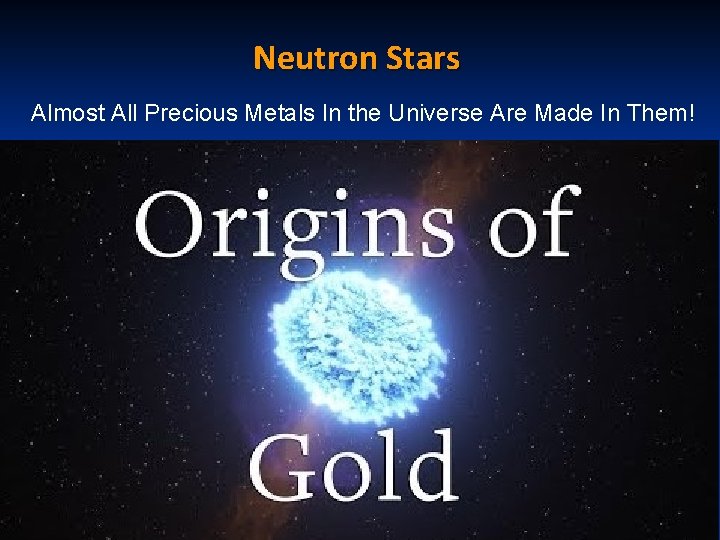
Neutron Stars Almost All Precious Metals In the Universe Are Made In Them!
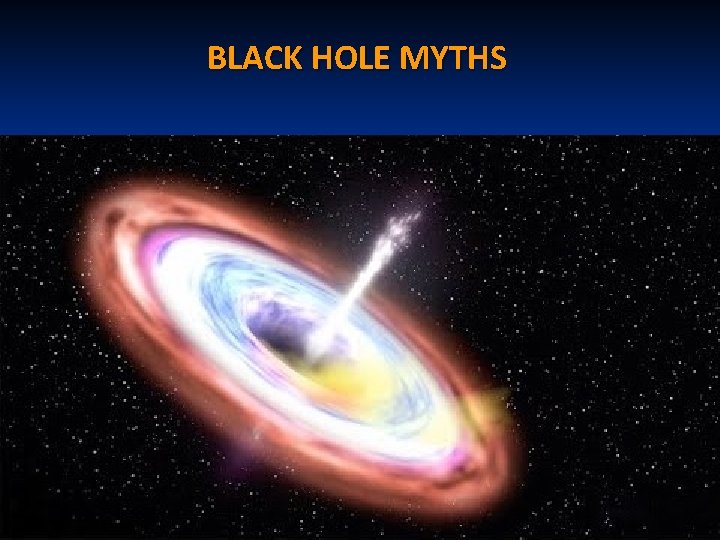
BLACK HOLES If core is 3 x or more mass of the sun, black hole! • Gravitational force so strong, nothing can escape it NOT EVEN LIGHT! Common Misconception: A Black Hole is like a vacuum cleaner • If our Sun was replaced with a black hole of the same mass, earth orbit would not change. • Why? The MASS is the same Schwarzschild radius – Radius where escape speed = speed of light • You have to cross this to be sucked into a black hole • If our sun was a black hole, the radius would be just 1. 9 miles. Black holes can be detected by x-rays shed as matter is drawn towards it • As atoms move close to black hole, they heat up. • Once heated to a few million Kelvin, they give of X-rays • Release before they cross the Schwarzchild radius
BLACK HOLE MYTHS
LOW MASS STARS Low mass stars have the longest lives! 0. 5 x mass of the sun down to. 08 x mass of the sun Red Dwarves are the most common low mass stars Proxima Centauri is a Red Dwarf • They become white dwarfs and then black dwarfs Brown Dwarfs • Failed Stars – too cool to achieve hydrogen fusion
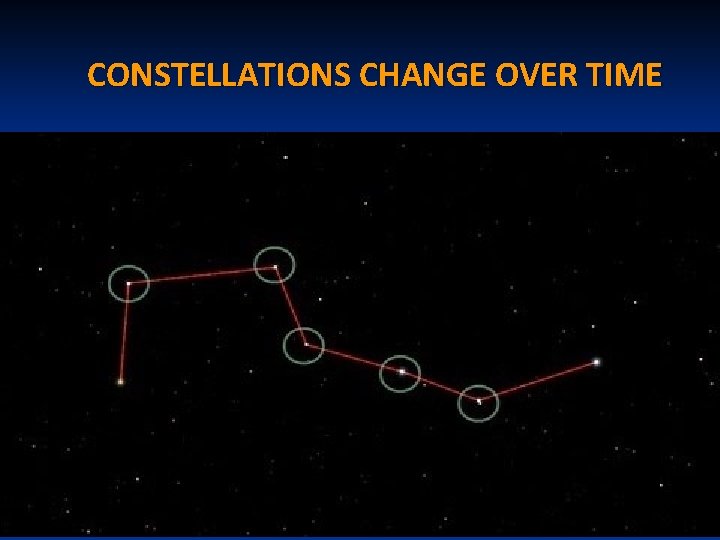
MULTIPLE STARS Binary Stars – two stars orbiting common center of mass • Brighter called the primary star • Other is called the companion star • About half of all stars come in pairs! Constellation – A Grouping of stars Early astronomers divided stars into groups and made imaginary figures out of them. 88 constellations used by astronomers today
CONSTELLATIONS CHANGE OVER TIME
QUESTIONS?