
Aerosol remote sensing based on combined use of

Aerosol remote sensing based on combined use of reflectance and polarization measurements Itaru Sano and Sonoyo Mukai Kinki University Japan
Contents 1. GCOM satellite series SGLI on GCOM-1 C 2. Aerosol retrieval 2 ch polarization method POLDER 2 ch polarization & 1 ch total radiance method POLDER + GOSAT / CAI Application to biomass burning aerosols
GCOM satellites
Background & Objective of GCOM-1 C / SGLI Japanese space agency (JAXA) has been developing the new Earth observing system, GCOM satellite series as contribution of GEO. GCOM-1 Climate will board the second generation global imager (SGLI) for monitoring the various kinds of Earth's reflectance's, atmosphere, land, and ocean). One of unique feature of SGLI compared to VIIRS or other imagers is polarization measurements at red and near infrared with high resolution (1 km x 1 km). A goal of this work is to develop an efficient algorithm for global aerosol retrieval by using both polarization and total radiance data given by SGLI on GCOM-C.

Global Change Observation Mission (GCOM) 2 satellite series for 5 years, total 13 years observation. ü GCOM-W AMSR 2 (AMSR-E follow on microwave radiometer) for WATER CYCLE ( Satellite name : 雫 ) ü GCOM-C SGLI (GLI follow on) for RADIATION BUDGET and CARBON CYCLE GCOM-C (CLIMATE) AMSR 2 GCOM-W (WATER) Shizuku Sensor SGLI Advanced Microwave Radiometer 2 (AMSR 2) Passive Microwave Observation Water vapor, soil moisture etc Sensor Second Generation Global Imager (SGLI) Optical Observation 380 nm – 12 micron Cloud, Aerosol, Vegetation, Chlorophyll etc Courtesy of Dr. Tanaka (JAXA/EORC) 5

SGLI on GCOM-1 Climate satellite SGLI ; Second Generation Global Imager +Y deep space +X flight direction + Z earth SGLI IRS (Infrared Scanning Radiometer) SGLI VNR (Visible and Near IR Radiometer) Mission Life > 5 years Solar Paddle > 4000 w (End of Life) Mass about 2, 000 kg Courtesy of Dr. Tanaka (JAXA/EORC) 6
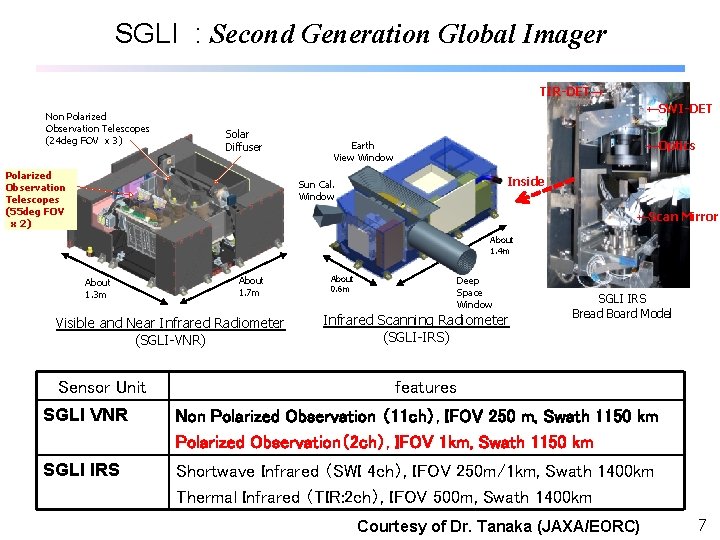
SGLI : Second Generation Global Imager TIR-DET→ Non Polarized Observation Telescopes (24 deg FOV x 3) ←SWI-DET Solar Diffuser Polarized Observation Telescopes (55 deg FOV x 2) Earth View Window ←Optics Inside Sun Cal. Window ←Scan Mirror About 1. 4 m About 1. 3 m About 1. 7 m Visible and Near Infrared Radiometer (SGLI-VNR) Sensor Unit About 0. 6 m Deep Space Window Infrared Scanning Radiometer (SGLI-IRS) SGLI IRS Bread Board Model features SGLI VNR Non Polarized Observation (11 ch), IFOV 250 m, Swath 1150 km Polarized Observation(2 ch), IFOV 1 km, Swath 1150 km SGLI IRS Shortwave Infrared (SWI 4 ch), IFOV 250 m/1 km, Swath 1400 km Thermal Infrared (TIR: 2 ch), IFOV 500 m, Swath 1400 km Courtesy of Dr. Tanaka (JAXA/EORC) 7
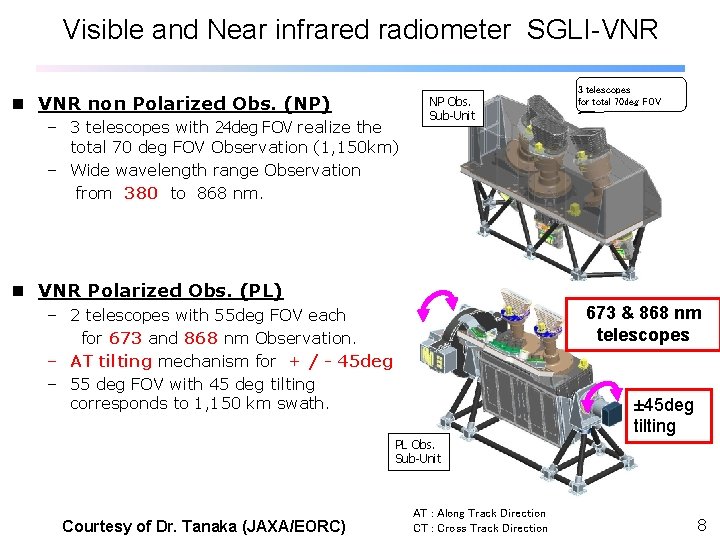
Visible and Near infrared radiometer SGLI-VNR non Polarized Obs. (NP) – 3 telescopes with 24 deg FOV realize the total 70 deg FOV Observation (1, 150 km) – Wide wavelength range Observation from 380 to 868 nm. NP Obs. Sub-Unit 3 telescopes for total 70 deg FOV n VNR Polarized Obs. (PL) 673 & 868 nm telescopes – 2 telescopes with 55 deg FOV each for 673 and 868 nm Observation. – AT tilting mechanism for + / - 45 deg – 55 deg FOV with 45 deg tilting corresponds to 1, 150 km swath. ± 45 deg tilting PL Obs. Sub-Unit Courtesy of Dr. Tanaka (JAXA/EORC) AT : Along Track Direction CT : Cross Track Direction 8
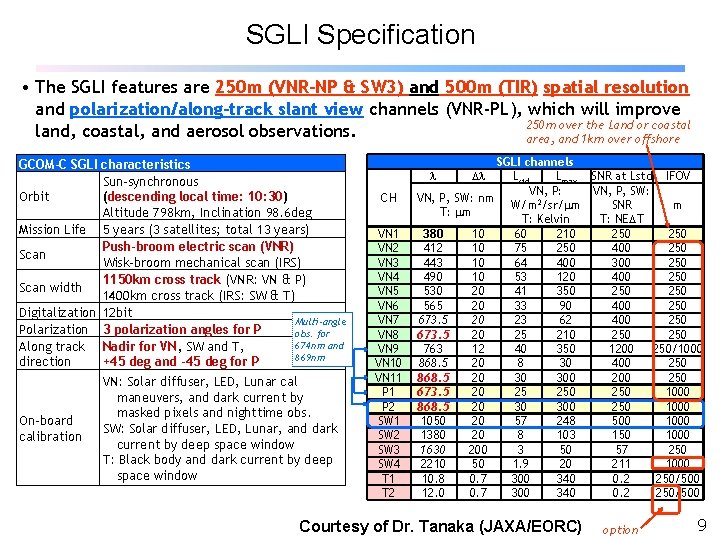
SGLI Specification • The SGLI features are 250 m (VNR-NP & SW 3) and 500 m (TIR) spatial resolution and polarization/along-track slant view channels (VNR-PL), which will improve 250 m over the Land or coastal land, coastal, and aerosol observations. area, and 1 km over offshore GCOM-C SGLI characteristics Sun-synchronous (descending local time: 10: 30) Orbit Altitude 798 km, Inclination 98. 6 deg Mission Life 5 years (3 satellites; total 13 years) Push-broom electric scan (VNR) Scan Wisk-broom mechanical scan (IRS) 1150 km cross track (VNR: VN & P) Scan width 1400 km cross track (IRS: SW & T) Digitalization 12 bit Multi-angle Polarization 3 polarization angles for P obs. for 674 nm and Along track Nadir for VN, SW and T, 869 nm direction +45 deg and -45 deg for P On-board calibration VN: Solar diffuser, LED, Lunar cal maneuvers, and dark current by masked pixels and nighttime obs. SW: Solar diffuser, LED, Lunar, and dark current by deep space window T: Black body and dark current by deep space window CH VN 1 VN 2 VN 3 VN 4 VN 5 VN 6 VN 7 VN 8 VN 9 VN 10 VN 11 P 2 SW 1 SW 2 SW 3 SW 4 T 1 T 2 SGLI channels Lstd Lmax SNR at Lstd IFOV VN, P: VN, P, SW: nm 2 m W/m /sr/ m SNR T: m T: Kelvin T: NE T 380 10 60 210 250 412 10 75 250 400 250 443 10 64 400 300 250 490 10 53 120 400 250 530 20 41 350 250 565 20 33 90 400 250 673. 5 20 23 62 400 250 673. 5 20 25 210 250 763 12 40 350 1200 250/1000 868. 5 20 8 30 400 250 868. 5 20 30 300 250 673. 5 20 25 250 1000 868. 5 20 30 300 250 1000 1050 20 57 248 500 1000 1380 20 8 103 150 1000 1630 200 3 50 57 250 2210 50 1. 9 20 211 1000 10. 8 0. 7 300 340 0. 2 250/500 12. 0 0. 7 300 340 0. 2 250/500 Courtesy of Dr. Tanaka (JAXA/EORC) option 9
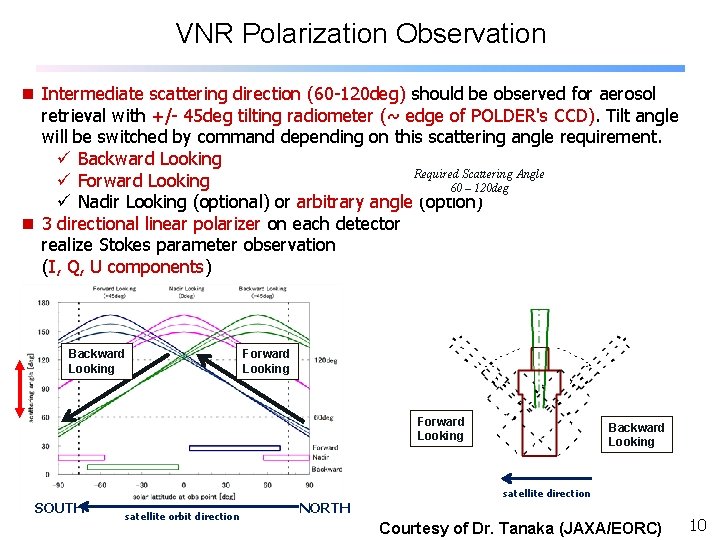
VNR Polarization Observation n Intermediate scattering direction (60 -120 deg) should be observed for aerosol retrieval with +/- 45 deg tilting radiometer (~ edge of POLDER's CCD). Tilt angle will be switched by command depending on this scattering angle requirement. ü Backward Looking Required Scattering Angle ü Forward Looking 60 – 120 deg ü Nadir Looking (optional) or arbitrary angle (option) n 3 directional linear polarizer on each detector realize Stokes parameter observation (I, Q, U components) Backward Looking Forward Looking SOUTH satellite orbit direction NORTH Backward Looking satellite direction Courtesy of Dr. Tanaka (JAXA/EORC) 10
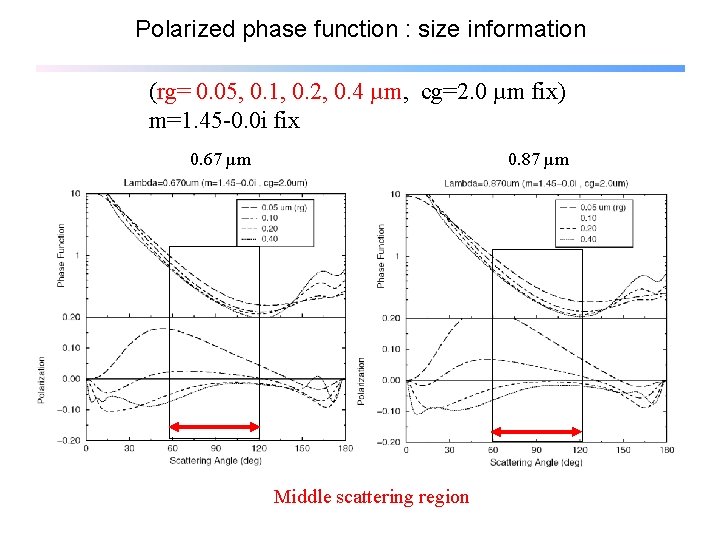
Polarized phase function : size information (rg= 0. 05, 0. 1, 0. 2, 0. 4 µm, cg=2. 0 µm fix) m=1. 45 -0. 0 i fix 0. 67 µm 0. 87 µm Middle scattering region
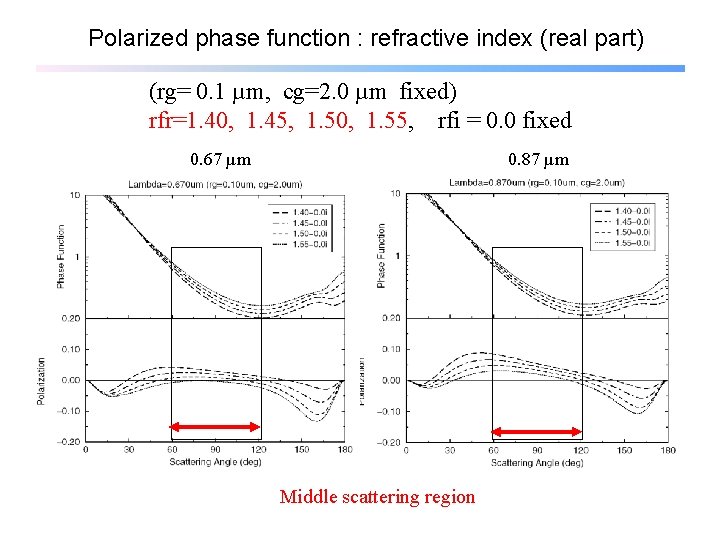
Polarized phase function : refractive index (real part) (rg= 0. 1 µm, cg=2. 0 µm fixed) rfr=1. 40, 1. 45, 1. 50, 1. 55, rfi = 0. 0 fixed 0. 67 µm 0. 87 µm Middle scattering region
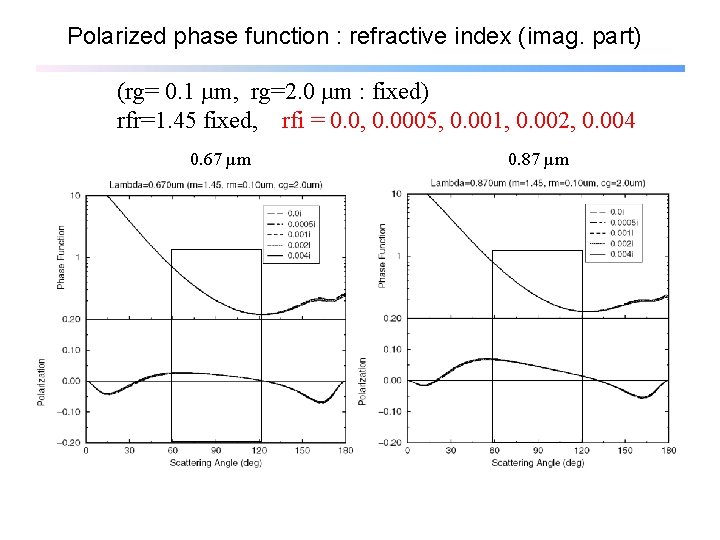
Polarized phase function : refractive index (imag. part) (rg= 0. 1 µm, rg=2. 0 µm : fixed) rfr=1. 45 fixed, rfi = 0. 0, 0. 0005, 0. 001, 0. 002, 0. 004 0. 67 µm 0. 87 µm
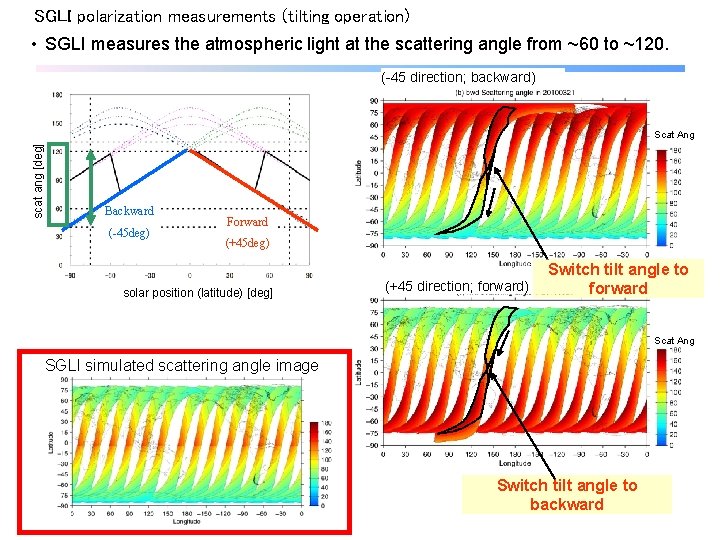
SGLI polarization measurements (tilting operation) • SGLI measures the atmospheric light at the scattering angle from ~60 to ~120. (-45 direction; backward) scat ang [deg] Scat Ang Backward (-45 deg) Forward (+45 deg) solar position (latitude) [deg] (+45 direction; forward) Switch tilt angle to forward Scat Ang SGLI simulated scattering angle image Switch tilt angle to backward
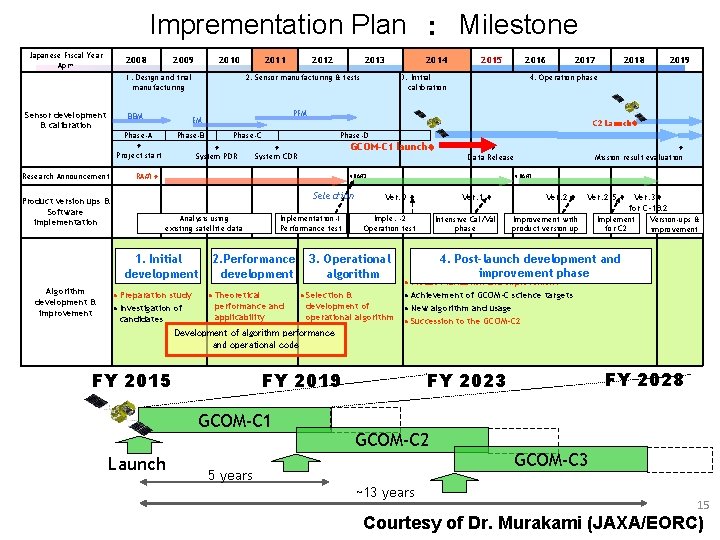
Imprementation Plan : Milestone Japanese Fiscal Year Apr~ 2008 2009 2010 1. Design and trial manufacturing Sensor development & calibration BBM 2013 Phase-B 2014 2015 3. Initial calibration 2019 Phase-D GCOM-C 1 launch System CDR Selection Inplementation-1 Performance test Analysis using existing satellite data candidates 2018 4. Operation phase Data Release RA#2 • Preparation study • Investigation of 2017 C 2 Launch Phase-C System PDR 1. Initial development 2016 PFM RA#1 Product version ups & Software implementation Algorithm development & improvement 2012 2. Sensor manufacturing & tests EM Phase-A Project start Research Announcement 2011 2. Performance development • Theoretical RA#3 Ver. 0 Ver. 1 Imple. -2 Operation test 3. Operational algorithm • Selection & performance and applicability Mission result evaluation development of operational algorithm Intensive Cal/Val phase Ver. 2. 5 Ver. 3 for C-1&2 Improvement with product version up Implement for C 2 Version-ups & improvement 4. Post-launch development and improvement phase • Product validation and improvement • Achievement of GCOM-C science targets • New algorithm and usage • Succession to the GCOM-C 2 Development of algorithm performance and operational code FY 2015 FY 2019 GCOM-C 1 Launch FY 2028 FY 2023 GCOM-C 2 5 years ~13 years GCOM-C 3 15 Courtesy of Dr. Murakami (JAXA/EORC)
Aerosol retrieval algorithm for SGLI
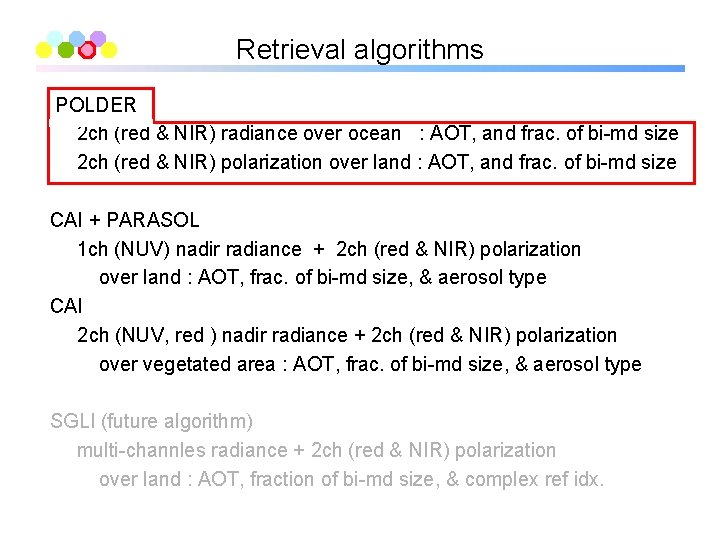
Retrieval algorithms POLDER 2 ch (red & NIR) radiance over ocean : AOT, and frac. of bi-md size 2 ch (red & NIR) polarization over land : AOT, and frac. of bi-md size CAI + PARASOL 1 ch (NUV) nadir radiance + 2 ch (red & NIR) polarization over land : AOT, frac. of bi-md size, & aerosol type CAI 2 ch (NUV, red ) nadir radiance + 2 ch (red & NIR) polarization over vegetated area : AOT, frac. of bi-md size, & aerosol type SGLI (future algorithm) multi-channles radiance + 2 ch (red & NIR) polarization over land : AOT, fraction of bi-md size, & complex ref idx.
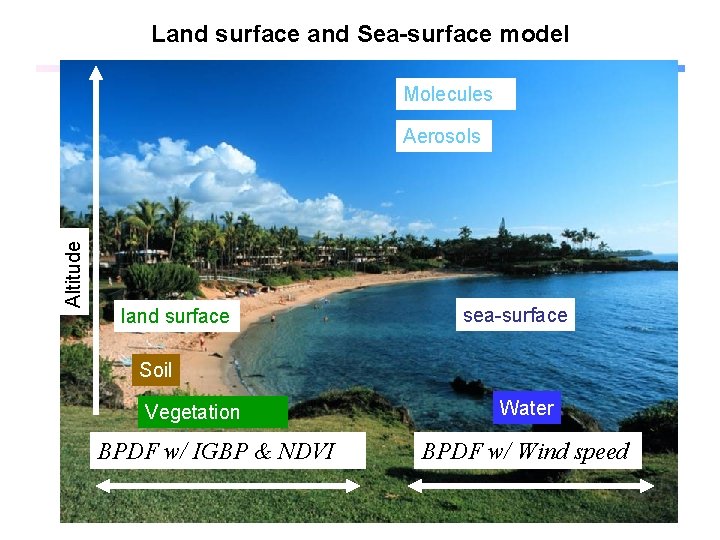
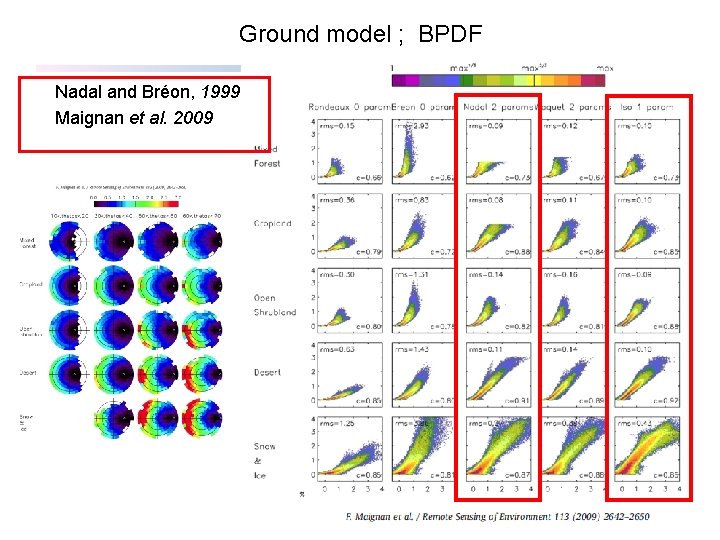
Land surface and Sea-surface model Molecules Altitude Aerosols land surface sea-surface Soil Vegetation BPDF w/ IGBP & NDVI Water BPDF w/ Wind speed
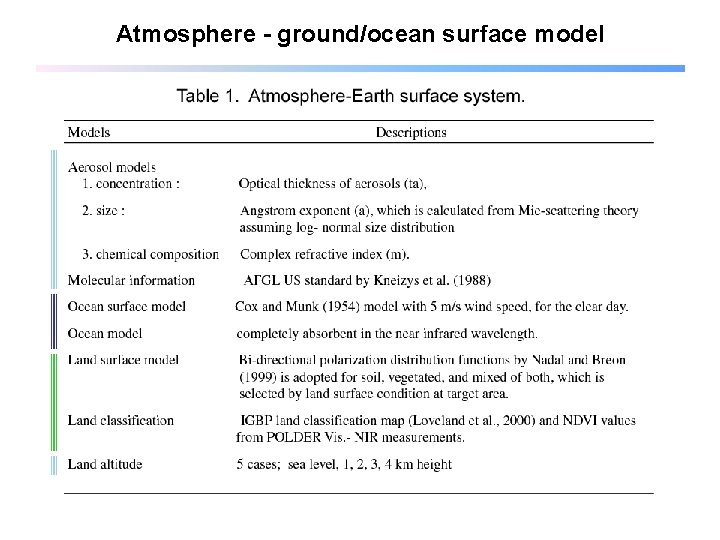
Atmosphere - ground/ocean surface model
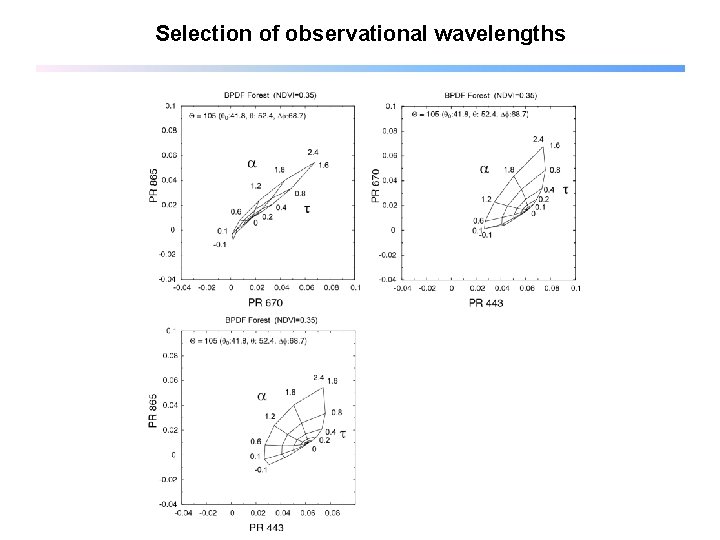
Selection of observational wavelengths
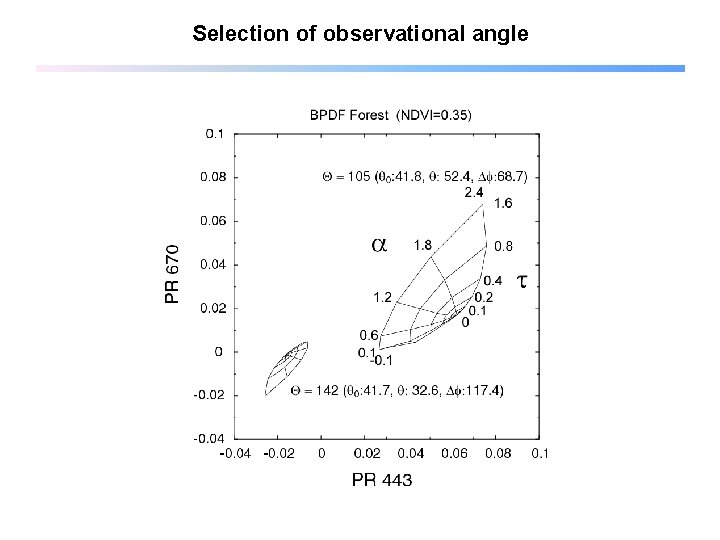
Selection of observational angle
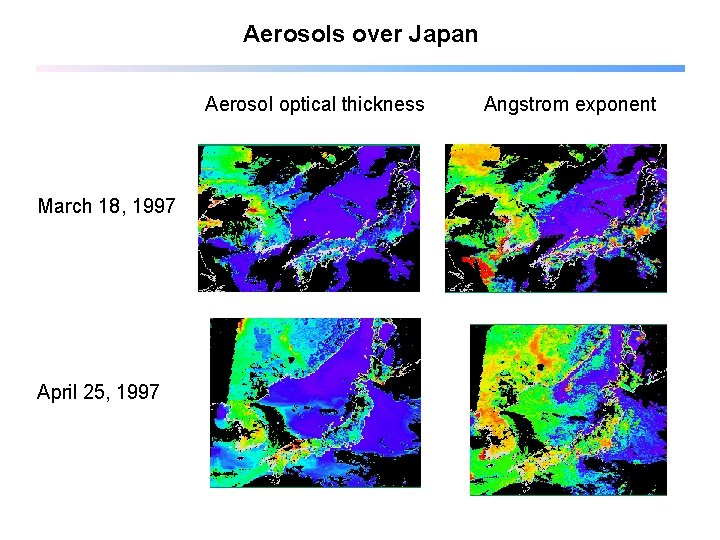
Aerosols over Japan Aerosol optical thickness March 18, 1997 April 25, 1997 Angstrom exponent
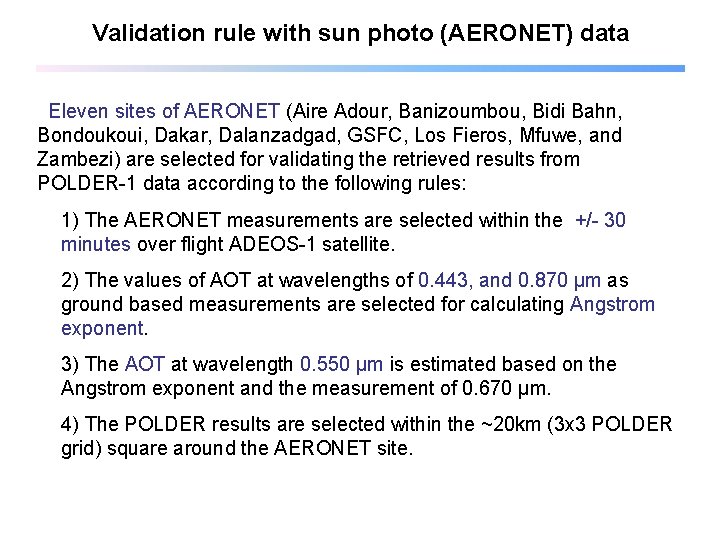
Validation rule with sun photo (AERONET) data Eleven sites of AERONET (Aire Adour, Banizoumbou, Bidi Bahn, Bondoukoui, Dakar, Dalanzadgad, GSFC, Los Fieros, Mfuwe, and Zambezi) are selected for validating the retrieved results from POLDER-1 data according to the following rules: 1) The AERONET measurements are selected within the +/- 30 minutes over flight ADEOS-1 satellite. 2) The values of AOT at wavelengths of 0. 443, and 0. 870 µm as ground based measurements are selected for calculating Angstrom exponent. 3) The AOT at wavelength 0. 550 µm is estimated based on the Angstrom exponent and the measurement of 0. 670 µm. 4) The POLDER results are selected within the ~20 km (3 x 3 POLDER grid) square around the AERONET site.
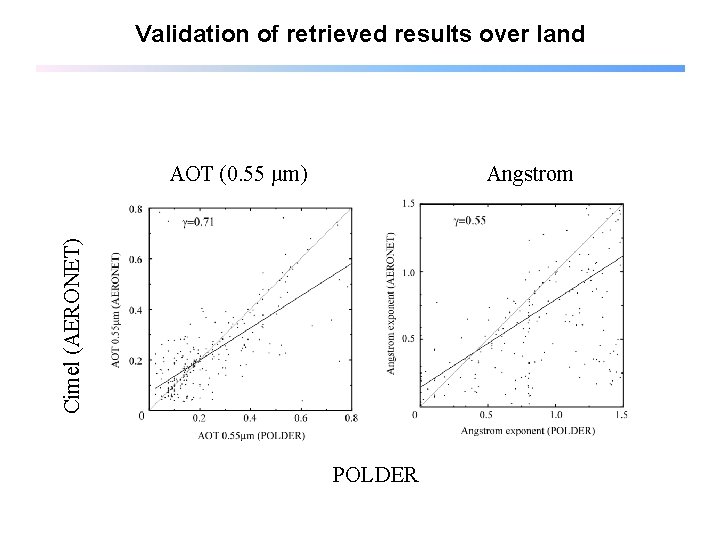
Validation of retrieved results over land Angstrom Cimel (AERONET) AOT (0. 55 µm) POLDER
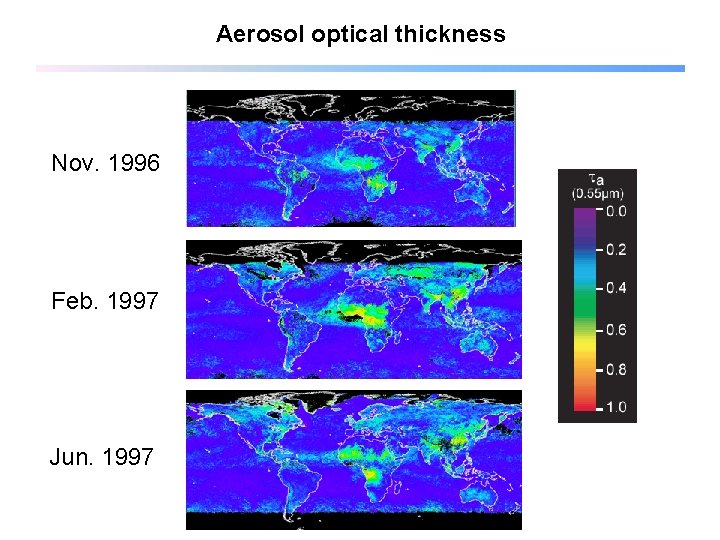
Aerosol optical thickness Nov. 1996 Feb. 1997 Jun. 1997
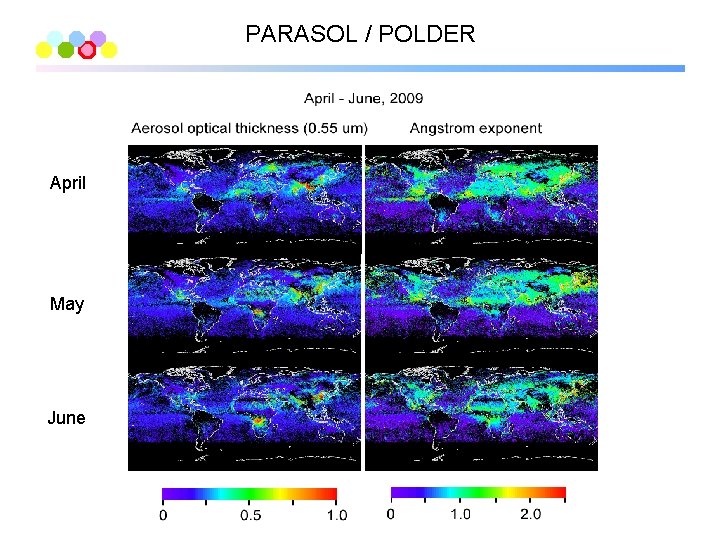
PARASOL / POLDER April May June
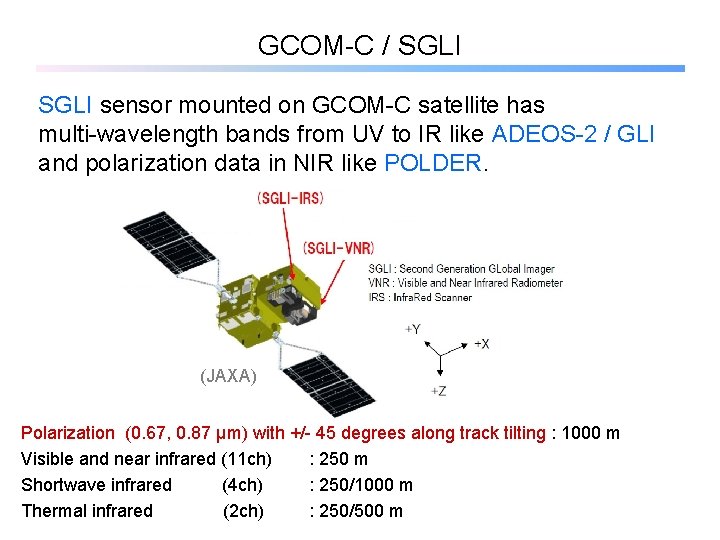
GCOM-C / SGLI sensor mounted on GCOM-C satellite has multi-wavelength bands from UV to IR like ADEOS-2 / GLI and polarization data in NIR like POLDER. (JAXA) Polarization (0. 67, 0. 87 µm) with +/- 45 degrees along track tilting : 1000 m Visible and near infrared (11 ch) : 250 m Shortwave infrared (4 ch) : 250/1000 m Thermal infrared (2 ch) : 250/500 m
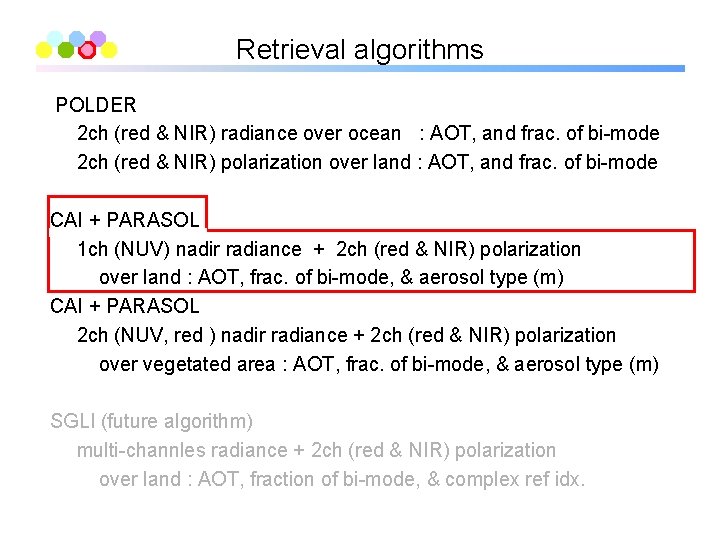
Retrieval algorithms POLDER 2 ch (red & NIR) radiance over ocean : AOT, and frac. of bi-mode 2 ch (red & NIR) polarization over land : AOT, and frac. of bi-mode CAI + PARASOL 1 ch (NUV) nadir radiance + 2 ch (red & NIR) polarization over land : AOT, frac. of bi-mode, & aerosol type (m) CAI + PARASOL 2 ch (NUV, red ) nadir radiance + 2 ch (red & NIR) polarization over vegetated area : AOT, frac. of bi-mode, & aerosol type (m) SGLI (future algorithm) multi-channles radiance + 2 ch (red & NIR) polarization over land : AOT, fraction of bi-mode, & complex ref idx.
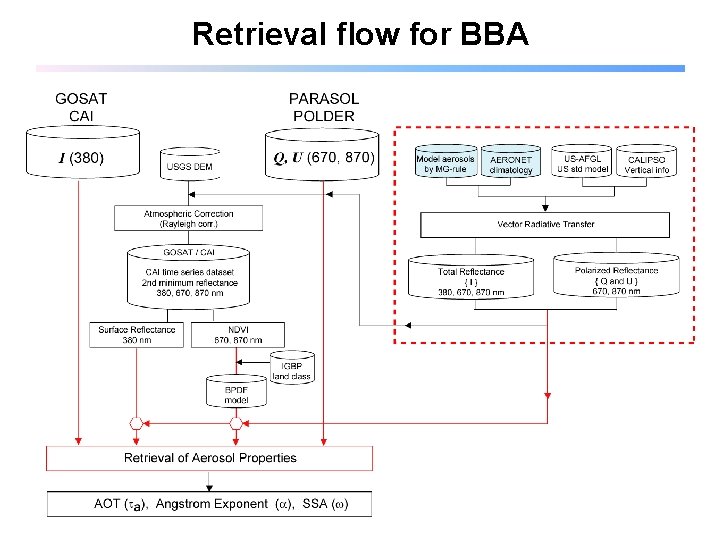
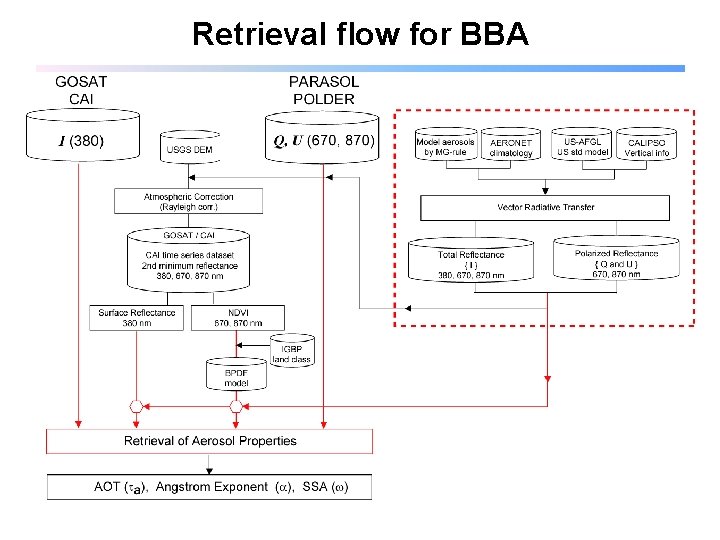
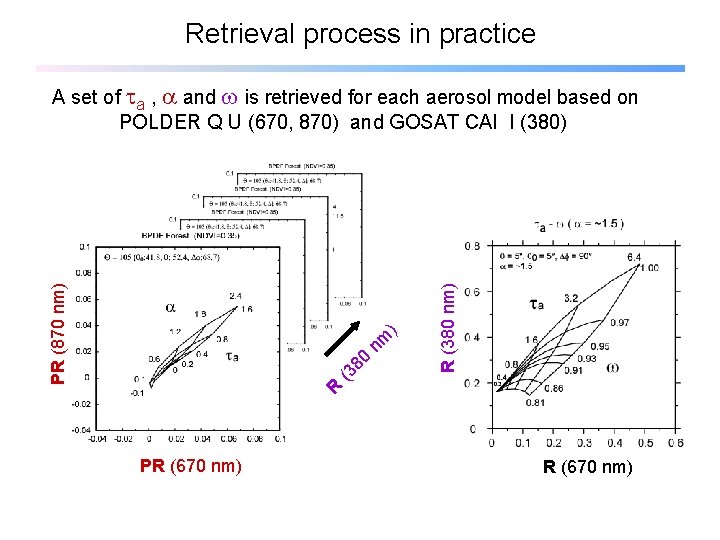
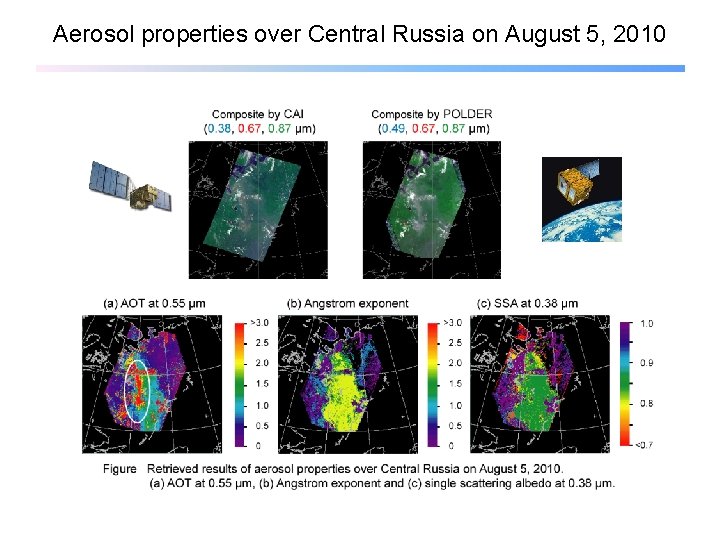
Retrieval of biomass burning aerosols based on combined use of near-UV radiance by GOSAT/CAI & near-IR polarization by PARASOL/POLDER.
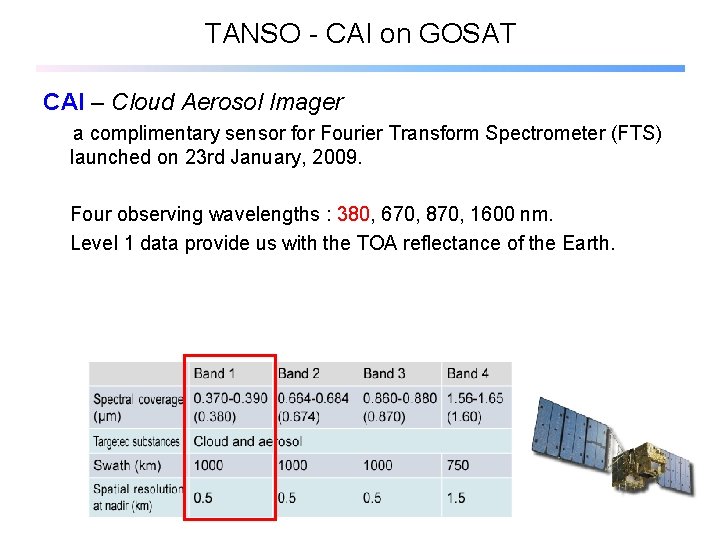
TANSO - CAI on GOSAT CAI – Cloud Aerosol Imager a complimentary sensor for Fourier Transform Spectrometer (FTS) launched on 23 rd January, 2009. Four observing wavelengths : 380, 670, 870, 1600 nm. Level 1 data provide us with the TOA reflectance of the Earth.
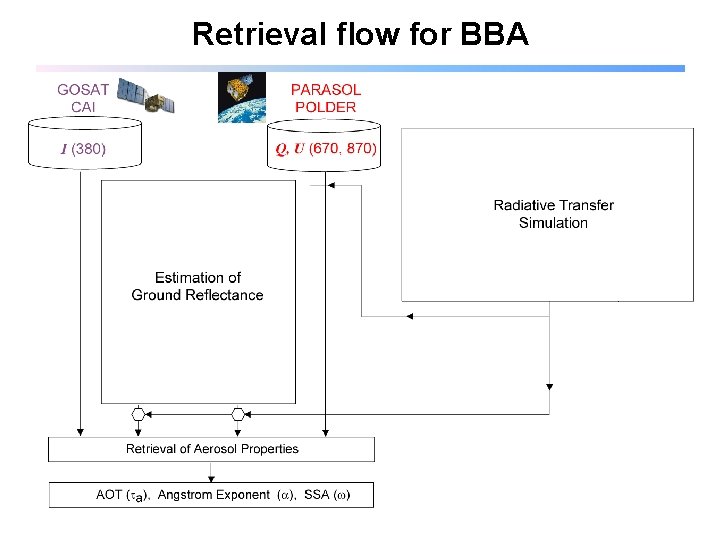
Retrieval flow for BBA
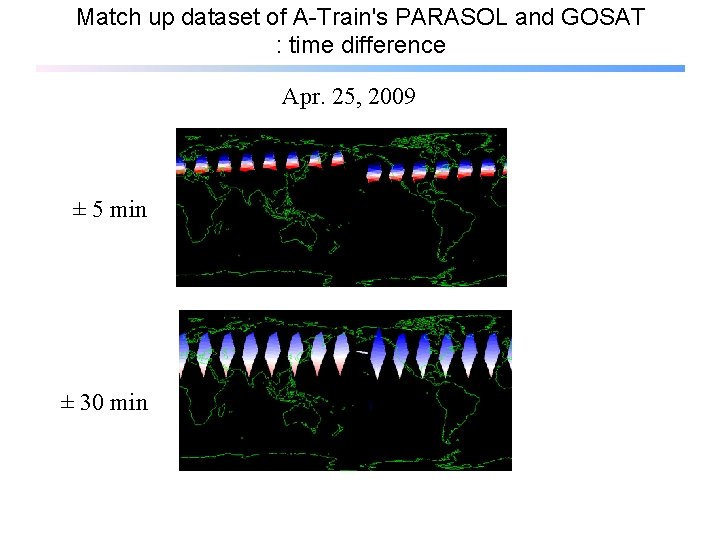
Match up dataset of A-Train's PARASOL and GOSAT : time difference Apr. 25, 2009 ± 5 min ± 30 min
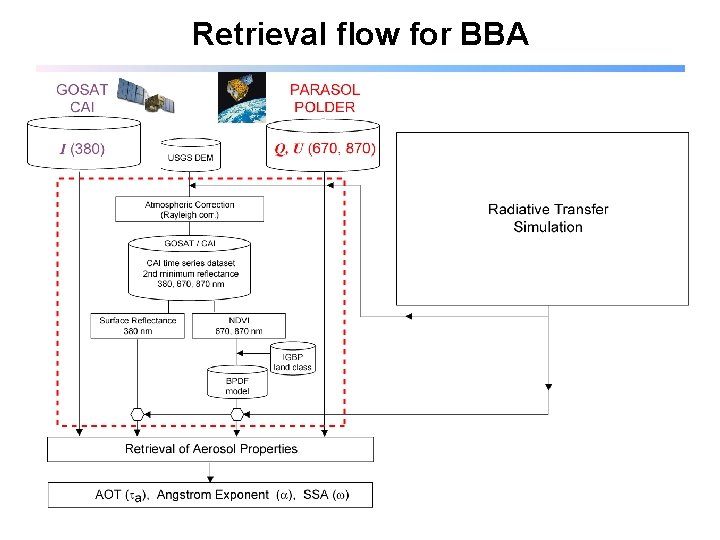
Retrieval flow for BBA
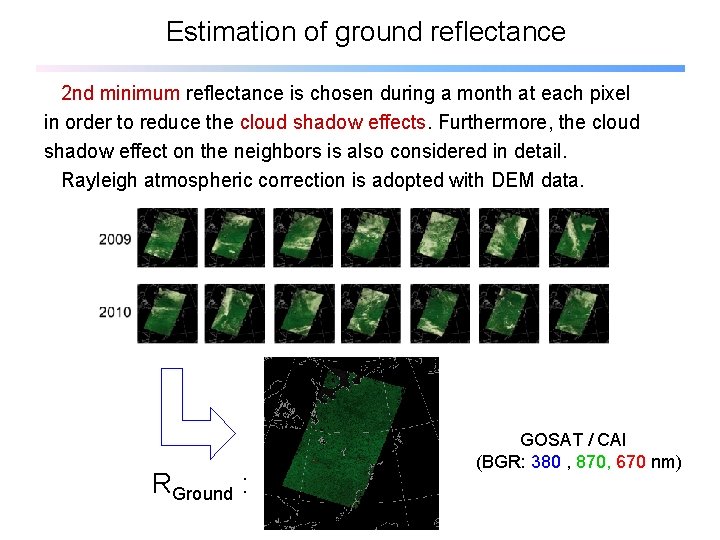
Estimation of ground reflectance 2 nd minimum reflectance is chosen during a month at each pixel in order to reduce the cloud shadow effects. Furthermore, the cloud shadow effect on the neighbors is also considered in detail. Rayleigh atmospheric correction is adopted with DEM data. RGround : GOSAT / CAI (BGR: 380 , 870, 670 nm)
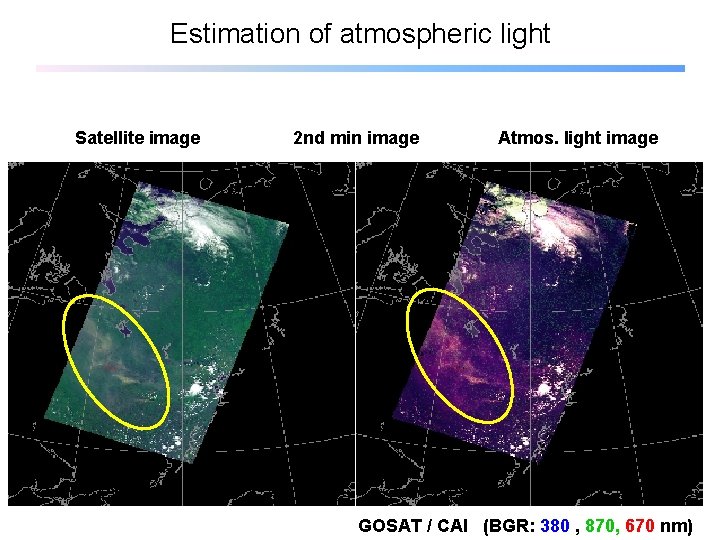
Estimation of atmospheric light Satellite image 2 nd min image Atmos. light image GOSAT / CAI (BGR: 380 , 870, 670 nm)
Retrieval flow for BBA
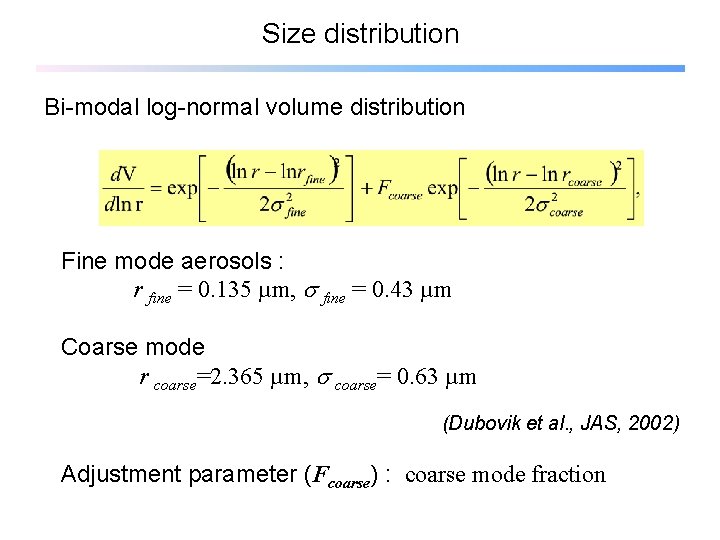
Size distribution Bi-modal log-normal volume distribution Fine mode aerosols : r fine = 0. 135 µm, fine = 0. 43 µm Coarse mode r coarse=2. 365 µm, coarse= 0. 63 µm (Dubovik et al. , JAS, 2002) Adjustment parameter (Fcoarse) : coarse mode fraction
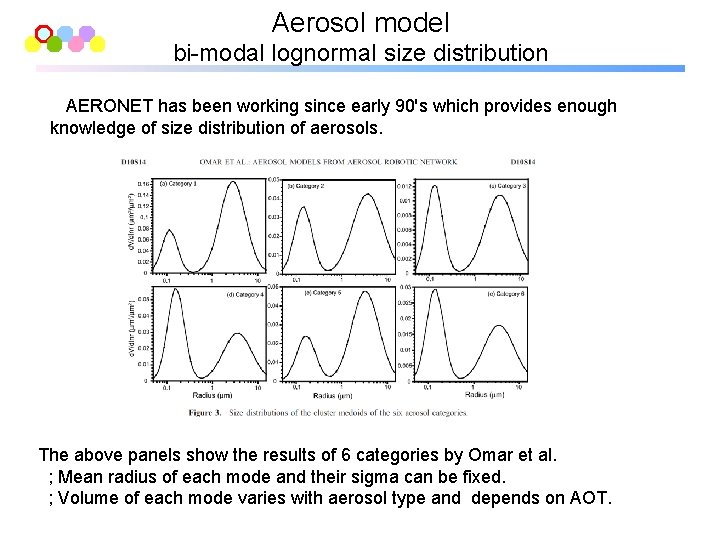
Aerosol model bi-modal lognormal size distribution AERONET has been working since early 90's which provides enough knowledge of size distribution of aerosols. The above panels show the results of 6 categories by Omar et al. ; Mean radius of each mode and their sigma can be fixed. ; Volume of each mode varies with aerosol type and depends on AOT.
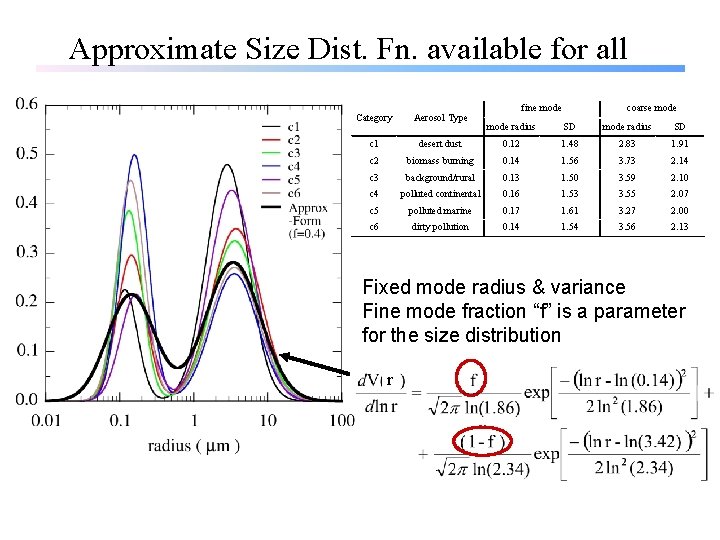
Approximate Size Dist. Fn. available for all Category Aerosol Type c 1 fine mode coarse mode radius SD desert dust 0. 12 1. 48 2. 83 1. 91 c 2 biomass burning 0. 14 1. 56 3. 73 2. 14 c 3 background/rural 0. 13 1. 50 3. 59 2. 10 c 4 polluted continental 0. 16 1. 53 3. 55 2. 07 c 5 polluted marine 0. 17 1. 61 3. 27 2. 00 c 6 dirty pollution 0. 14 1. 54 3. 56 2. 13 Fixed mode radius & variance r mode fraction “f” is a parameter Fine for the size distribution r
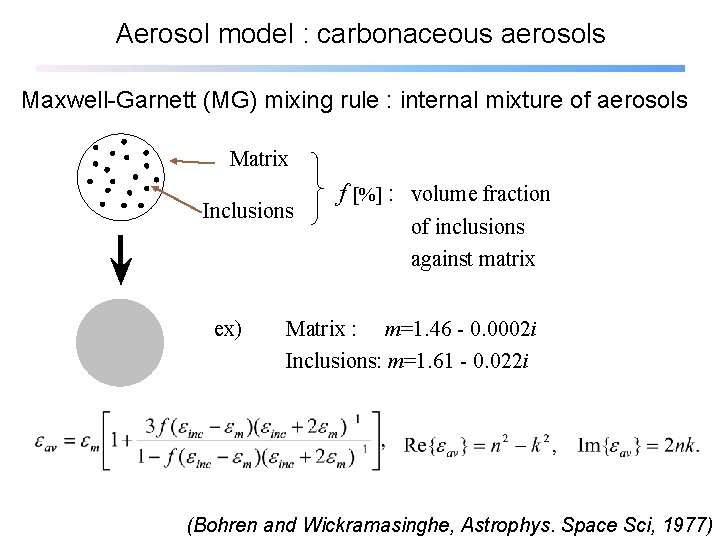
Aerosol model : carbonaceous aerosols Maxwell-Garnett (MG) mixing rule : internal mixture of aerosols Matrix Inclusions ex) f [%] : volume fraction of inclusions against matrix Matrix : m=1. 46 - 0. 0002 i Inclusions: m=1. 61 - 0. 022 i (Bohren and Wickramasinghe, Astrophys. Space Sci, 1977)
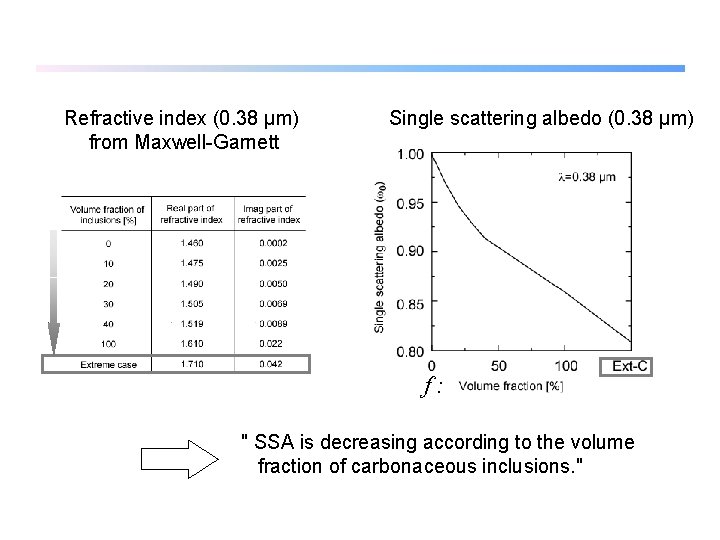
Refractive index (0. 38 µm) from Maxwell-Garnett Single scattering albedo (0. 38 µm) f: " SSA is decreasing according to the volume fraction of carbonaceous inclusions. "
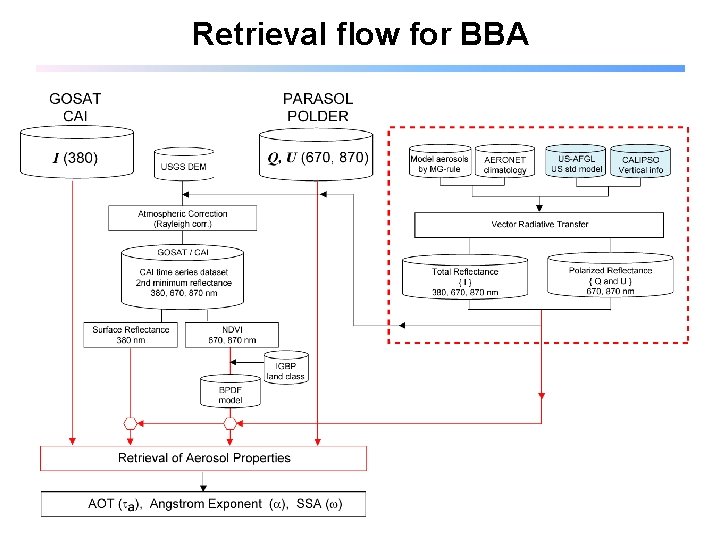
Retrieval flow for BBA
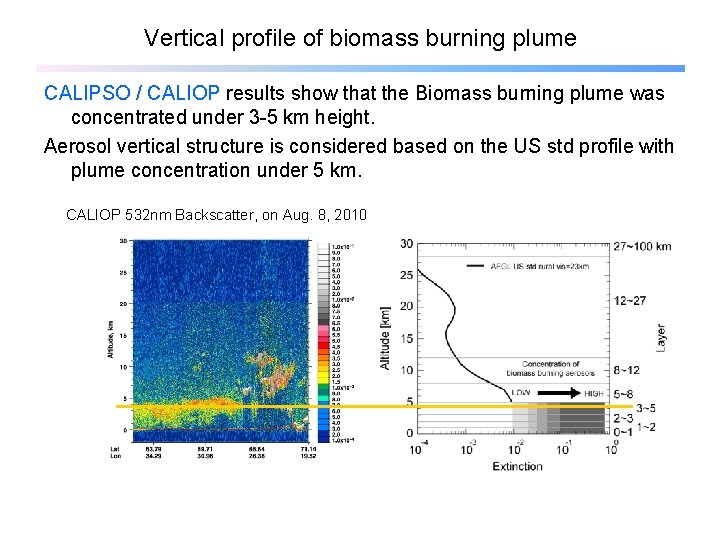
Vertical profile of biomass burning plume CALIPSO / CALIOP results show that the Biomass burning plume was concentrated under 3 -5 km height. Aerosol vertical structure is considered based on the US std profile with plume concentration under 5 km. CALIOP 532 nm Backscatter, on Aug. 8, 2010
Retrieval flow for BBA
Ground model ; BPDF Nadal and Bréon, 1999 Maignan et al. 2009
Retrieval process in practice R (380 nm) R (3 80 nm ) PR (870 nm) A set of a , a and is retrieved for each aerosol model based on POLDER Q U (670, 870) and GOSAT CAI I (380) PR (670 nm)
Aerosol properties over Central Russia on August 5, 2010
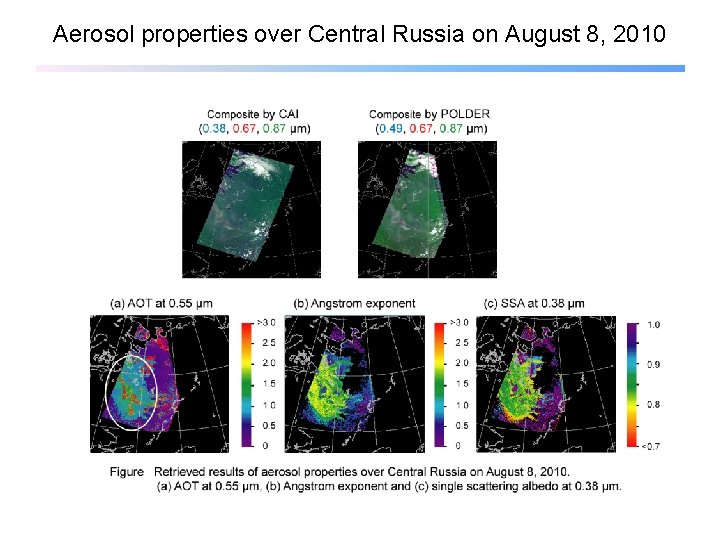
Aerosol properties over Central Russia on August 8, 2010
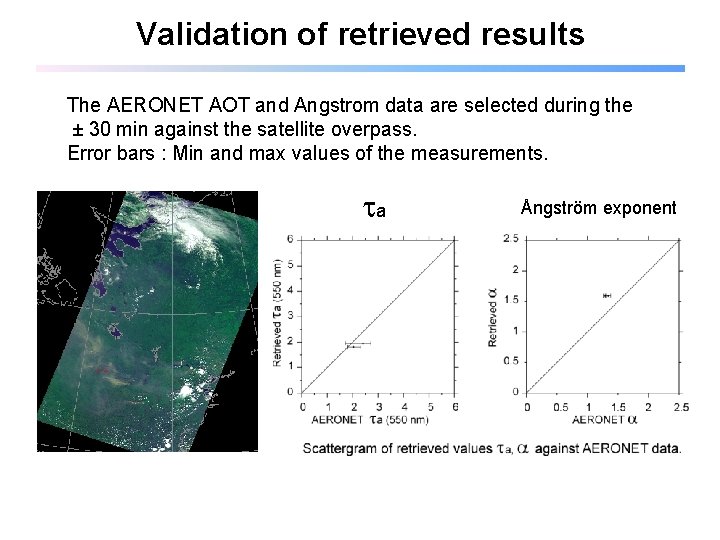
Validation of retrieved results The AERONET AOT and Angstrom data are selected during the ± 30 min against the satellite overpass. Error bars : Min and max values of the measurements. a Ångström exponent
Summary SGLI on GCOM-1 C will take for aerosols, high resolution (1 km x 1 km ) polarimetric measurements at 2 chs (0. 67, 0. 87 um) with simultaneous nadir total reflectance from 0. 38 to 10 um. For carbonaceous aerosol retrieval, we propose simple algorithm based on combined use of near-UV radiance and polarized radiance at red and NIR bands. Future work for SGLI Dust aerosols: Spheroid DB (provided from Oleg) Efficient and fast algorithm for operational use including Oleg's inversion algorithms.
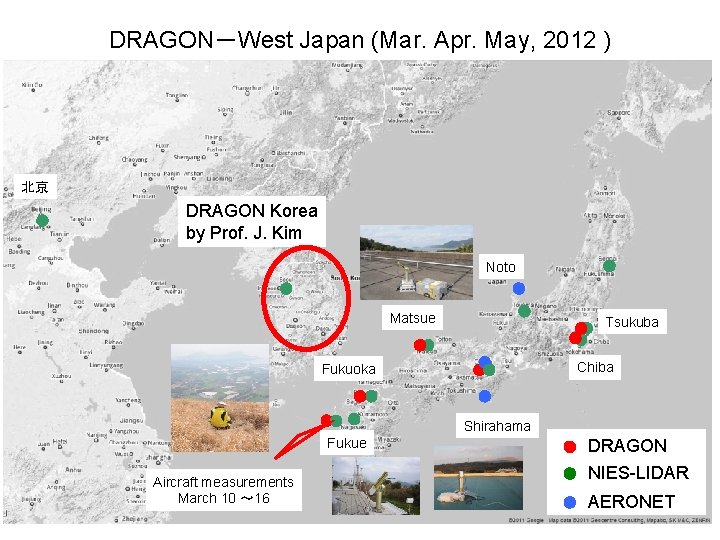
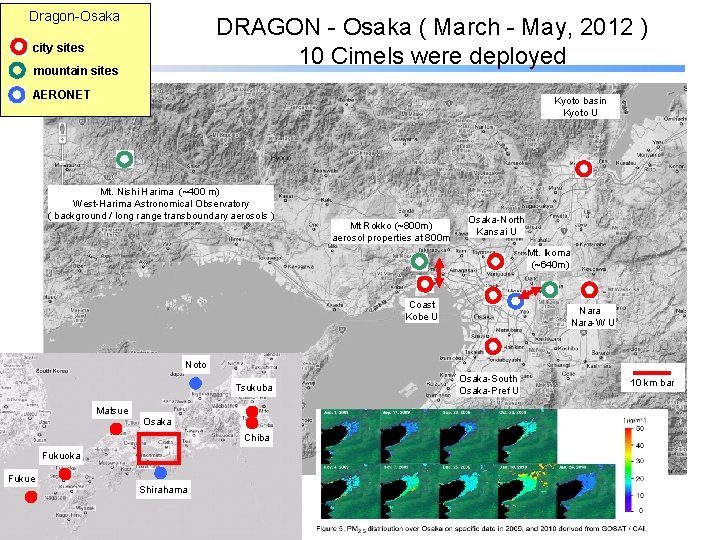
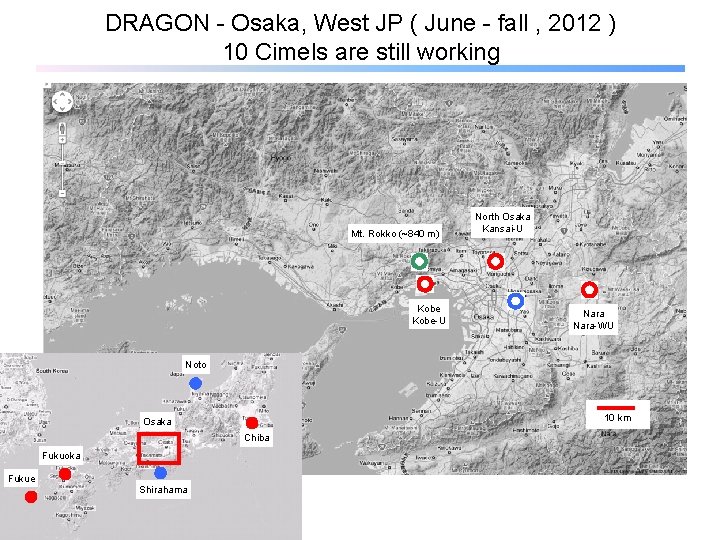
Another study for aerosols
DRAGON-West Japan (Mar. Apr. May, 2012 ) 北京 DRAGON Korea by Prof. J. Kim Noto Matsue Tsukuba Chiba Fukuoka Shirahama Fukue Aircraft measurements March 10 ~ 16 DRAGON NIES-LIDAR AERONET
Dragon-Osaka DRAGON - Osaka ( March - May, 2012 ) 10 Cimels were deployed city sites mountain sites AERONET Kyoto basin Kyoto U Mt. Nishi Harima (~400 m) West-Harima Astronomical Observatory ( background / long range transboundary aerosols ) Mt Rokko (~800 m) aerosol properties at 800 m Osaka-North Kansai U Mt. Ikoma (~640 m) Coast Kobe U Nara-W U Noto Tsukuba Matsue Osaka Chiba Fukuoka Fukue Shirahama Osaka-South Osaka-Pref U 10 km bar
DRAGON - Osaka, West JP ( June - fall , 2012 ) 10 Cimels are still working Mt. Rokko (~840 m) Kobe-U North Osaka Kansai-U Nara-WU Noto 10 km Osaka Chiba Fukuoka Fukue Shirahama
Distribution of AOT and PM 2. 5 over Osaka AOT(0. 67 m) → PM 2. 5
- Slides: 55