
AERODYNAMICS OF TRAIN Module 3 AERODYNAMICS OF TRAIN

- Slides: 11
AERODYNAMICS OF TRAIN Module 3
AERODYNAMICS OF TRAIN
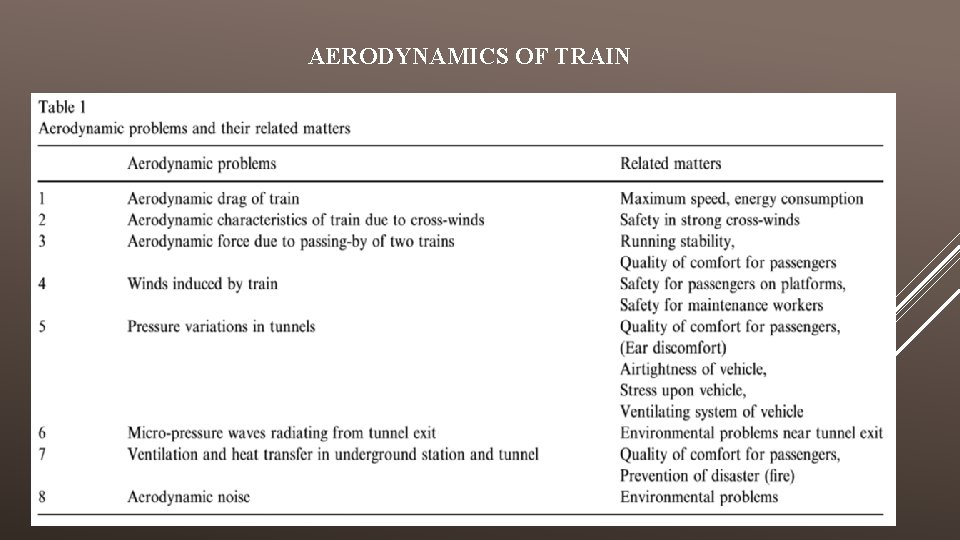
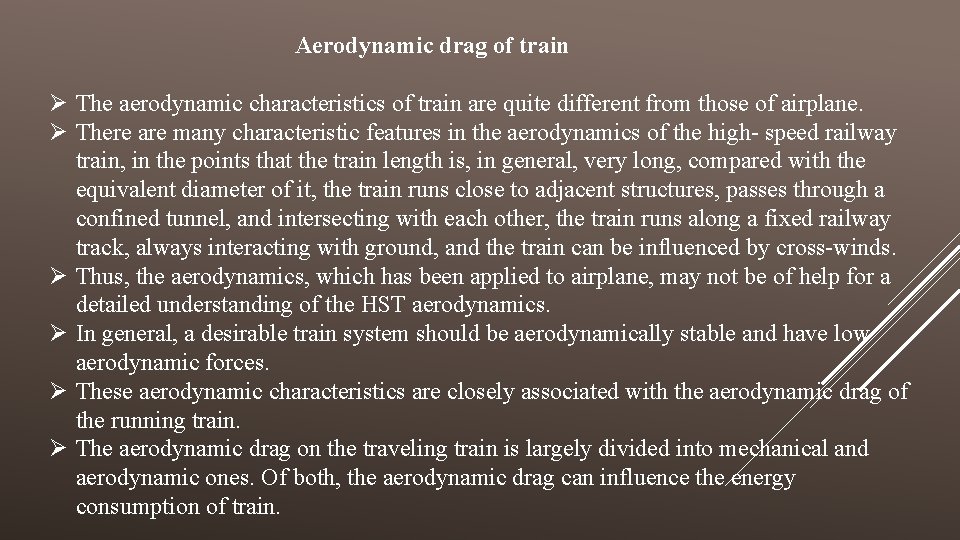
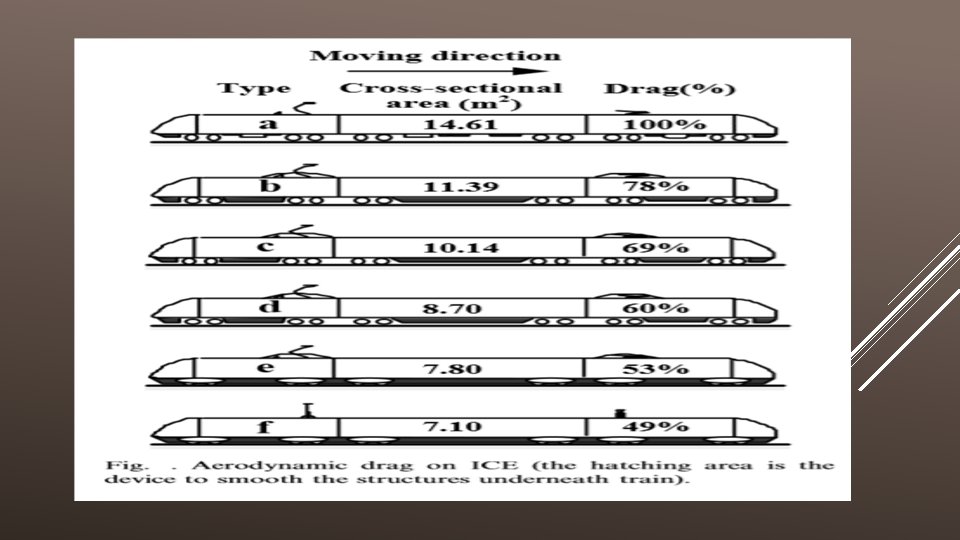
Aerodynamic drag of train Ø The aerodynamic characteristics of train are quite different from those of airplane. Ø There are many characteristic features in the aerodynamics of the high- speed railway train, in the points that the train length is, in general, very long, compared with the equivalent diameter of it, the train runs close to adjacent structures, passes through a confined tunnel, and intersecting with each other, the train runs along a fixed railway track, always interacting with ground, and the train can be influenced by cross-winds. Ø Thus, the aerodynamics, which has been applied to airplane, may not be of help for a detailed understanding of the HST aerodynamics. Ø In general, a desirable train system should be aerodynamically stable and have low aerodynamic forces. Ø These aerodynamic characteristics are closely associated with the aerodynamic drag of the running train. Ø The aerodynamic drag on the traveling train is largely divided into mechanical and aerodynamic ones. Of both, the aerodynamic drag can influence the energy consumption of train.
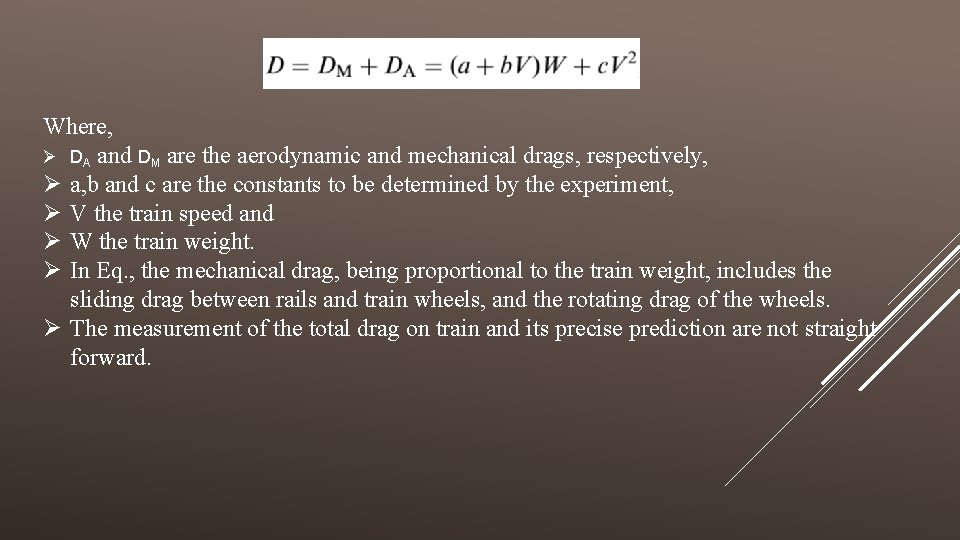
Ø Thus, detailed understanding on the aerodynamic drag and its precise evaluation are of practical importance. Ø It has been well known that the aerodynamic drag is proportional to the square of speed, while the mechanical drag is proportional to the speed. Ø Compared with the mechanical drag, the portion of the aerodynamic drag becomes larger as the train speed increases. Ø Thus, reduction of the aerodynamic drag on high-speed railway train is one of the essential issues for the development of the desirable train system. Ø In the open air without any cross-wind effects, the total drag on the traveling train can be expressed by a sum of the aerodynamic and mechanical ones:
Where, Ø DA and DM are the aerodynamic and mechanical drags, respectively, Ø a, b and c are the constants to be determined by the experiment, Ø V the train speed and Ø W the train weight. Ø In Eq. , the mechanical drag, being proportional to the train weight, includes the sliding drag between rails and train wheels, and the rotating drag of the wheels. Ø The measurement of the total drag on train and its precise prediction are not straight forward.
Ø Ø Ø CROSS-WIND EFFECTS The cross-wind effects on the traveling train can closely be associated with the traveling safety. The cross- winds can be more seriously influence when the train runs over a bridge. Heavier vehicles could improve the crosswind stability but on the contrary issues like lower energy consumption demand lighter vehicles, which at the same time would lead to benefits regarding track deterioration and track maintenance. Since the aerodynamic forces are most critical on the leading vehicle of a train, the weight change from a locomotive -as the leading and heaviest vehicle of a loco-train - to a vehicle of a multiple unit increases the demands on crosswind stability of trains. In addition, unsteady cross wind like various gusts is becoming a major concern.
Aerodynamic noise due to train
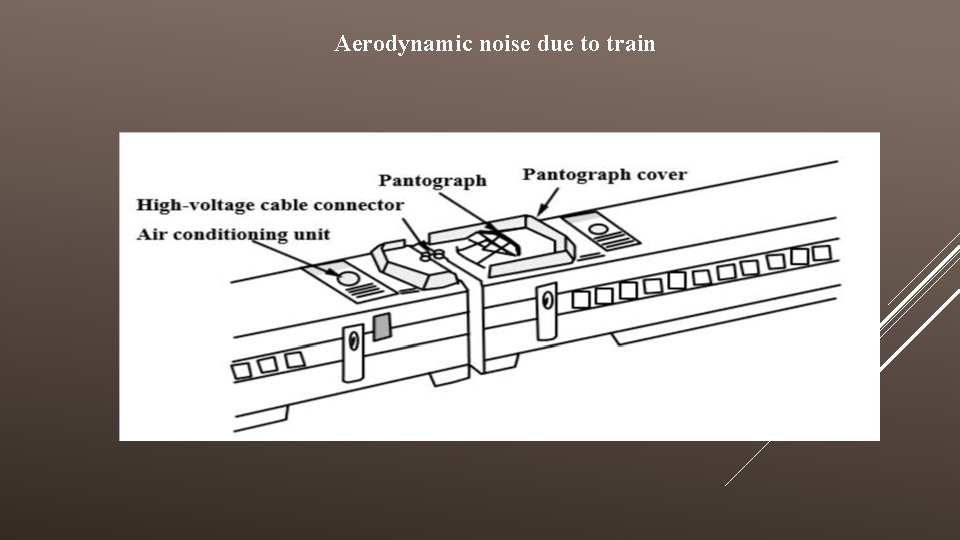
Ø For the assessment of aerodynamic noises produced by a traveling train in the open air, it can be often convenient to classify the noise sources. Ø In addition to the aerodynamic noises due to the flows around the traveling train, there are many different noises which are caused by train wheels, structures around track, pantograph system, etc. Ø In order to reduce these noises, it is required to know how extent is each contribution to the noises. Ø In general, aerodynamic noises are strongly dependent on the train speed U, being approximately proportional to U 6 - U 8: Ø Thus, the noise alleviation is of more practical importance when the train speed increases. Ø It can be found that the aerodynamic noises due to the traveling train are largely generated by the fore-body of the train, the connection part between trains, and the pantograph system.
Ø The fore-body of a train is one of the noise sources. In usual, there a lot of roughness on the fore-body surface. Ø The aerodynamic noises are strongly dependent on the detailed configuration of the surface roughness and the entire shape of train fore-body as well. Ø These geometrical configurations are associated with the wind speed along them and separation. Ø In practice, the pantograph system is composed of many bars with small diameters, which can play a musical instrument to create the aerodynamic noises. Ø The pantograph system creates a number of vortices behind it. Ø A pantograph cover can be used to reduce the aerodynamics noises generated by the pantograph system.
THANK YOU