
Aerodynamics of Flow Around a Cylinder EML 4304
- Slides: 26
Aerodynamics of Flow Around a Cylinder EML 4304 L – THERMAL FLUIDS LABORATORY SPRING 2017 T/TR 9: 30 AM – 10: 51 AM
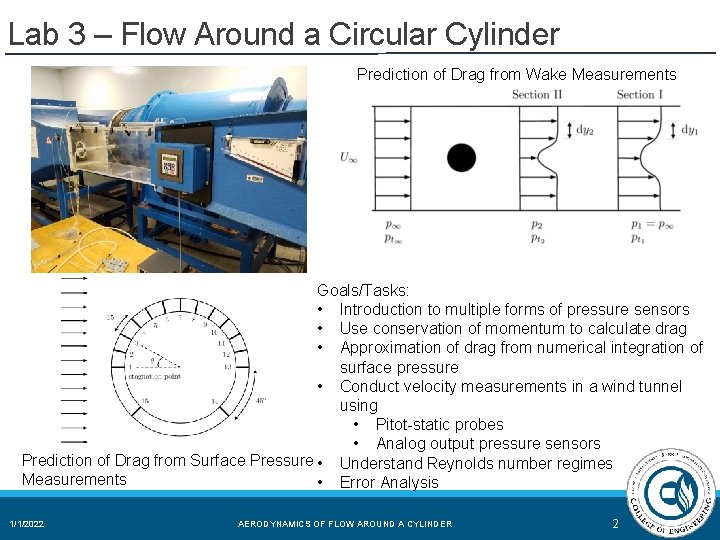
Lab 3 – Flow Around a Circular Cylinder Prediction of Drag from Wake Measurements Goals/Tasks: • Introduction to multiple forms of pressure sensors • Use conservation of momentum to calculate drag • Approximation of drag from numerical integration of surface pressure • Conduct velocity measurements in a wind tunnel using • Pitot-static probes • Analog output pressure sensors Prediction of Drag from Surface Pressure • Understand Reynolds number regimes Measurements • Error Analysis 1/1/2022 AERODYNAMICS OF FLOW AROUND A CYLINDER 2
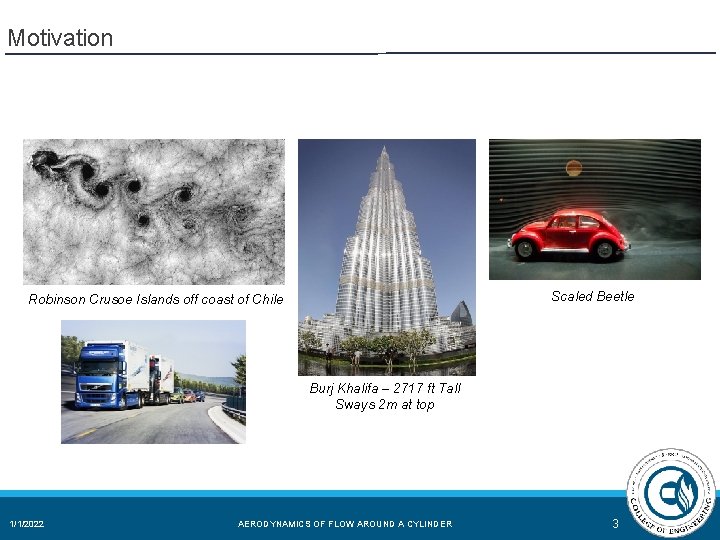
Motivation Scaled Beetle Robinson Crusoe Islands off coast of Chile Burj Khalifa – 2717 ft Tall Sways 2 m at top 1/1/2022 AERODYNAMICS OF FLOW AROUND A CYLINDER 3
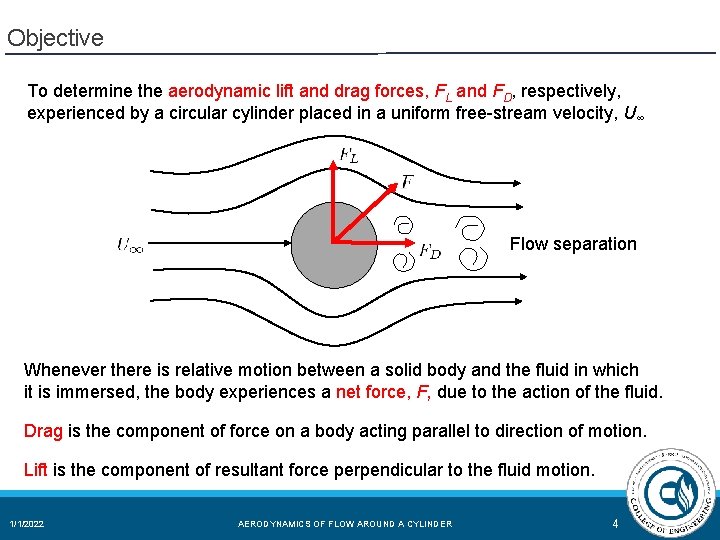
Objective To determine the aerodynamic lift and drag forces, FL and FD, respectively, experienced by a circular cylinder placed in a uniform free-stream velocity, U∞ Flow separation Whenever there is relative motion between a solid body and the fluid in which it is immersed, the body experiences a net force, F, due to the action of the fluid. Drag is the component of force on a body acting parallel to direction of motion. Lift is the component of resultant force perpendicular to the fluid motion. 1/1/2022 AERODYNAMICS OF FLOW AROUND A CYLINDER 4
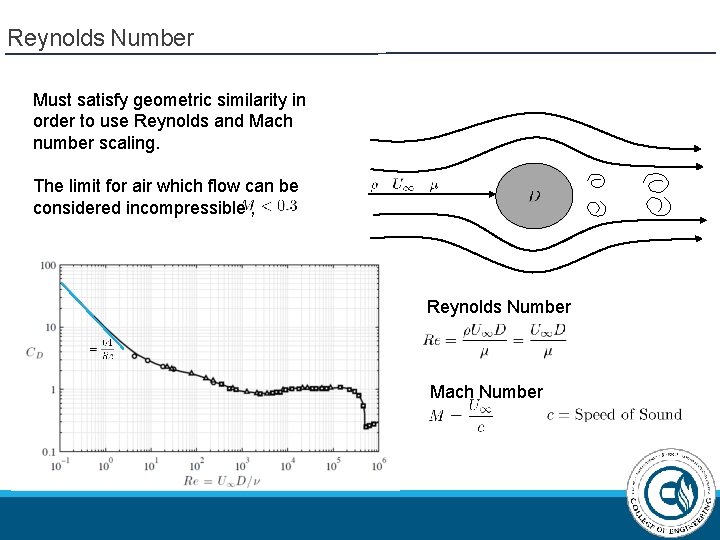
Reynolds Number Must satisfy geometric similarity in order to use Reynolds and Mach number scaling. The limit for air which flow can be considered incompressible , Reynolds Number Mach Number
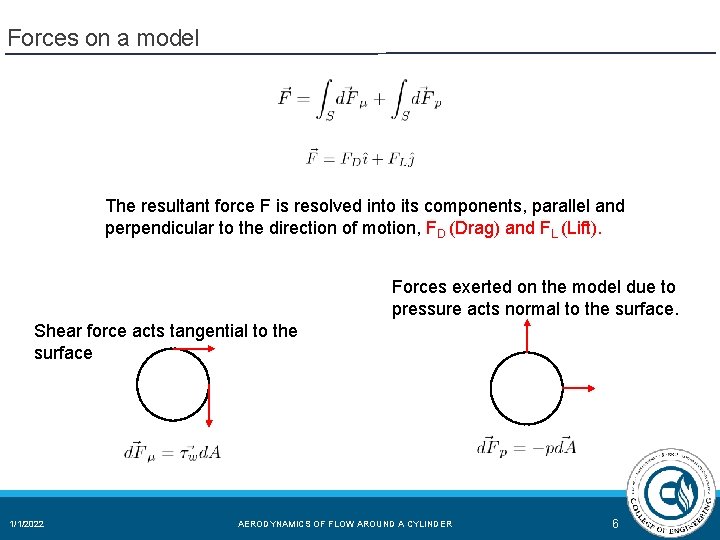
Forces on a model The resultant force F is resolved into its components, parallel and perpendicular to the direction of motion, FD (Drag) and FL (Lift). Forces exerted on the model due to pressure acts normal to the surface. Shear force acts tangential to the surface 1/1/2022 AERODYNAMICS OF FLOW AROUND A CYLINDER 6
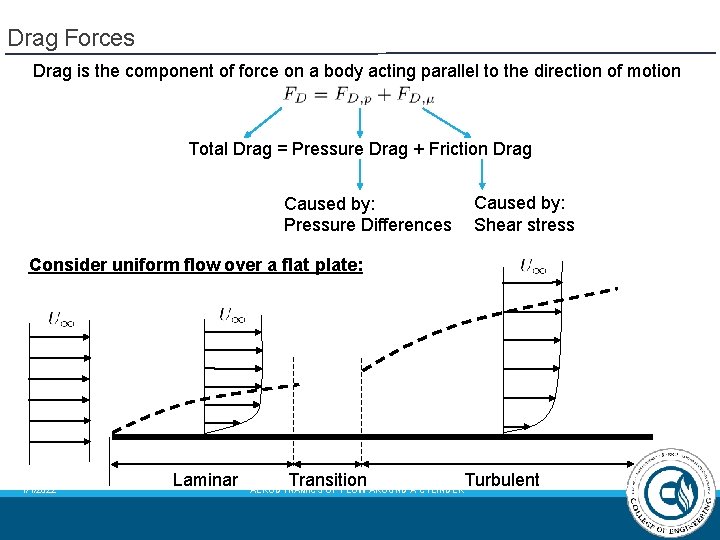
Drag Forces Drag is the component of force on a body acting parallel to the direction of motion Total Drag = Pressure Drag + Friction Drag Caused by: Pressure Differences Caused by: Shear stress Consider uniform flow over a flat plate: 1/1/2022 Laminar Transition AERODYNAMICS OF FLOW AROUND A CYLINDER Turbulent 7
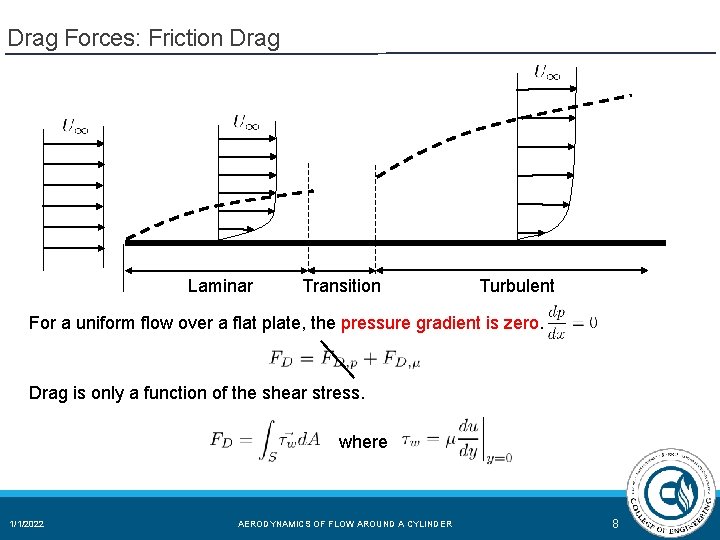
Drag Forces: Friction Drag Laminar Transition Turbulent For a uniform flow over a flat plate, the pressure gradient is zero. Drag is only a function of the shear stress. where 1/1/2022 AERODYNAMICS OF FLOW AROUND A CYLINDER 8
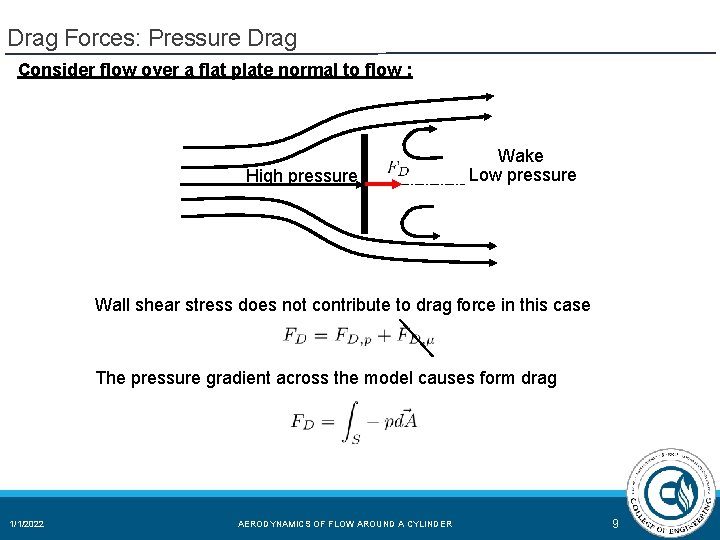
Drag Forces: Pressure Drag Consider flow over a flat plate normal to flow : High pressure Wake Low pressure Wall shear stress does not contribute to drag force in this case The pressure gradient across the model causes form drag 1/1/2022 AERODYNAMICS OF FLOW AROUND A CYLINDER 9
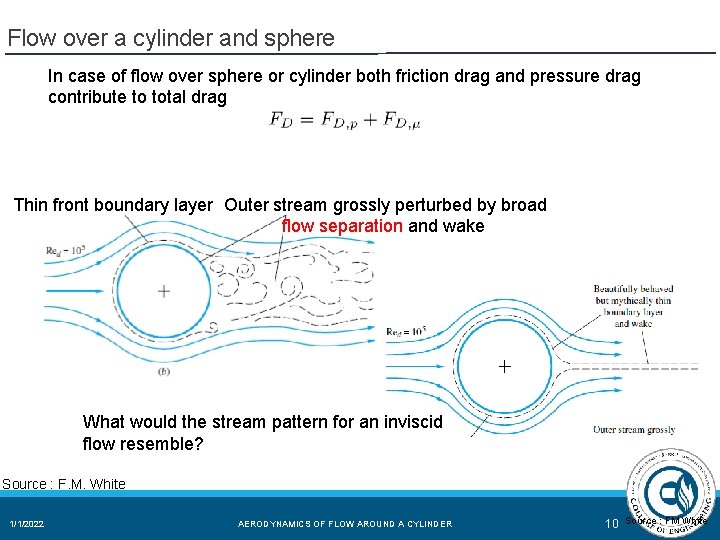
Flow over a cylinder and sphere In case of flow over sphere or cylinder both friction drag and pressure drag contribute to total drag Thin front boundary layer Outer stream grossly perturbed by broad flow separation and wake What would the stream pattern for an inviscid flow resemble? Source : F. M. White 1/1/2022 AERODYNAMICS OF FLOW AROUND A CYLINDER 10 Source : FM White
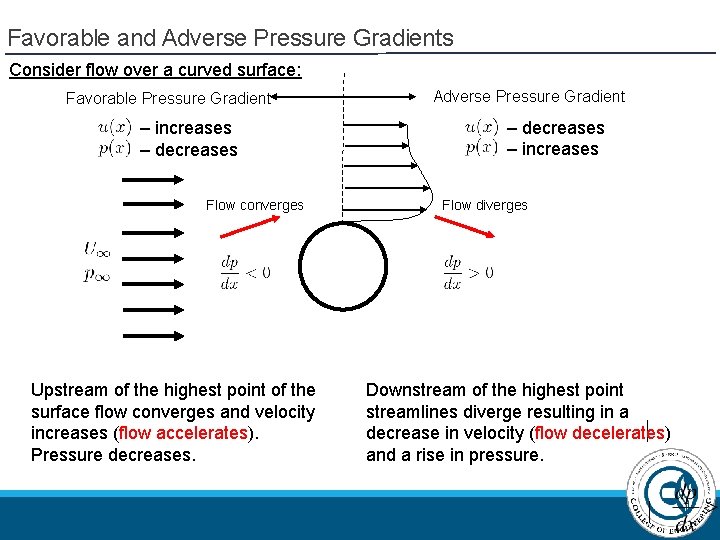
Favorable and Adverse Pressure Gradients Consider flow over a curved surface: Favorable Pressure Gradient – increases – decreases Flow converges Upstream of the highest point of the surface flow converges and velocity increases (flow accelerates). Pressure decreases. Adverse Pressure Gradient – decreases – increases Flow diverges Downstream of the highest point streamlines diverge resulting in a decrease in velocity (flow decelerates) and a rise in pressure.
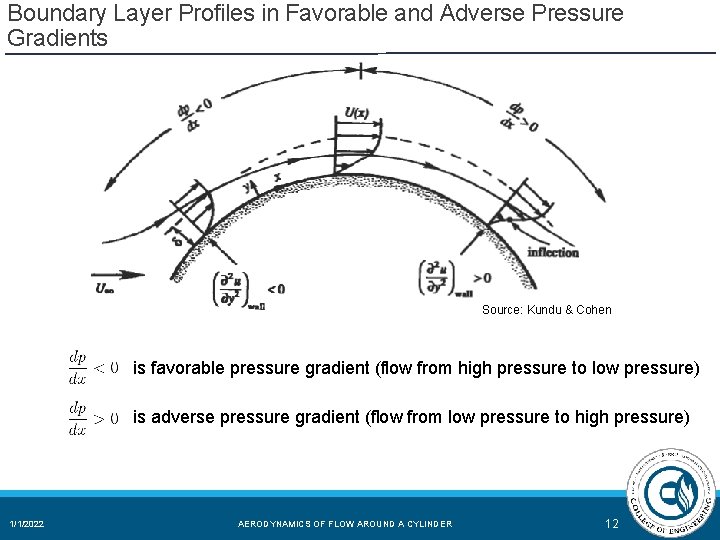
Boundary Layer Profiles in Favorable and Adverse Pressure Gradients Source: Kundu & Cohen is favorable pressure gradient (flow from high pressure to low pressure) is adverse pressure gradient (flow from low pressure to high pressure) 1/1/2022 AERODYNAMICS OF FLOW AROUND A CYLINDER 12
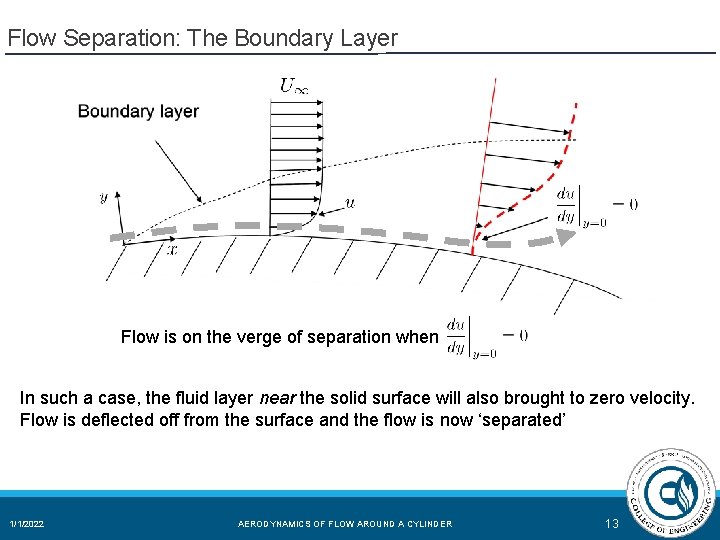
Flow Separation: The Boundary Layer Flow is on the verge of separation when In such a case, the fluid layer near the solid surface will also brought to zero velocity. Flow is deflected off from the surface and the flow is now ‘separated’ 1/1/2022 AERODYNAMICS OF FLOW AROUND A CYLINDER 13
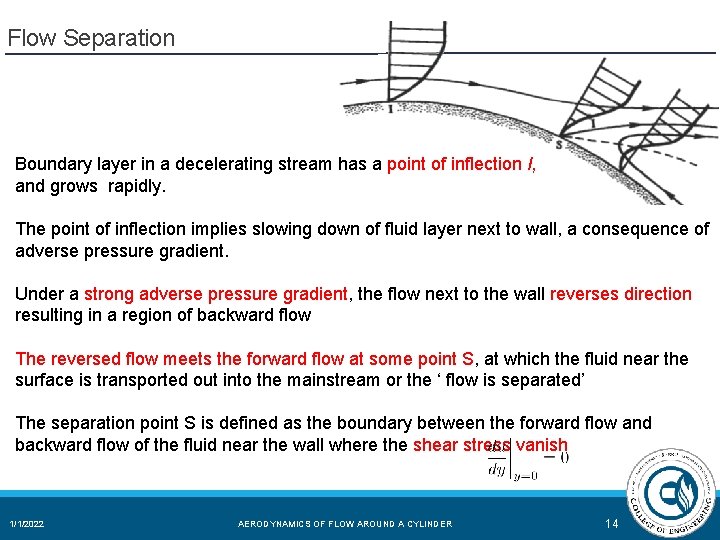
Flow Separation Boundary layer in a decelerating stream has a point of inflection I, and grows rapidly. The point of inflection implies slowing down of fluid layer next to wall, a consequence of adverse pressure gradient. Under a strong adverse pressure gradient, the flow next to the wall reverses direction resulting in a region of backward flow The reversed flow meets the forward flow at some point S, at which the fluid near the surface is transported out into the mainstream or the ‘ flow is separated’ The separation point S is defined as the boundary between the forward flow and backward flow of the fluid near the wall where the shear stress vanish 1/1/2022 AERODYNAMICS OF FLOW AROUND A CYLINDER 14
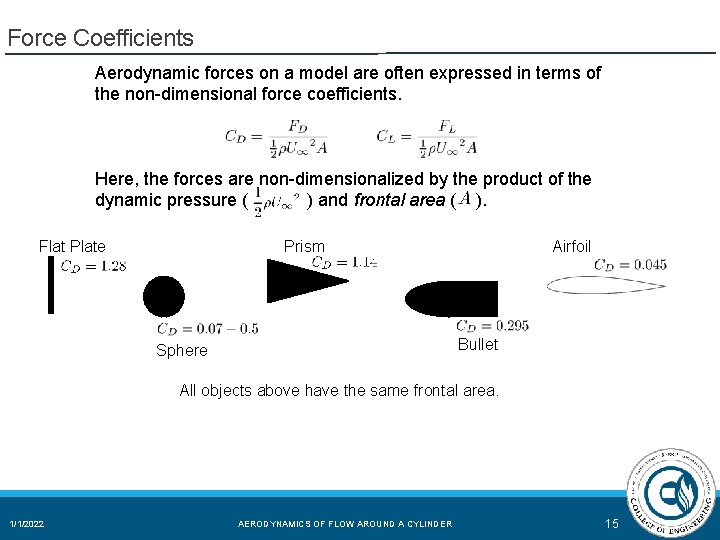
Force Coefficients Aerodynamic forces on a model are often expressed in terms of the non-dimensional force coefficients. Here, the forces are non-dimensionalized by the product of the dynamic pressure ( ) and frontal area ( ). Prism Flat Plate Airfoil Bullet Sphere All objects above have the same frontal area. 1/1/2022 AERODYNAMICS OF FLOW AROUND A CYLINDER 15
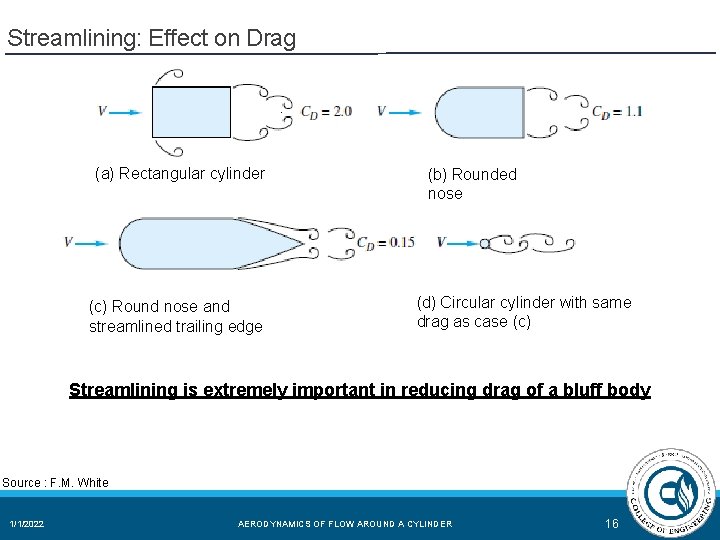
Streamlining: Effect on Drag (a) Rectangular cylinder (c) Round nose and streamlined trailing edge (b) Rounded nose (d) Circular cylinder with same drag as case (c) Streamlining is extremely important in reducing drag of a bluff body Source : F. M. White 1/1/2022 AERODYNAMICS OF FLOW AROUND A CYLINDER 16
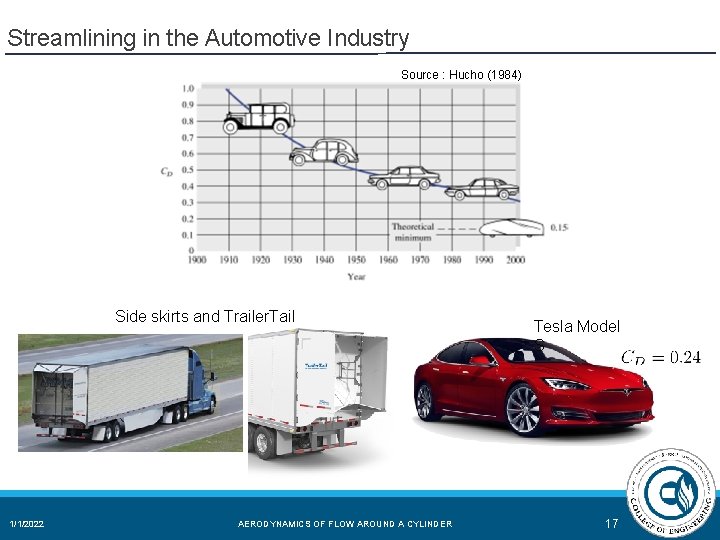
Streamlining in the Automotive Industry Source : Hucho (1984) Side skirts and Trailer. Tail 1/1/2022 AERODYNAMICS OF FLOW AROUND A CYLINDER Tesla Model S 17
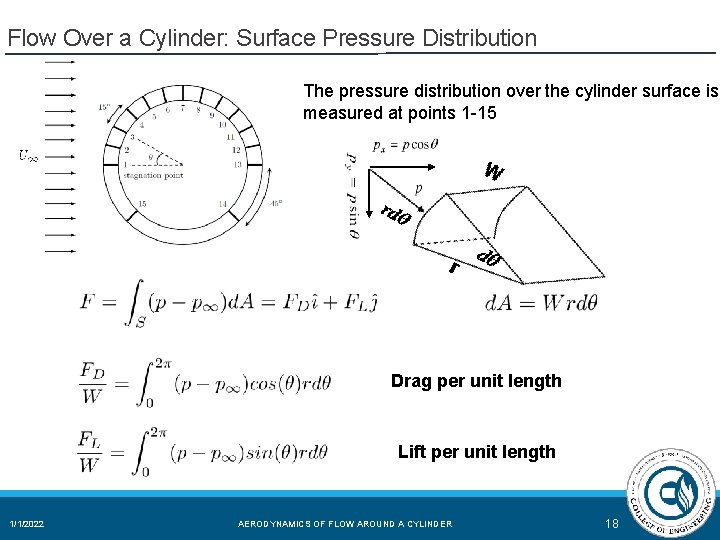
Flow Over a Cylinder: Surface Pressure Distribution The pressure distribution over the cylinder surface is measured at points 1 -15 Drag per unit length Lift per unit length 1/1/2022 AERODYNAMICS OF FLOW AROUND A CYLINDER 18
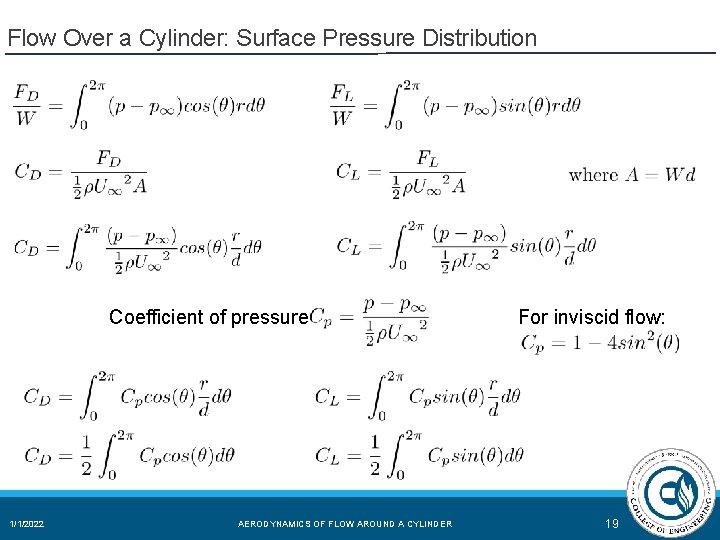
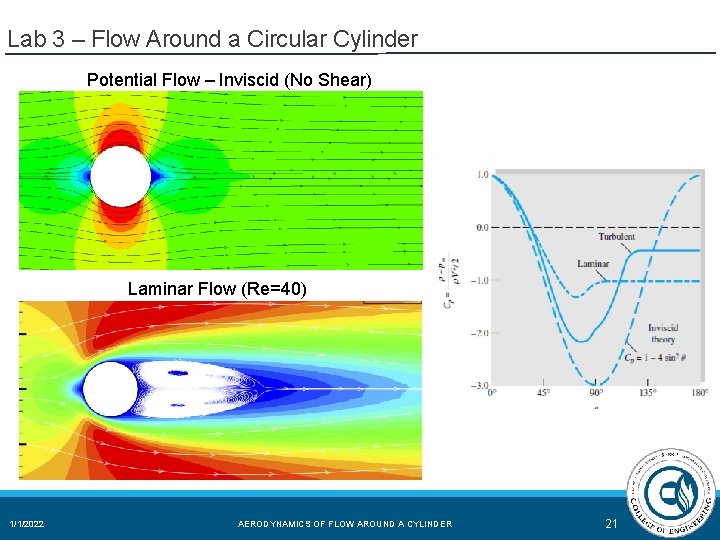
Flow Over a Cylinder: Surface Pressure Distribution Coefficient of pressure 1/1/2022 AERODYNAMICS OF FLOW AROUND A CYLINDER For inviscid flow: 19
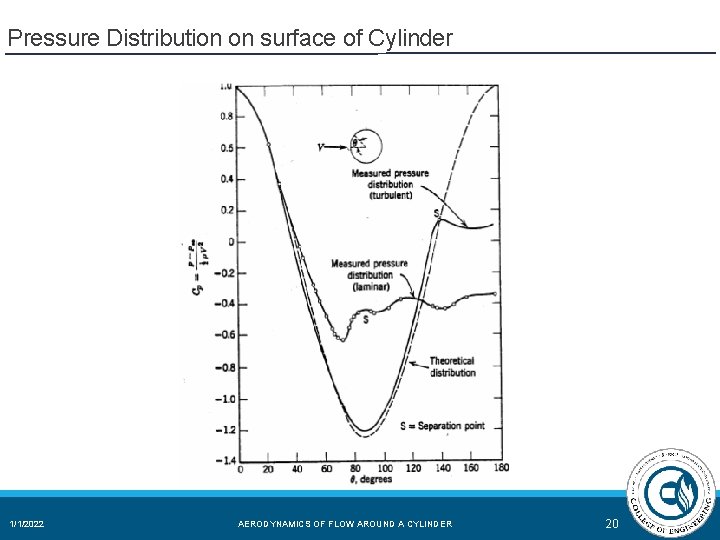
Pressure Distribution on surface of Cylinder 1/1/2022 AERODYNAMICS OF FLOW AROUND A CYLINDER 20
Lab 3 – Flow Around a Circular Cylinder Potential Flow – Inviscid (No Shear) Laminar Flow (Re=40) 1/1/2022 AERODYNAMICS OF FLOW AROUND A CYLINDER 21
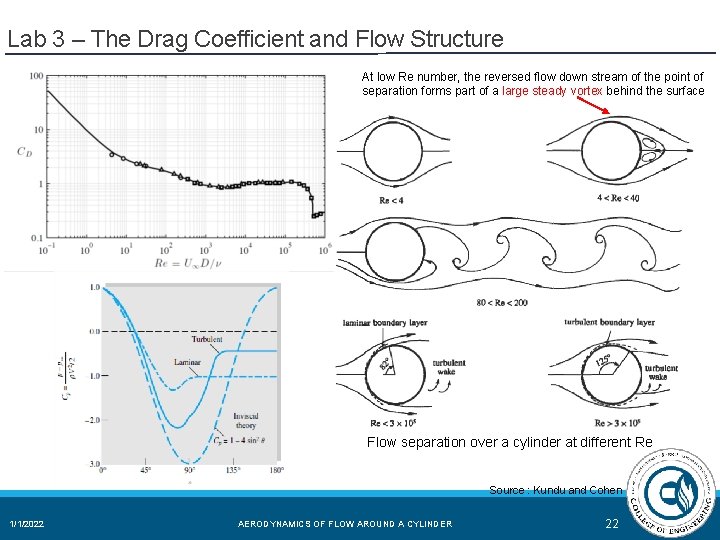
Lab 3 – The Drag Coefficient and Flow Structure At low Re number, the reversed flow down stream of the point of separation forms part of a large steady vortex behind the surface Flow separation over a cylinder at different Re Source : Kundu and Cohen 1/1/2022 AERODYNAMICS OF FLOW AROUND A CYLINDER 22
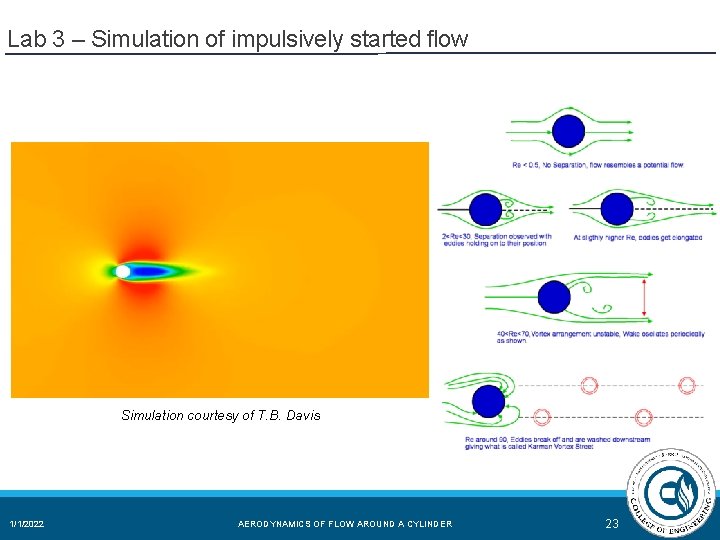
Lab 3 – Simulation of impulsively started flow Simulation courtesy of T. B. Davis 1/1/2022 AERODYNAMICS OF FLOW AROUND A CYLINDER 23
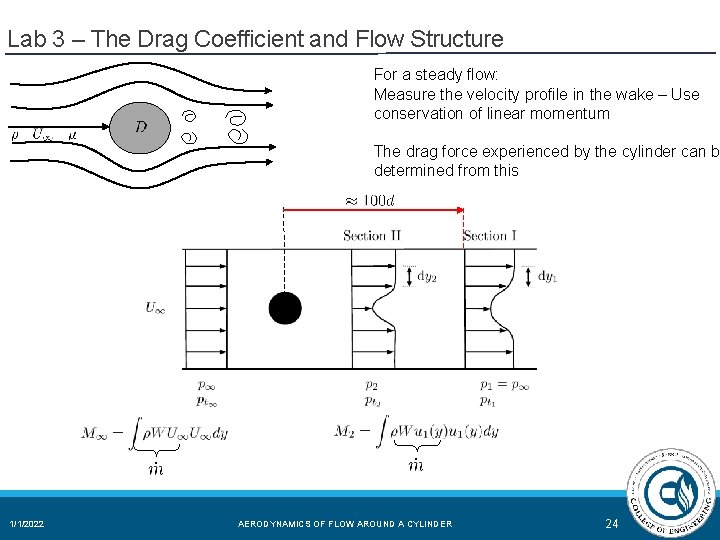
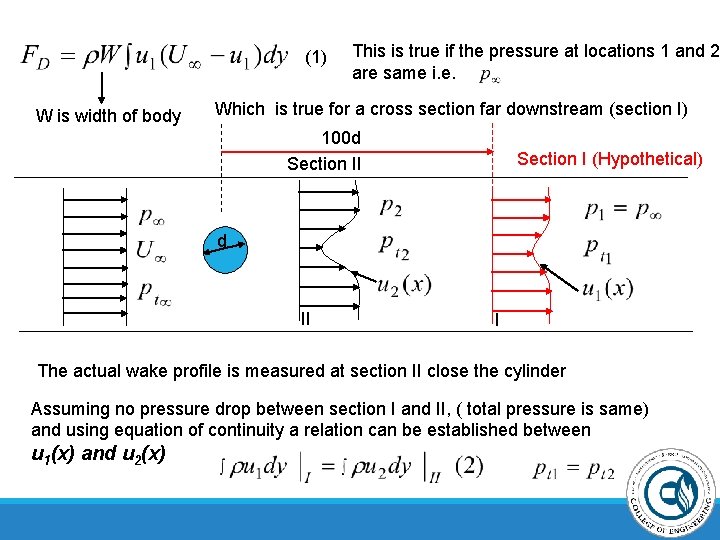
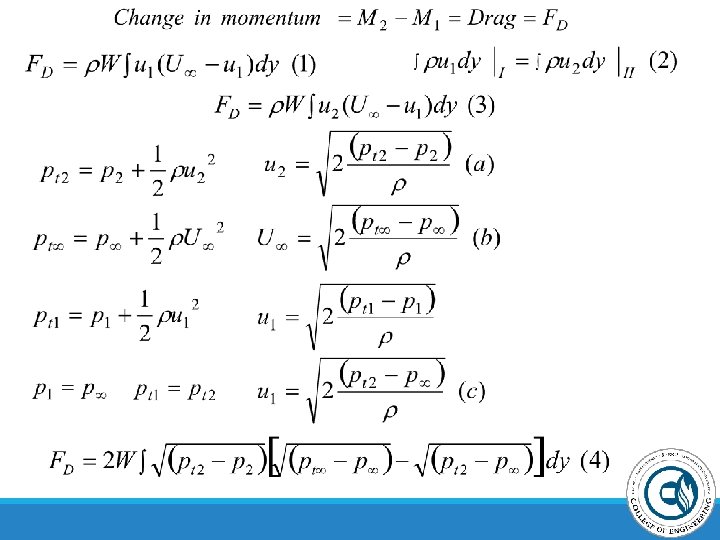
Lab 3 – The Drag Coefficient and Flow Structure For a steady flow: Measure the velocity profile in the wake – Use conservation of linear momentum The drag force experienced by the cylinder can b determined from this 1/1/2022 AERODYNAMICS OF FLOW AROUND A CYLINDER 24
(1) W is width of body This is true if the pressure at locations 1 and 2 are same i. e. Which is true for a cross section far downstream (section I) 100 d Section II Section I (Hypothetical) d II I The actual wake profile is measured at section II close the cylinder Assuming no pressure drop between section I and II, ( total pressure is same) and using equation of continuity a relation can be established between u 1(x) and u 2(x)