
Aerodynamics Group Applied Aerodynamics Conference Basic Aerodynamics Applied
Aerodynamics Group Applied Aerodynamics Conference Basic Aerodynamics Applied to Airline Flying to Improve Fuel Efficiency/Payloads and Safety : Hugh DIBLEY FRAe. S, FRIN, MCILT formerly BOAC/BA Airbus Toulouse (Busy slides for reading without audio!) RAe. S Applied Aerodynamics Conference - Hugh DIBLEY : “Aerodynamics Applied to Airline Operations” 18 th July 2012 1 /nn
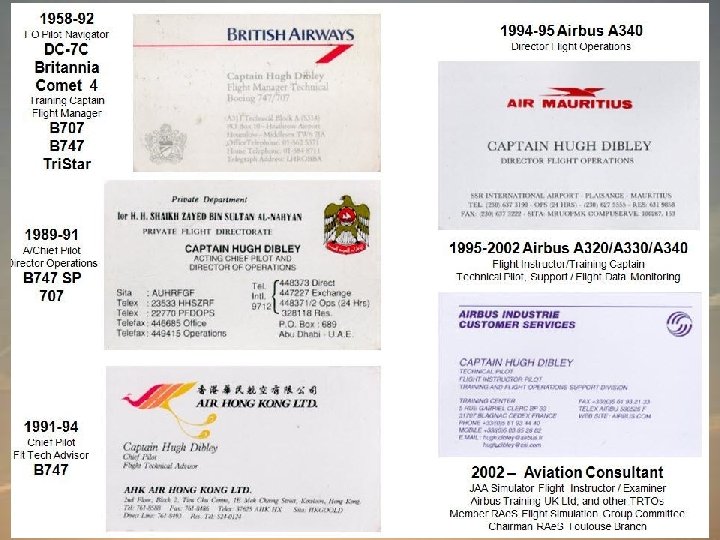
RAe. S Applied Aerodynamics Conference - Hugh DIBLEY : “Aerodynamics Applied to Airline Operations” 18 th July 2012 2 /nn
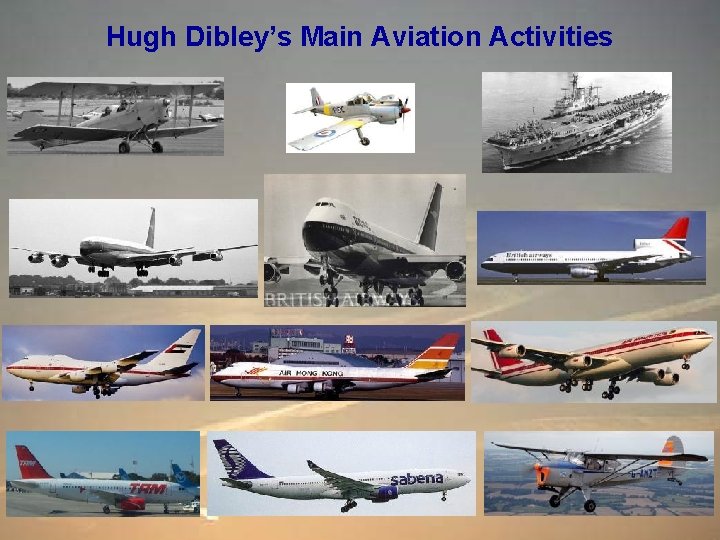
Hugh Dibley’s Main Aviation Activities RAe. S Applied Aerodynamics Conference - Hugh DIBLEY : “Aerodynamics Applied to Airline Operations” 18 th July 2012 3 /nn
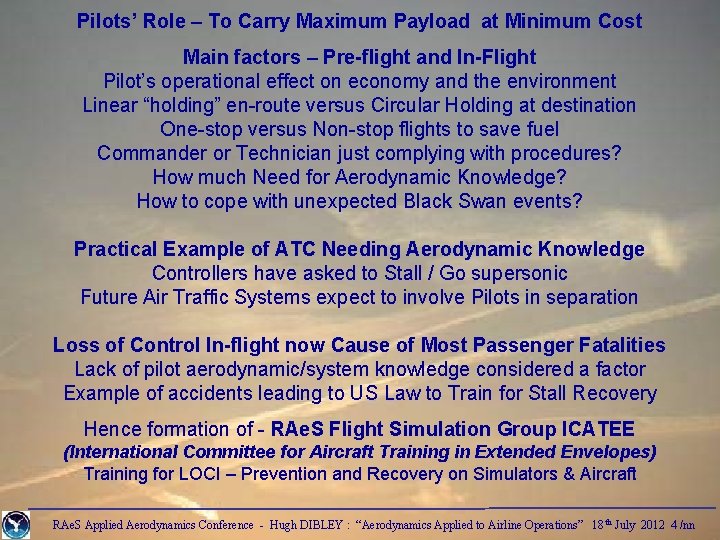
Pilots’ Role – To Carry Maximum Payload at Minimum Cost Main factors – Pre-flight and In-Flight Pilot’s operational effect on economy and the environment Linear “holding” en-route versus Circular Holding at destination One-stop versus Non-stop flights to save fuel Commander or Technician just complying with procedures? How much Need for Aerodynamic Knowledge? How to cope with unexpected Black Swan events? Practical Example of ATC Needing Aerodynamic Knowledge Controllers have asked to Stall / Go supersonic Future Air Traffic Systems expect to involve Pilots in separation Loss of Control In-flight now Cause of Most Passenger Fatalities Lack of pilot aerodynamic/system knowledge considered a factor Example of accidents leading to US Law to Train for Stall Recovery Hence formation of - RAe. S Flight Simulation Group ICATEE (International Committee for Aircraft Training in Extended Envelopes) Training for LOCI – Prevention and Recovery on Simulators & Aircraft RAe. S Applied Aerodynamics Conference - Hugh DIBLEY : “Aerodynamics Applied to Airline Operations” 18 th July 2012 4 /nn
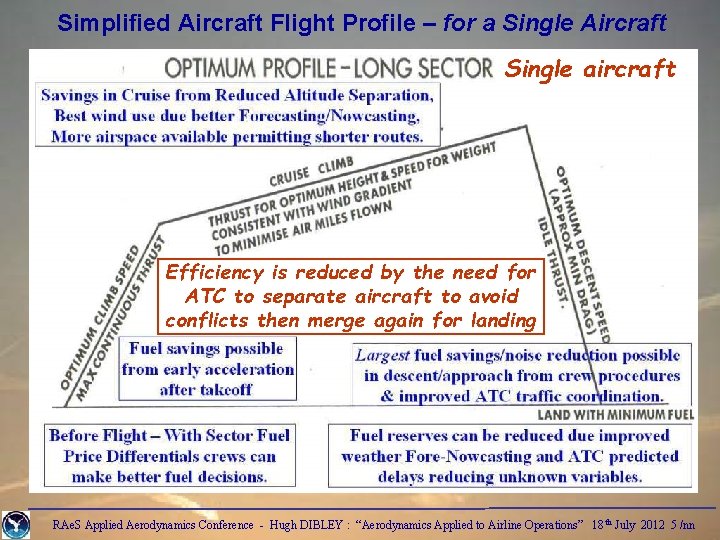
Simplified Aircraft Flight Profile – for a Single Aircraft Single aircraft Efficiency is reduced by the need for ATC to separate aircraft to avoid conflicts then merge again for landing RAe. S Applied Aerodynamics Conference - Hugh DIBLEY : “Aerodynamics Applied to Airline Operations” 18 th July 2012 5 /nn
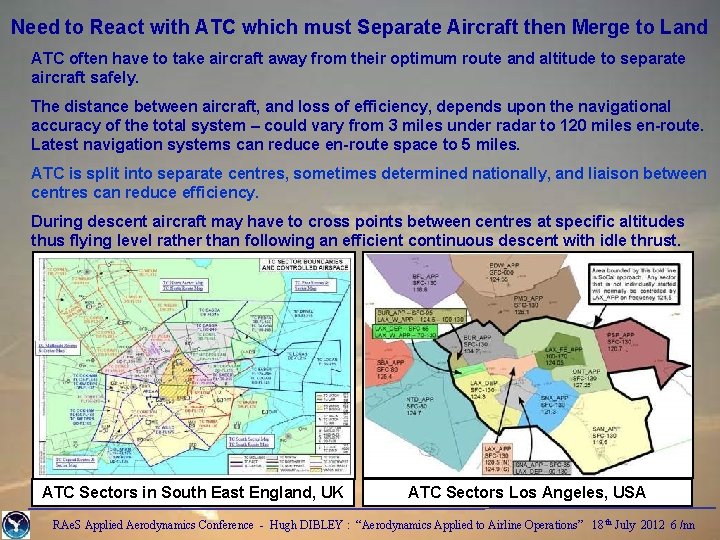
Need to React with ATC which must Separate Aircraft then Merge to Land ATC often have to take aircraft away from their optimum route and altitude to separate aircraft safely. The distance between aircraft, and loss of efficiency, depends upon the navigational accuracy of the total system – could vary from 3 miles under radar to 120 miles en-route. Latest navigation systems can reduce en-route space to 5 miles. ATC is split into separate centres, sometimes determined nationally, and liaison between centres can reduce efficiency. During descent aircraft may have to cross points between centres at specific altitudes thus flying level rather than following an efficient continuous descent with idle thrust. ATC Sectors in South East England, UK ATC Sectors Los Angeles, USA RAe. S Applied Aerodynamics Conference - Hugh DIBLEY : “Aerodynamics Applied to Airline Operations” 18 th July 2012 6 /nn
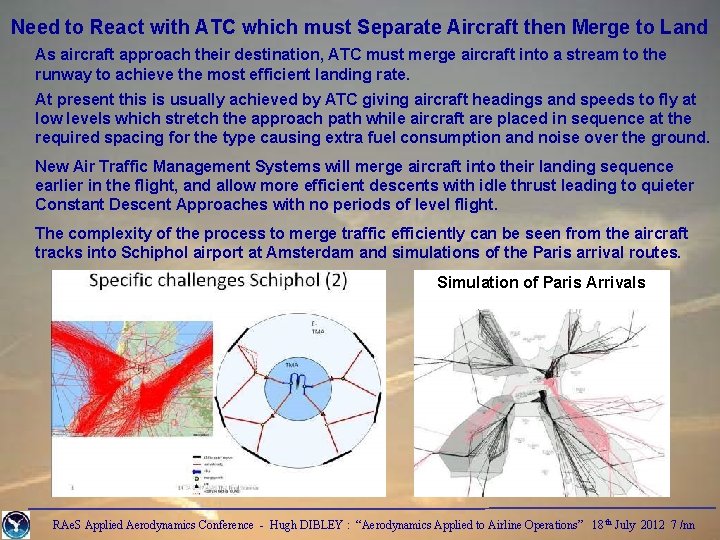
Need to React with ATC which must Separate Aircraft then Merge to Land As aircraft approach their destination, ATC must merge aircraft into a stream to the runway to achieve the most efficient landing rate. At present this is usually achieved by ATC giving aircraft headings and speeds to fly at low levels which stretch the approach path while aircraft are placed in sequence at the required spacing for the type causing extra fuel consumption and noise over the ground. New Air Traffic Management Systems will merge aircraft into their landing sequence earlier in the flight, and allow more efficient descents with idle thrust leading to quieter Constant Descent Approaches with no periods of level flight. The complexity of the process to merge traffic efficiently can be seen from the aircraft tracks into Schiphol airport at Amsterdam and simulations of the Paris arrival routes. Simulation of Paris Arrivals RAe. S Applied Aerodynamics Conference - Hugh DIBLEY : “Aerodynamics Applied to Airline Operations” 18 th July 2012 7 /nn

Maximize Take-off Weight Prime Requirement – Sound Knowledge of Take-off Performance Principles To Take-off at the Maximum Allowable Weight for the Conditions RAe. S Applied Aerodynamics Conference - Hugh DIBLEY : “Aerodynamics Applied to Airline Operations” 18 th July 2012 8 /nn

Carry Minimum Safe Fuel Reserves to Maximize Payload Cost of Extra Fuel which can reduce Payload On long sectors extra fuel displaces payload thus losing revenue - loss is extreme on very long sectors when the tanks are already full and the only way to fly further is to reduce the passenger load/weight. RAe. S Applied Aerodynamics Conference - Hugh DIBLEY : “Aerodynamics Applied to Airline Operations” 18 th July 2012 9 /nn
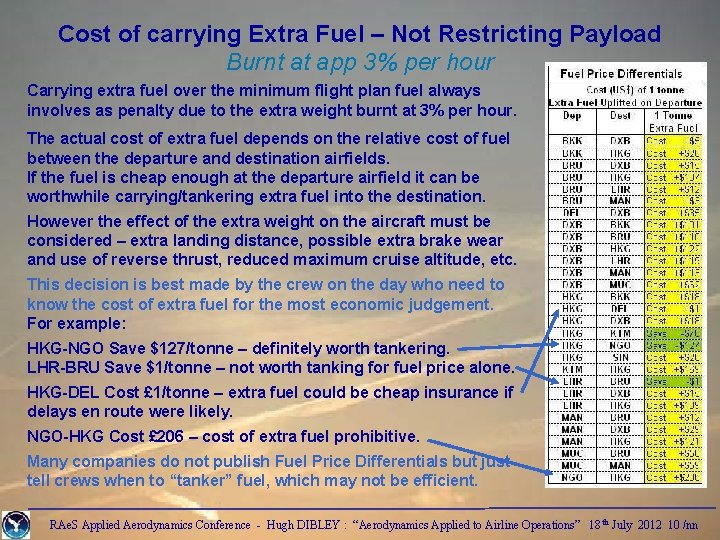
Cost of carrying Extra Fuel – Not Restricting Payload Burnt at app 3% per hour Carrying extra fuel over the minimum flight plan fuel always involves as penalty due to the extra weight burnt at 3% per hour. The actual cost of extra fuel depends on the relative cost of fuel between the departure and destination airfields. If the fuel is cheap enough at the departure airfield it can be worthwhile carrying/tankering extra fuel into the destination. However the effect of the extra weight on the aircraft must be considered – extra landing distance, possible extra brake wear and use of reverse thrust, reduced maximum cruise altitude, etc. This decision is best made by the crew on the day who need to know the cost of extra fuel for the most economic judgement. For example: HKG-NGO Save $127/tonne – definitely worth tankering. LHR-BRU Save $1/tonne – not worth tanking for fuel price alone. HKG-DEL Cost £ 1/tonne – extra fuel could be cheap insurance if delays en route were likely. NGO-HKG Cost £ 206 – cost of extra fuel prohibitive. Many companies do not publish Fuel Price Differentials but just tell crews when to “tanker” fuel, which may not be efficient. RAe. S Applied Aerodynamics Conference - Hugh DIBLEY : “Aerodynamics Applied to Airline Operations” 18 th July 2012 10 /nn
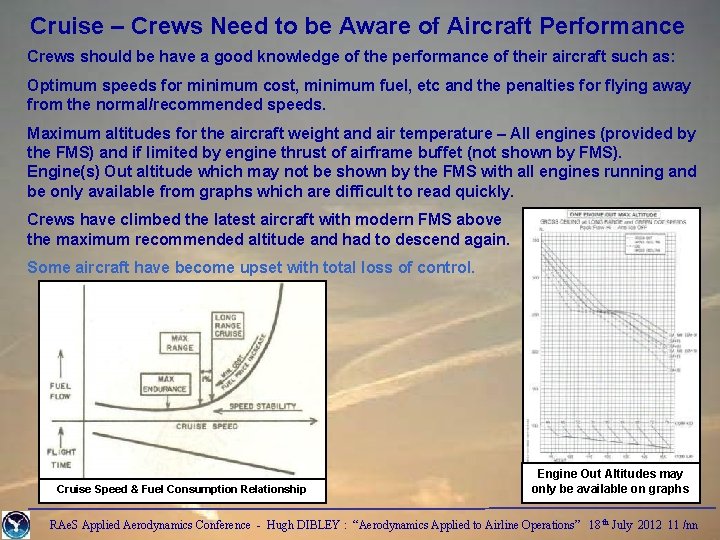
Cruise – Crews Need to be Aware of Aircraft Performance Crews should be have a good knowledge of the performance of their aircraft such as: Optimum speeds for minimum cost, minimum fuel, etc and the penalties for flying away from the normal/recommended speeds. Maximum altitudes for the aircraft weight and air temperature – All engines (provided by the FMS) and if limited by engine thrust of airframe buffet (not shown by FMS). Engine(s) Out altitude which may not be shown by the FMS with all engines running and be only available from graphs which are difficult to read quickly. Crews have climbed the latest aircraft with modern FMS above the maximum recommended altitude and had to descend again. Some aircraft have become upset with total loss of control. Cruise Speed & Fuel Consumption Relationship Engine Out Altitudes may only be available on graphs RAe. S Applied Aerodynamics Conference - Hugh DIBLEY : “Aerodynamics Applied to Airline Operations” 18 th July 2012 11 /nn
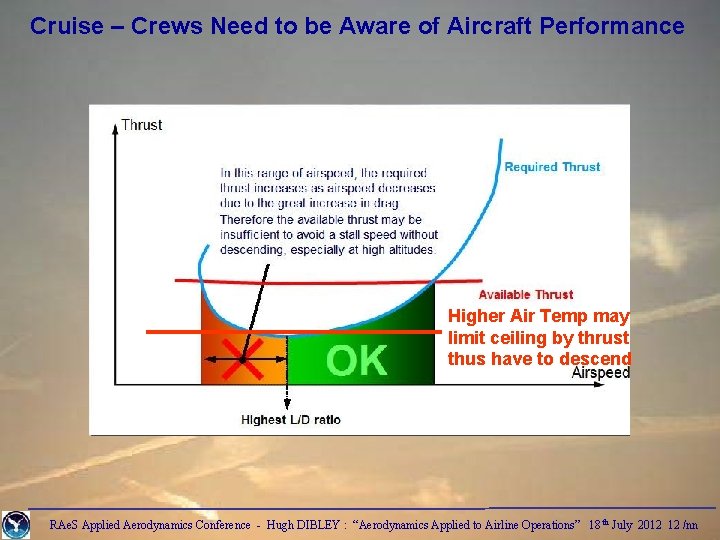
Cruise – Crews Need to be Aware of Aircraft Performance Higher Air Temp may limit ceiling by thrust thus have to descend RAe. S Applied Aerodynamics Conference - Hugh DIBLEY : “Aerodynamics Applied to Airline Operations” 18 th July 2012 12 /nn
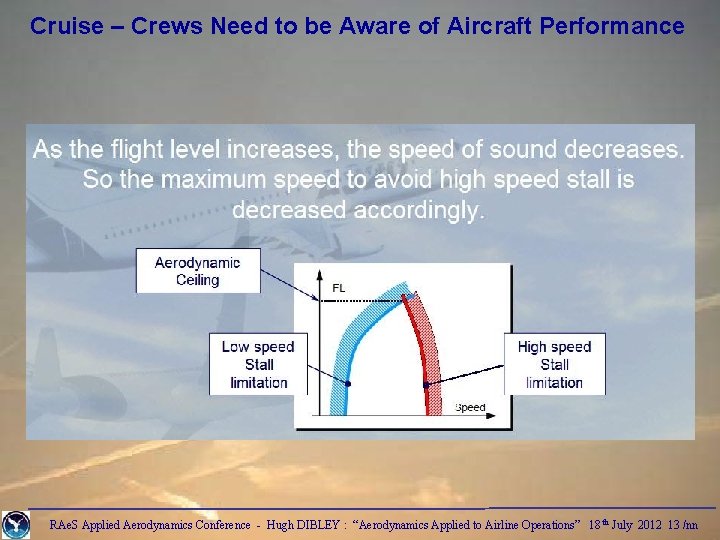
Cruise – Crews Need to be Aware of Aircraft Performance RAe. S Applied Aerodynamics Conference - Hugh DIBLEY : “Aerodynamics Applied to Airline Operations” 18 th July 2012 13 /nn
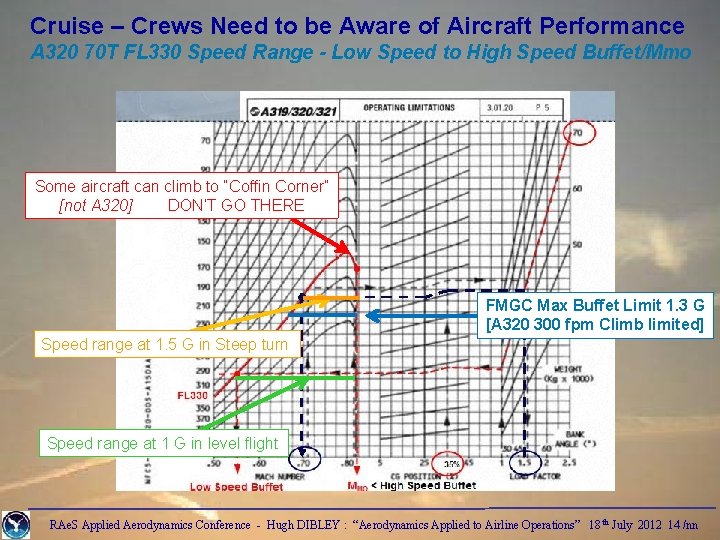
Cruise – Crews Need to be Aware of Aircraft Performance A 320 70 T FL 330 Speed Range - Low Speed to High Speed Buffet/Mmo Some aircraft can climb to “Coffin Corner” [not A 320] DON’T GO THERE FMGC Max Buffet Limit 1. 3 G [A 320 300 fpm Climb limited] Speed range at 1. 5 G in Steep turn Speed range at 1 G in level flight RAe. S Applied Aerodynamics Conference - Hugh DIBLEY : “Aerodynamics Applied to Airline Operations” 18 th July 2012 14 /nn

Cruise – Crews Need to be Aware of Aircraft Performance Table showing Boeing 747 Freighter Performance. All Engines & Engines Out All Engine Max Altitude aerodynamically limited - Low Speed Buffet close to Cruise IAS RAe. S Applied Aerodynamics Conference - Hugh DIBLEY : “Aerodynamics Applied to Airline Operations” 18 th July 2012 15 /nn
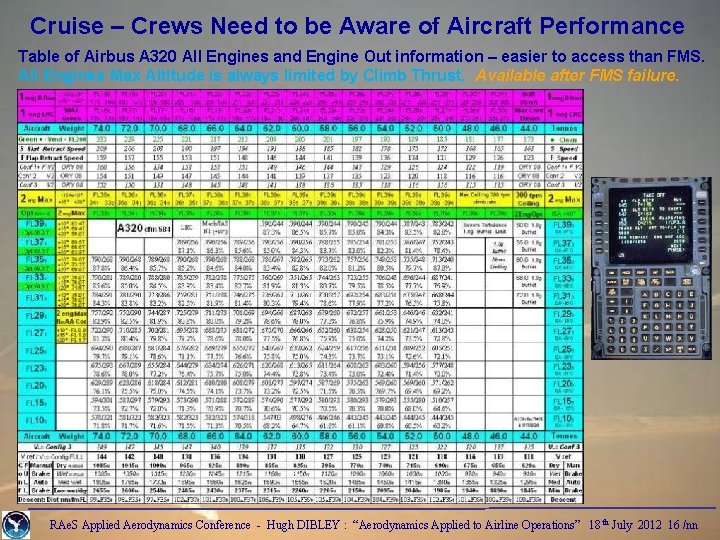
Cruise – Crews Need to be Aware of Aircraft Performance Table of Airbus A 320 All Engines and Engine Out information – easier to access than FMS. All Engines Max Altitude is always limited by Climb Thrust. Available after FMS failure. RAe. S Applied Aerodynamics Conference - Hugh DIBLEY : “Aerodynamics Applied to Airline Operations” 18 th July 2012 16 /nn
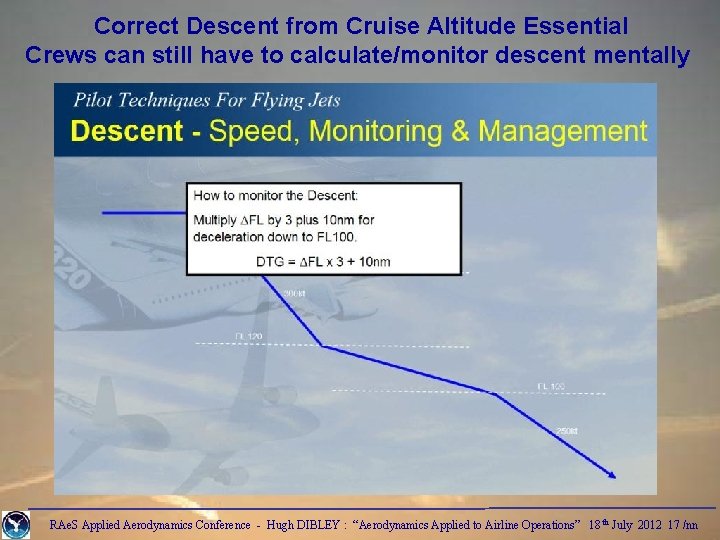
Correct Descent from Cruise Altitude Essential Crews can still have to calculate/monitor descent mentally RAe. S Applied Aerodynamics Conference - Hugh DIBLEY : “Aerodynamics Applied to Airline Operations” 18 th July 2012 17 /nn
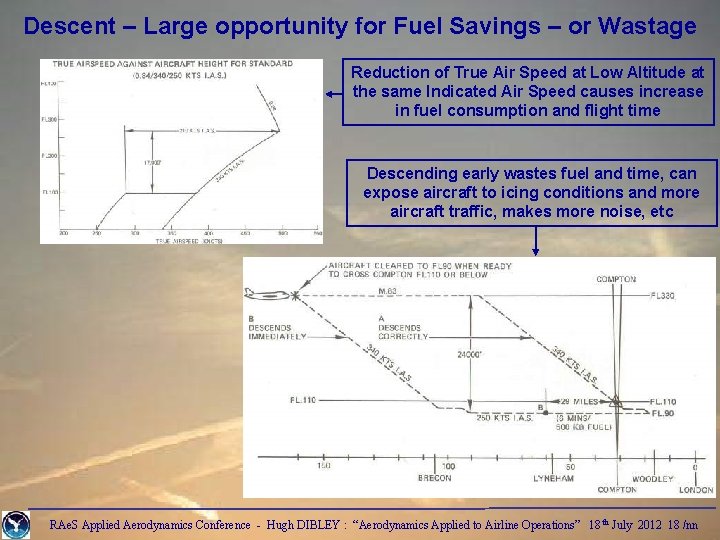
Descent – Large opportunity for Fuel Savings – or Wastage Reduction of True Air Speed at Low Altitude at the same Indicated Air Speed causes increase in fuel consumption and flight time Descending early wastes fuel and time, can expose aircraft to icing conditions and more aircraft traffic, makes more noise, etc RAe. S Applied Aerodynamics Conference - Hugh DIBLEY : “Aerodynamics Applied to Airline Operations” 18 th July 2012 18 /nn
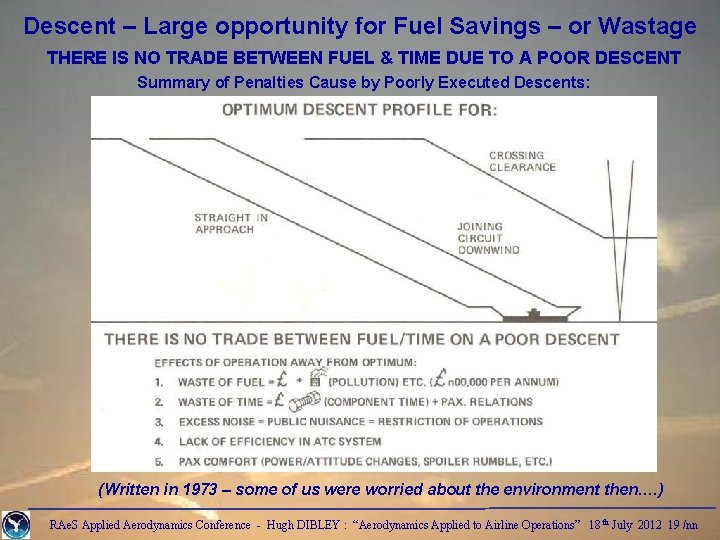
Descent – Large opportunity for Fuel Savings – or Wastage THERE IS NO TRADE BETWEEN FUEL & TIME DUE TO A POOR DESCENT Summary of Penalties Cause by Poorly Executed Descents: (Written in 1973 – some of us were worried about the environment then…. ) RAe. S Applied Aerodynamics Conference - Hugh DIBLEY : “Aerodynamics Applied to Airline Operations” 18 th July 2012 19 /nn
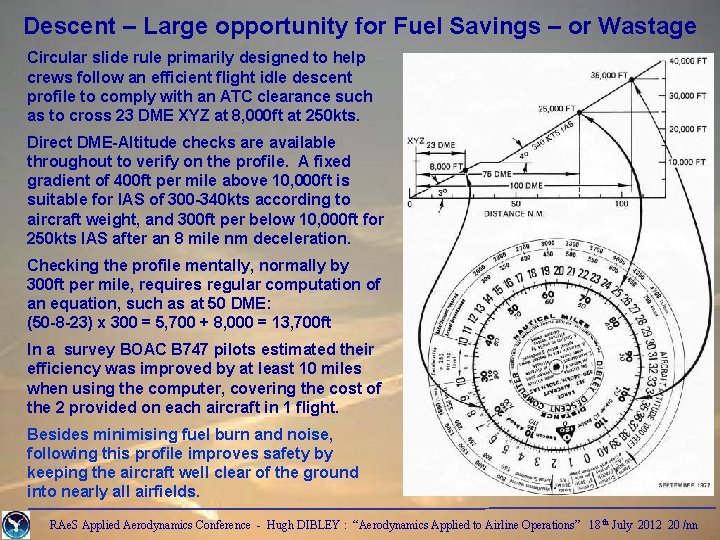
Descent – Large opportunity for Fuel Savings – or Wastage Circular slide rule primarily designed to help crews follow an efficient flight idle descent profile to comply with an ATC clearance such as to cross 23 DME XYZ at 8, 000 ft at 250 kts. Direct DME-Altitude checks are available throughout to verify on the profile. A fixed gradient of 400 ft per mile above 10, 000 ft is suitable for IAS of 300 -340 kts according to aircraft weight, and 300 ft per below 10, 000 ft for 250 kts IAS after an 8 mile nm deceleration. Checking the profile mentally, normally by 300 ft per mile, requires regular computation of an equation, such as at 50 DME: (50 -8 -23) x 300 = 5, 700 + 8, 000 = 13, 700 ft In a survey BOAC B 747 pilots estimated their efficiency was improved by at least 10 miles when using the computer, covering the cost of the 2 provided on each aircraft in 1 flight. Besides minimising fuel burn and noise, following this profile improves safety by keeping the aircraft well clear of the ground into nearly all airfields. RAe. S Applied Aerodynamics Conference - Hugh DIBLEY : “Aerodynamics Applied to Airline Operations” 18 th July 2012 20 /nn
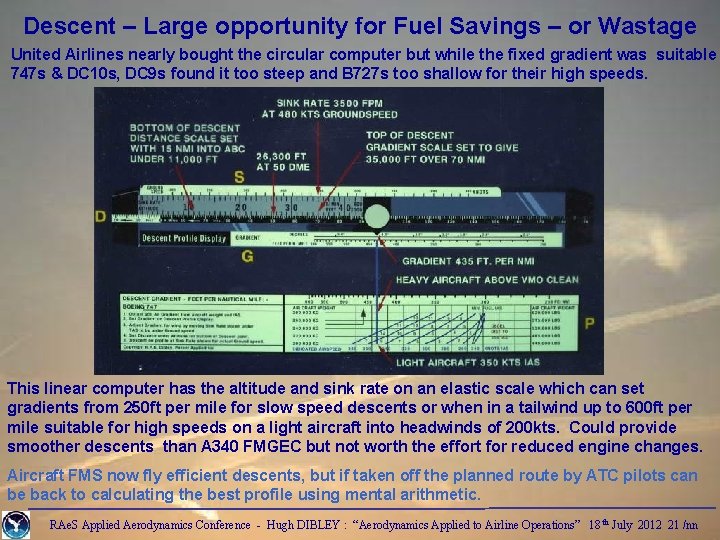
Descent – Large opportunity for Fuel Savings – or Wastage United Airlines nearly bought the circular computer but while the fixed gradient was suitable 747 s & DC 10 s, DC 9 s found it too steep and B 727 s too shallow for their high speeds. This linear computer has the altitude and sink rate on an elastic scale which can set gradients from 250 ft per mile for slow speed descents or when in a tailwind up to 600 ft per mile suitable for high speeds on a light aircraft into headwinds of 200 kts. Could provide smoother descents than A 340 FMGEC but not worth the effort for reduced engine changes. Aircraft FMS now fly efficient descents, but if taken off the planned route by ATC pilots can be back to calculating the best profile using mental arithmetic. RAe. S Applied Aerodynamics Conference - Hugh DIBLEY : “Aerodynamics Applied to Airline Operations” 18 th July 2012 21 /nn
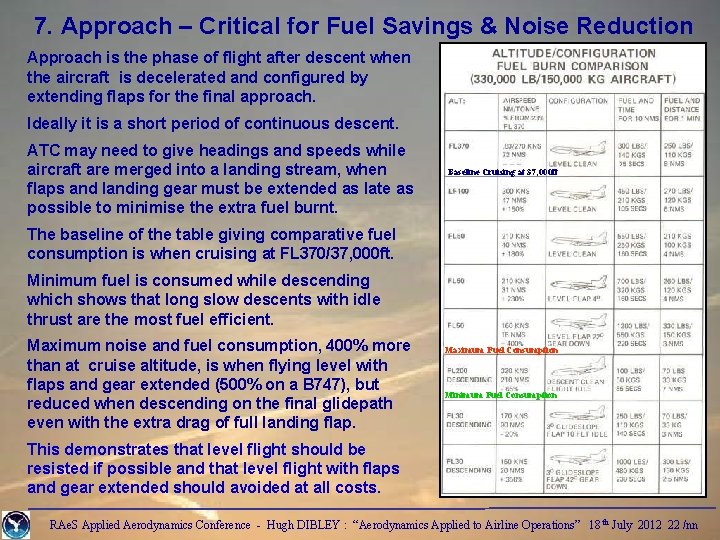
7. Approach – Critical for Fuel Savings & Noise Reduction Approach is the phase of flight after descent when the aircraft is decelerated and configured by extending flaps for the final approach. Ideally it is a short period of continuous descent. ATC may need to give headings and speeds while aircraft are merged into a landing stream, when flaps and landing gear must be extended as late as possible to minimise the extra fuel burnt. Baseline Cruising at 37, 000 ft The baseline of the table giving comparative fuel consumption is when cruising at FL 370/37, 000 ft. Minimum fuel is consumed while descending which shows that long slow descents with idle thrust are the most fuel efficient. Maximum noise and fuel consumption, 400% more than at cruise altitude, is when flying level with flaps and gear extended (500% on a B 747), but reduced when descending on the final glidepath even with the extra drag of full landing flap. Maximum Fuel Consumption Minimum Fuel Consumption This demonstrates that level flight should be resisted if possible and that level flight with flaps and gear extended should avoided at all costs. RAe. S Applied Aerodynamics Conference - Hugh DIBLEY : “Aerodynamics Applied to Airline Operations” 18 th July 2012 22 /nn
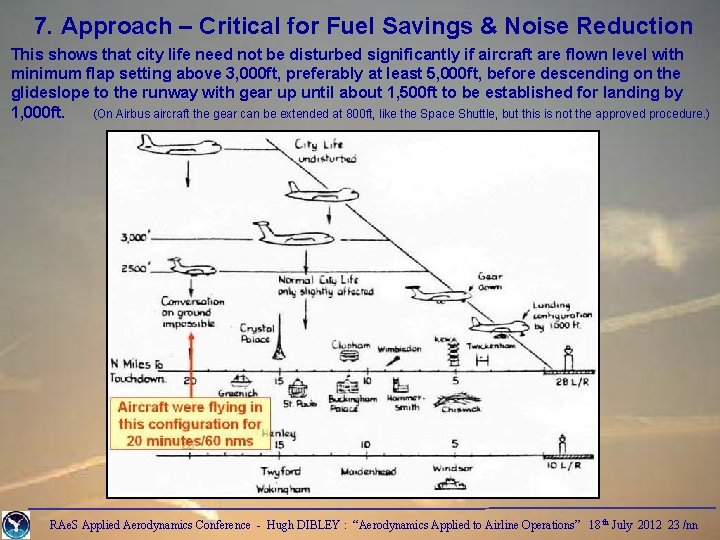
7. Approach – Critical for Fuel Savings & Noise Reduction This shows that city life need not be disturbed significantly if aircraft are flown level with minimum flap setting above 3, 000 ft, preferably at least 5, 000 ft, before descending on the glideslope to the runway with gear up until about 1, 500 ft to be established for landing by 1, 000 ft. (On Airbus aircraft the gear can be extended at 800 ft, like the Space Shuttle, but this is not the approved procedure. ) RAe. S Applied Aerodynamics Conference - Hugh DIBLEY : “Aerodynamics Applied to Airline Operations” 18 th July 2012 23 /nn
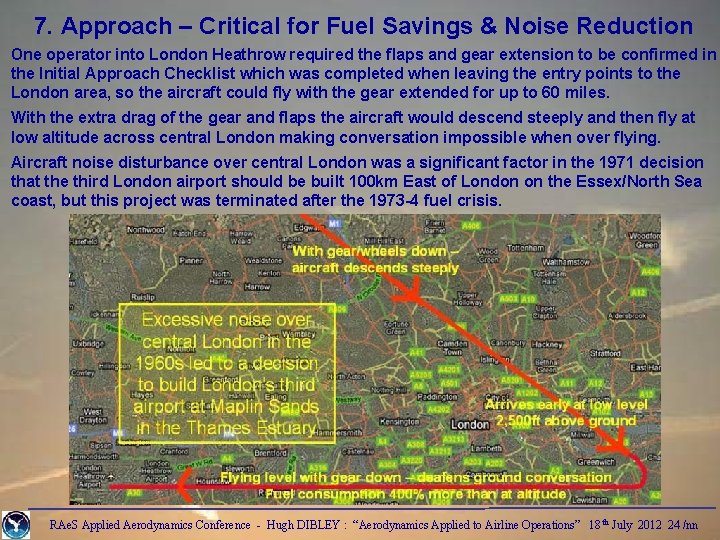
7. Approach – Critical for Fuel Savings & Noise Reduction One operator into London Heathrow required the flaps and gear extension to be confirmed in the Initial Approach Checklist which was completed when leaving the entry points to the London area, so the aircraft could fly with the gear extended for up to 60 miles. With the extra drag of the gear and flaps the aircraft would descend steeply and then fly at low altitude across central London making conversation impossible when over flying. Aircraft noise disturbance over central London was a significant factor in the 1971 decision that the third London airport should be built 100 km East of London on the Essex/North Sea coast, but this project was terminated after the 1973 -4 fuel crisis. RAe. S Applied Aerodynamics Conference - Hugh DIBLEY : “Aerodynamics Applied to Airline Operations” 18 th July 2012 24 /nn
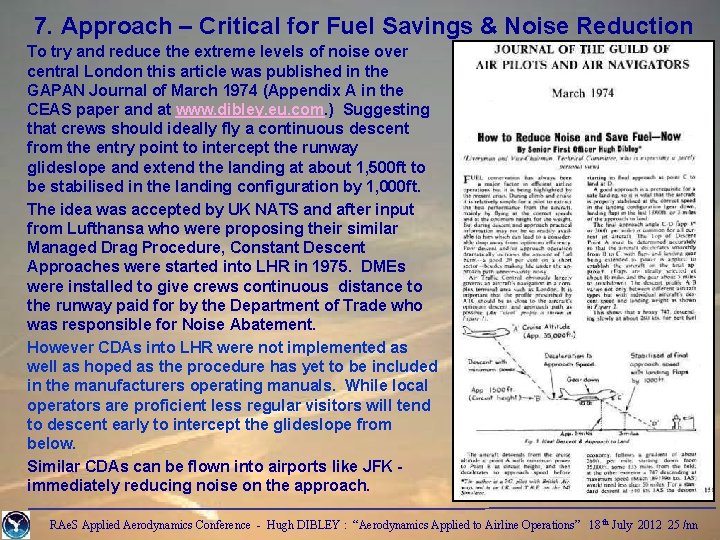
7. Approach – Critical for Fuel Savings & Noise Reduction To try and reduce the extreme levels of noise over central London this article was published in the GAPAN Journal of March 1974 (Appendix A in the CEAS paper and at www. dibley. eu. com. ) Suggesting that crews should ideally fly a continuous descent from the entry point to intercept the runway glideslope and extend the landing at about 1, 500 ft to be stabilised in the landing configuration by 1, 000 ft. The idea was accepted by UK NATS and after input from Lufthansa who were proposing their similar Managed Drag Procedure, Constant Descent Approaches were started into LHR in 1975. DMEs were installed to give crews continuous distance to the runway paid for by the Department of Trade who was responsible for Noise Abatement. However CDAs into LHR were not implemented as well as hoped as the procedure has yet to be included in the manufacturers operating manuals. While local operators are proficient less regular visitors will tend to descent early to intercept the glideslope from below. Similar CDAs can be flown into airports like JFK immediately reducing noise on the approach. RAe. S Applied Aerodynamics Conference - Hugh DIBLEY : “Aerodynamics Applied to Airline Operations” 18 th July 2012 25 /nn
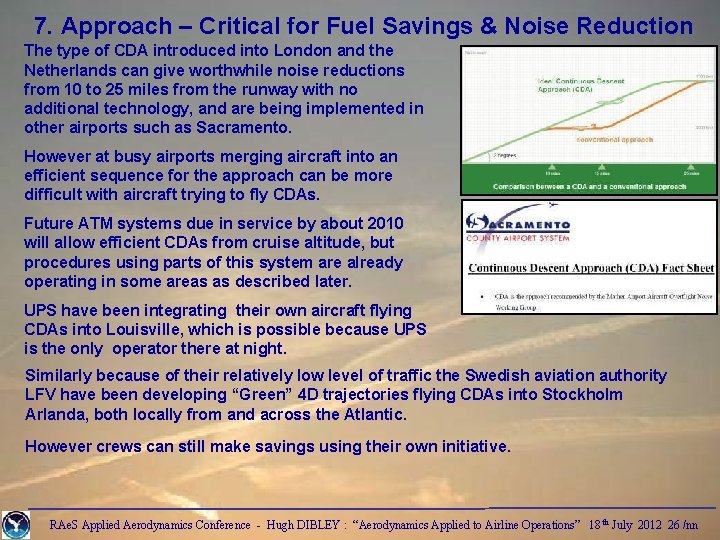
7. Approach – Critical for Fuel Savings & Noise Reduction The type of CDA introduced into London and the Netherlands can give worthwhile noise reductions from 10 to 25 miles from the runway with no additional technology, and are being implemented in other airports such as Sacramento. However at busy airports merging aircraft into an efficient sequence for the approach can be more difficult with aircraft trying to fly CDAs. Future ATM systems due in service by about 2010 will allow efficient CDAs from cruise altitude, but procedures using parts of this system are already operating in some areas as described later. UPS have been integrating their own aircraft flying CDAs into Louisville, which is possible because UPS is the only operator there at night. Similarly because of their relatively low level of traffic the Swedish aviation authority LFV have been developing “Green” 4 D trajectories flying CDAs into Stockholm Arlanda, both locally from and across the Atlantic. However crews can still make savings using their own initiative. RAe. S Applied Aerodynamics Conference - Hugh DIBLEY : “Aerodynamics Applied to Airline Operations” 18 th July 2012 26 /nn
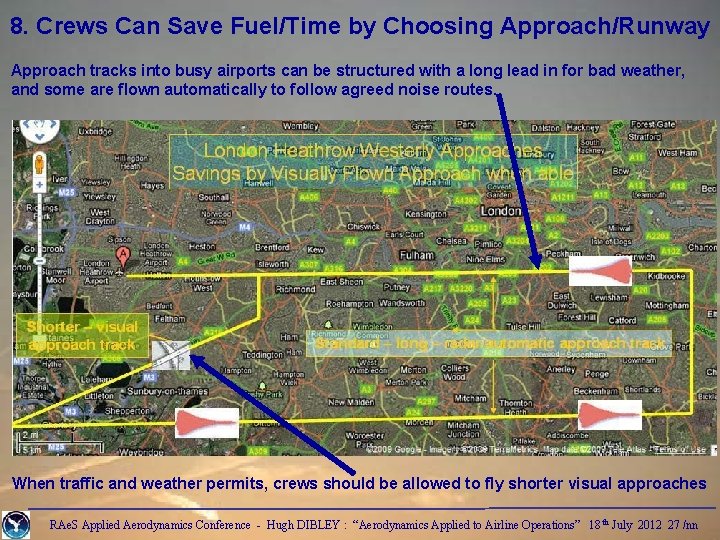
8. Crews Can Save Fuel/Time by Choosing Approach/Runway Approach tracks into busy airports can be structured with a long lead in for bad weather, and some are flown automatically to follow agreed noise routes. When traffic and weather permits, crews should be allowed to fly shorter visual approaches RAe. S Applied Aerodynamics Conference - Hugh DIBLEY : “Aerodynamics Applied to Airline Operations” 18 th July 2012 27 /nn
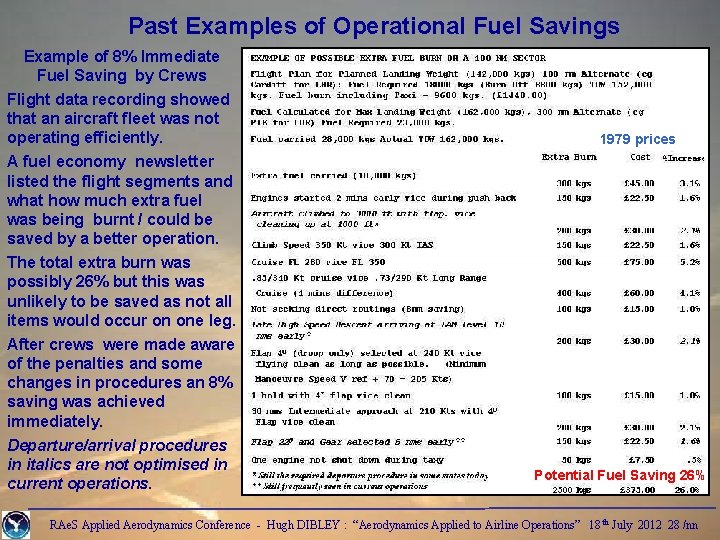
Past Examples of Operational Fuel Savings Example of 8% Immediate Fuel Saving by Crews Flight data recording showed that an aircraft fleet was not operating efficiently. A fuel economy newsletter listed the flight segments and what how much extra fuel was being burnt / could be saved by a better operation. The total extra burn was possibly 26% but this was unlikely to be saved as not all items would occur on one leg. After crews were made aware of the penalties and some changes in procedures an 8% saving was achieved immediately. Departure/arrival procedures in italics are not optimised in current operations. 1979 prices Potential Fuel Saving 26% RAe. S Applied Aerodynamics Conference - Hugh DIBLEY : “Aerodynamics Applied to Airline Operations” 18 th July 2012 28 /nn
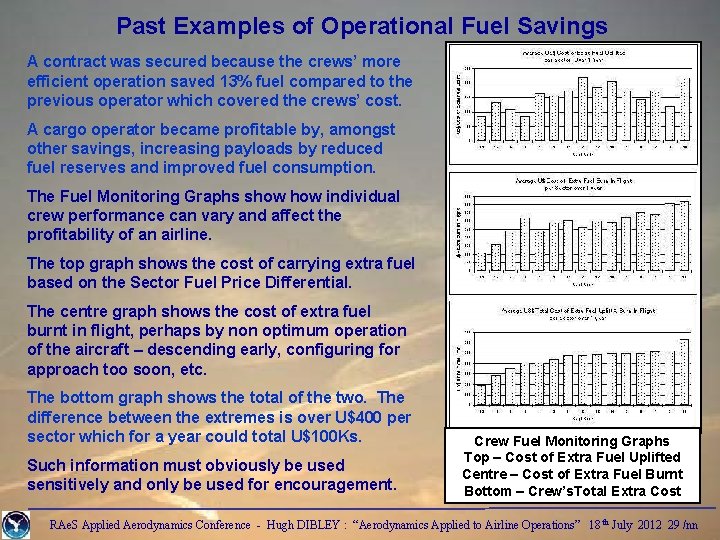
Past Examples of Operational Fuel Savings A contract was secured because the crews’ more efficient operation saved 13% fuel compared to the previous operator which covered the crews’ cost. A cargo operator became profitable by, amongst other savings, increasing payloads by reduced fuel reserves and improved fuel consumption. The Fuel Monitoring Graphs show individual crew performance can vary and affect the profitability of an airline. The top graph shows the cost of carrying extra fuel based on the Sector Fuel Price Differential. The centre graph shows the cost of extra fuel burnt in flight, perhaps by non optimum operation of the aircraft – descending early, configuring for approach too soon, etc. The bottom graph shows the total of the two. The difference between the extremes is over U$400 per sector which for a year could total U$100 Ks. Such information must obviously be used sensitively and only be used for encouragement. Crew Fuel Monitoring Graphs Top – Cost of Extra Fuel Uplifted Centre – Cost of Extra Fuel Burnt Bottom – Crew’s. Total Extra Cost RAe. S Applied Aerodynamics Conference - Hugh DIBLEY : “Aerodynamics Applied to Airline Operations” 18 th July 2012 29 /nn
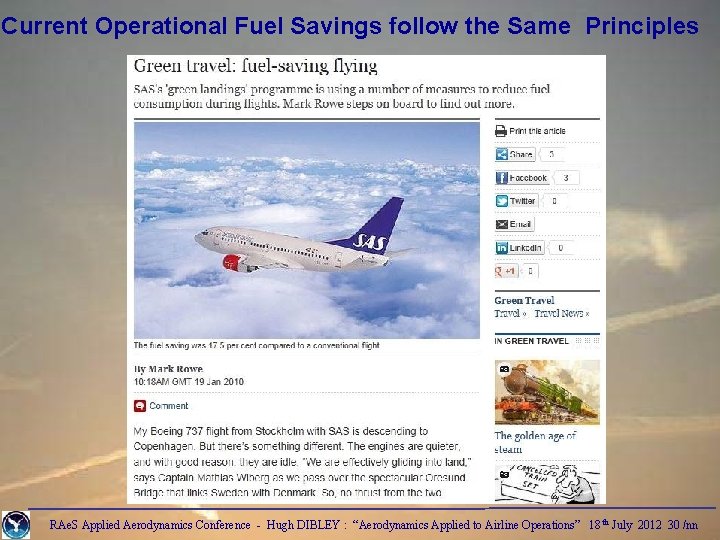
Current Operational Fuel Savings follow the Same Principles RAe. S Applied Aerodynamics Conference - Hugh DIBLEY : “Aerodynamics Applied to Airline Operations” 18 th July 2012 30 /nn
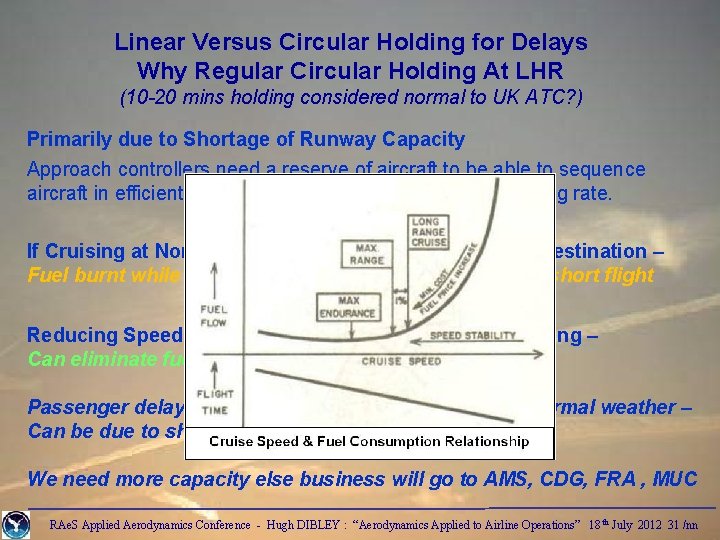
Linear Versus Circular Holding for Delays Why Regular Circular Holding At LHR (10 -20 mins holding considered normal to UK ATC? ) Primarily due to Shortage of Runway Capacity Approach controllers need a reserve of aircraft to be able to sequence aircraft in efficiently to maximise LHR’s single runway landing rate. If Cruising at Normal Speed En Route then Circling at Destination – Fuel burnt while circling/holding is wasted – XX% on a short flight Reducing Speed En Route to Lose the Time Spent Circling – Can eliminate fuel wastage. Passenger delays in immigration due bunching in abnormal weather – Can be due to shortage of runway capacity. . We need more capacity else business will go to AMS, CDG, FRA , MUC RAe. S Applied Aerodynamics Conference - Hugh DIBLEY : “Aerodynamics Applied to Airline Operations” 18 th July 2012 31 /nn
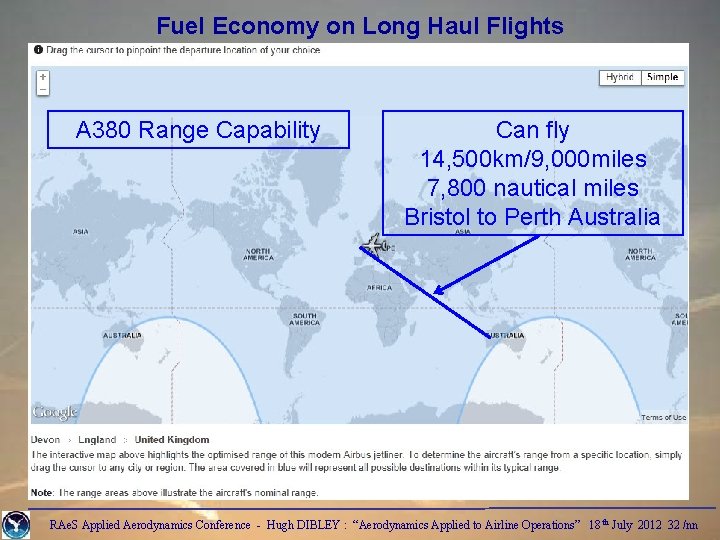
Fuel Economy on Long Haul Flights A 380 Range Capability Can fly 14, 500 km/9, 000 miles 7, 800 nautical miles Bristol to Perth Australia RAe. S Applied Aerodynamics Conference - Hugh DIBLEY : “Aerodynamics Applied to Airline Operations” 18 th July 2012 32 /nn
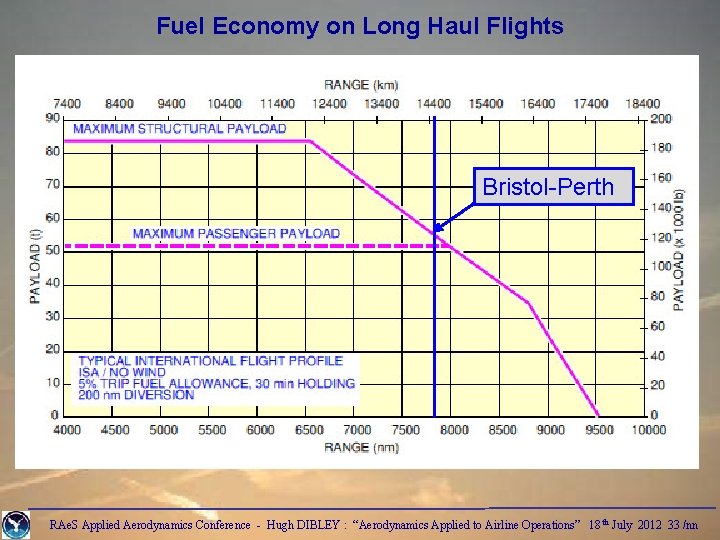
Fuel Economy on Long Haul Flights Bristol-Perth RAe. S Applied Aerodynamics Conference - Hugh DIBLEY : “Aerodynamics Applied to Airline Operations” 18 th July 2012 33 /nn
Fuel Economy on Long Haul Flights Flight Bristol – Perth Australia 14, 500 km/9, 000 statute miles Flying Close to Colombo – about half way Flight Time approx 18 hours Fuel carried for Colombo–Perth is burnt at 4% per hour Bristol-Colombo Therefore about an extra 35% fuel can be required for a non-stop flight on a high take-off weight aircraft capable of flying the 9, 000 miles non stop. A lighter aircraft designed to fly with the same payload but with a range of only 4, 500 miles will save more fuel. This was illustrated in the next slides by Dr John Green’s 2008 paper for Greener By Design, presented to the RAe. S Toulouse Branch - RAe. S Applied Aerodynamics Conference - Hugh DIBLEY : “Aerodynamics Applied to Airline Operations” 18 th July 2012 34 /nn
Options for reducing fuel burn per passenger-km RAe. S Applied Aerodynamics Conference - Hugh DIBLEY : “Aerodynamics Applied to Airline Operations” 18 th July 2012 35 /nn
Effect of design range and operating range on payload-fuel efficiency RAe. S Applied Aerodynamics Conference - Hugh DIBLEY : “Aerodynamics Applied to Airline Operations” 18 th July 2012 36 /nn
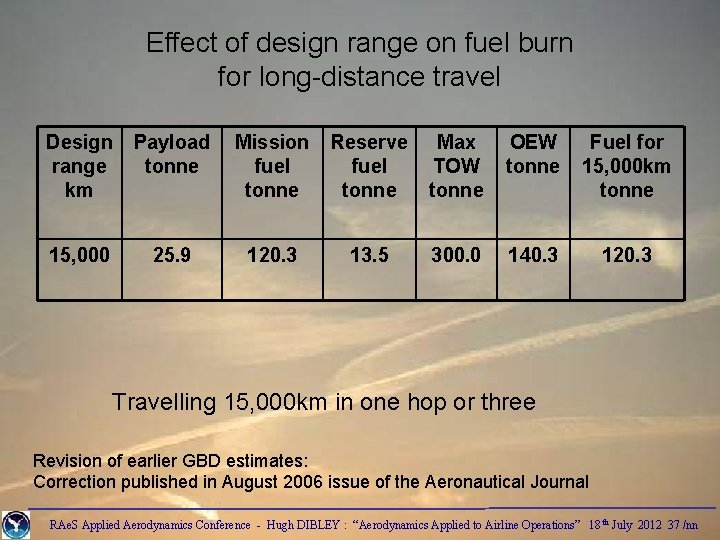
Effect of design range on fuel burn for long-distance travel Design range km Payload tonne Mission fuel tonne Reserve fuel tonne Max TOW tonne OEW tonne Fuel for 15, 000 km tonne 15, 000 25. 9 120. 3 13. 5 300. 0 140. 3 120. 3 Travelling 15, 000 km in one hop or three Revision of earlier GBD estimates: Correction published in August 2006 issue of the Aeronautical Journal RAe. S Applied Aerodynamics Conference - Hugh DIBLEY : “Aerodynamics Applied to Airline Operations” 18 th July 2012 37 /nn
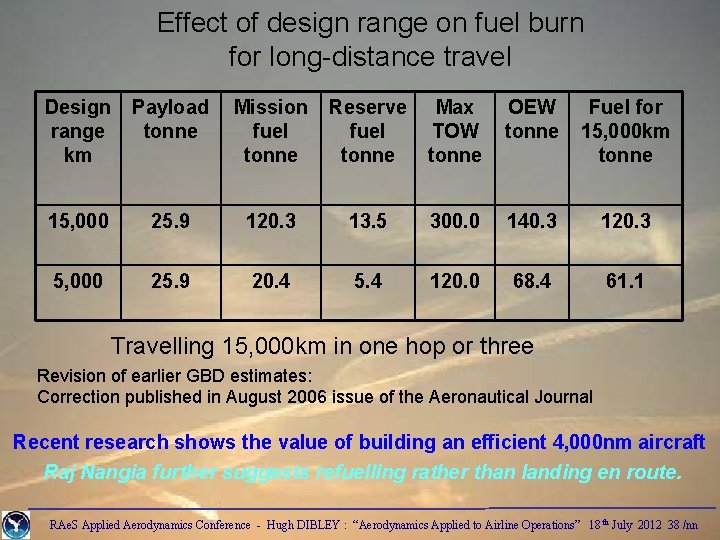
Effect of design range on fuel burn for long-distance travel Design range km Payload tonne Mission fuel tonne Reserve fuel tonne Max TOW tonne OEW tonne Fuel for 15, 000 km tonne 15, 000 25. 9 120. 3 13. 5 300. 0 140. 3 120. 3 5, 000 25. 9 20. 4 5. 4 120. 0 68. 4 61. 1 Travelling 15, 000 km in one hop or three Revision of earlier GBD estimates: Correction published in August 2006 issue of the Aeronautical Journal Recent research shows the value of building an efficient 4, 000 nm aircraft Raj Nangia further suggests refuelling rather than landing en route. RAe. S Applied Aerodynamics Conference - Hugh DIBLEY : “Aerodynamics Applied to Airline Operations” 18 th July 2012 38 /nn
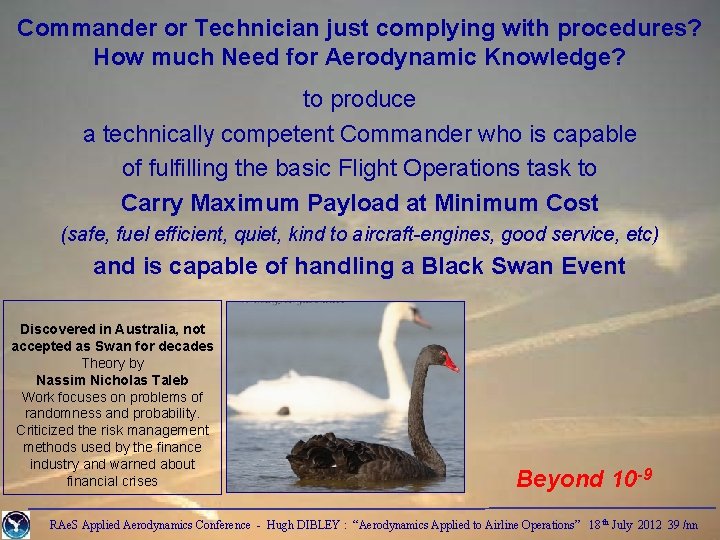
Commander or Technician just complying with procedures? How much Need for Aerodynamic Knowledge? to produce a technically competent Commander who is capable of fulfilling the basic Flight Operations task to Carry Maximum Payload at Minimum Cost (safe, fuel efficient, quiet, kind to aircraft-engines, good service, etc) and is capable of handling a Black Swan Event Discovered in Australia, not accepted as Swan for decades Theory by Nassim Nicholas Taleb Work focuses on problems of randomness and probability. Criticized the risk management methods used by the finance industry and warned about financial crises Beyond 10 -9 RAe. S Applied Aerodynamics Conference - Hugh DIBLEY : “Aerodynamics Applied to Airline Operations” 18 th July 2012 39 /nn
Dealing with Black Swans RAe. S Applied Aerodynamics Conference - Hugh DIBLEY : “Aerodynamics Applied to Airline Operations” 18 th July 2012 40 /nn
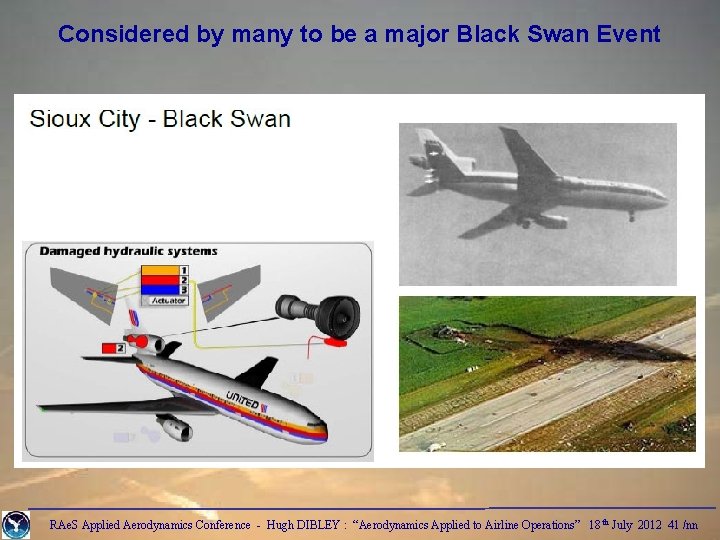
Considered by many to be a major Black Swan Event RAe. S Applied Aerodynamics Conference - Hugh DIBLEY : “Aerodynamics Applied to Airline Operations” 18 th July 2012 41 /nn
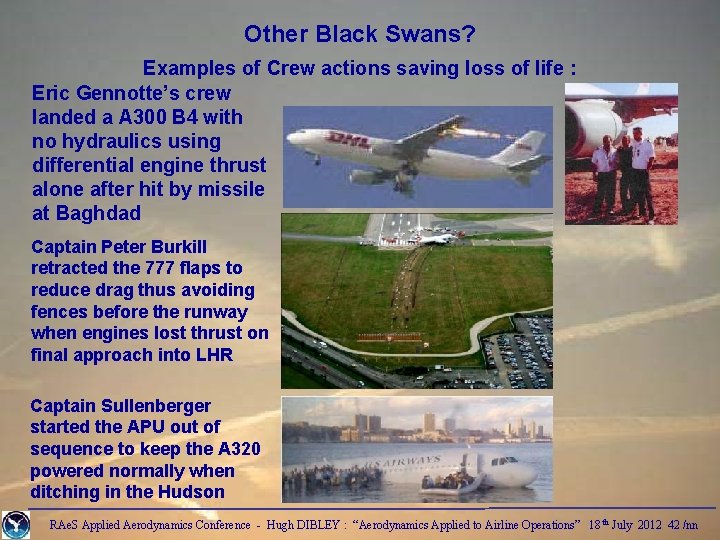
Other Black Swans? Examples of Crew actions saving loss of life : Eric Gennotte’s crew landed a A 300 B 4 with no hydraulics using differential engine thrust alone after hit by missile at Baghdad Captain Peter Burkill retracted the 777 flaps to reduce drag thus avoiding fences before the runway when engines lost thrust on final approach into LHR Captain Sullenberger started the APU out of sequence to keep the A 320 powered normally when ditching in the Hudson RAe. S Applied Aerodynamics Conference - Hugh DIBLEY : “Aerodynamics Applied to Airline Operations” 18 th July 2012 42 /nn
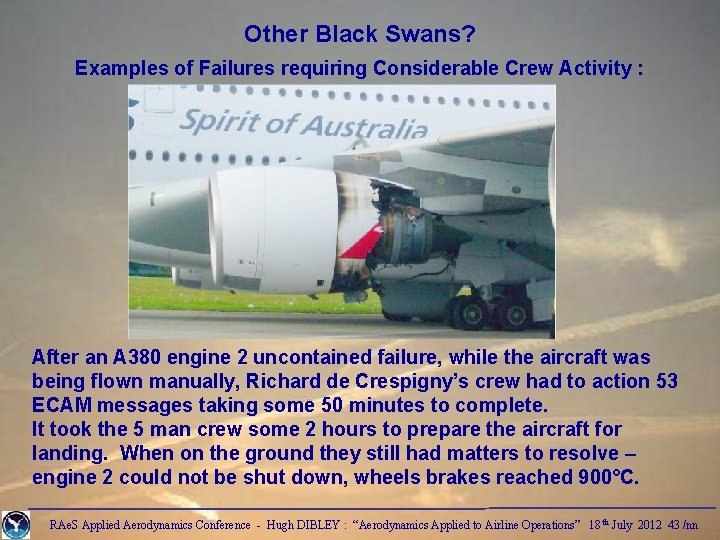
Other Black Swans? Examples of Failures requiring Considerable Crew Activity : After an A 380 engine 2 uncontained failure, while the aircraft was being flown manually, Richard de Crespigny’s crew had to action 53 ECAM messages taking some 50 minutes to complete. It took the 5 man crew some 2 hours to prepare the aircraft for landing. When on the ground they still had matters to resolve – engine 2 could not be shut down, wheels brakes reached 900°C. RAe. S Applied Aerodynamics Conference - Hugh DIBLEY : “Aerodynamics Applied to Airline Operations” 18 th July 2012 43 /nn
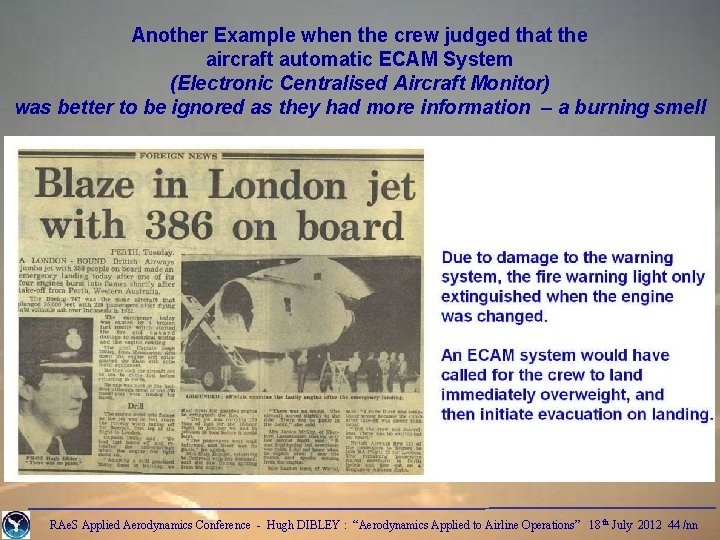
Another Example when the crew judged that the aircraft automatic ECAM System (Electronic Centralised Aircraft Monitor) was better to be ignored as they had more information – a burning smell RAe. S Applied Aerodynamics Conference - Hugh DIBLEY : “Aerodynamics Applied to Airline Operations” 18 th July 2012 44 /nn
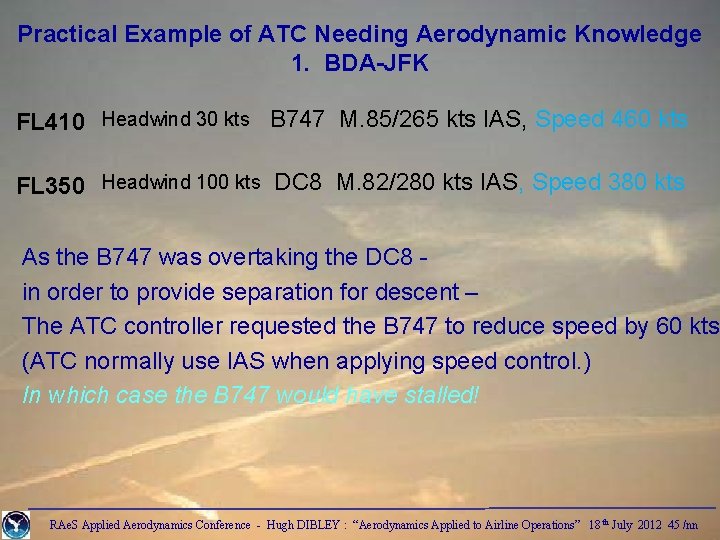
Practical Example of ATC Needing Aerodynamic Knowledge 1. BDA-JFK FL 410 Headwind 30 kts B 747 M. 85/265 kts IAS, Speed 460 kts FL 350 Headwind 100 kts DC 8 M. 82/280 kts IAS, Speed 380 kts As the B 747 was overtaking the DC 8 in order to provide separation for descent – The ATC controller requested the B 747 to reduce speed by 60 kts (ATC normally use IAS when applying speed control. ) In which case the B 747 would have stalled! RAe. S Applied Aerodynamics Conference - Hugh DIBLEY : “Aerodynamics Applied to Airline Operations” 18 th July 2012 45 /nn
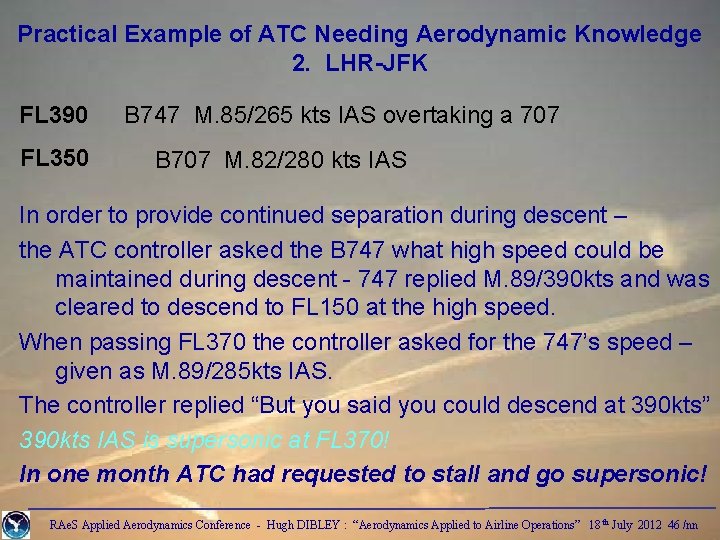
Practical Example of ATC Needing Aerodynamic Knowledge 2. LHR-JFK FL 390 FL 350 B 747 M. 85/265 kts IAS overtaking a 707 B 707 M. 82/280 kts IAS In order to provide continued separation during descent – the ATC controller asked the B 747 what high speed could be maintained during descent - 747 replied M. 89/390 kts and was cleared to descend to FL 150 at the high speed. When passing FL 370 the controller asked for the 747’s speed – given as M. 89/285 kts IAS. The controller replied “But you said you could descend at 390 kts” 390 kts IAS is supersonic at FL 370! In one month ATC had requested to stall and go supersonic! RAe. S Applied Aerodynamics Conference - Hugh DIBLEY : “Aerodynamics Applied to Airline Operations” 18 th July 2012 46 /nn
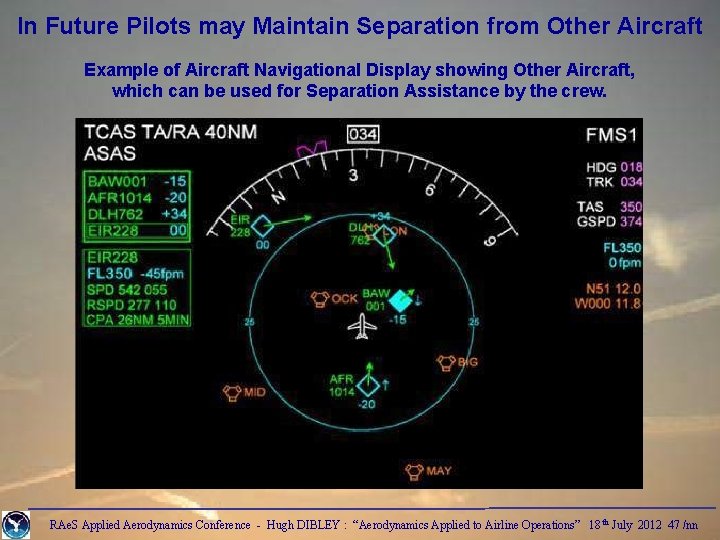
In Future Pilots may Maintain Separation from Other Aircraft Example of Aircraft Navigational Display showing Other Aircraft, which can be used for Separation Assistance by the crew. RAe. S Applied Aerodynamics Conference - Hugh DIBLEY : “Aerodynamics Applied to Airline Operations” 18 th July 2012 47 /nn
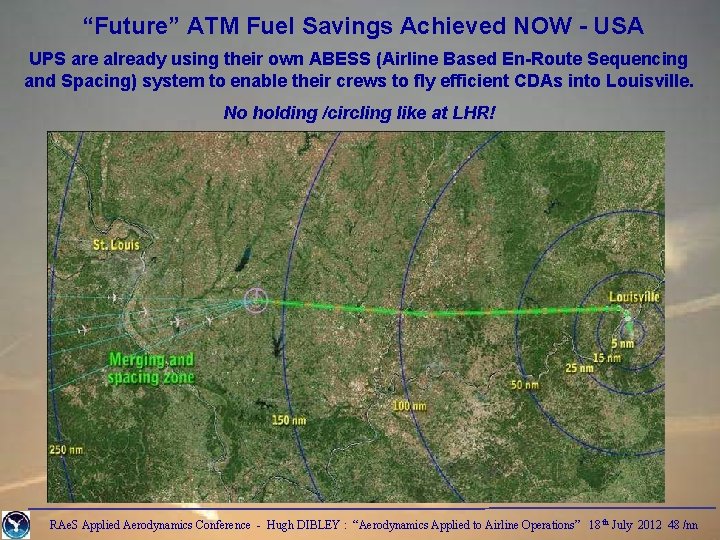
“Future” ATM Fuel Savings Achieved NOW - USA UPS are already using their own ABESS (Airline Based En-Route Sequencing and Spacing) system to enable their crews to fly efficient CDAs into Louisville. No holding /circling like at LHR! RAe. S Applied Aerodynamics Conference - Hugh DIBLEY : “Aerodynamics Applied to Airline Operations” 18 th July 2012 48 /nn
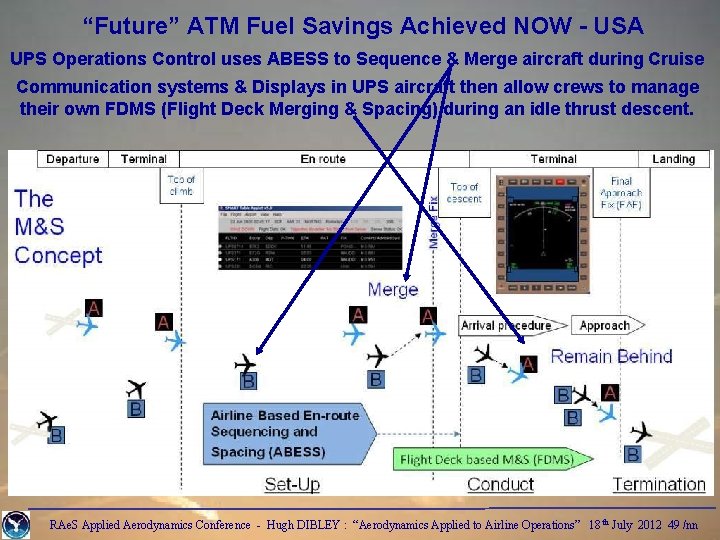
“Future” ATM Fuel Savings Achieved NOW - USA UPS Operations Control uses ABESS to Sequence & Merge aircraft during Cruise Communication systems & Displays in UPS aircraft then allow crews to manage their own FDMS (Flight Deck Merging & Spacing) during an idle thrust descent. RAe. S Applied Aerodynamics Conference - Hugh DIBLEY : “Aerodynamics Applied to Airline Operations” 18 th July 2012 49 /nn
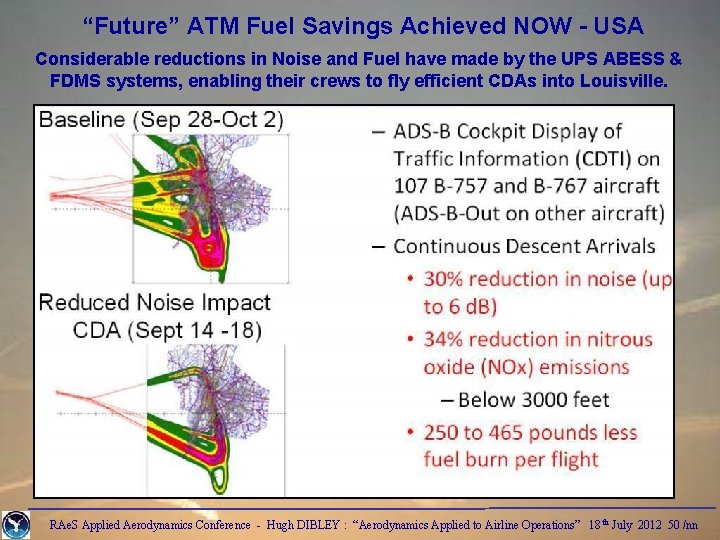
“Future” ATM Fuel Savings Achieved NOW - USA Considerable reductions in Noise and Fuel have made by the UPS ABESS & FDMS systems, enabling their crews to fly efficient CDAs into Louisville. RAe. S Applied Aerodynamics Conference - Hugh DIBLEY : “Aerodynamics Applied to Airline Operations” 18 th July 2012 50 /nn
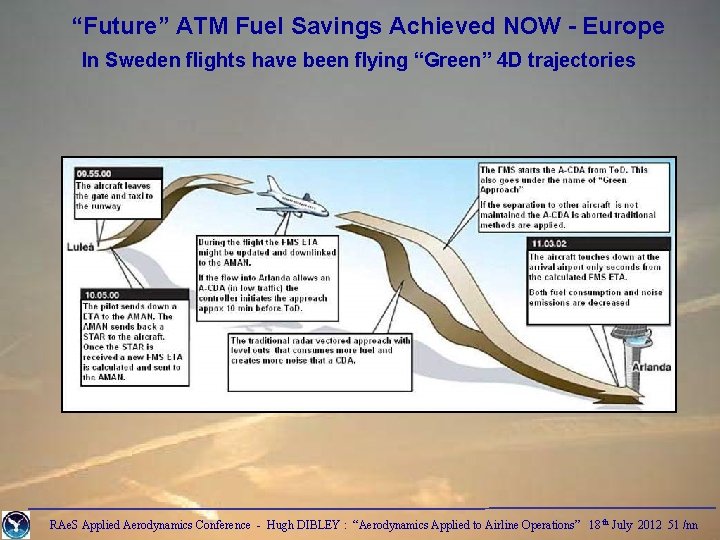
“Future” ATM Fuel Savings Achieved NOW - Europe In Sweden flights have been flying “Green” 4 D trajectories RAe. S Applied Aerodynamics Conference - Hugh DIBLEY : “Aerodynamics Applied to Airline Operations” 18 th July 2012 51 /nn
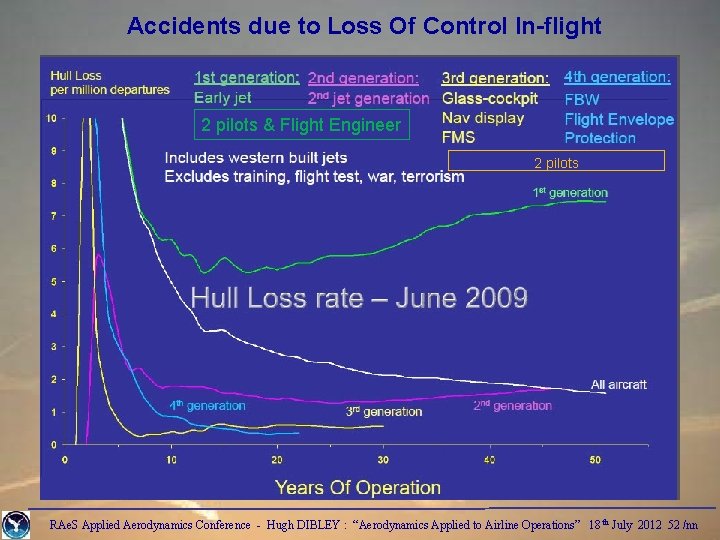
Accidents due to Loss Of Control In-flight 2 pilots & Flight Engineer 2 pilots RAe. S Applied Aerodynamics Conference - Hugh DIBLEY : “Aerodynamics Applied to Airline Operations” 18 th July 2012 52 /nn
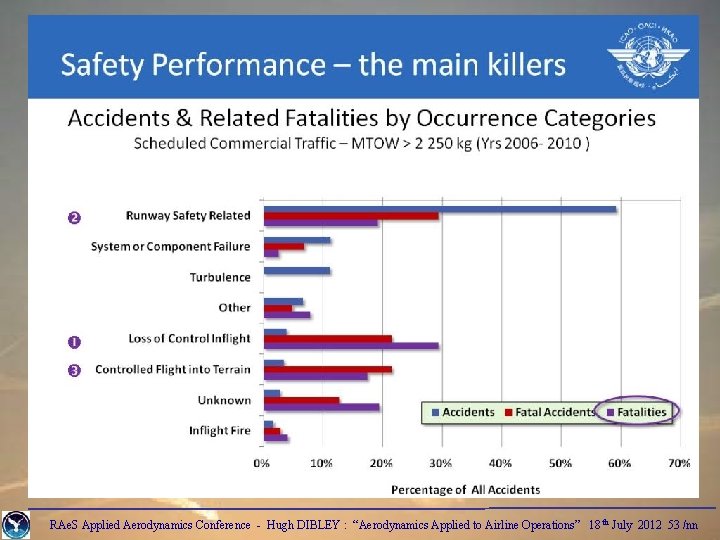
RAe. S Applied Aerodynamics Conference - Hugh DIBLEY : “Aerodynamics Applied to Airline Operations” 18 th July 2012 53 /nn
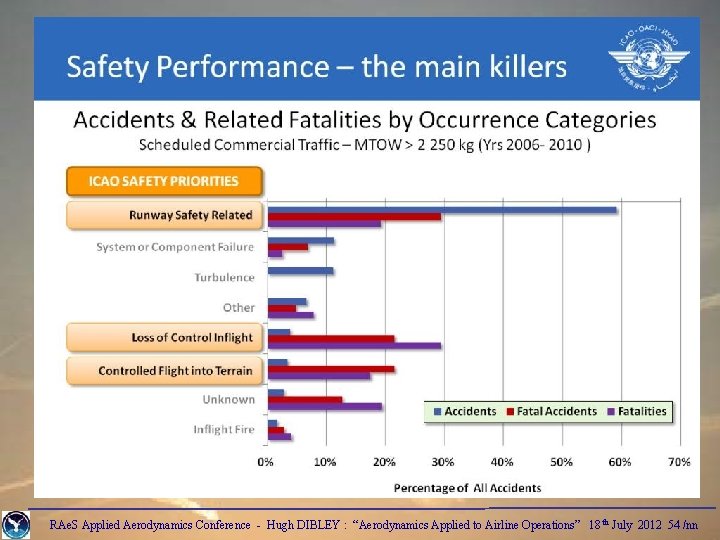
RAe. S Applied Aerodynamics Conference - Hugh DIBLEY : “Aerodynamics Applied to Airline Operations” 18 th July 2012 54 /nn
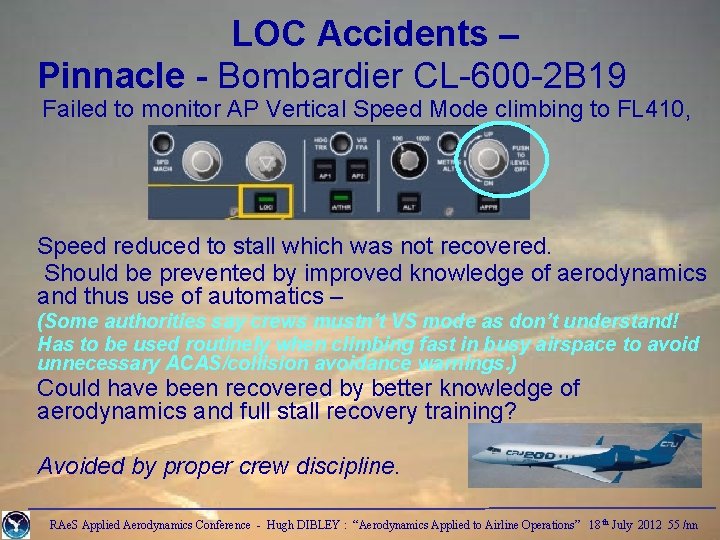
LOC Accidents – Pinnacle - Bombardier CL-600 -2 B 19 Failed to monitor AP Vertical Speed Mode climbing to FL 410, Speed reduced to stall which was not recovered. Should be prevented by improved knowledge of aerodynamics and thus use of automatics – (Some authorities say crews mustn’t VS mode as don’t understand! Has to be used routinely when climbing fast in busy airspace to avoid unnecessary ACAS/collision avoidance warnings. ) Could have been recovered by better knowledge of aerodynamics and full stall recovery training? Avoided by proper crew discipline. RAe. S Applied Aerodynamics Conference - Hugh DIBLEY : “Aerodynamics Applied to Airline Operations” 18 th July 2012 55 /nn
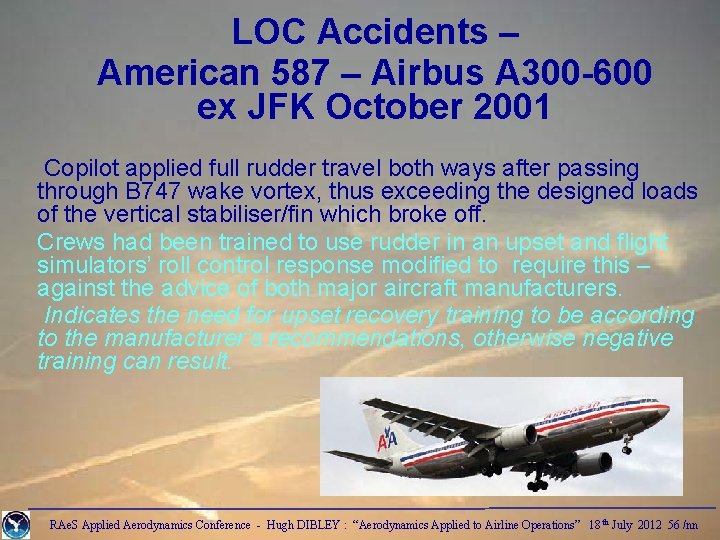
LOC Accidents – American 587 – Airbus A 300 -600 ex JFK October 2001 Copilot applied full rudder travel both ways after passing through B 747 wake vortex, thus exceeding the designed loads of the vertical stabiliser/fin which broke off. Crews had been trained to use rudder in an upset and flight simulators’ roll control response modified to require this – against the advice of both major aircraft manufacturers. Indicates the need for upset recovery training to be according to the manufacturer’s recommendations, otherwise negative training can result. RAe. S Applied Aerodynamics Conference - Hugh DIBLEY : “Aerodynamics Applied to Airline Operations” 18 th July 2012 56 /nn
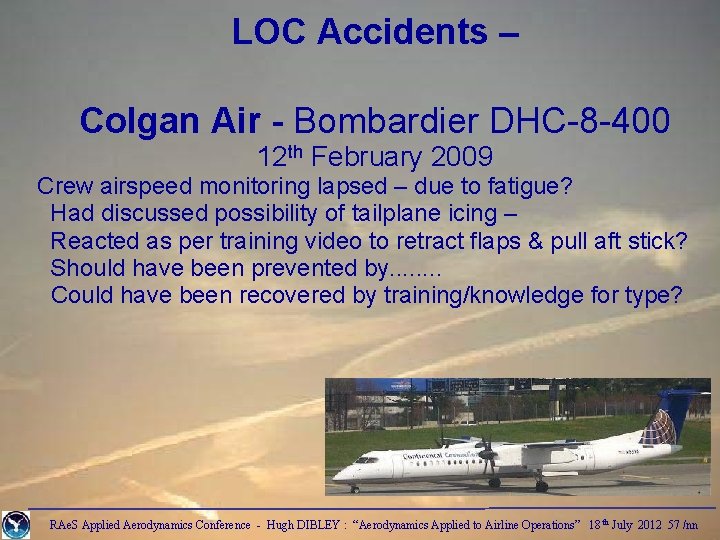
LOC Accidents – Colgan Air - Bombardier DHC-8 -400 12 th February 2009 Crew airspeed monitoring lapsed – due to fatigue? Had discussed possibility of tailplane icing – Reacted as per training video to retract flaps & pull aft stick? Should have been prevented by. . . . Could have been recovered by training/knowledge for type? RAe. S Applied Aerodynamics Conference - Hugh DIBLEY : “Aerodynamics Applied to Airline Operations” 18 th July 2012 57 /nn
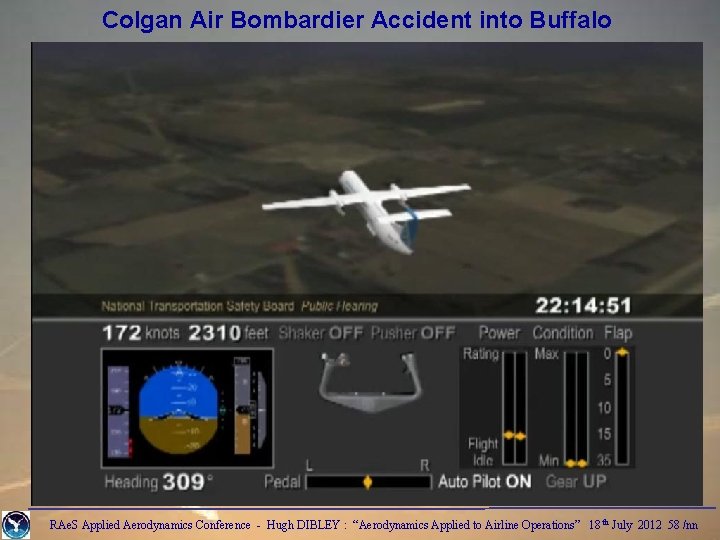
Colgan Air Bombardier Accident into Buffalo RAe. S Applied Aerodynamics Conference - Hugh DIBLEY : “Aerodynamics Applied to Airline Operations” 18 th July 2012 58 /nn
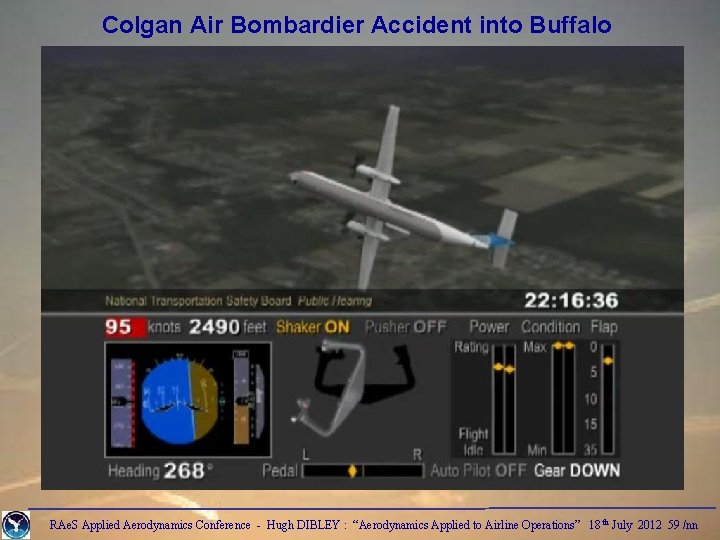
Colgan Air Bombardier Accident into Buffalo RAe. S Applied Aerodynamics Conference - Hugh DIBLEY : “Aerodynamics Applied to Airline Operations” 18 th July 2012 59 /nn
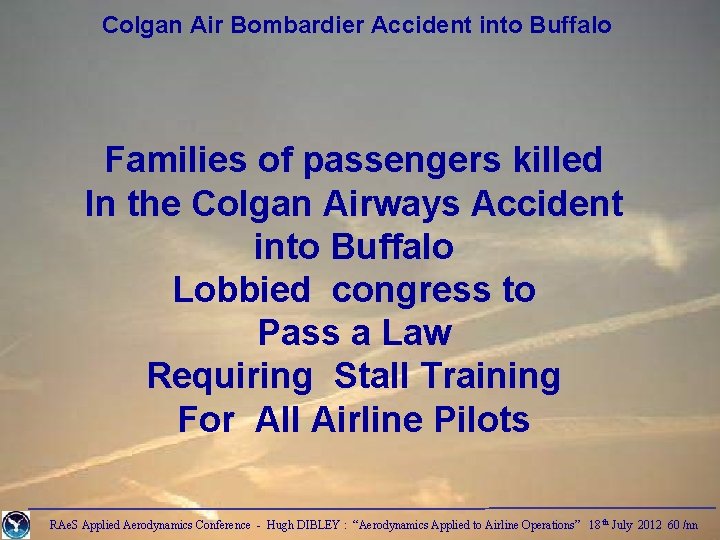
Colgan Air Bombardier Accident into Buffalo Families of passengers killed In the Colgan Airways Accident into Buffalo Lobbied congress to Pass a Law Requiring Stall Training For All Airline Pilots RAe. S Applied Aerodynamics Conference - Hugh DIBLEY : “Aerodynamics Applied to Airline Operations” 18 th July 2012 60 /nn
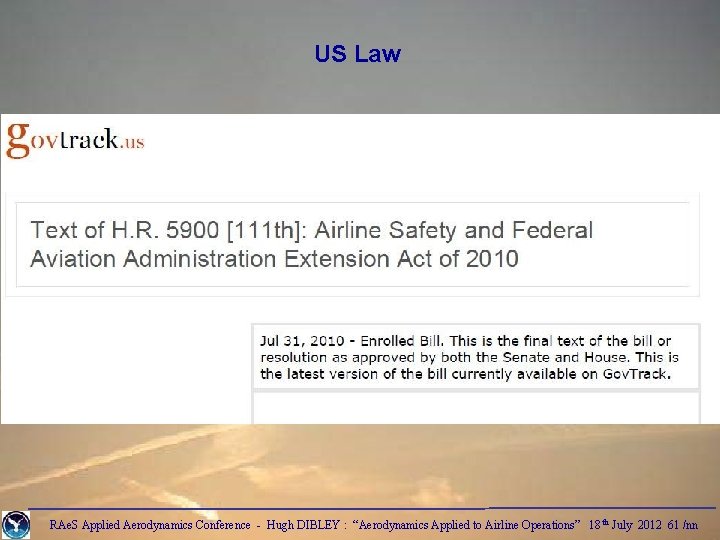
US Law RAe. S Applied Aerodynamics Conference - Hugh DIBLEY : “Aerodynamics Applied to Airline Operations” 18 th July 2012 61 /nn
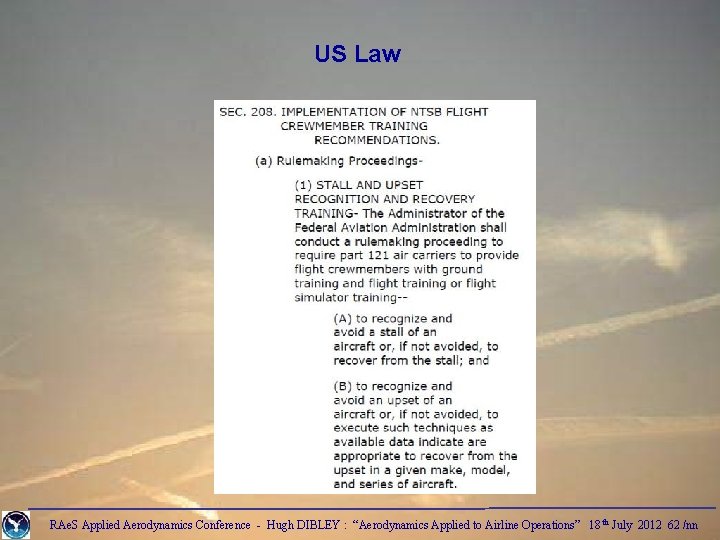
US Law RAe. S Applied Aerodynamics Conference - Hugh DIBLEY : “Aerodynamics Applied to Airline Operations” 18 th July 2012 62 /nn
RAe. S Applied Aerodynamics Conference - Hugh DIBLEY : “Aerodynamics Applied to Airline Operations” 18 th July 2012 63 /nn
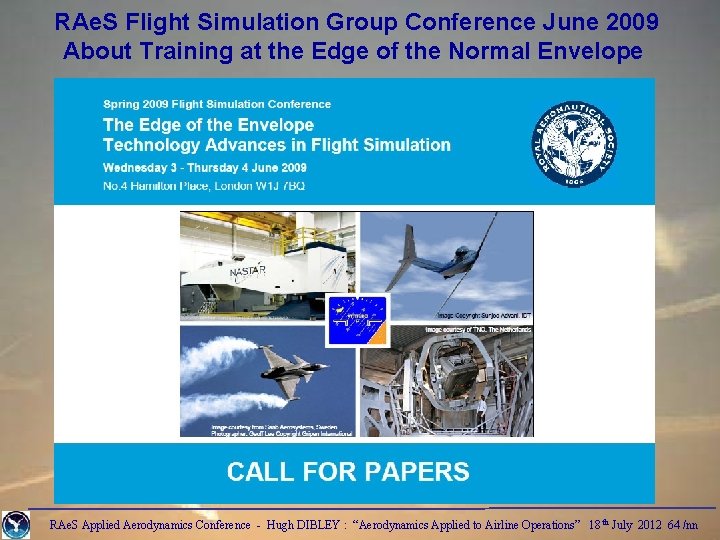
RAe. S Flight Simulation Group Conference June 2009 About Training at the Edge of the Normal Envelope RAe. S Applied Aerodynamics Conference - Hugh DIBLEY : “Aerodynamics Applied to Airline Operations” 18 th July 2012 64 /nn
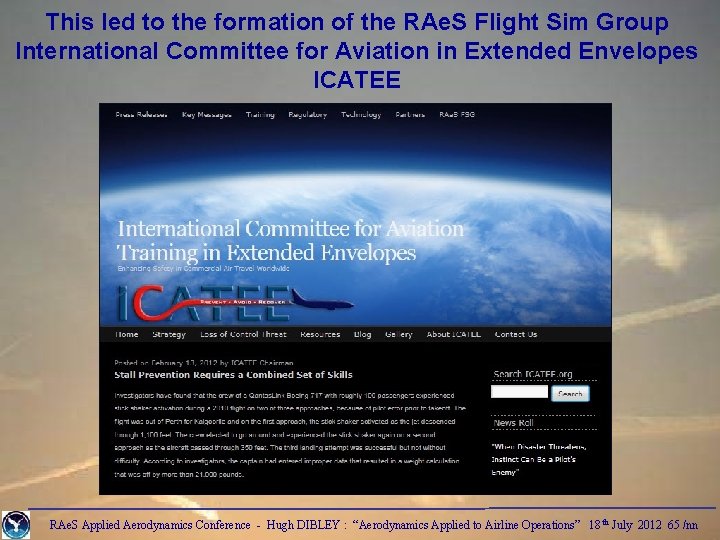
This led to the formation of the RAe. S Flight Sim Group International Committee for Aviation in Extended Envelopes ICATEE RAe. S Applied Aerodynamics Conference - Hugh DIBLEY : “Aerodynamics Applied to Airline Operations” 18 th July 2012 65 /nn
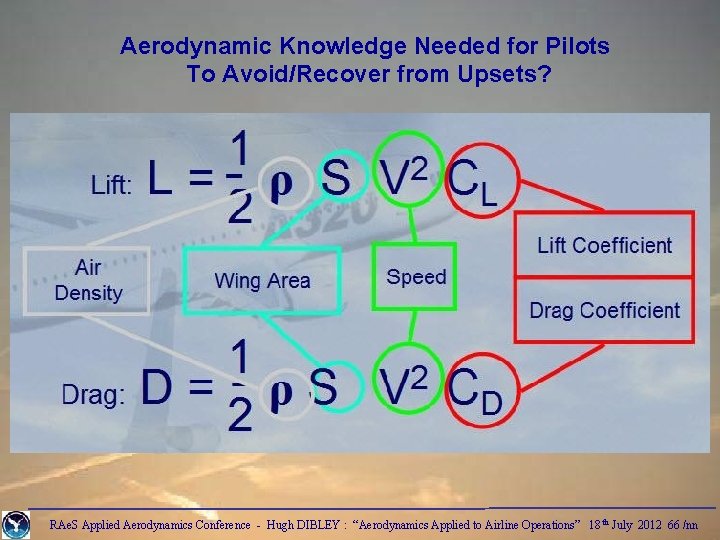
Aerodynamic Knowledge Needed for Pilots To Avoid/Recover from Upsets? RAe. S Applied Aerodynamics Conference - Hugh DIBLEY : “Aerodynamics Applied to Airline Operations” 18 th July 2012 66 /nn
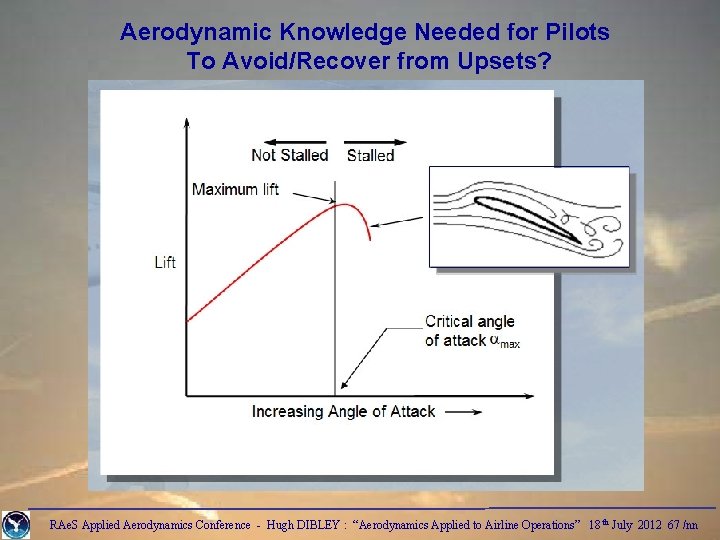
Aerodynamic Knowledge Needed for Pilots To Avoid/Recover from Upsets? RAe. S Applied Aerodynamics Conference - Hugh DIBLEY : “Aerodynamics Applied to Airline Operations” 18 th July 2012 67 /nn
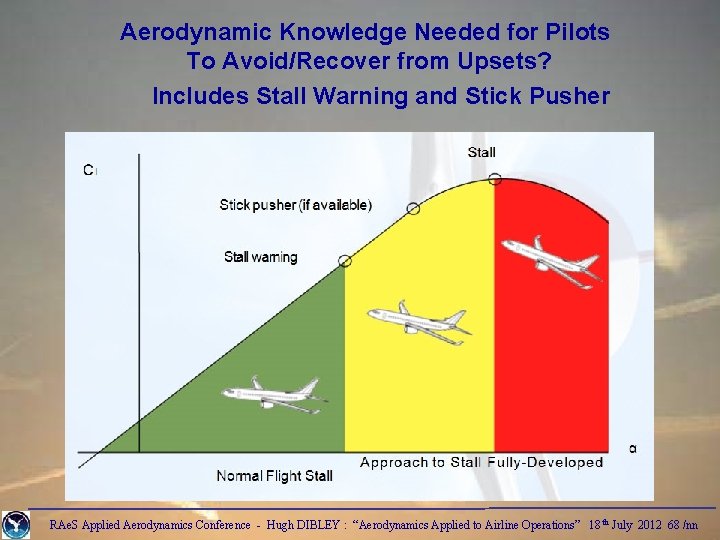
Aerodynamic Knowledge Needed for Pilots To Avoid/Recover from Upsets? Includes Stall Warning and Stick Pusher RAe. S Applied Aerodynamics Conference - Hugh DIBLEY : “Aerodynamics Applied to Airline Operations” 18 th July 2012 68 /nn
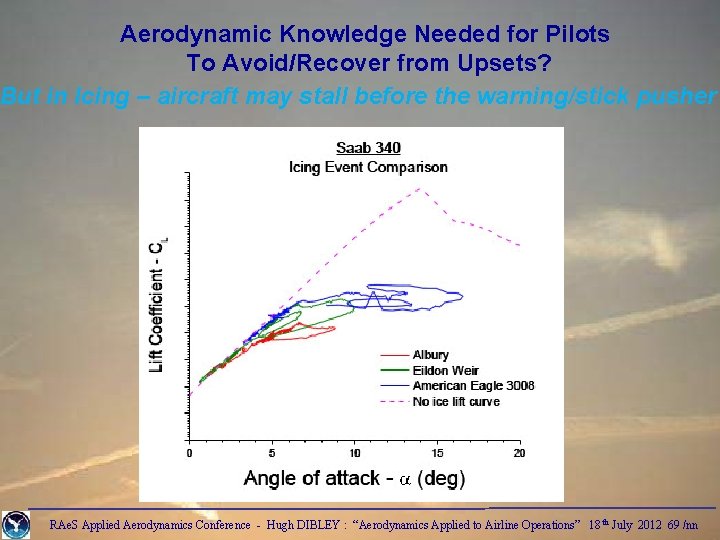
Aerodynamic Knowledge Needed for Pilots To Avoid/Recover from Upsets? But in Icing – aircraft may stall before the warning/stick pusher RAe. S Applied Aerodynamics Conference - Hugh DIBLEY : “Aerodynamics Applied to Airline Operations” 18 th July 2012 69 /nn
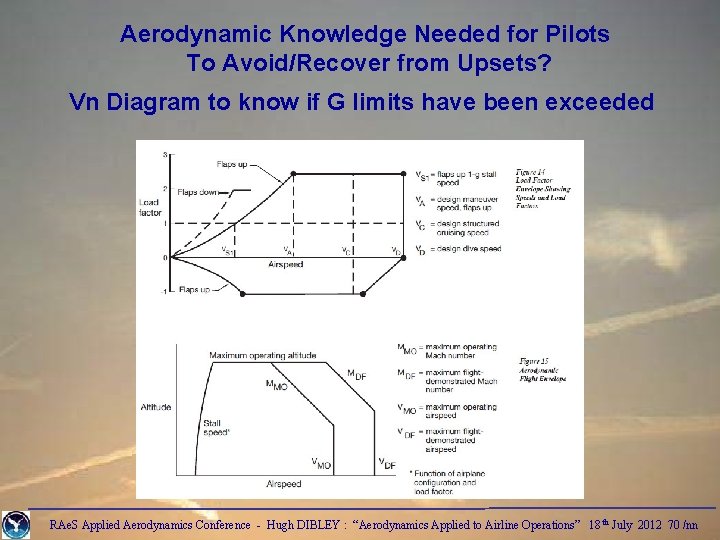
Aerodynamic Knowledge Needed for Pilots To Avoid/Recover from Upsets? Vn Diagram to know if G limits have been exceeded RAe. S Applied Aerodynamics Conference - Hugh DIBLEY : “Aerodynamics Applied to Airline Operations” 18 th July 2012 70 /nn
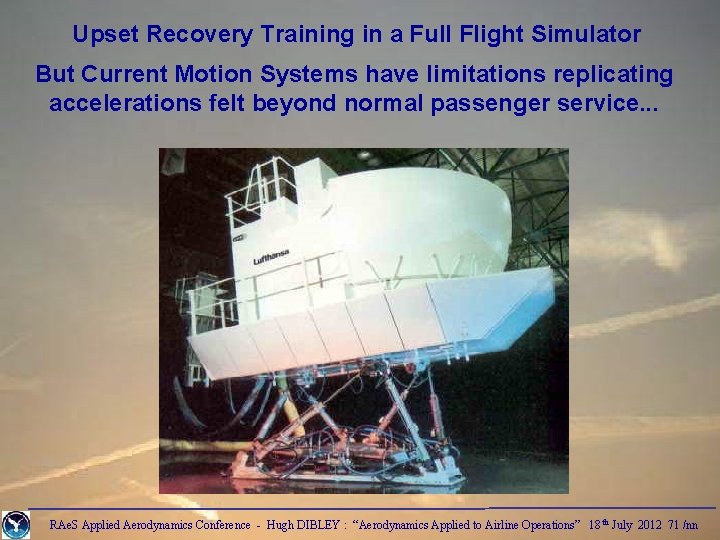
Upset Recovery Training in a Full Flight Simulator But Current Motion Systems have limitations replicating accelerations felt beyond normal passenger service. . . RAe. S Applied Aerodynamics Conference - Hugh DIBLEY : “Aerodynamics Applied to Airline Operations” 18 th July 2012 71 /nn
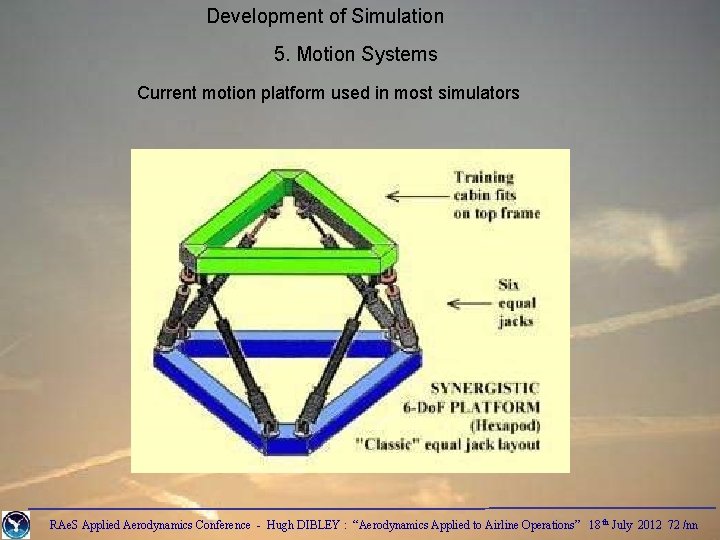
Development of Simulation 5. Motion Systems Current motion platform used in most simulators RAe. S Applied Aerodynamics Conference - Hugh DIBLEY : “Aerodynamics Applied to Airline Operations” 18 th July 2012 72 /nn
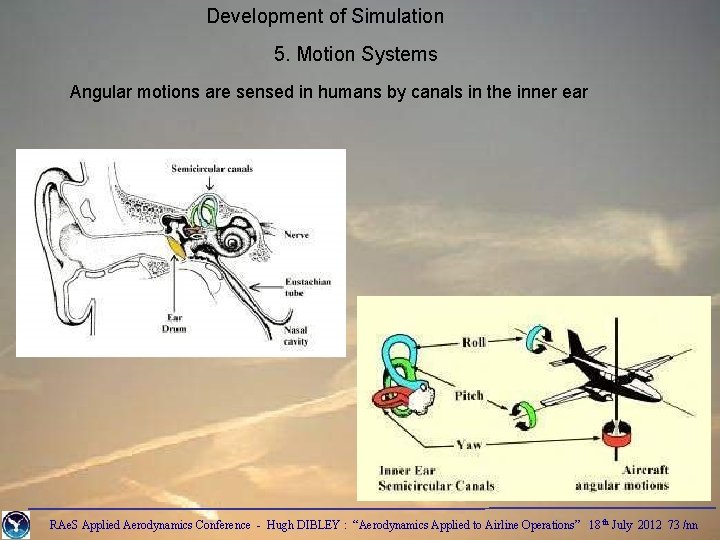
Development of Simulation 5. Motion Systems Angular motions are sensed in humans by canals in the inner ear RAe. S Applied Aerodynamics Conference - Hugh DIBLEY : “Aerodynamics Applied to Airline Operations” 18 th July 2012 73 /nn
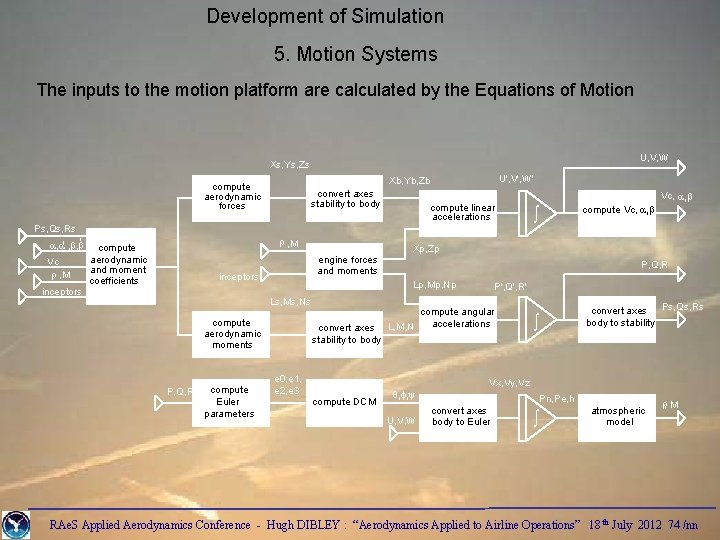
Development of Simulation 5. Motion Systems The inputs to the motion platform are calculated by the Equations of Motion U, V, W Xs, Ys, Zs U', V', W' Xb, Yb, Zb compute aerodynamic forces convert axes stability to body compute linear accelerations Ps, Qs, Rs a, a' , b, b' Vc r , M compute aerodynamic and moment coefficients engine forces and moments inceptors compute aerodynamic moments P, Q, R compute Euler parameters convert axes stability to body e 0, e 1, e 2, e 3 compute DCM ò compute Vc, a, b Xp, Zp P, Q, R Lp, Mp, Np Ls, Ms, Ns Vc, a, b P', Q', R' compute angular accelerations L, M, N q, f, y U, V, W convert axes Ps, Qs, Rs body to stability ò Vx, Vy, Vz Pn, Pe, h convert axes body to Euler ò atmospheric model r, M RAe. S Applied Aerodynamics Conference - Hugh DIBLEY : “Aerodynamics Applied to Airline Operations” 18 th July 2012 74 /nn
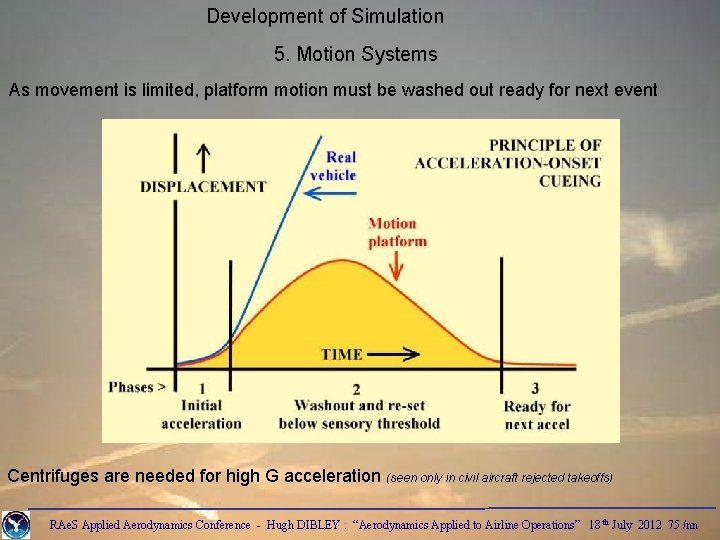
Development of Simulation 5. Motion Systems As movement is limited, platform motion must be washed out ready for next event Centrifuges are needed for high G acceleration (seen only in civil aircraft rejected takeoffs) RAe. S Applied Aerodynamics Conference - Hugh DIBLEY : “Aerodynamics Applied to Airline Operations” 18 th July 2012 75 /nn
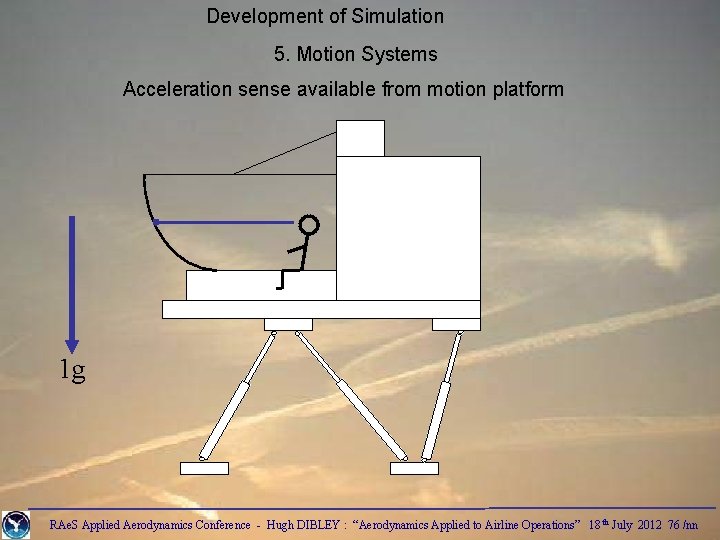
Development of Simulation 5. Motion Systems Acceleration sense available from motion platform 1 g RAe. S Applied Aerodynamics Conference - Hugh DIBLEY : “Aerodynamics Applied to Airline Operations” 18 th July 2012 76 /nn
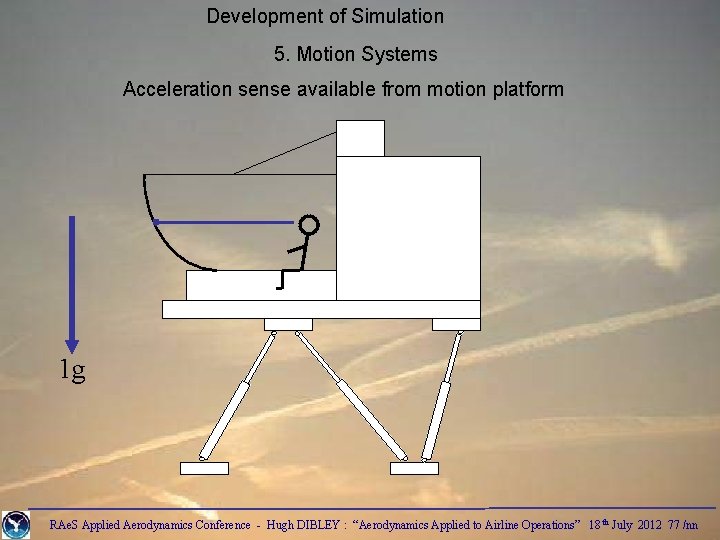
Development of Simulation 5. Motion Systems Acceleration sense available from motion platform 1 g RAe. S Applied Aerodynamics Conference - Hugh DIBLEY : “Aerodynamics Applied to Airline Operations” 18 th July 2012 77 /nn

Development of Simulation 5. Motion Systems Acceleration sense available from motion platform 1 g RAe. S Applied Aerodynamics Conference - Hugh DIBLEY : “Aerodynamics Applied to Airline Operations” 18 th July 2012 78 /nn
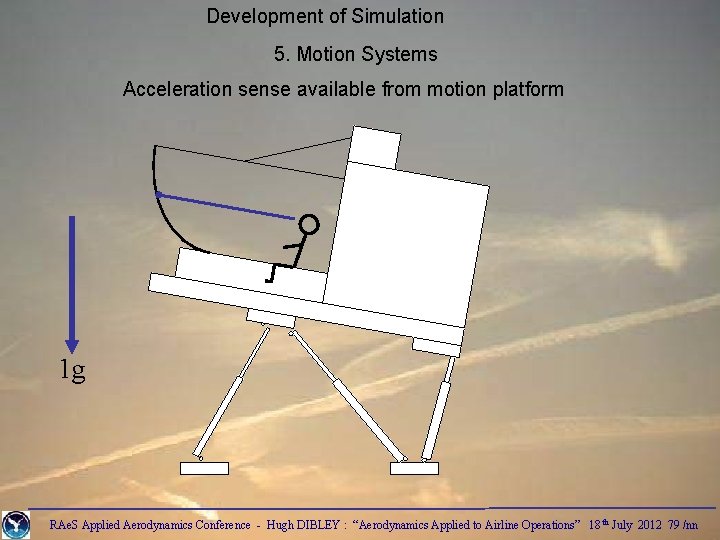
Development of Simulation 5. Motion Systems Acceleration sense available from motion platform 1 g RAe. S Applied Aerodynamics Conference - Hugh DIBLEY : “Aerodynamics Applied to Airline Operations” 18 th July 2012 79 /nn
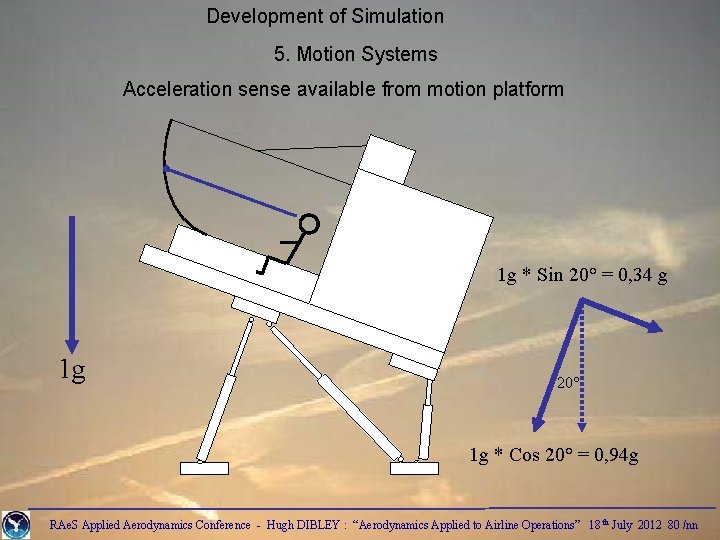
Development of Simulation 5. Motion Systems Acceleration sense available from motion platform 1 g * Sin 20° = 0, 34 g 1 g 20° 1 g * Cos 20° = 0, 94 g RAe. S Applied Aerodynamics Conference - Hugh DIBLEY : “Aerodynamics Applied to Airline Operations” 18 th July 2012 80 /nn
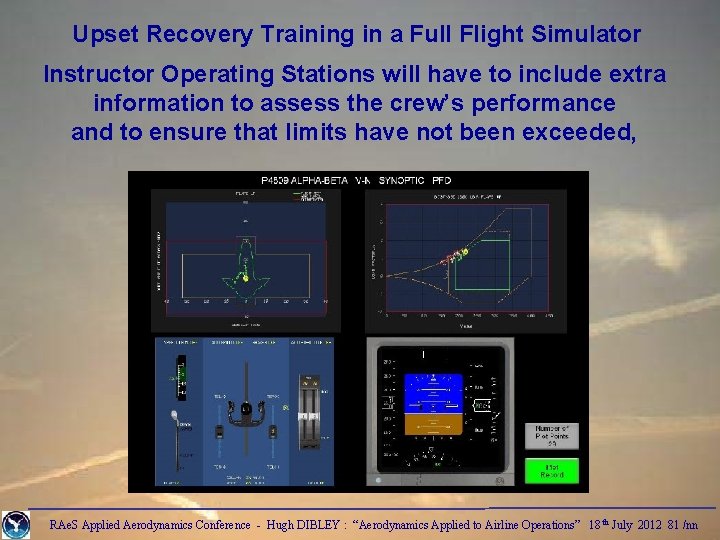
Upset Recovery Training in a Full Flight Simulator Instructor Operating Stations will have to include extra information to assess the crew’s performance and to ensure that limits have not been exceeded, RAe. S Applied Aerodynamics Conference - Hugh DIBLEY : “Aerodynamics Applied to Airline Operations” 18 th July 2012 81 /nn
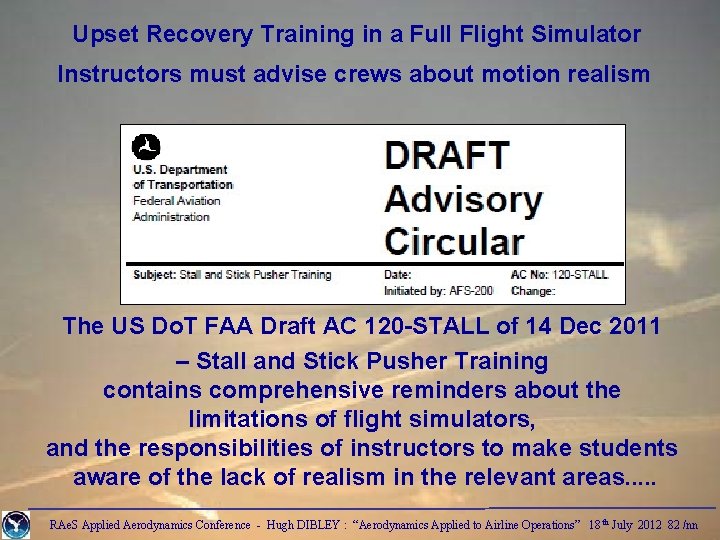
Upset Recovery Training in a Full Flight Simulator Instructors must advise crews about motion realism The US Do. T FAA Draft AC 120 -STALL of 14 Dec 2011 – Stall and Stick Pusher Training contains comprehensive reminders about the limitations of flight simulators, and the responsibilities of instructors to make students aware of the lack of realism in the relevant areas. . . RAe. S Applied Aerodynamics Conference - Hugh DIBLEY : “Aerodynamics Applied to Airline Operations” 18 th July 2012 82 /nn
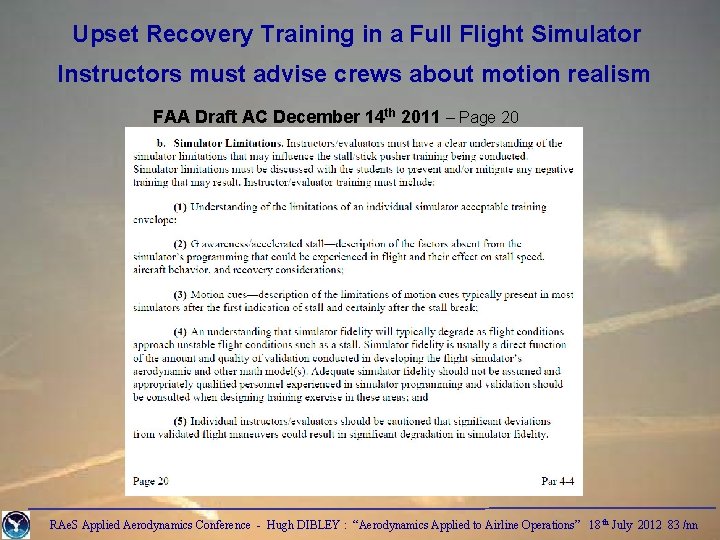
Upset Recovery Training in a Full Flight Simulator Instructors must advise crews about motion realism FAA Draft AC December 14 th 2011 – Page 20 RAe. S Applied Aerodynamics Conference - Hugh DIBLEY : “Aerodynamics Applied to Airline Operations” 18 th July 2012 83 /nn
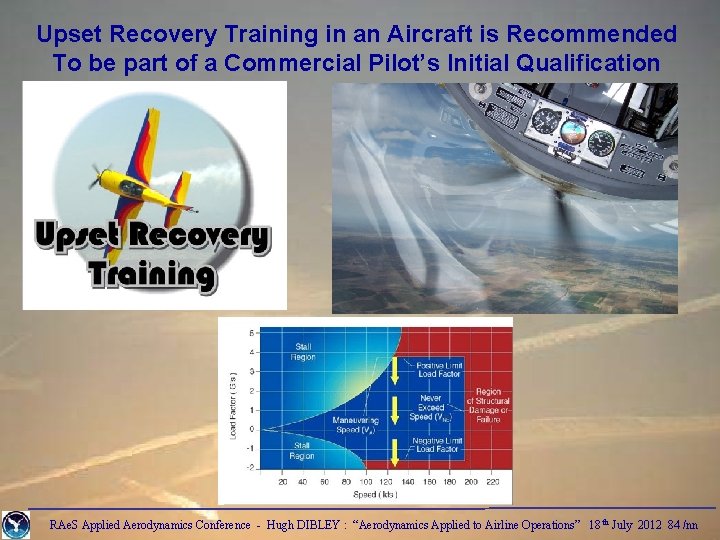
Upset Recovery Training in an Aircraft is Recommended To be part of a Commercial Pilot’s Initial Qualification RAe. S Applied Aerodynamics Conference - Hugh DIBLEY : “Aerodynamics Applied to Airline Operations” 18 th July 2012 84 /nn
Reducing LOC-I Accidents 1998 & 2004 AURTA addressed Recovery 2008 version introduced prevention A vital factor is to make crews aware of the hazards “Prevention is Prime” Hence the ICATEE’s Upset. Prevention. Recovery. Training. Aid RAe. S Applied Aerodynamics Conference - Hugh DIBLEY : “Aerodynamics Applied to Airline Operations” 18 th July 2012 85 /nn
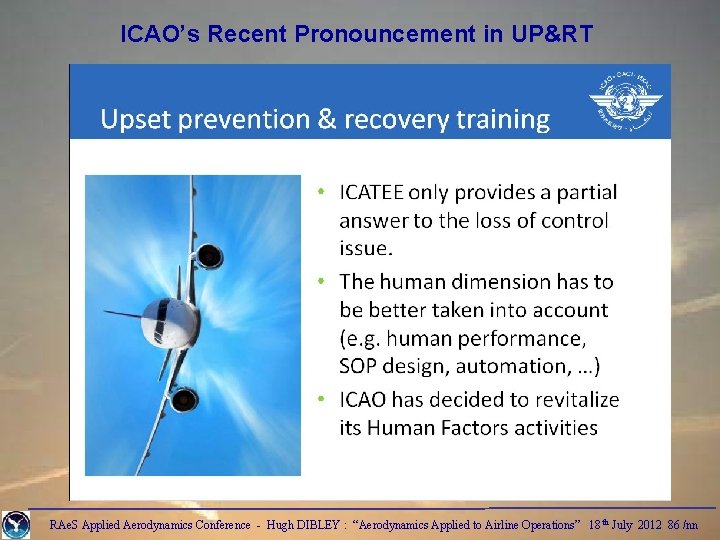
ICAO’s Recent Pronouncement in UP&RT RAe. S Applied Aerodynamics Conference - Hugh DIBLEY : “Aerodynamics Applied to Airline Operations” 18 th July 2012 86 /nn
MCC Courses All airline pilots must pass a Multi-Crew Cooperation Course These concentrate on the fact that: We all make mistakes, We should admit our mistakes/we were wrong We must help each other work together for the common good – of not having an accident. MCC Courses should be compulsory for bankers! RAe. S Applied Aerodynamics Conference - Hugh DIBLEY : “Aerodynamics Applied to Airline Operations” 18 th July 2012 87 /nn

Equation/Formula for the Meaning of Life? Attraction force to be the dream? RAe. S Applied Aerodynamics Conference - Hugh DIBLEY : “Aerodynamics Applied to Airline Operations” 18 th July 2012 88 /nn
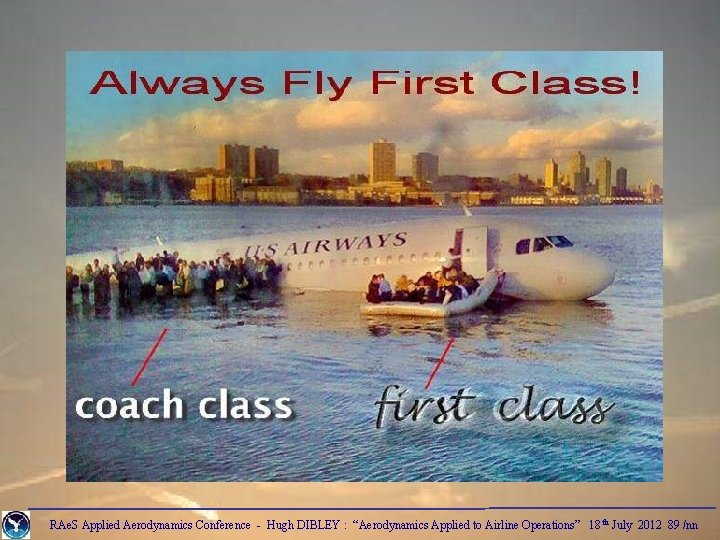
RAe. S Applied Aerodynamics Conference - Hugh DIBLEY : “Aerodynamics Applied to Airline Operations” 18 th July 2012 89 /nn
Thank you RAe. S Applied Aerodynamics Conference - Hugh DIBLEY : “Aerodynamics Applied to Airline Operations” 18 th July 2012 90 /nn
- Slides: 90