
Aerobic Respiration Section 9 2 Aerobic Respiration Oxygen
Aerobic Respiration Section 9: 2

Aerobic Respiration – Oxygen Present Occurs in the mitochondria of eukaryotes and the cytosol of prokaryotes. Pyruvic acid, from Glycolysis, diffuses in from the cytosol to the mitochondrial matrix. The space inside the inner membranes
Overview Krebs or the ETC. will only occur if, CO 2, H 2 O and O 2 are ALL present.
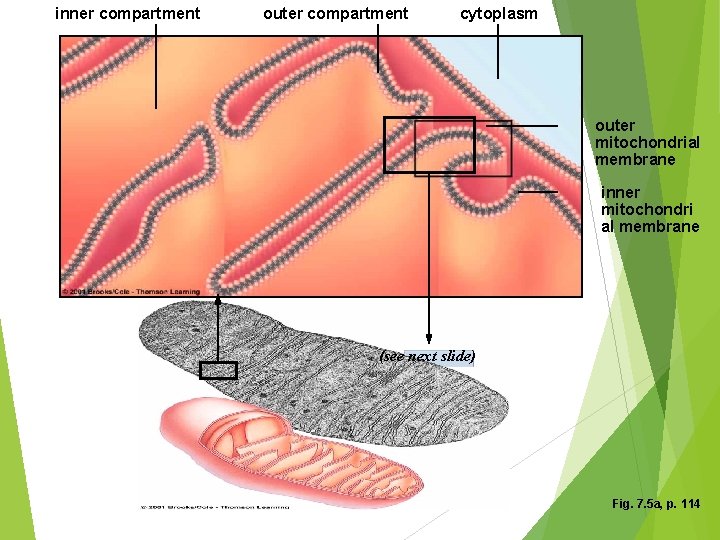
inner compartment outer compartment cytoplasm outer mitochondrial membrane inner mitochondri al membrane (see next slide) Fig. 7. 5 a, p. 114
Aerobic Respiration – before Krebs Cycle Pyruvic acid joins with coenzyme A (Co. A), no carbons, to form acetyl Co. A – 2 carbons CO 2 is lost in this process and NAD is reduced to NADH and H+.
Krebs Cycle A biochemical pathway that breaks down a molecule, acetyl Co. A, producing CO 2, NADH, FADH, and ATP and Citric acid. Ultimately producing products that will run cellular respiration. 5 steps to the Krebs cycle
Step 1 The 2 -carbon acetyl Co. A combines with a 4 -carbon compound, oxaloacetic acid, to form a 6 -carbon molecule, citric acid This step regenerates coenzyme A
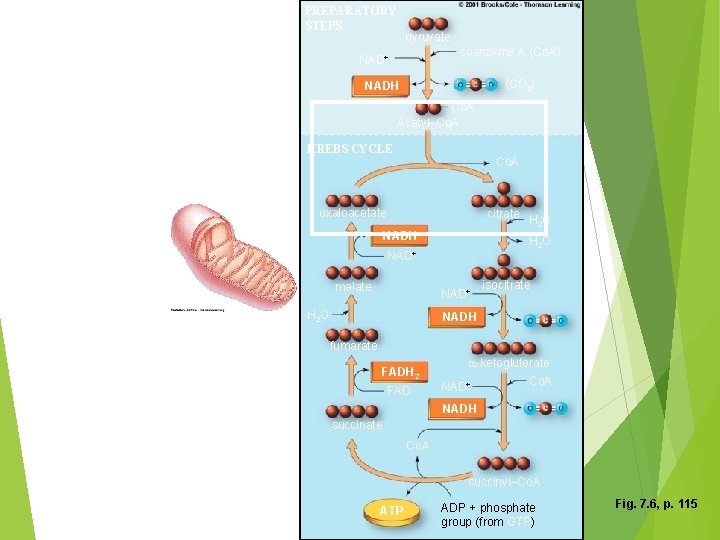
PREPARATORY STEPS pyruvate coenzyme A (Co. A) NAD+ (CO 2) NADH Co. A Acetyl–Co. A KREBS CYCLE Co. A oxaloacetate citrate H O 2 NADH H 2 O NAD+ malate NAD+ H 2 O isocitrate NADH fumarate FADH 2 FAD a-ketogluterate Co. A NAD+ NADH succinate Co. A succinyl–Co. A ATP ADP + phosphate group (from GTP) Fig. 7. 6, p. 115
Step 2 Citric acid releases a CO 2 and a hydrogen to form a 5 -carbon compound NAD+ accepts an H+ to become NADH and H+.
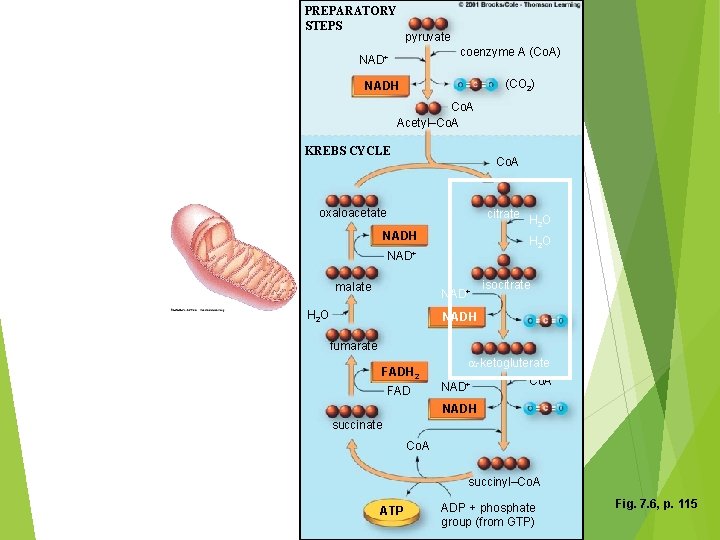
PREPARATORY STEPS pyruvate coenzyme A (Co. A) NAD+ (CO 2) NADH Co. A Acetyl–Co. A KREBS CYCLE Co. A oxaloacetate citrate H O 2 NADH H 2 O NAD+ malate NAD+ H 2 O isocitrate NADH fumarate FADH 2 FAD a-ketogluterate Co. A NAD+ NADH succinate Co. A succinyl–Co. A ATP ADP + phosphate group (from GTP) Fig. 7. 6, p. 115
Step 3 The 5 -carbon compound releases CO 2 and H+ to form a 4 -carbon compound. NAD+ is reduced again to NADH and One molecules of ATP is made
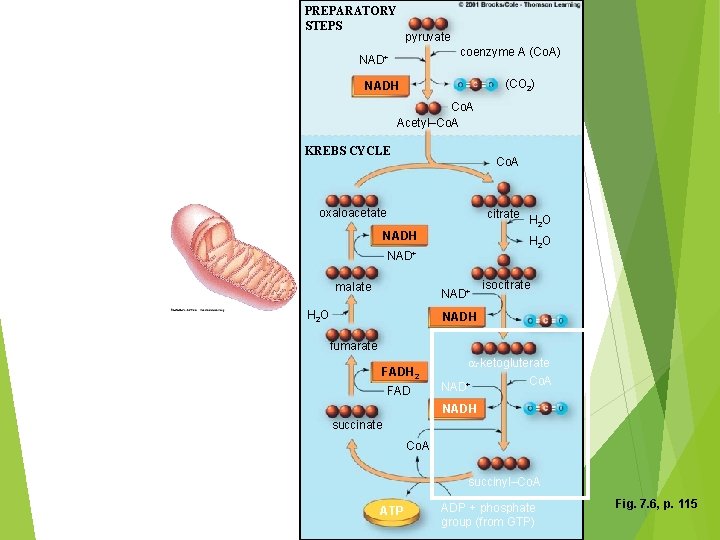
PREPARATORY STEPS pyruvate coenzyme A (Co. A) NAD+ (CO 2) NADH Co. A Acetyl–Co. A KREBS CYCLE Co. A oxaloacetate citrate H O 2 NADH H 2 O NAD+ malate NAD+ H 2 O isocitrate NADH fumarate FADH 2 FAD a-ketogluterate Co. A NAD+ NADH succinate Co. A succinyl–Co. A ATP ADP + phosphate group (from GTP) Fig. 7. 6, p. 115
Step 4 The 4 -carbon compound releases hydrogen The hydrogen forms with FAD+ to form FADH 2. FAD is another electron acceptor.
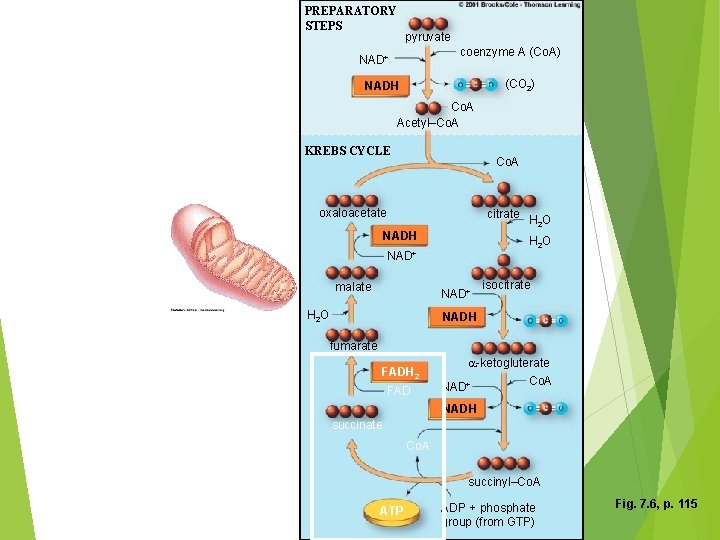
PREPARATORY STEPS pyruvate coenzyme A (Co. A) NAD+ (CO 2) NADH Co. A Acetyl–Co. A KREBS CYCLE Co. A oxaloacetate citrate H O 2 NADH H 2 O NAD+ malate NAD+ H 2 O isocitrate NADH fumarate FADH 2 FAD a-ketogluterate Co. A NAD+ NADH succinate Co. A succinyl–Co. A ATP ADP + phosphate group (from GTP) Fig. 7. 6, p. 115
Step 5 The 4 -carbon compound releases a hydrogen to REFORM oxaloacetic acid + NAD is reduced again to + NADH and H
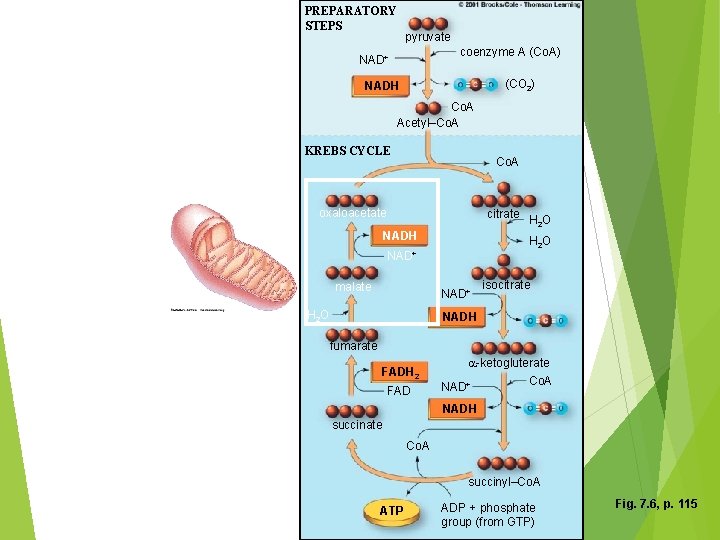
PREPARATORY STEPS pyruvate coenzyme A (Co. A) NAD+ (CO 2) NADH Co. A Acetyl–Co. A KREBS CYCLE Co. A oxaloacetate citrate H O 2 NADH H 2 O NAD+ malate NAD+ H 2 O isocitrate NADH fumarate FADH 2 FAD a-ketogluterate Co. A NAD+ NADH succinate Co. A succinyl–Co. A ATP ADP + phosphate group (from GTP) Fig. 7. 6, p. 115
Glycolysis, produces 2 NADH and 2 pyruvic acid, 2 ATP. One molecule of glucose from glycolysis needs 2 turns of the Krebs to produce: Summary: 10 NADH, 2 FADH, 4 ATP, 4 CO 2. The 10 NADH and 2 FADH (both energy molecules) will drive the next stage of cellular respiration in the Electron Transport Chain.
Krebs Cycle conclusion Location – Mitochondrial Matrix (space inside the inner membrane) Function – Produce CO 2, ATP, NADH, FADH and Citric Acid. Reactants – Pyruvic Acid, Acetlyl-Co. A, Oxaloacitic Acid, NAD, FAD, ADP and C 0 enzyme A. Products – CO 2 NADH, FADH, ATP and Citric acid.
The Electron Transport Chain in Cellular Respiration
Cellular Respiration The process that releases energy by breaking down glucose and other food molecules in the presence of oxygen.
Electron Transport Chain A chemical reaction that uses high energy electrons made in the Krebs cycle to convert ADP into ATP. Aerobic – means with oxygen Anaerobic – means without oxygen
Electron Transport Chain ATP is produced when NADH and FADH 2 release hydrogen atoms, regenerating NAD+ and FAD+. This occurs along the lining of the inner membranes of the mitochondria.
Steps of ETC 1. Electrons from the hydrogens atoms of NADH and FADH are passed along a series of molecules, losing energy along the way.
2. This energy pumps protons from the matrix to the other side of the membrane. This creates a concentration gradient across the inner membrane of the mitochondria.
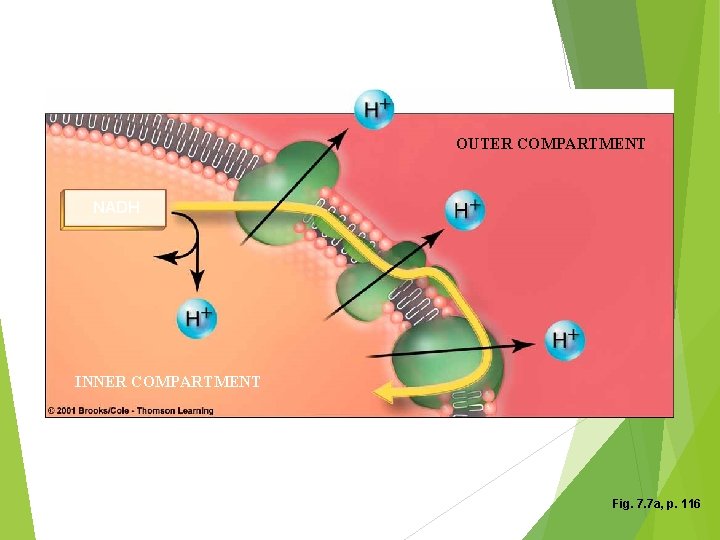
OUTER COMPARTMENT NADH INNER COMPARTMENT Fig. 7. 7 a, p. 116
This high proton concentration is what drives chemiosmosis ( ATP production) into the inner membrane. ATP synthase is located in the inner membrane. ATP is made as protons move down their concentration gradient in the mitochondria. 3.
Oxygen’s Role Oxygen is the final electron acceptor, accepting electrons from the last molecule in the ETC. This allows ATP to continue to be synthesized. Oxygen also accepts the hydrogen atoms from NADH and FADH. This combination of electron, hydrogens and oxygen forms WATER!!!!! O 2 + e- +H - = H 2 O
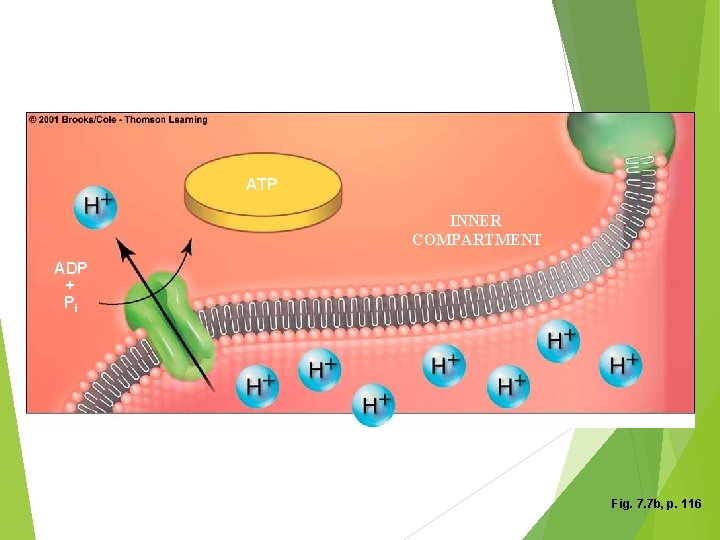
ATP NADH INNER COMPARTMENT ADP + Pi Fig. 7. 7 b, p. 116
Energy Yield Per molecule of glucose, 36 ATP’s are produced. 2 in Glycolysis, and approximately, 4 in Krebs and 30 in ETC. C 6 H 12 O 6 + 6 O 2 6 CO 2 + 6 H 2 O + energy
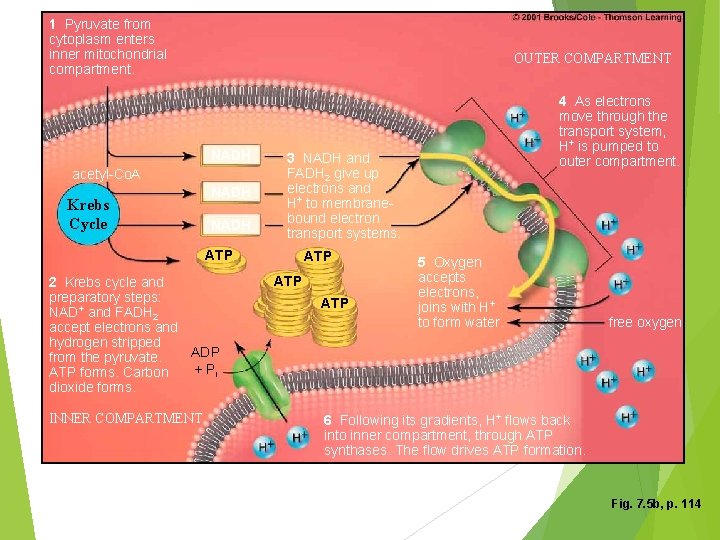
1 Pyruvate from cytoplasm enters inner mitochondrial compartment. OUTER COMPARTMENT NADH acetyl-Co. A Krebs Cycle NADH 3 NADH and FADH 2 give up electrons and H+ to membranebound electron transport systems. ATP 2 Krebs cycle and preparatory steps: NAD+ and FADH 2 accept electrons and hydrogen stripped ADP from the pyruvate. + Pi ATP forms. Carbon dioxide forms. INNER COMPARTMENT 4 As electrons move through the transport system, H+ is pumped to outer compartment. ATP ATP 5 Oxygen accepts electrons, joins with H+ to form water. free oxygen 6 Following its gradients, H+ flows back into inner compartment, through ATP synthases. The flow drives ATP formation. Fig. 7. 5 b, p. 114
Krebs Cycle and ETC. Both the Krebs Cycle and the Electron Transport chain can not proceed without the presence of O 2 H 2 O CO 2
Conclusion of Electron Transport Chain Location – Lining of the inner membrane of the mitochondria. Function – Produce ATP and water Reactants – NADH, FADH, ADP and O 2. Products – NAD, FAD, ATP and Water
Order of processes in Cellular Respiration. 1. Glycolysis 2. Krebs cycle 3. Electron Transport Chain
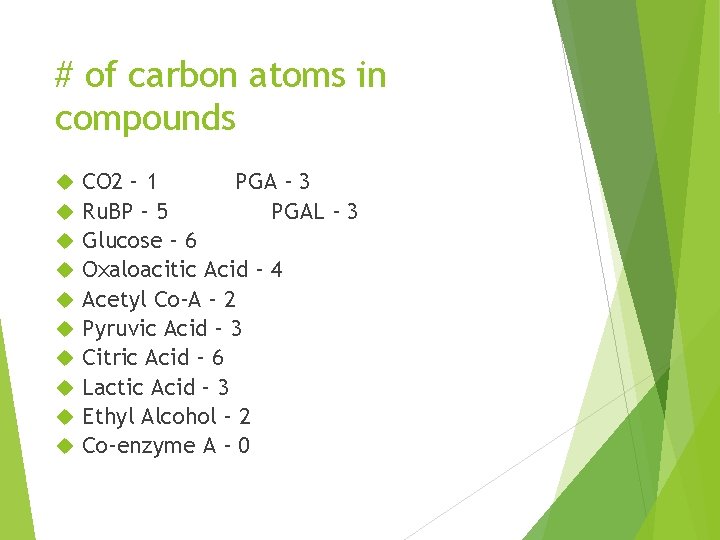
# of carbon atoms in compounds CO 2 – 1 PGA - 3 Ru. BP – 5 PGAL - 3 Glucose – 6 Oxaloacitic Acid – 4 Acetyl Co-A – 2 Pyruvic Acid – 3 Citric Acid – 6 Lactic Acid – 3 Ethyl Alcohol – 2 Co-enzyme A - 0
- Slides: 34