
Aerobic Respiration Overview Occurs in Four Distinct Stages
Aerobic Respiration: Overview Occurs in Four Distinct Stages: 1. Glycolysis: 10 -step process in the cytoplasm. 2. Pyruvate Oxidation: 1 -step process in the mitochondrial matrix. 3. Krebs Cycle: 8 -step cyclical process in the mitochondrial matrix. 4. Electron Transport Chain & Chemiosmosis: Multi-step process in the inner mitochondrial membrane.
Energy Transfer Terminology Substrate-level Phosphorylation: • ATP forms directly in an enzyme-catalyzed reaction. Oxidative Phosphorylation: • ATP forms indirectly through a series of enzyme-catalyzed redox reactions involving oxygen as the final electron acceptor.
Energy Carriers • NAD+ and FAD+ are low energy, oxidized coenzymes that act as electron acceptors. • When an electron(s) are added to these molecules, they become reduced to NADH and FADH 2. • In this case, reducing a molecule gives it more energy.
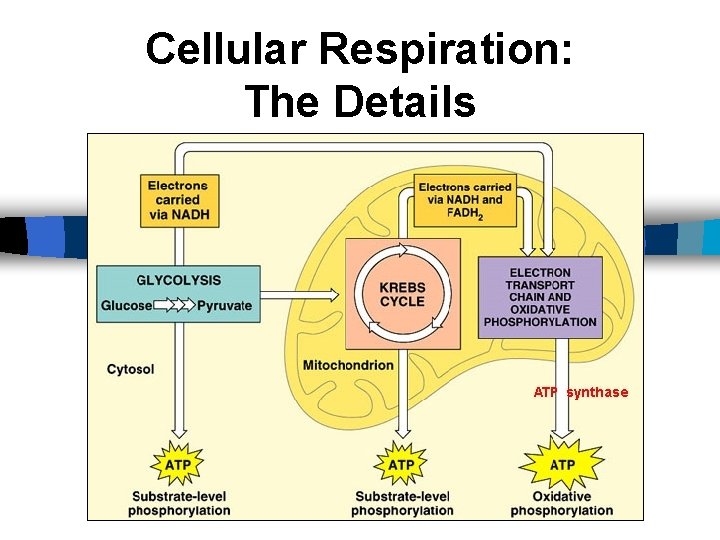
Cellular Respiration: The Details
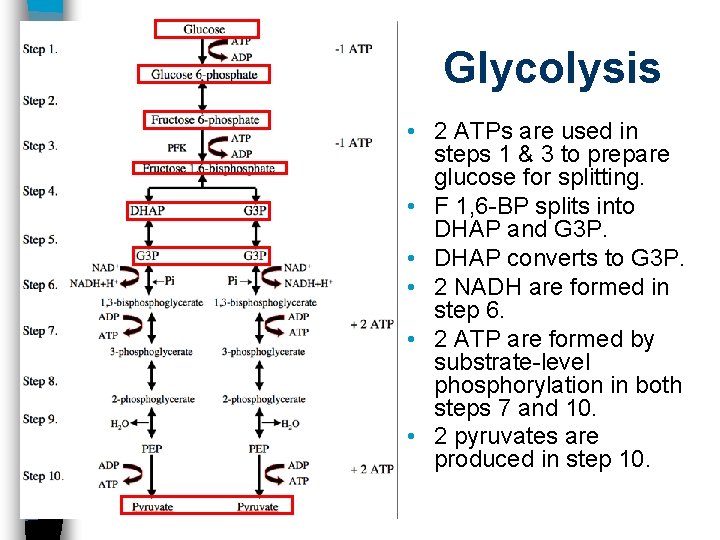
Glycolysis • 2 ATPs are used in steps 1 & 3 to prepare glucose for splitting. • F 1, 6 -BP splits into DHAP and G 3 P. • DHAP converts to G 3 P. • 2 NADH are formed in step 6. • 2 ATP are formed by substrate-level phosphorylation in both steps 7 and 10. • 2 pyruvates are produced in step 10.
Glycolysis Energy Yield & Products: 4 ATP produced – 2 ATP used = 2 net ATP 2 NADH 2 pyruvates Further processing in aerobic cellular respiration (if oxygen is available)
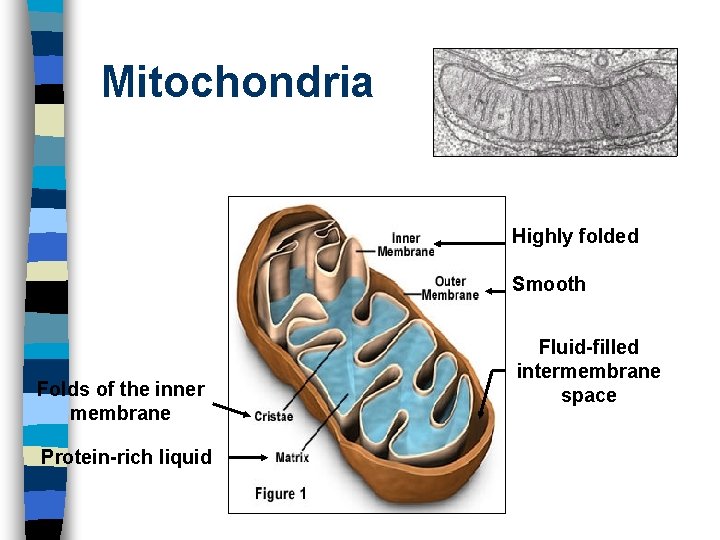
Mitochondria Highly folded Smooth Folds of the inner membrane Protein-rich liquid Fluid-filled intermembrane space
See PDF Glycolysis
Pyruvate Oxidation (if oxygen is present…) The following occurs for each pyruvate: 1. CO 2 removed. 2. NAD+ reduced to NADH and the 2 -carbon compound becomes acetic acid. 3. Coenzyme A (Co. A) attaches to acetic acid to form acetyl-Co. A.

Pyruvate Oxidation
Pyruvate Oxidation Energy Yield & Products: 2 NADH 2 acetyl-Co. A 2 CO 2 (released as waste)
See PDF Pyruvate Oxidation
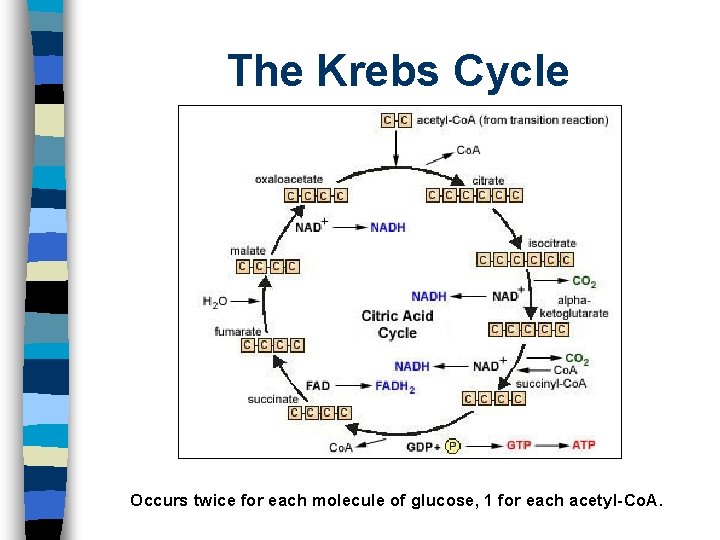
The Krebs Cycle Occurs twice for each molecule of glucose, 1 for each acetyl-Co. A.
The Krebs Cycle 1. In step 1, acetyl-Co. A combines with oxaloacetate to form citrate. 2. In step 2, citrate is rearranged to isocitrate. 3. NAD+ is reduced to NADH in steps 3, 4 and 8. 4. FAD is reduced to FADH 2 in step 6. 5. ATP if formed in step 5 by substrate-level phosphorylation. The phosphate group from succinyl-Co. A is transferred to GDP, forming GTP, which then forms ATP. 6. In step 8, oxaloacetate is formed from malate, which is used as a reactant in step 1. 7. CO 2 is released in steps 3 and 4.
The Krebs Cycle Energy Yield & Products: 2 ATP 6 NADH 2 FADH 2 4 CO 2 (released as waste) NADH and FADH 2 carry electrons to the electron transport chain for further production of ATP by oxidative phosphorylation.

See PDF Krebs
- Slides: 16