
Aerobic Exercises Mark David S Basco PTRP Department
Aerobic Exercises Mark David S. Basco, PTRP Department of Physical Therapy College of Allied Medical Professions University of the Philippines Manila
Objectives At the end of the session, students should be able to �Determine the components of an exercise program �Apply principles of a conditioning program for patients with �Coronary Artery Disease �Stroke and/or history of Hypertension �Peripheral Vascular Disease �COPD �Diabetes Mellitus �Well population
Objectives �Determine criteria for initiating an exercise session for different clients / patients. �Decide when to terminate an exercise session based on established protocols and guidelines
What do we need for this topic? Background knowledge of: �Cardiovascular physiology �Exercise physiology �Muscle physiology �Knowledge of different conditions presenting with impaired aerobic capacity Most importantly: �An open and inquisitive mind
Endurance �Ability to work for prolonged periods of time and resist fatigue �Types �Cardiovascular �Muscular
Determinants of an aerobic exercise program INTENSITY DURATION FREQUENCY MODE
Intensity �Overload principle �Specificity principle �Quantifying intensity �Heart Rate �VO 2 Max �Rating of Perceived Exertion
Intensity Heart Rate �Maximum Heart Rate � 220 -age �Karvonens Formula �THR= RHR + (MHR - RHR) (60 -80%) �Deconditioned – 40 -50% �Cardiopulmonary disease – 40 – 60% �Healthy individuals – 60 – 80% �For UE work �MHR = 220 – age - 11
Intensity Rating of Perceived Exertion �Useful for patients with heart rate suppressors e. g. Beta blockers �Original �Revised
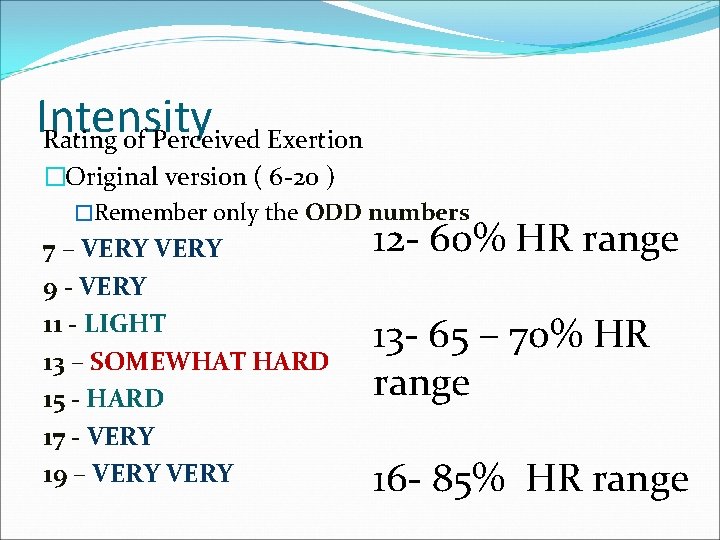
Intensity Rating of Perceived Exertion �Original version ( 6 -20 ) �Remember only the ODD numbers 12 - 60% HR range 7 – VERY 9 - VERY 11 - LIGHT 13 - 65 – 70% HR 13 – SOMEWHAT HARD range 15 - HARD 17 - VERY 19 – VERY 16 - 85% HR range
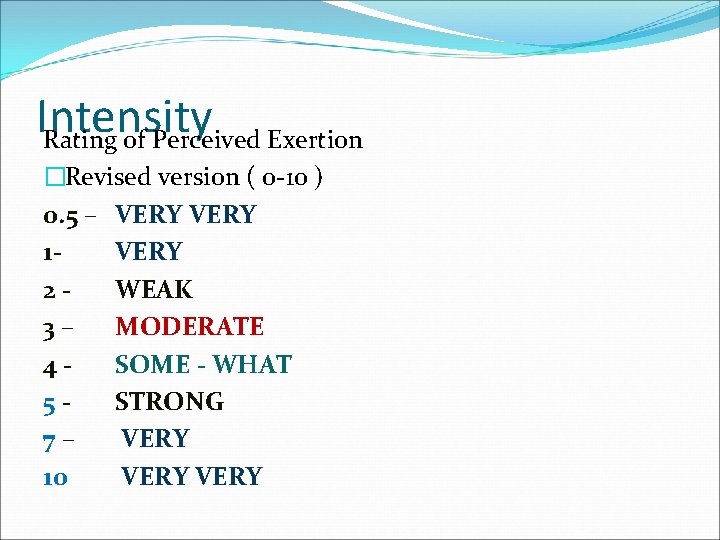
Intensity Rating of Perceived Exertion �Revised version ( 0 -10 ) 0. 5 – VERY 1 VERY 2 WEAK 3– MODERATE 4 SOME - WHAT 5 STRONG 7– VERY 10 VERY
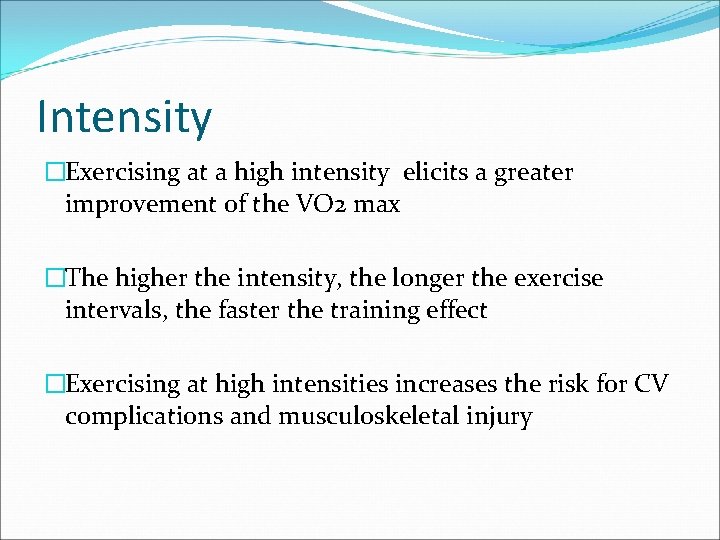
Intensity �Exercising at a high intensity elicits a greater improvement of the VO 2 max �The higher the intensity, the longer the exercise intervals, the faster the training effect �Exercising at high intensities increases the risk for CV complications and musculoskeletal injury
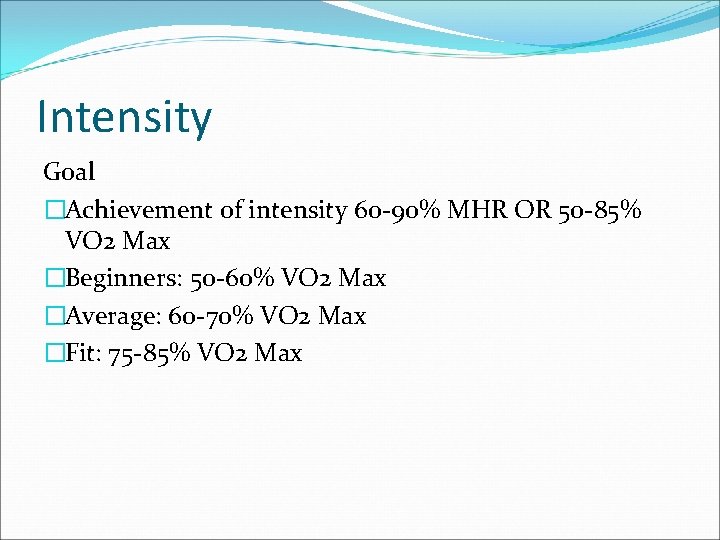
Intensity Goal �Achievement of intensity 60 -90% MHR OR 50 -85% VO 2 Max �Beginners: 50 -60% VO 2 Max �Average: 60 -70% VO 2 Max �Fit: 75 -85% VO 2 Max
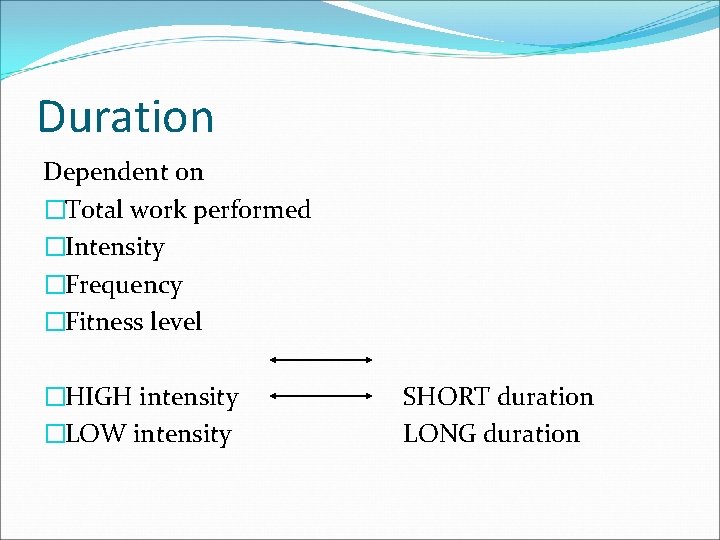
Duration Dependent on �Total work performed �Intensity �Frequency �Fitness level �HIGH intensity �LOW intensity SHORT duration LONG duration
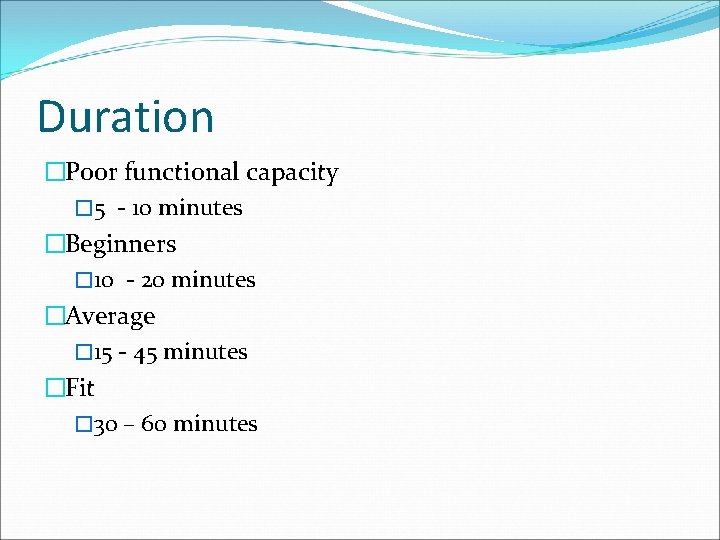
Duration �Poor functional capacity � 5 - 10 minutes �Beginners � 10 - 20 minutes �Average � 15 - 45 minutes �Fit � 30 – 60 minutes
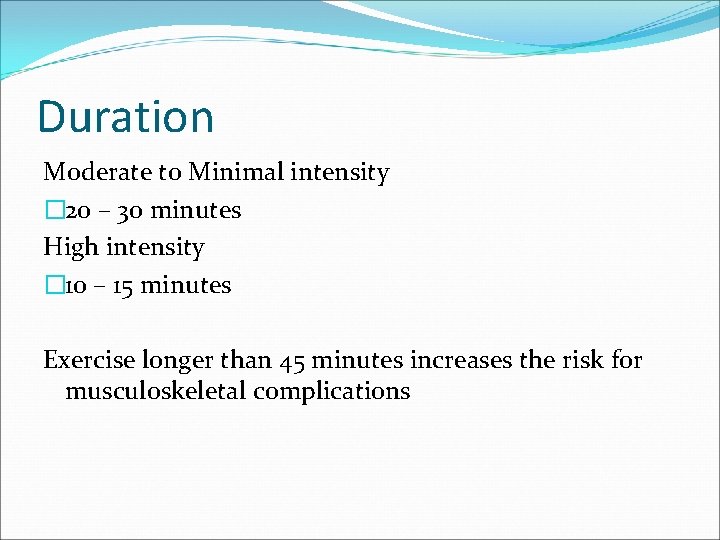
Duration Moderate to Minimal intensity � 20 – 30 minutes High intensity � 10 – 15 minutes Exercise longer than 45 minutes increases the risk for musculoskeletal complications
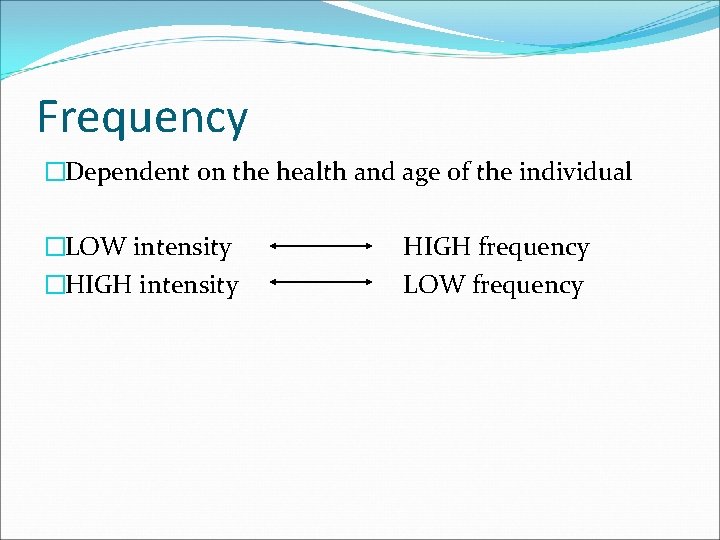
Frequency �Dependent on the health and age of the individual �LOW intensity �HIGH intensity HIGH frequency LOW frequency
Frequency �POOR �Daily �Beginner �Every other day �Optimal frequency � 3 -4 times a week � 2 times a week does not generally evoke CV changes for well population �Increase in frequency beyond optimal range, increases risk for musculoskeletal complications � 30 -45 mins 3 x a week protects against CV disorders
Frequency 3 – 5 sessions / week �Greater than 5 METS Daily or multiple daily sessions �Less than 5 METS
Mode �Large muscles �Rhythmic �Long duration �Lower extremity versus Upper extremity exercise
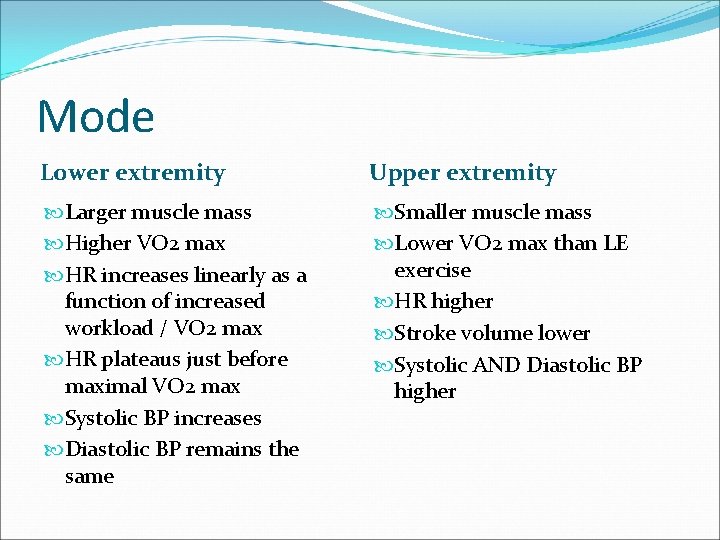
Mode Lower extremity Upper extremity Larger muscle mass Higher VO 2 max HR increases linearly as a function of increased workload / VO 2 max HR plateaus just before maximal VO 2 max Systolic BP increases Diastolic BP remains the same Smaller muscle mass Lower VO 2 max than LE exercise HR higher Stroke volume lower Systolic AND Diastolic BP higher
Exercise program Warm-up Aerobic exercise period Cool-down
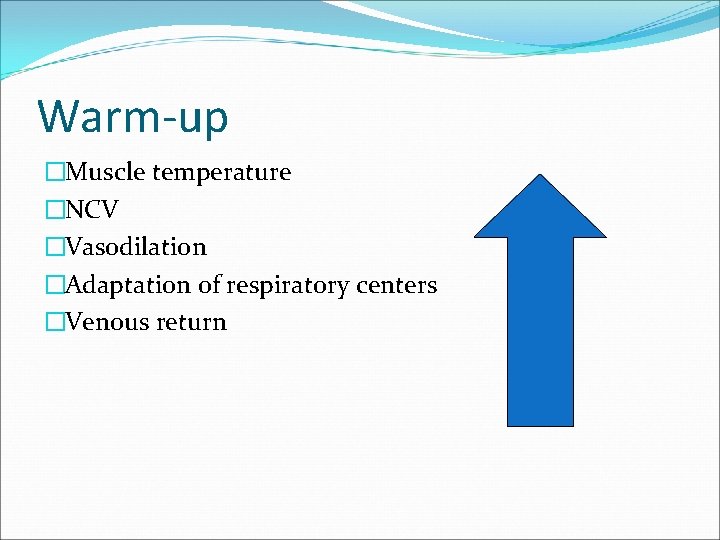
Warm-up �Muscle temperature �NCV �Vasodilation �Adaptation of respiratory centers �Venous return
Warm-up � 2 components �Graduated low intensity warm-up (5 -10 minutes) of total body movement �HR increase 20 bpm �Flexibility exercises
Warm-up �Should NOT cause fatigue �Decreases �Risk for ECG changes (arrythmias) �Musculoskeletal disorder
Aerobic exercise �Continuous �Interval �Circuit-interval
Continuous �Submaximal and sustained �Achievement of the steady state �Duration; 20 – 60 minutes �Intensity: 60 – 85% VO 2 Max �Most effective in increasing endurance for healthy individuals
Continuous Two types: �Intermediate Slow Distance � 20 -60 minutes continuous exercise �Most commonly used for managing weight �Long Slow Distance �Longer than 60 minutes for athletic training �Provided after 6 months of successful ISD
Interval �Designed to improve strength and power more than endurance �Incorporates recovery after continual exercise �Useful for beginners �Work – rest - work
Interval �Exercise period is followed by rest interval �Rest relief (Passive recovery) �Work relief (Active recovery) �Work recovery ratio � 1: 1 to 1: 5 � 1 : 1. 5 work interval allows the succeeding exercise interval to begin before recovery is complete
Interval Aerobic Interval Training �For patients with poor CV fitness � 2 -15 minutes at 50 -80% functional capacity Anaerobic Interval Training �For patients with high CV fitness � 30 sec – 4 minutes at 85 -100% functional capacity �Usually results in greater lactic acid concentrations
Circuit �Series of exercise activities �Several exercise modes �Improves both strength and endurance
Circuit interval �Stresses both aerobic and anerobic systems �Delays the need for glycolysis and lactic acid production
Cool-down �Prevents �Pooling of blood �Post-exercise syncope �Ischemia, arrythmias, and other complications �Increases oxidation of metabolic waste
Cool-down �Length of cool-down phase proportional to intensity and length of the conditioning phase �Typical 30 -40 aerobic exercise period �Warrants a 5 -10 minute cool-down phase
Aerobic Conditioning program design Coronary Artery Disease Stroke and/or history of Hypertension Peripheral Vascular Disease COPD Diabetes Mellitus Well population
Coronary Artery Disease �In-patient phase �Out-patient phase �Maintenance phase
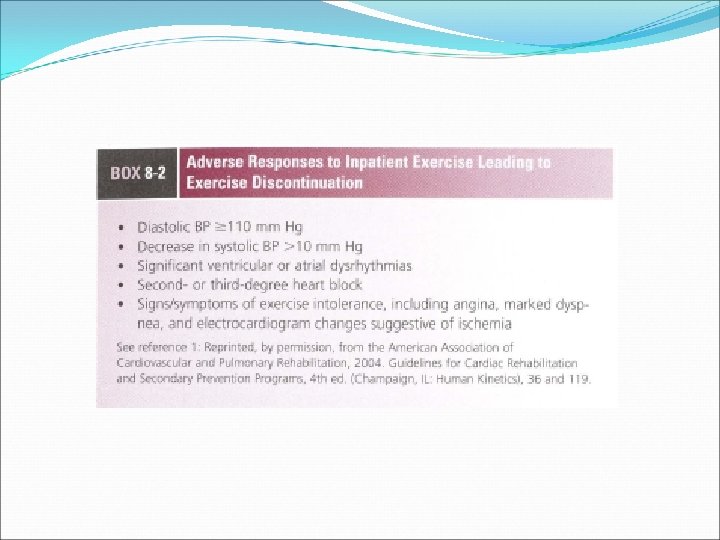
In – patient phase � 3 - 5 days �Objectives �Initiate early return to independence �Prevent deleterious effect of bed rest �Help allay anxiety and depression �Promote risk factor modification
In – patient phase �Role of PT �Sit- to- stand 1 -3 days post-op �Orthostatic challenge to the CV system 3 -5 days post-op �Low-level exercise program (1 -3 METS)
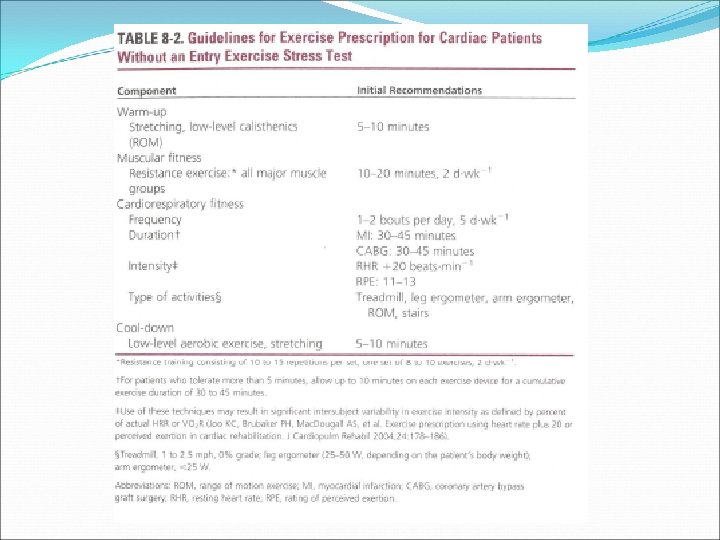
In – patient phase Exercise recommendations �Intensity � 2 -3 METS progressing to 3 -5 METS by d/c �RPE < 13 (6 -20) �Post-MI: HR <120 bpm or RHR + 20 bpm �To tolerance, if asymptomatic
In – patient phase Exercise recommendations �Duration �Begin with intermittent bouts lasting 3 -5 minutes, as tolerated �Rest periods can be slow walk or complete rest �Attempt 2: 1 exercise/rest ratio �Frequency �Early mobilization: 3 -4 times / day (days 1 -3) �Later mobilization: 2 times/day (beginning on day 4) with increased duration
In – patient phase Exercise recommendations �Mode �ADLs �Selected arm and leg exercises �Early supervised ambulation
Out-patient phase �Initiated 6 -8 weeks upon discharge �Objectives �Improve functional capacity �Promote early return to normal activity �Promote positive lifestyle changes � 9 METS functional capacity: suggested exit point �Weaned from continuous monitoring to selfmonitoring
Out-patient phase Exercise recommendations �Intensity: 40 -60% MHR �Duration: Initial 10 -15 minutes, Target 30 -60 minutes �Frequency: 3 – 4 times / week �Mode: Continuous / Circuit interval �Walking, treadmill, cycle ergometer
Maintenance phase � 3 - 6 months post-cardiac patient �Objectives �Maintenance of function �Compliance with exercise program �Risk factor modification �Entry-level criteria �Functional capacity of 5 METS �Clinically stable angina �Medically controlled arrhythmias during exercise
Maintenance phase Exercise recommendations �Intensity � 40 -75% MHR �Duration � 45 minutes to tolerance / session �Frequency � 3 – 5 days / week �Mode: �Continuous / Interval
Coronary artery disease Mode of exercise �Patient preference �Skill required for proper performance �Potential for carryover at home �Availability of exercise equipment
Stroke and Hypertension �Avoid valsalva maneuver �Avoid isometric component �Circuit training (weight training + endurance) �RPE when patient is taking anti-HTN �Instruct patients to move slowly
Stroke and Hypertension Exercise recommmendations �Intensity: 40 -70% VO 2 Max / 40 -65% MHR �Duration: Gradual warm-ups and cool-down / 30 -60 minute/session (aerobic training) �Frequency: 3 -7 days/week �Mode: Large muscle group aerobic exercise, walking, swimming
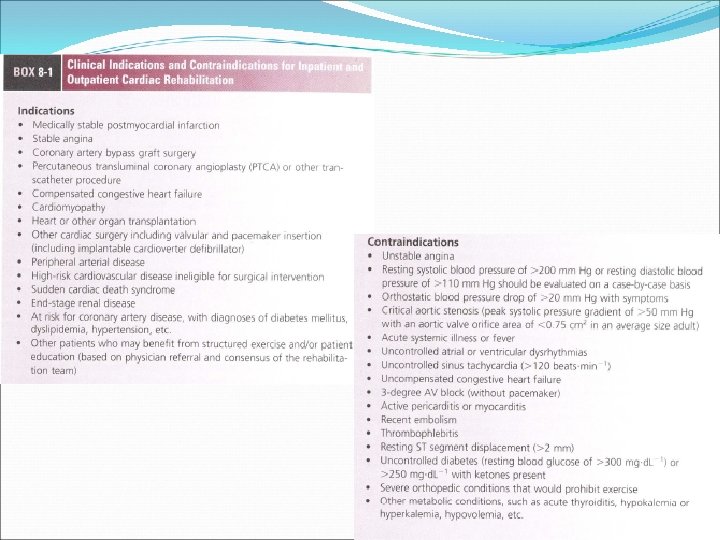
Stroke and Hypertension Special considerations �NO exercise if resting systolic BP > 200 mm. Hg or diastolic BP > 110 mm. Hg �Risk of heat intolerance for patients taking beta blockers and diuretics �Anti-HTN may provoke syncope post-exercise: good cool-down �Individuals with BP > or equal 160/100 should add endurance exercise after initiating pharmacologic therapy
Peripheral Vascular Disease (PVD) �Relieve claudication �Improve walking capacity and qol �Ensourage daily exercise with frequent rest periods �Low impact, NWB activities (swimming, cycling) �Add WB exercise as condition improves �Avoid exercising in COLD air or water �Interval training is appropriate �FEET care
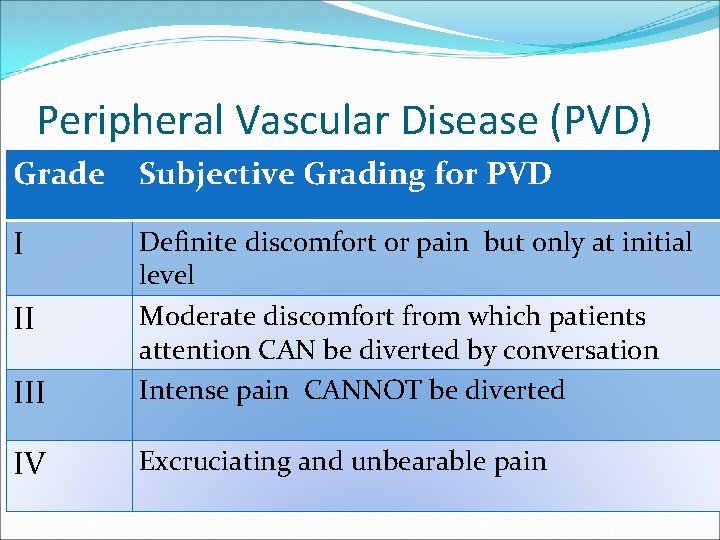
Peripheral Vascular Disease (PVD) Grade Subjective Grading for PVD I III Definite discomfort or pain but only at initial level Moderate discomfort from which patients attention CAN be diverted by conversation Intense pain CANNOT be diverted IV Excruciating and unbearable pain II
Peripheral Vascular Disease (PVD) Exercise recommmendation �Intensity: Grade II – III on the claudiaction pain �Frequency: 3 -5 days / week �Duration: initial: 35 minutes of intermittent walking; increased 5 minutes each session until 50 minutes of intermittent walking can be completed �Goal: 35 -50 minutes of continuous walking �Mode: non-impact aerobic exercise
COPD �Keep the exercise intensity low and gradually increase over time �Reduce intensity if symptoms occur �Mind the environment �Use of supplemental oxygen / bronchodilators �Breathing exercises �Walking strongly recommended
COPD Exercise recommendations �Intensity: low intensity, adjust according to patient’s response �Duration: maximal limits tolerated by the symptoms �Frequency: 3 – 5 times / week; if reduced functional capacity , daily �Mode: walking, staionary cycling progress with upper body resistive exercises
Diabetes Mellitus �Exercise improves glucose control and circulation �Reduces cardiovascular risk �Assists in weight control �Reduces stress �Patients should undergo exercise testing prior to initiation of an exercise program
Diabetes Mellitus Exercise recommendations �Intensity: 50 – 80% HR Reserve �Duration: 20 – 60 minutes �Frequency: 3 – 4 /week �Mode: walking, treadmill, stationary cycle
Diabetes Mellitus Considerations �Monitor glucose levels prior to and following exercise �Should exercise with glucose level between 100 – 200 mg /dl �Have carbohydrate snack readily available during exercise �Do not exercise when �Fasting glucose > 250 mg/dl + ketosis �Use caution when glucose > 300 mg/dl �Maintain hydration during exercise session
Diabetes Mellitus �Do not exercise alone �Avoid exercising body part injected by insulin �Do not exercise patients with poorly controlled complications �Do not exercise in extreme environmental temperatures �Late-onset hypoglycemia can occur up to 48 hours following exercise especially when beginning or modifying program
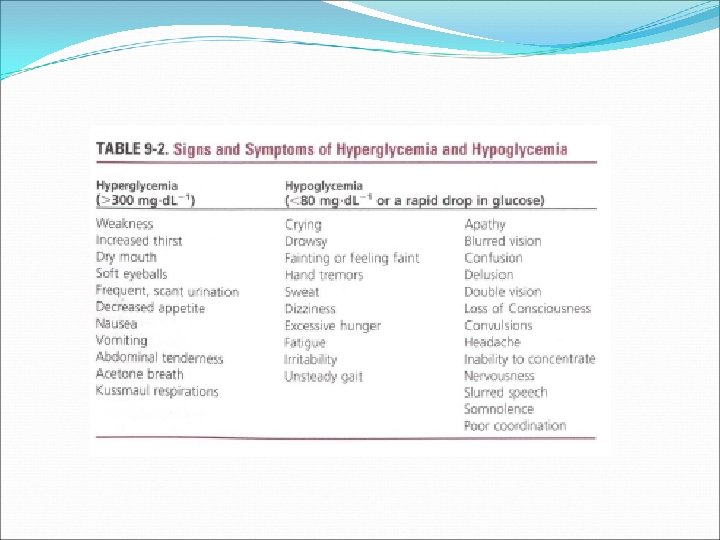
Diabetes Mellitus �Ingest 20 – 30 grams of additional carbohydrates if pre -exercise glucose is <100 mg/dl �Avoid valsalva and jarring/pounding activities �Monitor for signs of autonomic neuropathy (hypoglycemia / hyperglycemia) �Proper feet care �Limit WB activities for patients with peripheral neuropathy
Well Population �Mode �Season
Well Population Mode �Long Slow Distance training �Pace / Tempo �Interval �Repetition �Fartlek
Long Slow Distance �Intensity �Achievement of 70% VO 2 max (80& MHR) �Duration �Training distance > race distance �Lasts from 30 minutes – 2 hours �Frequency � 1 -2 per week �Conversation exercise
Long Slow Distance Benefits: Increase �CV and thermoreg function �Mitochondria �Oxidative capacity �Fat utilization and lactate clearance Disadvantages �Not specific with lower intensity sports �Does not stimulate neurologic pattern
Pace / Tempo �Intensity: At the lactate threshold or slightly above the race pace �Duration: 20 -30 minutes �Frequency: 1 -2 / week �“Threshold training”
Pace / Tempo Benefits �Develops race pace �Enhance body to sustain exercise �Increases running economy �Increases lactate threshold
Interval �Intensity: Close to the VO 2 Max �Duration: 3 – 5 minutes; Work/Rest ratio 1: 1 �Frequency: 1 – 2 / week �Benefit �Increase VO 2 max �Not to be performed if unfit
Repetition �Intensity: Greater than VO 2 Max �Duration: 30 – 90 seconds; Work/Rest ratio 1: 5 �Frequency: Once a week �High reliance on anaerobic metabolism �Benefits �Increases running speed �High capacity for anaerobic metabolism �Beneficial for final kick / push
Fartlek �Intensity: Varies between LSD and pace �Duration: 20 – 60 minutes �Frequency: Once a week �Benefits �Challenges all the system �Increases VO 2 max �Reduce boredom �Increases lactate threshold �Increases running conomy
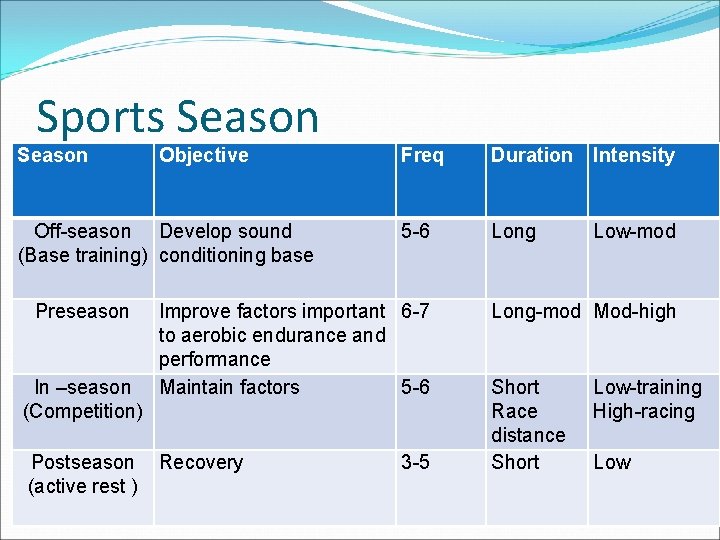
Sports Season Objective Off-season Develop sound (Base training) conditioning base Preseason In –season (Competition) Postseason (active rest ) Freq Duration Intensity 5 -6 Long Improve factors important 6 -7 to aerobic endurance and performance Maintain factors 5 -6 Recovery 3 -5 Low-mod Long-mod Mod-high Short Race distance Short Low-training High-racing Low
References �Rothstein, J. M. , Roy, S. H. , & Wolf, S. L. (2005). The rehabilitation specialist’s handbook. Philadelphia: F. A. Davis. �Whaley, M. H. , Brubaker, P. H. , & Otto, R. M. (2005). ACSM’s guidelines for exercise testing and prescription. Philadelphia: Lippincott Williams & Wilkins. �Kisner, C. , & Colby, L. A. (2007). Therapeutic exercise: Foundations and techniques. Philadelphia: F. A. Davis. �Seigelman, R. P. , & O’ Sullivan, S. B. (2006). National physical therapy examination review and study guide. Philadelphia: International Education Resources. �Powerpoint presentation of Prof. Mitch B. Encabo, MPA, PTRP, RPT, CSCS

Do you have any questions? ? ? If none, THANK YOU VERY MUCH. . . Have a nice day ahead of you. . .
- Slides: 76