
Aerobic Capacity Body Composition COMPONENTS OF FITNESS Flexibility


Aerobic Capacity Body Composition COMPONENTS OF FITNESS Flexibility Muscle Strength/ endurance

Aerobic Capacity Ability of the Cardiovascular system to deliver oxygen rich blood to body tissues. Muscles ability to process and utilize oxygen to produce energy.
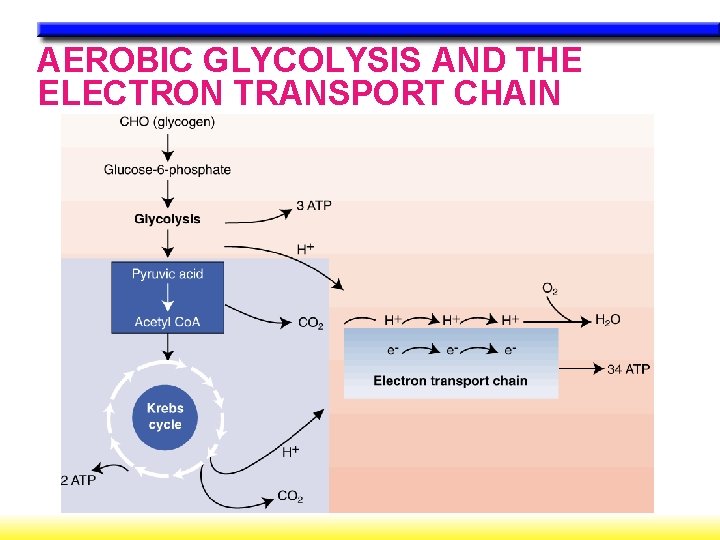
AEROBIC GLYCOLYSIS AND THE ELECTRON TRANSPORT CHAIN
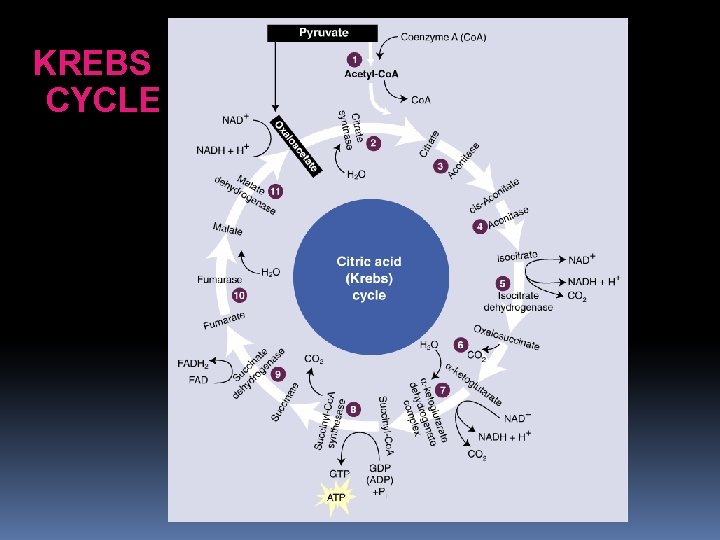
KREBS CYCLE

Evaluating Aerobic Capacity Measure VO 2 max via spirometry / graded exercise stress test Estimate Sub-maximal graded exercise test Step test �Based on the fact that individuals with higher SV will recover faster �Recovery HR will be lower in individuals w/ higher VO 2 max
VO 2 max Units liters/minute or ml/minute (absolute) ml/kg/min (relative to body weight) ml/kg of FFM/min (relative to FFM) Range 15 (sedentary with disease) to 75 (young endurance runner) ml/kg/min Women about 10 -20% lower than men
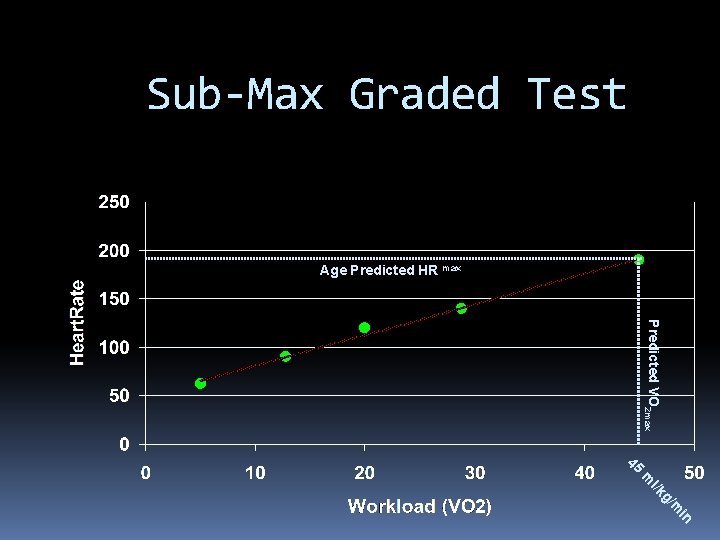
Sub-Max Graded Test Age Predicted HR max Predicted VO 2 max 45 in m g/ l/k m
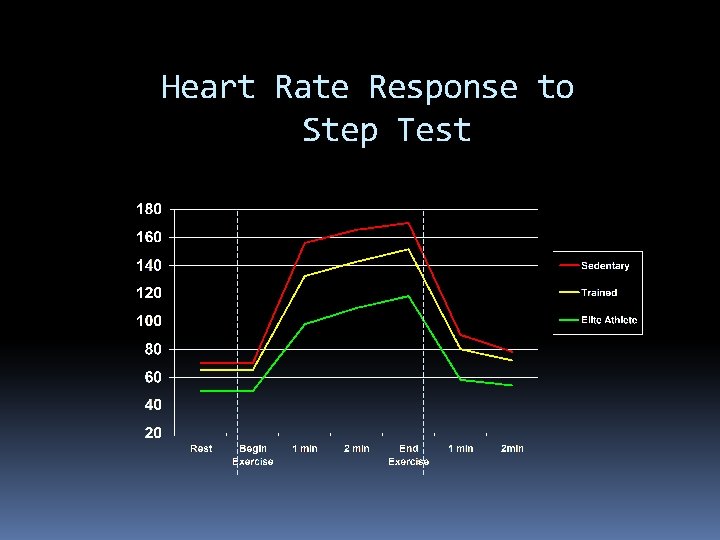
Heart Rate Response to Step Test
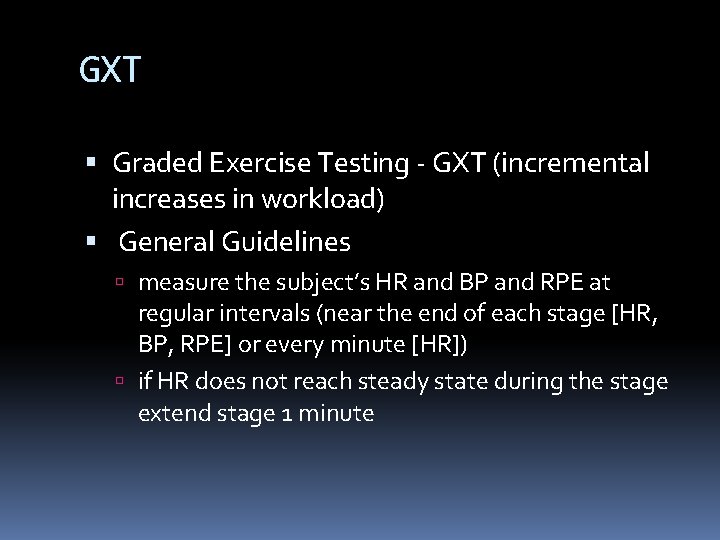
GXT Graded Exercise Testing - GXT (incremental increases in workload) General Guidelines measure the subject’s HR and BP and RPE at regular intervals (near the end of each stage [HR, BP, RPE] or every minute [HR]) if HR does not reach steady state during the stage extend stage 1 minute
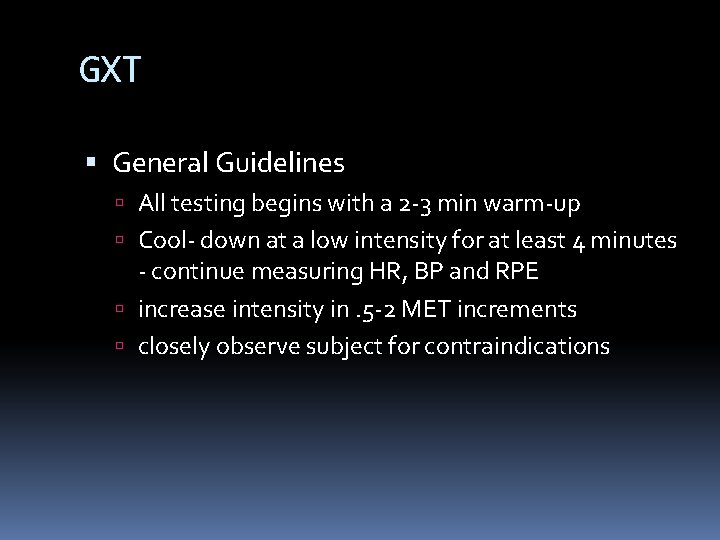
GXT General Guidelines All testing begins with a 2 -3 min warm-up Cool- down at a low intensity for at least 4 minutes - continue measuring HR, BP and RPE increase intensity in. 5 -2 MET increments closely observe subject for contraindications
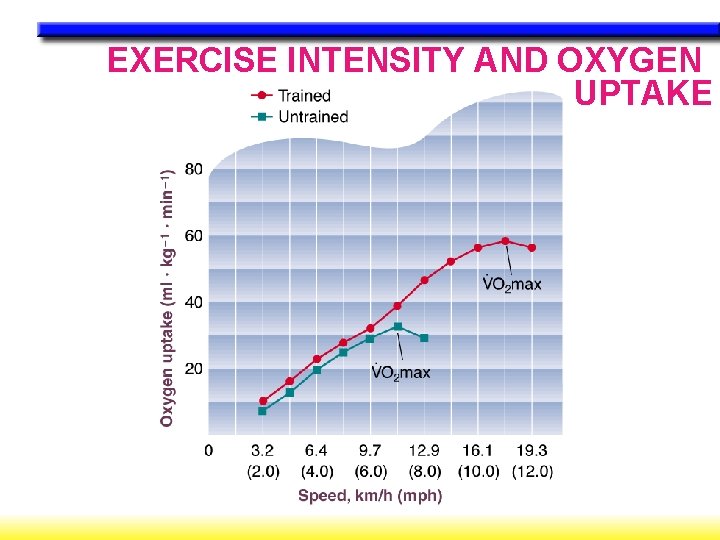
EXERCISE INTENSITY AND OXYGEN UPTAKE
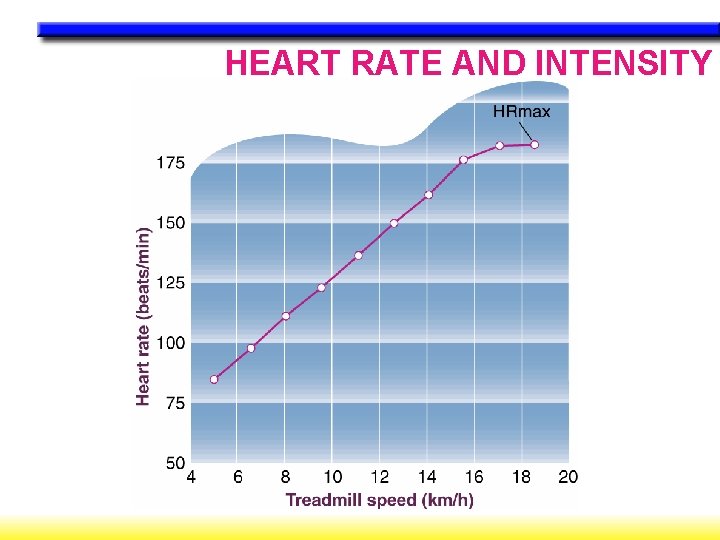
HEART RATE AND INTENSITY
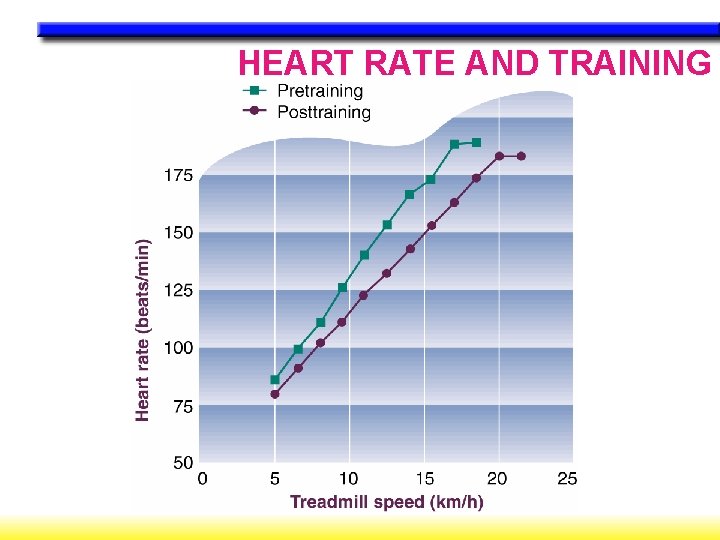
HEART RATE AND TRAINING
ACSM Bike Test 1. 2 -3 minute warm-up 2. Take HR twice during each stage (3 minute stages) and RPE/BP once 3. If HRs are greater than 110, steady state should be reached (HRs within 6 bpm) before increasing the workload

Treadmill Tests Bruce Protocol Balke Ellestad Others……….
Treadmill Protocols Bruce and Ellestad larger increments use on younger and/or more physically active Balke-Ware smaller increments (1 MET/stage or lower) use on older, deconditioned, and/or diseased subjects
Bruce Treadmill Protocol 1. Measure resting BP and HR while standing on the belt of the treadmill 2. Ask subject to straddle the belt while starting treadmill at 1. 7 mph and 0% grade 3. Ask subject to begin walking and when comfortable release handrails 4. This is a warm-up and should continue until subject is comfortable
Bruce Treadmill Protocol 5. Stage 1 Increase grade to 10% 3 minutes long Measure HR at end of each minute and BP at end of each stage
Bruce Treadmill Protocol 6. The objective is to reach a steady state HR between 115 and 155 bpm (usually occurs during the first 6 minutes of exercise or by the end of the 2 nd stage) – Page 98 guidelines 7. Once subject reaches proper HR terminate the test at the end of that stage
Bruce Treadmill Protocol 8. Reduce treadmill speed to 1. 7 mph and 5% grade and cool-down for 4 minutes. 9. VO 2 is estimated from the last minute of a fully completed stage
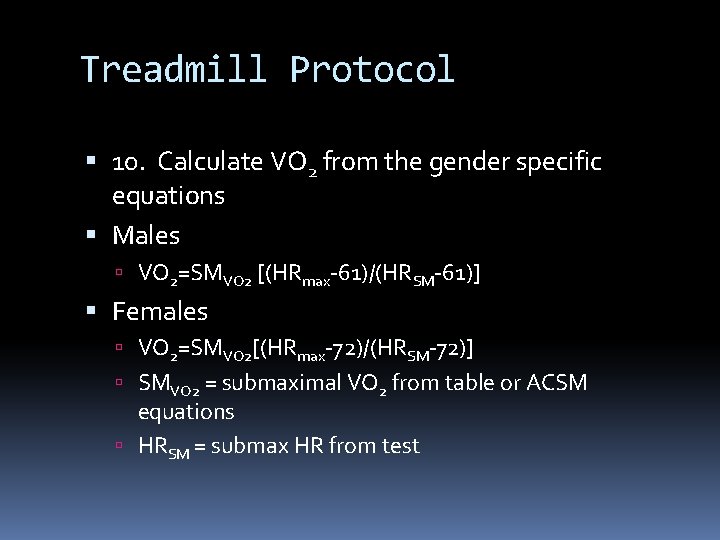
Treadmill Protocol 10. Calculate VO 2 from the gender specific equations Males VO 2=SMVO 2 [(HRmax-61)/(HRSM-61)] Females VO 2=SMVO 2[(HRmax-72)/(HRSM-72)] SMVO 2 = submaximal VO 2 from table or ACSM equations HRSM = submax HR from test
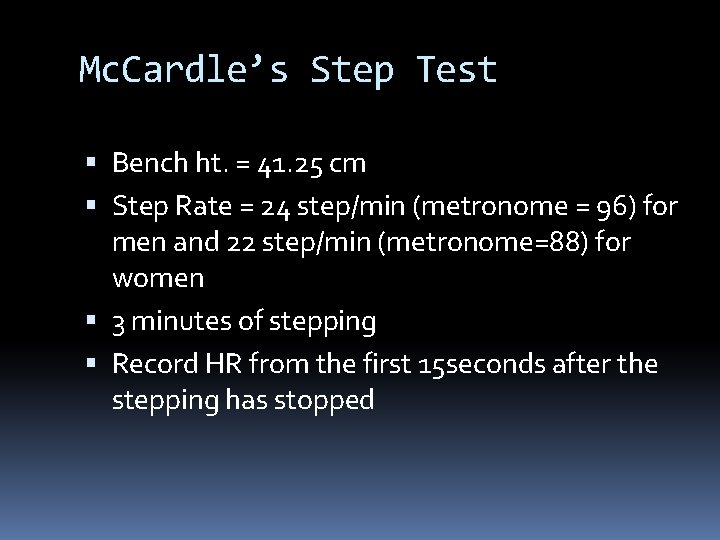
Mc. Cardle’s Step Test Bench ht. = 41. 25 cm Step Rate = 24 step/min (metronome = 96) for men and 22 step/min (metronome=88) for women 3 minutes of stepping Record HR from the first 15 seconds after the stepping has stopped
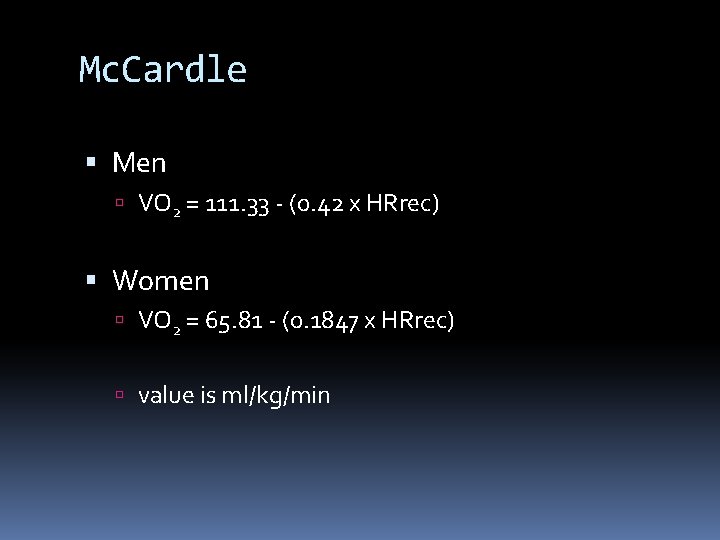
Mc. Cardle Men VO 2 = 111. 33 - (0. 42 x HRrec) Women VO 2 = 65. 81 - (0. 1847 x HRrec) value is ml/kg/min
Maximal Protocols Field Tests 12 minute run 1. 5 mile run Rockport Walking Test

12 minute run
12 minute run The further you can run in 12 minutes the higher your VO 2 max
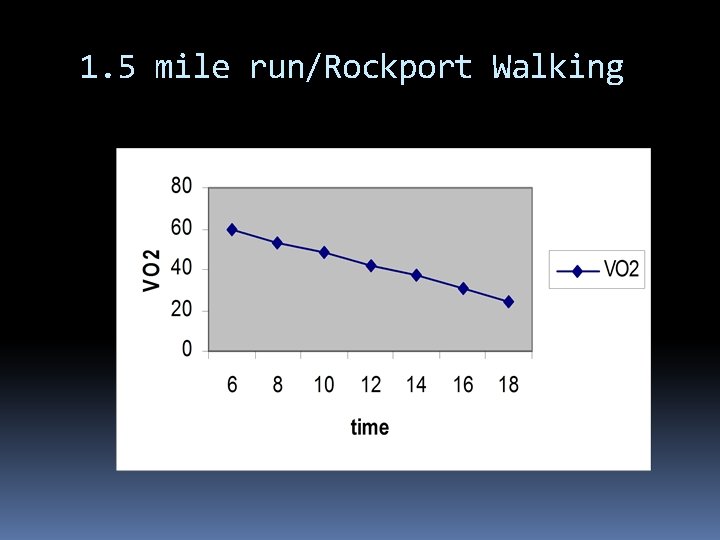
1. 5 mile run/Rockport Walking
1. 5 Mile Run/1 Mile Walk The faster you can run 1. 5 miles or walk 1 mile the higher your VO 2 max
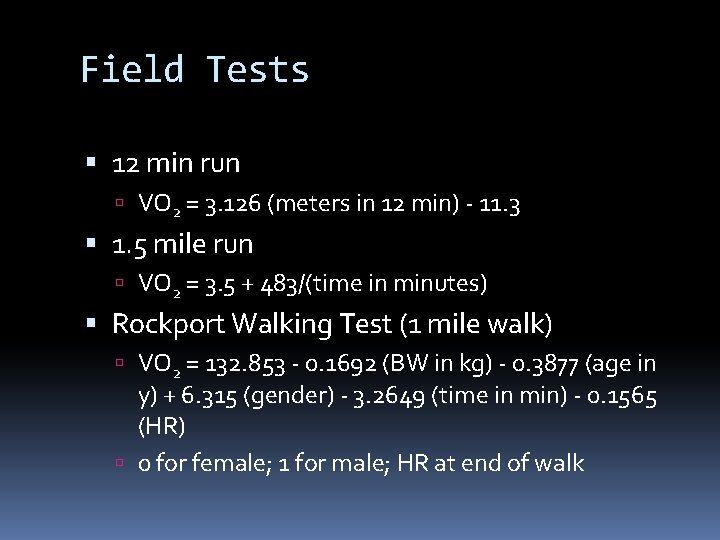
Field Tests 12 min run VO 2 = 3. 126 (meters in 12 min) - 11. 3 1. 5 mile run VO 2 = 3. 5 + 483/(time in minutes) Rockport Walking Test (1 mile walk) VO 2 = 132. 853 - 0. 1692 (BW in kg) - 0. 3877 (age in y) + 6. 315 (gender) - 3. 2649 (time in min) - 0. 1565 (HR) 0 for female; 1 for male; HR at end of walk

Body Composition
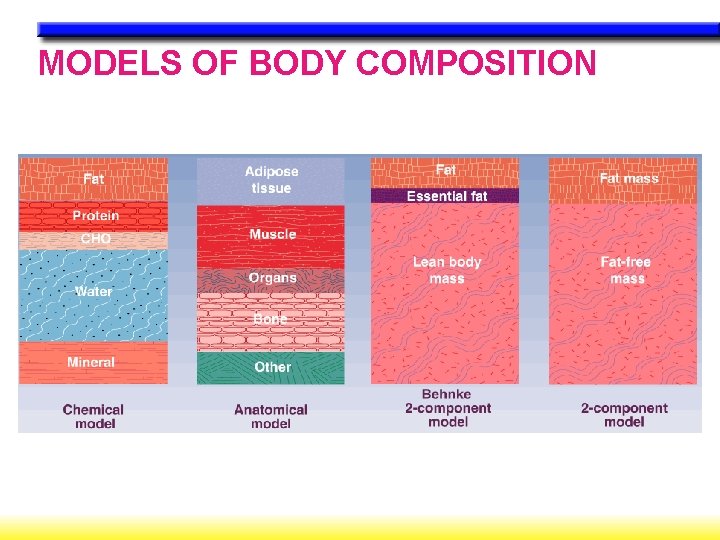
MODELS OF BODY COMPOSITION
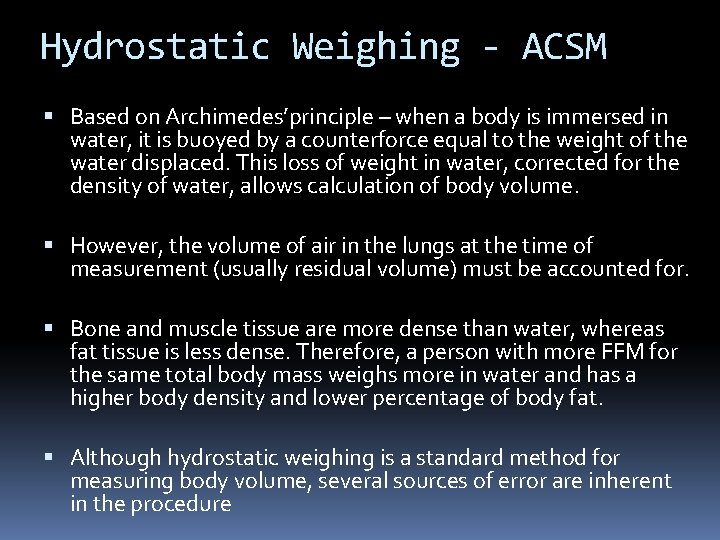
Hydrostatic Weighing - ACSM Based on Archimedes’principle – when a body is immersed in water, it is buoyed by a counterforce equal to the weight of the water displaced. This loss of weight in water, corrected for the density of water, allows calculation of body volume. However, the volume of air in the lungs at the time of measurement (usually residual volume) must be accounted for. Bone and muscle tissue are more dense than water, whereas fat tissue is less dense. Therefore, a person with more FFM for the same total body mass weighs more in water and has a higher body density and lower percentage of body fat. Although hydrostatic weighing is a standard method for measuring body volume, several sources of error are inherent in the procedure
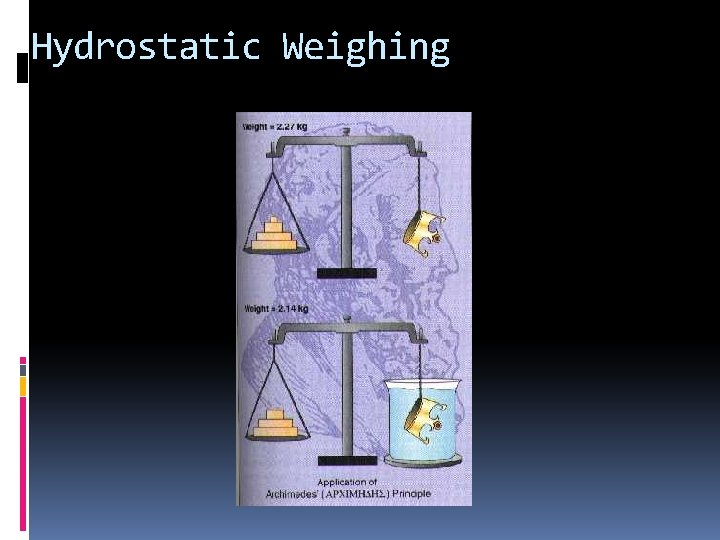
Hydrostatic Weighing
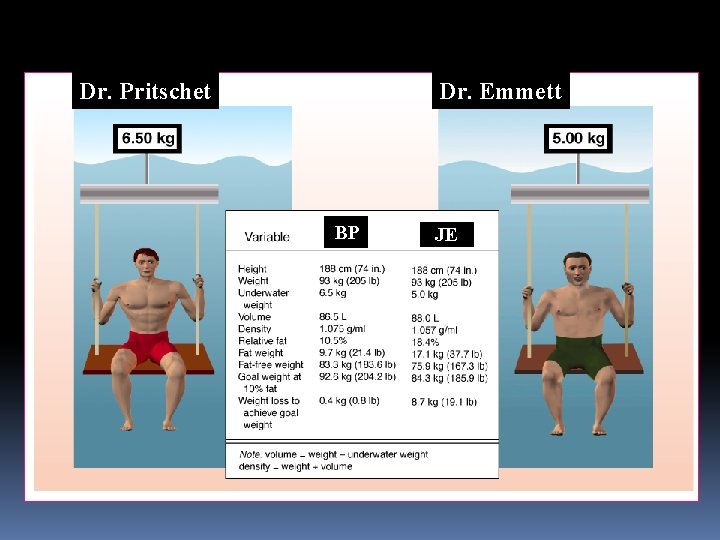
Dr. Pritschet Dr. Emmett BP JE
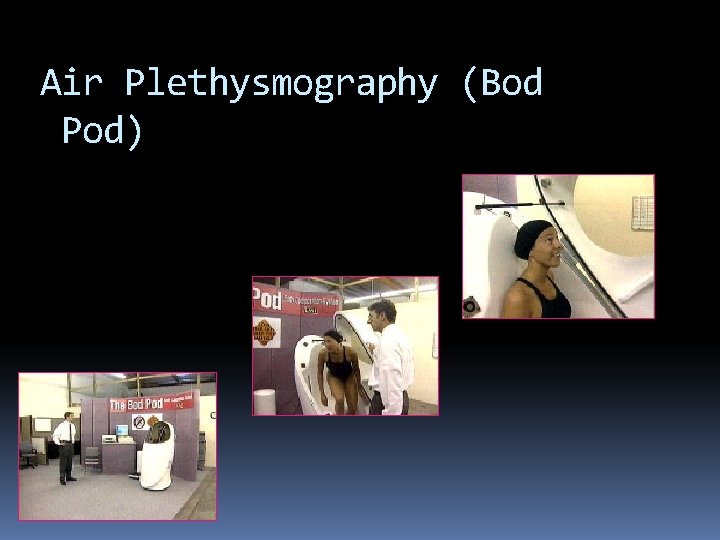
Air Plethysmography (Bod Pod)
Plethysmography - ACSM Body volume can also be measured by air displacement rather than water displacement (hydrostatic weighing). One commercial system uses a dual-chamber plethysmograph that measures body volume by changes in pressure in a closed chamber. This new technology shows great promise and can more easily accommodate individuals who cannot perform the procedures associated with underwater weighing.
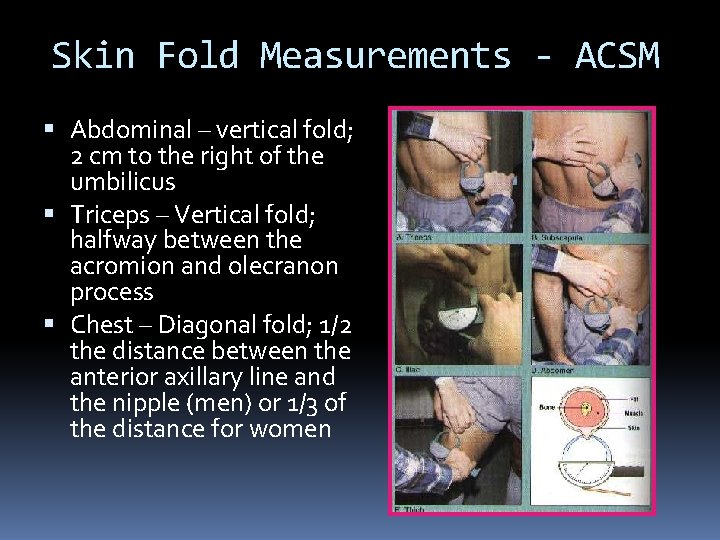
Skin Fold Measurements - ACSM Abdominal – vertical fold; 2 cm to the right of the umbilicus Triceps – Vertical fold; halfway between the acromion and olecranon process Chest – Diagonal fold; 1/2 the distance between the anterior axillary line and the nipple (men) or 1/3 of the distance for women
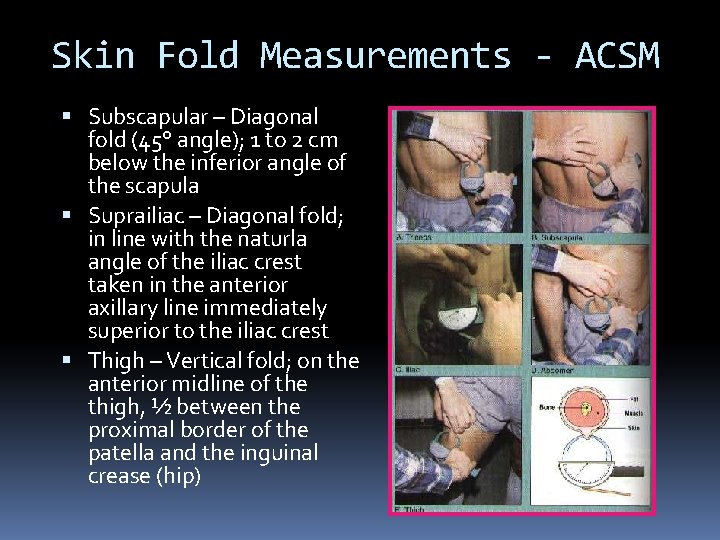
Skin Fold Measurements - ACSM Subscapular – Diagonal fold (45° angle); 1 to 2 cm below the inferior angle of the scapula Suprailiac – Diagonal fold; in line with the naturla angle of the iliac crest taken in the anterior axillary line immediately superior to the iliac crest Thigh – Vertical fold; on the anterior midline of the thigh, ½ between the proximal border of the patella and the inguinal crease (hip)
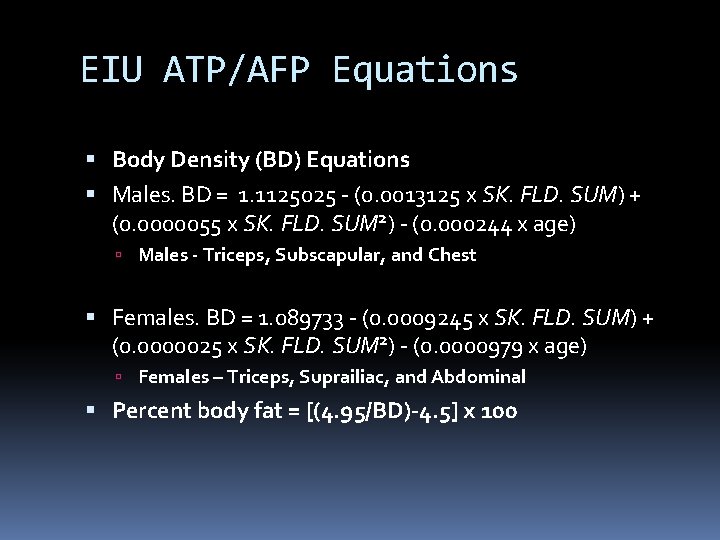
EIU ATP/AFP Equations Body Density (BD) Equations Males. BD = 1. 1125025 - (0. 0013125 x SK. FLD. SUM) + (0. 0000055 x SK. FLD. SUM 2) - (0. 000244 x age) Males - Triceps, Subscapular, and Chest Females. BD = 1. 089733 - (0. 0009245 x SK. FLD. SUM) + (0. 0000025 x SK. FLD. SUM 2) - (0. 0000979 x age) Females – Triceps, Suprailiac, and Abdominal Percent body fat = [(4. 95/BD)-4. 5] x 100
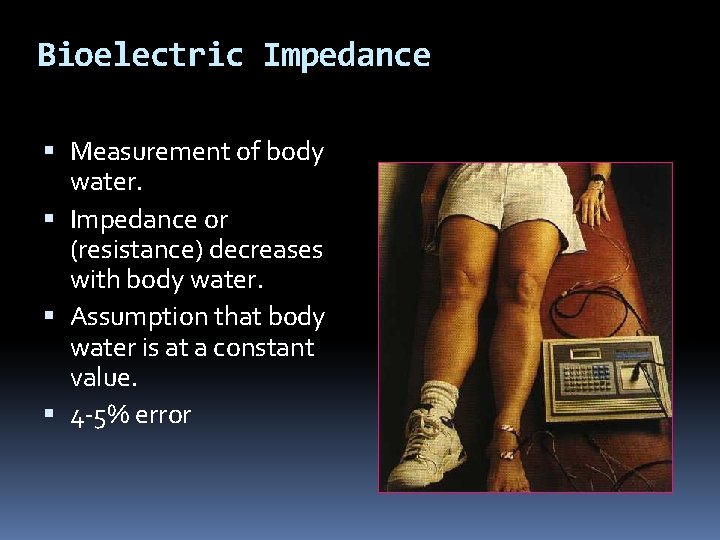
Bioelectric Impedance Measurement of body water. Impedance or (resistance) decreases with body water. Assumption that body water is at a constant value. 4 -5% error
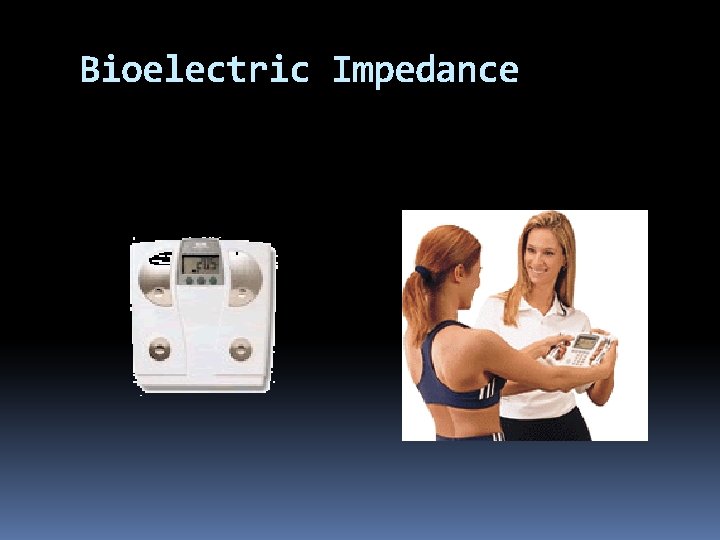
Bioelectric Impedance
Bioelectical Impedance Analysis (BIA) - ACSM Abstain from eating or drinking with 4 hours of the assessment Avoid moderate or vigorous physical activity within 12 hours of the assessment Void completely before the assessment Abstain from alcohol consumption within 48 hours of the assessment Ingest no diuretic agents, including caffeine, prior to the assessment unless prescribe by a physician
Dual Energy X-Ray Absorptiometry - ACSM Can be used to assess total bone mineral as well as regional estimates of bone, fat, and lean tissue. It uses a three component model to predict body fatness and offers advantages over densitometry techniques. DEXA is typically found in clinical setting and can be used to measure body composition across the life span
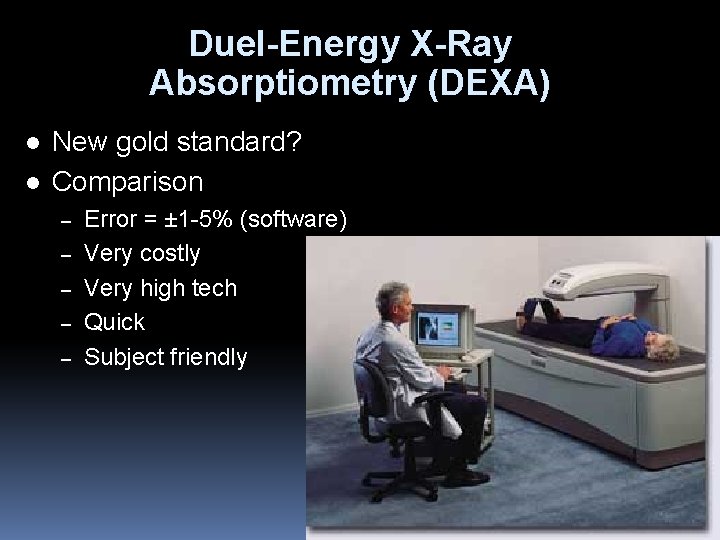
Duel-Energy X-Ray Absorptiometry (DEXA) l l New gold standard? Comparison – – – Error = ± 1 -5% (software) Very costly Very high tech Quick Subject friendly
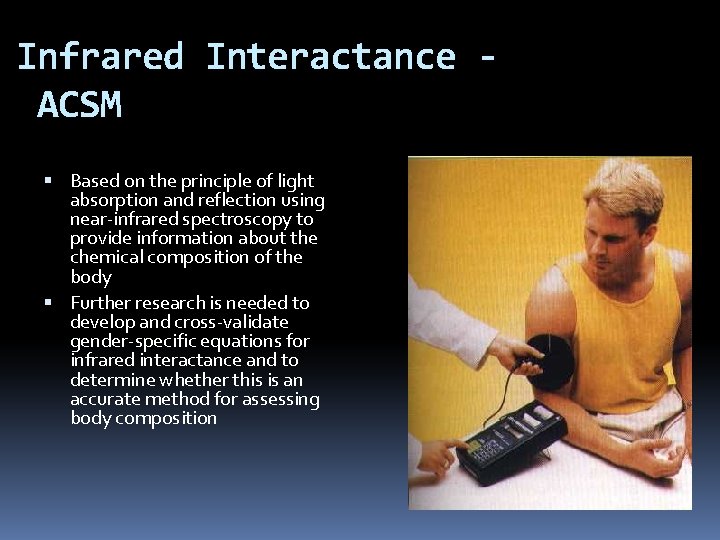
Infrared Interactance ACSM Based on the principle of light absorption and reflection using near-infrared spectroscopy to provide information about the chemical composition of the body Further research is needed to develop and cross-validate gender-specific equations for infrared interactance and to determine whether this is an accurate method for assessing body composition
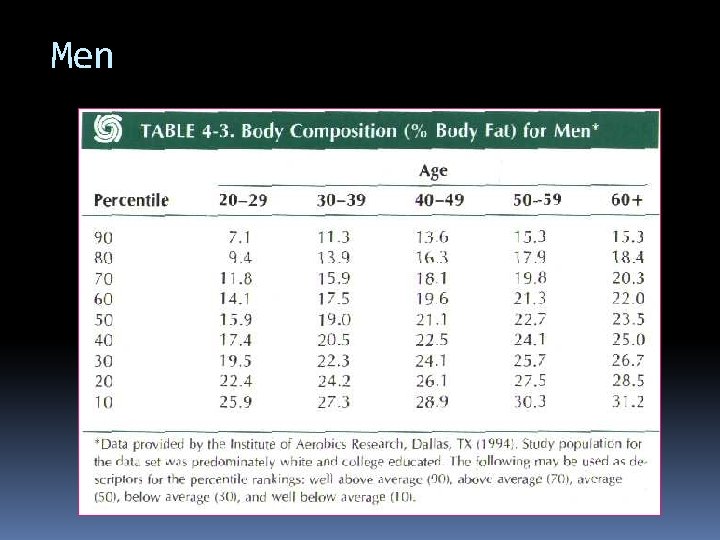
Men
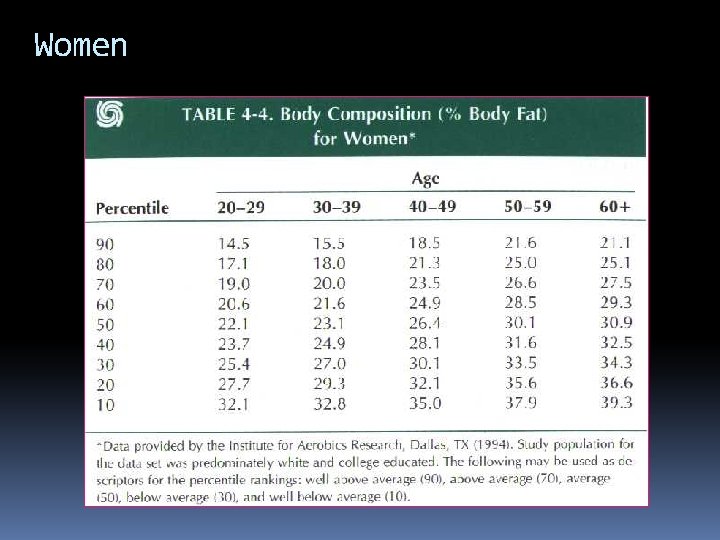
Women
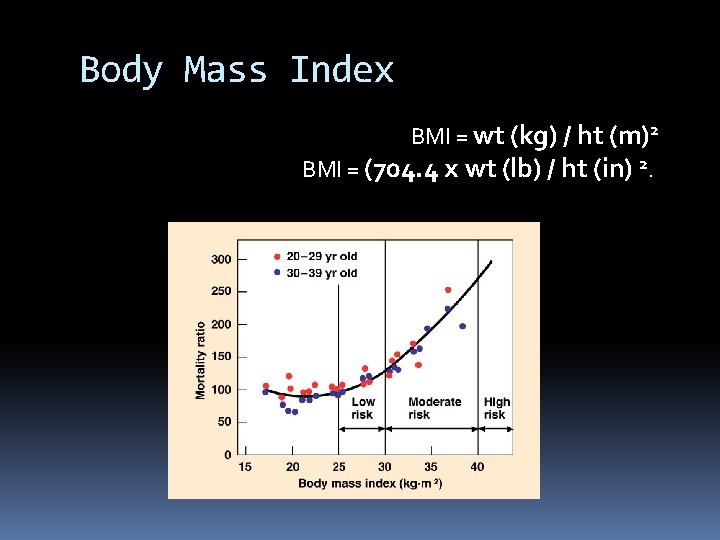
Body Mass Index BMI = wt (kg) / ht (m)2 BMI = (704. 4 x wt (lb) / ht (in) 2.
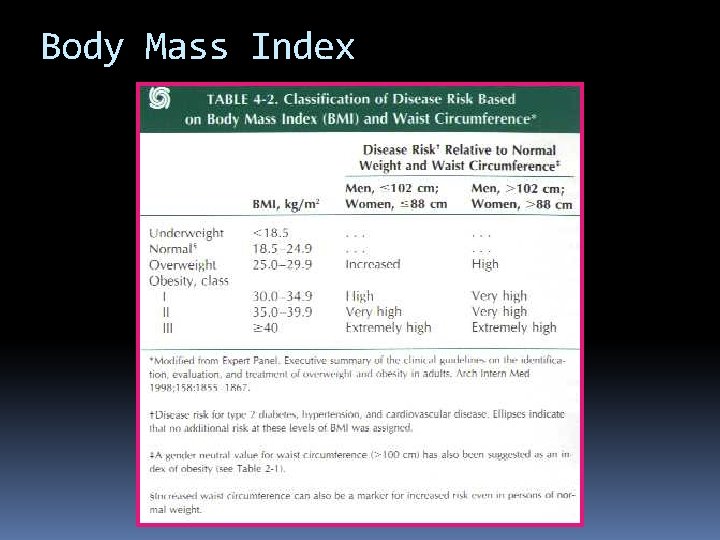
Body Mass Index
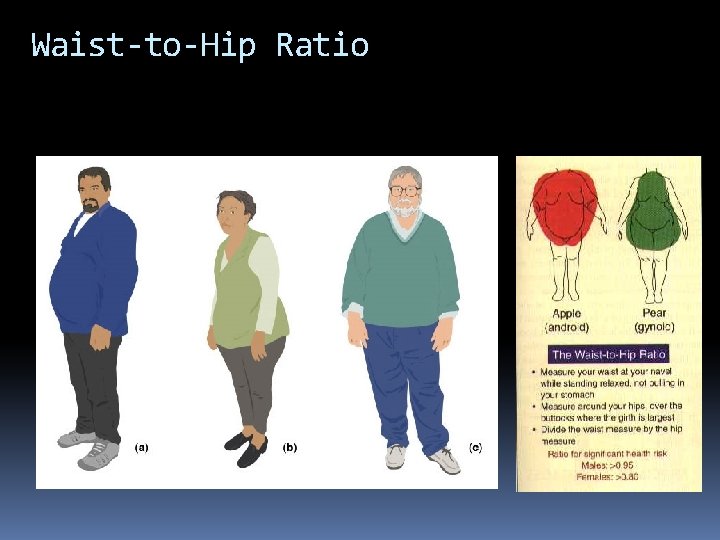
Waist-to-Hip Ratio
Waist-to-Hip Ratio - ACSM Individuals with more fat on the trunk, especially abdominal fat are at increase risk for various diseases. The waist to hip ratio has been used as a simple method for determining body fat patterns Waist to hip ratio = circumference of waist divided by the circumference of the hips
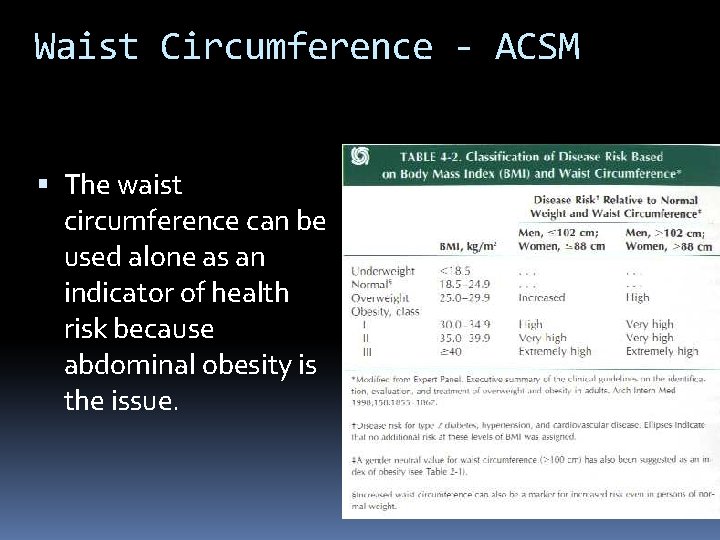
Waist Circumference - ACSM The waist circumference can be used alone as an indicator of health risk because abdominal obesity is the issue.
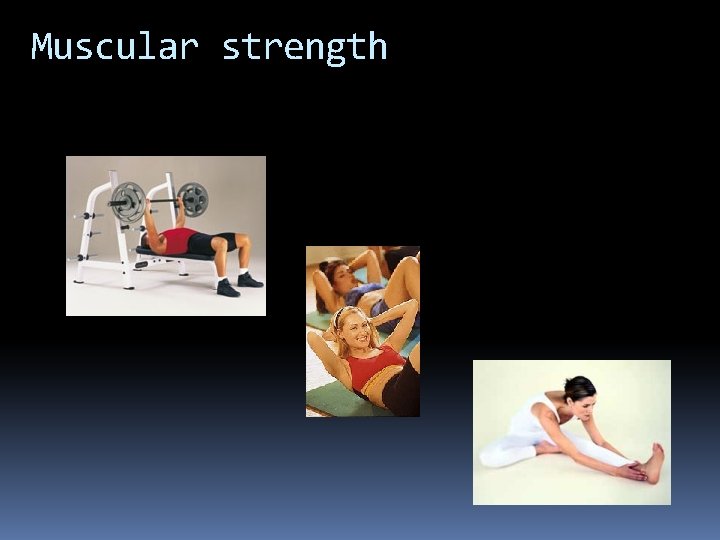
Muscular strength
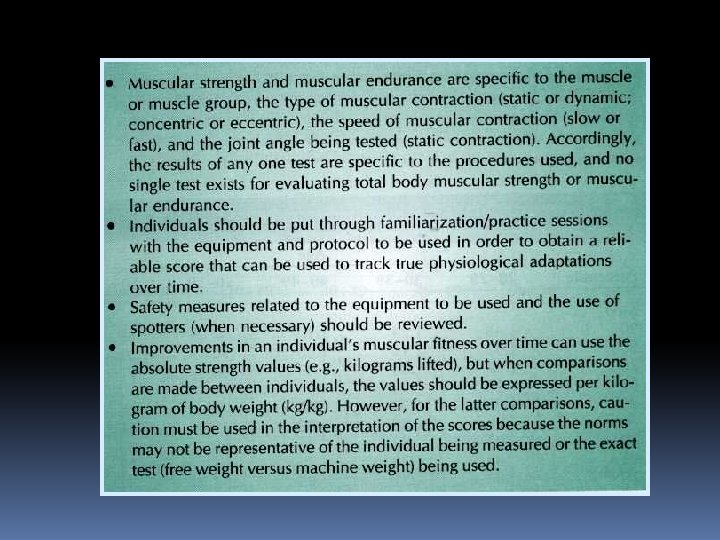
Muscular Strength
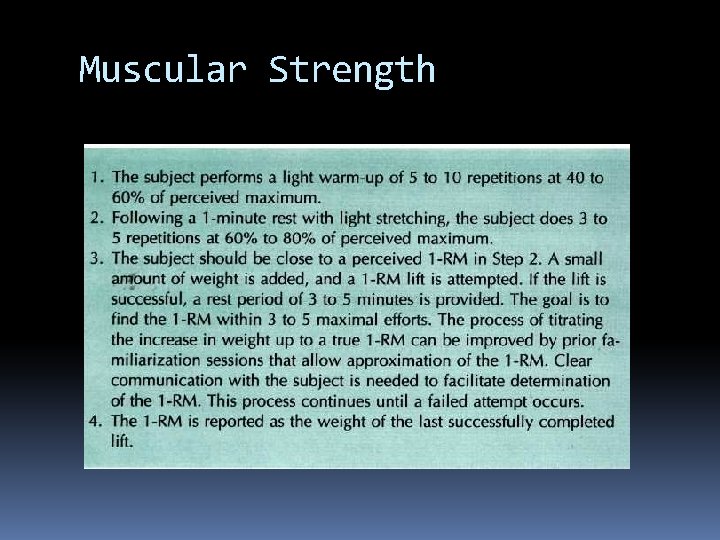
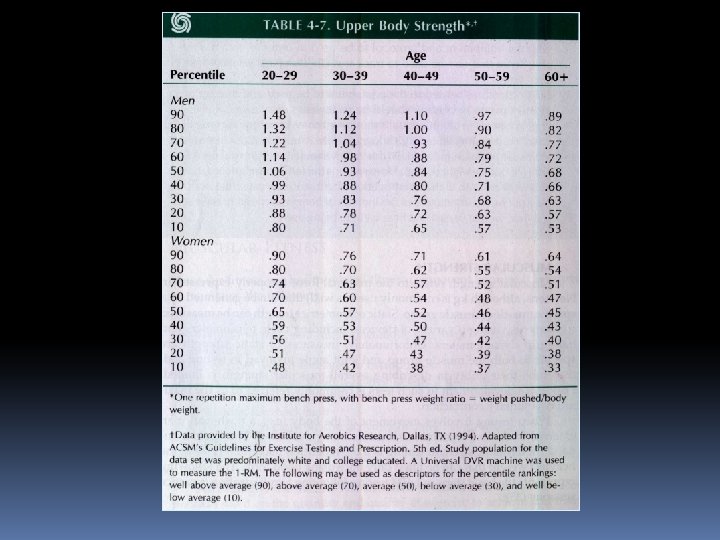
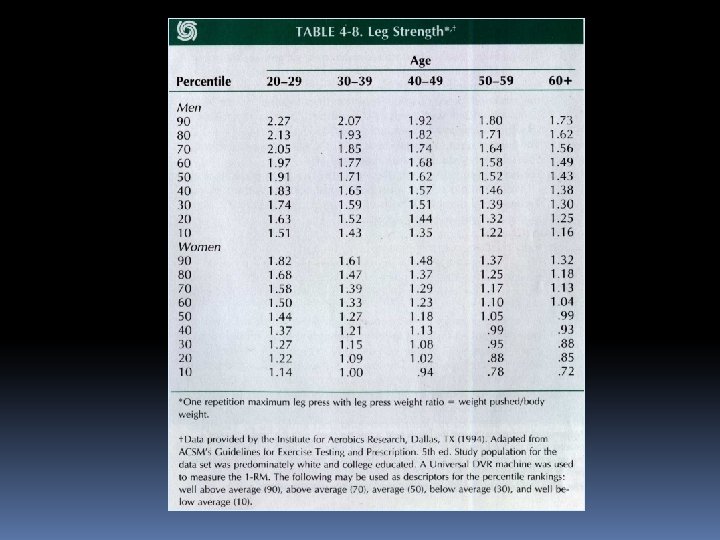
Muscular Strength – 1 RM The subject performs a light warm-up of 5 -10 reps at 40 to 60% of perceived maximum. Following a 1 -minute rest with light stretching, the subject does 3 to 5 repetitions at 60 to 80% of perceived maximum. The subject should be close to a perceived 1 -RM in step 2. A small amount of weight is added, and a 1 -RM lift is attempted.
Muscular Strength – 1 RM If the lift is successful, a rest period of 3 to 5 minutes is provided. The goal is to find the 1 -RM within 3 to 5 maximal efforts. The process of titrating the increase in weight up to a true 1 -RM can be improved by prior familiarization sessions that allow approximation of the 1 -RM.
Muscular Strength – 1 RM Clear communication with the subject is needed to facilitate determination of the 1 RM. The process continues until a failed attempt occurs. The 1 -RM is reported as the weight of the last successfully completed lift.
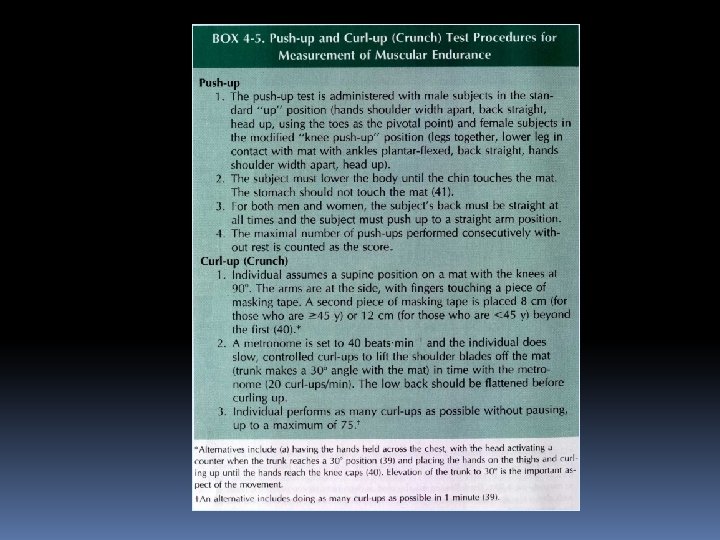
Muscular Endurance
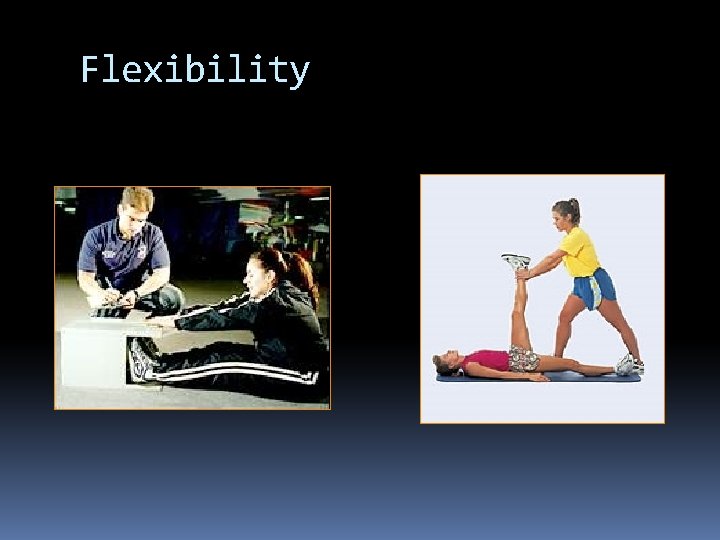
Flexibility
Flexibility - ACSM The ability to move a joint through its complete range of motion (ROM) Importance in athletics and the ability to carry out activities of daily living Maintaining flexibility facilitates movement Movement beyond a joint’s shortened range of motion cause tissue damage. Factors that determine flexibility: Joint capsule Body (joint) temperature Ligaments and tendons
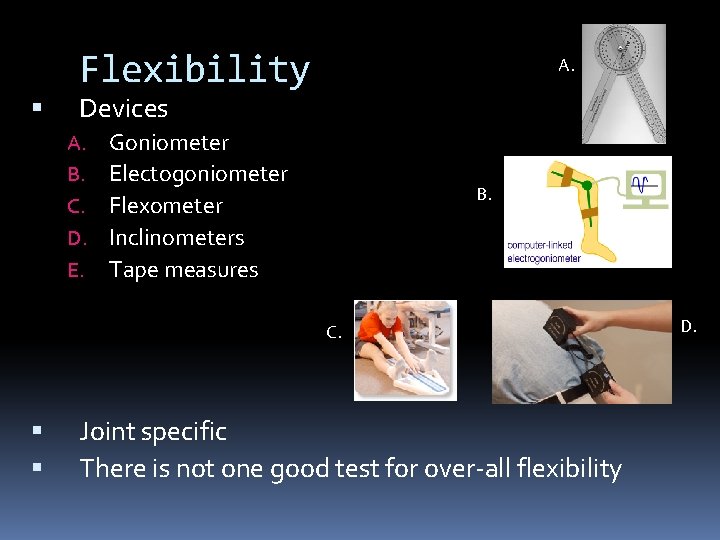
Flexibility A. Devices A. B. C. D. E. Goniometer Electogoniometer Flexometer Inclinometers Tape measures B. C. Joint specific There is not one good test for over-all flexibility D.
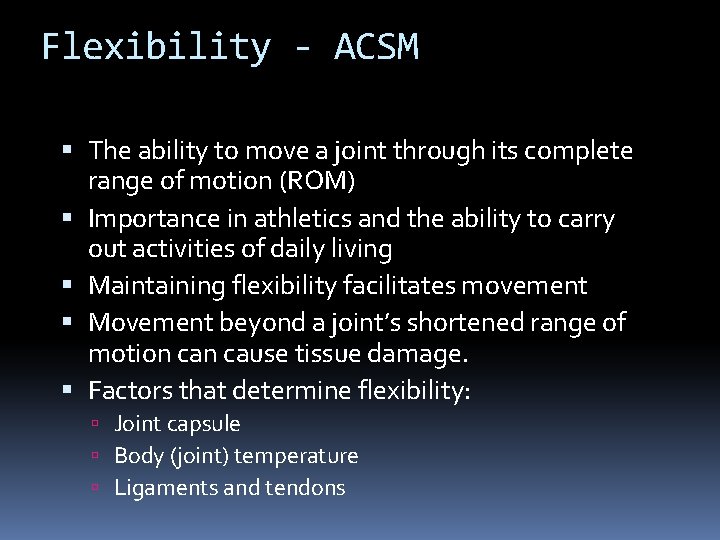
YMCA Sit and Reach Test Place a yard stick on the floor At a right angle, place a piece of tape at the 15 inch mark Have participant sit with the yard stick between their legs Heals of the feet should touch the edge of the taped line and be 10 to 12 inches apart
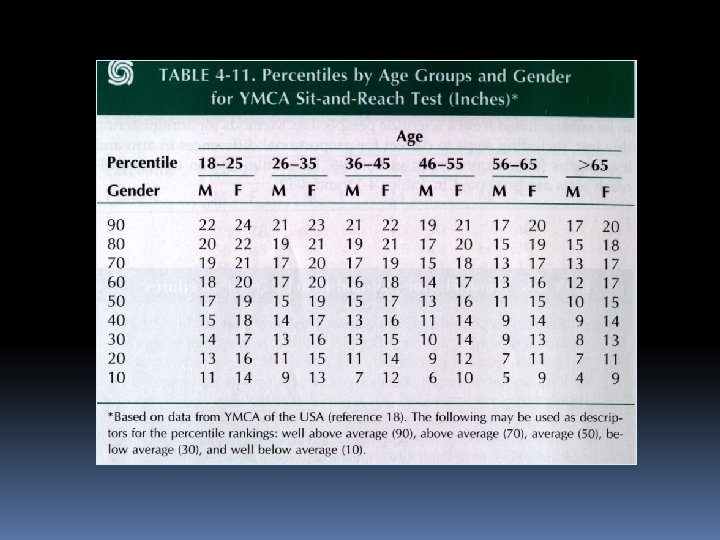
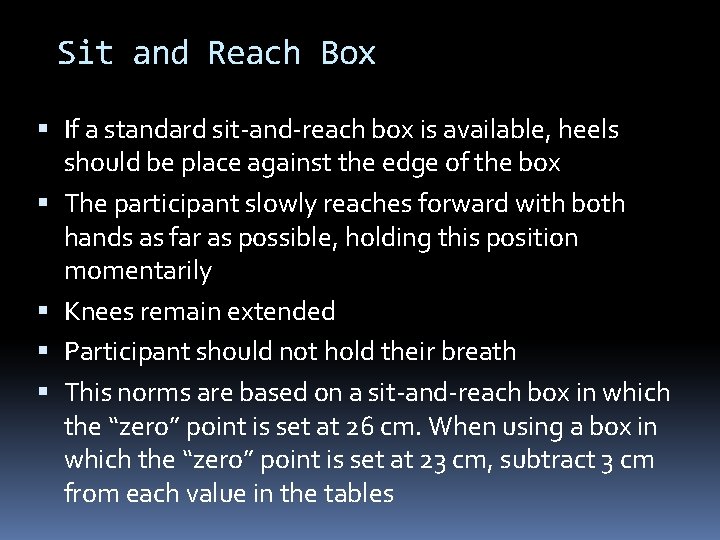
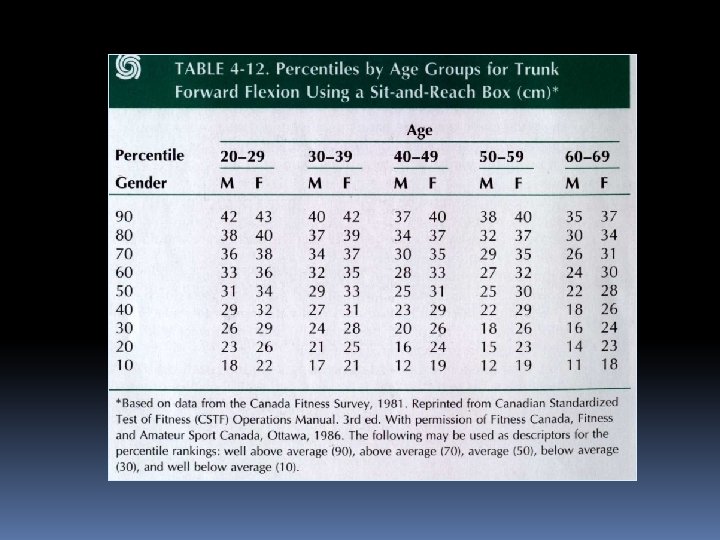
Sit and Reach Box If a standard sit-and-reach box is available, heels should be place against the edge of the box The participant slowly reaches forward with both hands as far as possible, holding this position momentarily Knees remain extended Participant should not hold their breath This norms are based on a sit-and-reach box in which the “zero” point is set at 26 cm. When using a box in which the “zero” point is set at 23 cm, subtract 3 cm from each value in the tables
- Slides: 71