
AEMT INTRODUCTION TO CPAP Vermont Statewide EMS Protocol
- Slides: 37
AEMT INTRODUCTION TO CPAP Vermont Statewide EMS Protocol Education
Objectives: To supply the AEMT with guidance on the use of Continuous Positive Airway Pressure (CPAP) including: The anatomy and physiology of a respiratory patient The indications for the use of CPAP The adverse effects of the use of CPAP How to use the CPAP device Vermont Department of Health - EMS
Disclaimer This presentation provides an overview of the CPAP device and its appropriate use You should also seek guidance about: The specific device your agency will use Any additional training required by your agency Additional training recommended by the CPAP device manufacturer Vermont Department of Health - EMS
Vermont Department of Health - EMS
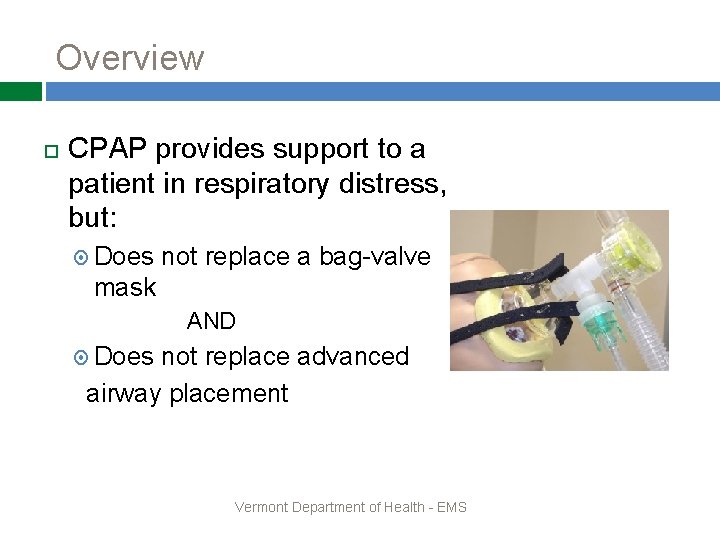
Overview CPAP provides support to a patient in respiratory distress, but: Does not replace a bag-valve mask AND Does not replace advanced airway placement Vermont Department of Health - EMS
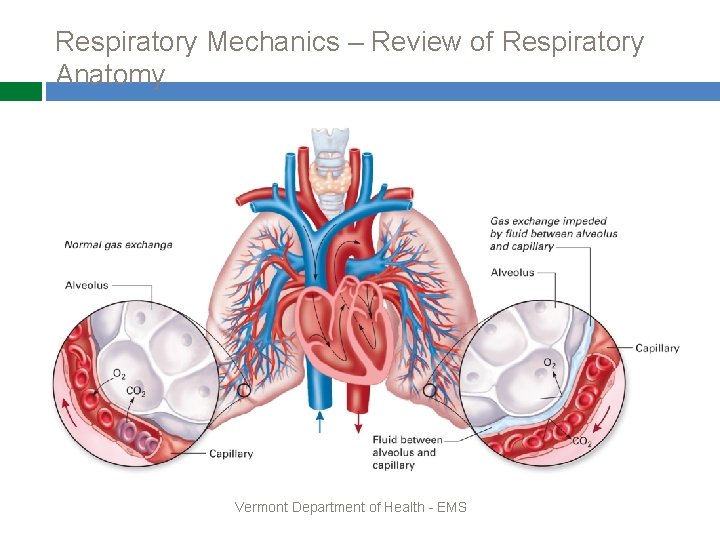
Respiratory Mechanics – Review of Respiratory Anatomy Vermont Department of Health - EMS
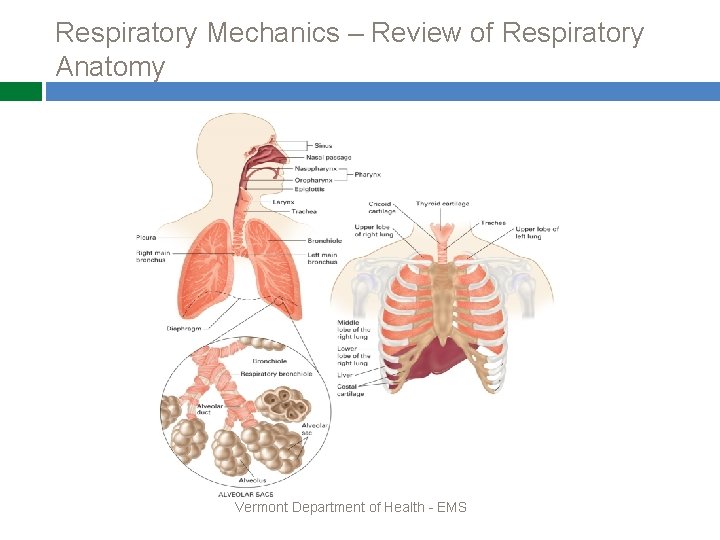
Respiratory Mechanics – Review of Respiratory Anatomy Vermont Department of Health - EMS
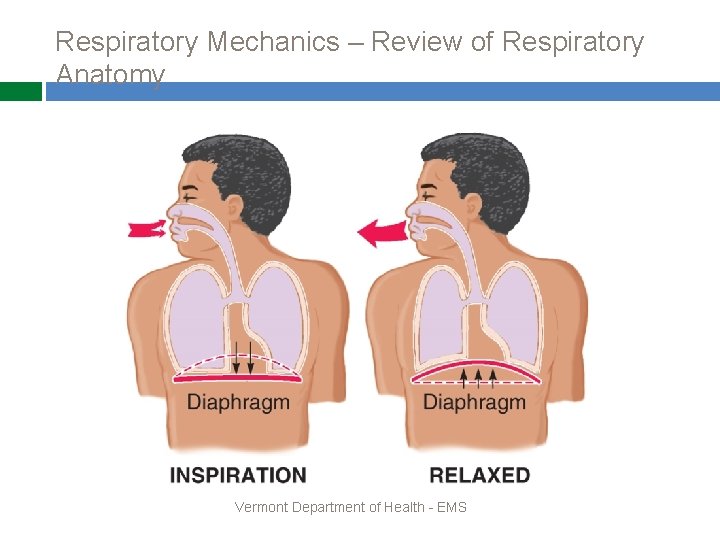
Respiratory Mechanics – Review of Respiratory Anatomy Vermont Department of Health - EMS
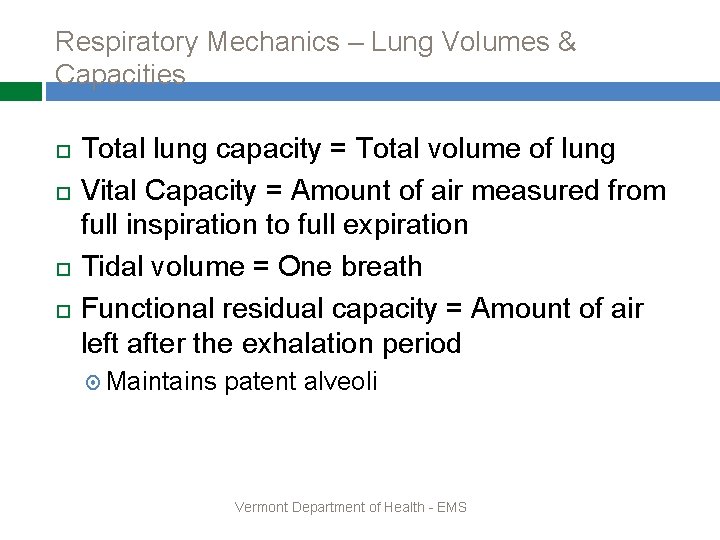
Respiratory Mechanics – Lung Volumes & Capacities Total lung capacity = Total volume of lung Vital Capacity = Amount of air measured from full inspiration to full expiration Tidal volume = One breath Functional residual capacity = Amount of air left after the exhalation period Maintains patent alveoli Vermont Department of Health - EMS
Respiratory Mechanics – Peak Inspiratory Flow Vermont Department of Health - EMS
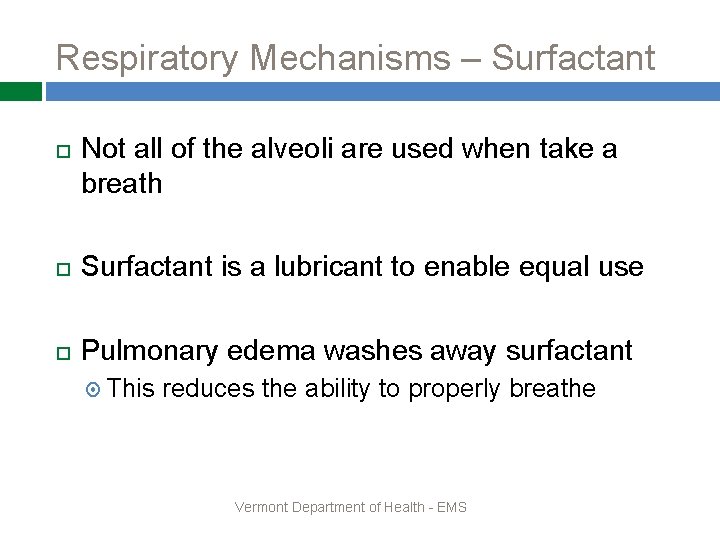
Respiratory Mechanisms – Surfactant Not all of the alveoli are used when take a breath Surfactant is a lubricant to enable equal use Pulmonary edema washes away surfactant This reduces the ability to properly breathe Vermont Department of Health - EMS
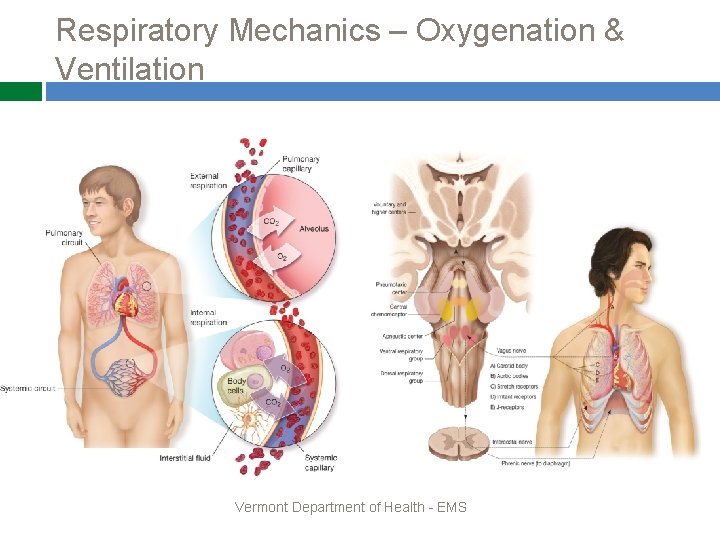
Respiratory Mechanics – Oxygenation & Ventilation Vermont Department of Health - EMS
Common Dysfunctions Obstructive: Air impeded from moving through airways. Increased airway resistance causing reduced expiratory airflow rates Restrictive: Limited lung expansion, reduced lung volumes Vermont Department of Health - EMS
What is CPAP? Continuous Positive Airway Pressure “Breathing Against a Threshold of Resistance” “Pneumatic Splinting of Airways” “Oxygen Therapy in it’s Most Efficient Form” Vermont Department of Health - EMS
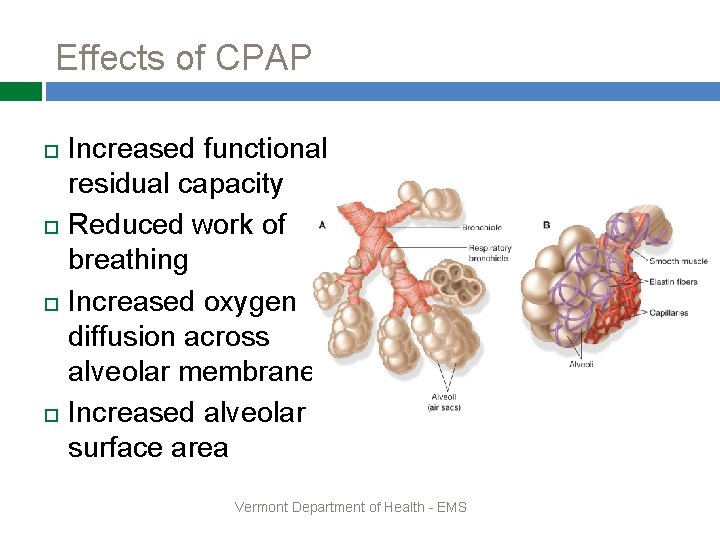
Effects of CPAP Increased functional residual capacity Reduced work of breathing Increased oxygen diffusion across alveolar membrane Increased alveolar surface area Vermont Department of Health - EMS
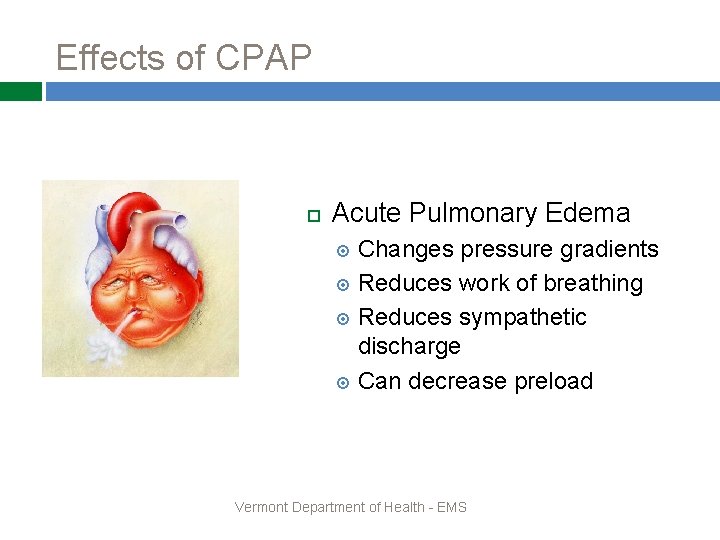
Effects of CPAP Acute Pulmonary Edema Changes pressure gradients Reduces work of breathing Reduces sympathetic discharge Can decrease preload Vermont Department of Health - EMS
Adverse effects from CPAP Barotrauma Aspiration Skin abrasions Sinus pressure Decreased cardiac output Conjunctivitis Air-trapping Gastric distension General to profound discomfort Vermont Department of Health - EMS
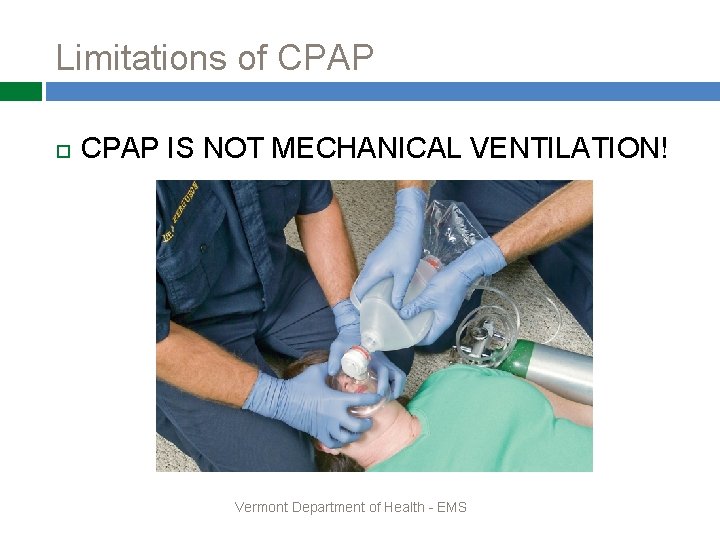
Limitations of CPAP IS NOT MECHANICAL VENTILATION! Vermont Department of Health - EMS
Limitations of CPAP Increased intrathoracic pressure can produce hypotension Psychological effects Pneumothorax Corneal drying Vermont Department of Health - EMS
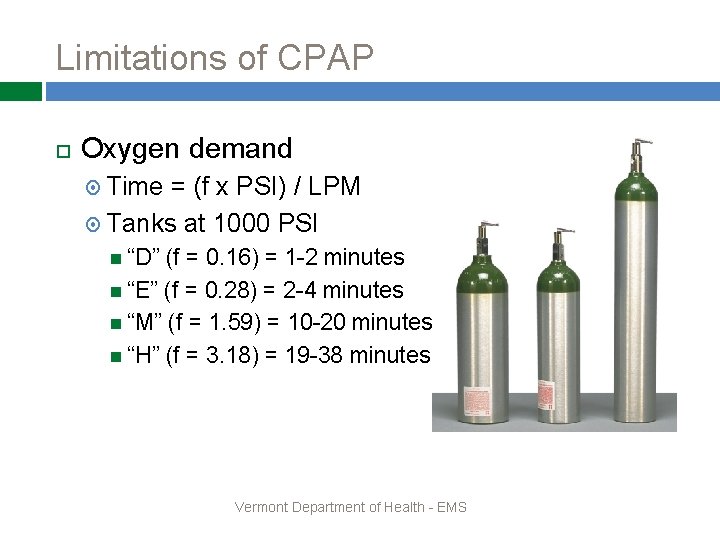
Limitations of CPAP Oxygen demand Time = (f x PSI) / LPM Tanks at 1000 PSI “D” (f = 0. 16) = 1 -2 minutes “E” (f = 0. 28) = 2 -4 minutes “M” (f = 1. 59) = 10 -20 minutes “H” (f = 3. 18) = 19 -38 minutes Vermont Department of Health - EMS
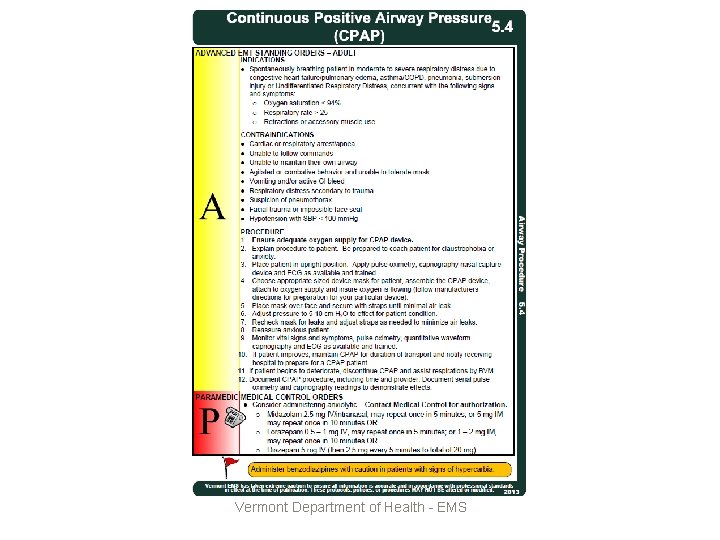
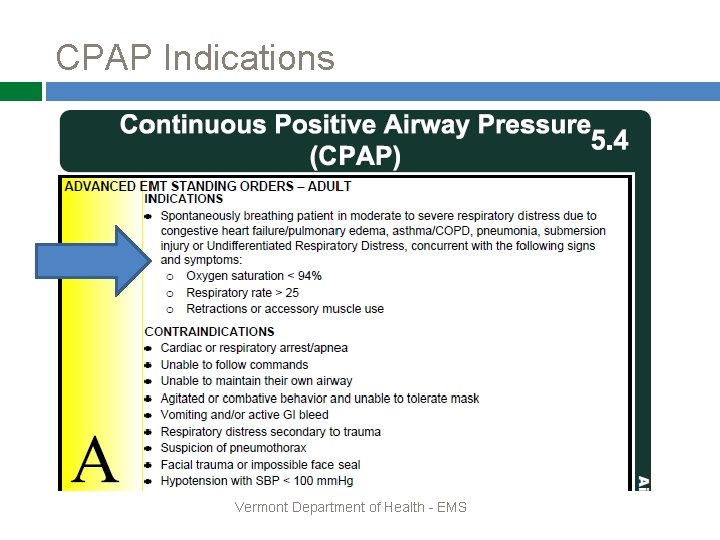
CPAP Indications Vermont Department of Health - EMS
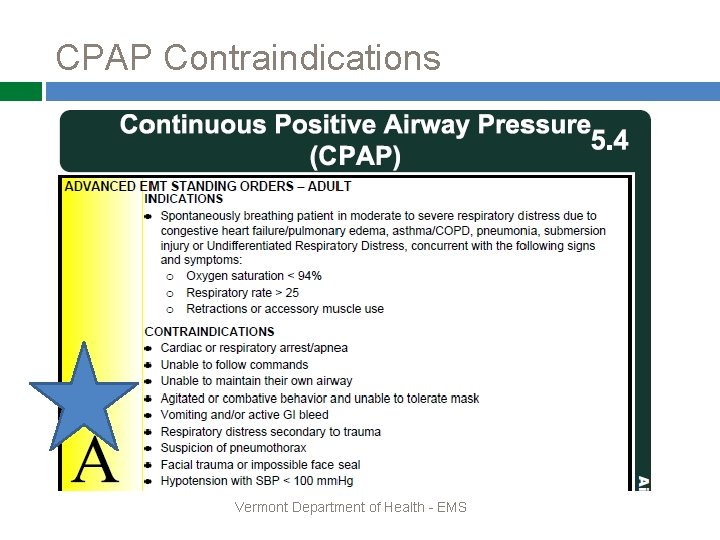
CPAP Contraindications Vermont Department of Health - EMS
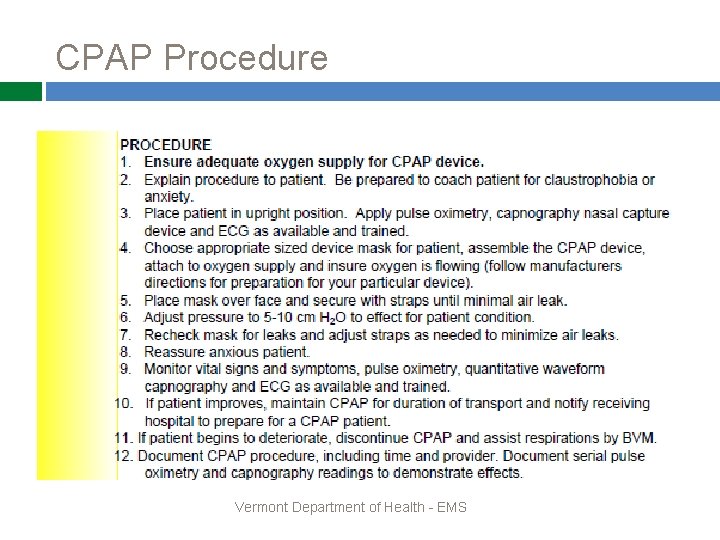
CPAP Procedure Vermont Department of Health - EMS
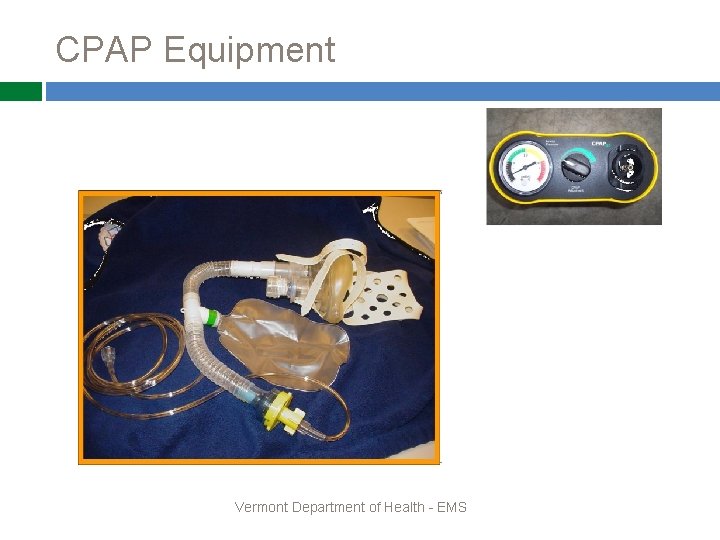
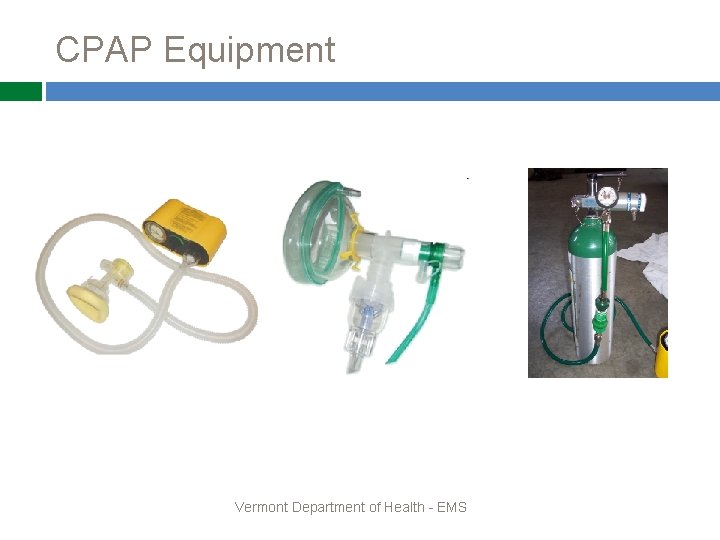
CPAP Equipment Vermont Department of Health - EMS
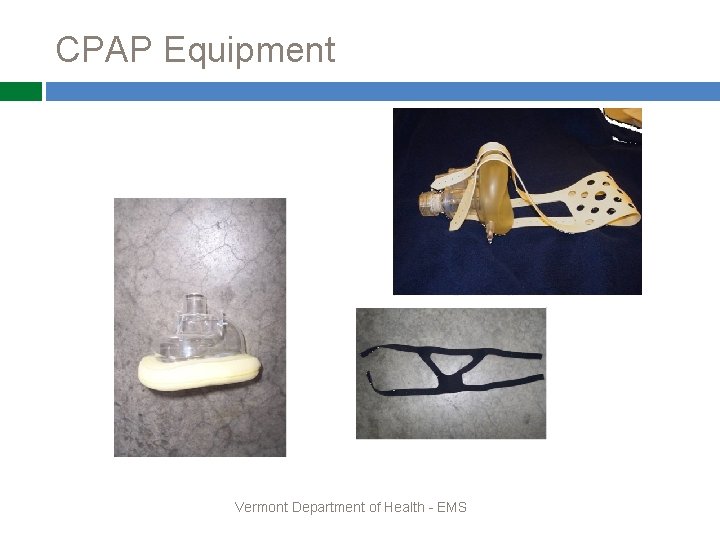
CPAP Equipment Vermont Department of Health - EMS
CPAP Equipment Vermont Department of Health - EMS
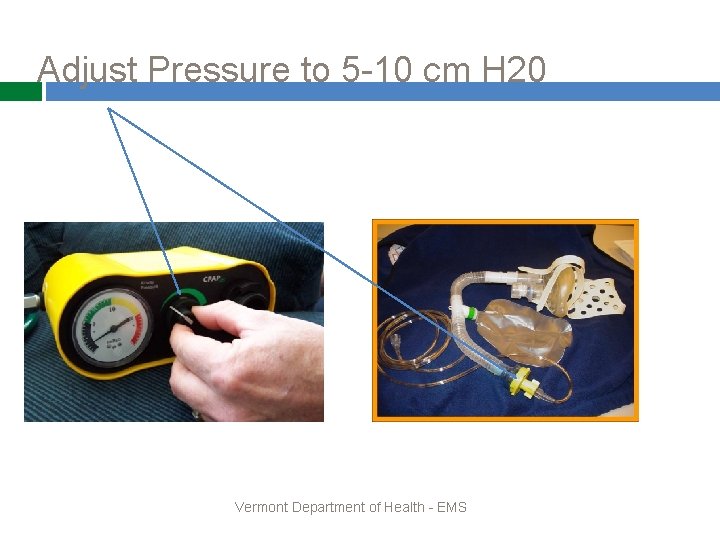
Adjust Pressure to 5 -10 cm H 20 Vermont Department of Health - EMS
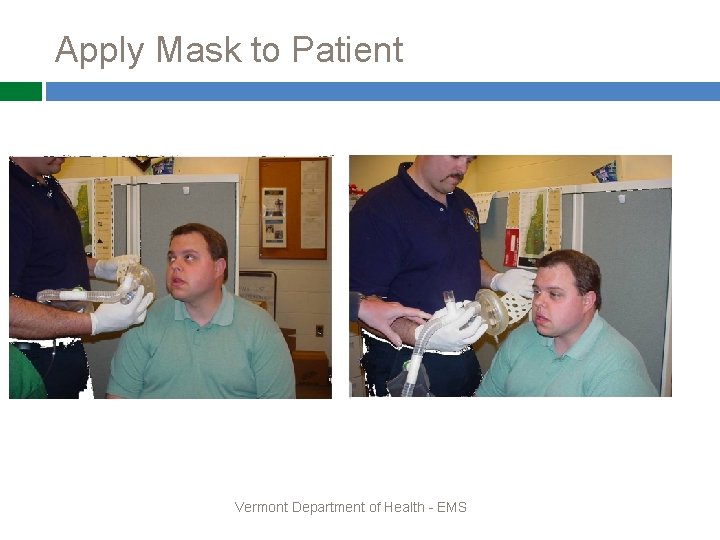
Apply Mask to Patient Vermont Department of Health - EMS
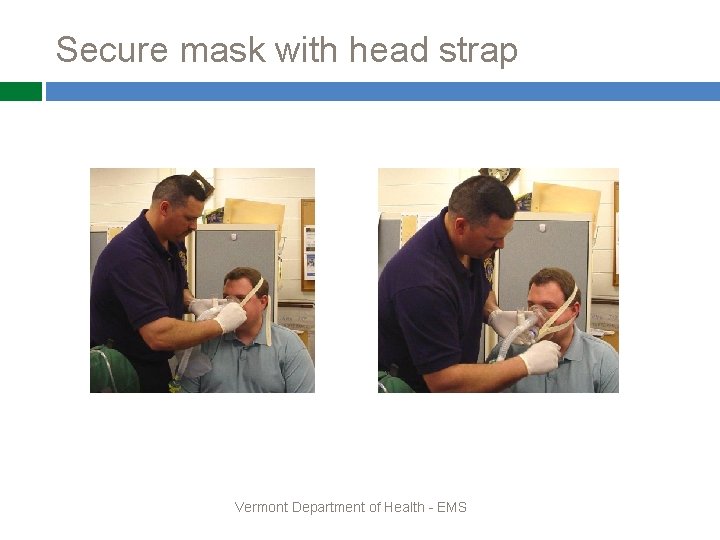
Secure mask with head strap Vermont Department of Health - EMS
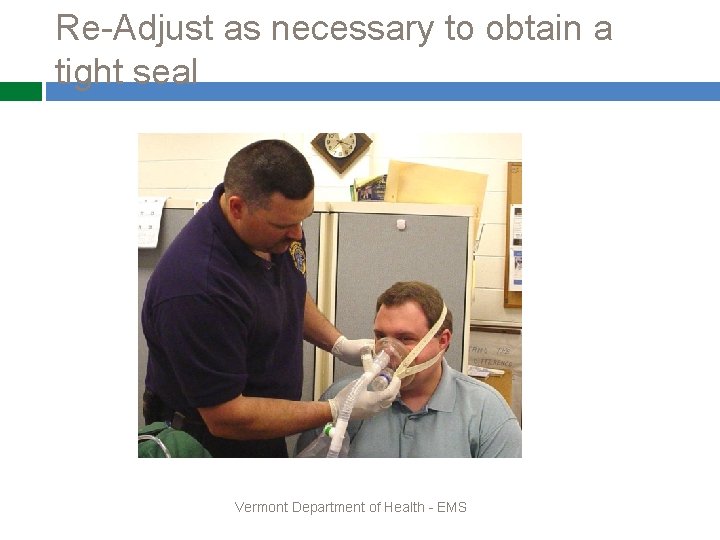
Re-Adjust as necessary to obtain a tight seal Vermont Department of Health - EMS
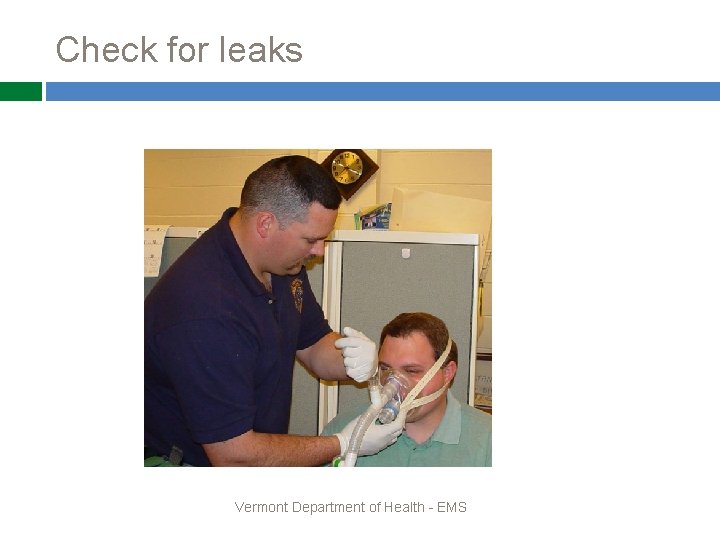
Check for leaks Vermont Department of Health - EMS
Instructions to the Patient Tell your patient about CPAP and what will happen at each step “I am going to put this mask on your face to help push air into your lungs and push the fluid out” “It may feel like you are sticking your head out a car window. ” “It will feel a little strange at first, but you will notice right away that your breathing will be a lot easier. ” “Just relax, Vermont breathe normally, and you will see this Department of Health - EMS will really help. ”
Always Remember…. . By the time 911 is called, your patient has been struggling for a while A mask can induce the feeling of a smothering effect So, it is important: For you to understand the feel of having CPAP applied to your face Not to give up on your patient if they Do not like CPAP Initially refuse it Vermont Department of Health - EMS
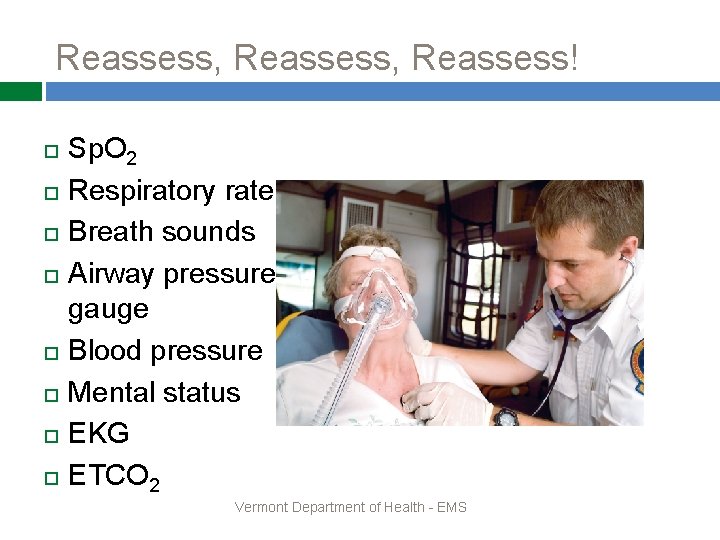
Reassess, Reassess! Sp. O 2 Respiratory rate Breath sounds Airway pressure gauge Blood pressure Mental status EKG ETCO 2 Vermont Department of Health - EMS
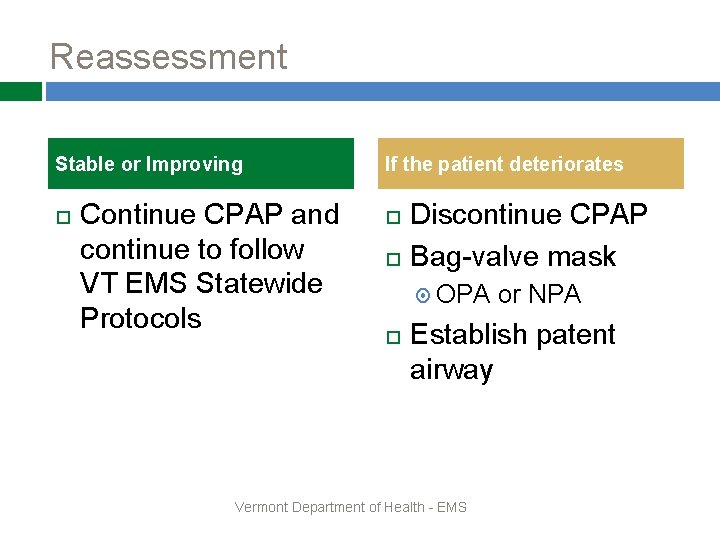
Reassessment Stable or Improving Continue CPAP and continue to follow VT EMS Statewide Protocols If the patient deteriorates Discontinue CPAP Bag-valve mask OPA or NPA Establish patent airway Vermont Department of Health - EMS
CPAP Documentation Necessary elements: Initial assessment System utilized Medical control requests 5 minute assessment Arrival condition Vermont Department of Health - EMS
Acknowledgements Images on slides 6, 7, 8, 12, 15, 18, 20, and 34 are used, with permission, from the Transition Series published by Brady/Pearson. Vermont Department of Health - EMS