
AEB 4283 International Development Policy Week 4 Theories
AEB 4283: International Development Policy Week 4: “Theories of Development” Today: • Start new topic, Chapter 3: “Theories of Development” Assignment: • Read Todaro and Smith (Chapter 3)
CLASSICAL THEORIES OF DEVELOPMENT
Chapter 3 Classic Theories of Economic Growth and Development
Development Theories n n Development theories seek to explain how sources of growth can be integrated into a transformation process that produces sustained increases in living standards The development theories are in the form of: • Formal economic models – graphical or mathematical • Descriptive – stages or structural changes that countries tend to experience as development proceeds • Identification and examination of the role of international relations and their impacts on growth prospects of LDCs
Classical Theories of Economic Development FOUR Approaches: n n Linear stages of growth model (1950 s – 1960 s) Theories and patterns of structural change (1970 s) International-dependence revolution (1970 s) Neoclassical, free market counterrevolution (1980 s – 1990 s)
1) The Linear-Stages-of-Growth Model n n n Popular in 1950’s & 1960’s → described the process of development as a series of successive stages of economic growth through which all countries had to pass Inspired by the successful experience with the Marshall Plan in Europe • U. S. financial & technical assistance enabled war-torn countries of Europe to rebuild and modernize their economies after WWII The thinking → developing countries could learn a lot from the historical growth experience of the now developed countries in transforming their economies from poor agrarian societies to modern industrial giants Emphasized the role of accelerated capital accumulation These models were replaced in the 1970’s by Structural
1) The Linear-Stages-of-Growth Model n n n Theory → Right quantities of capital (a mixture of savings, investment and foreign aid) were all that was necessary to enable the development process With this “right balance” all countries could move along the same growth path and through the “stages of development” that the DCs had Development became synonymous with rapid,
1) The Linear-Stages-of-Growth Model 1 -A. Rostow’s Stages of Growth 1 -B. Harrod-Domar growth model
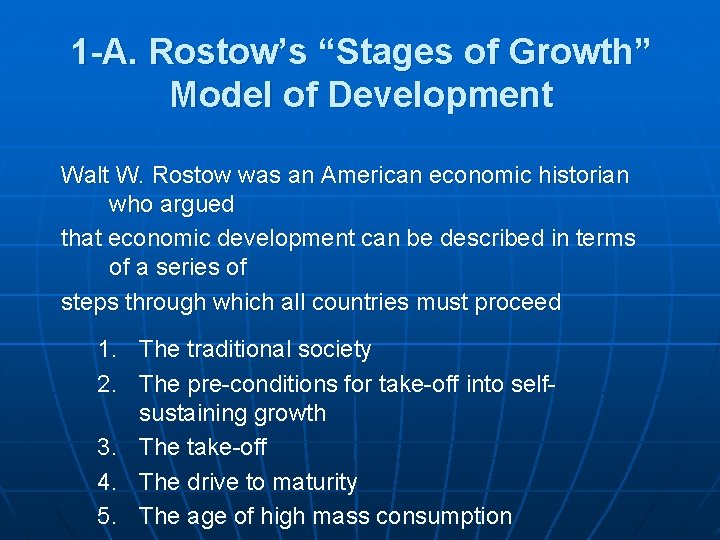
1 -A. Rostow’s “Stages of Growth” Model of Development Walt W. Rostow was an American economic historian who argued that economic development can be described in terms of a series of steps through which all countries must proceed 1. The traditional society 2. The pre-conditions for take-off into selfsustaining growth 3. The take-off 4. The drive to maturity 5. The age of high mass consumption
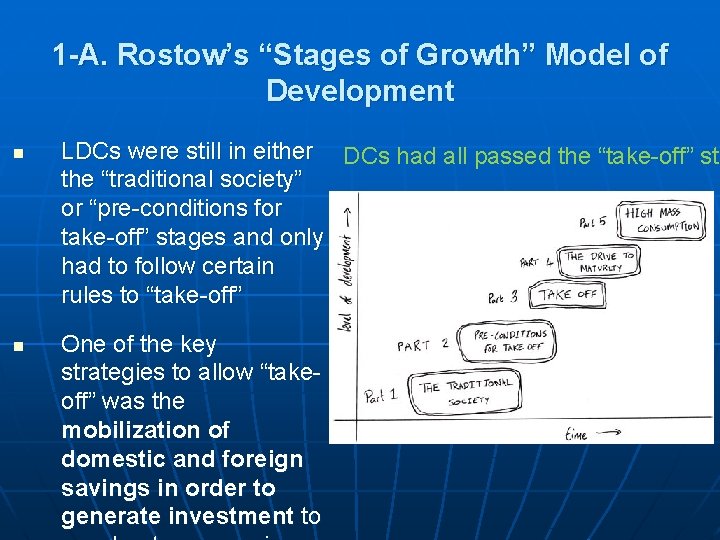
1 -A. Rostow’s “Stages of Growth” Model of Development n n LDCs were still in either DCs had all passed the “take-off” sta the “traditional society” or “pre-conditions for take-off” stages and only had to follow certain rules to “take-off” One of the key strategies to allow “takeoff” was the mobilization of domestic and foreign savings in order to generate investment to
1 -A. Rostow’s Model - Criticisms n n n Strong bias towards western model of modernization (free vs. controlled markets). Tries to fit economic progress into a linear system (many countries make false starts, Russia). It considers mostly large countries: countries with a large population (Japan), with natural resources available at just the right time in its history (Coal in Northern European countries) or with a large land mass (Argentina).
1 -B. The Harrod-Domar Model n n n Following on Rostow’s theory the model describes the mechanism by which more investment leads to more growth. The model is used to explain an economy's growth rate in terms of the level of saving and productivity of capital. Assumptions: • Every economy must save a portion of its national income, if only to replace its worn-out capital stock (equipment, buildings, etc. ) • In order for an economy to grow, new investments to the capital stock are necessary • New investment is provided by the level of total savings • There is a direct economic relationship k/a capital-
1 -B. The Harrod-Domar Model n n Utilizing these assumptions, the Harrod-Domar model states that the rate of growth of GNP is determined jointly by the national savings rate and the national capitaloutput ratio The growth rate of GNP will be positively related to the savings ratio and negatively related to the capital-output ratio In this model, the main constraint on development was the relatively low level of new capital formation (savings) in LDCs (i. e. , a “capital constraint”) Foreign aid could help make up the difference (as could foreign investment although in the 1950 s and 60 s, foreign investment flows were far smaller than they are
1 -B. The Harrod-Domar Model: Implications n n In a Cold War world, the “capital constraint” problem provided justification for huge transfers of capital and technical assistance from DCs to LDCs – a Marshall Plan for the developing world Theory proved lacking, not because investment isn’t a necessary condition for increasing economic growth, but because it is NOT A SUFFICIENT condition for such growth.
1 -B. The Harrod-Domar Model: Shortcomings n LDCs did not have the necessary institutional, structural and attitudinal conditions in place the way Europe did after WWII • Well integrated commodity markets • Well integrated currency markets • Good transportation facilities • Well trained and educated workforce • Relatively efficient government bureaucracies • Limitations were recognized by the late 1950 s or early 1960 s The Marshall Plan
2) Structural-Change Models n n n These models tend to emphasize the transformation of domestic economic structures from traditional subsistence agriculture economies to more modern, urbanized and industrially diverse manufacturing /service economies. It is not just about capital formation but also about altering the industrial composition of an economy. The Lewis two-sector model (successful in explaining recent transformation of the Chinese economy).
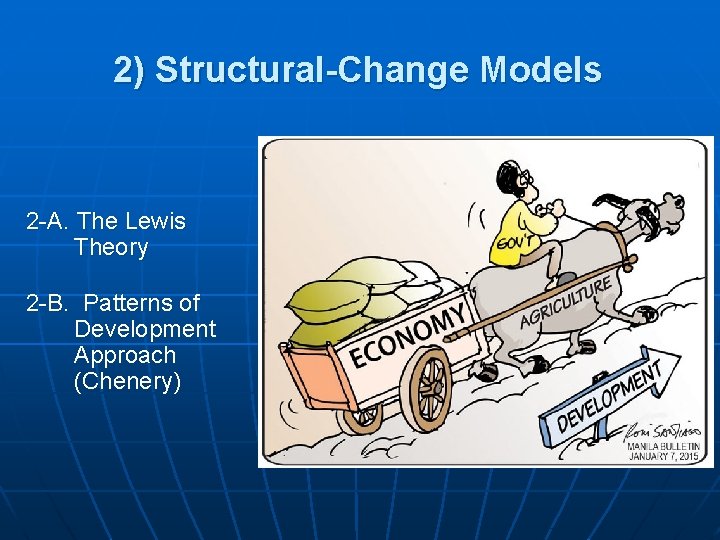
2) Structural-Change Models 2 -A. The Lewis Theory 2 -B. Patterns of Development Approach (Chenery)
2 -A. The Lewis Theory Background: n n n Sir W. Arthur Lewis – Nobel laureate in economics for his work in development (from St. Lucia) Developed in the mid 1950 s (later extended by Fei and Ranis) Became the general theory of the development process during the 1960 s and early 1970 s (Nobel Prize not until 1979)
2 -A. The Lewis Theory n n Primary focus of the model is on the structural transformation of a primarily subsistence economy via: • The process of labor transfer from the rural agricultural sector to the modern sector • The resultant growth of output and employment in the modern sector Characterized the economies of developing countries as consisting of two sectors: 1. A relatively high-productivity, modern, urban, industrial sector 2. A traditional, overpopulated, rural, subsistence sector characterized by zero marginal labor productivity i. e. surplus labor can be withdrawn from the agricultural
2 -A. The Lewis Theory OTHER KEY ASSUMPTIONS: • Expansion of output in the modern sector is determined by the rate of industrial investment and capital accumulation in the modern sector • Investment is made possible by profits generated in the modern sector • Capitalists re-invest all of their profits n n Very valuable as an early conceptual portrayal of the development process of sectoral interaction and structural change! However, it has limitations in terms of its relevance to fit the reality of contemporary developing nations today
2 -A. The Lewis Theory - Limitations What if capitalist profits are reinvested in labor-saving capital equipment rather than just duplicating the existing capital stock as implicitly assumed in the Lewis model? Or worse yet, what if profits are sent abroad (“capital flight”)
2 -B. Chenery Patterns of Development Approach n n A bit like Rostow’s “Stages of Growth Model” in that it identifies a sequential process through which traditional agricultural economies are transformed However, it contrasts with Rostow and Lewis Models in that in recognizes that: • Increases in savings and investment are necessary but not sufficient • Changes in the economic, industrial and institutional structures of LDCs are necessary
2 -B. Chenery Patterns of Development Approach n n Increased savings and investment are necessary but not sufficient conditions for economic growth. Along with accumulation of human and physical capital, a set of interrelated structural changes are needed to make the transition from traditional economy to a modern one. Changes in: • Composition of consumer demand → from food and basic necessities to manufactured goods and services • International trade • Resource usage → Steady accumulation of physical & human capital • Production → Shift from agricultural to industrial production • Urbanization → Growth of cities and urban industry
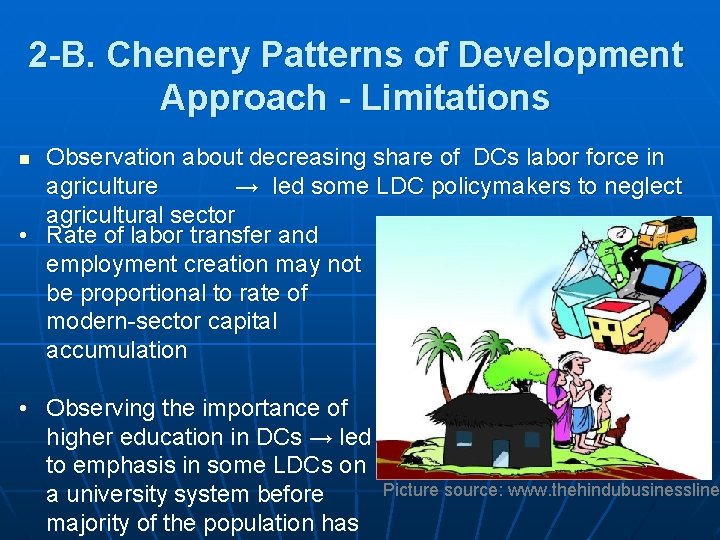
2 -B. Chenery Patterns of Development Approach - Limitations Observation about decreasing share of DCs labor force in agriculture → led some LDC policymakers to neglect agricultural sector • Rate of labor transfer and employment creation may not be proportional to rate of modern-sector capital accumulation n • Observing the importance of higher education in DCs → led to emphasis in some LDCs on a university system before majority of the population has Picture source: www. thehindubusinessline
2 -B. Chenery Patterns of Development Approach – Final Points n This theoretical contribution pointed out that development can depend on domestic and international factors which are outside of the control in LDCs • DC government policies that indirectly influence them (e. g. , trade policies) • DC government and multilateral institutional influence over their domestic policies (e. g. , through foreign assistance programs)
Chenery Model Recognized that the Pace and Patterns of Development Can Vary Based On: n n n Resource endowments Country size Government policies and objectives Availability of external capital and technology The international trade environment → Highlighted the importance of the need for a correct mix of policies affecting a wide range of sectors and practices
3) The International-Dependence Revolution n Grew out of the increasing disenchantment with both the stages-of-growth and structural-change models and it gained support in the 1970 s especially among LDCs themselves. They fell out of favor in the 80’s and 90’s as the neoclassical models took over in importance. Now regaining some support among today’s antiglobalization advocates These models views • LDCs as being beset by institutional, political and economic rigidities, both domestic and international. • LDCs are caught up in dependence relationships with rich countries (Raul Prebisch)
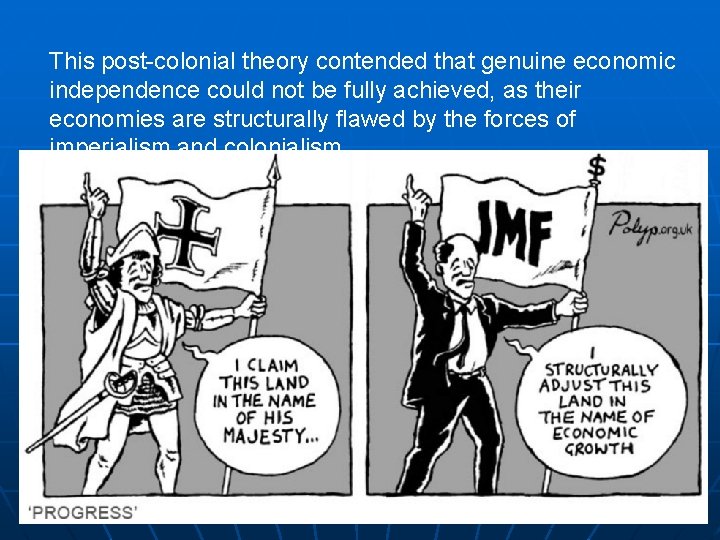
This post-colonial theory contended that genuine economic independence could not be fully achieved, as their economies are structurally flawed by the forces of imperialism and colonialism.
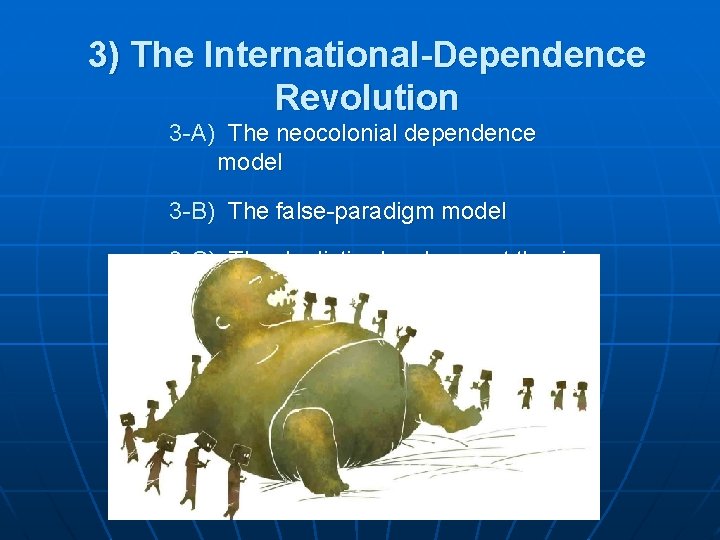
3) The International-Dependence Revolution 3 -A) The neocolonial dependence model 3 -B) The false-paradigm model 3 -C) The dualistic-development thesis
3 -A) The Neocolonial Dependence Model n n n Outgrowth of Marxist thinking → Believes that the existence and continuance of underdevelopment is due to historical evolution of a highly unequal international capitalist system of rich/poor country relationships Unequal power relationships between the “center” (the DCs) and the “periphery” (LDCs) render attempts by LDCs to be self-reliant and economically independent difficult if not impossible These relationships are perpetuated by DCs and a small elite ruling class (landlords, military rulers, merchants, public officials, etc. ) in LDCs that is rewarded by this international capitalist system of inequality
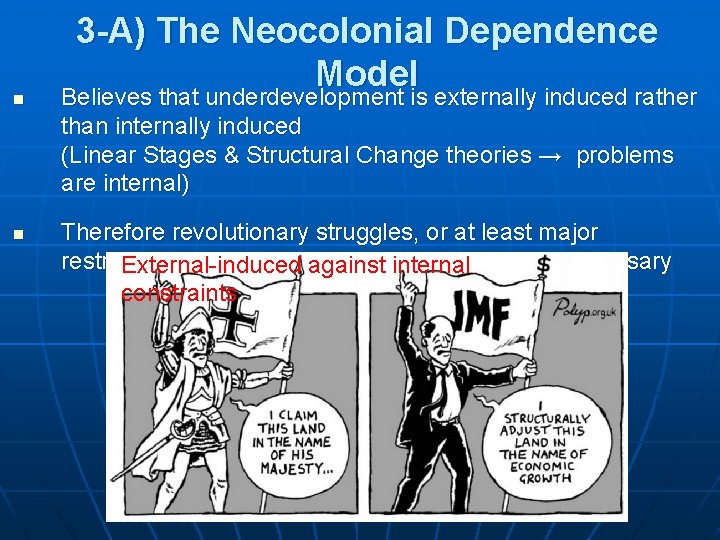
n n 3 -A) The Neocolonial Dependence Model Believes that underdevelopment is externally induced rather than internally induced (Linear Stages & Structural Change theories → problems are internal) Therefore revolutionary struggles, or at least major restructuring of the world capitalist system is necessary External-induced against internal constraints
3 -B) The False-Paradigm Model n n n Less radical than the Neocolonial Dependence Model Underdevelopment is the result of faulty and inappropriate advice from well-meaning but poorlyinformed, biased or ethnocentric international advisors from DC assistance organizations and multilateral donor agencies Recommendations are therefore often based on an incorrect view of LDC realities → i. e. , a falseparadigm
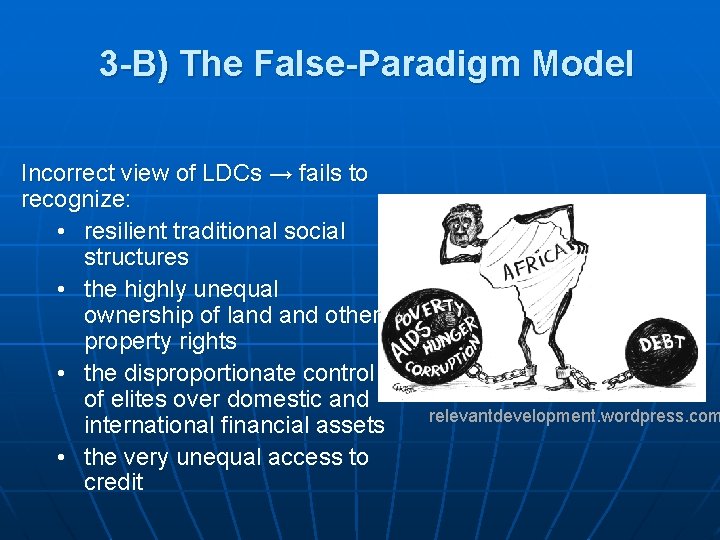
3 -B) The False-Paradigm Model Incorrect view of LDCs → fails to recognize: • resilient traditional social structures • the highly unequal ownership of land other property rights • the disproportionate control of elites over domestic and international financial assets • the very unequal access to credit relevantdevelopment. wordpress. com
3 b) The False-Paradigm Model n n n Resulting policies often tend only to serve the vested interests of existing power groups (domestic and international) due to a range of institutional factors Furthermore, many LDC politicians and high-level government officials, economists, university professors, trade unionists and other civil servants are trained at DC institutions and thus often return with irrelevant or inappropriate training and policy recommendations. . . As a result, desirable institutional and structural reforms are neglected or given insufficient attention
3 -C) The Dualistic-Development Thesis n n Dualism is a concept in development economics that focuses on the existence and persistence of increasing divergences between rich and poor Four elements of dualism: 1. Different sets of conditions, of which some are superior and others inferior, can coexist in a given space. 2. The coexistence is chronic and not transitional (opposite of Stages of Growth and Structural Changes models) 3. The degrees of superiority or inferiority have a tendency to increase over time. 4. The superior element does little or nothing to pull
- Slides: 35