
AEB 07 Euro NCAP Summary Overview Euro NCAP
AEB 07 – Euro NCAP Summary Overview • Euro NCAP is a private consumer test organization, based in Leuven, Belgium, partly funded by European governments • Euro NCAP was established in 1997 • Euro NCAP tests apply to (passenger car) vehicles with standard equipment across EU-28 • Euro NCAP tests are optional, one does not need to have a valid star rating to be able to sell a vehicle in Europe • Euro NCAP stars are intended to be consumer information, there is no other implication from the test results
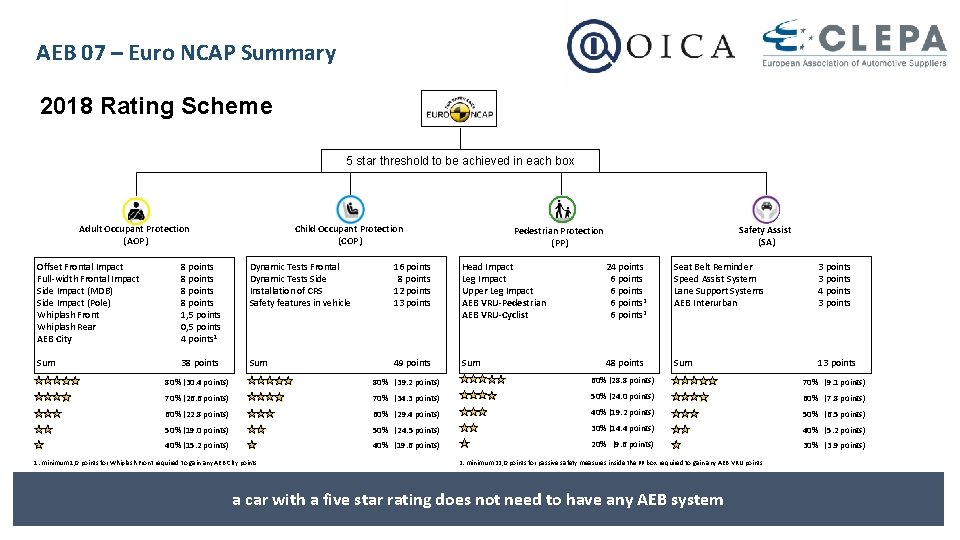
AEB 07 – Euro NCAP Summary 2018 Rating Scheme 5 star threshold to be achieved in each box Adult Occupant Protection (AOP) Child Occupant Protection (COP) Safety Assist (SA) Pedestrian Protection (PP) Offset Frontal Impact Full-width Frontal Impact Side Impact (MDB) Side Impact (Pole) Whiplash Front Whiplash Rear AEB City 8 points 1, 5 points 0, 5 points 4 points 1 Dynamic Tests Frontal Dynamic Tests Side Installation of CRS Safety features in vehicle 16 points 8 points 12 points 13 points Head Impact Leg Impact Upper Leg Impact AEB VRU-Pedestrian AEB VRU-Cyclist 24 points 6 points 2 Seat Belt Reminder Speed Assist System Lane Support Systems AEB Interurban 3 points 4 points 3 points Sum 38 points Sum 49 points Sum 48 points Sum 13 points 80% (30. 4 points) 70% (26. 6 points) 60% (22. 8 points) 50% (19. 0 points) 40% (15. 2 points) 1: minimum 1, 0 points for Whiplash Front required to gain any AEB City points 80% (39. 2 points) 60% (28. 8 points) 70% (9. 1 points) 70% (34. 3 points) 50% (24. 0 points) 60% (7. 8 points) 60% (29. 4 points) 40% (19. 2 points) 50% (6. 5 points) 50% (24. 5 points) 30% (14. 4 points) 40% (5. 2 points) 40% (19. 6 points) 20% (9. 6 points) 30% (3. 9 points) 2: minimum 22, 0 points for passive safety measures inside the PP box required to gain any AEB VRU points a car with a five star rating does not need to have any AEB system
AEB 07 – Euro NCAP Summary AEB Vehicle-to-Vehicle • AEB V 2 V is part of the rating since 2014 • Scoring is based on collision speed • AEB City: - Adult Occupant Protection Box (4/38 points) (max. speed tested 50 km/h) - Automatic Intervention - stationary target only • AEB Interurban: - Safety Assist Box (3/13 points) (max. speed tested 80 km/h) - Forward Collision Warning followed by Dynamic Brake Support and/or Automatic Intervention - stationary, moving and braking target • Rating of FCW/DBS is based also on collision speed (pre-configured brake robot triggered by FCW)
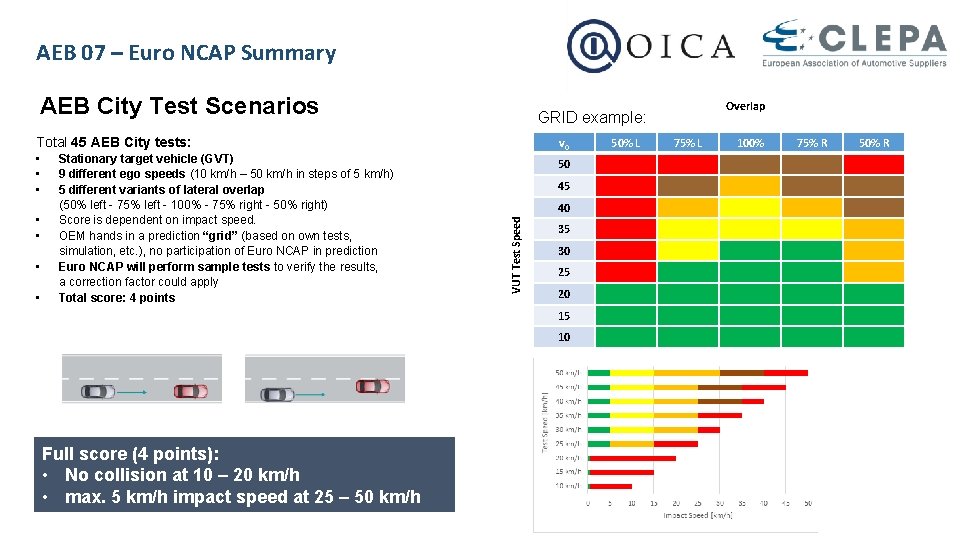
AEB 07 – Euro NCAP Summary AEB City Test Scenarios Total 45 AEB City tests: • • Stationary target vehicle (GVT) 9 different ego speeds (10 km/h – 50 km/h in steps of 5 km/h) 5 different variants of lateral overlap (50% left - 75% left - 100% - 75% right - 50% right) Score is dependent on impact speed. OEM hands in a prediction “grid” (based on own tests, simulation, etc. ), no participation of Euro NCAP in prediction Euro NCAP will perform sample tests to verify the results, a correction factor could apply Total score: 4 points v 0 50 45 40 VUT Test Speed • • • 35 30 25 20 15 10 Full score (4 points): • No collision at 10 – 20 km/h • max. 5 km/h impact speed at 25 – 50 km/h Overlap GRID example: 50% L 75% L 100% 75% R 50% R
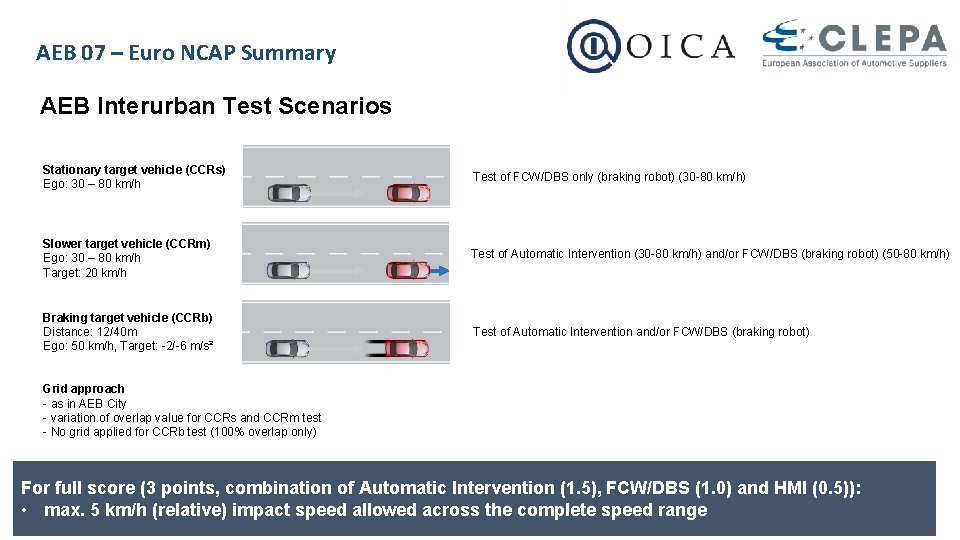
AEB 07 – Euro NCAP Summary AEB Interurban Test Scenarios Stationary target vehicle (CCRs) Ego: 30 – 80 km/h Test of FCW/DBS only (braking robot) (30 -80 km/h) Slower target vehicle (CCRm) Ego: 30 – 80 km/h Target: 20 km/h Test of Automatic Intervention (30 -80 km/h) and/or FCW/DBS (braking robot) (50 -80 km/h) Braking target vehicle (CCRb) Distance: 12/40 m Ego: 50 km/h, Target: -2/-6 m/s² Test of Automatic Intervention and/or FCW/DBS (braking robot) Grid approach - as in AEB City - variation of overlap value for CCRs and CCRm test - No grid applied for CCRb test (100% overlap only) For full score (3 points, combination of Automatic Intervention (1. 5), FCW/DBS (1. 0) and HMI (0. 5)): • max. 5 km/h (relative) impact speed allowed across the complete speed range
AEB 07 – Euro NCAP Summary AEB Vehicle-to-Pedestrian • AEB V 2 P is part of the rating since 2016 • Pedestrian/VRU Protection Box (6/48 Points) • Tests during daylight and obscure light conditions • Lateral and longitudinal tests • Rating is based on collision speed
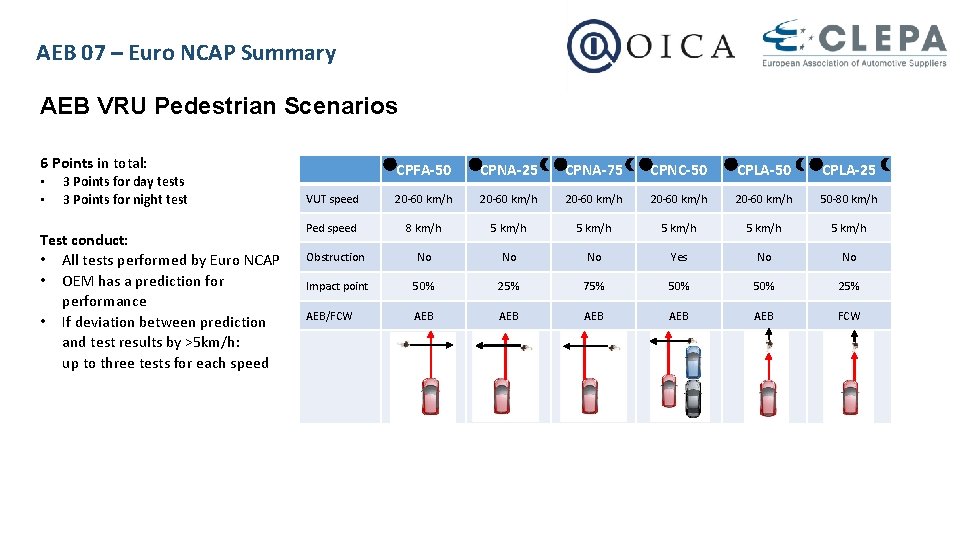
AEB 07 – Euro NCAP Summary AEB VRU Pedestrian Scenarios 6 Points in total: • • 3 Points for day tests 3 Points for night test Test conduct: • All tests performed by Euro NCAP • OEM has a prediction for performance • If deviation between prediction and test results by >5 km/h: up to three tests for each speed CPFA-50 CPNA-25 CPNA-75 CPNC-50 CPLA-25 VUT speed 20 -60 km/h 20 -60 km/h 50 -80 km/h Ped speed 8 km/h 5 km/h 5 km/h Obstruction No No No Yes No No Impact point 50% 25% 75% 50% 25% AEB/FCW AEB AEB AEB FCW
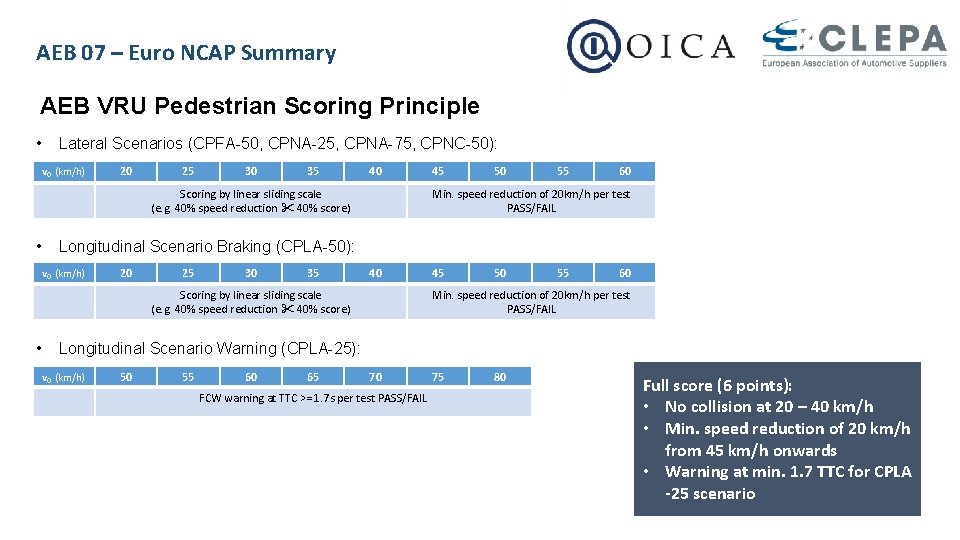
AEB 07 – Euro NCAP Summary AEB VRU Pedestrian Scoring Principle • Lateral Scenarios (CPFA-50, CPNA-25, CPNA-75, CPNC-50): v₀ (km/h) 20 25 30 35 40 Scoring by linear sliding scale (e. g. 40% speed reduction 40% score) • 50 55 60 Min. speed reduction of 20 km/h per test PASS/FAIL Longitudinal Scenario Braking (CPLA-50): v₀ (km/h) 20 25 30 35 40 Scoring by linear sliding scale (e. g. 40% speed reduction 40% score) • 45 45 50 55 60 Min. speed reduction of 20 km/h per test PASS/FAIL Longitudinal Scenario Warning (CPLA-25): v₀ (km/h) 50 55 60 65 70 FCW warning at TTC >= 1. 7 s per test PASS/FAIL 75 80 Full score (6 points): • No collision at 20 – 40 km/h • Min. speed reduction of 20 km/h from 45 km/h onwards • Warning at min. 1. 7 TTC for CPLA -25 scenario
AEB 07 – Euro NCAP Summary AEB Vehicle-to-Bicyclist • AEB V 2 B is part of the rating since 2018 • Pedestrian/VRU Protection Box (6/48 Points) • Tests during daylight conditions • Lateral and longitudinal tests • Rating is based on collision speed
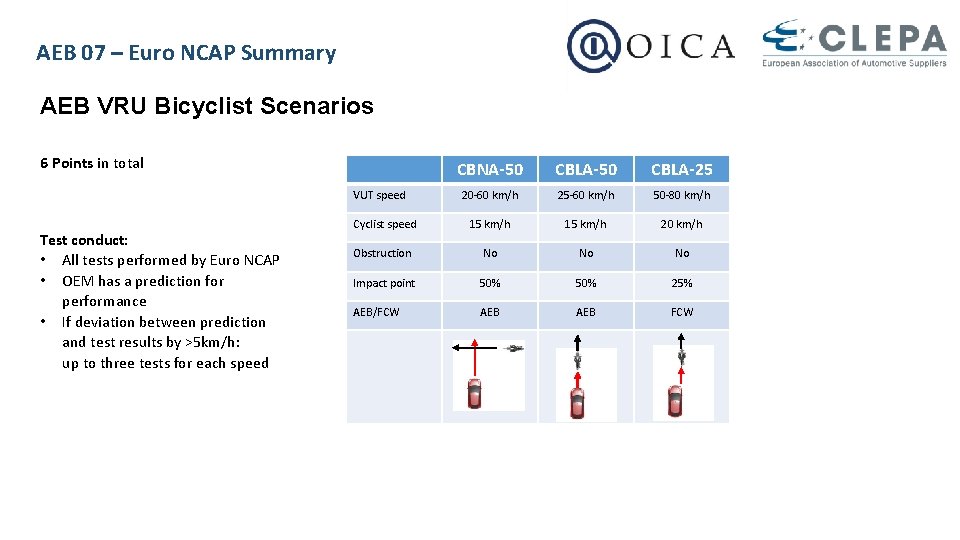
AEB 07 – Euro NCAP Summary AEB VRU Bicyclist Scenarios 6 Points in total CBNA-50 CBLA-25 20 -60 km/h 25 -60 km/h 50 -80 km/h Cyclist speed 15 km/h 20 km/h Obstruction No No No Impact point 50% 25% AEB/FCW AEB FCW VUT speed Test conduct: • All tests performed by Euro NCAP • OEM has a prediction for performance • If deviation between prediction and test results by >5 km/h: up to three tests for each speed
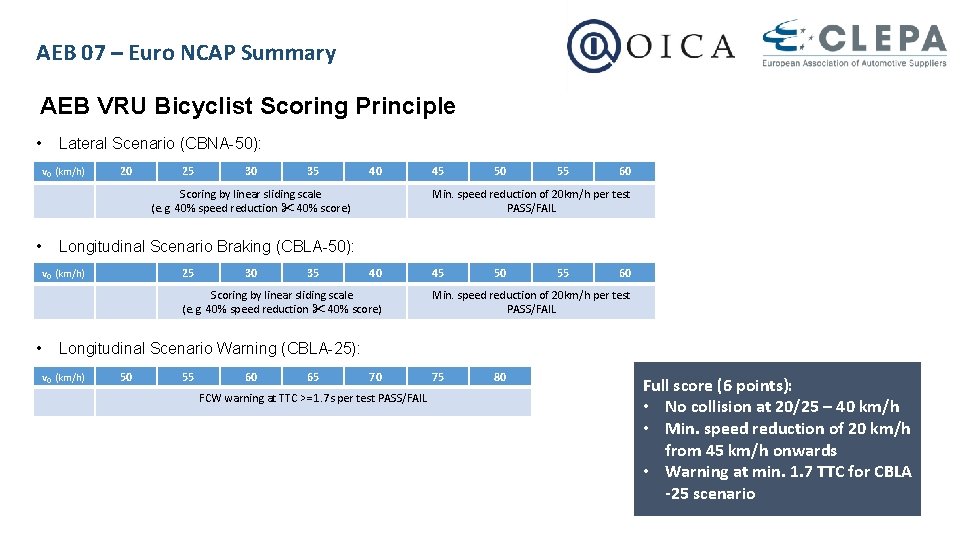
AEB 07 – Euro NCAP Summary AEB VRU Bicyclist Scoring Principle • Lateral Scenario (CBNA-50): v₀ (km/h) 20 25 30 35 40 Scoring by linear sliding scale (e. g. 40% speed reduction 40% score) • 50 55 60 Min. speed reduction of 20 km/h per test PASS/FAIL Longitudinal Scenario Braking (CBLA-50): 25 v₀ (km/h) 30 35 40 Scoring by linear sliding scale (e. g. 40% speed reduction 40% score) • 45 45 50 55 60 Min. speed reduction of 20 km/h per test PASS/FAIL Longitudinal Scenario Warning (CBLA-25): v₀ (km/h) 50 55 60 65 70 FCW warning at TTC >= 1. 7 s per test PASS/FAIL 75 80 Full score (6 points): • No collision at 20/25 – 40 km/h • Min. speed reduction of 20 km/h from 45 km/h onwards • Warning at min. 1. 7 TTC for CBLA -25 scenario
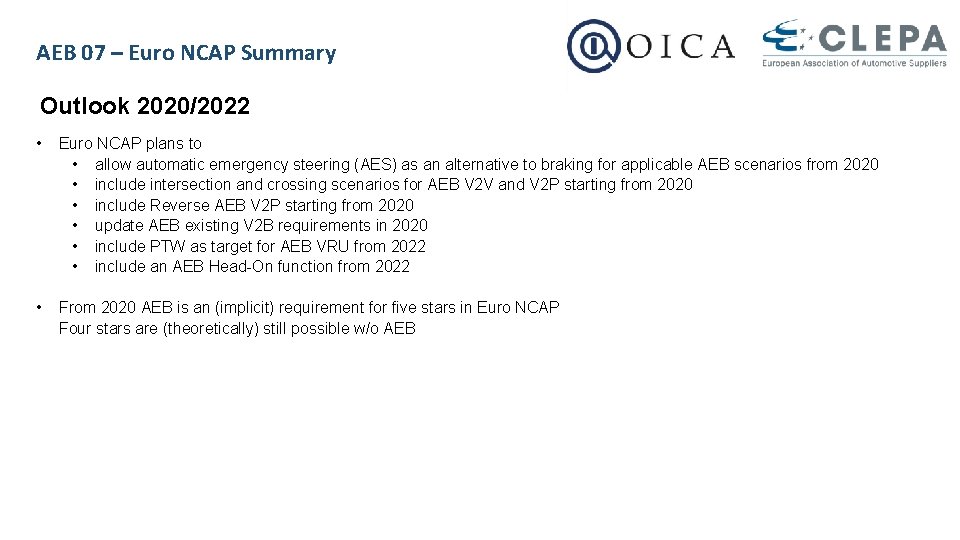
AEB 07 – Euro NCAP Summary Outlook 2020/2022 • Euro NCAP plans to • allow automatic emergency steering (AES) as an alternative to braking for applicable AEB scenarios from 2020 • include intersection and crossing scenarios for AEB V 2 V and V 2 P starting from 2020 • include Reverse AEB V 2 P starting from 2020 • update AEB existing V 2 B requirements in 2020 • include PTW as target for AEB VRU from 2022 • include an AEB Head-On function from 2022 • From 2020 AEB is an (implicit) requirement for five stars in Euro NCAP Four stars are (theoretically) still possible w/o AEB
AEB 07 – Euro NCAP Summary • Euro NCAP tests are optional, one does not need to have a valid star rating to be able to sell a vehicle in Europe • Euro NCAP stars are intended to be consumer information, there is no other implication from the test results • until today (2018) AEB is no prerequisite for a five star rating • some AEB tests are sample tests only • in some cases it is possible to repeat a failed AEB test, or repeat a test where the result deviates from the prediction of the OEM • full collision avoidance across the complete defined speed range is not required for a full score in any AEB test scenario
- Slides: 13