
Advocating for Your Child at School Why your


- Slides: 14
Advocating for Your Child at School
Why your advocacy may be needed • The best predictor of student success comes from families encouraging learning at home and being involved in their child’s education. • When things aren’t going well at school, you are your child’s voice. • You know your child’s strengths, challenges, and interests. Advocating helps make sure your child has the support to thrive.
How to help advocate for your child at school • Understand what it means to advocate. • “Advocate” just means speaking up about your concerns. • You can advocate quietly and with just one person - like your child’s teacher. • Know its OK to speak up. • It might feel like it’s overstepping, but it’s OK to speak up if you’re worried. • It’s not disrespectful to share your concerns.
How to help advocate for your child as school • Write down your thoughts. • It helps to organize your thoughts and what things are important to talk about. • If you think better out loud, record what you’re thinking or practice with a friend. Remember, “practice makes perfect!” • Note concerns as well as possible solutions to those concerns.
How to help advocate for your child at school • If you have a good relationship with your child’s teacher: • Send an email, or a text, or make a call to find out when there is a good time to talk. • If you’re not comfortable, get help from administrator, friend or another parent. • It’s better to speak than not to speak up at all. • Ask as many questions as you need to. • Make sure you understand what’s happening at school. If you’re worried about specific things, ask about them.
How to help advocate for your child at school • Don’t be afraid to show emotion-but be respectful. • Try not to make things personal or lash out. It makes it harder for people to help you when they’re feeling attacked. • Most teachers and school staff are trying their best and want to help, even if you both don’t always agree. • Do your best to defuse tense situations, stay organized and focused.
How to help advocate for your child at school • Advocating for students with special needs: • Learn all you can about your child’s special needs. • Ask a lot of questions and pay attention to the answers. • Research and understand special education law.
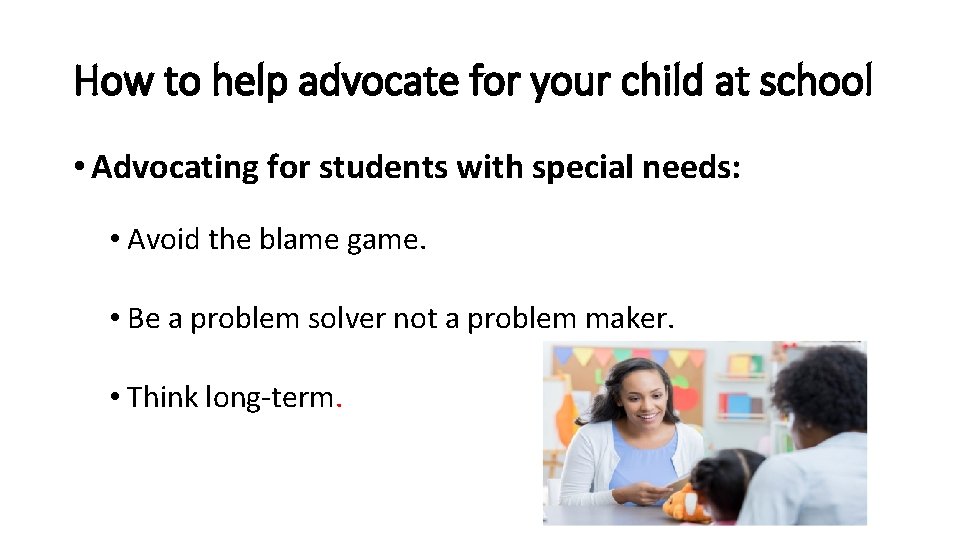
How to help advocate for your child at school • Advocating for students with special needs: • Avoid the blame game. • Be a problem solver not a problem maker. • Think long-term.
How to help advocate for your child at school • Ask for extra help for your child • If your child is falling behind, don’t be afraid to ask for help. • Ask for a free school evaluation. • Get requested information in writing. • If your child has an IEP, learn about the schools’ legal obligations to you and your child.
How your teacher can help advocate for your child at school 11 P’s: 1. Gain the support of the principal. 2. Be positive. 3. Be a problem solver. 4. Set goals and plan for each student.
How your teacher can help advocate for your child at school 11 P’s (continued) 5. Be practical with suggestions and solutions that are workable. 6. Participate, be active, and make a contribution. 7. Share your passion with colleagues. 8. Recognize the potential in all students.
How your teacher can help advocate for your child at school 11 P’s (continued) 9. “Polish the Apple. ” Often give compliments and praise. 10. Prepare to have evidence and data to support your suggestions. 11. Protect all students.
Keep speaking up! Every child needs a champion! It begins with all establishing a relationship. Advocating for your child shouldn’t be a one-time thing. You’ll probably need to keep doing it.
THANK YOU! Tamara Huff, Family and Community Network Specialist Wichita Public Schools / USD 259 (316) 973 -4576 Keith Reynolds, Director of Training for Equity and Diversity Wichita Public Schools / USD 259 (316) 973 -4572