
Advocacy for Students with Dyslexia Micki Moran The
- Slides: 25
Advocacy for Students with Dyslexia Micki Moran The Child&Family Law Center A division of Grund &Leavitt
Legal Disclaimer • This webinar is not intended to serve as legal advice. • COVID-19: Federal law has not changed as a result of the pandemic. Remote learning is not working well for many students and it is likely that students may need additional services or compensatory education once schools resume. This is beyond the scope of this webinar and will be the subject of an upcoming webinar in January of 2021.
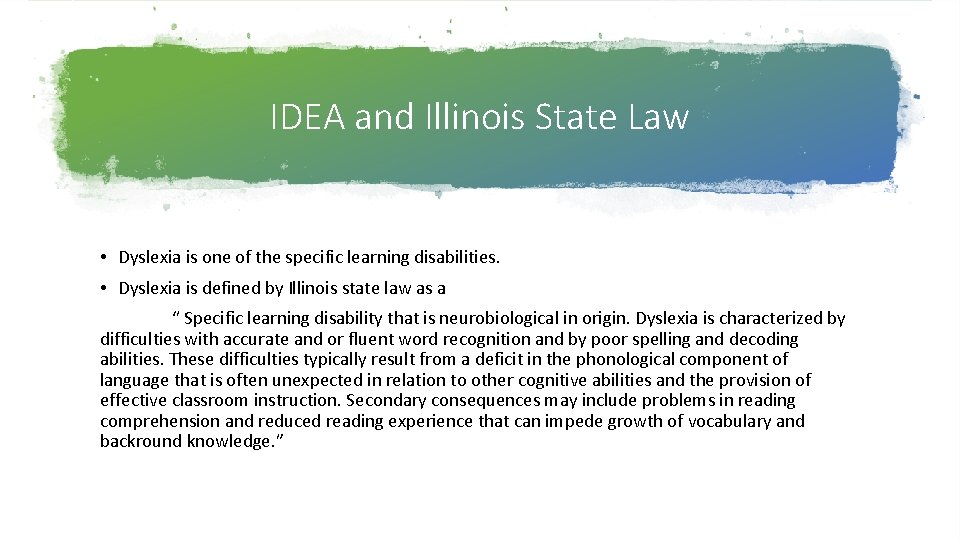
IDEA and Illinois State Law • Dyslexia is one of the specific learning disabilities. • Dyslexia is defined by Illinois state law as a “ Specific learning disability that is neurobiological in origin. Dyslexia is characterized by difficulties with accurate and or fluent word recognition and by poor spelling and decoding abilities. These difficulties typically result from a deficit in the phonological component of language that is often unexpected in relation to other cognitive abilities and the provision of effective classroom instruction. Secondary consequences may include problems in reading comprehension and reduced reading experience that can impede growth of vocabulary and backround knowledge. ”
Early identification and Evaluations • The key to identifying dyslexia is a comprehensive evaluation by a qualified professional. • There is not one measure alone that will diagnose a child with a dyslexia. • If you are concerned about your child’s progress it is essential that you address this with the school. Put your concerns in writing. • If the district refuses to evaluate you may decide to pursue the evaluation privately. This can be a very good investment.
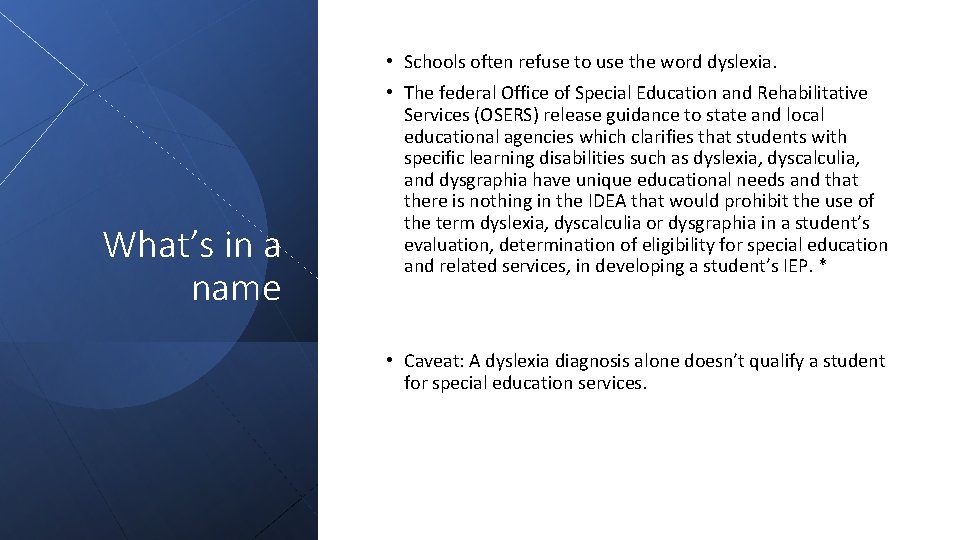
• Schools often refuse to use the word dyslexia. What’s in a name • The federal Office of Special Education and Rehabilitative Services (OSERS) release guidance to state and local educational agencies which clarifies that students with specific learning disabilities such as dyslexia, dyscalculia, and dysgraphia have unique educational needs and that there is nothing in the IDEA that would prohibit the use of the term dyslexia, dyscalculia or dysgraphia in a student’s evaluation, determination of eligibility for special education and related services, in developing a student’s IEP. * • Caveat: A dyslexia diagnosis alone doesn’t qualify a student for special education services.
OSERS guidance on dyslexia • Reminds states of the importance of addressing the unique educational needs of children with specific learning disabilities resulting from dyslexia, dyscalculia, and dysgraphia during IEP meetings.
ESSA and Dyslexia • The Every Student Succeeds Act, referred to ESSA, is a federal law that went into effect in December of 2015 and directly addresses dyslexia. ESSA places a focus on literacy through new programs. It created the National Center on Improving Literacy. (https: //improvingliteracy. org/)
Eligibility Requires: 1. Physical or mental impairment-listing “specific learning disabilities” as one of the examples. 2. Substantially limiting –determined without mitigating measures, such as assistive technology, learned behavioral of adaptive neurological modifications, and reasonable accommodations or auxiliary aids/services. 3. A major life activity-listing reading among the examples as a result of the ADAA.
The purpose of special education under the IDEA • It is the school district’s responsibility to ensure that all children with disabilities have available to them a free, appropriate, public education (FAPE) that emphasizes special education and related services designed to meet their unique needs and prepare them for further education, employment, and independent living.
Myths • Your child doesn’t have to be two years behind to receive interventions. • They have to fail first. • Schools don’t diagnose dyslexia.
Research based interventions • a statement of the special education and related services and supplementary aids and services, based on peer-reviewed research to the extent practicable, to be provided to the child, or on behalf of the child, and a statement of the program modifications or supports for school personnel that will be provided for the child. . .
Instruction • • Explicit Systematic Comprehensive Systematic
• Cases are hard to win on this issue alone- (Wilson, Orton-Gillingham). However, schools must be able to articulate what methodology they are using and why it is appropriate. • In cases where parents prevail the following factors ( at least one ) are present: Methodology • Procedural Violation ( lack of notice, denial of parent input or participation, failure to evaluate in all areas of suspected disability) • Substantive ( the IEP was not appropriate, failure to individualize, lack of specific instruction, goals not met, lack of progress). • School’s inability to describe interventions and their appropriateness for this student.
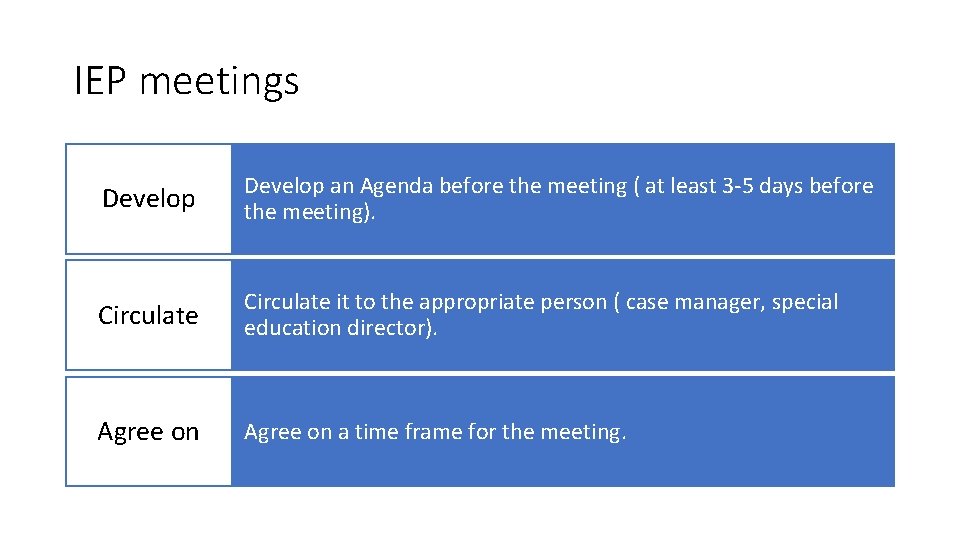
IEP meetings Develop an Agenda before the meeting ( at least 3 -5 days before the meeting). Circulate it to the appropriate person ( case manager, special education director). Agree on a time frame for the meeting.
IEP meetings • What does your child need? • What is working? • What isn’t working?
• General concerns IEP goals • Lack of understanding at IEP meetings regarding dyslexia and correspondingly the teaching of reading. • Goals should be tied to educational needs. ( phonological processing, spelling, writing, fluency). • Accurate and quantifiable Present Levels of Performance are the starting point. Data driven.
IEP Goals • Measurable • Data Driven • Include who is responsible for taking data • For each area of need there should be a goal. For example, if fluency is a need, there should be a stand- alone fluency goal. • If there is a spelling goal that should be a separate goal. In short, every need cannot be addressed in one goal.
Goals are the cornerstone of every IEP • Ask for draft goals in advance of the meeting. • Schools should provide any reports or documents in advance of the meeting. • If you have concerns about the goals put those concerns in writing. • Ask why the goals are appropriate for your child.
Free, Appropriate, Public Education • Progress must be more than minimal. • Goals must be appropriately ambitious in light of the student’s unique circumstances. • Best isn’t the standard. Appropriate.
• No list is appropriate for every student. Must be individualized based on need. Accommodations for students with dyslexia • Examples Dictation, Reader, Assistive Technology, Oral instructions, Study Guides Important: Accommodations are not the same as educational interventions. It is important that the school not rely too heavily on accommodations for students instead of providing services.
Stay informed • Educate yourself regarding dyslexia. • Insist on data for every goal. • If you have concerns request an IEP meeting.
Advocacy 1 Put all communications/concerns in writing. 2 Be specific about your concerns. 3 Use bullet points. 4 Document any issues.
Selected Resources • ISBE Division of Special Education Services The Dyslexia Guide: A Handbook for Parents, Educators, and Students. ( July, 2019) • International Dyslexic Association www. dyslexiaiada. org • Decoding Dyslexia Illinois www. dyslexiaial. org • Everyone Reading Illinois. www. everyonereadingillinois. org • Dyslexia Training Institute www. dyslexiatraininginstitute. org • Learning Ally www. learningally. org • The Yale Center for Dyslexia and Creativity www. dyslexia. yale. edu.
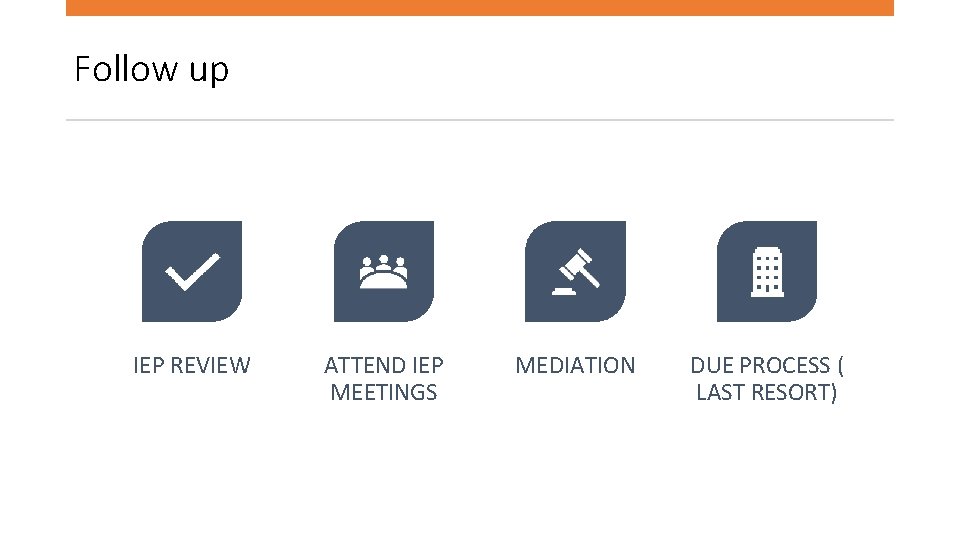
Follow up IEP REVIEW ATTEND IEP MEETINGS MEDIATION DUE PROCESS ( LAST RESORT)
Contact Information Micki Moran mmoran@grundlaw. com (312)-640 -0500