
Advocacy Campaign for Gender Equality and Womens Empowerment
- Slides: 19
Advocacy Campaign for Gender Equality and Women’s Empowerment UN Women Nepal 24 March 2017
Agenda • Terms of Reference – Outline of the assignment • Request for Proposal – Operational procedures
Assignment Under the overall supervision and in close collaboration with UN Women, responsibility for preparation of a detailed advocacy campaign strategy and plan as well as the subsequent roll out of all of its components, including: • • Kathmandu-based campaign (decision-makers, private sector, development partners, etc. ) District-level campaign in Sunsari, Makwanpur, Kavre, Nawalparashi, Banke and Kailali (women’s leadership roles in economic activities etc. ) District-level campaign in Sindhupalchowk and Dhading (ending violence against women, labour migration, human trafficking, etc. ) District-level campaign in Sindhuli, Sarlahi and Rautahat (women in agriculture, local decision-making processes, etc. )
Background The assignment is designed under the overall framework of UN Women Nepal’s work to: • Raise awareness on gender-based discrimination and structural barriers hindering women’s leadership roles in economic activities, including in households, communities and labour markets in local contexts. women’s economic empowerment through a multipronged approach • Bring about policy changes that are sensitive to the needs of women by advocating strongly for gender-sensitive plans and policies • Promote increased participation and representation of rural women farmers in local-level decision-making processes through community -level awareness raising and policy advocacy
Objectives Overall objective • Develop and roll out an advocacy campaign to strengthen UN Women Nepal’s efforts to promote gender equality and women’s empowerment across a varied range of issues, in Kathmandu and in several districts across Nepal.
Objectives The specific objectives are as follows: • Develop a 2 -3 -page communication- and advocacy strategy that identifies focus areas, defines key advocacy messages, desired policy outcomes and a detailed plan for roll out • Translate the communication- and advocacy strategy into a comprehensive and action-oriented advocacy campaign to be implemented both in selected districts and at a national level • Monitoring of campaign activities and target audiences to ensure a successful roll out of the advocacy campaign
Scope of activities 1. Planning and Campaign Design • The campaign shall be designed for the government’s approval, and segmented by geographic coverage so that it can be funded from a range of sources • The design process in its entirety shall involve building strong relationships and partnerships between UN Women, implementing media agency and other actors relevant to the advocacy campaign. 2. Awareness Raising and Advocacy Activities/Interventions • Propose and organise specific national and local level public awareness activities/interventions by mobilising e. g. decision makers, local/national government officials, members of communities, men and boys, CSOs, private sector, etc. • In total, 27 activities/interventions shall be organised for the four segments at national and district levels.
Scope of activities Segment 1 • Seven Kathmandu-based activities/interventions, each with a separate theme/focus area, for the national-level awareness raising and advocacy for influencing decision-makers, senior officials of relevant ministries and key government offices, CSOs, development partners and private sector stakeholder to bring about positive policy changes and ensure sustained and continued support to various aspects of women’s economic empowerment. At least two of these shall focus on issues around the nexus between labour migration and human trafficking and three on women in agriculture
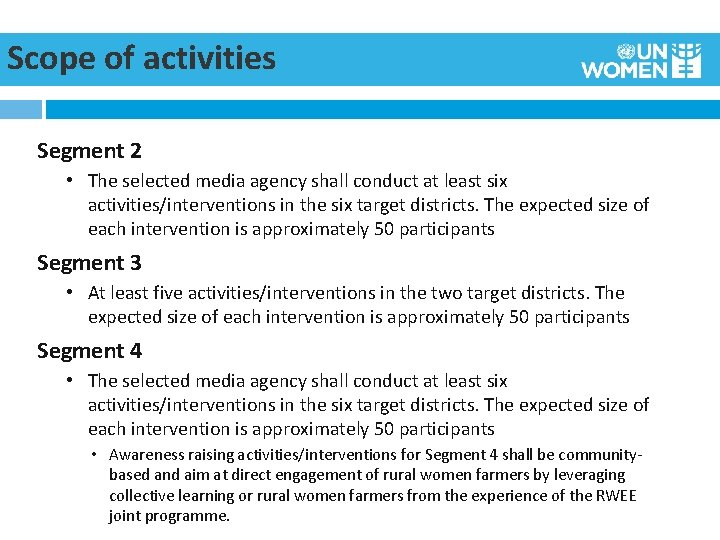
Scope of activities Segment 2 • The selected media agency shall conduct at least six activities/interventions in the six target districts. The expected size of each intervention is approximately 50 participants Segment 3 • At least five activities/interventions in the two target districts. The expected size of each intervention is approximately 50 participants Segment 4 • The selected media agency shall conduct at least six activities/interventions in the six target districts. The expected size of each intervention is approximately 50 participants • Awareness raising activities/interventions for Segment 4 shall be communitybased and aim at direct engagement of rural women farmers by leveraging collective learning or rural women farmers from the experience of the RWEE joint programme.
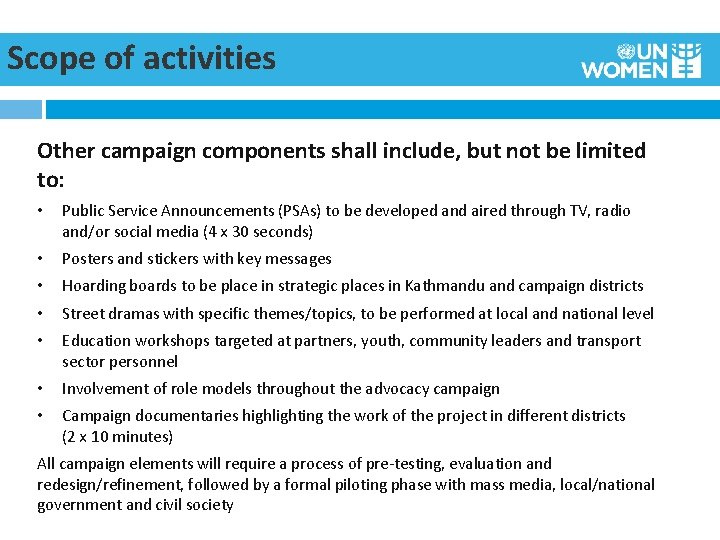
Scope of activities Other campaign components shall include, but not be limited to: • Public Service Announcements (PSAs) to be developed and aired through TV, radio and/or social media (4 x 30 seconds) • Posters and stickers with key messages • Hoarding boards to be place in strategic places in Kathmandu and campaign districts • Street dramas with specific themes/topics, to be performed at local and national level • Education workshops targeted at partners, youth, community leaders and transport sector personnel • Involvement of role models throughout the advocacy campaign • Campaign documentaries highlighting the work of the project in different districts (2 x 10 minutes) All campaign elements will require a process of pre-testing, evaluation and redesign/refinement, followed by a formal piloting phase with mass media, local/national government and civil society
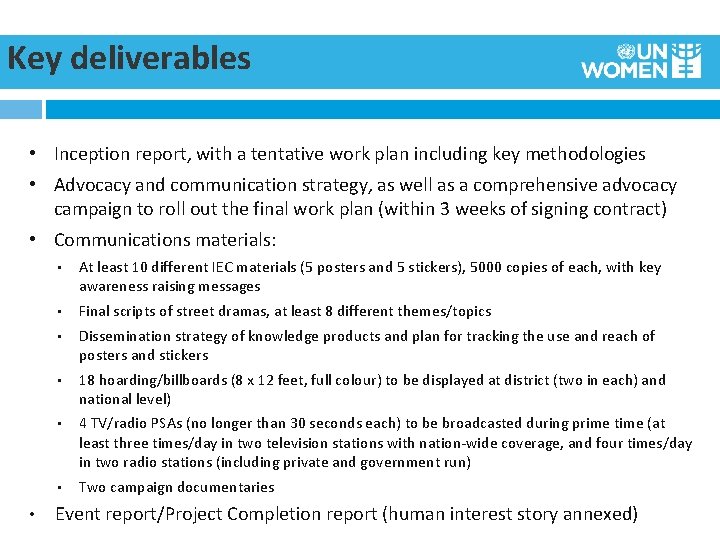
Key deliverables • Inception report, with a tentative work plan including key methodologies • Advocacy and communication strategy, as well as a comprehensive advocacy campaign to roll out the final work plan (within 3 weeks of signing contract) • Communications materials: • • At least 10 different IEC materials (5 posters and 5 stickers), 5000 copies of each, with key awareness raising messages • Final scripts of street dramas, at least 8 different themes/topics • Dissemination strategy of knowledge products and plan for tracking the use and reach of posters and stickers • 18 hoarding/billboards (8 x 12 feet, full colour) to be displayed at district (two in each) and national level) • 4 TV/radio PSAs (no longer than 30 seconds each) to be broadcasted during prime time (at least three times/day in two television stations with nation-wide coverage, and four times/day in two radio stations (including private and government run) • Two campaign documentaries Event report/Project Completion report (human interest story annexed)
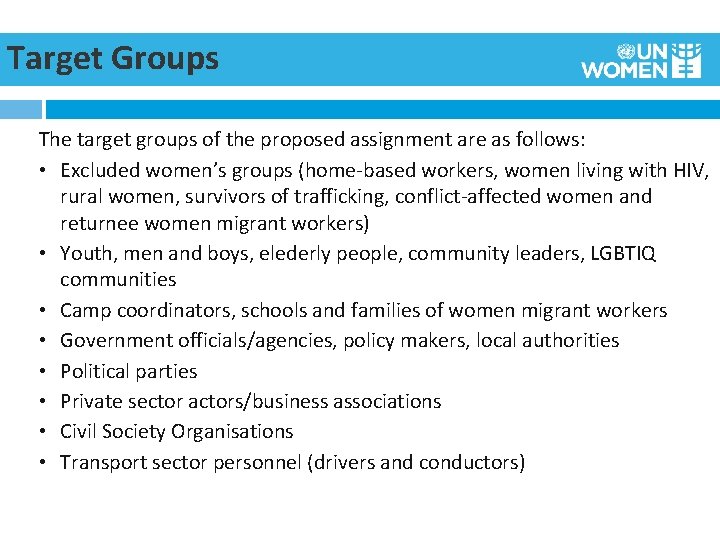
Target Groups The target groups of the proposed assignment are as follows: • Excluded women’s groups (home-based workers, women living with HIV, rural women, survivors of trafficking, conflict-affected women and returnee women migrant workers) • Youth, men and boys, elederly people, community leaders, LGBTIQ communities • Camp coordinators, schools and families of women migrant workers • Government officials/agencies, policy makers, local authorities • Political parties • Private sector actors/business associations • Civil Society Organisations • Transport sector personnel (drivers and conductors)
Methodology to be developed by contracted agency
Time and location Timeframe • 14 months • Contract period: 21 May 2017 – 30 September 2018 • Programme period: 21 May 2017 – 31 August 2018 • Reporting period: 1 -30 September 2018 Project location • Eleven districts – Sunsari, Makwanpur, Kavre, Sindhupalchowk, Dhading, Nawalparashi, Banke, Kailali, Sindhuli, Sarlahi and Rautahat, as well as in Kathmandu
Reporting • Event reports: • • Summary report(s) of national and local public awareness-raising events of the advocacy campaign (within 15 days of each event) Summary report(s) of supplementary campaign with education workshops (within 20 days of each workshop) • Completion report, not exceeding ten pages, documenting the impacts of the advocacy campaign, including 3 -4 successful case stories (by September 2018) • Human interest stories: at least 20 human interest stories with 50 high resolution photographs documenting the positive changes in the lives of UN Women project beneficiaries that can be used for photo essays/exhibitions should be annexed to the completion report • Meeting every month (or more frequent if required)
Evaluation criteria (annex-3) Preliminary Evaluation: • Not in among United Nations suspended companies; • Offers are signed by an authorized party, including Power of Attorney if stipulated; • The offer is valid (Proposal submission form Annex-6 signed for 120 days); • The offer is complete and eligible; • Evidence of legal registration; • Organization latest Audit Report (past 1 year); • Latest tax clearance certificate; • Organization Board of Directors/composition of management.
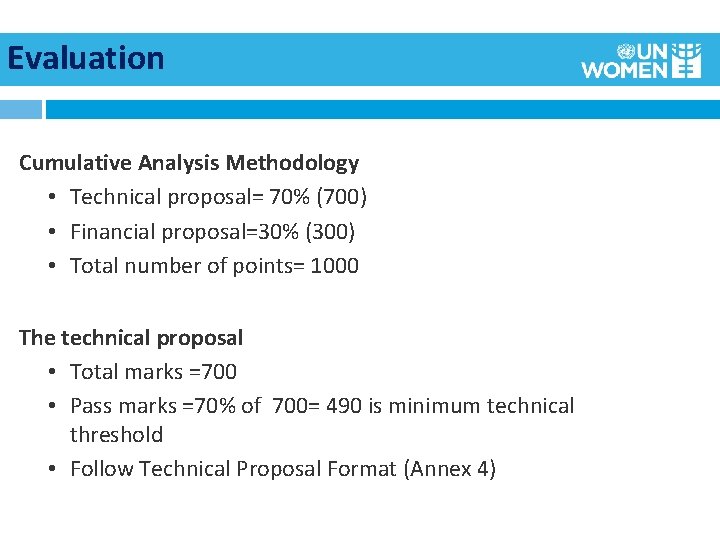
Evaluation Cumulative Analysis Methodology • Technical proposal= 70% (700) • Financial proposal=30% (300) • Total number of points= 1000 The technical proposal • Total marks =700 • Pass marks =70% of 700= 490 is minimum technical threshold • Follow Technical Proposal Format (Annex 4)
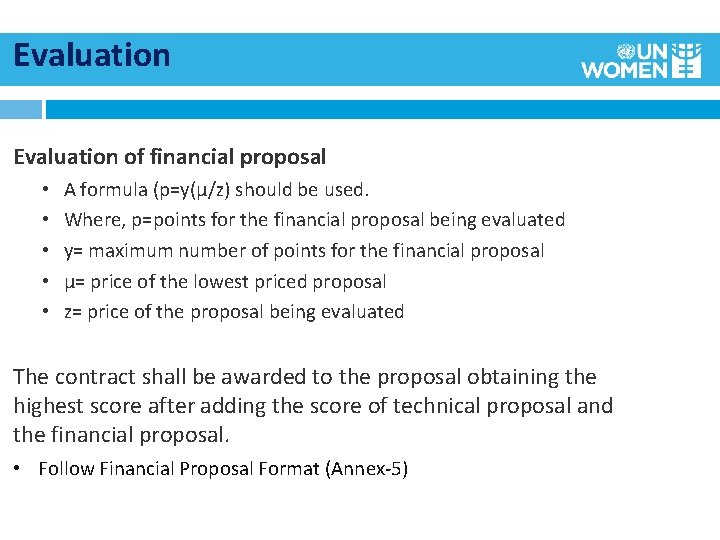
Evaluation of financial proposal • • • A formula (p=y(μ/z) should be used. Where, p=points for the financial proposal being evaluated y= maximum number of points for the financial proposal μ= price of the lowest priced proposal z= price of the proposal being evaluated The contract shall be awarded to the proposal obtaining the highest score after adding the score of technical proposal and the financial proposal. • Follow Financial Proposal Format (Annex-5)
Questions ? ? ?