
Advising Students for College Math Success Recommendations Based
Advising Students for College Math Success: Recommendations Based on Student Performance Data Presenters: Diana De. Vol Bevilacqua - Assistant Director of Math Advising Rodica Barbu - Mathematics Academic Advisor
Presentation Objectives • Why are students successful at math in high school but fail in college? • What does data* show about success in College Algebra and Calculus? • What are good strategies for success? *data will be taken after Au 12 (the term we switched to semesters)
Why should we be concerned about the success of students in mathematics? • “Math gives students: • quantitative tools • logical reasoning • analytic skills • problem solving skills • a sense of the quantitative modeling“ • Taken from the Ohio Mathematics Initiative: “Rethinking Postsecondary Mathematics”, March 2014
Why should we be concerned about the success of students in mathematics? • “Math has become central to: • social sciences • medicine • environmental sciences • business and finance • advanced design • other disciplines” • Taken from the Ohio Mathematics Initiative: “Rethinking Postsecondary Mathematics”, March 2014
Why should we be concerned about the success of students in mathematics? • Too much overlap without mastery in K-12* • A national survey 1) estimated that half of all juniors and seniors in U. S. high schools are taking dual – enrollment courses. • 57% of dual-credit enrollees are in courses that have no uniform examination like the AP or IB exams. • *“The abstract and technical ideas & skills of math are best learned the first time through. Bad math habits can be acquired the more times that concept is taught. ” • 1) Richard W. Clark – “Dual Credit: A Report of Programs and Policies that Offer High School Students College Credits”, Pew Charitable Trusts, 2001
History & Timeline of Ohio Math Initiatives for High Schools and Colleges
COMMON CORE MATH STANDARDS: “college math readiness” means “a student who passes high school Algebra 2”. Note: Standards adopted in Ohio June 2010, implemented Autumn 2010 in all precollege schools, affected incoming college freshmen beginning Autumn 2014.
Ohio Core Math Curriculum Graduation Requirement for Entrance into State Funded Colleges • Beginning in 2014, the State of Ohio began requiring students to earn 3 units of math, recommending 4 units, including Algebra II. • A Statistics course can count as a unit.
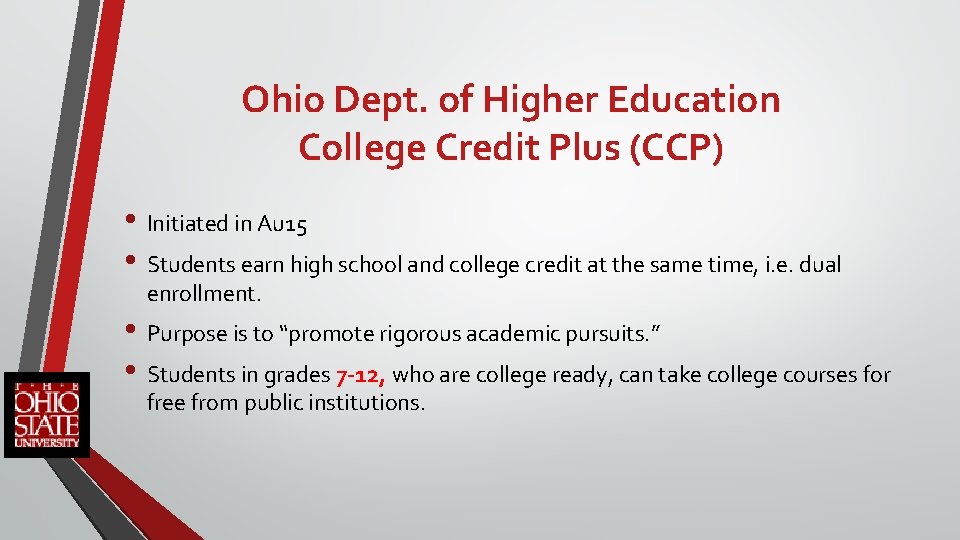
Ohio Dept. of Higher Education College Credit Plus (CCP) • Initiated in Au 15 • Students earn high school and college credit at the same time, i. e. dual enrollment. • Purpose is to “promote rigorous academic pursuits. ” • Students in grades 7 -12, who are college ready, can take college courses for free from public institutions.
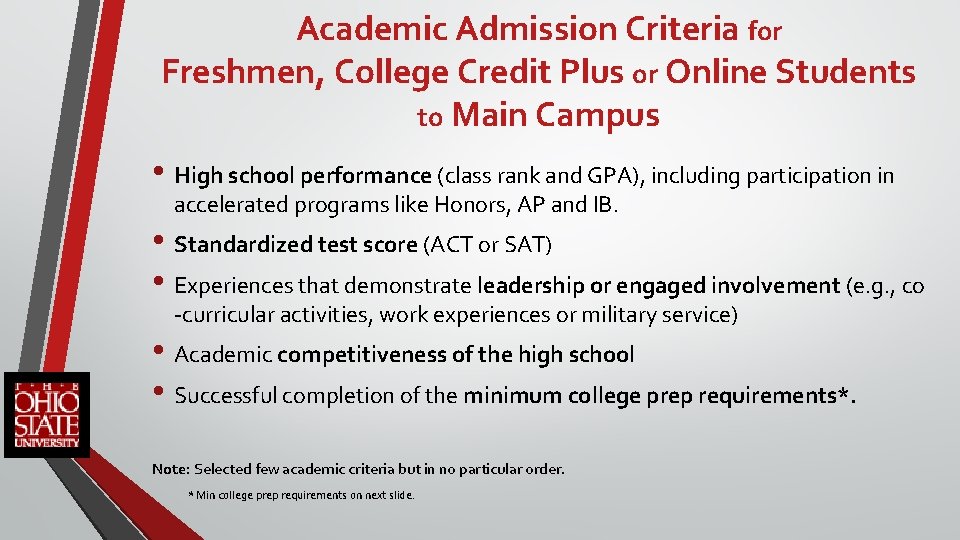
Academic Admission Criteria for Freshmen, College Credit Plus or Online Students to Main Campus • High school performance (class rank and GPA), including participation in accelerated programs like Honors, AP and IB. • Standardized test score (ACT or SAT) • Experiences that demonstrate leadership or engaged involvement (e. g. , co -curricular activities, work experiences or military service) • Academic competitiveness of the high school • Successful completion of the minimum college prep requirements*. Note: Selected few academic criteria but in no particular order. * Min college prep requirements on next slide.


OSU Math Placement • B Test=Basic Algebra Skills (40 questions) • ACT math < 25 or SAT math < 570 • College Algebra: score of 27 or higher on B test • D Test*=Calculus Readiness (25 questions) • ACT math > 25 or SAT math > 570 • College Algebra: 4 < score < 8 on D test • Pre-calculus: 9 < score < 12 on D test • Calculus I: score > 13 on D test
Traditional College Algebra Math 1148 • • Admittance to Course Performance in Course
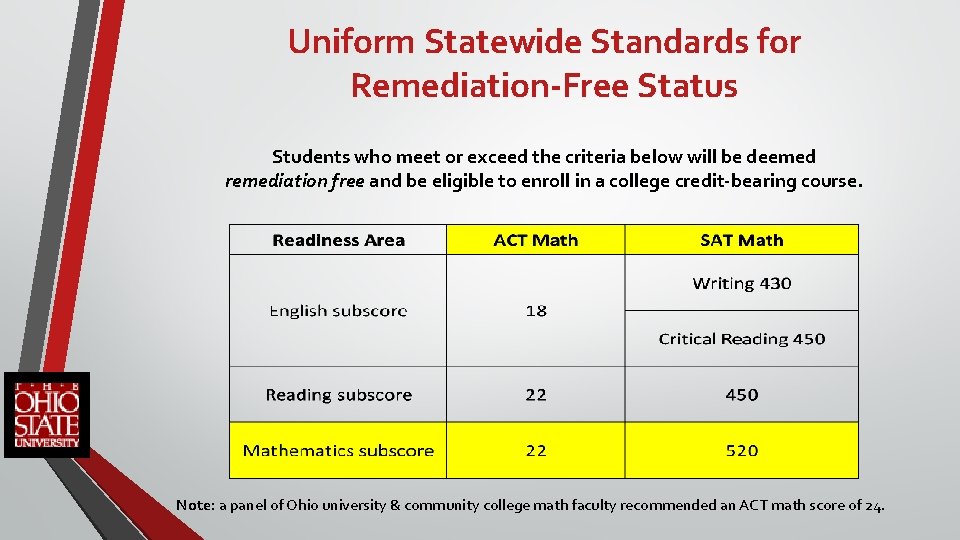
Uniform Statewide Standards for Remediation-Free Status Students who meet or exceed the criteria below will be deemed remediation free and be eligible to enroll in a college credit-bearing course. Note: a panel of Ohio university & community college math faculty recommended an ACT math score of 24.
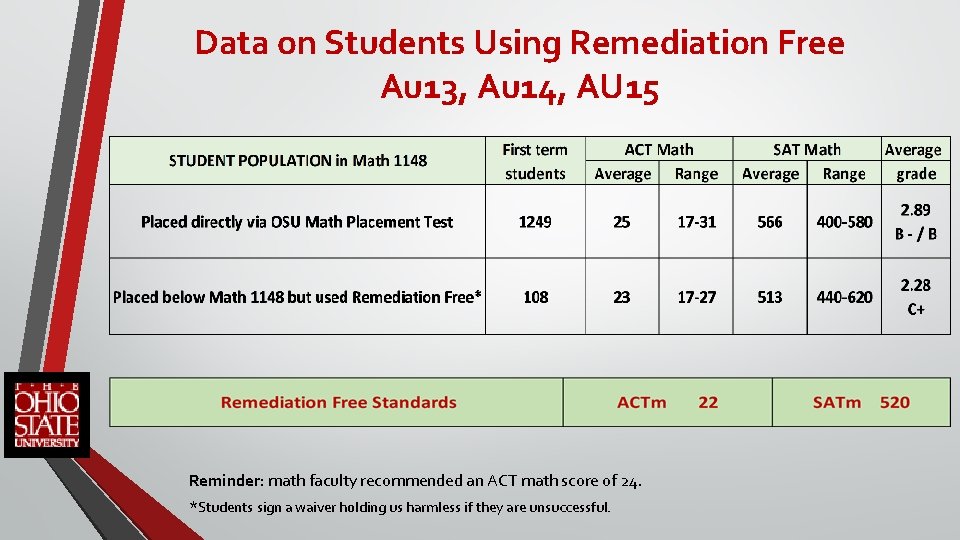
Data on Students Using Remediation Free Au 13, Au 14, AU 15 Reminder: math faculty recommended an ACT math score of 24. *Students sign a waiver holding us harmless if they are unsuccessful.
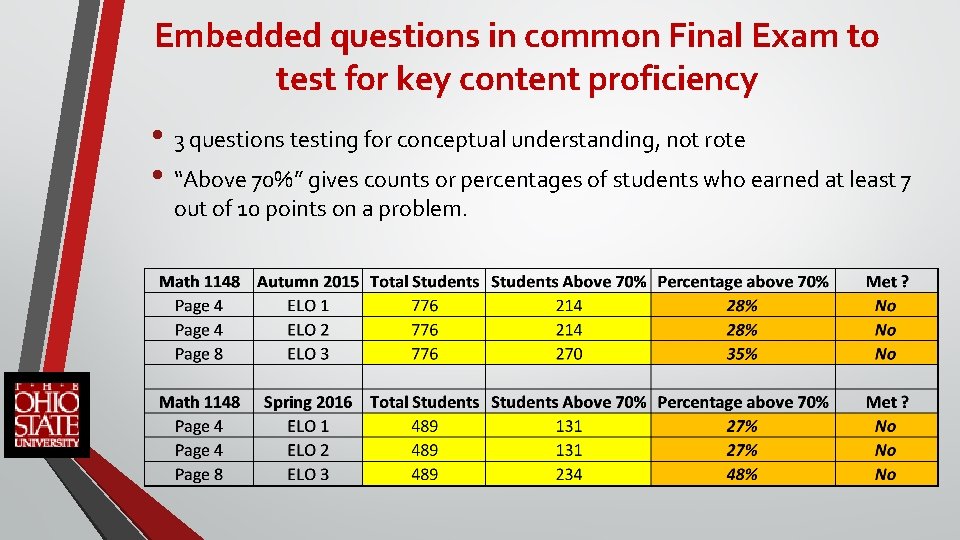
Embedded questions in common Final Exam to test for key content proficiency • 3 questions testing for conceptual understanding, not rote • “Above 70%” gives counts or percentages of students who earned at least 7 out of 10 points on a problem.
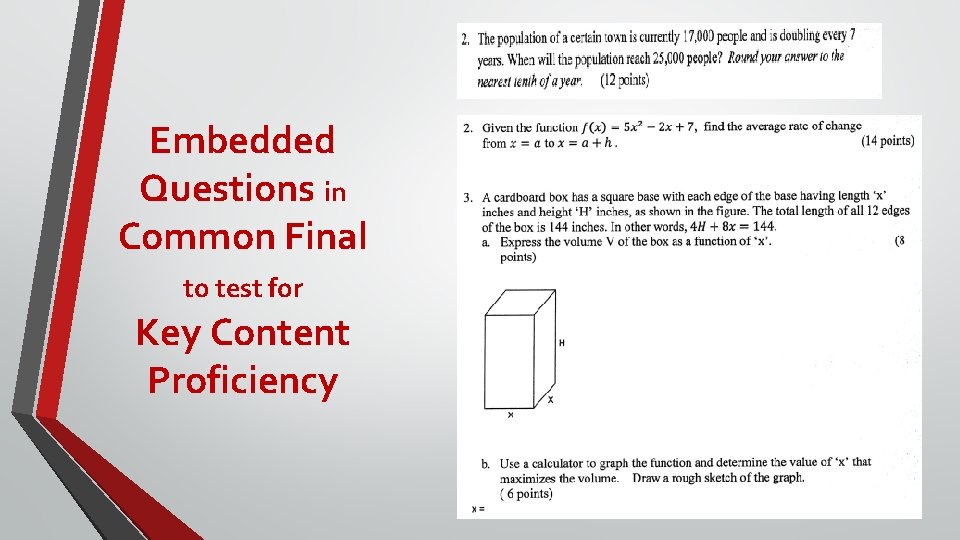
Embedded Questions in Common Final to test for Key Content Proficiency
Traditional Calculus and Analytical Geometry

Ohio State Calculus courses • • • 1151* Traditional Calculus and Analytical Geometry I 1152* Traditional Calculus and Analytical Geometry II • • 1161 Accelerated Calculus I (Covers differentiation and integration only) 2162 Accelerated Calculus II (multivariable) • • 1156 Calculus I for Biology majors 1172* Engineering Math A (Calculus II for Engineers) • • 1181 H Honors Calculus I (Covers 1151 & 1152 material) 2182 H Honors Calculus II (multivariable) • 4181 H & 4182 H – Honors Analysis I & II 2153 Traditional Calculus and Analytical Geometry III (multivariable) *Since Au 14, courses where no calculators are allowed on exams
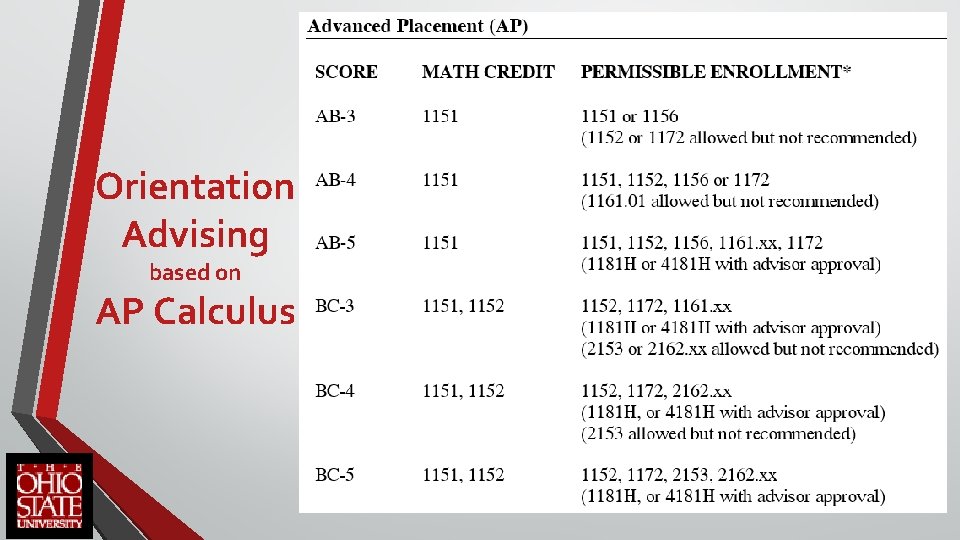
Orientation Advising based on AP Calculus
AP Calculus (CLAB or CLBC), possible reasons for the underprepared & permission to repeat • • High school teachers may teach to the test and not to conceptual understanding. • Starting in Au’ 14, calculators were no longer allowed for Ohio State’s Math Calculus I and II exams (1151, 1152, 1172). • • New freshmen request repeat previously taken courses for “a better foundation. ” Exams are graded on only the answered questions. A score of 5=A, 4=B, 3=C. Exams allow any calculator, including ones with the QWERTY keyboard; teachers may be teaching an easier way with the calculator; students don’t learn the concepts. Beginning in Au’ 15, the Math Dept. began allowing students to repeat the highest course for which they have credit. Previously, they had to move on to the next course.
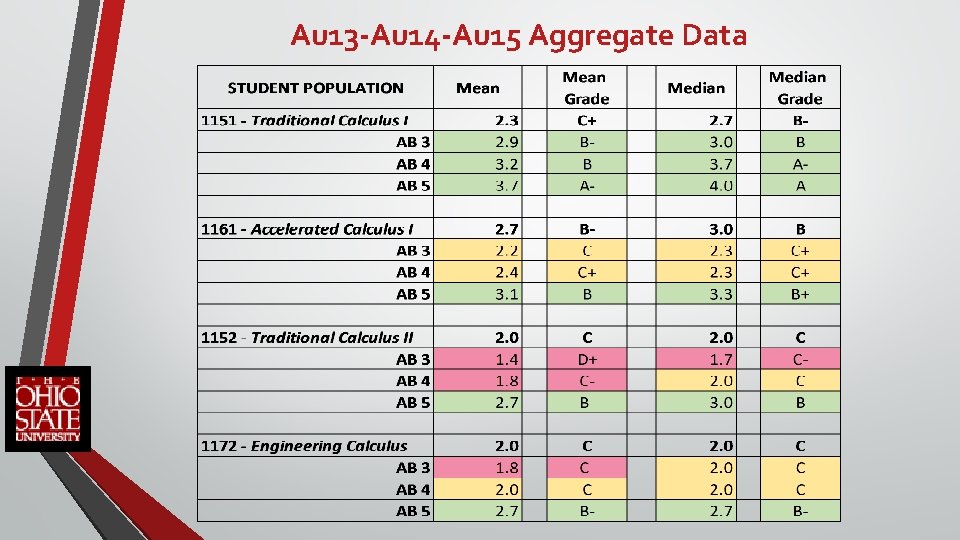
Au 13 -Au 14 -Au 15 Aggregate Data

Embedded questions in common Final Exam to test for key content proficiency • 3 questions testing for conceptual understanding, not rote • “Above 70%” gives counts or percentages of students who earned at least 7 out of 10 points on a problem.
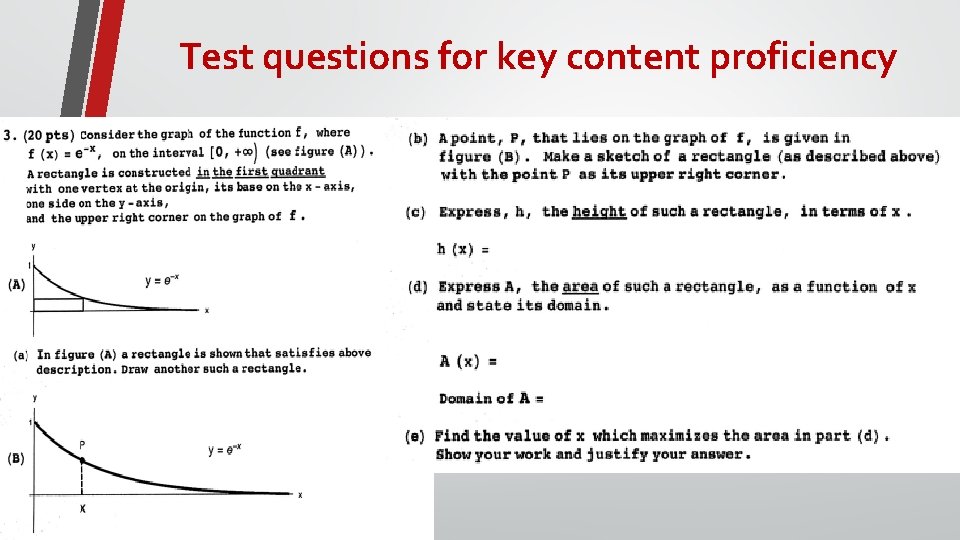
Test questions for key content proficiency
Study Strategies to Aid in Success • • Read textbook on the day’s topic before going to class • • Practice, PRACTICE using pencil & paper for at least 2 hours per day Attend class daily, take complete notes, read all details in syllabus Work on homework immediately or as close to the end of math class as possible Read notes after class and add to them from the textbook readings Highlight sticking points in notes to ask in recitation or office hours Go to instructor’s office hours, tutor room, form a study or meta group Don’t go to office hours saying you are completely lost. Instead take samples of attempted problems Use the Schaum’s Outline for various math topics Take timed practice quizzes and tests After a test is returned, cover the wrong answers and redo the problems
More Study Strategies • Use same study space, reduce distractions & multitasking • Take breaks every 30 minutes • Use mnemonics, review frequently (formula page, flash cards, apps: Study Blue, ANKI, One. Note) • Chunking & abstracting of ideas • Link new concepts to previously studied ones • Make a list of your common mistakes…and watch yourself • Have a notebook with completely solved one-of-a-kind problems • Do end-of-chapter problems (more practice with multiple concepts = comprehensive questions) • Internalize the material – structure it in a way that makes sense to you
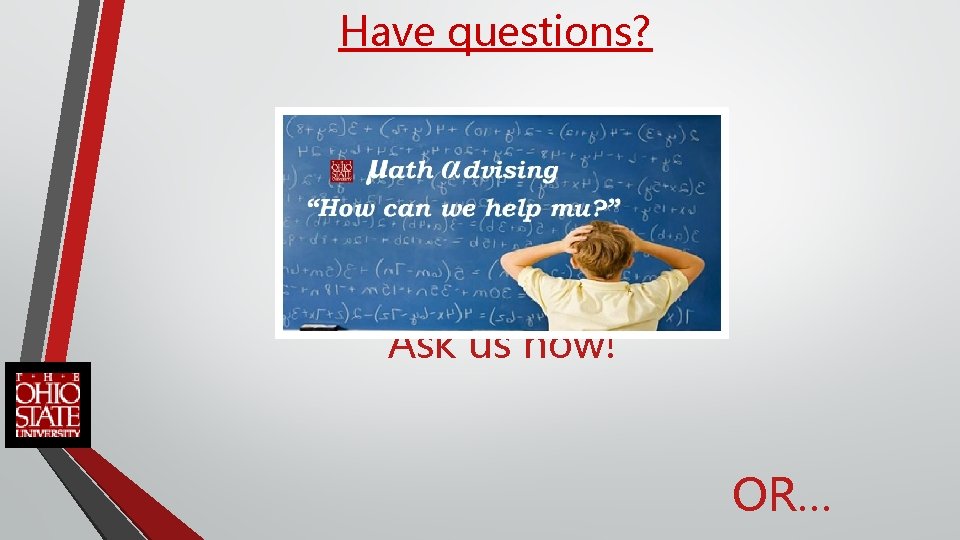
Have questions? Ask us now! OR…

Email us! Devol-Bevilacqua. 1@osu. edu Barbu. 4@osu. edu
Extra slides not used in Presentation
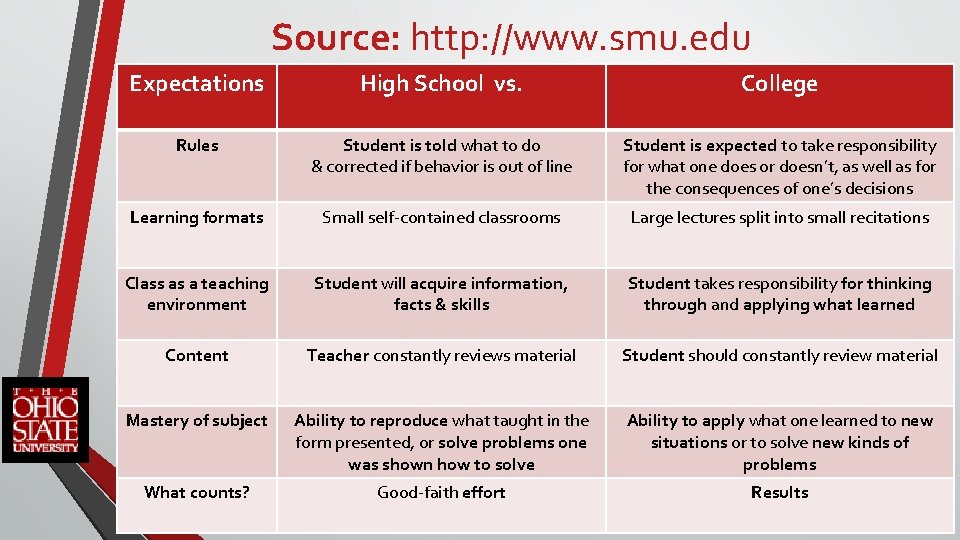
Source: http: //www. smu. edu Expectations High School vs. College Rules Student is told what to do & corrected if behavior is out of line Student is expected to take responsibility for what one does or doesn’t, as well as for the consequences of one’s decisions Learning formats Small self-contained classrooms Large lectures split into small recitations Class as a teaching environment Student will acquire information, facts & skills Student takes responsibility for thinking through and applying what learned Content Teacher constantly reviews material Student should constantly review material Mastery of subject Ability to reproduce what taught in the form presented, or solve problems one was shown how to solve Ability to apply what one learned to new situations or to solve new kinds of problems What counts? Good-faith effort Results
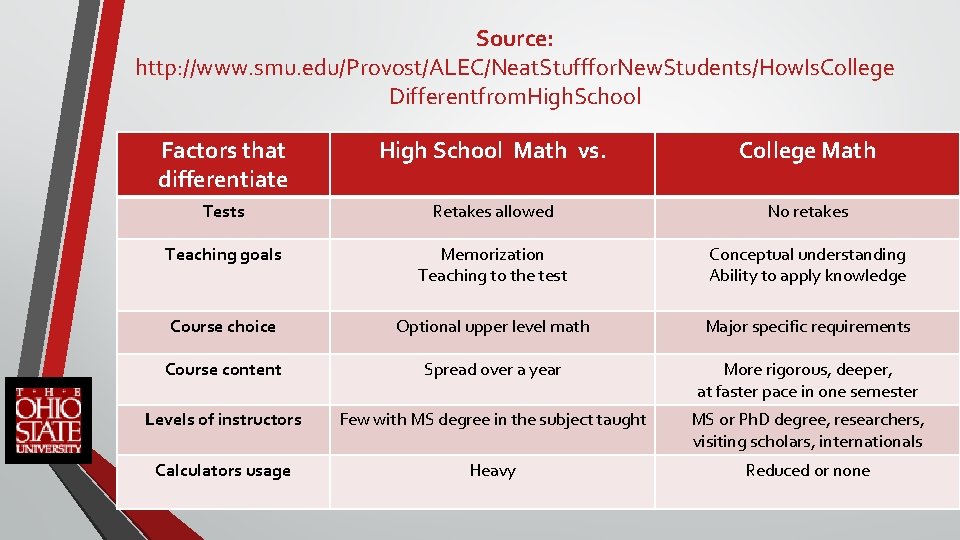
Source: http: //www. smu. edu/Provost/ALEC/Neat. Stufffor. New. Students/How. Is. College Differentfrom. High. School Factors that differentiate High School Math vs. College Math Tests Retakes allowed No retakes Teaching goals Memorization Teaching to the test Conceptual understanding Ability to apply knowledge Course choice Optional upper level math Major specific requirements Course content Spread over a year More rigorous, deeper, at faster pace in one semester Levels of instructors Few with MS degree in the subject taught MS or Ph. D degree, researchers, visiting scholars, internationals Calculators usage Heavy Reduced or none
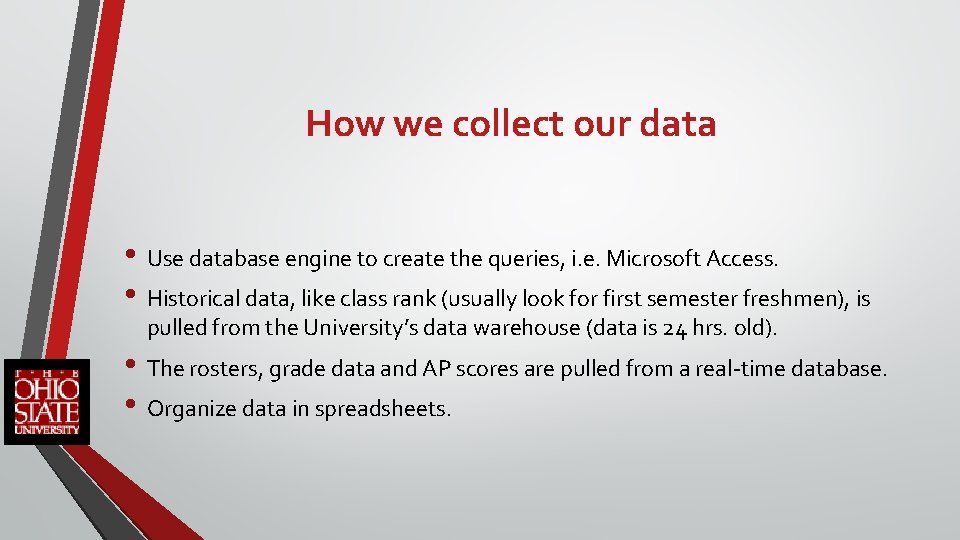
How we collect our data • Use database engine to create the queries, i. e. Microsoft Access. • Historical data, like class rank (usually look for first semester freshmen), is pulled from the University’s data warehouse (data is 24 hrs. old). • The rosters, grade data and AP scores are pulled from a real-time database. • Organize data in spreadsheets.
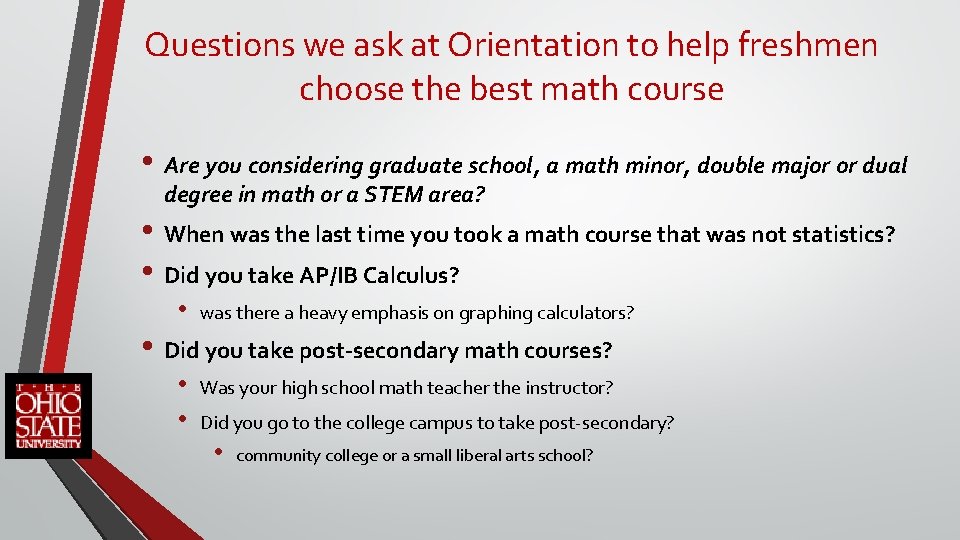
Questions we ask at Orientation to help freshmen choose the best math course • Are you considering graduate school, a math minor, double major or dual degree in math or a STEM area? • When was the last time you took a math course that was not statistics? • Did you take AP/IB Calculus? • was there a heavy emphasis on graphing calculators? • Did you take post-secondary math courses? • • Was your high school math teacher the instructor? Did you go to the college campus to take post-secondary? • community college or a small liberal arts school?
- Slides: 33