
Advertising and Signs Ordinance Summary November 18 2020
Advertising and Signs Ordinance Summary November 18, 2020
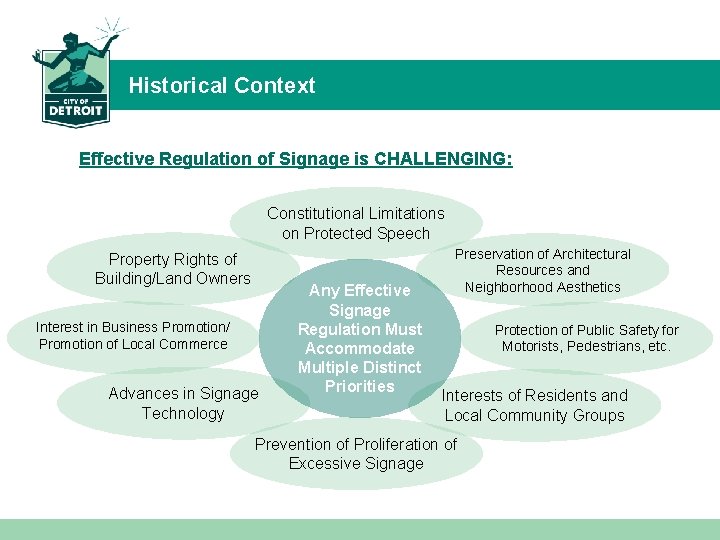
Historical Context Effective Regulation of Signage is CHALLENGING: Constitutional Limitations on Protected Speech Property Rights of Building/Land Owners Interest in Business Promotion/ Promotion of Local Commerce Advances in Signage Technology Any Effective Signage Regulation Must Accommodate Multiple Distinct Priorities Preservation of Architectural Resources and Neighborhood Aesthetics Protection of Public Safety for Motorists, Pedestrians, etc. Interests of Residents and Local Community Groups Prevention of Proliferation of Excessive Signage
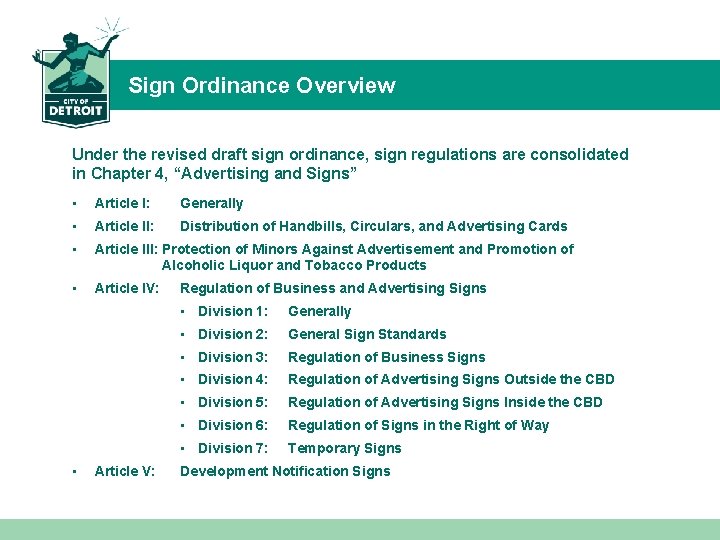
Sign Ordinance Overview Under the revised draft sign ordinance, sign regulations are consolidated in Chapter 4, “Advertising and Signs” • Article I: Generally • Article II: Distribution of Handbills, Circulars, and Advertising Cards • Article III: Protection of Minors Against Advertisement and Promotion of Alcoholic Liquor and Tobacco Products • Article IV: • Article V: Regulation of Business and Advertising Signs • Division 1: Generally • Division 2: General Sign Standards • Division 3: Regulation of Business Signs • Division 4: Regulation of Advertising Signs Outside the CBD • Division 5: Regulation of Advertising Signs Inside the CBD • Division 6: Regulation of Signs in the Right of Way • Division 7: Temporary Signs Development Notification Signs
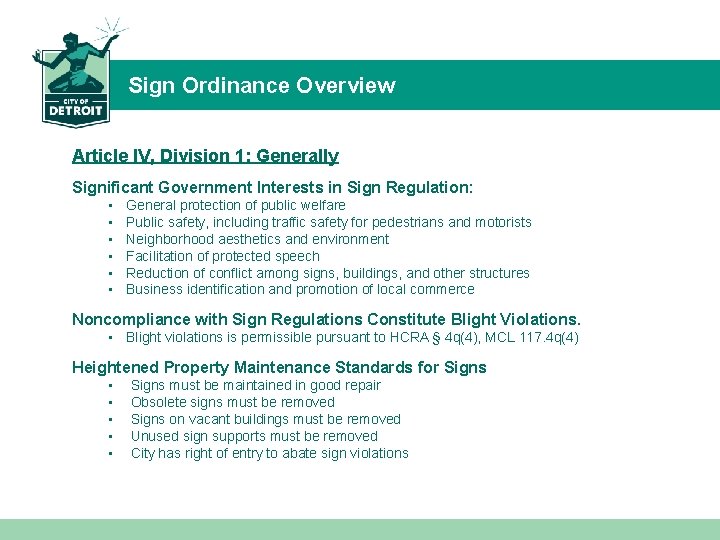
Sign Ordinance Overview Article IV, Division 1: Generally Significant Government Interests in Sign Regulation: • • • General protection of public welfare Public safety, including traffic safety for pedestrians and motorists Neighborhood aesthetics and environment Facilitation of protected speech Reduction of conflict among signs, buildings, and other structures Business identification and promotion of local commerce Noncompliance with Sign Regulations Constitute Blight Violations. • Blight violations is permissible pursuant to HCRA § 4 q(4), MCL 117. 4 q(4) Heightened Property Maintenance Standards for Signs • • • Signs must be maintained in good repair Obsolete signs must be removed Signs on vacant buildings must be removed Unused sign supports must be removed City has right of entry to abate sign violations
Sign Ordinance Overview Amortization of Existing Nonconforming Signs • By codifying sign regulations under its police powers, the City can phase out (amortize) nonconforming signs over a reasonable 10 -year period. Heritage Signs • Older signs may contribute positively to the City’s aesthetics, even if they are obsolete. Ordinance recognizes unilluminated painted signs have been obsolete for a period of at least 50 years as “Heritage Signs” which are exempted from otherwise applicable property maintenance requirements and other standards. Process for Waiver and Adjustment of Sign Standards • New opportunity for adjustments/waivers of dimensional or operational parameters for all types of signs. • Adjustment/waiver process conducted by the PDD Director via public hearing, subject to public notice/comment and Open Meetings Act standards. • PDD decisions are subject to appeal to the Department of Appeals and Hearings. Sign Guidebook • BSEED to publish a guidebook containing pictures, graphics, workflows, sample applications and forms, and other information to make sign regulations and procedures accessible to the public.

Sign Ordinance Overview Article IV, Division 2: General Sign Standards • Provides general requirements for any single sign, based on: (1) Type of Sign Construction (2) Master Plan Designation Types of Sign Construction: 1) Arcade Signs 7) Portable Signs Also: 2) Awning Signs 8) Projecting Signs Illuminated Signs 3) Marquee Signs 9) Raceway Signs Animated Signs 4) Mechanical Signs 10) Roof Signs Dynamic Signs 5) Monument Signs 11) Wall Signs Double-Face Signs 6) Pole Signs 12) Window Signs
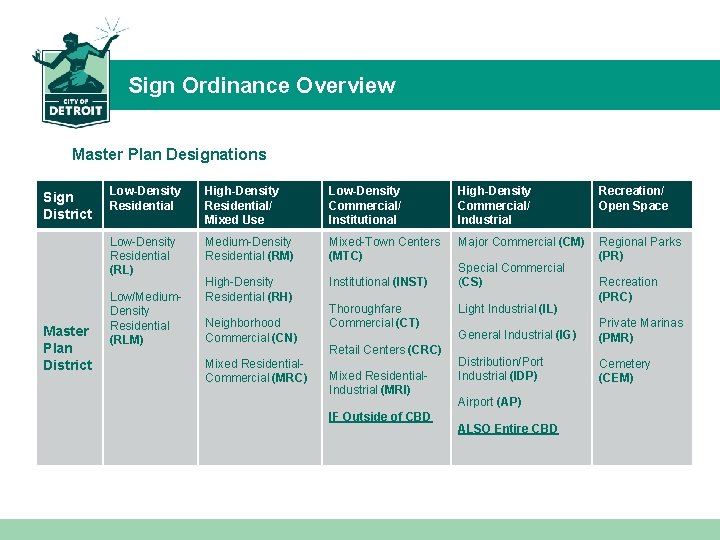
Sign Ordinance Overview Master Plan Designations Sign District Master Plan District Low-Density Residential High-Density Residential/ Mixed Use Low-Density Commercial/ Institutional High-Density Commercial/ Industrial Recreation/ Open Space Low-Density Residential (RL) Medium-Density Residential (RM) Mixed-Town Centers (MTC) Major Commercial (CM) Regional Parks (PR) High-Density Residential (RH) Institutional (INST) Low/Medium. Density Residential (RLM) Neighborhood Commercial (CN) Mixed Residential. Commercial (MRC) Thoroughfare Commercial (CT) Retail Centers (CRC) Mixed Residential. Industrial (MRI) IF Outside of CBD Special Commercial (CS) Light Industrial (IL) Recreation (PRC) General Industrial (IG) Private Marinas (PMR) Distribution/Port Industrial (IDP) Cemetery (CEM) Airport (AP) ALSO Entire CBD
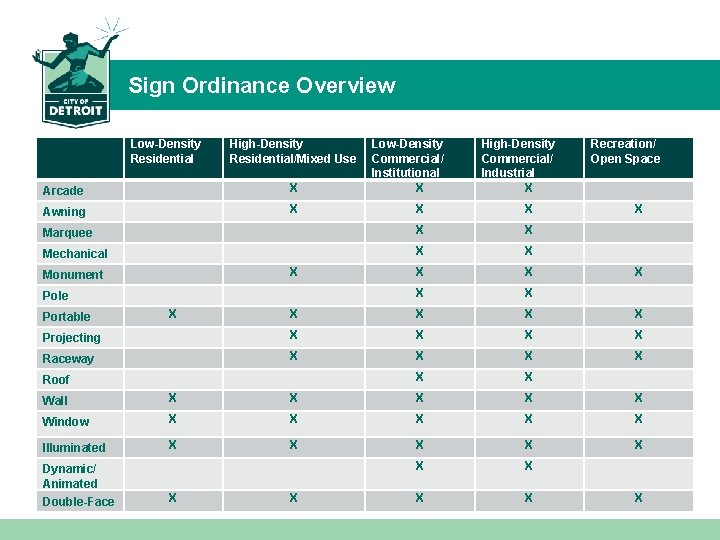
Sign Ordinance Overview Low-Density Residential High-Density Residential/Mixed Use Arcade X Awning X Low-Density Commercial/ Institutional X High-Density Commercial/ Industrial X Recreation/ Open Space X X Marquee X X Mechanical X X X X X Projecting X X Raceway X X X X Monument Pole Portable X Roof X X Wall X X X Window X X X Illuminated X X X X X Dynamic/ Animated Double-Face X X X
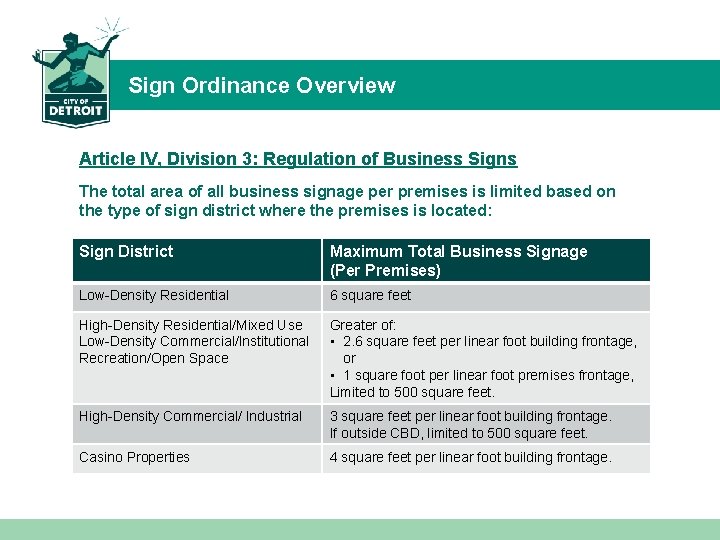
Sign Ordinance Overview Article IV, Division 3: Regulation of Business Signs The total area of all business signage per premises is limited based on the type of sign district where the premises is located: Sign District Maximum Total Business Signage (Per Premises) Low-Density Residential 6 square feet High-Density Residential/Mixed Use Low-Density Commercial/Institutional Recreation/Open Space Greater of: • 2. 6 square feet per linear foot building frontage, or • 1 square foot per linear foot premises frontage, Limited to 500 square feet. High-Density Commercial/ Industrial 3 square feet per linear foot building frontage. If outside CBD, limited to 500 square feet. Casino Properties 4 square feet per linear foot building frontage.
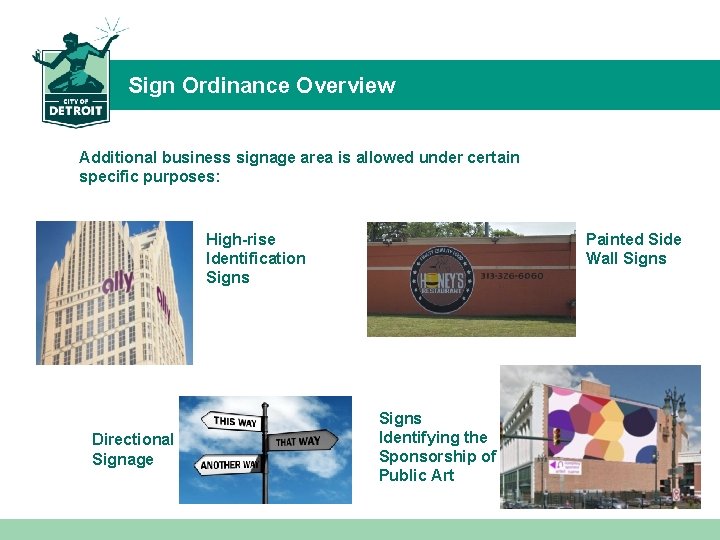
Sign Ordinance Overview Additional business signage area is allowed under certain specific purposes: High-rise Identification Signs Directional Signage Painted Side Wall Signs Identifying the Sponsorship of Public Art
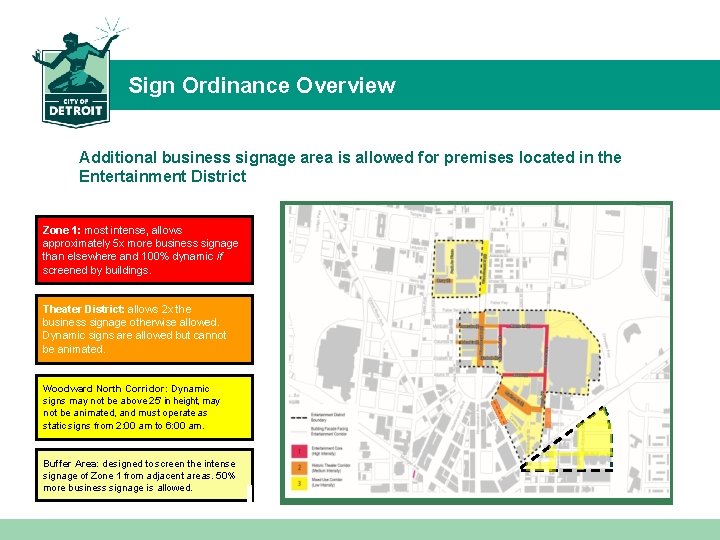
Sign Ordinance Overview Additional business signage area is allowed for premises located in the Entertainment District Zone 1: most intense, allows approximately 5 x more business signage than elsewhere and 100% dynamic if screened by buildings. Theater District: allows 2 x the business signage otherwise allowed. Dynamic signs are allowed but cannot be animated. Woodward North Corridor: Dynamic signs may not be above 25’ in height, may not be animated, and must operate as static signs from 2: 00 am to 6: 00 am. Buffer Area: designed to screen the intense signage of Zone 1 from adjacent areas. 50% more business signage is allowed.
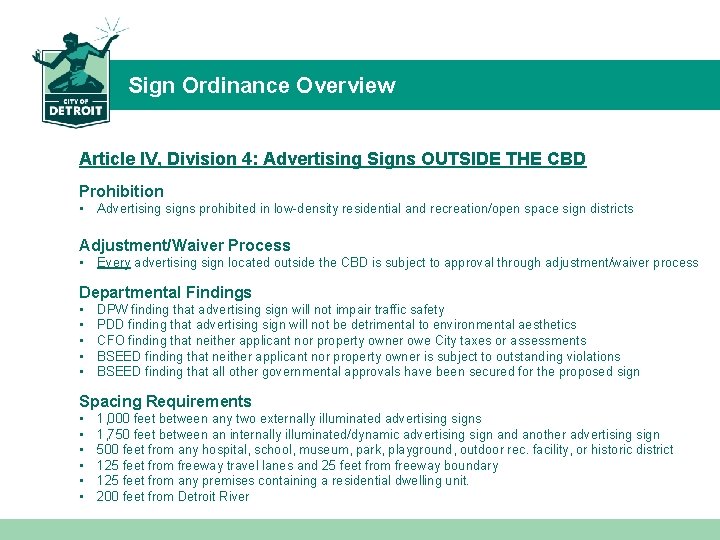
Sign Ordinance Overview Article IV, Division 4: Advertising Signs OUTSIDE THE CBD Prohibition • Advertising signs prohibited in low-density residential and recreation/open space sign districts Adjustment/Waiver Process • Every advertising sign located outside the CBD is subject to approval through adjustment/waiver process Departmental Findings • • • DPW finding that advertising sign will not impair traffic safety PDD finding that advertising sign will not be detrimental to environmental aesthetics CFO finding that neither applicant nor property owner owe City taxes or assessments BSEED finding that neither applicant nor property owner is subject to outstanding violations BSEED finding that all other governmental approvals have been secured for the proposed sign Spacing Requirements • • • 1, 000 feet between any two externally illuminated advertising signs 1, 750 feet between an internally illuminated/dynamic advertising sign and another advertising sign 500 feet from any hospital, school, museum, park, playground, outdoor rec. facility, or historic district 125 feet from freeway travel lanes and 25 feet from freeway boundary 125 feet from any premises containing a residential dwelling unit. 200 feet from Detroit River
Sign Ordinance Overview Dimensional Limitations • Height: 45 feet if adjacent to freeway, 35 feet for all other locations. • Clearance: 15 feet • Area: 672 square feet if adjacent to freeway, 378 square feet if adjacent to road >80 feet wide 250 square feet if adjacent to road <80 feet wide Landscaping • If a premises is occupied solely by an advertising sign and no other building or structure, it must contain perimeter landscaping to a depth of five feet, which must be maintained in good health and quality.
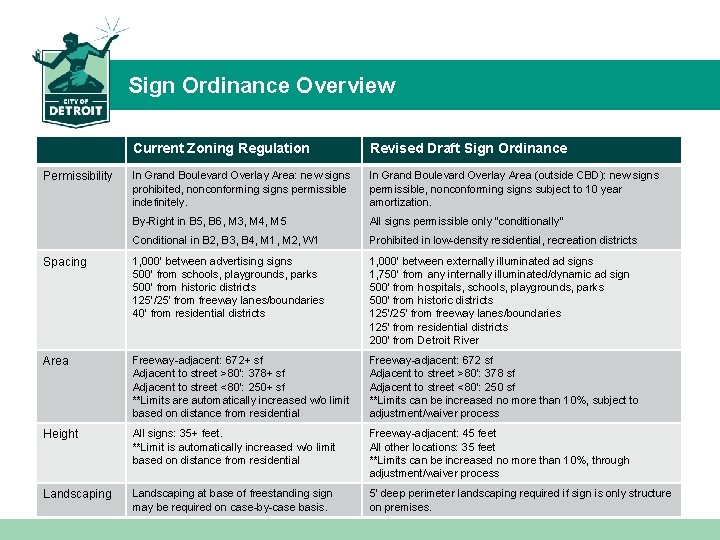
Sign Ordinance Overview Current Zoning Regulation Revised Draft Sign Ordinance In Grand Boulevard Overlay Area: new signs prohibited, nonconforming signs permissible indefinitely. In Grand Boulevard Overlay Area (outside CBD): new signs permissible, nonconforming signs subject to 10 year amortization. By-Right in B 5, B 6, M 3, M 4, M 5 All signs permissible only “conditionally" Conditional in B 2, B 3, B 4, M 1, M 2, W 1 Prohibited in low-density residential, recreation districts Spacing 1, 000’ between advertising signs 500’ from schools, playgrounds, parks 500’ from historic districts 125’/25’ from freeway lanes/boundaries 40’ from residential districts 1, 000’ between externally illuminated ad signs 1, 750’ from any internally illuminated/dynamic ad sign 500’ from hospitals, schools, playgrounds, parks 500’ from historic districts 125’/25’ from freeway lanes/boundaries 125’ from residential districts 200’ from Detroit River Area Freeway-adjacent: 672+ sf Adjacent to street >80’: 378+ sf Adjacent to street <80’: 250+ sf **Limits are automatically increased w/o limit based on distance from residential Freeway-adjacent: 672 sf Adjacent to street >80’: 378 sf Adjacent to street <80’: 250 sf **Limits can be increased no more than 10%, subject to adjustment/waiver process Height All signs: 35+ feet. **Limit is automatically increased w/o limit based on distance from residential Freeway-adjacent: 45 feet All other locations: 35 feet **Limits can be increased no more than 10%, through adjustment/waiver process Landscaping at base of freestanding sign may be required on case-by-case basis. 5’ deep perimeter landscaping required if sign is only structure on premises. Permissibility
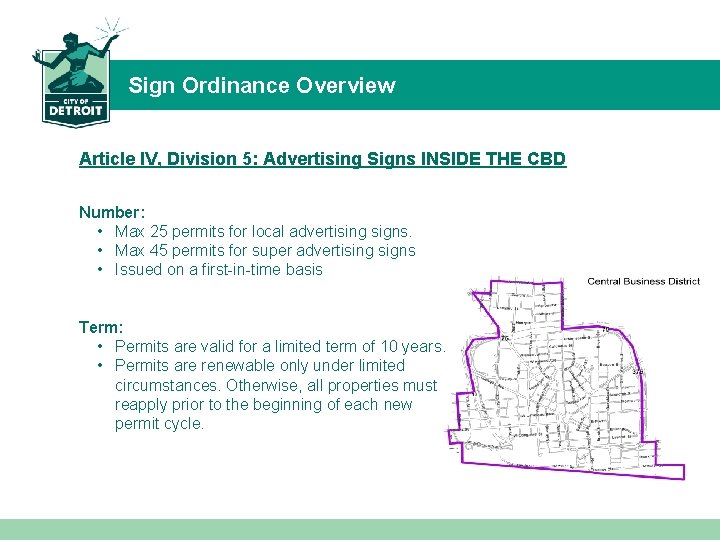
Sign Ordinance Overview Article IV, Division 5: Advertising Signs INSIDE THE CBD Number: • Max 25 permits for local advertising signs. • Max 45 permits for super advertising signs • Issued on a first-in-time basis Term: • Permits are valid for a limited term of 10 years. • Permits are renewable only under limited circumstances. Otherwise, all properties must reapply prior to the beginning of each new permit cycle.
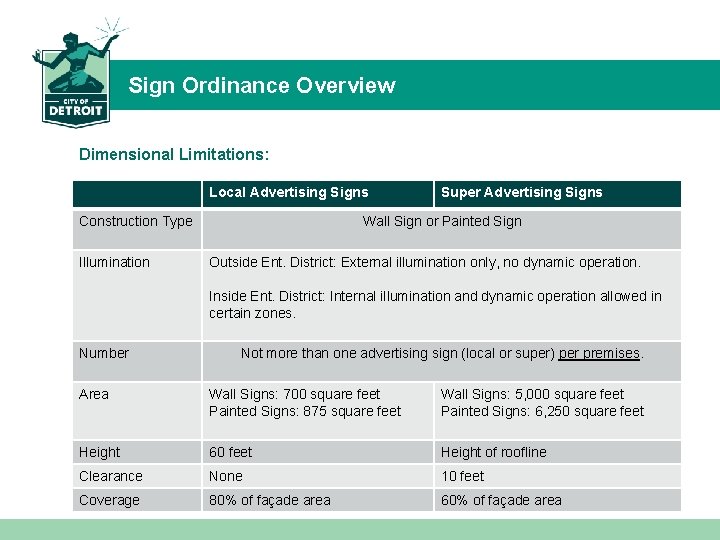
Sign Ordinance Overview Dimensional Limitations: Local Advertising Signs Construction Type Illumination Super Advertising Signs Wall Sign or Painted Sign Outside Ent. District: External illumination only, no dynamic operation. Inside Ent. District: Internal illumination and dynamic operation allowed in certain zones. Number Not more than one advertising sign (local or super) per premises. Area Wall Signs: 700 square feet Painted Signs: 875 square feet Wall Signs: 5, 000 square feet Painted Signs: 6, 250 square feet Height 60 feet Height of roofline Clearance None 10 feet Coverage 80% of façade area 60% of façade area
Sign Ordinance Overview Mitigation of Harmful Visual Aesthetics of Super Advertising Signs: Super advertising signs are far larger and more impactful than any other type of sign allowed under the Sign Ordinance. The City may evaluate proposed super advertising sign as to their expected negative visual aesthetics. If it determines that a super advertising sign’s negative visual aesthetics are expected to be excessive, then the City can require a monetary contribution to support the creation of new art murals and other public art to mitigate the negative visual aesthetics.
Sign Ordinance Overview Article IV, Division 6: Regulation of Signs in the Right of Way (ROW) Business Signage in the ROW: • Signs located in the ROW that are intended to direct attention to adjacent businesses are considered on-premises business signage. Directional/Wayfinding Signage in the ROW: • Directional and wayfinding signage is permissible in the ROW, subject to dimensional limitations. • Traffic control signals and signage that are installed and operated by a governmental authority are not subject to these regulations. Advertising Signage in the ROW: • Limited advertising signage is permissible in ROWs that are outside of low-density residential sign districts. • Area limited to 18 square feet if illuminated or 24 square feet if unilluminated. • Must be incorporated into a larger structure that provides non-advertising public benefit to pedestrians, such as a news stand, bus shelter, or bicycle docking station.
Sign Ordinance Overview Article IV, Division 7: Temporary Signs Limitations on Number, Area, Term: • One temporary sign is allowed per premises or ground-floor tenant space. • Maximum allowable temporary sign area for a premises can be between 6 and 32 square feet, depending on the sign district where the premises is located. • Temporary signs may be permitted for not more than 90 days. Additional Temporary Sign Allowances: • Limited additional temporary signage may be allowed in specific circumstances: • Temporary signage on premises listed as for sale or lease • Temporary signage on premises with open building or construction permits • Portable temporary signage on residential premises during specified periods of the year.
Conforming Amendments to Zoning Ordinance Unaffected Sign-Related Zoning Provisions Include: • Sign-related standards for Traditional Main Street Overlay (TMSO) Areas that are stricter than applicable Chapter 4 regulations (Sec. 50 -14 -450). • Sign-related standards for Planned Development (PD) Districts that are stricter than applicable Chapter 4 regulations (Sec. 50 -11 -15(l)). • Signs remain subject to Special District Review (SDR) in PC and PCA Districts (Secs. 50 -11 -66, 50 -11 -96). • Signs remain subject to existing design review procedures applicable to other special zoning districts, including: • SD 3 Districts (PDD review) • SD 4 Districts (BSEED and Council review) • SD 5 Districts (CPC, PDD, and Council review)
- Slides: 20