
ADVERTISING 2 The Role of Captions Gillian Dyer




- Slides: 14
ADVERTISING 2 The Role of Captions /Gillian Dyer/
Dyer vs. Williamson n n Attitude towards advertising Focus (images, language, etc. ) Role of ideology, creativity Theoretical and practical aspects
The aim of captions: n n Attract attention Catch our imagination Say something memorable Invest the product with meaning by tone, rhythm and association
Method: n n n n bizarre and controversial statements manipulating and distorting everyday meaning using words out of context using imperatives: “Try this!” playing with words, puns: “Black on the map” misspelling words deliberately to give the product uniqueness “Words do not only describe things, they communicate feelings, associations and attitudes – they bring ideas to our minds. ” – similarities with Williamson’s argument
How to target emotions? BRAND NAMES: Communicate denotatively and connotatively. Role of connotative meaning: they should bring flattering associations to our minds. E. g. beauty products: recall cleanliness, naturaleness, purity, etc. TONE OF VOICE: Not always nice and sweet, sometimes deliberately aggressive. E. g. : n n Tea: high-class tone of voice /tantalizing, delicately/ n Car: conversational, jocular Often tries to recreate the experience of enjoying the product n
How to target emotions? n FORMAT: Dialogue or monologue; monologue testimonial style, interior monologue technique; borrowing from other discourse: scientific and legal language; scientific sounding terms to impress the audience Sometimes captions mislead deliberately, verging on illegality: “orange crush” instead of “orange squash” wants to make people think that there are more oranges in the drink;
How to target emotions? KEY WORDS: n Adverbs and adjectives: they can stimulate envy, dreams and desires by evoking looks, touch, taste, smell and sounds without actually misrepresenting a product; commonly used (fresh, wonderful, rich, golden) + more creative ones („tomatoful, ” „teenfresh, ” etc. ) n Creative adjectival compounds: „new-face hygiene, ” etc. All of these want to suggest that the product has a special quality
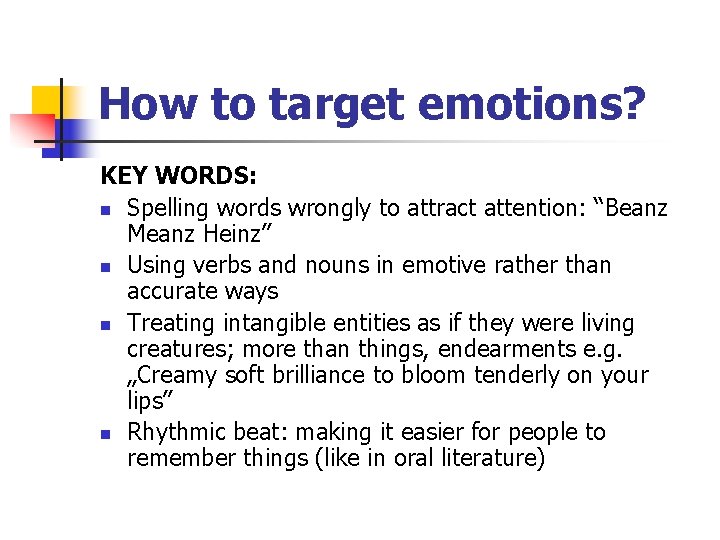
How to target emotions? KEY WORDS: n Spelling words wrongly to attract attention: “Beanz Meanz Heinz” n Using verbs and nouns in emotive rather than accurate ways n Treating intangible entities as if they were living creatures; more than things, endearments e. g. „Creamy soft brilliance to bloom tenderly on your lips” n Rhythmic beat: making it easier for people to remember things (like in oral literature)
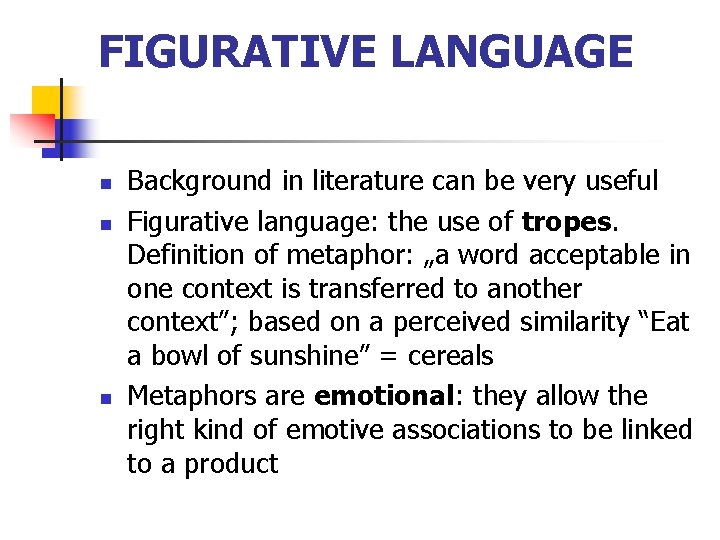
FIGURATIVE LANGUAGE n n n Background in literature can be very useful Figurative language: the use of tropes. Definition of metaphor: „a word acceptable in one context is transferred to another context”; based on a perceived similarity “Eat a bowl of sunshine” = cereals Metaphors are emotional: they allow the right kind of emotive associations to be linked to a product
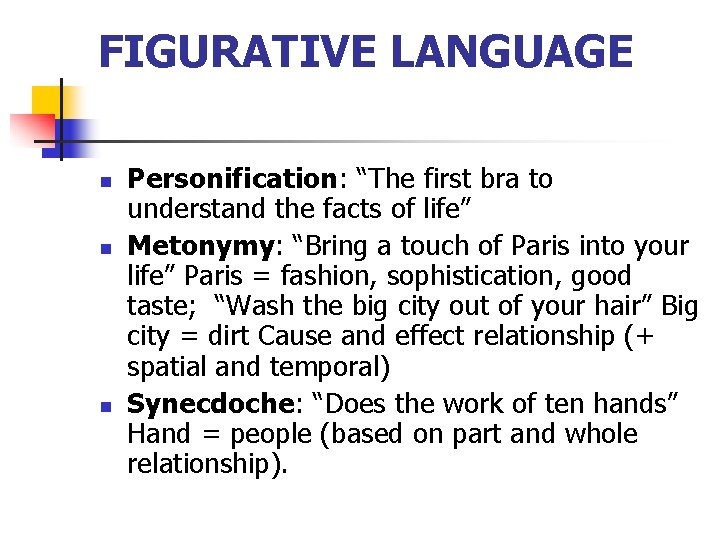
FIGURATIVE LANGUAGE n n n Personification: “The first bra to understand the facts of life” Metonymy: “Bring a touch of Paris into your life” Paris = fashion, sophistication, good taste; “Wash the big city out of your hair” Big city = dirt Cause and effect relationship (+ spatial and temporal) Synecdoche: “Does the work of ten hands” Hand = people (based on part and whole relationship).
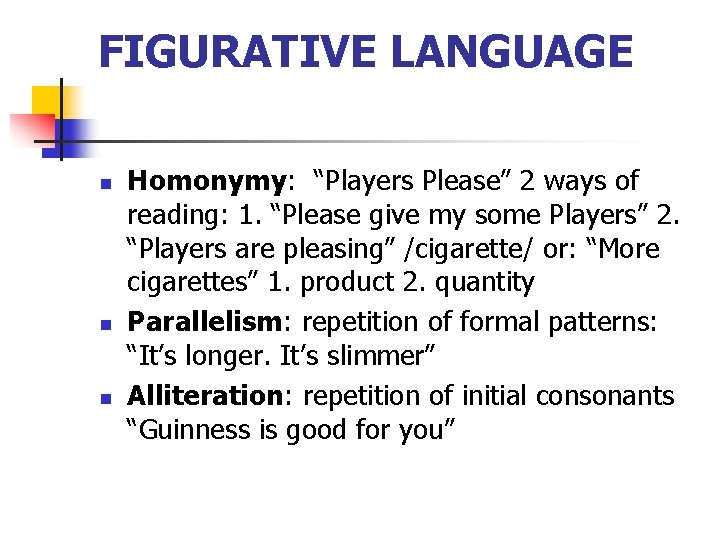
FIGURATIVE LANGUAGE n n n Homonymy: “Players Please” 2 ways of reading: 1. “Please give my some Players” 2. “Players are pleasing” /cigarette/ or: “More cigarettes” 1. product 2. quantity Parallelism: repetition of formal patterns: “It’s longer. It’s slimmer” Alliteration: repetition of initial consonants “Guinness is good for you”
CALLIGRAPHY KITKAT made up of pictures of the bar of chocolate. These ads suggest that language is absent and the product speaks for itself. The calligram tries to unite the sign and its referent
1. Language/Dyer: 1. How does it attract attention? 2. How does it target emotions? 3. How would you describe the tone of the voice? The role of music? 4. Identify key words used! 5. Does the ad use tropes? 2. Visual image/Williamson: 1. What is the hidden/ideological meaning? 2. What kind of associations does the ad use? 3. What kind of fundamental human needs and desires are evoked? 4. What is the „referent system”?
Commercials: 1. 2. 3. 4. Pickwick: http: //www. youtube. com/watch? v=n 37 Kyn. Jd. Cgw Twinings: http: //www. youtube. com/watch? v=B_HBCTSs. Yy. Q Nescafe: http: //www. youtube. com/watch? v=8 y. Ye -B_YIg. E Starbucks: http: //www. youtube. com/watch? v=y. N 9_WT 9 l 7 xo