
Adverse Driving Conditions Adapted from New York State
- Slides: 48
Adverse Driving Conditions Adapted from New York State Driver Education Research & Innovation Center Project (DERIC) curriculum materials www. health. ny. gov/prevention/injury_prevention/deric/index. htm for driver instructor use.
Choices and Consequences 1. How do attitudes, emotions, beliefs and values interfere with safe driving? 2. What healthy attitudes and behaviors support a safe driving environment? 3. How do unhealthy attitudes and behaviors result in physical and mental impairment? 4. What physical and mental conditions interfere with safe driving? 5. What are the differences between impulsive and calculated risks? 6. What are the differences between aggressive driving and road rage?
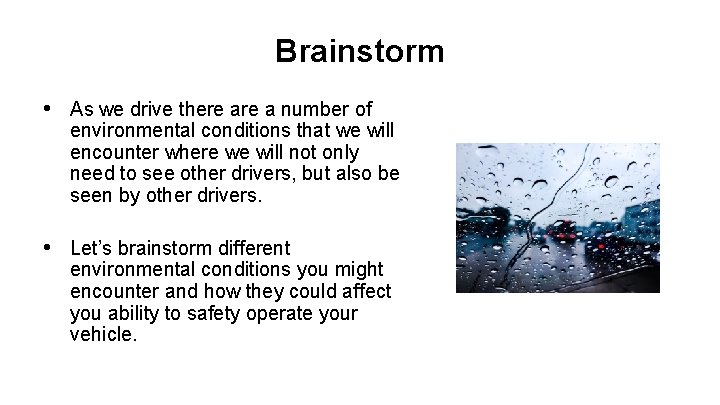
Brainstorm • As we drive there a number of environmental conditions that we will encounter where we will not only need to see other drivers, but also be seen by other drivers. • Let’s brainstorm different environmental conditions you might encounter and how they could affect you ability to safety operate your vehicle.
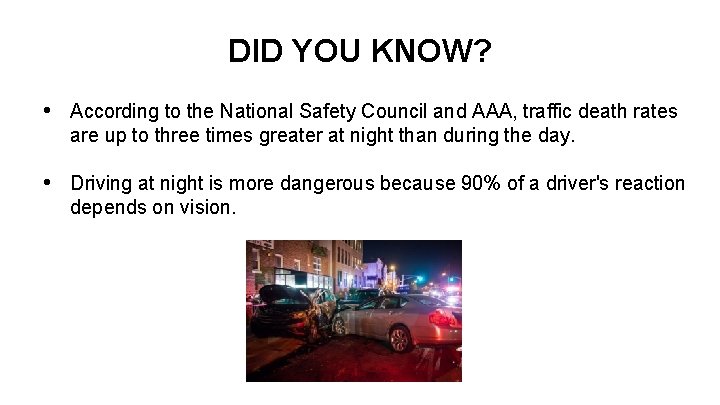
DID YOU KNOW? • According to the National Safety Council and AAA, traffic death rates are up to three times greater at night than during the day. • Driving at night is more dangerous because 90% of a driver's reaction depends on vision.
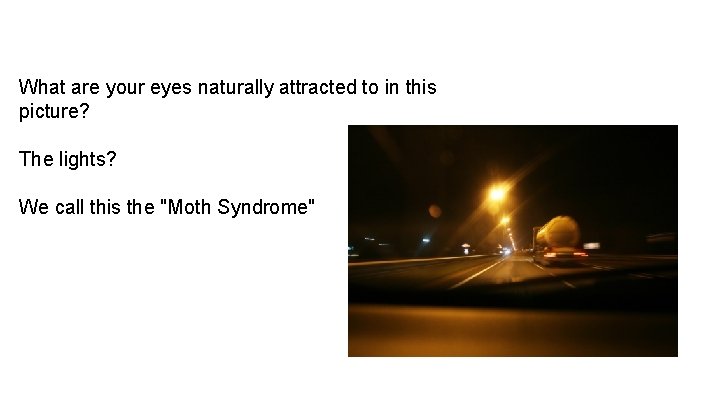
What are your eyes naturally attracted to in this picture? The lights? We call this the "Moth Syndrome"
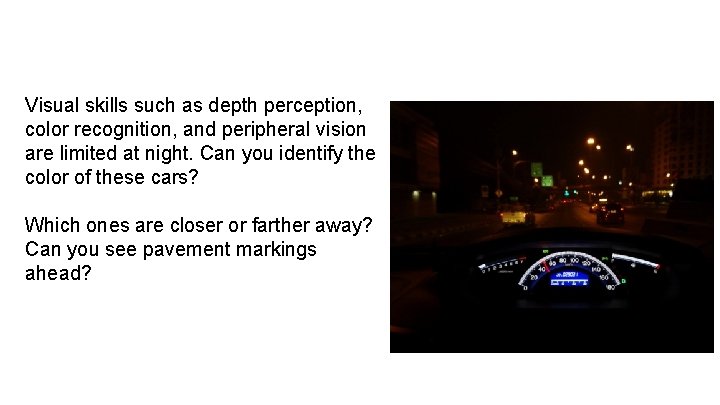
Visual skills such as depth perception, color recognition, and peripheral vision are limited at night. Can you identify the color of these cars? Which ones are closer or farther away? Can you see pavement markings ahead?
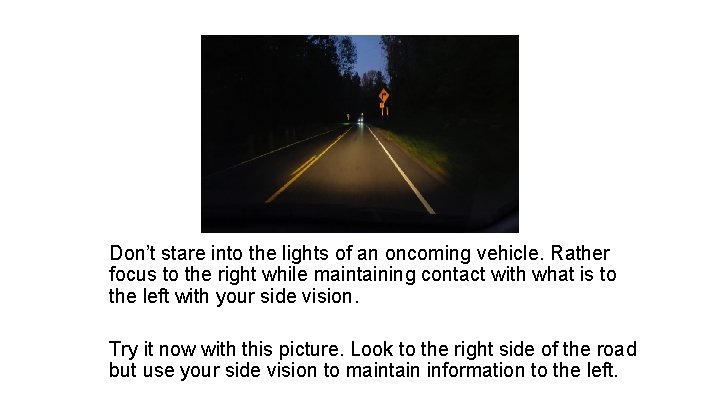
Don’t stare into the lights of an oncoming vehicle. Rather focus to the right while maintaining contact with what is to the left with your side vision. Try it now with this picture. Look to the right side of the road but use your side vision to maintain information to the left.
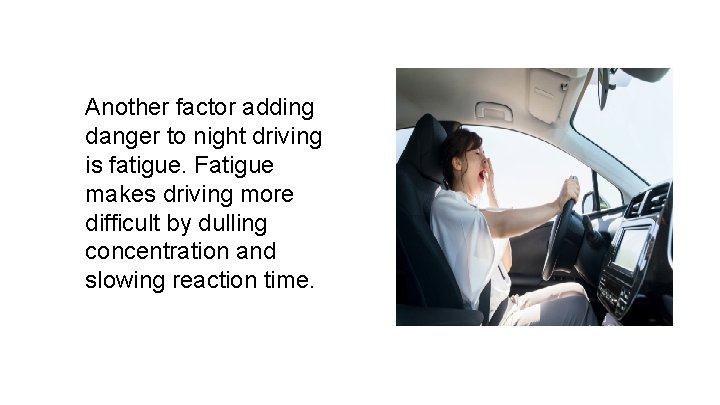
Another factor adding danger to night driving is fatigue. Fatigue makes driving more difficult by dulling concentration and slowing reaction time.
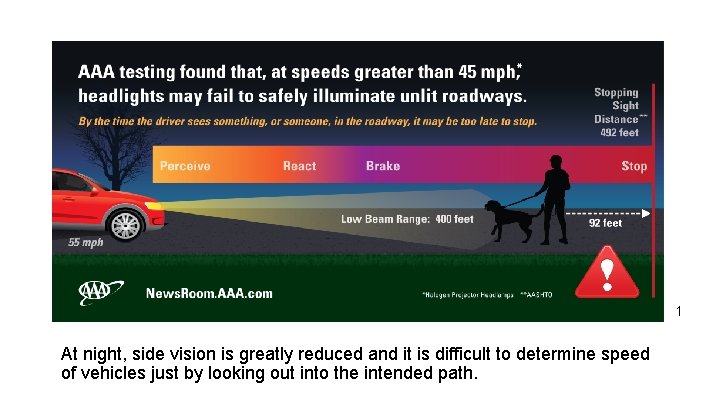
1 At night, side vision is greatly reduced and it is difficult to determine speed of vehicles just by looking out into the intended path.
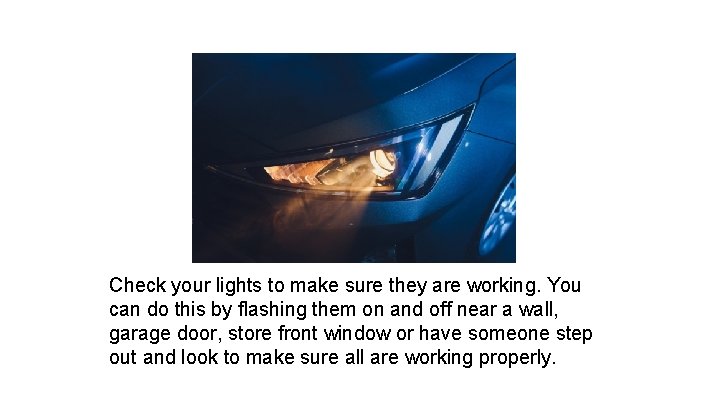
Check your lights to make sure they are working. You can do this by flashing them on and off near a wall, garage door, store front window or have someone step out and look to make sure all are working properly.
Driving at Night-Special Considerations • To avoid being blinded by oncoming high beam lights, look ahead and towards the shoulder of the road using your side vision to stay on track. • Use your high-beam lights when driving in rural areas and on open highways away from urban and metropolitan areas. • If you are driving with your high-beam lights on, you must dim them at least 500 ft. from any oncoming vehicle, so you don't blind the oncoming driver. • Remember to use your low-beams if you are within 200 -300 ft. of the vehicle you are following to avoid blinding the driver ahead of you.
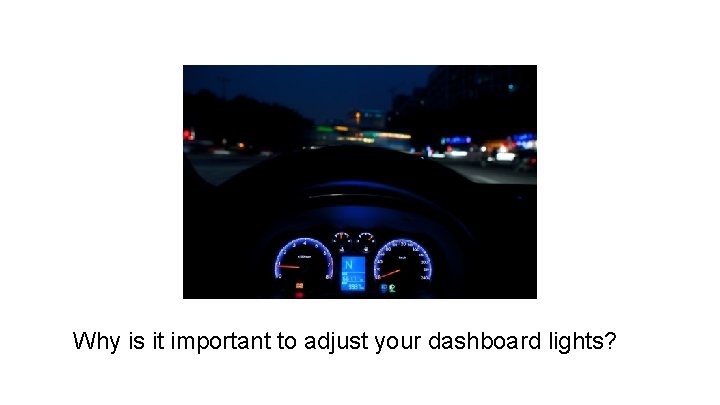
Why is it important to adjust your dashboard lights?
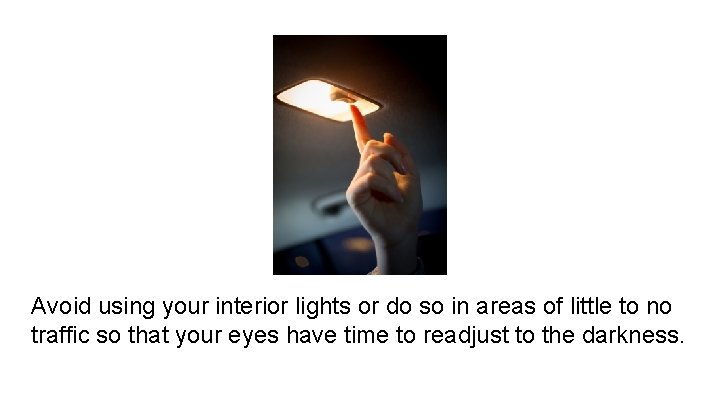
Avoid using your interior lights or do so in areas of little to no traffic so that your eyes have time to readjust to the darkness.
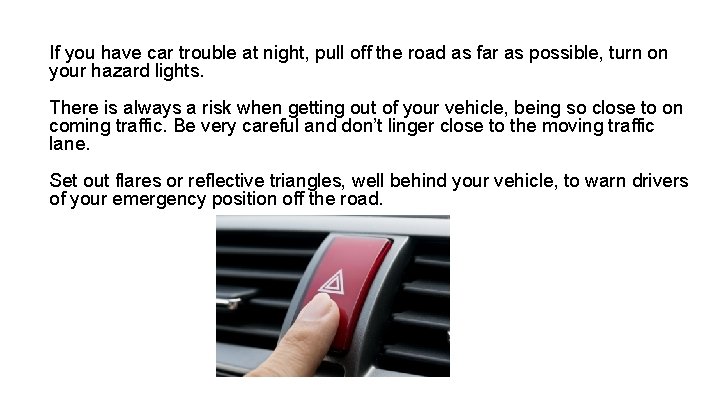
If you have car trouble at night, pull off the road as far as possible, turn on your hazard lights. There is always a risk when getting out of your vehicle, being so close to on coming traffic. Be very careful and don’t linger close to the moving traffic lane. Set out flares or reflective triangles, well behind your vehicle, to warn drivers of your emergency position off the road.
Let’s review New York State restrictions regarding night driving for those with a junior license.
Identify, List, and Discuss: Special Factors for Residential Streets • Alternate street parking problems • State of an emergency parking • Snow drifts near driveways • Slippery intersections due to puddles and leaves clogging • • • drainage Slippery intersections due to freezing sections of the road where vehicle heat melts down the snow and it turns to ice Salted intersections in winter makes for loose gravel in Spring Low driving areas such as viaducts can flood
Identifying Different Weather Conditions As a group, develop a list of the different weather conditions a driver will encounter.
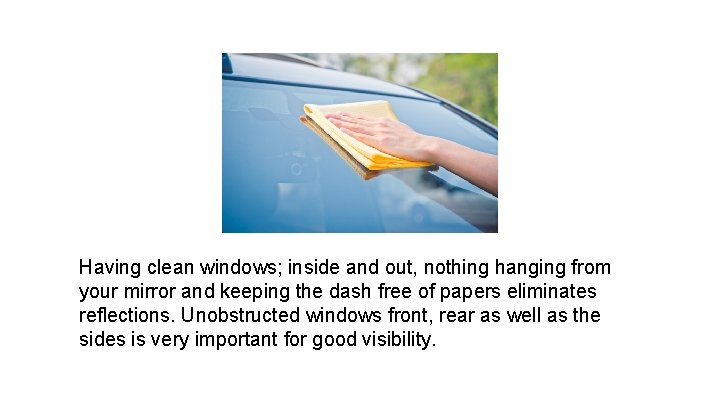
Having clean windows; inside and out, nothing hanging from your mirror and keeping the dash free of papers eliminates reflections. Unobstructed windows front, rear as well as the sides is very important for good visibility.
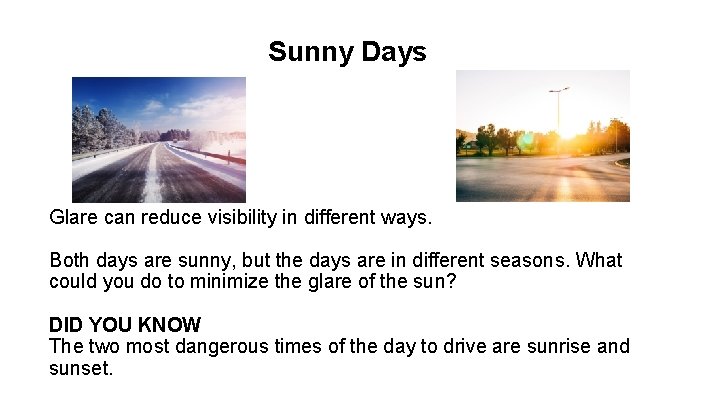
Sunny Days Glare can reduce visibility in different ways. Both days are sunny, but the days are in different seasons. What could you do to minimize the glare of the sun? DID YOU KNOW The two most dangerous times of the day to drive are sunrise and sunset.
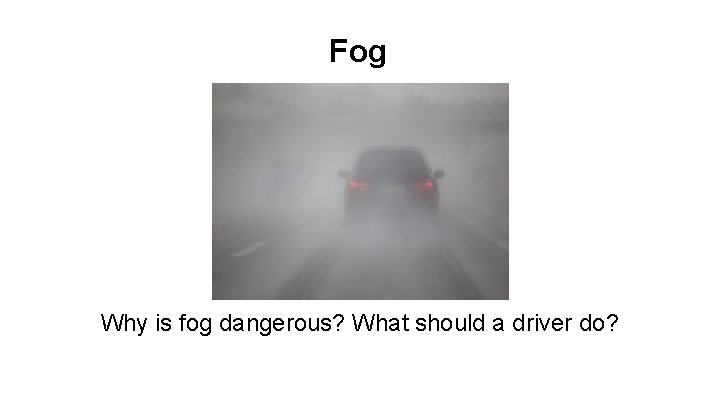
Fog Why is fog dangerous? What should a driver do?
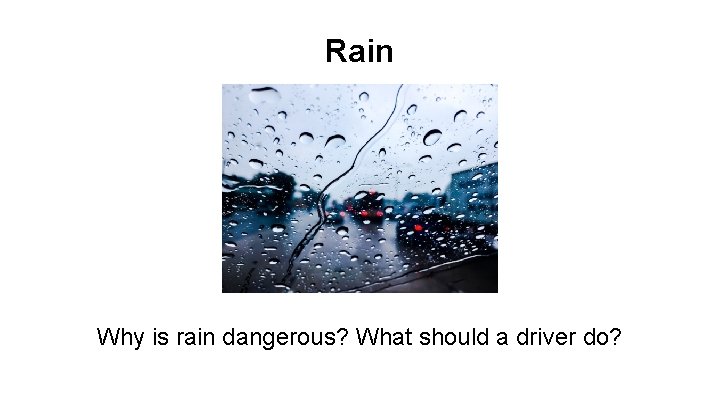
Rain Why is rain dangerous? What should a driver do?
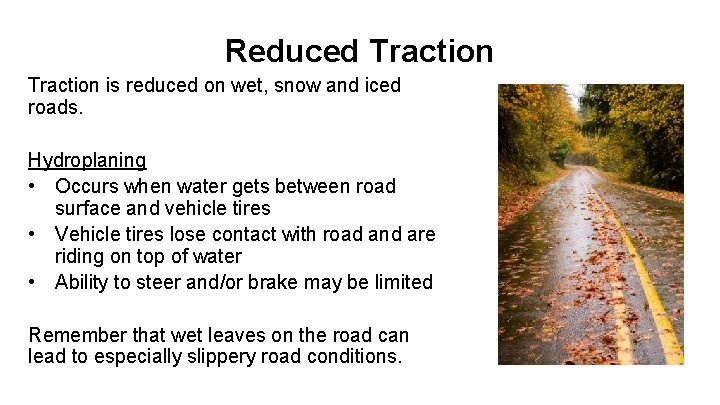
Reduced Traction is reduced on wet, snow and iced roads. Hydroplaning • Occurs when water gets between road surface and vehicle tires • Vehicle tires lose contact with road and are riding on top of water • Ability to steer and/or brake may be limited Remember that wet leaves on the road can lead to especially slippery road conditions.
Downed Power Lines Storms can lead to downed power lines. • Never drive over a downed line or anything in contact with them. • If you are in a vehicle that has come in contact with a downed power line, stay in the vehicle and call 9 -1 -1, unless you see fire or smoke.
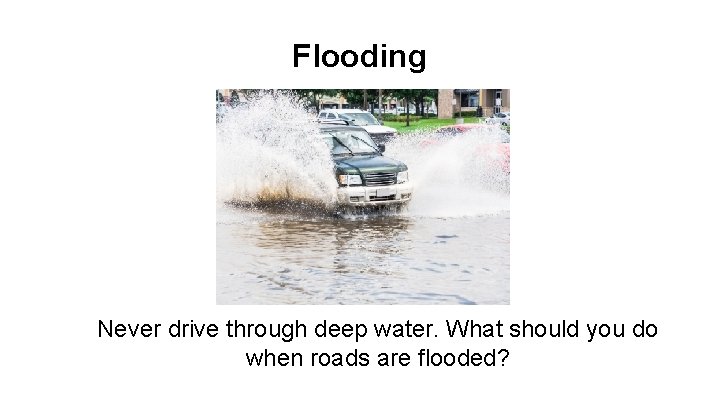
Flooding Never drive through deep water. What should you do when roads are flooded?
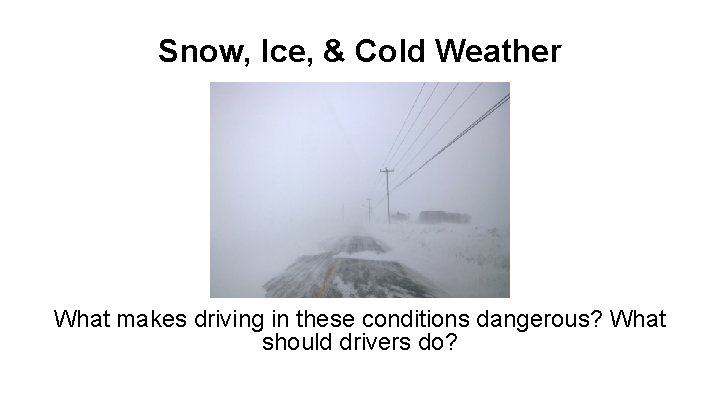
Snow, Ice, & Cold Weather What makes driving in these conditions dangerous? What should drivers do?
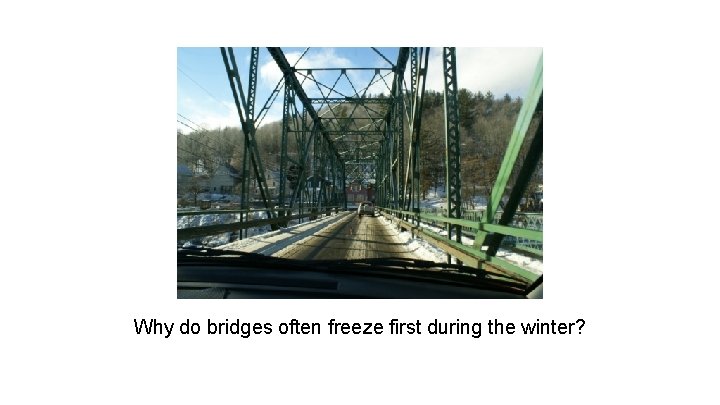
Why do bridges often freeze first during the winter?
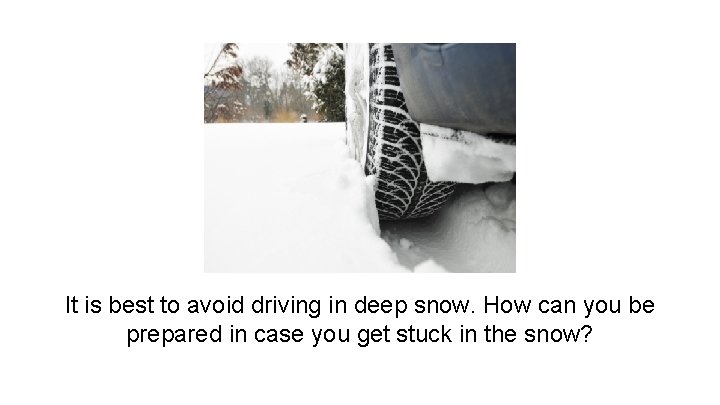
It is best to avoid driving in deep snow. How can you be prepared in case you get stuck in the snow?
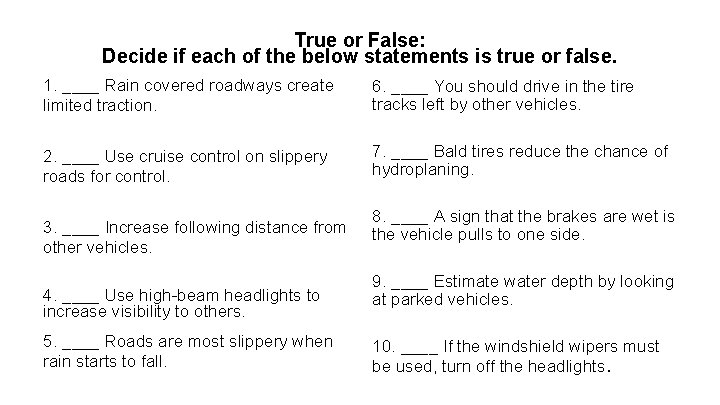
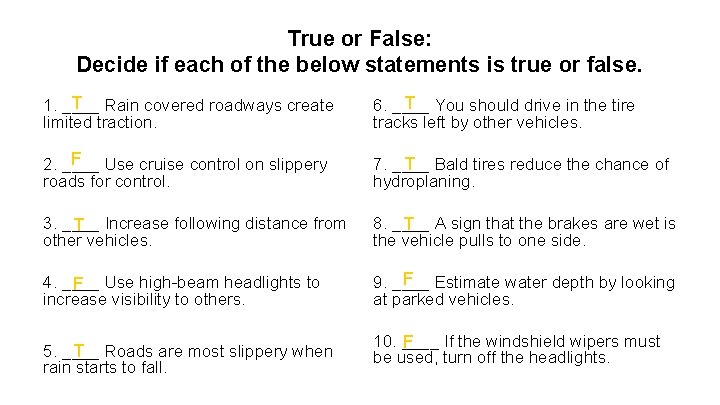
True or False: Decide if each of the below statements is true or false. 1. ____ Rain covered roadways create limited traction. 6. ____ You should drive in the tire tracks left by other vehicles. 2. ____ Use cruise control on slippery roads for control. 7. ____ Bald tires reduce the chance of hydroplaning. 3. ____ Increase following distance from other vehicles. 4. ____ Use high-beam headlights to increase visibility to others. 5. ____ Roads are most slippery when rain starts to fall. 8. ____ A sign that the brakes are wet is the vehicle pulls to one side. 9. ____ Estimate water depth by looking at parked vehicles. 10. ____ If the windshield wipers must be used, turn off the headlights.
True or False: Decide if each of the below statements is true or false. T Rain covered roadways create 1. ____ limited traction. T You should drive in the tire 6. ____ tracks left by other vehicles. F Use cruise control on slippery 2. ____ roads for control. T Bald tires reduce the chance of 7. ____ hydroplaning. 3. ____ T Increase following distance from other vehicles. 8. ____ T A sign that the brakes are wet is the vehicle pulls to one side. 4. ____ F Use high-beam headlights to increase visibility to others. F Estimate water depth by looking 9. ____ at parked vehicles. T Roads are most slippery when 5. ____ rain starts to fall. 10. ____ If the windshield wipers must F be used, turn off the headlights.
Evasive Actions • Response to emergency events like skidding and vehicle failures • New technology assists with vehicle control
Evasive Steering • Steering around an obstacle is preferred to braking at speeds above 25 mph. 2 Why? • Remember, in wet weather, sudden braking often leads to skids. 2 Acceptable Methods 1. Push-Pull Method 2. Fixed Hand Steering Method (shortcoming: arms may get locked together as you attempt to steer past 180 degrees, limiting ability to make further fine adjustments).
Evasive Braking • You may be forced in some emergency situations to brake quickly, if swerving to another space is not an option or you failed to identify an open space. • Use the heel-pivot method. • If you have ABS, apply steady direct pressure on the brake; if not use squeeze braking (keep heel on floor and use toes to apply pressure to brake). 3
Evasive Acceleration • This technique is not frequently used, but it can be helpful to avoid crashes at intersections and in merging situations. • Can you think of any other situations where you might have to evasively accelerate?
Skidding • Skidding is a situation in which your tires lose all or part of their grip on the road. • This can be the result from accelerating or braking too hard, steering too much or too quickly, or entering a curve with too much speed.
Preventing Skidding • Apply the brakes in a smooth and progressive manner. • Make smooth, precise steering wheel movements. • Slow down well in advance of curves. • Maintain speeds appropriate for conditions. • Avoid shifting to lower gears in slick conditions.
Vehicle Breakdowns Regardless of how well vehicles are maintained, there always is a possibility that they may break down with little or no warning. Being visible in these situations is critical for safety: – Set out flares or other high-visibility warning devices such as reflective triangles. – Put your hazard lights on. – Remain in your vehicle and call for help.
Vehicle Indicator Light Meanings • Your vehicle can provide you with valuable information about performance, BUT only if you know what indicator lights mean. • What are some especially important vehicle indicator lights?
Engine Failure • How will you know? – May hear a loud bang, and the noise may continue – May lose power to the engine although may still be able to drive • What should you do? – – – Shift to NEUTRAL Search for a safe place off the road Put on your flashers to indicate that you are in trouble DO NOT BRAKE Carefully work your way over to closest side of the road and pull off
Engine Overheating • How will you know? – Temperature gauge will go into “red zone” – May start to see steam coming from under the hood • What to do? – – Turn off AC system Turn on your heater Pull off the road if the temperature does not go down DO NOT OPEN RADIATOR
Accelerator Failure • How will you know? – The gas pedal will not move up or down – The “RPM’s” may increase – Vehicle may start to pick up speed • What should you do? – – – Stay calm and shift to neutral May want to try pumping gas pedal to see if it will respond Search for a safe place to get off the road Steer smoothly/brake as gently as possible Pull off roadway Turn off vehicle
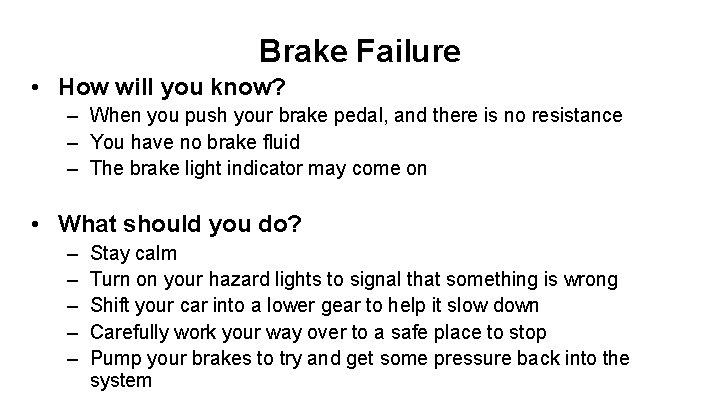
Brake Failure • How will you know? – When you push your brake pedal, and there is no resistance – You have no brake fluid – The brake light indicator may come on • What should you do? – – – Stay calm Turn on your hazard lights to signal that something is wrong Shift your car into a lower gear to help it slow down Carefully work your way over to a safe place to stop Pump your brakes to try and get some pressure back into the system
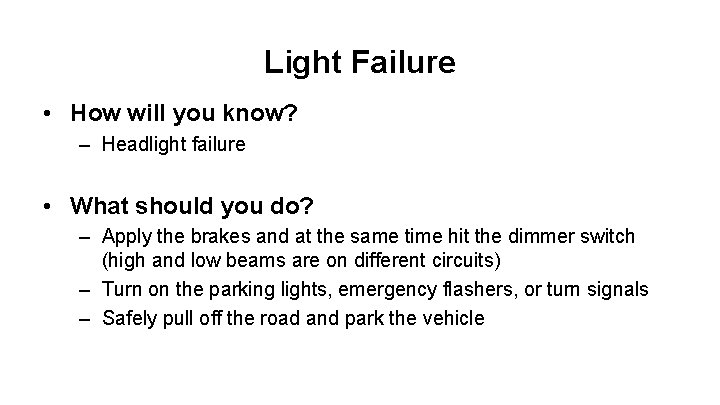
Light Failure • How will you know? – Headlight failure • What should you do? – Apply the brakes and at the same time hit the dimmer switch (high and low beams are on different circuits) – Turn on the parking lights, emergency flashers, or turn signals – Safely pull off the road and park the vehicle
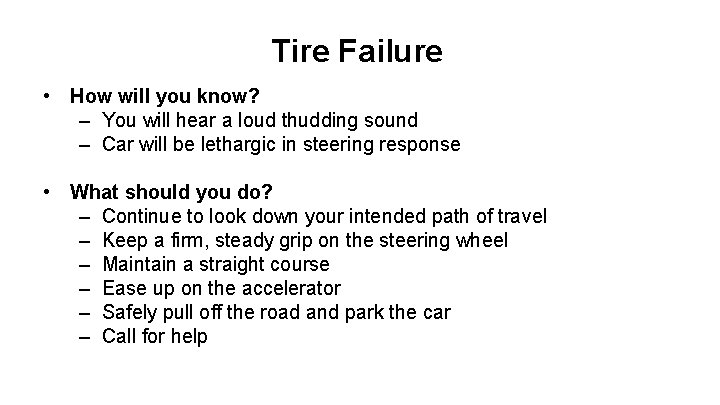
Tire Failure • How will you know? – You will hear a loud thudding sound – Car will be lethargic in steering response • What should you do? – Continue to look down your intended path of travel – Keep a firm, steady grip on the steering wheel – Maintain a straight course – Ease up on the accelerator – Safely pull off the road and park the car – Call for help
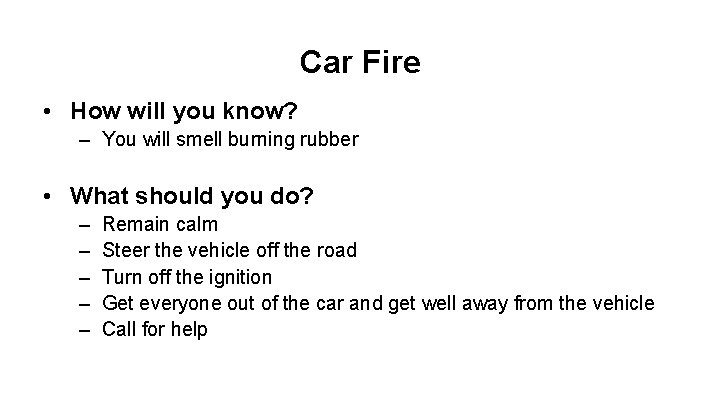
Car Fire • How will you know? – You will smell burning rubber • What should you do? – – – Remain calm Steer the vehicle off the road Turn off the ignition Get everyone out of the car and get well away from the vehicle Call for help
Vehicle Feature Learning Activity • List vehicle features and technology that can assist drivers in traction and steering control.
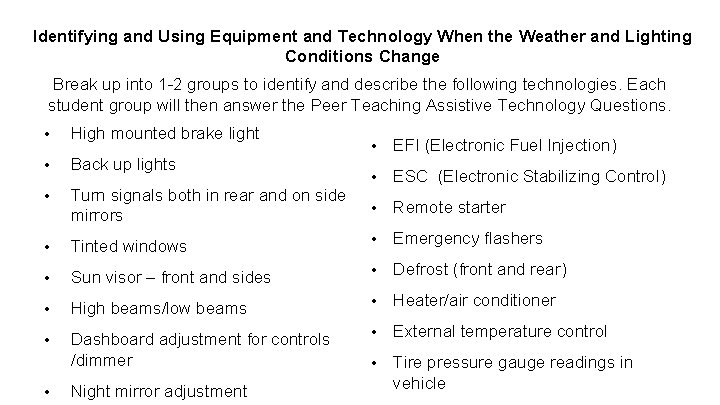
Identifying and Using Equipment and Technology When the Weather and Lighting Conditions Change Break up into 1 -2 groups to identify and describe the following technologies. Each student group will then answer the Peer Teaching Assistive Technology Questions. • High mounted brake light • Back up lights • Turn signals both in rear and on side mirrors • • EFI (Electronic Fuel Injection) • ESC (Electronic Stabilizing Control) • Remote starter Tinted windows • Emergency flashers • Sun visor – front and sides • Defrost (front and rear) • High beams/low beams • Heater/air conditioner • Dashboard adjustment for controls /dimmer • External temperature control • Tire pressure gauge readings in vehicle • Night mirror adjustment
Peer Teaching: Assistive Technology Questions • How does this technology work? • What environments or conditions is it appropriate for? • What are the pros of using this technology? • What are the cons of using this technology?
References 1. 2. 3. AAA. Infographic- Headlights. http: //newsneaaa. iprsoftware. com/file? fid=556 ca 7585 e 8 eef 1 f 5 fafb 89 e AAA. Get A Grip. A Guide to Wet-Weather Driving Techniques. 2012. https: //exchange. aaa. com/wp-content/uploads/2012/09/Get-a-Grip. pdf AAA. Senior Driving. AAA. com: Avoiding Crashes and Emergency Maneuvers. https: //seniordriving. aaa. com/improve-your-driving-skills/handle-unexpectedsituations/avoiding-crashes-emergency/