
Adversarial Search CS 30 David Kauchak Spring 2016
- Slides: 71
Adversarial Search CS 30 David Kauchak Spring 2016 Some material borrowed from : Sara Owsley Sood and others
Admin • Assignment 10 out – May work in groups of up to 4 people – Due Sunday 4/24 (though, don’t wait until the weekend to finish!)
A quick review of search Problem solving via search: • To define the state space, define three things: – is_goal – next_states – starting state Uninformed search vs. informed search – what’s the difference? – what are the techniques we’ve seen? – pluses and minuses?
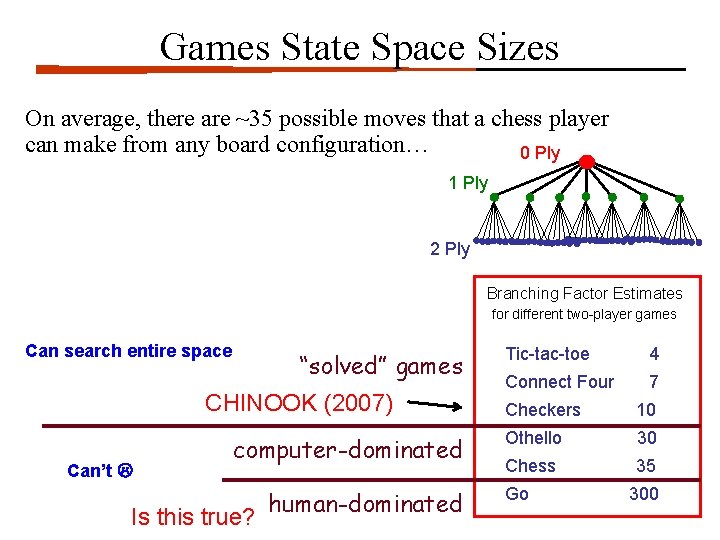
Why should we study games? Clear success criteria Important historically for AI Fun Good application of search – hard problems (chess 35100 states in search space, 1040 legal states) Some real-world problems fit this model – game theory (economics) – multi-agent problems
Types of games What are some of the games you’ve played?
Types of games: game properties single-player vs. 2 -player vs. multiplayer Fully observable (perfect information) vs. partially observable Discrete vs. continuous real-time vs. turn-based deterministic vs. non-deterministic (chance)
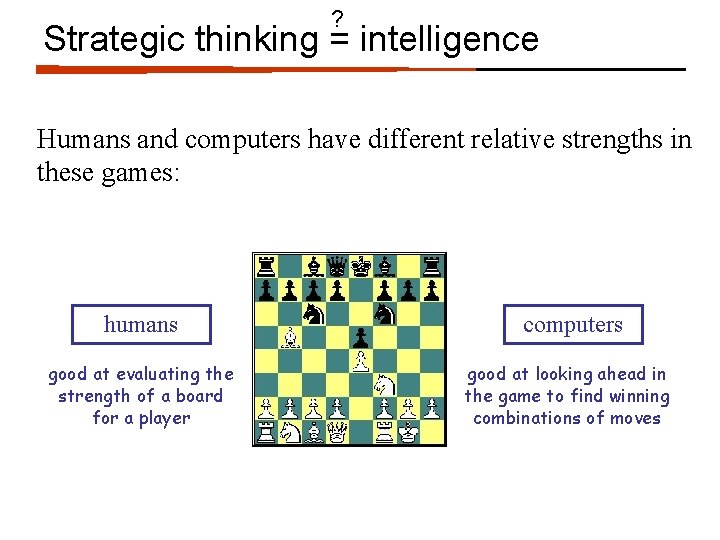
? Strategic thinking = intelligence For reasons previously stated, two-player games have been a focus of AI since its inception… Begs the question: Is strategic thinking the same as intelligence?
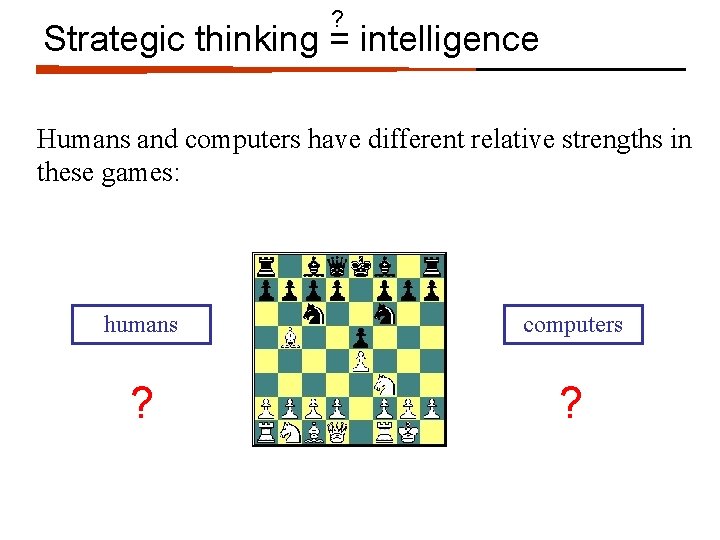
? Strategic thinking = intelligence Humans and computers have different relative strengths in these games: humans computers ? ?
? Strategic thinking = intelligence Humans and computers have different relative strengths in these games: humans good at evaluating the strength of a board for a player computers good at looking ahead in the game to find winning combinations of moves
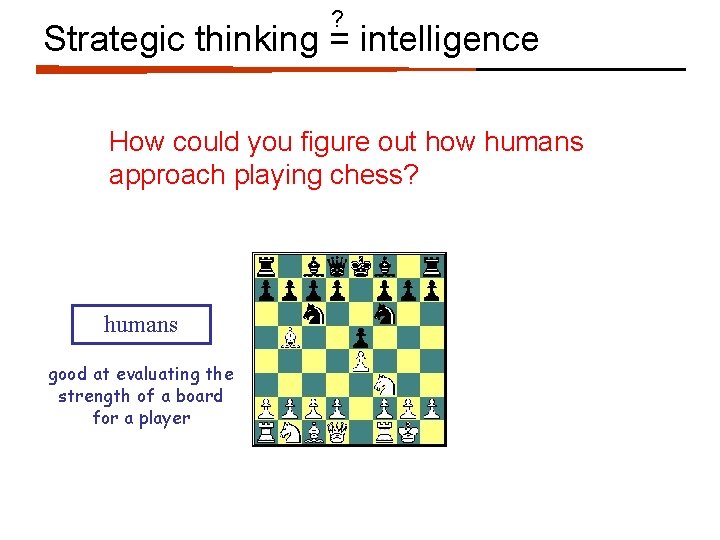
? Strategic thinking = intelligence How could you figure out how humans approach playing chess? humans good at evaluating the strength of a board for a player
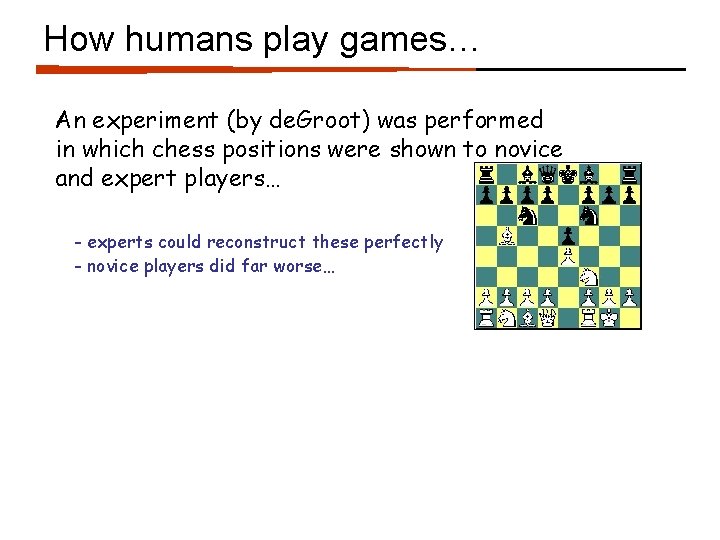
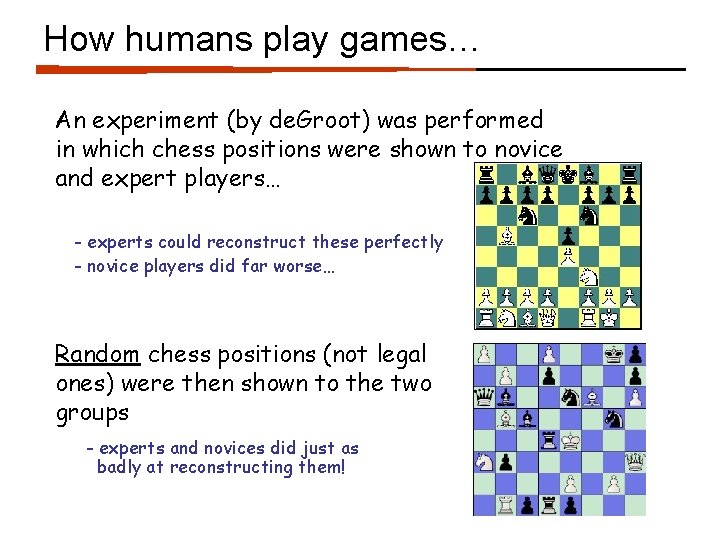
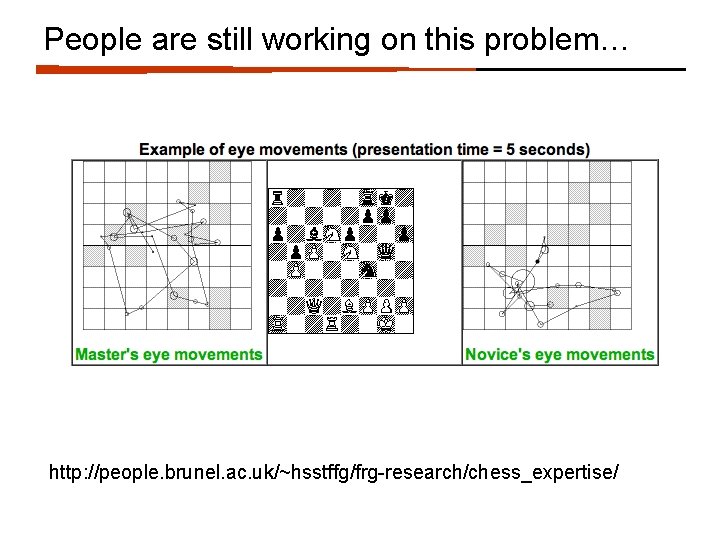
How humans play games… An experiment (by de. Groot) was performed in which chess positions were shown to novice and expert players… - experts could reconstruct these perfectly - novice players did far worse…
How humans play games… An experiment (by de. Groot) was performed in which chess positions were shown to novice and expert players… - experts could reconstruct these perfectly - novice players did far worse… Random chess positions (not legal ones) were then shown to the two groups - experts and novices did just as badly at reconstructing them!
People are still working on this problem… http: //people. brunel. ac. uk/~hsstffg/frg-research/chess_expertise/
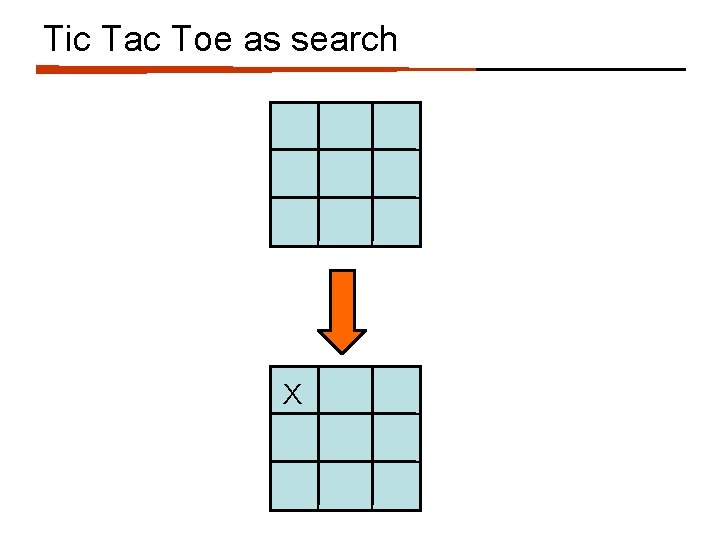
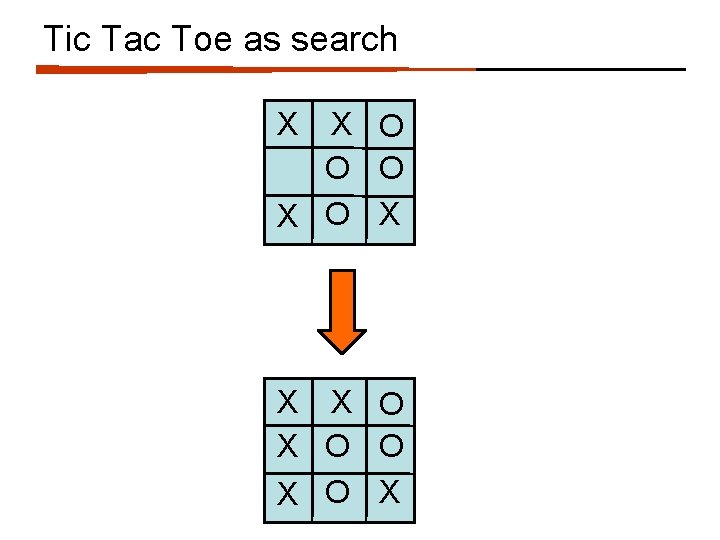
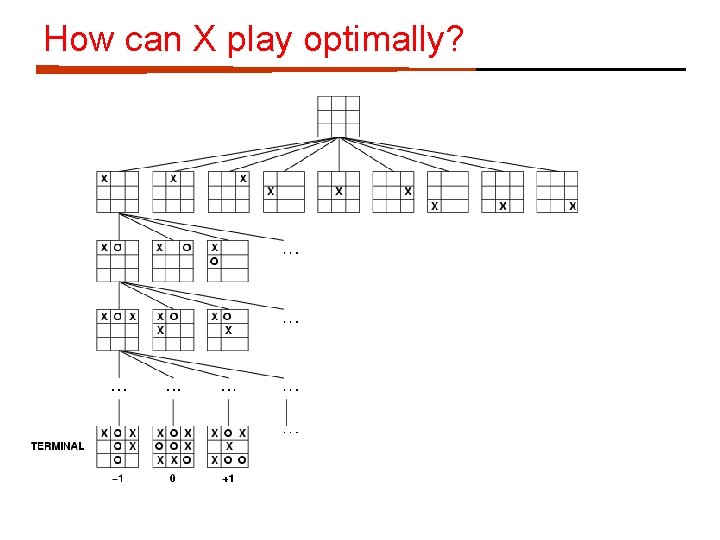
Tic Tac Toe as search If we want to write a program to play tic tac toe, what question are we trying to answer? Given a state (i. e. board configuration), what move should we make!
Tic Tac Toe as search X
Tic Tac Toe as search X X O O O X X X O O X
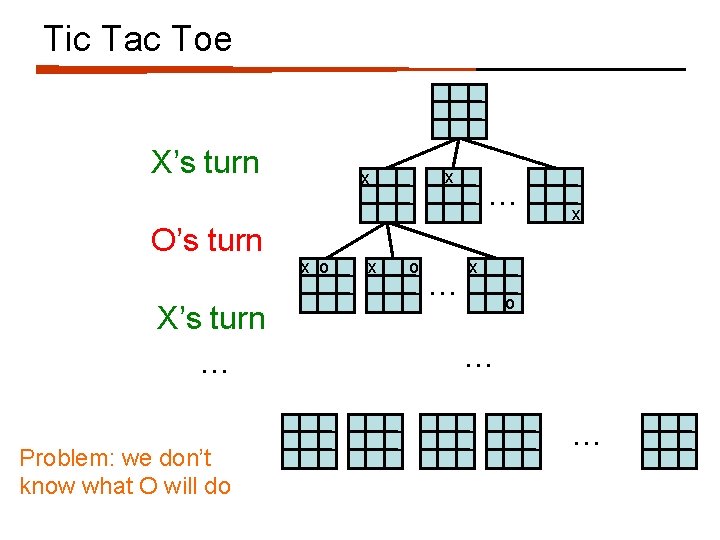
Tic Tac Toe as search How can we pose this as a search problem?
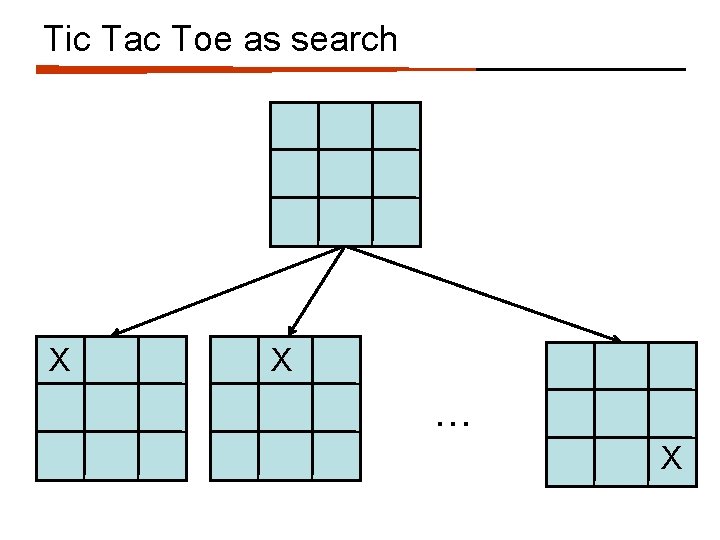
Tic Tac Toe as search X X … X
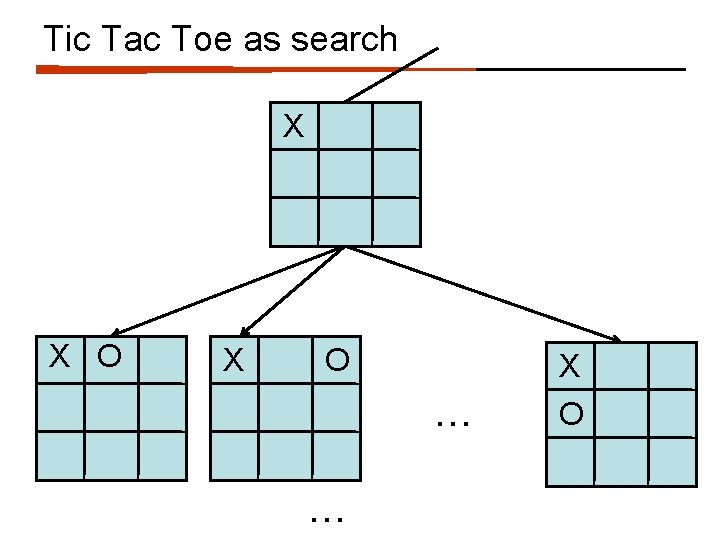
Tic Tac Toe as search X X O … … X O
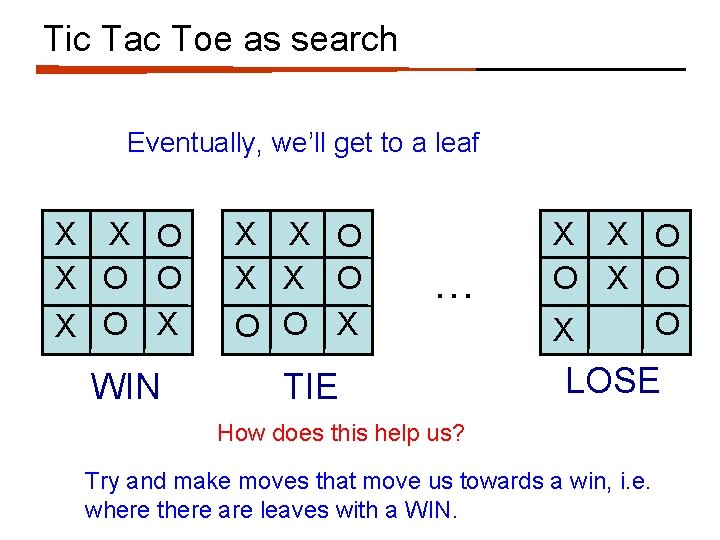
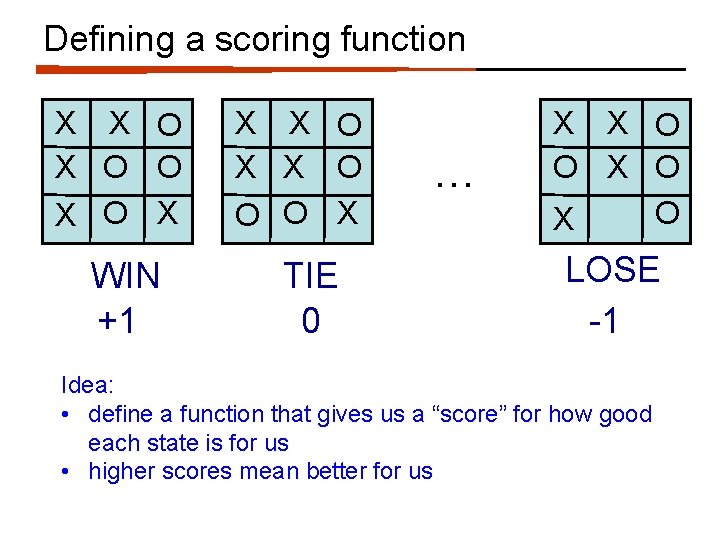
Tic Tac Toe as search Eventually, we’ll get to a leaf X X O O X WIN X X O O O X … TIE X X O O X LOSE How does this help us? Try and make moves that move us towards a win, i. e. where there are leaves with a WIN.
Tic Tac Toe X’s turn O’s turn X’s turn … Problem: we don’t know what O will do x x x o … …
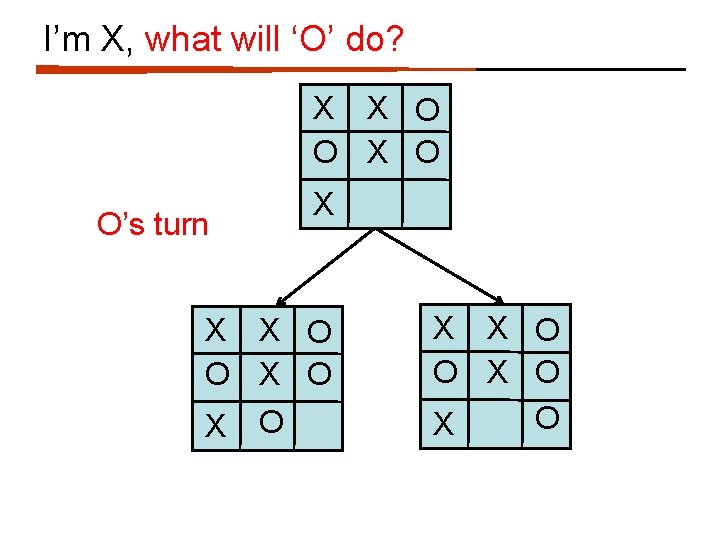
I’m X, what will ‘O’ do? X X O O’s turn X X X O O X O X X O O X
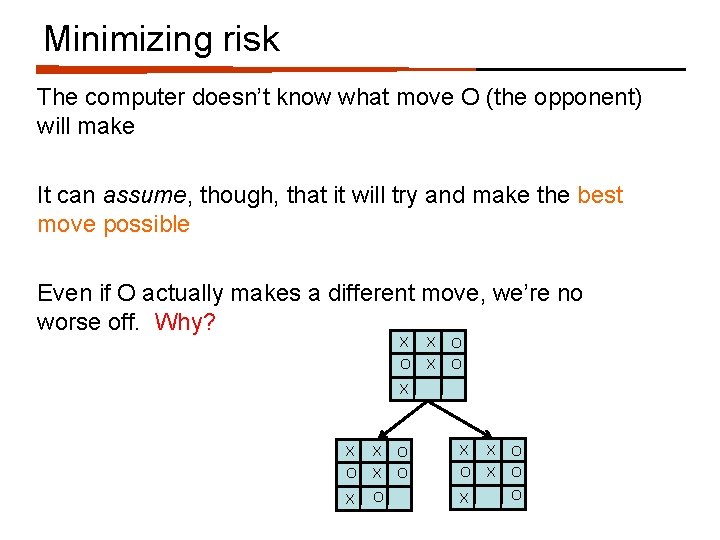
Minimizing risk The computer doesn’t know what move O (the opponent) will make It can assume, though, that it will try and make the best move possible Even if O actually makes a different move, we’re no worse off. Why? X X O O X X X O O O
Optimal Strategy An Optimal Strategy is one that is at least as good as any other, no matter what the opponent does – If there's a way to force the win, it will – Will only lose if there's no other option
Defining a scoring function X X O O X WIN +1 X X O O O X TIE 0 … X X O O X LOSE -1 Idea: • define a function that gives us a “score” for how good each state is for us • higher scores mean better for us
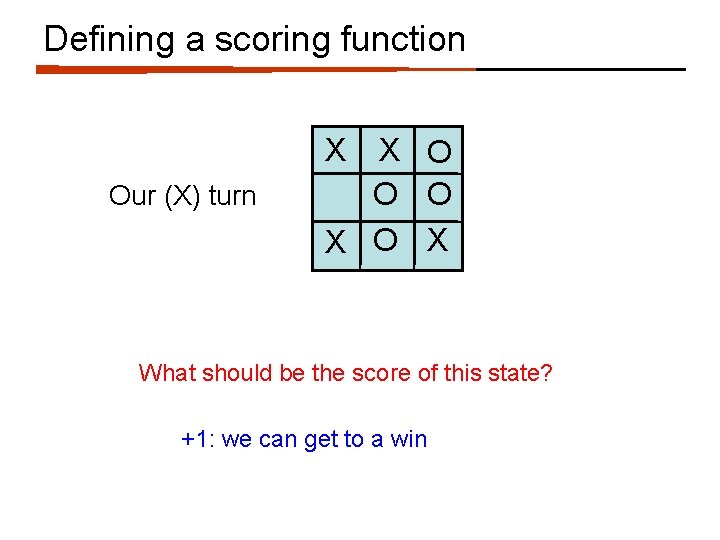
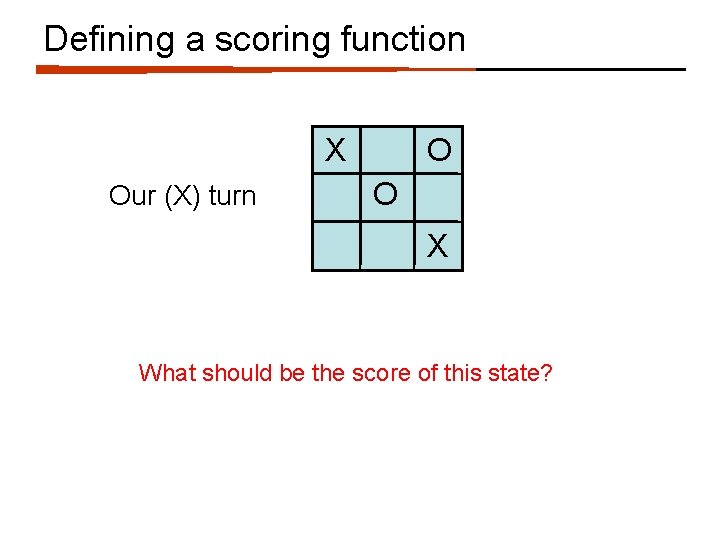
Defining a scoring function X Our (X) turn X O O O X What should be the score of this state? +1: we can get to a win
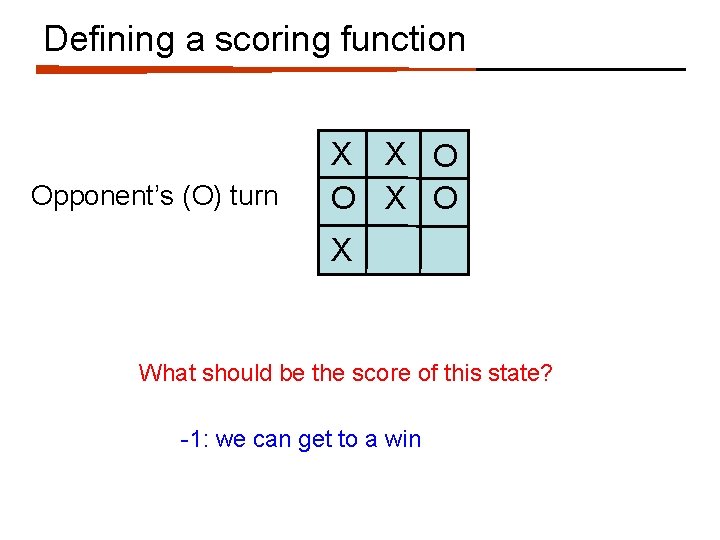
Defining a scoring function Opponent’s (O) turn X X O O X What should be the score of this state? -1: we can get to a win
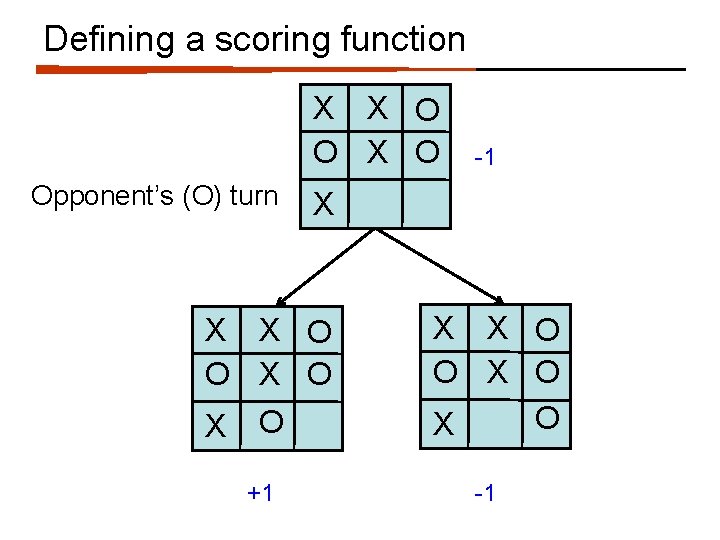
Defining a scoring function X X O Opponent’s (O) turn X X X O O X O +1 -1 X X O O X -1
Defining a scoring function X Our (X) turn O O X What should be the score of this state?
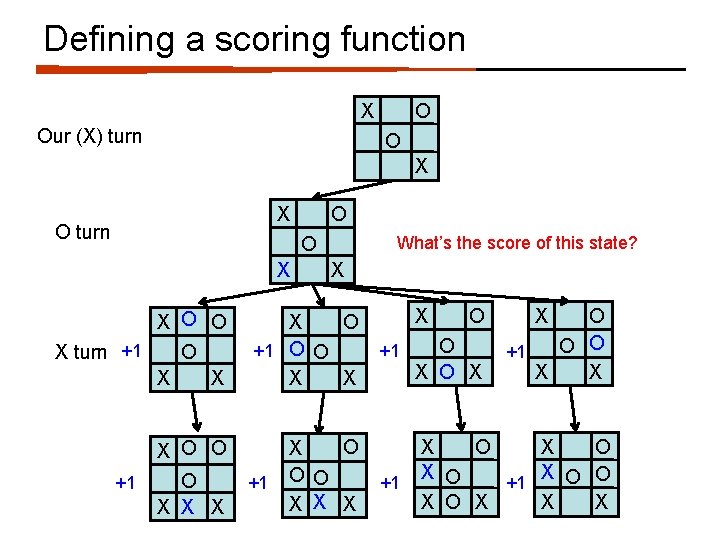
Defining a scoring function X Our (X) turn O O X X O turn O What’s the score of this state? O X X X O O X turn +1 O X X X O +1 O O X X X O X O O X X X +1 +1 O O X X O O O +1 X X X O X O O +1 X O X X X
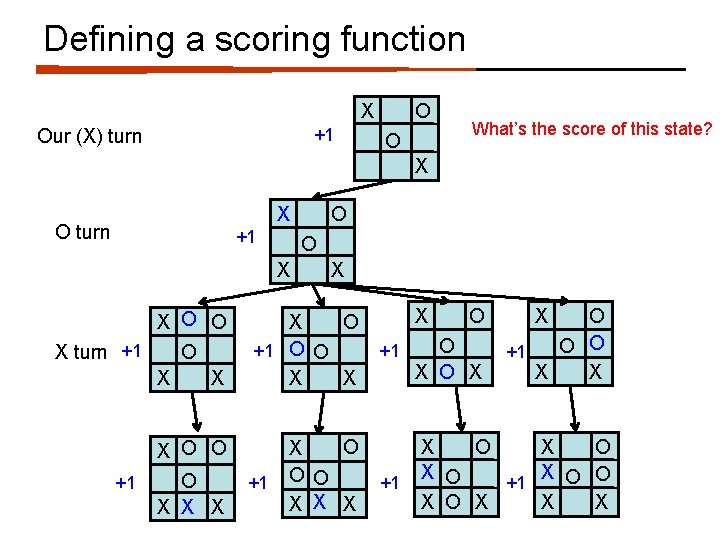
Defining a scoring function X +1 Our (X) turn O O What’s the score of this state? X X O turn +1 O O X X X O O X turn +1 O X X X O +1 O O X X X O X O O X X X +1 +1 O O X X O O O +1 X X X O X O O +1 X O X X X
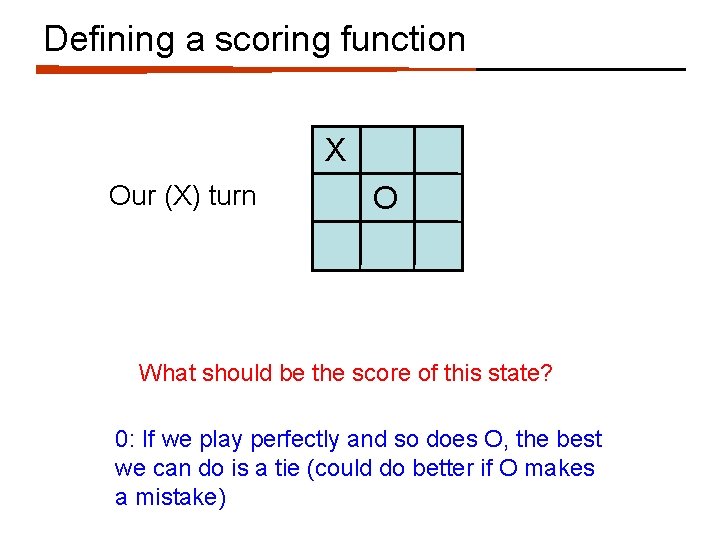
Defining a scoring function X Our (X) turn O What should be the score of this state? 0: If we play perfectly and so does O, the best we can do is a tie (could do better if O makes a mistake)
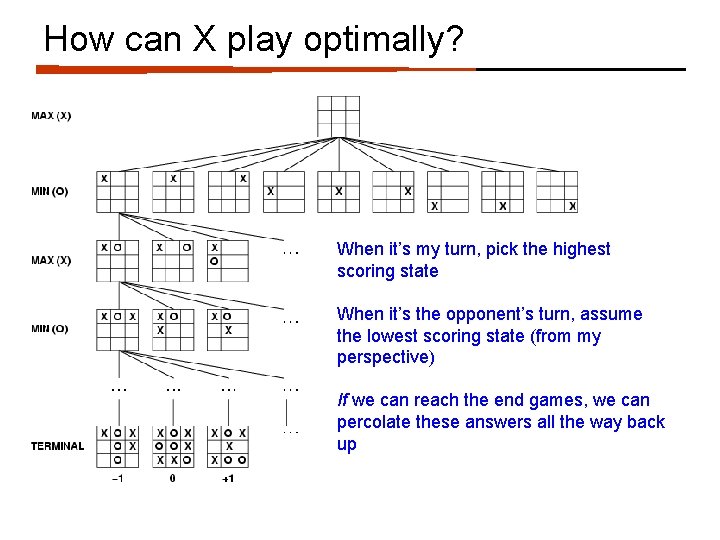
How can X play optimally?
How can X play optimally? When it’s my turn, pick the highest scoring state When it’s the opponent’s turn, assume the lowest scoring state (from my perspective) If we can reach the end games, we can percolate these answers all the way back up
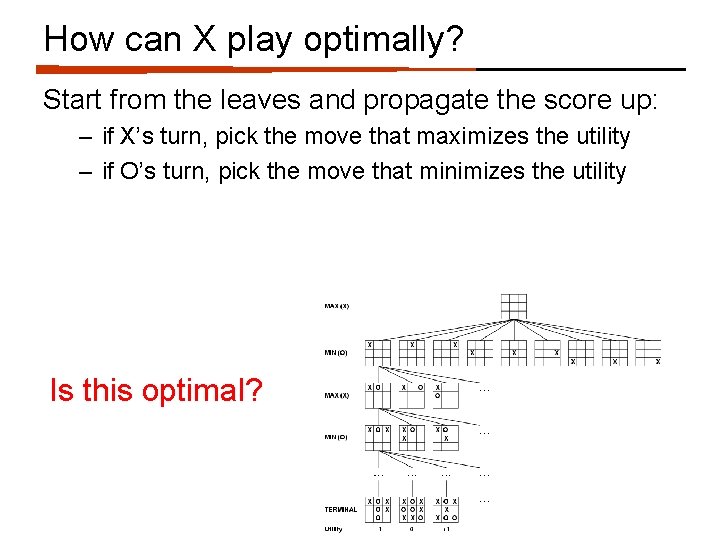
How can X play optimally? Start from the leaves and propagate the score up: – if X’s turn, pick the move that maximizes the utility – if O’s turn, pick the move that minimizes the utility Is this optimal?
Minimax Algorithm: An Optimal Strategy minimax(state) = - if state is a terminal state Utility(state) - if MY turn return the maximum of minimax(. . . ) on all next states of state - if OPPONENTS turn return the minimum of minimax(…) on all next states of state • Uses recursion to compute the “value” of each state • Proceeds to the leaves, then the values are “backed up” through the tree as the recursion unwinds • What type of search is this? • What does this assume about how MIN will play? What if this isn’t true?
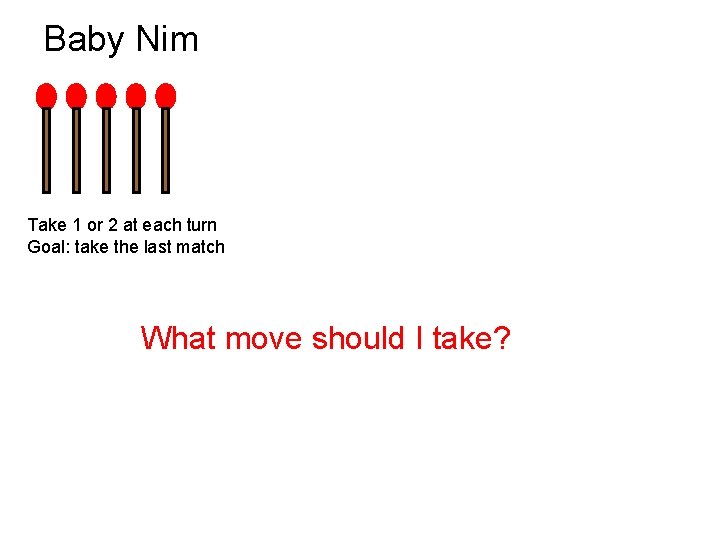
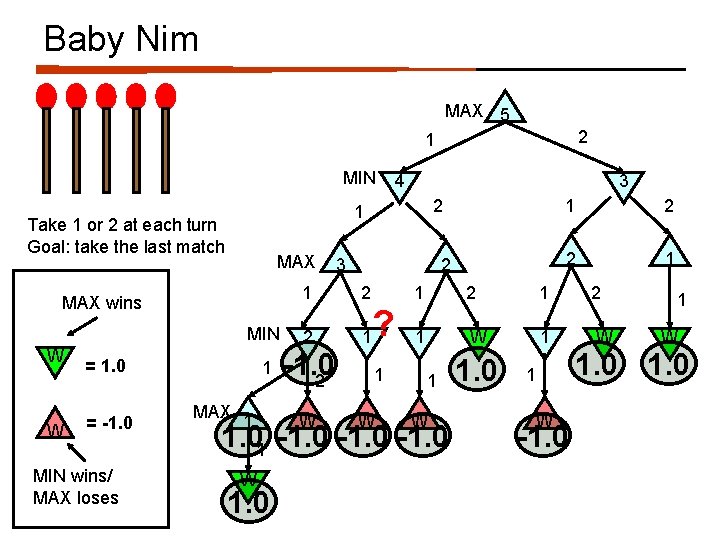
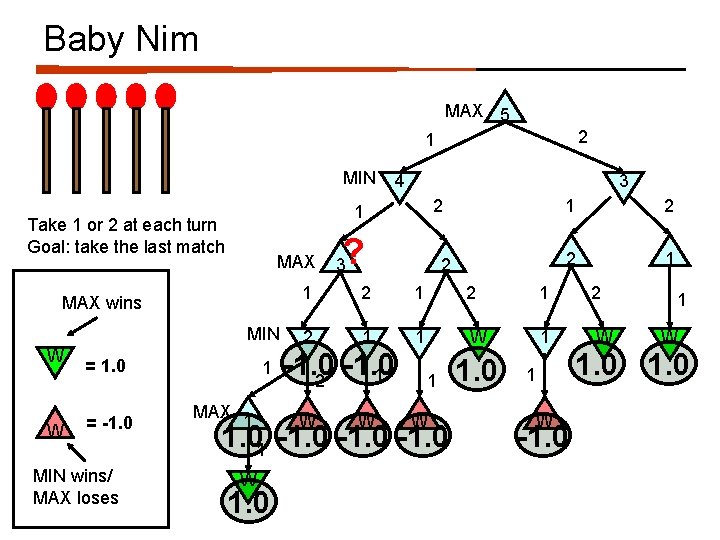
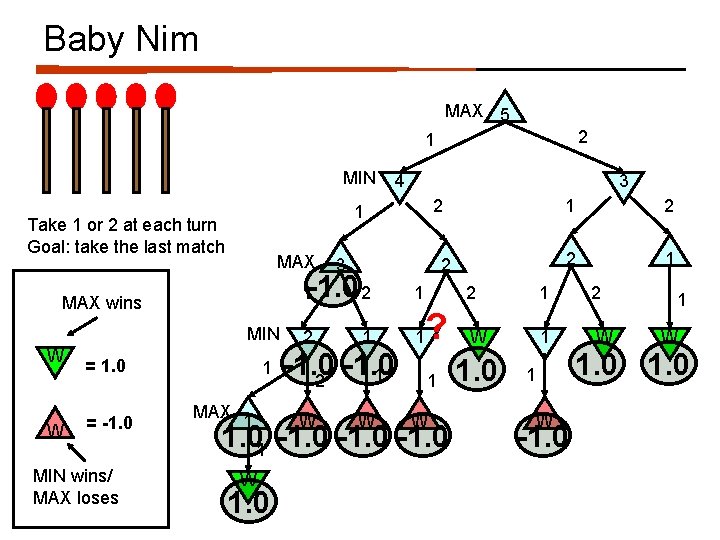
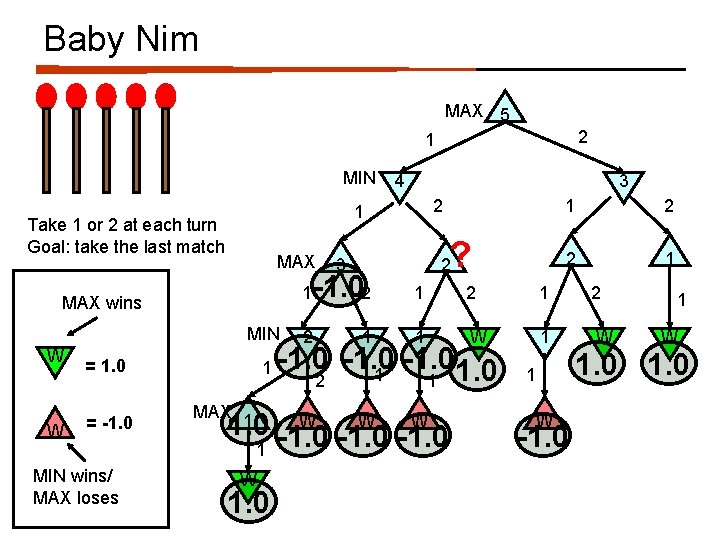
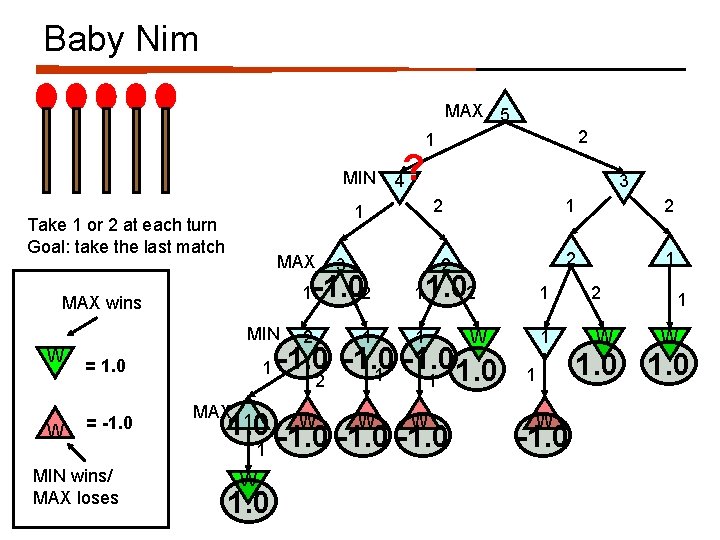
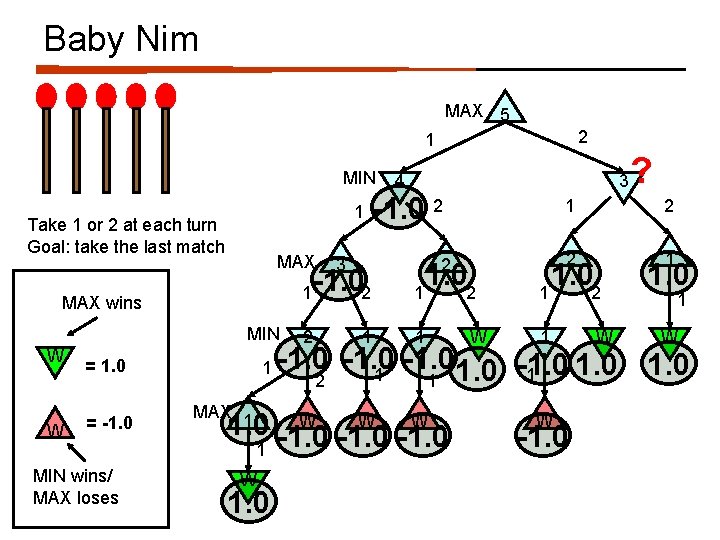
Baby Nim Take 1 or 2 at each turn Goal: take the last match What move should I take?
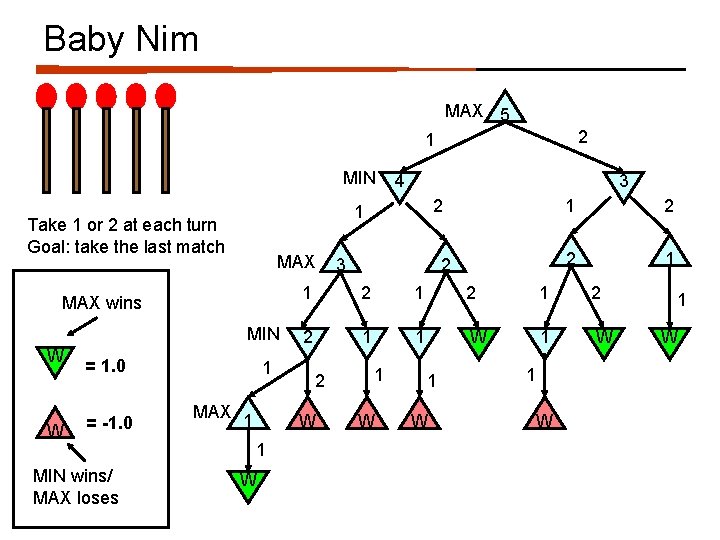
Baby Nim MAX 5 2 1 MIN MAX wins MIN W = 1. 0 = -1. 0 MIN wins/ MAX loses 3 2 1 Take 1 or 2 at each turn Goal: take the last match W 4 1 MAX 1 W 2 2 2 1 1 2 1 2 2 1 1 W 2 W 1 3 1 1 W 1 W
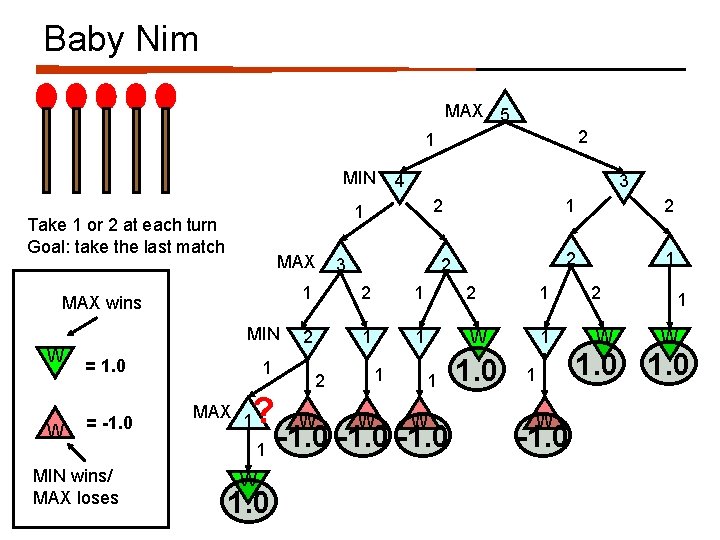
Baby Nim MAX 5 2 1 MIN MAX wins MIN W = 1. 0 = -1. 0 MIN wins/ MAX loses 3 2 1 Take 1 or 2 at each turn Goal: take the last match W 4 1 ? MAX 1 1 W 1. 0 3 2 1 2 2 1 1 W 2 W 1 W -1. 0 1 W -1. 0
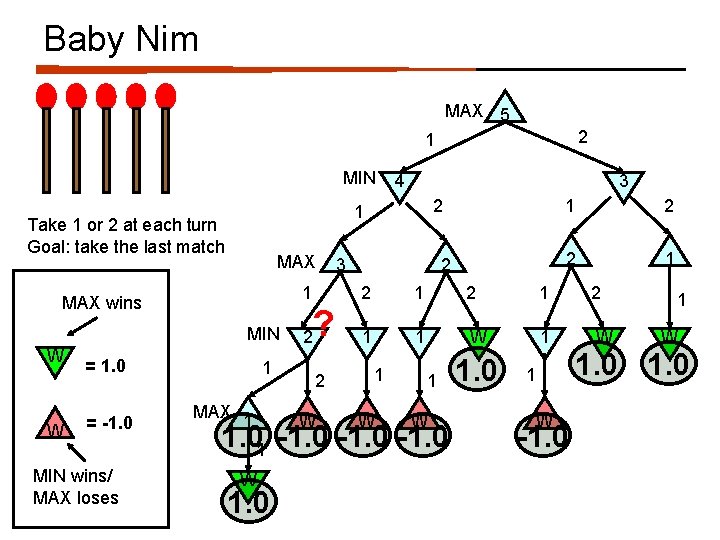
Baby Nim MAX 5 2 1 MIN MAX 1 MAX wins MIN W = 1. 0 = -1. 0 MIN wins/ MAX loses 3 2 1 Take 1 or 2 at each turn Goal: take the last match W 4 1 MAX 1 2 ? 2 W 3 2 1. 0 2 2 1 2 1 1 W 1 W 1. 01 -1. 0 W 1 1. 0 1 W -1. 0
Baby Nim MAX 5 2 1 MIN MAX W 2 2 MIN 2 1 1 -1. 0 2 = 1. 0 MIN wins/ MAX loses 2 3 1 MAX wins = -1. 0 3 1 Take 1 or 2 at each turn Goal: take the last match W 4 MAX 1 W ? 1 W 1. 0 2 2 1 1 2 1 W 1 W 1. 01 -1. 0 W 1 1. 0 1 W -1. 0
Baby Nim MAX 5 2 1 MIN MAX wins MIN W = 1. 0 = -1. 0 MIN wins/ MAX loses 3 2 1 Take 1 or 2 at each turn Goal: take the last match W 4 1 MAX 1 ? 3 2 1. 0 2 2 1 1 2 1 2 2 1 1 W -1. 0 1 2 W W 1. 01 -1. 0 W 1 1. 0 1 W -1. 0
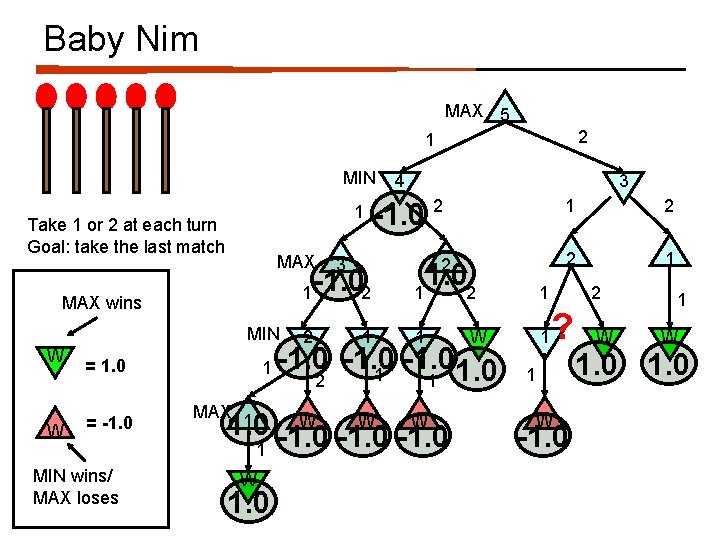
Baby Nim MAX 5 2 1 MIN MAX MIN W = 1. 0 MIN wins/ MAX loses 2 3 1 MAX 1 2 -1. 0 2 1 1 MAX wins = -1. 0 3 1 Take 1 or 2 at each turn Goal: take the last match W 4 1 -1. 0 1 2 W W ? 1 W 1. 01 -1. 0 W 1. 0 1 2 2 1 2 W 1. 0 1 W -1. 0
Baby Nim MAX 5 2 1 MIN MAX 1 MAX wins MIN W = 1. 0 = -1. 0 MIN wins/ MAX loses 3 2 1 Take 1 or 2 at each turn Goal: take the last match W 4 1 MAX 1 -1. 02 2 ? 3 1 2 W 1. 0 2 1 2 1 W 1 W W W 1. 0 -1. 0 1 2 1 -1. 0 1 2 1 1 W 1. 0 1 W -1. 0
Baby Nim MAX 5 MIN MAX 1 MAX wins MIN W = 1. 0 = -1. 0 MIN wins/ MAX loses 4 1 MAX 1 3 -1. 02 2 1 3 2 1 Take 1 or 2 at each turn Goal: take the last match W ? 2 1 1. 02 1 W -1. 0 1 2 1 W W W 1. 0 -1. 0 1 W 1. 0 1 2 2 1 1 2 1 W 1. 0 1 W -1. 0
Baby Nim MAX 5 2 1 MIN 1 Take 1 or 2 at each turn Goal: take the last match MAX 1 MAX wins MIN W W = 1. 0 = -1. 0 MIN wins/ MAX loses 1 MAX 1 3 -1. 02 2 4 1 2 2 1 1. 02 1 W W W 1. 0 -1. 0 1 W 1. 0 2 2 1 1 W -1. 0 1 1 1 2 ? W 1. 0 1 W -1. 0
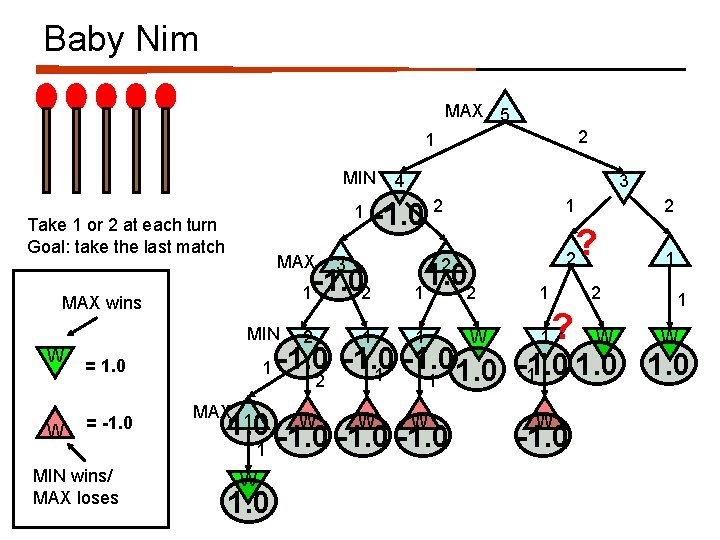
Baby Nim MAX 5 2 1 MIN 1 Take 1 or 2 at each turn Goal: take the last match MAX 1 MAX wins MIN W W = 1. 0 = -1. 0 MIN wins/ MAX loses 1 MAX 1 3 -1. 02 2 4 1 2 W 1. 0 2 2 1 1. 02 1 W 1 1 2 ? W 1 1 W -1. 0 1 1 2 1 W W W 1. 0 -1. 0 1 1 W -1. 0
Baby Nim MAX 5 2 1 MIN 1 Take 1 or 2 at each turn Goal: take the last match MAX 1 MAX wins MIN W W = 1. 0 = -1. 0 MIN wins/ MAX loses 1 MAX 1 3 -1. 02 2 4 1 2 2 1 1. 02 1 W 1. 0 2 2 ? 1 1. 02 1 W -1. 0 1 1 2 1 W W W 1. 0 -1. 0 1 W 1 1 W -1. 0
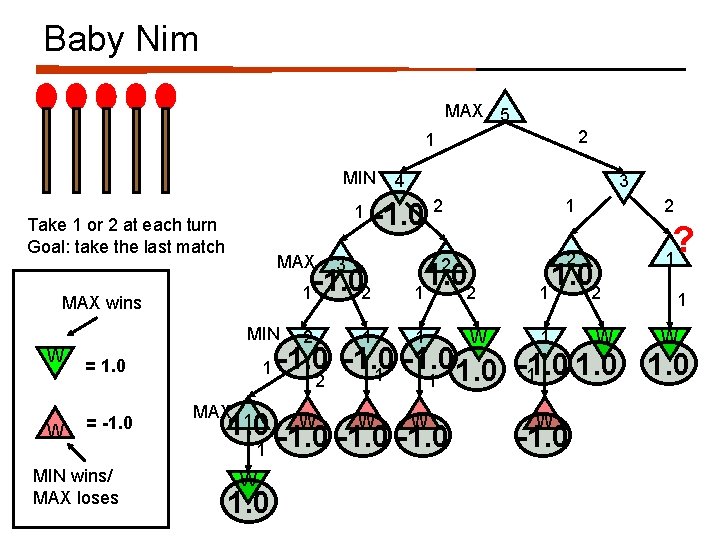
Baby Nim MAX 5 2 1 MIN 1 Take 1 or 2 at each turn Goal: take the last match MAX 1 MAX wins MIN W W = 1. 0 = -1. 0 MIN wins/ MAX loses 1 MAX 1 3 -1. 0 2 3 -1. 02 2 4 1 2 1 1. 02 1 W 1. 0 1 2 2 1 1. 02 1 W 1. 0 1 W -1. 0 1 1 2 1 W W W 1. 0 -1. 0 1 W 1 ? W -1. 0
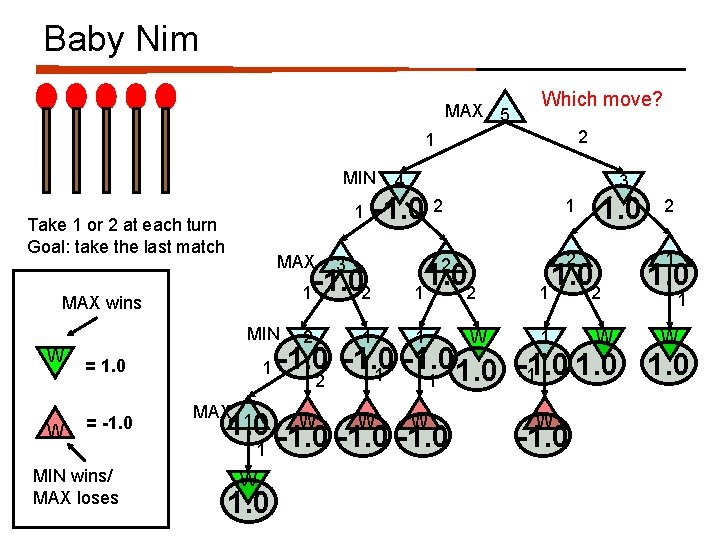
Baby Nim MAX 5 Which move? 2 1 MIN 1 Take 1 or 2 at each turn Goal: take the last match MAX 1 MAX wins MIN W W = 1. 0 = -1. 0 MIN wins/ MAX loses 1 MAX 1 3 -1. 0 2 3 -1. 02 2 4 1 1 1. 02 1 W 1. 0 2 2 1 1. 02 1 W 2 1 1. 0 1 W -1. 0 1 1 2 1 W W W 1. 0 -1. 0 1 1 W -1. 0
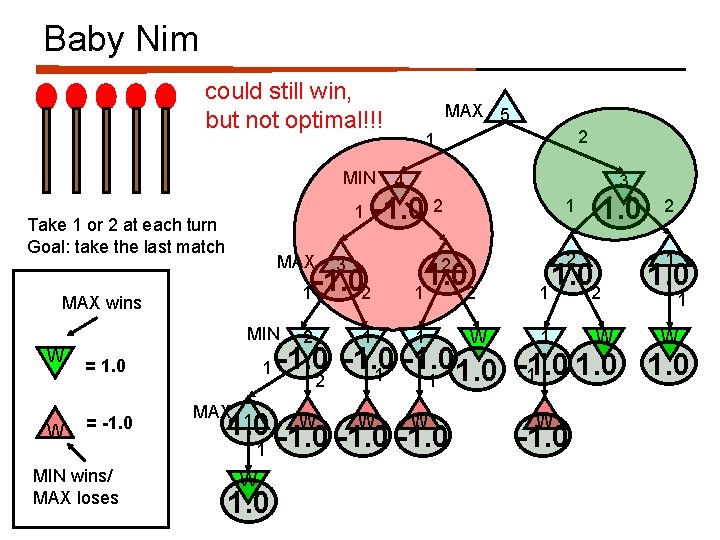
Baby Nim could still win, but not optimal!!! MIN 1 Take 1 or 2 at each turn Goal: take the last match MAX 1 MAX wins MIN W W = 1. 0 = -1. 0 MIN wins/ MAX loses 1 MAX 1 1 2 1 4 3 -1. 0 2 3 -1. 02 2 MAX 5 1 1. 02 1 W 1. 0 2 2 1 1. 02 1 W 2 1 1. 0 1 W -1. 0 1 1 2 1 W W W 1. 0 -1. 0 1 1 W -1. 0
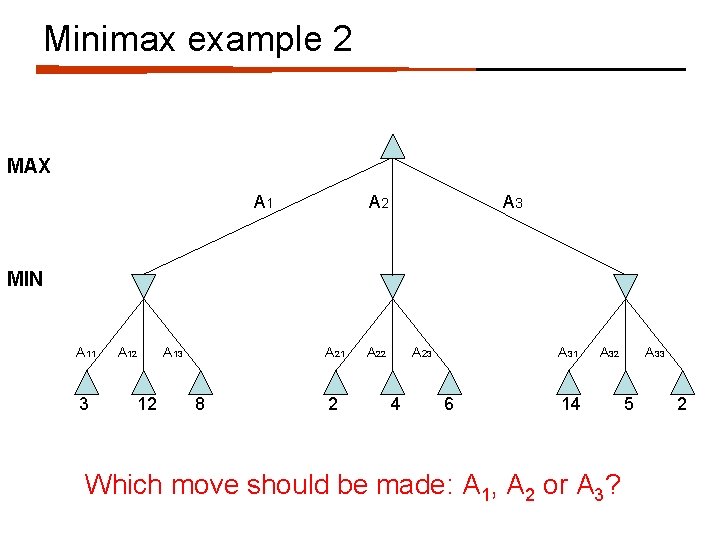
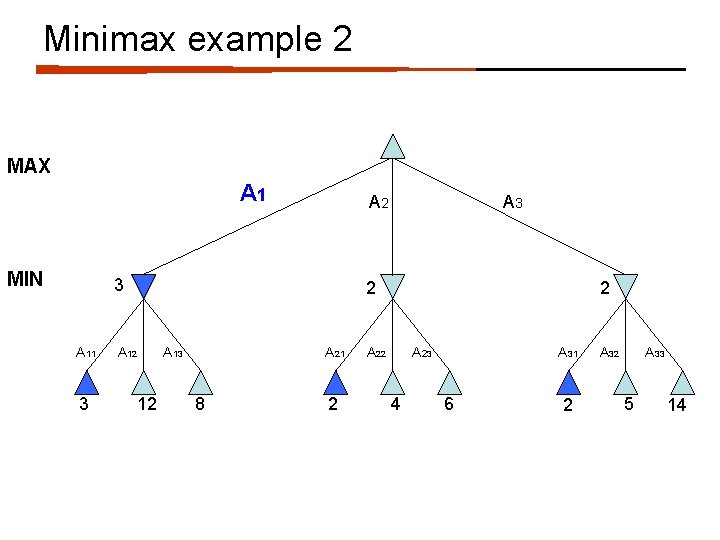
Minimax example 2 MAX A 1 A 2 A 3 MIN A 11 3 A 12 12 A 13 A 21 8 2 A 23 4 A 31 6 A 32 14 Which move should be made: A 1, A 2 or A 3? A 33 5 2
Minimax example 2 MAX A 1 MIN A 2 3 A 11 3 A 3 2 A 12 12 A 13 A 21 8 2 2 A 23 4 A 31 6 2 A 33 5 14
Properties of minimax Minimax is optimal! Are we done?
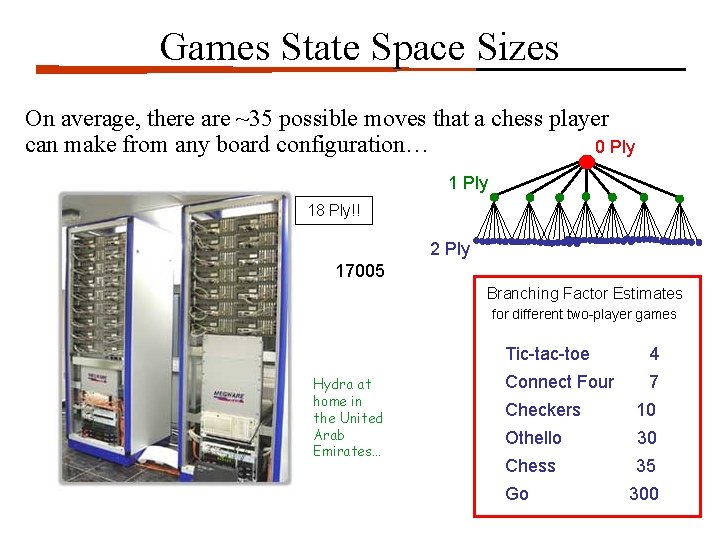
Games State Space Sizes On average, there are ~35 possible moves that a chess player can make from any board configuration… 0 Ply 18 Ply!! 2 Ply 17005 Branching Factor Estimates for different two-player games Hydra at home in the United Arab Emirates… Tic-tac-toe 4 Connect Four 7 Checkers 10 Othello 30 Chess 35 Go 300
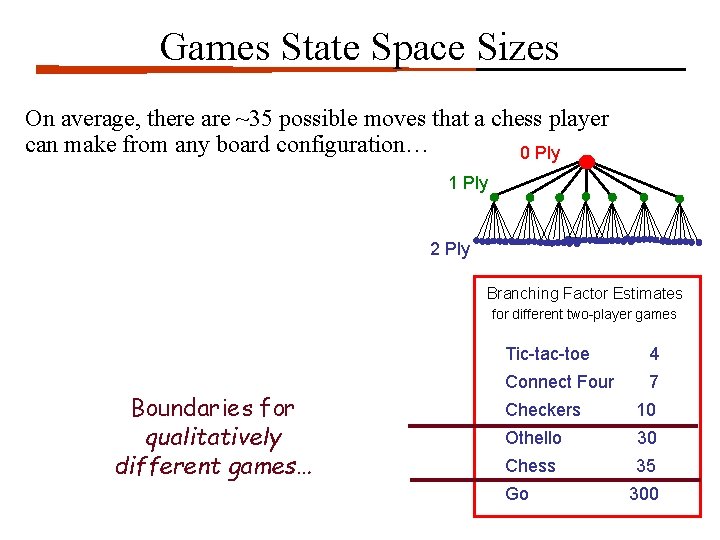
Games State Space Sizes On average, there are ~35 possible moves that a chess player can make from any board configuration… 0 Ply 1 Ply 2 Ply Branching Factor Estimates for different two-player games Boundaries for qualitatively different games… Tic-tac-toe 4 Connect Four 7 Checkers 10 Othello 30 Chess 35 Go 300
Games State Space Sizes On average, there are ~35 possible moves that a chess player can make from any board configuration… 0 Ply 1 Ply 2 Ply Branching Factor Estimates for different two-player games Can search entire space “solved” games CHINOOK (2007) Can’t computer-dominated Is this true? human-dominated Tic-tac-toe 4 Connect Four 7 Checkers 10 Othello 30 Chess 35 Go 300
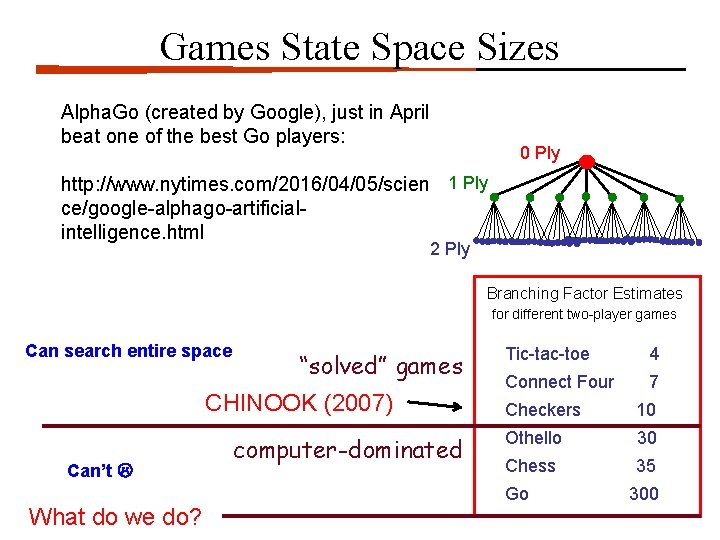
Games State Space Sizes Alpha. Go (created by Google), just in April beat one of the best Go players: 0 Ply http: //www. nytimes. com/2016/04/05/scien 1 Ply ce/google-alphago-artificialintelligence. html 2 Ply Branching Factor Estimates for different two-player games Can search entire space “solved” games CHINOOK (2007) Can’t What do we do? computer-dominated Tic-tac-toe 4 Connect Four 7 Checkers 10 Othello 30 Chess 35 Go 300
Alpha-Beta pruning
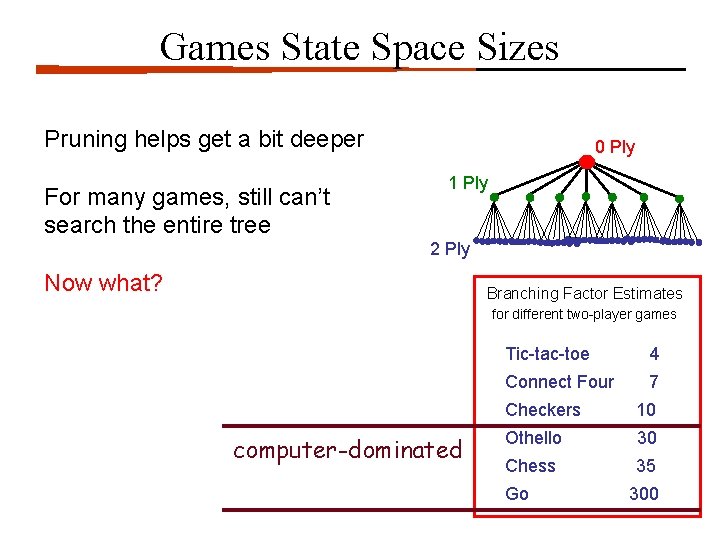
Games State Space Sizes Pruning helps get a bit deeper For many games, still can’t search the entire tree 0 Ply 1 Ply 2 Ply Now what? Branching Factor Estimates for different two-player games computer-dominated Tic-tac-toe 4 Connect Four 7 Checkers 10 Othello 30 Chess 35 Go 300
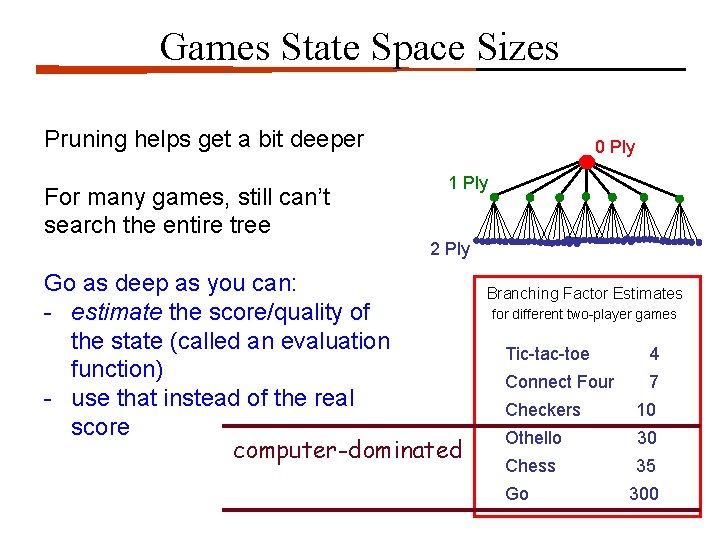
Games State Space Sizes Pruning helps get a bit deeper For many games, still can’t search the entire tree 0 Ply 1 Ply 2 Ply Go as deep as you can: - estimate the score/quality of the state (called an evaluation function) - use that instead of the real score computer-dominated Branching Factor Estimates for different two-player games Tic-tac-toe 4 Connect Four 7 Checkers 10 Othello 30 Chess 35 Go 300
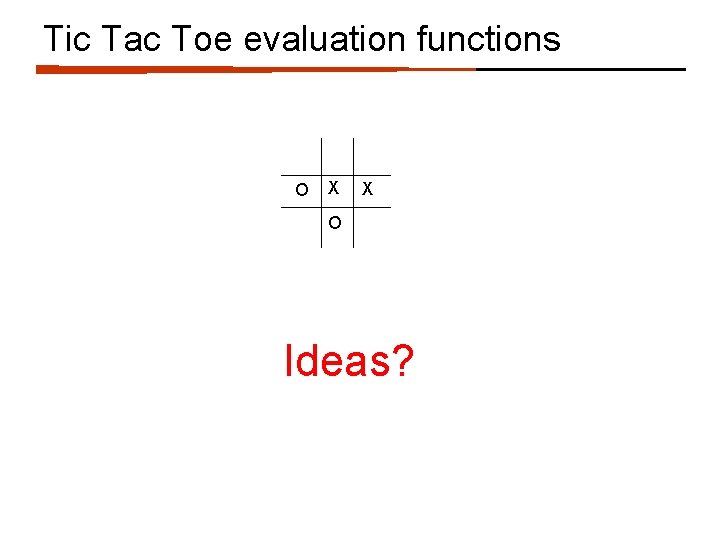
Tic Tac Toe evaluation functions O X X O Ideas?
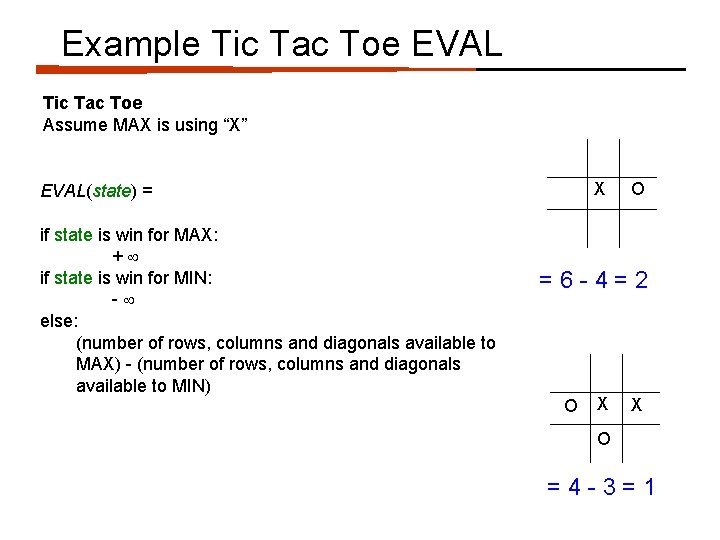
Example Tic Tac Toe EVAL Tic Tac Toe Assume MAX is using “X” X EVAL(state) = if state is win for MAX: + if state is win for MIN: - else: (number of rows, columns and diagonals available to MAX) - (number of rows, columns and diagonals available to MIN) O =6 -4=2 O X X O =4 -3=1
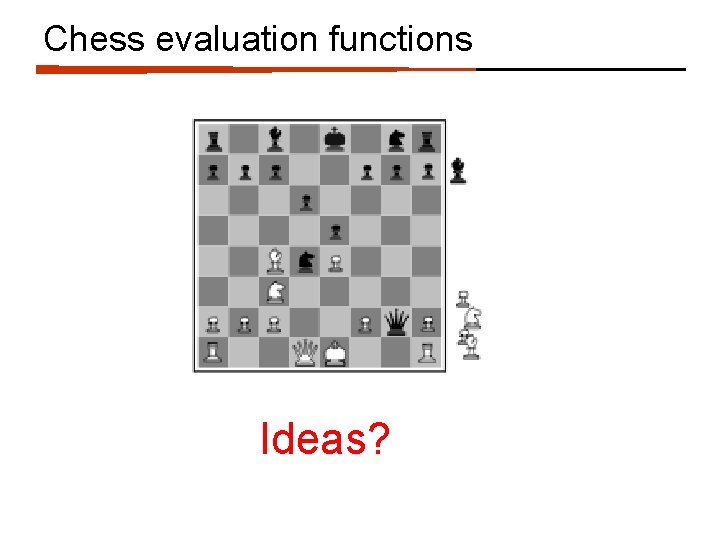
Chess evaluation functions Ideas?
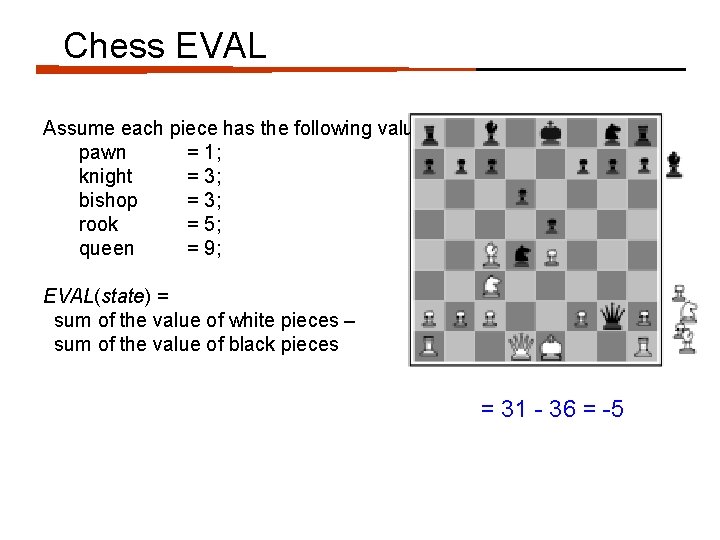
Chess EVAL Assume each piece has the following values pawn = 1; knight = 3; bishop = 3; rook = 5; queen = 9; EVAL(state) = sum of the value of white pieces – sum of the value of black pieces = 31 - 36 = -5
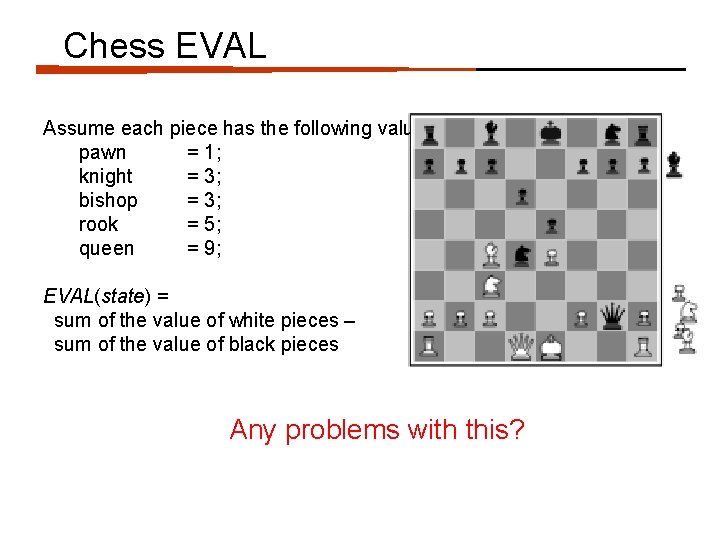
Chess EVAL Assume each piece has the following values pawn = 1; knight = 3; bishop = 3; rook = 5; queen = 9; EVAL(state) = sum of the value of white pieces – sum of the value of black pieces Any problems with this?
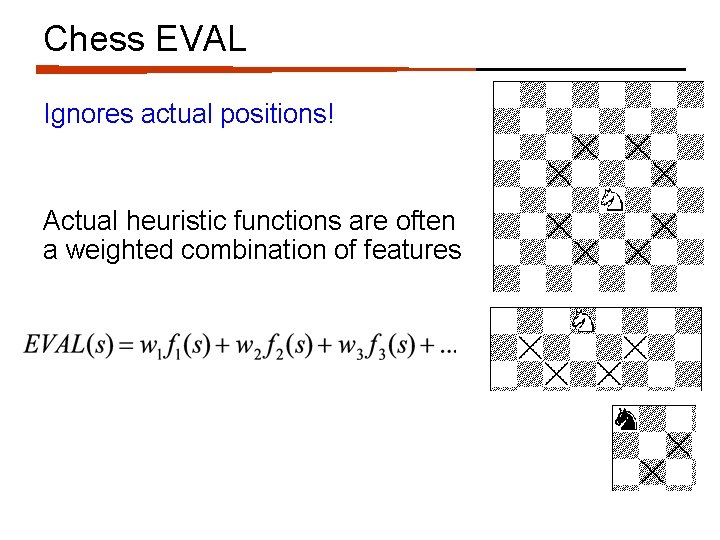
Chess EVAL Ignores actual positions! Actual heuristic functions are often a weighted combination of features
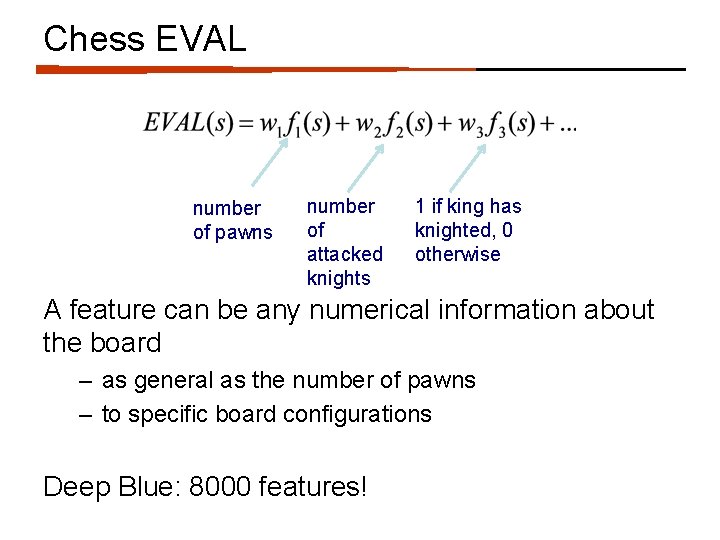
Chess EVAL number of pawns number of attacked knights 1 if king has knighted, 0 otherwise A feature can be any numerical information about the board – as general as the number of pawns – to specific board configurations Deep Blue: 8000 features!
history/end-game tables History – keep track of the quality of moves from previous games – use these instead of search end-game tables – do a reverse search of certain game configurations, for example all board configurations with king, rook and king – tells you what to do in any configuration meeting this criterion – if you ever see one of these during search, you lookup exactly what to do
end-game tables Devastatingly good Allows much deeper branching – for example, if the end-game table encodes a 20 -move finish and we can search up to 14 – can search up to depth 34 Stiller (1996) explored all end-games with 5 pieces – one case check-mate required 262 moves! Knoval (2006) explored all end-games with 6 pieces – one case check-mate required 517 moves! Traditional rules of chess require a capture or pawn move within 50 or it’s a stalemate
Opening moves At the very beginning, we’re the farthest possible from any goal state People are good with opening moves Tons of books, etc. on opening moves Most chess programs use a database of opening moves rather than search