
Adversarial Risk Analysis for Urban Security Jesus Rios
Adversarial Risk Analysis for Urban Security Jesus Rios, IBM Research David Rios, Cesar Gil, D. Banks
Outline • Adversarial Risk Analysis • The sequential Defend-Attack-Defend Model • Urban security resource allocation problem • Discussion 2
Adversarial Risk Analysis • A framework to manage risks from actions of intelligent adversaries • One-sided prescriptive support – Use a SEU model – Treat the adversary’s decision as uncertainties • New method to predict adversary’s actions – We assume the adversary is an expected utility maximizer • Model his decision problem • Assess his probabilities and utilities • Find his action of maximum expected utility – But other descriptive models are possible • Uncertainty in the Attacker’s decision stems from – our uncertainty about his probabilities and utilities 3

Defend–Attack–Defend model • Two intelligent players – Defender – Attacker • Sequential moves – Defender moves first, deploying defense resources – Attacker observes Defender’s move and choose an attack – Defender moves again responding to the attack 4
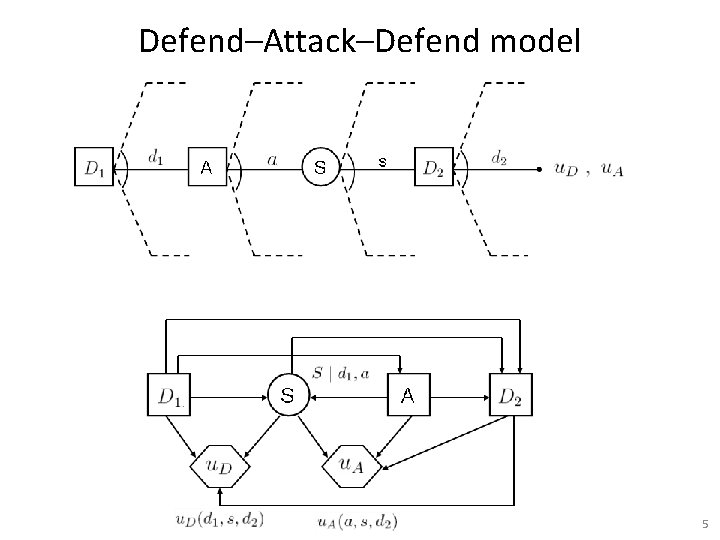
Defend–Attack–Defend model 5
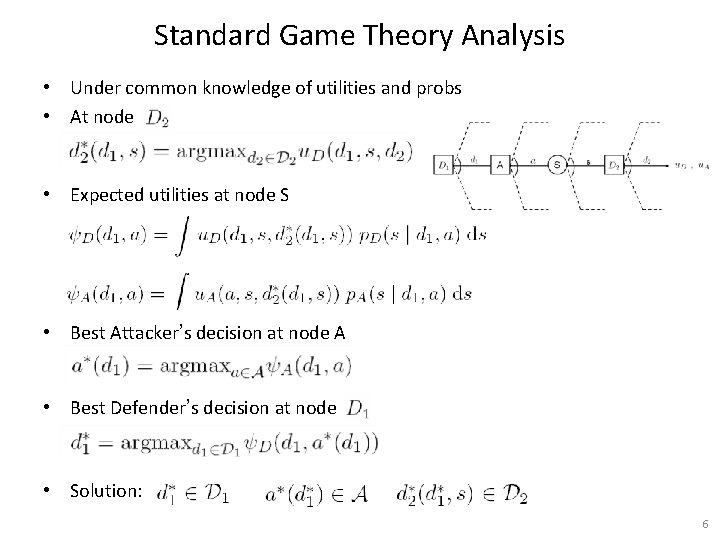
Standard Game Theory Analysis • Under common knowledge of utilities and probs • At node • Expected utilities at node S • Best Attacker’s decision at node A • Best Defender’s decision at node • Solution: 6
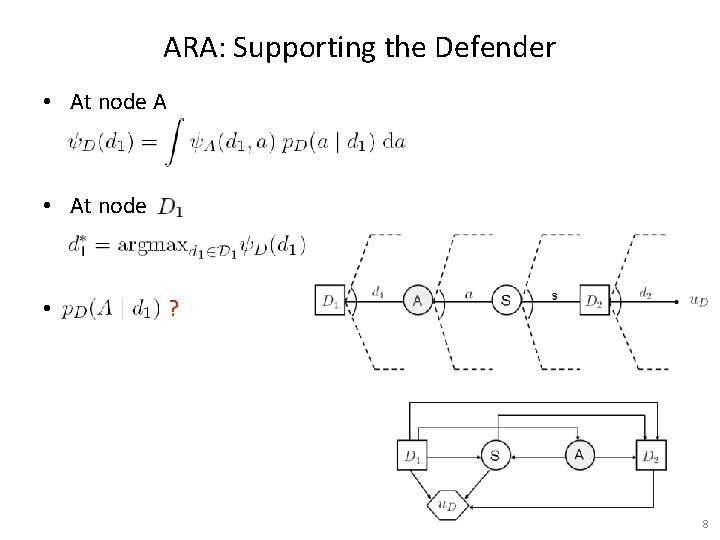
ARA: Supporting the Defender • At node A • At node • ? 8
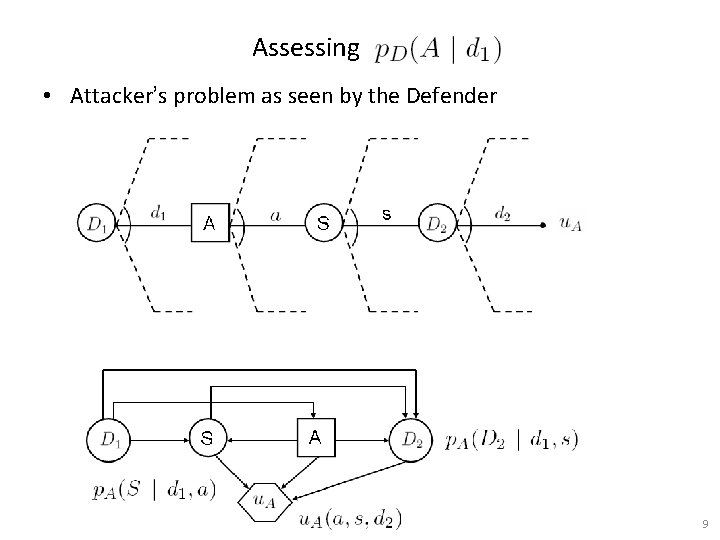
Assessing • Attacker’s problem as seen by the Defender 9
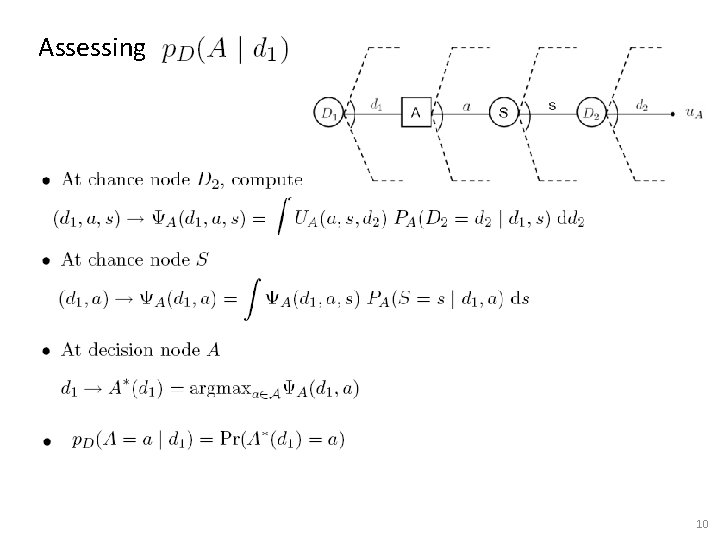
Assessing 10
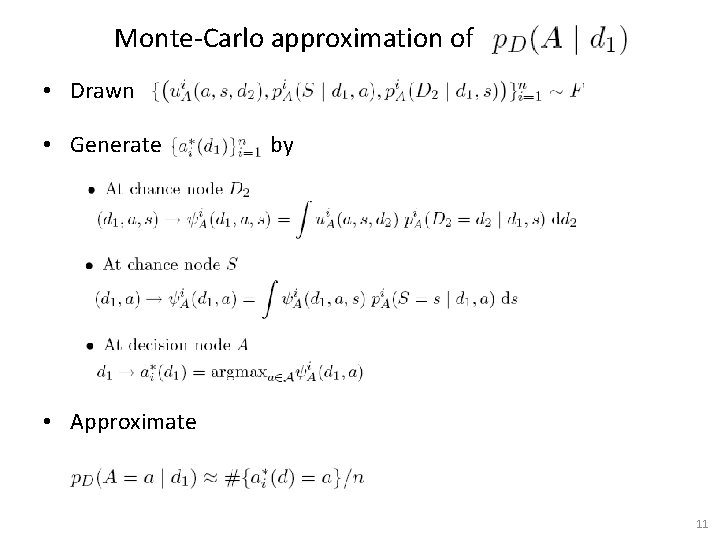
Monte-Carlo approximation of • Drawn • Generate by • Approximate 11
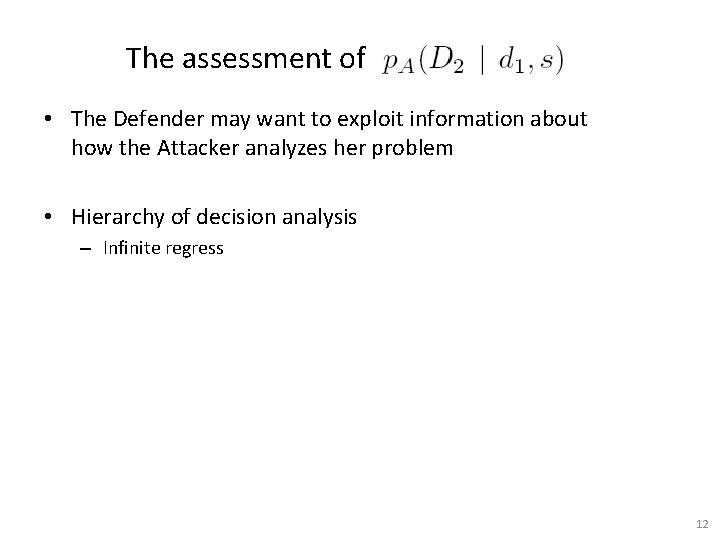
The assessment of • The Defender may want to exploit information about how the Attacker analyzes her problem • Hierarchy of decision analysis – Infinite regress 12
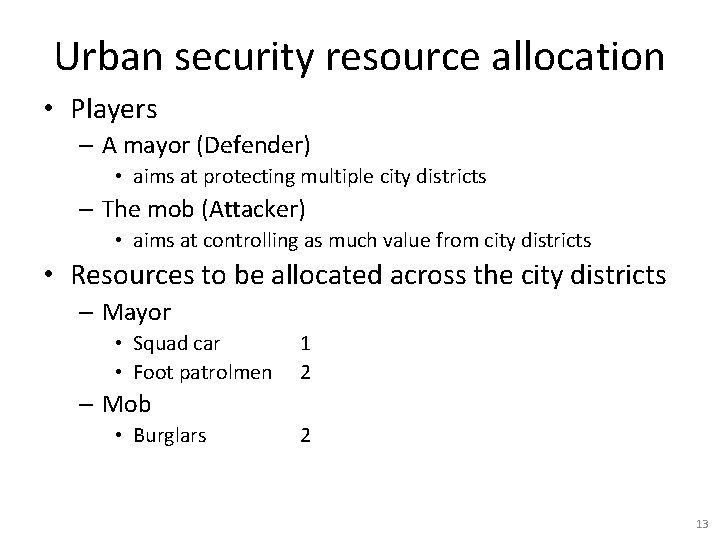
Urban security resource allocation • Players – A mayor (Defender) • aims at protecting multiple city districts – The mob (Attacker) • aims at controlling as much value from city districts • Resources to be allocated across the city districts – Mayor • Squad car • Foot patrolmen 1 2 – Mob • Burglars 2 13
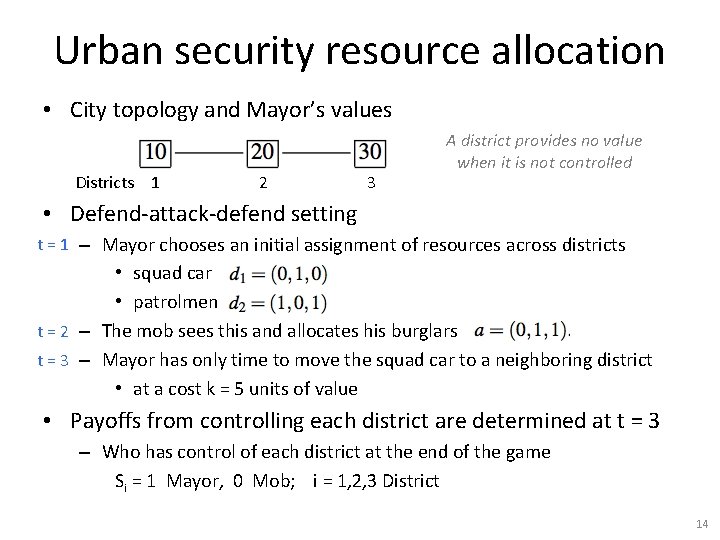
Urban security resource allocation • City topology and Mayor’s values Districts 1 2 3 A district provides no value when it is not controlled • Defend-attack-defend setting t = 1 – Mayor chooses an initial assignment of resources across districts • squad car • patrolmen t = 2 – The mob sees this and allocates his burglars t = 3 – Mayor has only time to move the squad car to a neighboring district • at a cost k = 5 units of value • Payoffs from controlling each district are determined at t = 3 – Who has control of each district at the end of the game Si = 1 Mayor, 0 Mob; i = 1, 2, 3 District 14
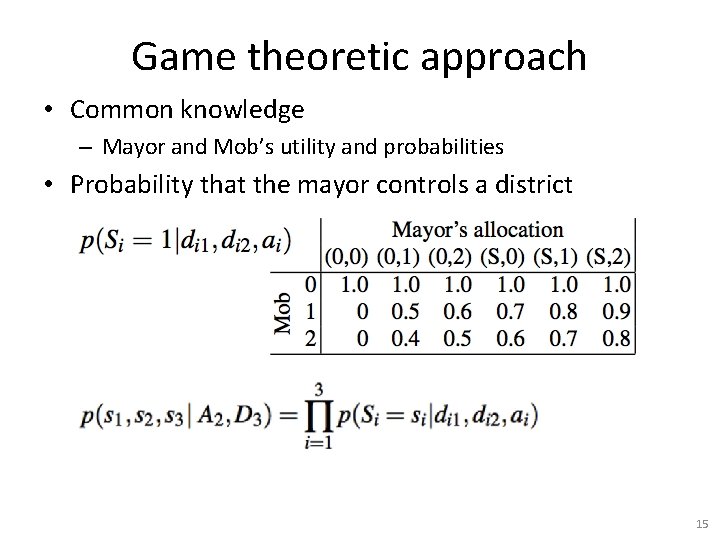
Game theoretic approach • Common knowledge – Mayor and Mob’s utility and probabilities • Probability that the mayor controls a district 15
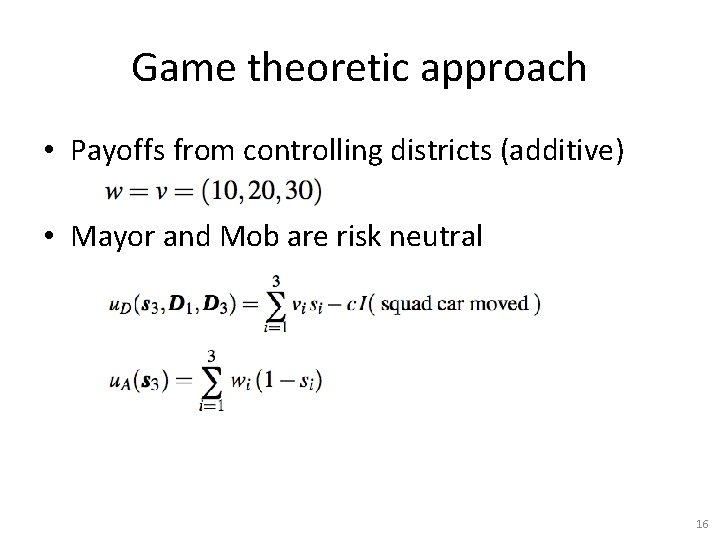
Game theoretic approach • Payoffs from controlling districts (additive) • Mayor and Mob are risk neutral 16
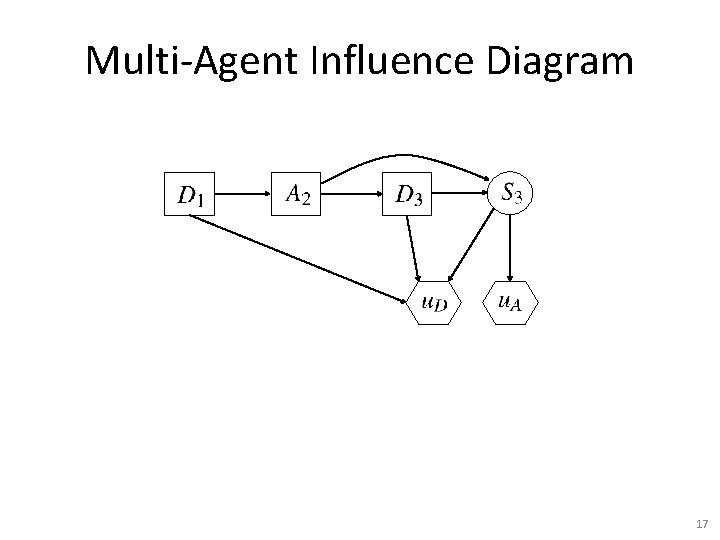
Multi-Agent Influence Diagram 17
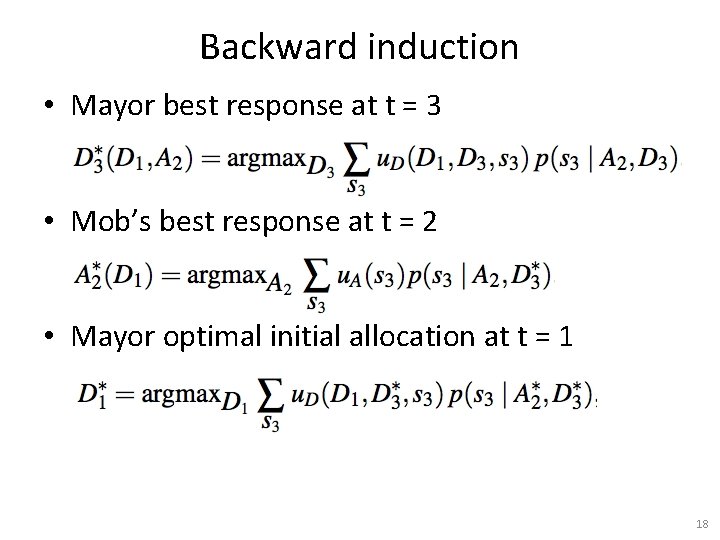
Backward induction • Mayor best response at t = 3 • Mob’s best response at t = 2 • Mayor optimal initial allocation at t = 1 18
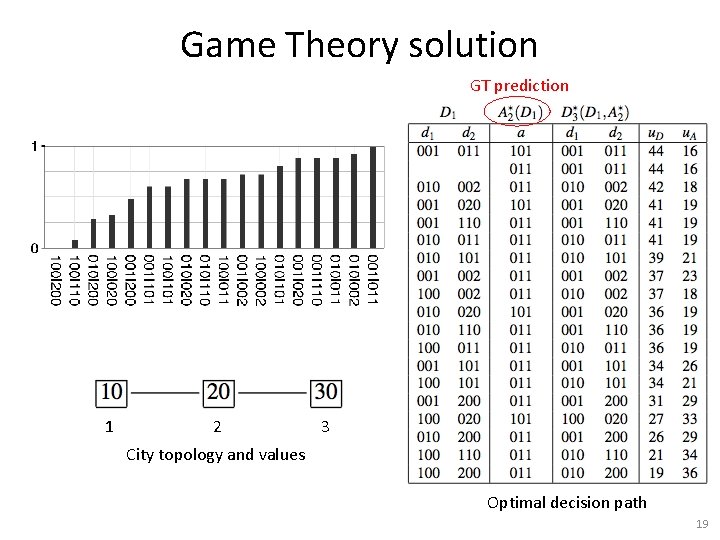
Game Theory solution GT prediction 1 2 3 City topology and values Optimal decision path 19
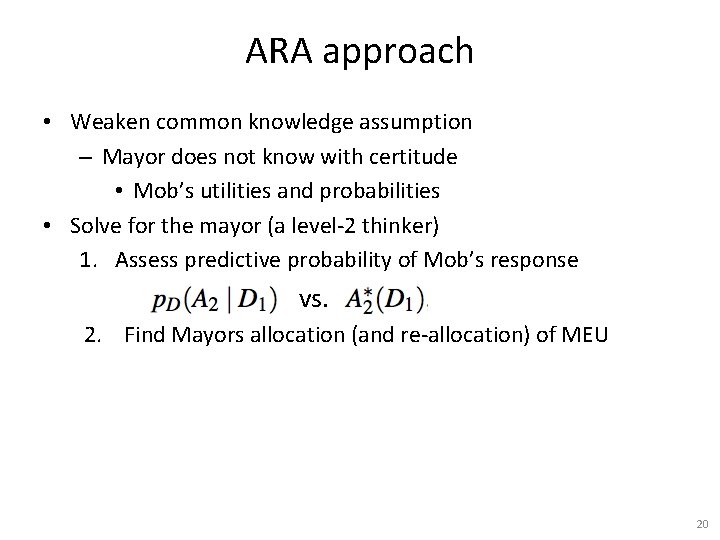
ARA approach • Weaken common knowledge assumption – Mayor does not know with certitude • Mob’s utilities and probabilities • Solve for the mayor (a level-2 thinker) 1. Assess predictive probability of Mob’s response vs. 2. Find Mayors allocation (and re-allocation) of MEU 20
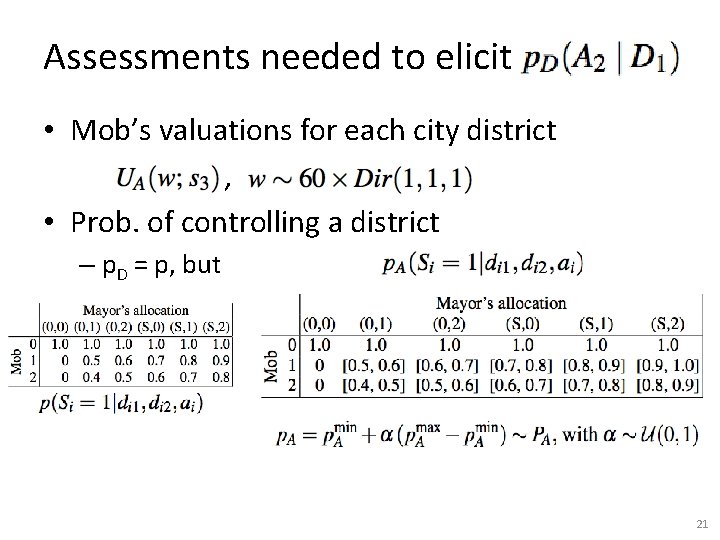
Assessments needed to elicit . • Mob’s valuations for each city district , • Prob. of controlling a district – p. D = p, but 21
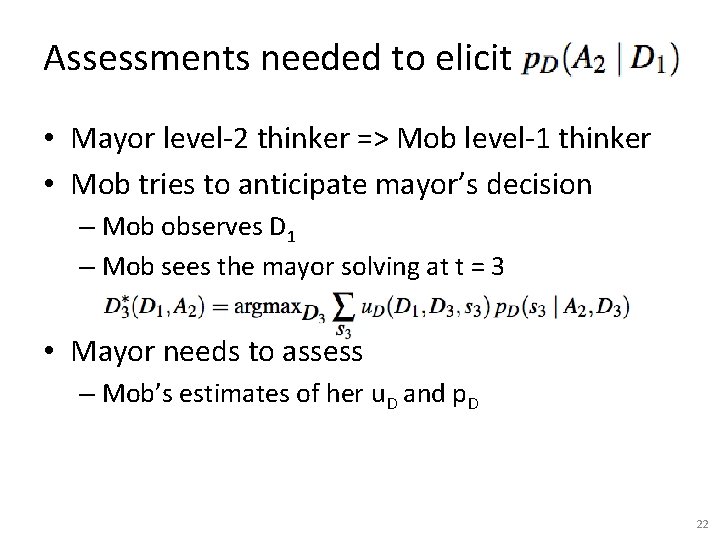
Assessments needed to elicit . • Mayor level-2 thinker => Mob level-1 thinker • Mob tries to anticipate mayor’s decision – Mob observes D 1 – Mob sees the mayor solving at t = 3 • Mayor needs to assess – Mob’s estimates of her u. D and p. D 22
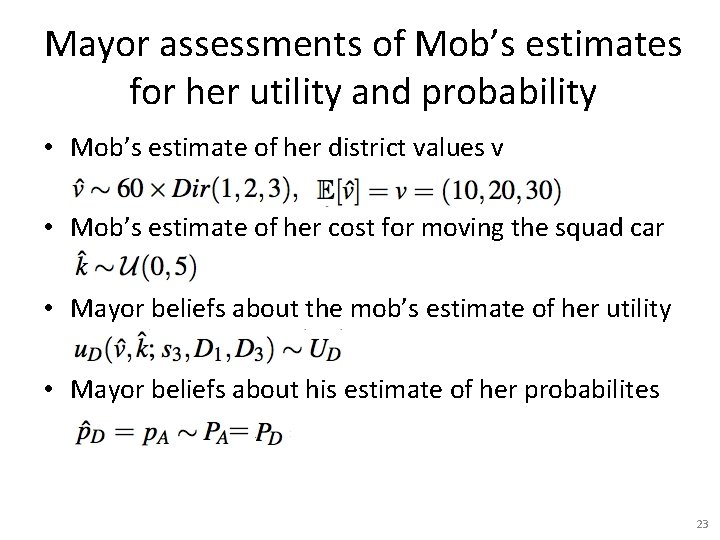
Mayor assessments of Mob’s estimates for her utility and probability • Mob’s estimate of her district values v • Mob’s estimate of her cost for moving the squad car • Mayor beliefs about the mob’s estimate of her utility • Mayor beliefs about his estimate of her probabilites 23
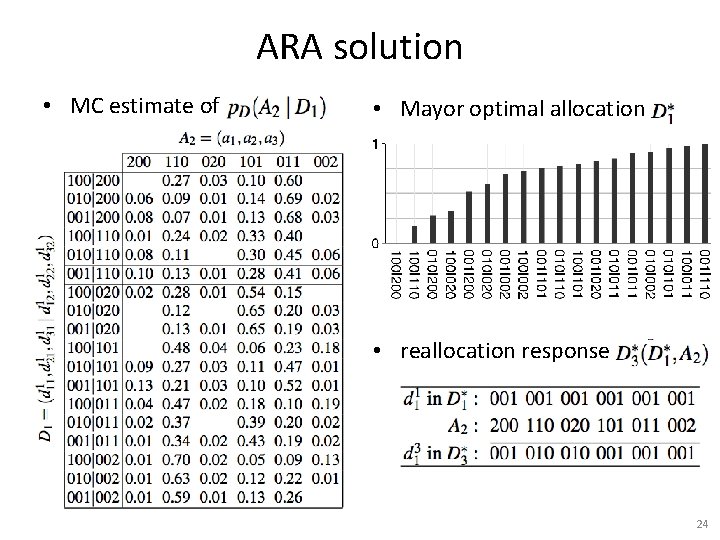
ARA solution • MC estimate of • Mayor optimal allocation • reallocation response 24
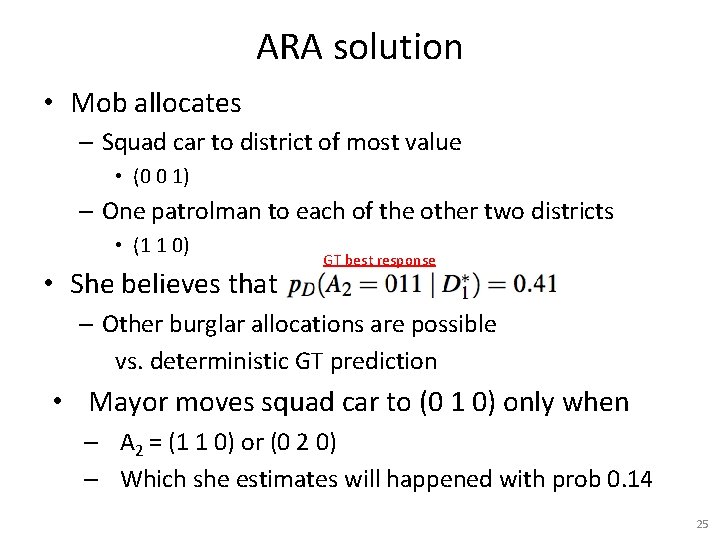
ARA solution • Mob allocates – Squad car to district of most value • (0 0 1) – One patrolman to each of the other two districts • (1 1 0) • She believes that GT best response – Other burglar allocations are possible vs. deterministic GT prediction • Mayor moves squad car to (0 1 0) only when – A 2 = (1 1 0) or (0 2 0) – Which she estimates will happened with prob 0. 14 25
ARA vs. GT solutions • Three best ARA solutions – 001|110, 100|011, 010|101 cover all districts with some defensive resource • Only one among the 5 best GT solutions does this – Leaving uncover the district of less value for the mayor – GT solution predicts that • the mob will always allocate one of his two burglars to the highest value district 26
Discussion • Are available resources to a player known to the other? • Mob seen as a level-1 thinker who uses GT to find her allocation decision after estimating her u and p – Other rationality models for the Mob • Sensitivity analysis – around GT assumption before ARA – focus elicitation around most relevant ARA assessments 27
- Slides: 26