
Adverbs Are words that modify qualify Verbs Adjectives
Adverbs Are words that modify (qualify): • Verbs • Adjectives • Other adverbs
Adverbs of manner Express how you do something Usually come after the main verb • He speaks quickly. • She drove home carefully.
Adverbs of manner Come before the main verb in passive sentences • The driver was seriously injured. • The equipment has been thoroughly tested.
Adverbs of frequency Express how often you do something Come before the main verb (if it is not to be) or after to be as a main verb • I never go to the supermarket on rainy nights. • He is often late for his appointments. • Exceptions: sometimes, usually, normally, commonly
Adverbs of time Express time references Usually go at the end of the sentence, or at the beginning, when you want to make a clear distinction between a previous time reference and the new one • I am going to London in July and in August I’m going to visit Liverpool.
Adverbs of degree Describe how much something is done or intensify an adjective Very, extremely, incredibly, almost, nearly intensify adjectives or other adverbs, and come before them. • The dinner party was very carefully planned. • I got extremely excited that evening.
Adverbs of degree Much, a lot are mostly used with verbs to express how much something was done, and go after the verbs • I like that film a lot. • Thank you very much.
Adverbs of degree A little, a bit can be used to intensify adjectives or adverbs or to express how much an action (a verb) is done, and follow the rules for the previous kinds of adverbs of degree • I’m a bit tired. • She sleeps a bit in the afternoon.
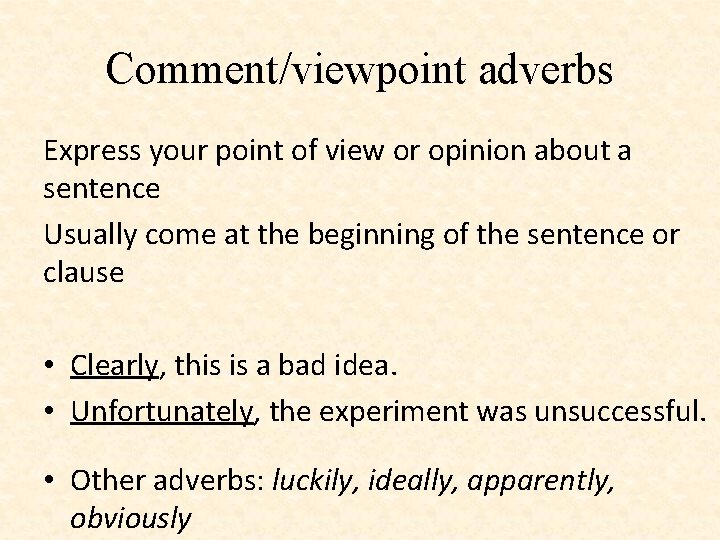
Comment/viewpoint adverbs Express your point of view or opinion about a sentence Usually come at the beginning of the sentence or clause • Clearly, this is a bad idea. • Unfortunately, the experiment was unsuccessful. • Other adverbs: luckily, ideally, apparently, obviously
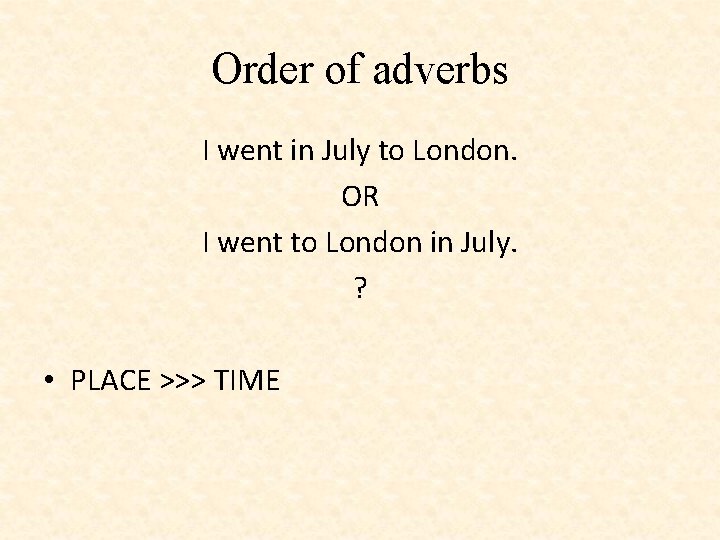
Order of adverbs I went in July to London. OR I went to London in July. ? • PLACE >>> TIME
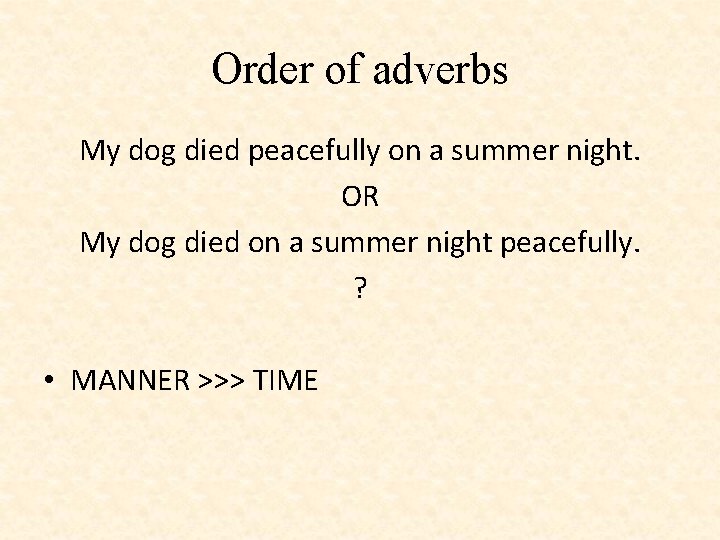
Order of adverbs My dog died peacefully on a summer night. OR My dog died on a summer night peacefully. ? • MANNER >>> TIME
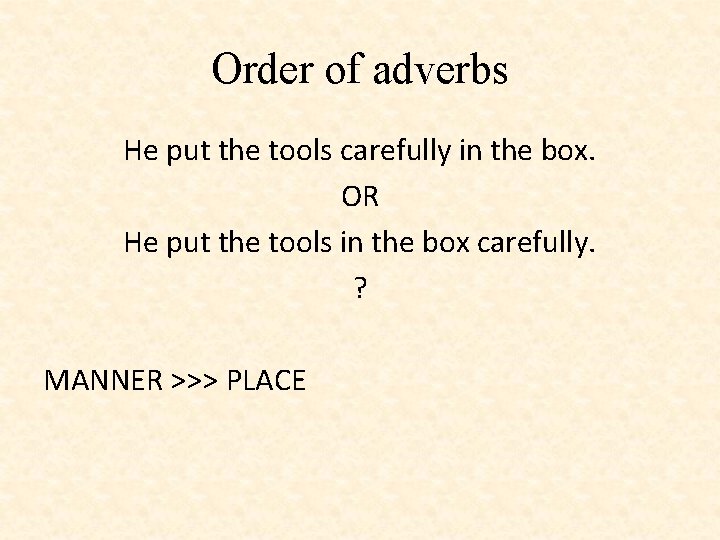
Order of adverbs He put the tools carefully in the box. OR He put the tools in the box carefully. ? MANNER >>> PLACE
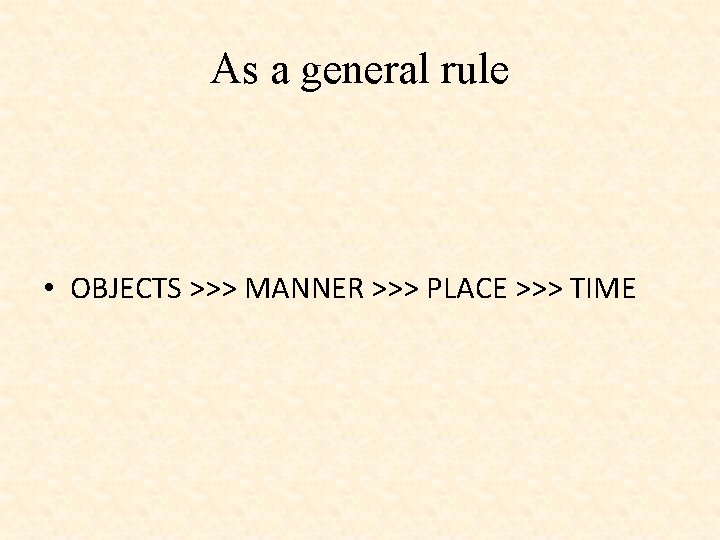
As a general rule • OBJECTS >>> MANNER >>> PLACE >>> TIME
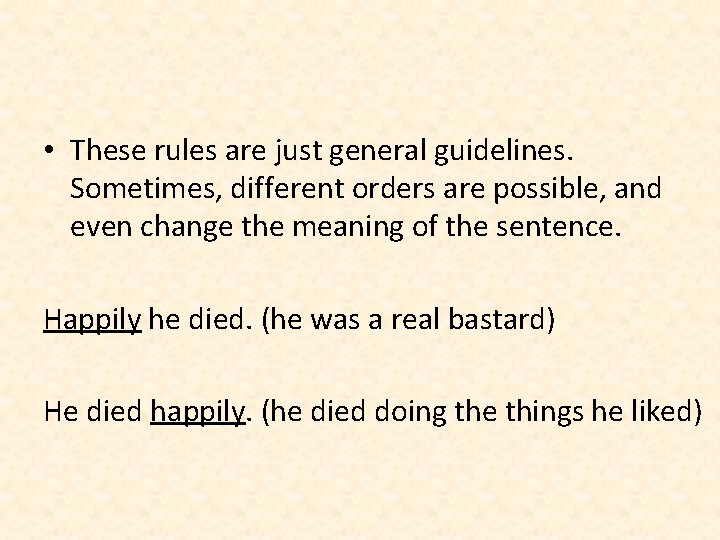
• These rules are just general guidelines. Sometimes, different orders are possible, and even change the meaning of the sentence. Happily he died. (he was a real bastard) He died happily. (he died doing the things he liked)
- Slides: 14