
ADVERBIAL CLAUSES ETSI de Telecomunicaciones English ADVERBIAL CLAUSES
ADVERBIAL CLAUSES ETSI de Telecomunicaciones English
ADVERBIAL CLAUSES INTRODUCTION o Definition They modify a verb (either finite or non-finite), an adjective, an adverb or another clause. e. g. : Don’t start before the machine is ready for operation Functioning until the transmission was completed, the link provided an optimum performance The portable was simpler than it was expected The programmer worked harder than he ever did before As it turned out, the satellite did not fulfil safety requirements

ADVERBIAL CLAUSES INTRODUCTION (2) o Position Most commonly, at the beginning or the end of the main clause. In some cases, medial position. e. g. : If possible, use a different method The scene must be illuminated until a distinctive image appears I was told that, if I applied early, I would be given an immediate answer
ADVERBIAL CLAUSES o Classification of adverbial clauses The exact number of adverbial clauses is open to doubt, since meanings sometimes overlap and the same clause may express different semantic values. The meaning intended by the clause can be deduced either from the introducing conjunction or from the sentence as a whole. Here, we shall consider the most common types, and more precisely, those that appear more often in technical texts.

ADVERBIAL CLAUSES o CLAUSES OF TIME They answer the question “When? ” and are common in the initial or end position. Main conjunctions: WHEN, WHENEVER, BEFORE, AFTER, UNTIL, SINCE, ONCE, AS, NOW THAT, AS SOON AS, AS LONG AS, THE MOMENT, DIRECTLY, WHILE. Some of these conjunctions may introduce verbless or abbreviated time clauses.
ADVERBIAL CLAUSES e. g. : When the line is engaged, the hold-on mode is automatically assigned Signals were modified as they entered the first multiplexor Directly the data arrived at its destination, the user interface transformed the flow into intelligible information Now that the research connected with the telecommunications field is advancing so fast, work prospects are also increasing When in doubt, ask for information (verbless) Once finished, disconnect the equipment (abbreviated)

ADVERBIAL CLAUSES o CLAUSES OF PLACE They answer the question “Where? ”. Conjunctions (also for verbless and abbreviated clauses): WHERE, WHEREVER e. g. : Answer “yes” or “no” where appropriate Wherever possible, all parts should be tested
ADVERBIAL CLAUSES o CLAUSES OF CONDITION These clauses give the circumstances under which the statement of the main clause will take place or be true, i. e. , they state the dependence of one circumstance or set of circumstances on another. Main conjunctions: IF (positive cond. ), UNLESS (negative cond. ), PROVIDED THAT, PROVIDING, SUPPOSED, SUPPOSING (mostly connected with questions), SO LONG AS, AS LONG AS, SO THAT, ON CONDITION THAT.
ADVERBIAL CLAUSES e. g. : If the international line is engaged, you must replace the handset and try again Unless it works properly, results will be unreliable (If it doesn’t work properly, results. . . ) Supposing the teacher saw you cheating, what would you do? You will be given the prize provided (that) your project is a novelty The director will phone you on condition that you make an appointment previously (Notice that the “comma” is compulsory whenever the subordinate comes first)
ADVERBIAL CLAUSES o Real and unreal conditions Real: We are not sure whether the condition has been (will be) fulfilled or not. Unreal: It is clear the condition has not been fulfilled (though it could be) e. g. : If it works, it will be a success (Real) If it worked, I didn’t realise (Real. Simple past in both clauses. Clearly factual) If it worked, it would be a success (Unreal. Conditional in the main clause. Hypothetical. ) If it had worked, I would have realised (Unreal. Impossible)
ADVERBIAL CLAUSES Clauses beginning with “If” are similar to questions which imply uncertainty. Thus, they tend to contain non-assertive forms such as “Ever” and “Any”. Clauses beginning with “Unless” stress the “excluded positive option” and, so, they normally contain assertive forms like “Some”. For the same reason, these clauses are not usually unreal conditions.
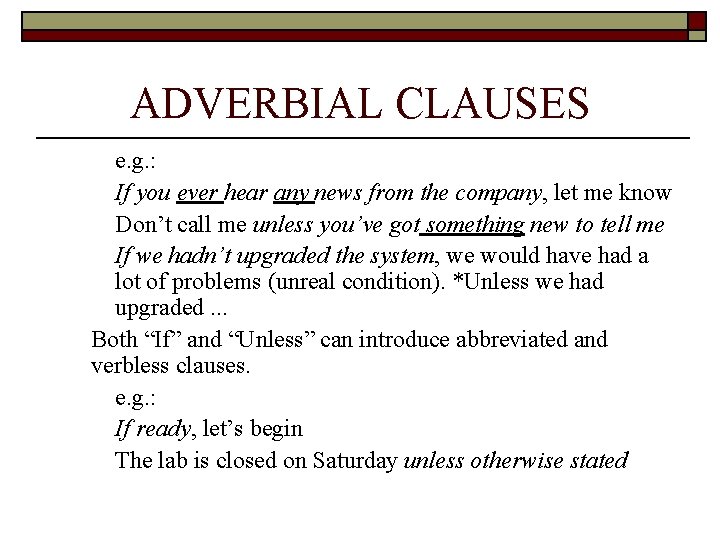
ADVERBIAL CLAUSES e. g. : If you ever hear any news from the company, let me know Don’t call me unless you’ve got something new to tell me If we hadn’t upgraded the system, we would have had a lot of problems (unreal condition). *Unless we had upgraded. . . Both “If” and “Unless” can introduce abbreviated and verbless clauses. e. g. : If ready, let’s begin The lab is closed on Saturday unless otherwise stated
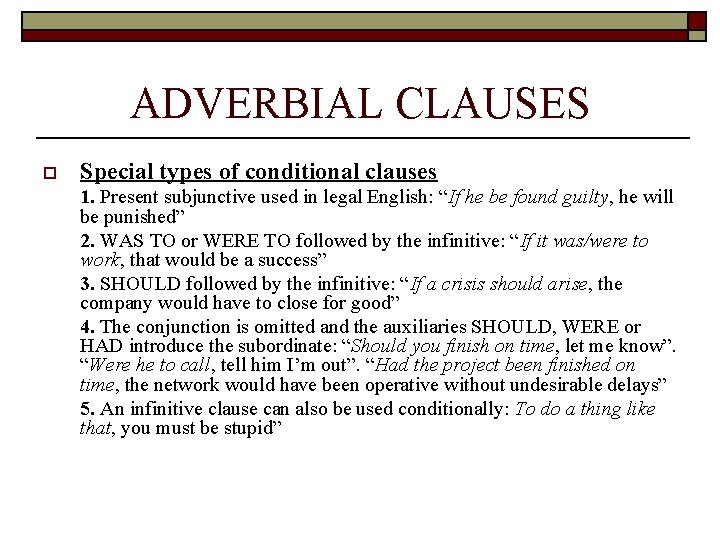
ADVERBIAL CLAUSES o Special types of conditional clauses 1. Present subjunctive used in legal English: “If he be found guilty, he will be punished” 2. WAS TO or WERE TO followed by the infinitive: “If it was/were to work, that would be a success” 3. SHOULD followed by the infinitive: “If a crisis should arise, the company would have to close for good” 4. The conjunction is omitted and the auxiliaries SHOULD, WERE or HAD introduce the subordinate: “Should you finish on time, let me know”. “Were he to call, tell him I’m out”. “Had the project been finished on time, the network would have been operative without undesirable delays” 5. An infinitive clause can also be used conditionally: To do a thing like that, you must be stupid”
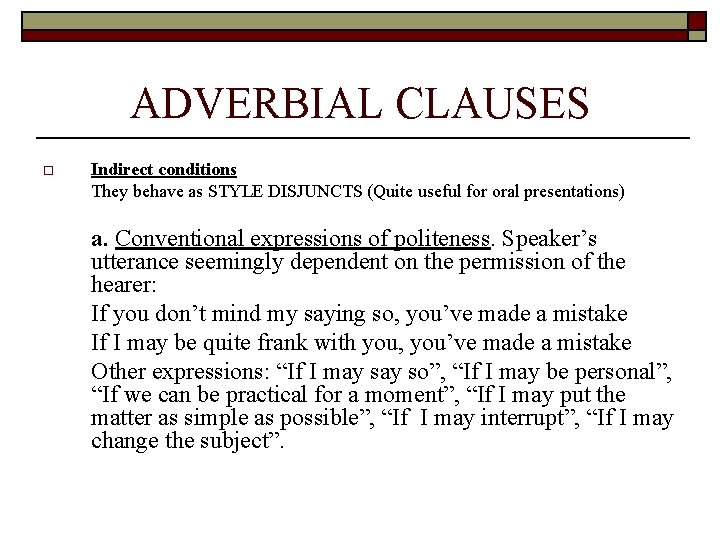
ADVERBIAL CLAUSES o Indirect conditions They behave as STYLE DISJUNCTS (Quite useful for oral presentations) a. Conventional expressions of politeness. Speaker’s utterance seemingly dependent on the permission of the hearer: If you don’t mind my saying so, you’ve made a mistake If I may be quite frank with you, you’ve made a mistake Other expressions: “If I may so”, “If I may be personal”, “If we can be practical for a moment”, “If I may put the matter as simple as possible”, “If I may interrupt”, “If I may change the subject”.
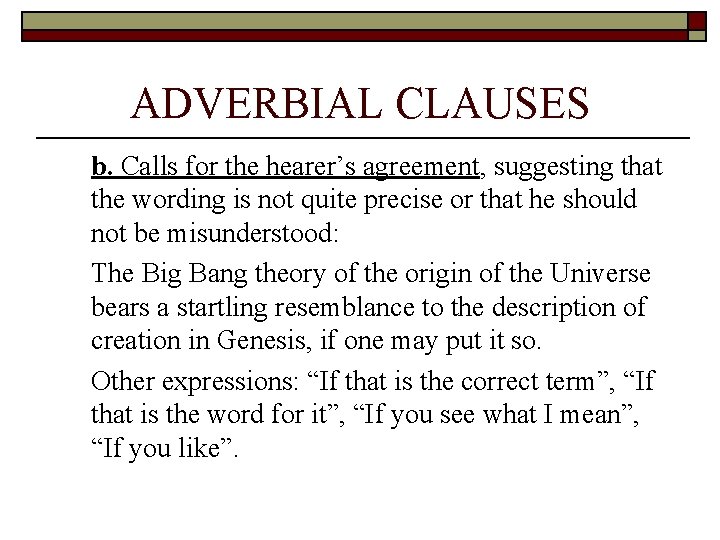
ADVERBIAL CLAUSES b. Calls for the hearer’s agreement, suggesting that the wording is not quite precise or that he should not be misunderstood: The Big Bang theory of the origin of the Universe bears a startling resemblance to the description of creation in Genesis, if one may put it so. Other expressions: “If that is the correct term”, “If that is the word for it”, “If you see what I mean”, “If you like”.
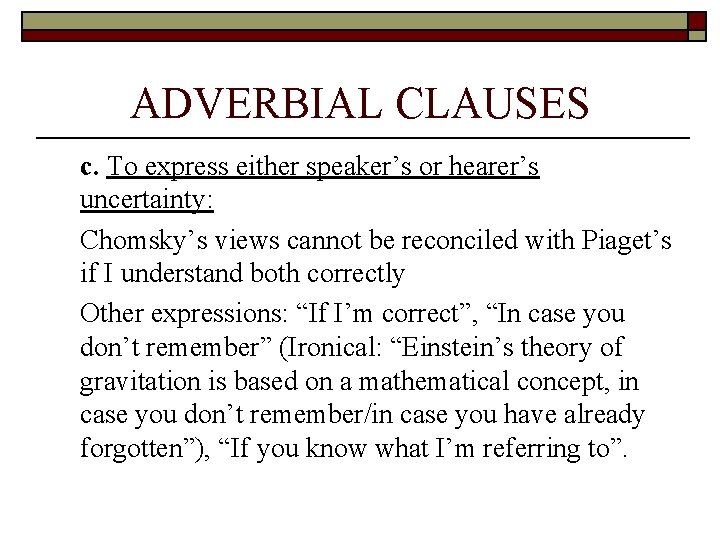
ADVERBIAL CLAUSES c. To express either speaker’s or hearer’s uncertainty: Chomsky’s views cannot be reconciled with Piaget’s if I understand both correctly Other expressions: “If I’m correct”, “In case you don’t remember” (Ironical: “Einstein’s theory of gravitation is based on a mathematical concept, in case you don’t remember/in case you have already forgotten”), “If you know what I’m referring to”.
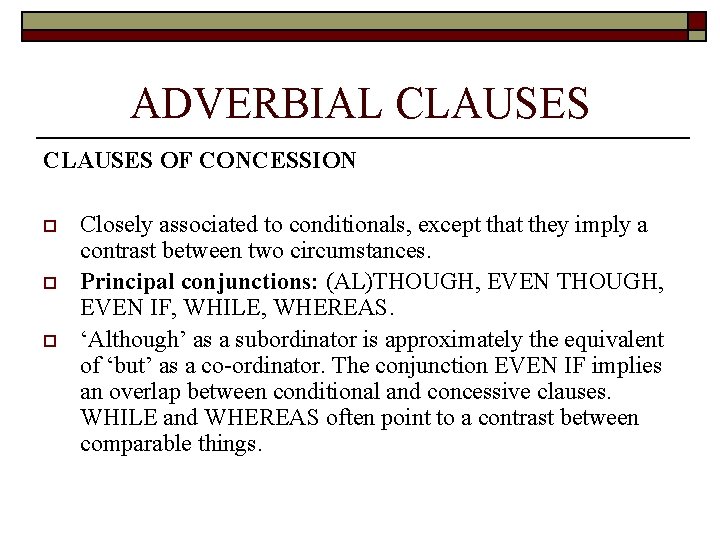
ADVERBIAL CLAUSES OF CONCESSION o o o Closely associated to conditionals, except that they imply a contrast between two circumstances. Principal conjunctions: (AL)THOUGH, EVEN IF, WHILE, WHEREAS. ‘Although’ as a subordinator is approximately the equivalent of ‘but’ as a co-ordinator. The conjunction EVEN IF implies an overlap between conditional and concessive clauses. WHILE and WHEREAS often point to a contrast between comparable things.
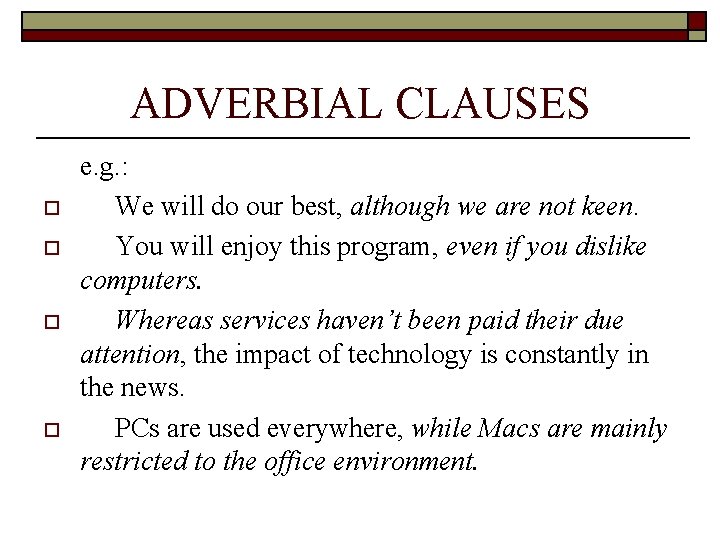
ADVERBIAL CLAUSES o o e. g. : We will do our best, although we are not keen. You will enjoy this program, even if you dislike computers. Whereas services haven’t been paid their due attention, the impact of technology is constantly in the news. PCs are used everywhere, while Macs are mainly restricted to the office environment.
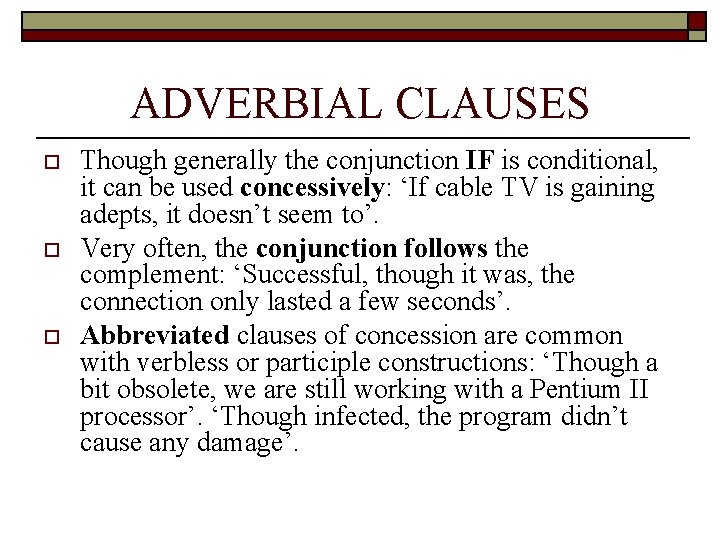
ADVERBIAL CLAUSES o o o Though generally the conjunction IF is conditional, it can be used concessively: ‘If cable TV is gaining adepts, it doesn’t seem to’. Very often, the conjunction follows the complement: ‘Successful, though it was, the connection only lasted a few seconds’. Abbreviated clauses of concession are common with verbless or participle constructions: ‘Though a bit obsolete, we are still working with a Pentium II processor’. ‘Though infected, the program didn’t cause any damage’.
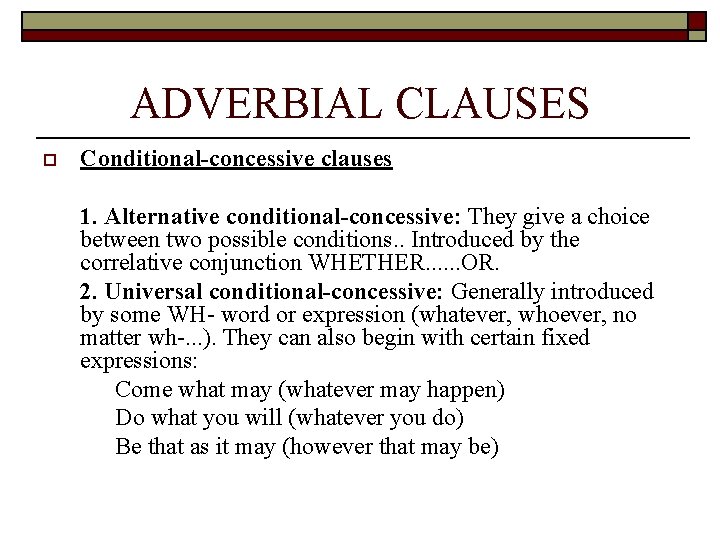
ADVERBIAL CLAUSES o Conditional-concessive clauses 1. Alternative conditional-concessive: They give a choice between two possible conditions. . Introduced by the correlative conjunction WHETHER. . . OR. 2. Universal conditional-concessive: Generally introduced by some WH- word or expression (whatever, whoever, no matter wh-. . . ). They can also begin with certain fixed expressions: Come what may (whatever may happen) Do what you will (whatever you do) Be that as it may (however that may be)

ADVERBIAL CLAUSES o 1. 2. 3. 4. e. g. : The satellite will keep its position, whatever the weather conditions are. Whether the weather improves or not, the satellite transmission won’t be subject to undesirable delays. However / No matter how fast the information is input, the system always takes its time to process that. Please, do contact us if you need further information. Be that as it may, thank you very much in advance.
ADVERBIAL CLAUSES OF REASON OR CAUSE o o o They give the reason for the activity expressed in the main clause. Main conjunctions: BECAUSE, SINCE, AS. . . Whereas is sometimes used to introduce a clause of reason in legal English. Conjunctions typically associated with time can also introduce these clauses. In many cases, the conjunction is omitted.
ADVERBIAL CLAUSES e. g. : It is true because I say it is. Whereas the defendant has pleaded guilty, the Court will be lenient with him. We’ll have to rearrange the configuration after we said we would. Being a man of ingenuity, he repaired the machine. We are happy you can manage.
ADVERBIAL CLAUSES OF PURPOSE o They state the finality of the action expressed by the main verb. Mainly introduced by: IN ORDER THAT/TO, IN ORDER FOR (+ noun), SO (THAT), SO AS TO. . . Very often they occur in the form of a full infinitive (as it happened with conditionals). o e. g. : The program was scanned so that unknown viruses could be found. We left the device connected in order for the staff to access relevant information whenever required. He destroyed the papers so that no one might see them. To open the carcass, you have to press down the button.
ADVERBIAL CLAUSES OF RESULT o o o They state what has happened (or may happen) as the result of the action or state expressed by the main clause. Principal conjunctions: SO. . . THAT, SO (THAT), SUCH. . . THAT, SUCH (THAT). e. g. : We introduced the necessary changes so that the operations gave the expected result. Our finances are such that we cannot afford another increase in the production expenses. Sometimes, clauses of result are similar to clauses of purpose. Compare: ‘We rearranged the configuration so that it could work properly’ with ‘. . . so that it worked properly’.
ADVERBIAL CLAUSES OF COMPARISON o They answer the questions HOW MUCH? , HOW LITTLE? . The principal conjunctions are AS, AS THOUGH/IF, AS. . . AS, SO. . . AS and structures of comparison. If there is doubt or unreality, the past tense is used. Sometimes, an inversion subject/verb is produced. o e. g. : Mathematicians often behave as though they knew all the answers. This is not a bad result as prices go. The composite is as dry as it’s going to get. Our company created new branches abroad, as did our competitors.
ADVERBIAL CLAUSES OF PROPORTION AND PREFERENCE o Clauses of proportion express a proportionality or equivalence of tendency or degree between situations. They are introduced by AS or the correlatives THE. . . THE (with a ‘fake’ comparative structure). o Clauses of preference are introduced by RATHER THAN or SOONER THAN followed by a bare infinitive. RATHER THAN can also precede a gerund or a noun.
ADVERBIAL CLAUSES o e. g. : As speed increased, more losses were produced. The more we thought about the matter, the less we understood it. Rather/Sooner than reducing the capacity, I’d replace several components. Rather than bulky deflecting coils, we’ll employ an electrostatic focus.
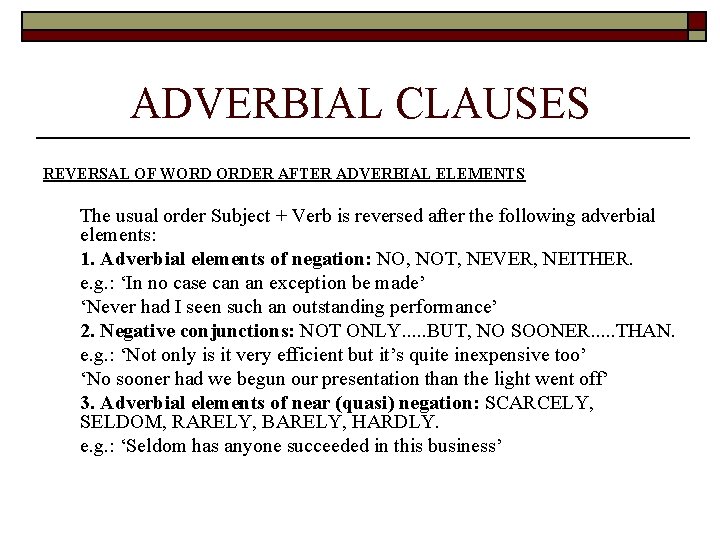
ADVERBIAL CLAUSES REVERSAL OF WORD ORDER AFTER ADVERBIAL ELEMENTS The usual order Subject + Verb is reversed after the following adverbial elements: 1. Adverbial elements of negation: NO, NOT, NEVER, NEITHER. e. g. : ‘In no case can an exception be made’ ‘Never had I seen such an outstanding performance’ 2. Negative conjunctions: NOT ONLY. . . BUT, NO SOONER. . . THAN. e. g. : ‘Not only is it very efficient but it’s quite inexpensive too’ ‘No sooner had we begun our presentation than the light went off’ 3. Adverbial elements of near (quasi) negation: SCARCELY, SELDOM, RARELY, BARELY, HARDLY. e. g. : ‘Seldom has anyone succeeded in this business’
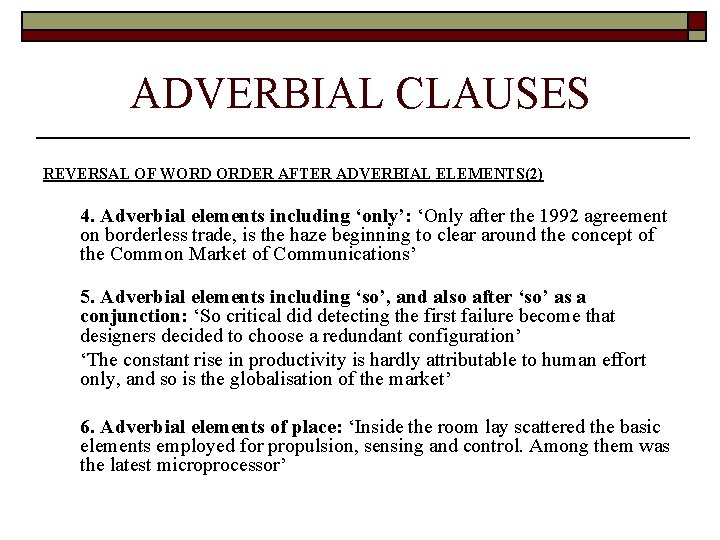
ADVERBIAL CLAUSES REVERSAL OF WORD ORDER AFTER ADVERBIAL ELEMENTS(2) 4. Adverbial elements including ‘only’: ‘Only after the 1992 agreement on borderless trade, is the haze beginning to clear around the concept of the Common Market of Communications’ 5. Adverbial elements including ‘so’, and also after ‘so’ as a conjunction: ‘So critical did detecting the first failure become that designers decided to choose a redundant configuration’ ‘The constant rise in productivity is hardly attributable to human effort only, and so is the globalisation of the market’ 6. Adverbial elements of place: ‘Inside the room lay scattered the basic elements employed for propulsion, sensing and control. Among them was the latest microprocessor’

ADVERBIAL CLAUSES I. Reduce the finite time clauses into non-finite or verbless ones. 1. When those changes were suggested, did you take them into consideration? . 2. Once the project is finished, it will have to be accepted by the General Board. 3. When the satellite is in space, its orbital location must be monitored very carefully and quite often. 4. Until you are asked to speak, you will be well advised to remain silent. 5. While the aircraft is taking off, passengers are not allowed to make use of private electronic equipment. 6. The transmission was disrupted due to a general failure in the head-end before it was completed. 7. When you enter the building, you will see the laboratory of digital signal processing right in front of you. 8. After we had proposed the purchase of a speech recognition system for the bank, we admitted that it might be too expensive.
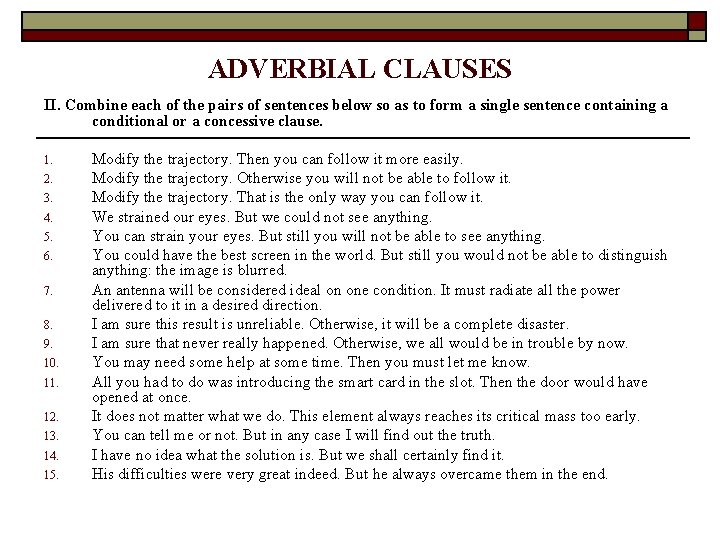
ADVERBIAL CLAUSES II. Combine each of the pairs of sentences below so as to form a single sentence containing a conditional or a concessive clause. 1. 2. 3. 4. 5. 6. 7. 8. 9. 10. 11. 12. 13. 14. 15. Modify the trajectory. Then you can follow it more easily. Modify the trajectory. Otherwise you will not be able to follow it. Modify the trajectory. That is the only way you can follow it. We strained our eyes. But we could not see anything. You can strain your eyes. But still you will not be able to see anything. You could have the best screen in the world. But still you would not be able to distinguish anything: the image is blurred. An antenna will be considered ideal on one condition. It must radiate all the power delivered to it in a desired direction. I am sure this result is unreliable. Otherwise, it will be a complete disaster. I am sure that never really happened. Otherwise, we all would be in trouble by now. You may need some help at some time. Then you must let me know. All you had to do was introducing the smart card in the slot. Then the door would have opened at once. It does not matter what we do. This element always reaches its critical mass too early. You can tell me or not. But in any case I will find out the truth. I have no idea what the solution is. But we shall certainly find it. His difficulties were very great indeed. But he always overcame them in the end.
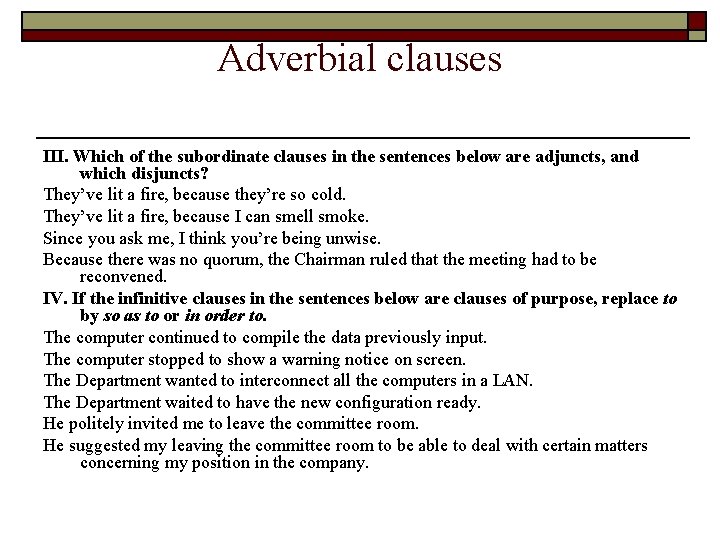
Adverbial clauses III. Which of the subordinate clauses in the sentences below are adjuncts, and which disjuncts? They’ve lit a fire, because they’re so cold. They’ve lit a fire, because I can smell smoke. Since you ask me, I think you’re being unwise. Because there was no quorum, the Chairman ruled that the meeting had to be reconvened. IV. If the infinitive clauses in the sentences below are clauses of purpose, replace to by so as to or in order to. The computer continued to compile the data previously input. The computer stopped to show a warning notice on screen. The Department wanted to interconnect all the computers in a LAN. The Department waited to have the new configuration ready. He politely invited me to leave the committee room. He suggested my leaving the committee room to be able to deal with certain matters concerning my position in the company.
- Slides: 33