
Adverb Position and Information Structure in Processing English
Adverb Position and Information Structure in Processing English Britta Stolterfoht, Lyn Frazier & Charles Clifton, Jr. University of Massachusetts, Amherst Linguistic Evidence 2006 Tübingen, 2. – 4. Februar
Overview 1. Information Structure and Word Order 2. Experimental evidence for information-structural constraints on word order variations 2. Information Structure and Adverb Placement 3. Information-structural constraints dependent on adverb placement 3. Adverb Position in Processing English 4. A self-paced reading study 4. Discussion Linguistic Evidence 2006 Tübingen, 2. – 4. Februar 2

1. Information Structure and Word Order Information-structural constraints on order variations in languages with flexible word order: change of word order affects focus-background articulation (e. g. , Abraham, 1992; Höhle, 1982; Haider, 1993, 2000; Steube, 2000) SOV (1 a). . . , dass [die Tante die Nichten begrüßt hat]F that the aunt the niece welcomed has ‘. . . that the aunt welcomed the nieces’ OSV (1 b). . . , dass die Tante [die Nichten begrüßt haben]F that the aunt the niece welcomed have ‘. . . that the nieces welcomed the aunt’ Linguistic Evidence 2006 Tübingen, 2. – 4. Februar 3
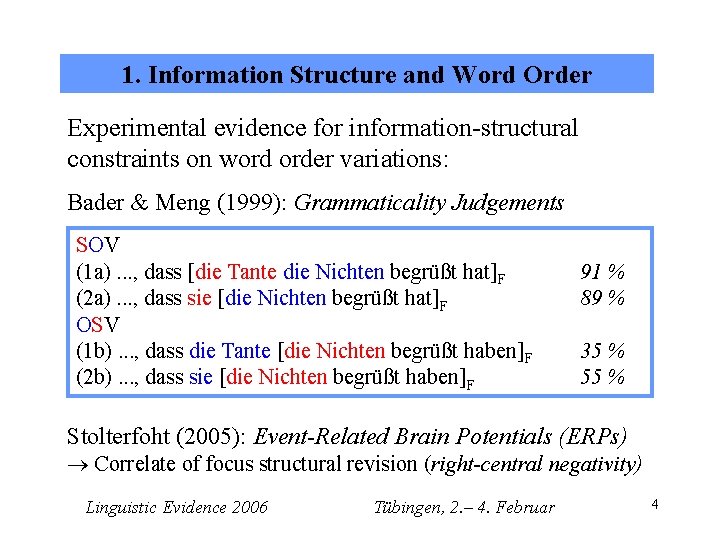
1. Information Structure and Word Order Experimental evidence for information-structural constraints on word order variations: Bader & Meng (1999): Grammaticality Judgements SOV (1 a). . . , dass [die Tante die Nichten begrüßt hat]F (2 a). . . , dass sie [die Nichten begrüßt hat]F OSV (1 b). . . , dass die Tante [die Nichten begrüßt haben]F (2 b). . . , dass sie [die Nichten begrüßt haben]F 91 % 89 % 35 % 55 % Stolterfoht (2005): Event-Related Brain Potentials (ERPs) Correlate of focus structural revision (right-central negativity) Linguistic Evidence 2006 Tübingen, 2. – 4. Februar 4
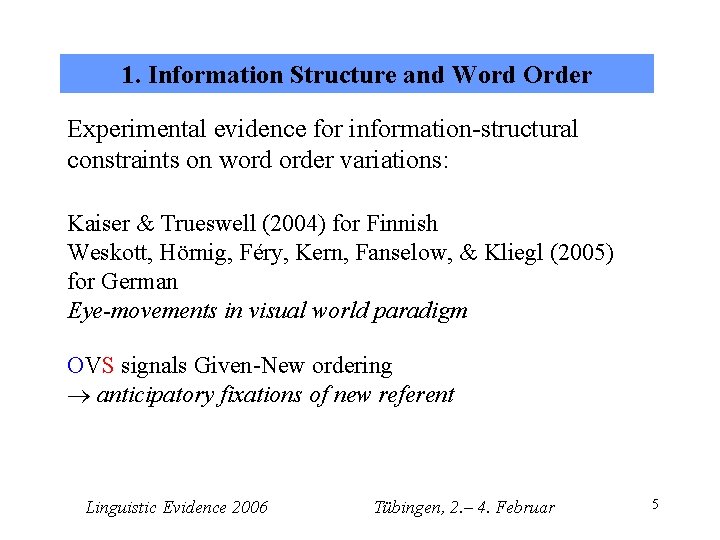
1. Information Structure and Word Order Experimental evidence for information-structural constraints on word order variations: Kaiser & Trueswell (2004) for Finnish Weskott, Hörnig, Féry, Kern, Fanselow, & Kliegl (2005) for German Eye-movements in visual world paradigm OVS signals Given-New ordering anticipatory fixations of new referent Linguistic Evidence 2006 Tübingen, 2. – 4. Februar 5
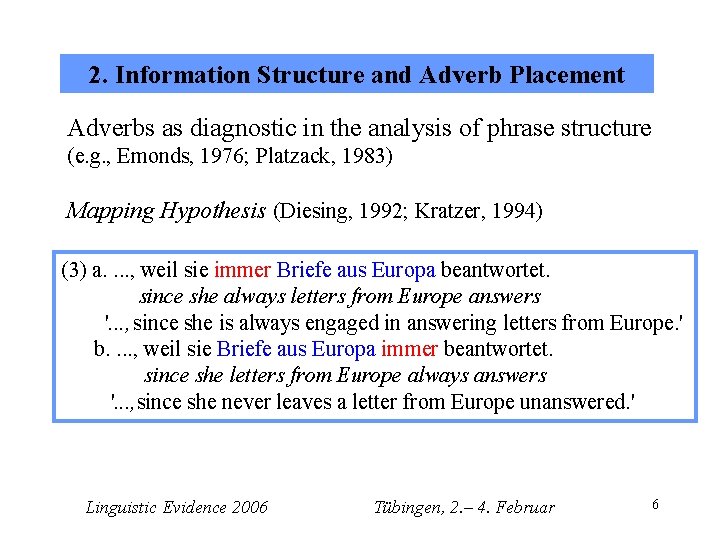
2. Information Structure and Adverb Placement Adverbs as diagnostic in the analysis of phrase structure (e. g. , Emonds, 1976; Platzack, 1983) Mapping Hypothesis (Diesing, 1992; Kratzer, 1994) (3) a. . , weil sie immer Briefe aus Europa beantwortet. since she always letters from Europe answers '. . . , since she is always engaged in answering letters from Europe. ' b. . , weil sie Briefe aus Europa immer beantwortet. since she letters from Europe always answers '. . . , since she never leaves a letter from Europe unanswered. ' Linguistic Evidence 2006 Tübingen, 2. – 4. Februar 6
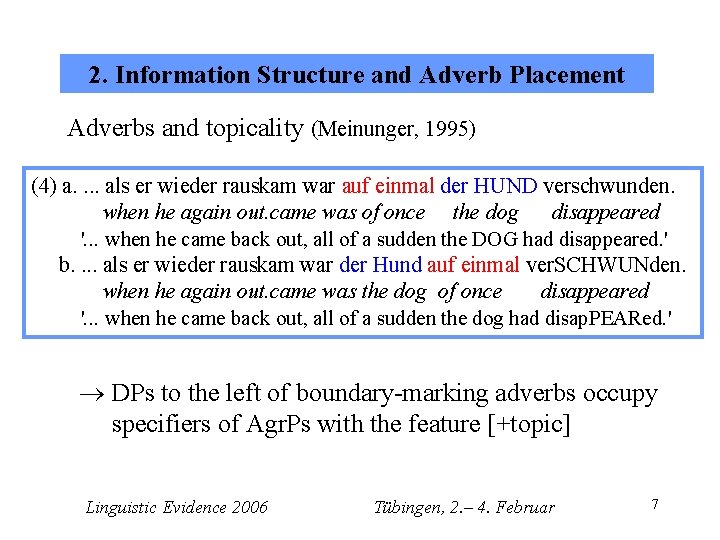
2. Information Structure and Adverb Placement Adverbs and topicality (Meinunger, 1995) (4) a. . als er wieder rauskam war auf einmal der HUND verschwunden. when he again out. came was of once the dog disappeared '. . . when he came back out, all of a sudden the DOG had disappeared. ' b. . als er wieder rauskam war der Hund auf einmal ver. SCHWUNden. when he again out. came was the dog of once disappeared '. . . when he came back out, all of a sudden the dog had disap. PEARed. ' DPs to the left of boundary-marking adverbs occupy specifiers of Agr. Ps with the feature [+topic] Linguistic Evidence 2006 Tübingen, 2. – 4. Februar 7
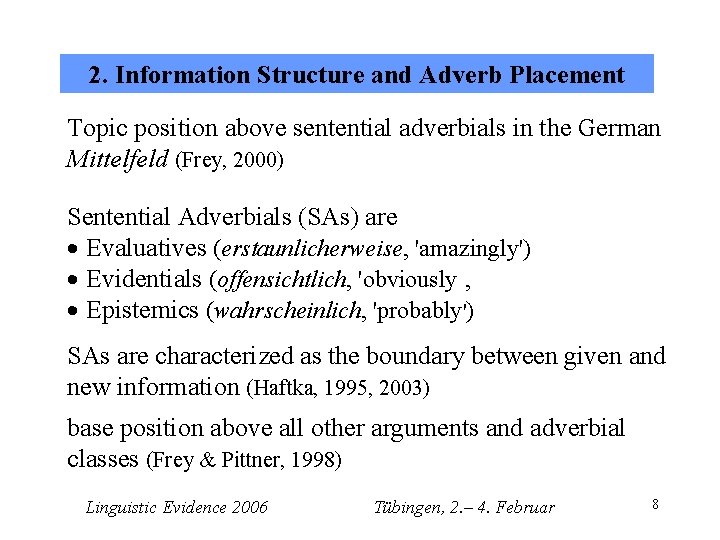
2. Information Structure and Adverb Placement Topic position above sentential adverbials in the German Mittelfeld (Frey, 2000) Sentential Adverbials (SAs) are Evaluatives (erstaunlicherweise, 'amazingly') Evidentials (offensichtlich, 'obviously ‚ Epistemics (wahrscheinlich, 'probably') SAs are characterized as the boundary between given and new information (Haftka, 1995, 2003) base position above all other arguments and adverbial classes (Frey & Pittner, 1998) Linguistic Evidence 2006 Tübingen, 2. – 4. Februar 8
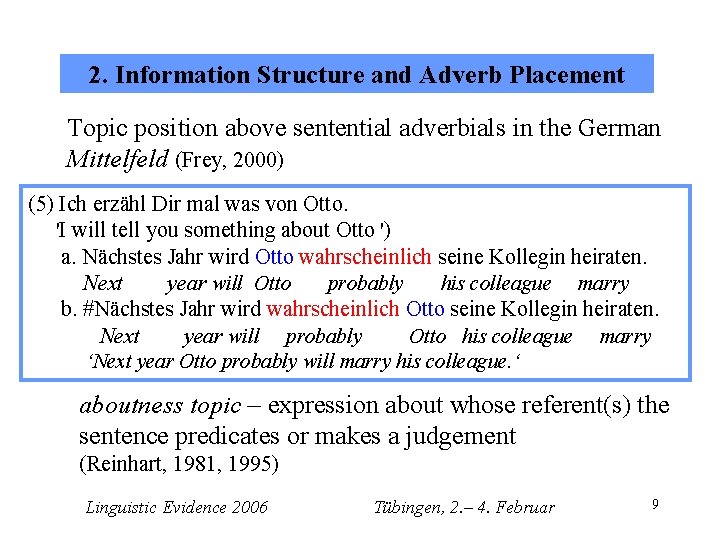
2. Information Structure and Adverb Placement Topic position above sentential adverbials in the German Mittelfeld (Frey, 2000) (5) Ich erzähl Dir mal was von Otto. 'I will tell you something about Otto ') a. Nächstes Jahr wird Otto wahrscheinlich seine Kollegin heiraten. Next year will Otto probably his colleague marry b. #Nächstes Jahr wird wahrscheinlich Otto seine Kollegin heiraten. Next year will probably Otto his colleague marry ‘Next year Otto probably will marry his colleague. ‘ aboutness topic – expression about whose referent(s) the sentence predicates or makes a judgement (Reinhart, 1981, 1995) Linguistic Evidence 2006 Tübingen, 2. – 4. Februar 9
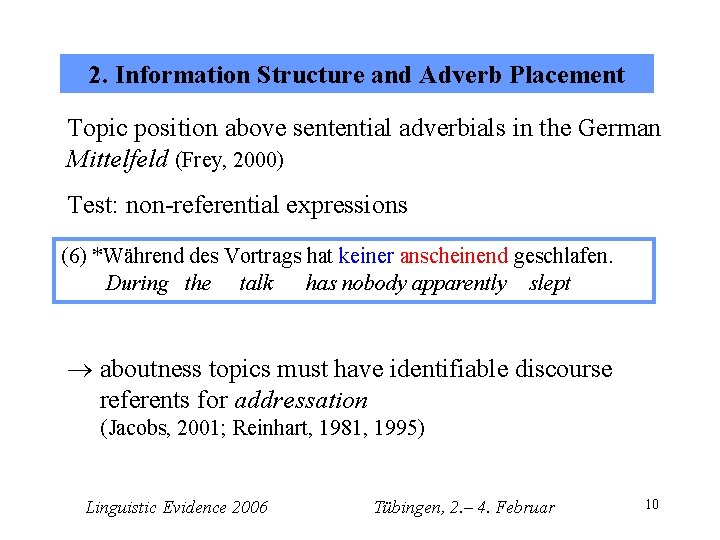
2. Information Structure and Adverb Placement Topic position above sentential adverbials in the German Mittelfeld (Frey, 2000) Test: non-referential expressions (6) *Während des Vortrags hat keiner anscheinend geschlafen. During the talk has nobody apparently slept aboutness topics must have identifiable discourse referents for addressation (Jacobs, 2001; Reinhart, 1981, 1995) Linguistic Evidence 2006 Tübingen, 2. – 4. Februar 10
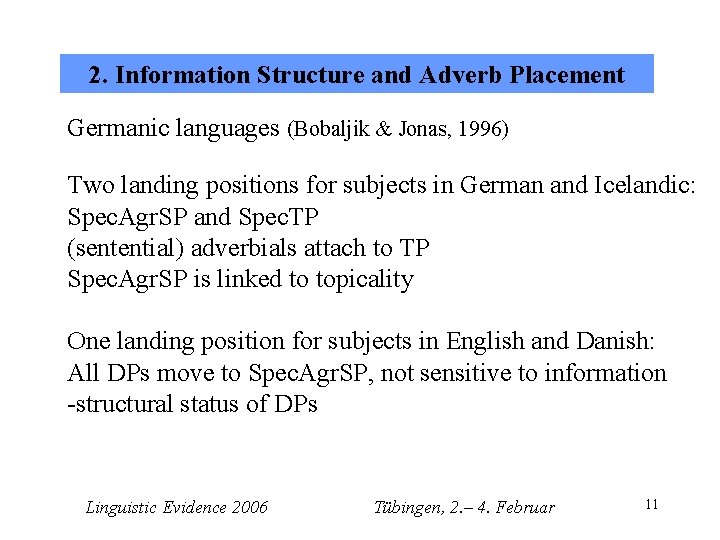
2. Information Structure and Adverb Placement Germanic languages (Bobaljik & Jonas, 1996) Two landing positions for subjects in German and Icelandic: Spec. Agr. SP and Spec. TP (sentential) adverbials attach to TP Spec. Agr. SP is linked to topicality One landing position for subjects in English and Danish: All DPs move to Spec. Agr. SP, not sensitive to information -structural status of DPs Linguistic Evidence 2006 Tübingen, 2. – 4. Februar 11
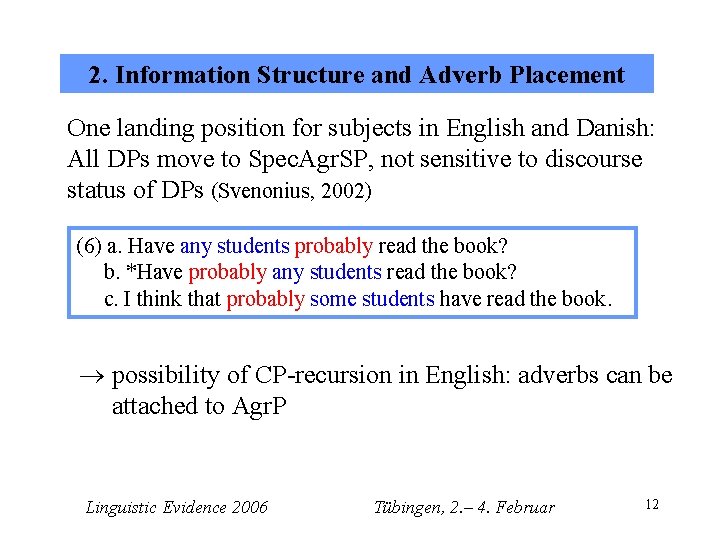
2. Information Structure and Adverb Placement One landing position for subjects in English and Danish: All DPs move to Spec. Agr. SP, not sensitive to discourse status of DPs (Svenonius, 2002) (6) a. Have any students probably read the book? b. *Have probably any students read the book? c. I think that probably some students have read the book. possibility of CP-recursion in English: adverbs can be attached to Agr. P Linguistic Evidence 2006 Tübingen, 2. – 4. Februar 12

2. Information Structure and Adverb Placement Conclusion Languages with flexible word order are sensitive to information-structural constraints with regard to • the order of arguments (SOV vs. OSV) • the placement of adverbials (Adv. S vs. SAdv) A language like English with a relatively fixed word order is not sensitive to information-structural constraints with regard to • the order of arguments (SVO) • the placement of adverbials (SAdv) Linguistic Evidence 2006 Tübingen, 2. – 4. Februar 13
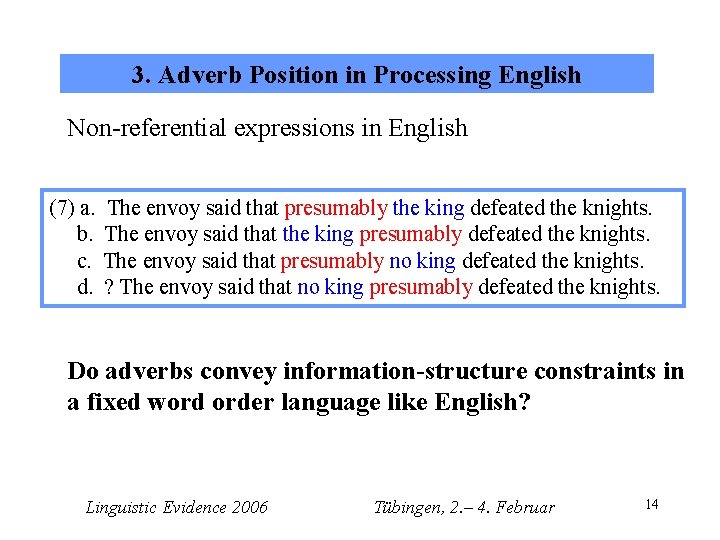
3. Adverb Position in Processing English Non-referential expressions in English (7) a. b. c. d. The envoy said that presumably the king defeated the knights. The envoy said that the king presumably defeated the knights. The envoy said that presumably no king defeated the knights. ? The envoy said that no king presumably defeated the knights. Do adverbs convey information-structure constraints in a fixed word order language like English? Linguistic Evidence 2006 Tübingen, 2. – 4. Februar 14
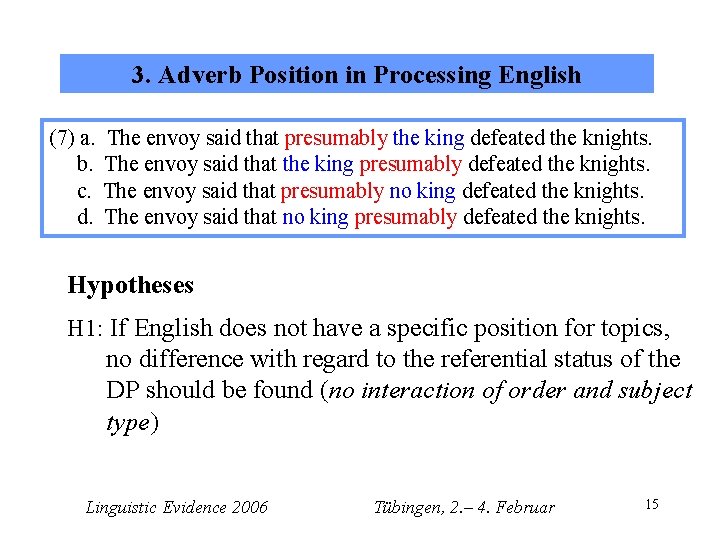
3. Adverb Position in Processing English (7) a. b. c. d. The envoy said that presumably the king defeated the knights. The envoy said that the king presumably defeated the knights. The envoy said that presumably no king defeated the knights. The envoy said that no king presumably defeated the knights. Hypotheses H 1: If English does not have a specific position for topics, no difference with regard to the referential status of the DP should be found (no interaction of order and subject type) Linguistic Evidence 2006 Tübingen, 2. – 4. Februar 15
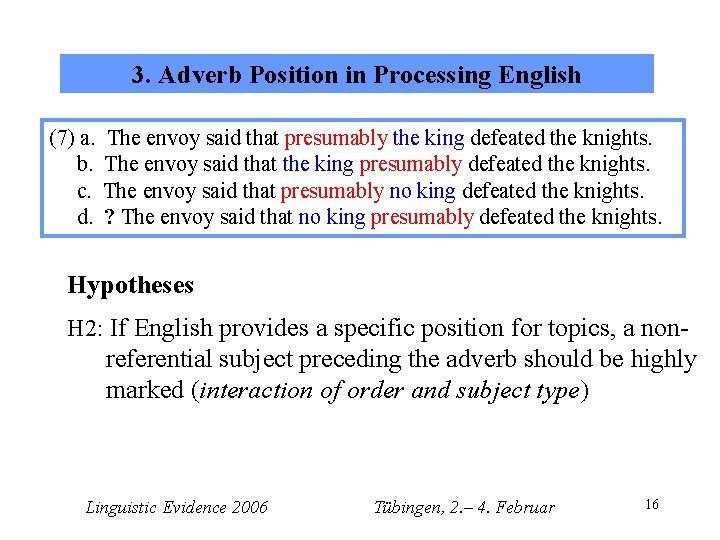
3. Adverb Position in Processing English (7) a. b. c. d. The envoy said that presumably the king defeated the knights. The envoy said that the king presumably defeated the knights. The envoy said that presumably no king defeated the knights. ? The envoy said that no king presumably defeated the knights. Hypotheses H 2: If English provides a specific position for topics, a non- referential subject preceding the adverb should be highly marked (interaction of order and subject type) Linguistic Evidence 2006 Tübingen, 2. – 4. Februar 16
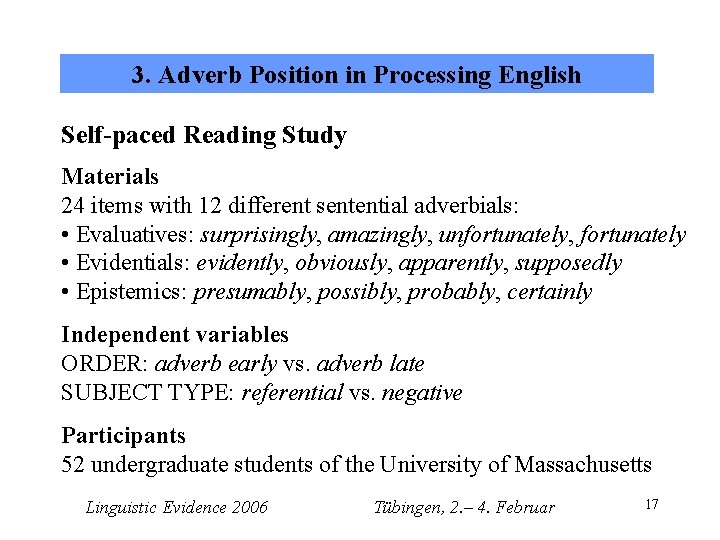
3. Adverb Position in Processing English Self-paced Reading Study Materials 24 items with 12 different sentential adverbials: • Evaluatives: surprisingly, amazingly, unfortunately, fortunately • Evidentials: evidently, obviously, apparently, supposedly • Epistemics: presumably, possibly, probably, certainly Independent variables ORDER: adverb early vs. adverb late SUBJECT TYPE: referential vs. negative Participants 52 undergraduate students of the University of Massachusetts Linguistic Evidence 2006 Tübingen, 2. – 4. Februar 17
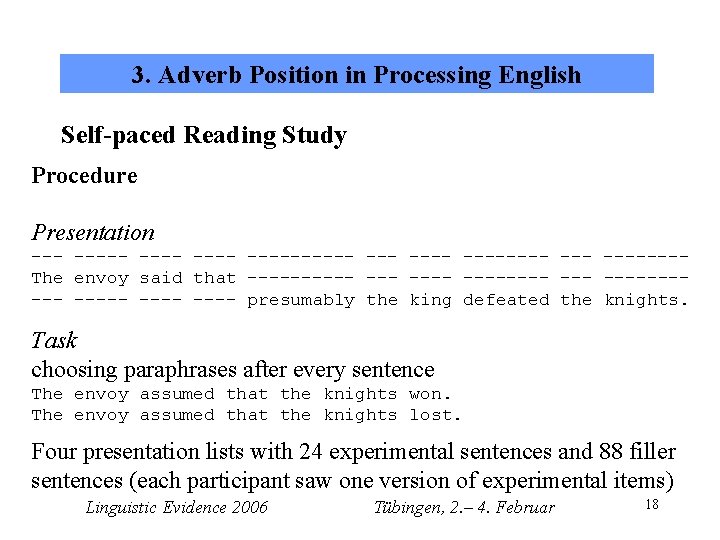
3. Adverb Position in Processing English Self-paced Reading Study Procedure Presentation ----- ---- -------The envoy said that ----- ---------- presumably the king defeated the knights. Task choosing paraphrases after every sentence The envoy assumed that the knights won. The envoy assumed that the knights lost. Four presentation lists with 24 experimental sentences and 88 filler sentences (each participant saw one version of experimental items) Linguistic Evidence 2006 Tübingen, 2. – 4. Februar 18
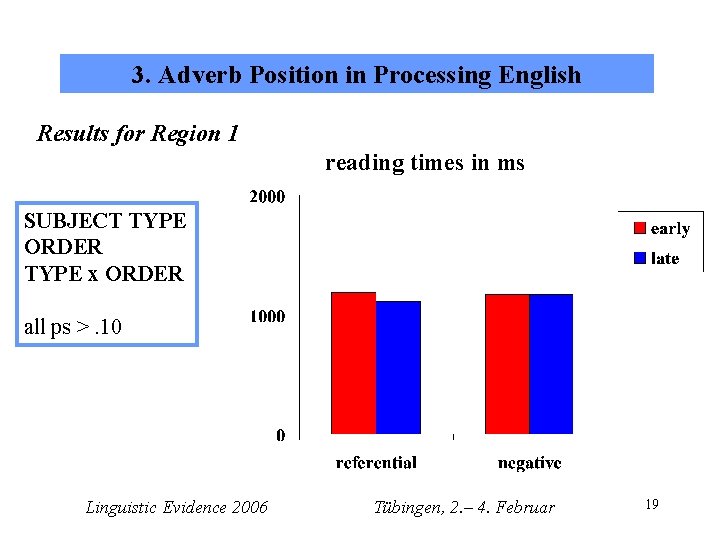
3. Adverb Position in Processing English Results for Region 1 reading times in ms SUBJECT TYPE ORDER TYPE x ORDER all ps >. 10 Linguistic Evidence 2006 Tübingen, 2. – 4. Februar 19
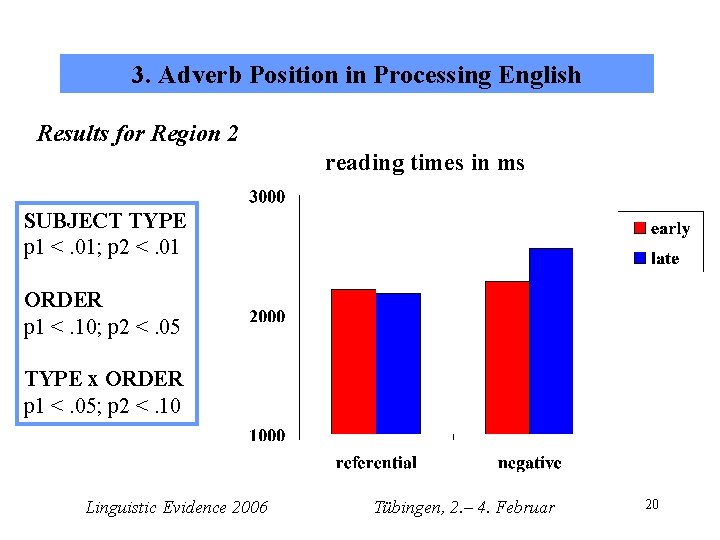
3. Adverb Position in Processing English Results for Region 2 reading times in ms SUBJECT TYPE p 1 <. 01; p 2 <. 01 ORDER p 1 <. 10; p 2 <. 05 TYPE x ORDER p 1 <. 05; p 2 <. 10 Linguistic Evidence 2006 Tübingen, 2. – 4. Februar 20
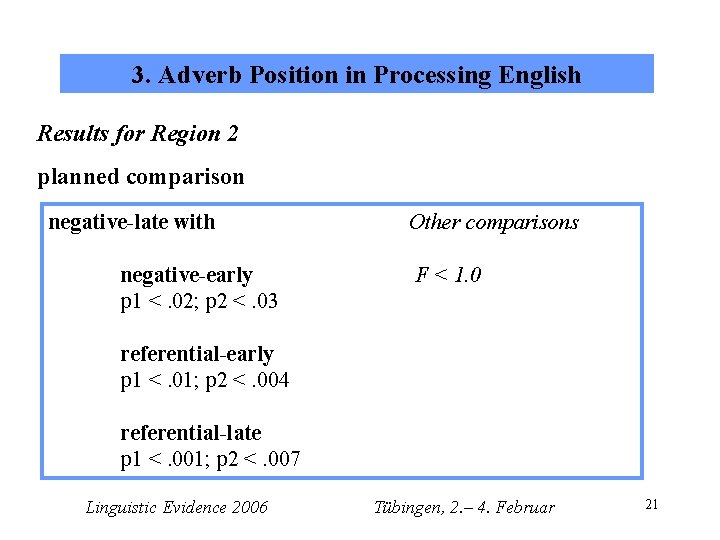
3. Adverb Position in Processing English Results for Region 2 planned comparison negative-late with negative-early p 1 <. 02; p 2 <. 03 Other comparisons F < 1. 0 referential-early p 1 <. 01; p 2 <. 004 referential-late p 1 <. 001; p 2 <. 007 Linguistic Evidence 2006 Tübingen, 2. – 4. Februar 21
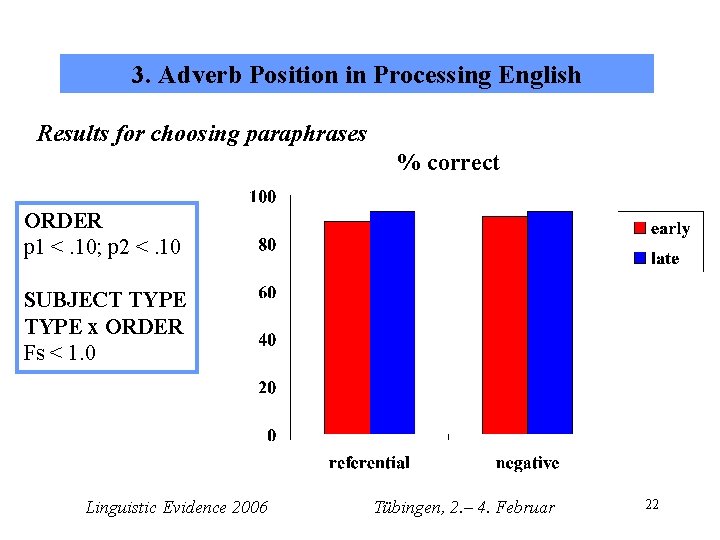
3. Adverb Position in Processing English Results for choosing paraphrases % correct ORDER p 1 <. 10; p 2 <. 10 SUBJECT TYPE x ORDER Fs < 1. 0 Linguistic Evidence 2006 Tübingen, 2. – 4. Februar 22
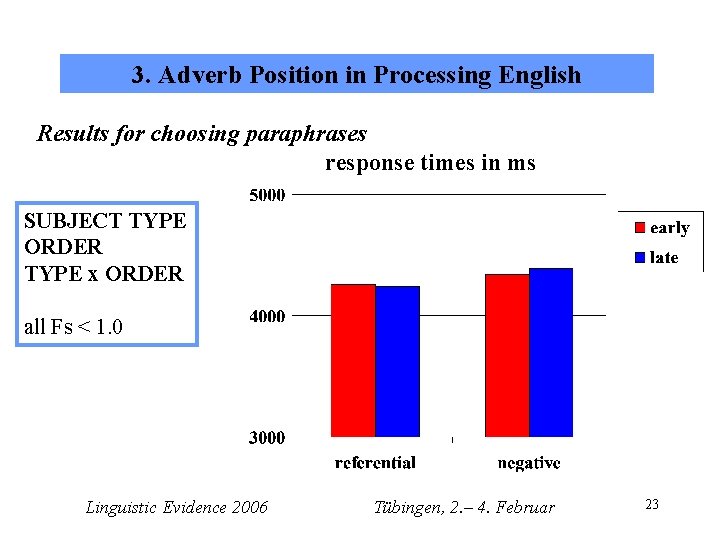
3. Adverb Position in Processing English Results for choosing paraphrases response times in ms SUBJECT TYPE ORDER TYPE x ORDER all Fs < 1. 0 Linguistic Evidence 2006 Tübingen, 2. – 4. Februar 23
4. Discussion Processing difficulties (longer reading times) in the critical region for sentences with a non-referential subject preceding the sentential adverbial. H 1: If English does not have a specific position for topics, no difference with regard to the referential status of the DP should be found H 2: If English provides a specific position for topics, a nonreferential subject preceding the adverb should be highly marked Linguistic Evidence 2006 Tübingen, 2. – 4. Februar 24
4. Discussion Evidence against the assumption that English has only one landing position for subjects which is not sensitive to information-structural status of DPs Outlook • Further evidence for influence of information structure Contextual information? • Experimental evidence for topic position in German? Linguistic Evidence 2006 Tübingen, 2. – 4. Februar 25
THANK YOU and William Evans for his help with collecting the data ! Linguistic Evidence 2006 Tübingen, 2. – 4. Februar 26
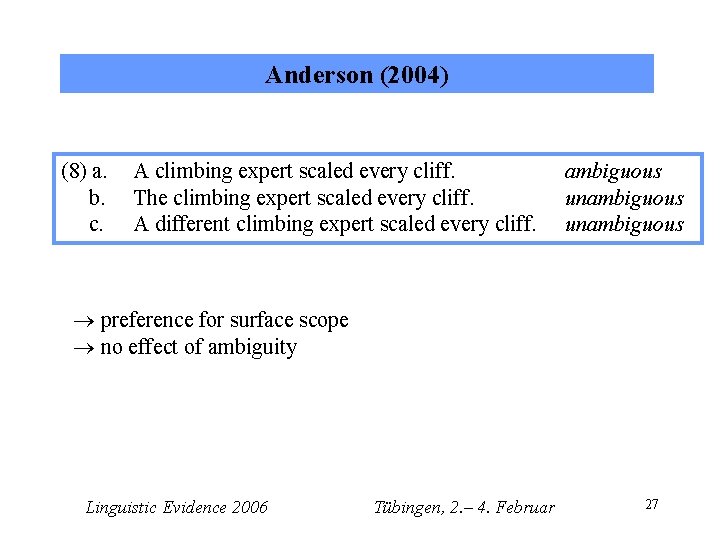
Anderson (2004) (8) a. b. c. A climbing expert scaled every cliff. The climbing expert scaled every cliff. A different climbing expert scaled every cliff. ambiguous unambiguous preference for surface scope no effect of ambiguity Linguistic Evidence 2006 Tübingen, 2. – 4. Februar 27
- Slides: 27