
ADVENTURES IN EXPLODING DOTS Exploration 3 ADDITION and
- Slides: 38
ADVENTURES IN EXPLODING DOTS: Exploration 3 ADDITION and MULTIPLICATION A deep understanding of long addition and multiplication
Teacher Notes We now play with the 1 10 machine and examine arithmetic algorithms in the light of the machine. We begin with long addition and then briefly move to multiplication and see the algorithms for them afresh. We’ll also explain some contradictions in English with regard to how we say numbers and exploit those contradictions! This exploration comes in five/six parts. PART 1: English is Weird PART 2: Addition PART 3: The Traditional Algorithm PART 4: Multiplication PART 5: “To multiply by 10, add a zero. ” HUH? EXTRA: Long Multiplication Example dialogue appears in blue. This Exploration could be conducted as a single, fast-paced lesson or taken slowly over a several class periods.
Teacher Notes PART 1: English is Weird Here’s a You. Tube video of James conducting this section on Zoom. Feel free to skip this video if you prefer just to read materials. https: //youtu. be/D 1 g. Xob. I 8 t. XI [11: 06 minutes]
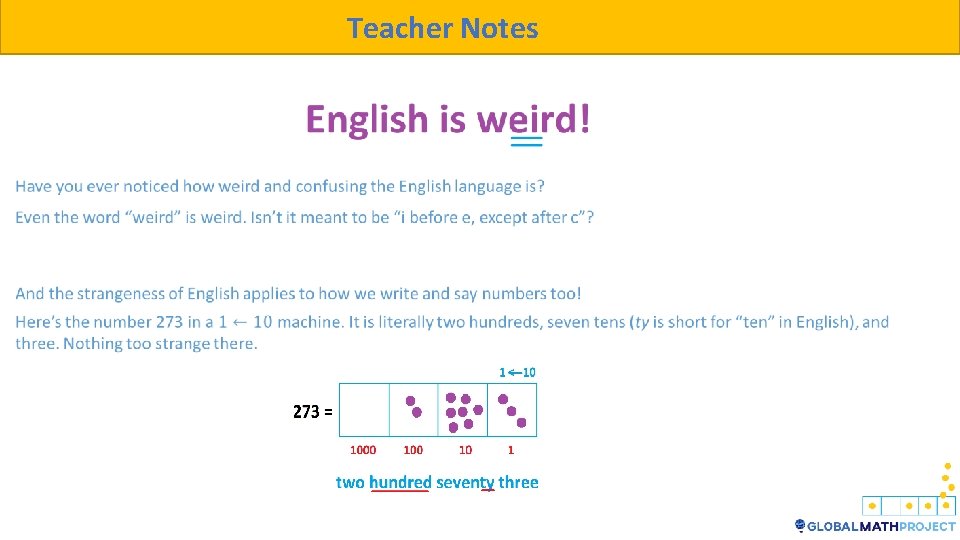
Teacher Notes
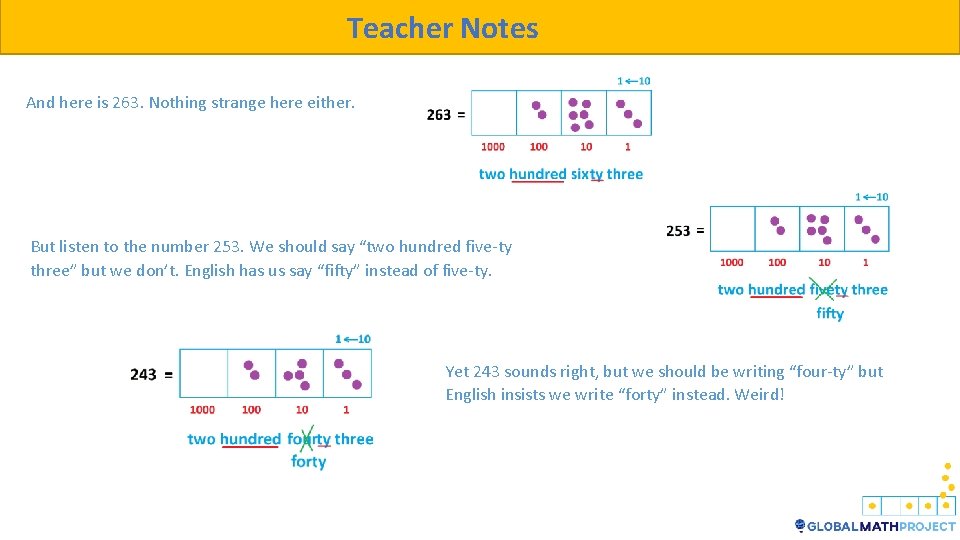
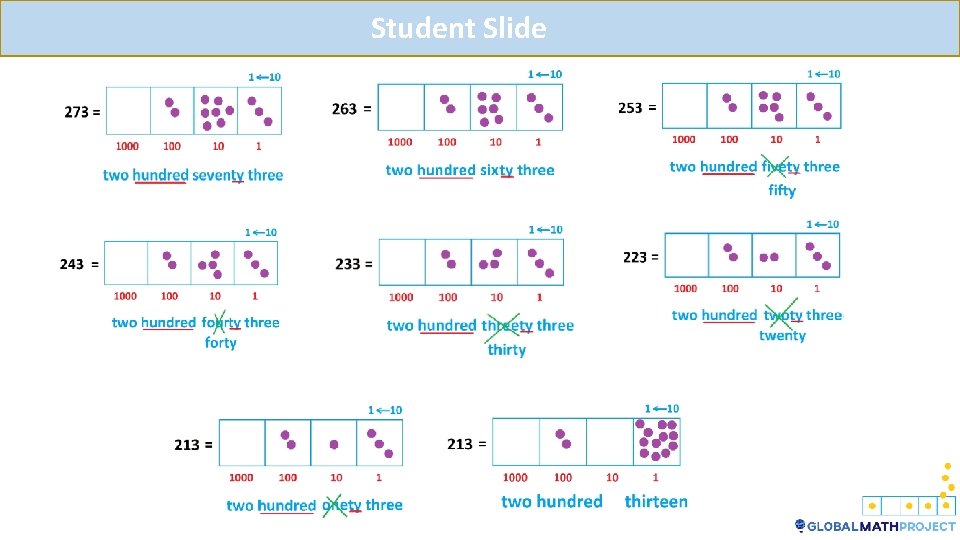
Teacher Notes And here is 263. Nothing strange here either. But listen to the number 253. We should say “two hundred five-ty three” but we don’t. English has us say “fifty” instead of five-ty. Yet 243 sounds right, but we should be writing “four-ty” but English insists we write “forty” instead. Weird!
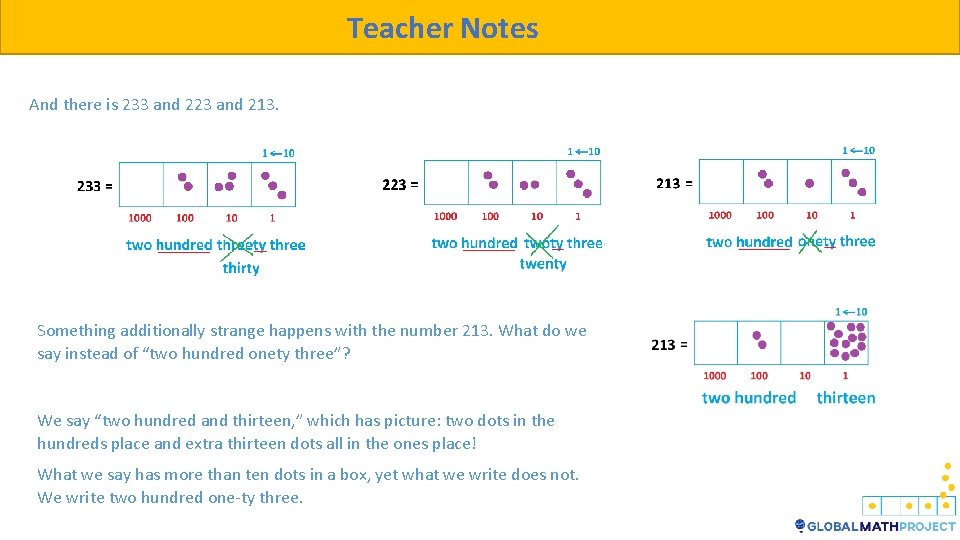
Teacher Notes And there is 233 and 223 and 213. Something additionally strange happens with the number 213. What do we say instead of “two hundred onety three”? We say “two hundred and thirteen, ” which has picture: two dots in the hundreds place and extra thirteen dots all in the ones place! What we say has more than ten dots in a box, yet what we write does not. We write two hundred one-ty three.
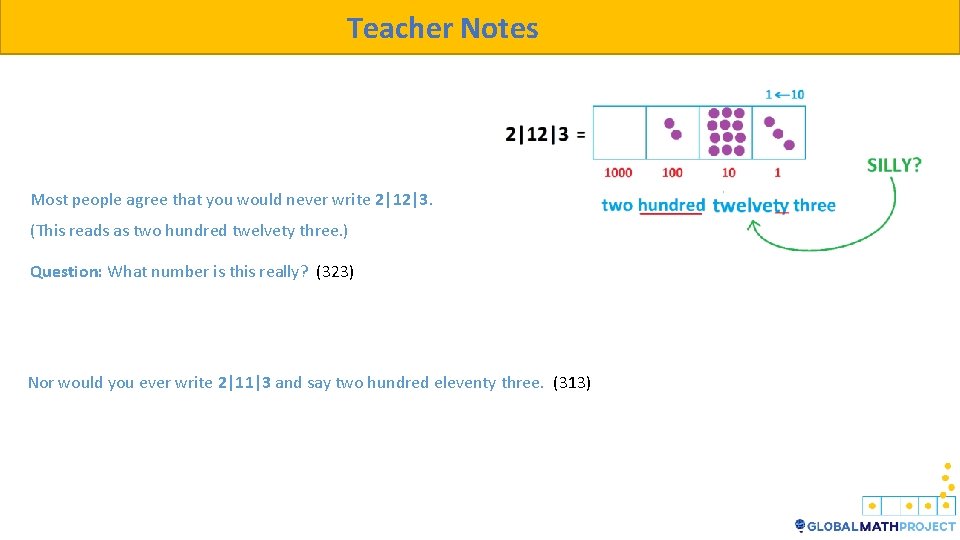
Teacher Notes Most people agree that you would never write 2|12|3. (This reads as two hundred twelvety three. ) Question: What number is this really? (323) Nor would you ever write 2|11|3 and say two hundred eleventy three. (313)
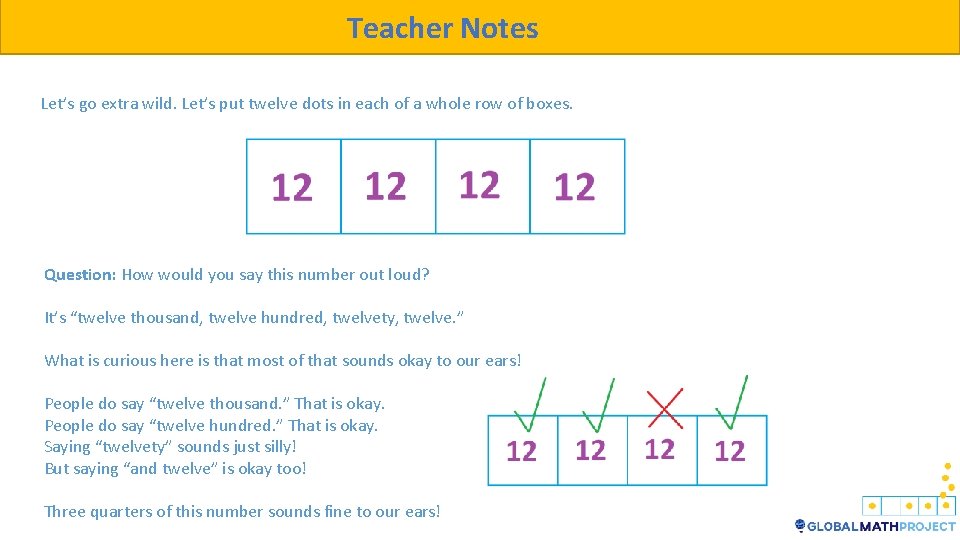
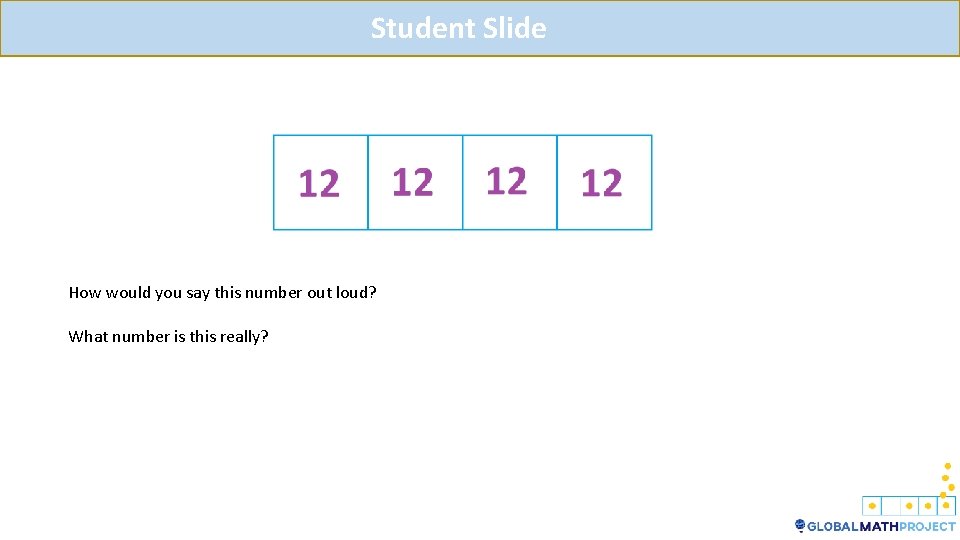
Teacher Notes Let’s go extra wild. Let’s put twelve dots in each of a whole row of boxes. Question: How would you say this number out loud? It’s “twelve thousand, twelve hundred, twelvety, twelve. ” What is curious here is that most of that sounds okay to our ears! People do say “twelve thousand. ” That is okay. People do say “twelve hundred. ” That is okay. Saying “twelvety” sounds just silly! But saying “and twelve” is okay too! Three quarters of this number sounds fine to our ears!
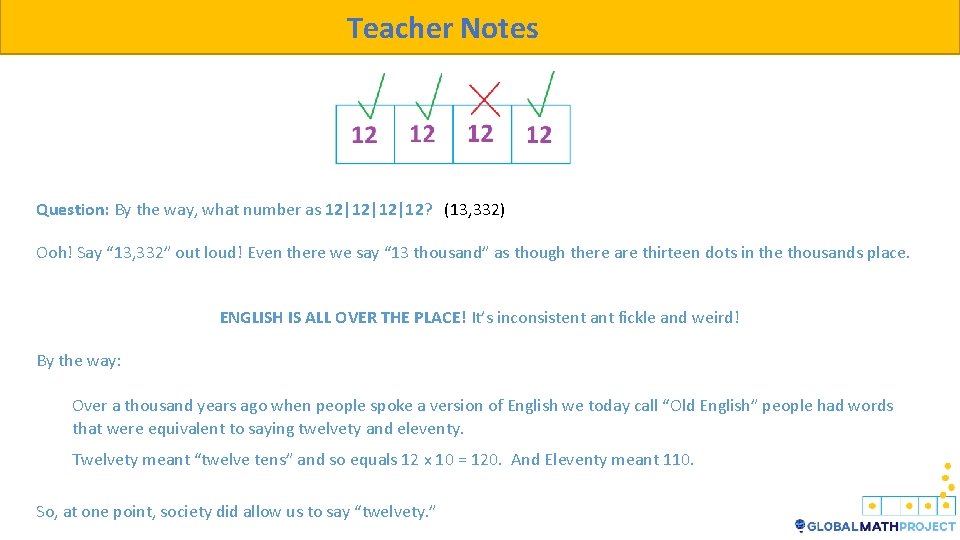
Teacher Notes Question: By the way, what number as 12|12|12|12? (13, 332) Ooh! Say “ 13, 332” out loud! Even there we say “ 13 thousand” as though there are thirteen dots in the thousands place. ENGLISH IS ALL OVER THE PLACE! It’s inconsistent ant fickle and weird! By the way: Over a thousand years ago when people spoke a version of English we today call “Old English” people had words that were equivalent to saying twelvety and eleventy. Twelvety meant “twelve tens” and so equals 12 x 10 = 120. And Eleventy meant 110. So, at one point, society did allow us to say “twelvety. ”
Teacher Notes I say … If English is allowed to sometimes be quirky, then we should be quirky too! Let’s use quirkiness to our advantage! EXTRA: The material in this section provides a lovely invitation for students who speak other languages to describe the regularity or irregularity of their language’s way of saying large numbers.
Student Slide
Student Slide
Student Slide How would you say this number out loud? What number is this really?
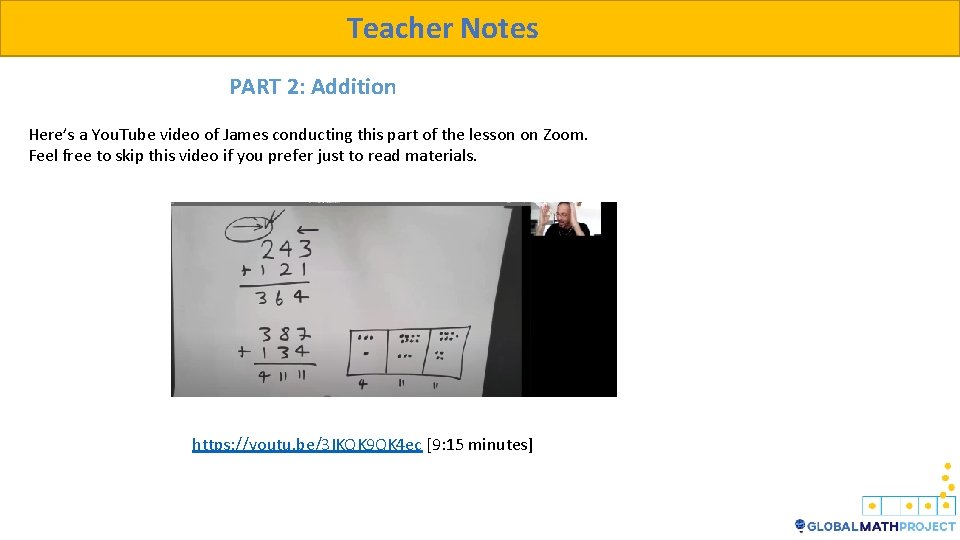
Teacher Notes PART 2: Addition Here’s a You. Tube video of James conducting this part of the lesson on Zoom. Feel free to skip this video if you prefer just to read materials. https: //youtu. be/3 IKQK 9 QK 4 ec [9: 15 minutes]
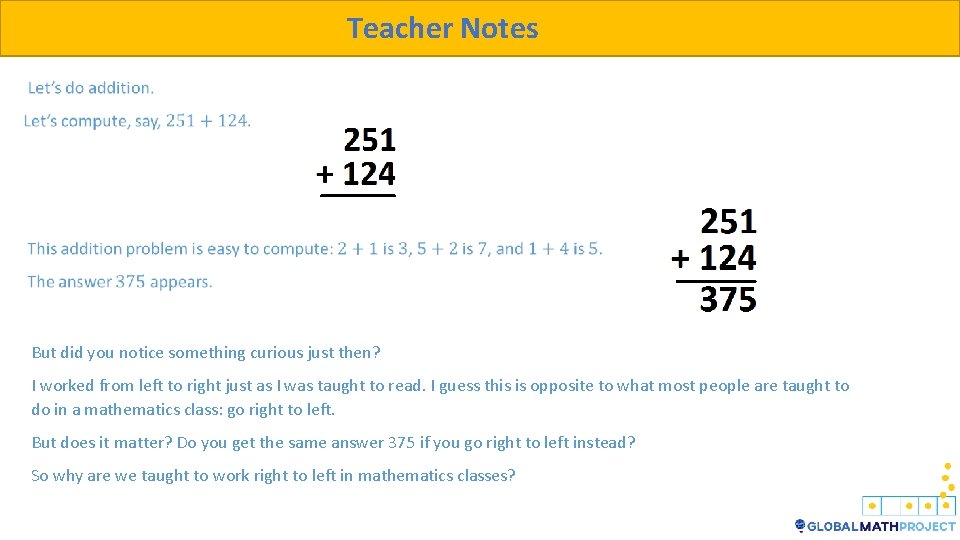
Teacher Notes But did you notice something curious just then? I worked from left to right just as I was taught to read. I guess this is opposite to what most people are taught to do in a mathematics class: go right to left. But does it matter? Do you get the same answer 375 if you go right to left instead? So why are we taught to work right to left in mathematics classes?
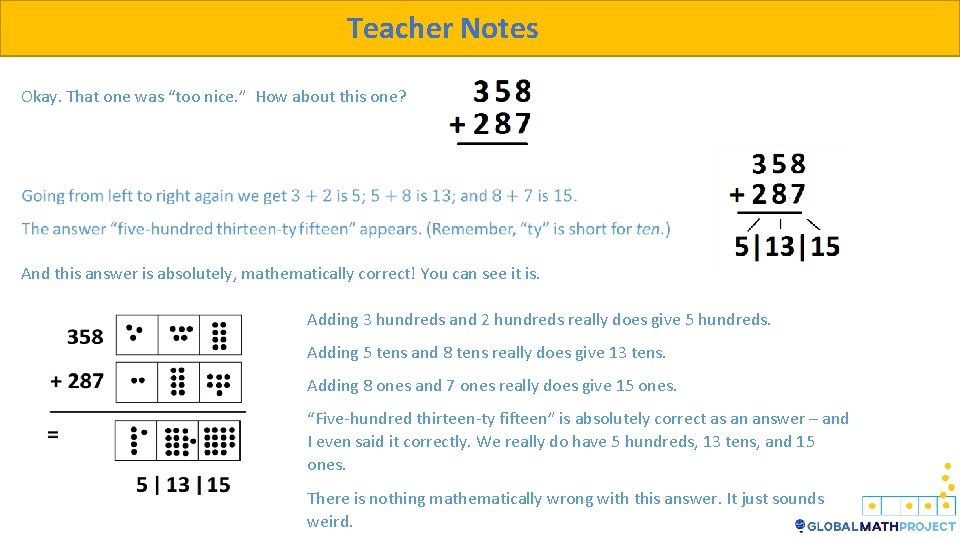
Teacher Notes Okay. That one was “too nice. ” How about this one? And this answer is absolutely, mathematically correct! You can see it is. Adding 3 hundreds and 2 hundreds really does give 5 hundreds. Adding 5 tens and 8 tens really does give 13 tens. Adding 8 ones and 7 ones really does give 15 ones. “Five-hundred thirteen-ty fifteen” is absolutely correct as an answer – and I even said it correctly. We really do have 5 hundreds, 13 tens, and 15 ones. There is nothing mathematically wrong with this answer. It just sounds weird.
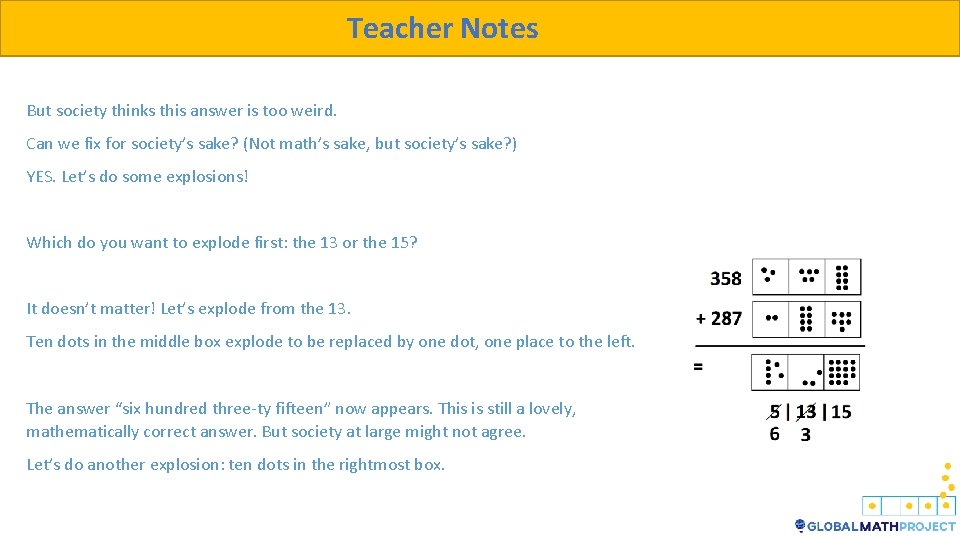
Teacher Notes But society thinks this answer is too weird. Can we fix for society’s sake? (Not math’s sake, but society’s sake? ) YES. Let’s do some explosions! Which do you want to explode first: the 13 or the 15? It doesn’t matter! Let’s explode from the 13. Ten dots in the middle box explode to be replaced by one dot, one place to the left. The answer “six hundred three-ty fifteen” now appears. This is still a lovely, mathematically correct answer. But society at large might not agree. Let’s do another explosion: ten dots in the rightmost box.
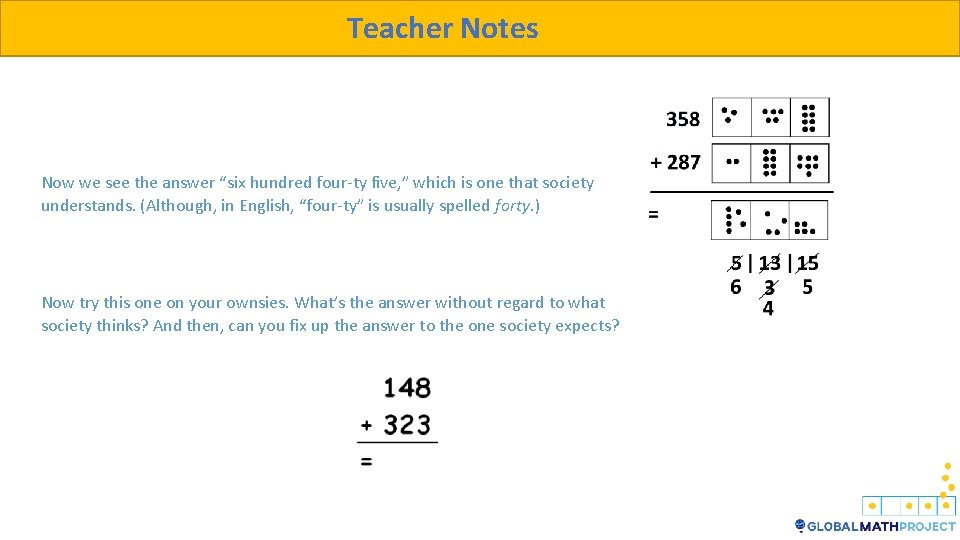
Teacher Notes Now we see the answer “six hundred four-ty five, ” which is one that society understands. (Although, in English, “four-ty” is usually spelled forty. ) Now try this one on your ownsies. What’s the answer without regard to what society thinks? And then, can you fix up the answer to the one society expects?
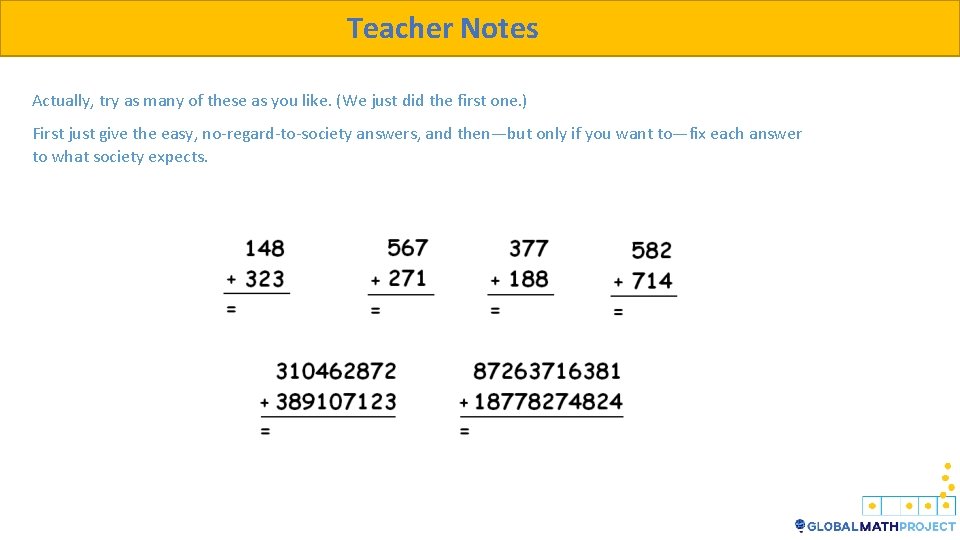
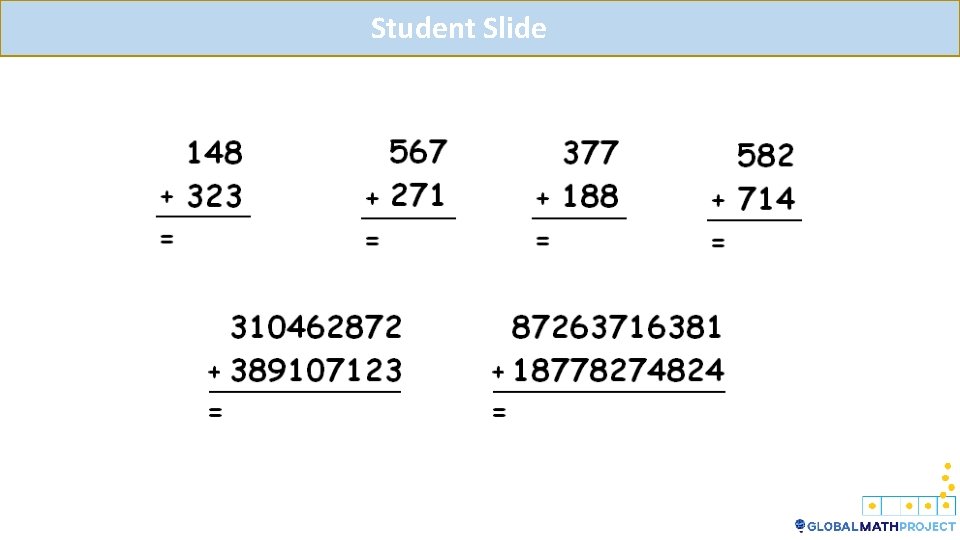
Teacher Notes Actually, try as many of these as you like. (We just did the first one. ) First just give the easy, no-regard-to-society answers, and then—but only if you want to—fix each answer to what society expects.
Student Slide
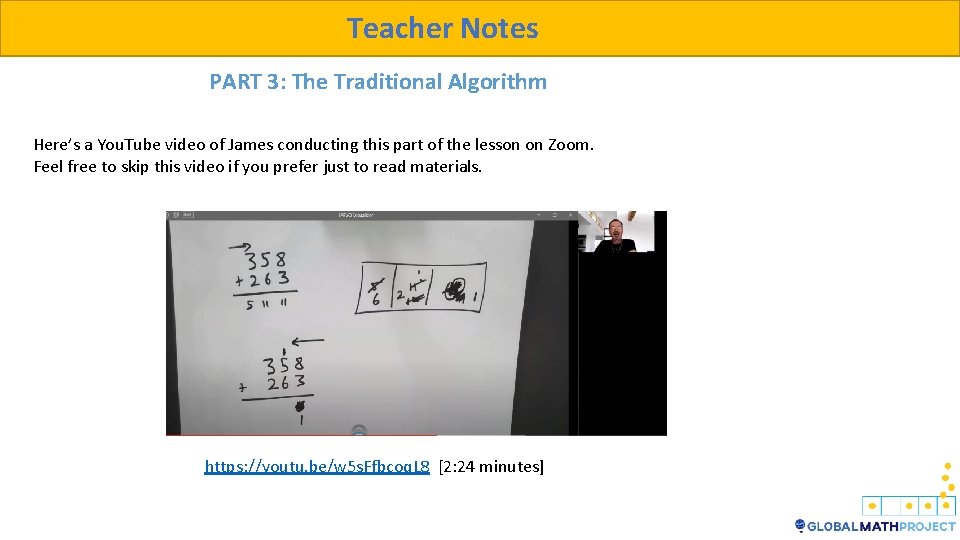
Teacher Notes PART 3: The Traditional Algorithm Here’s a You. Tube video of James conducting this part of the lesson on Zoom. Feel free to skip this video if you prefer just to read materials. https: //youtu. be/w 5 s. Ffbcoq. L 8 [2: 24 minutes]
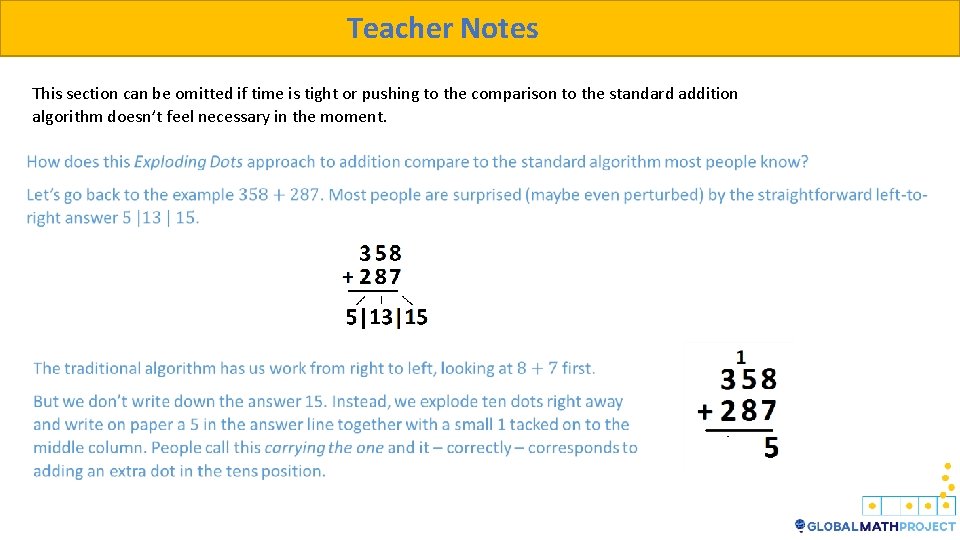
Teacher Notes This section can be omitted if time is tight or pushing to the comparison to the standard addition algorithm doesn’t feel necessary in the moment.
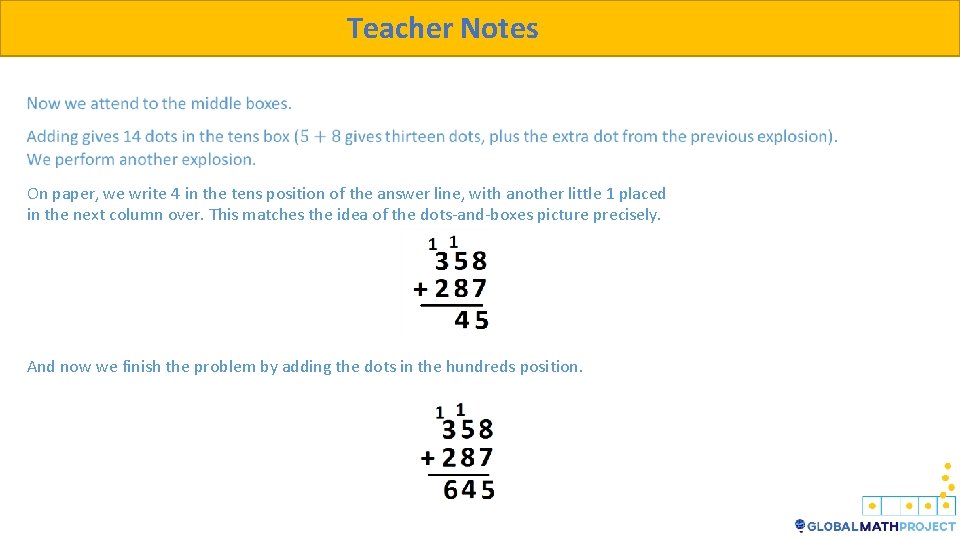
Teacher Notes On paper, we write 4 in the tens position of the answer line, with another little 1 placed in the next column over. This matches the idea of the dots-and-boxes picture precisely. And now we finish the problem by adding the dots in the hundreds position.
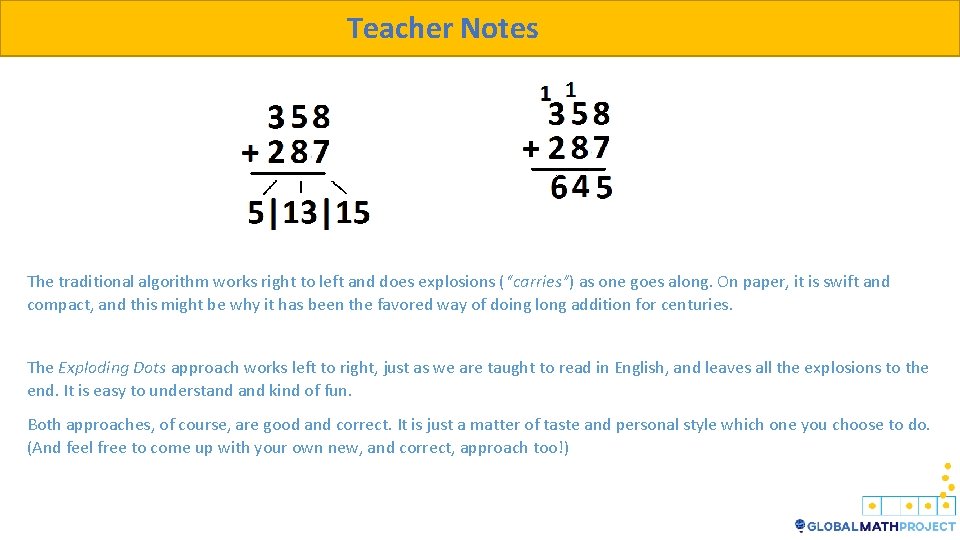
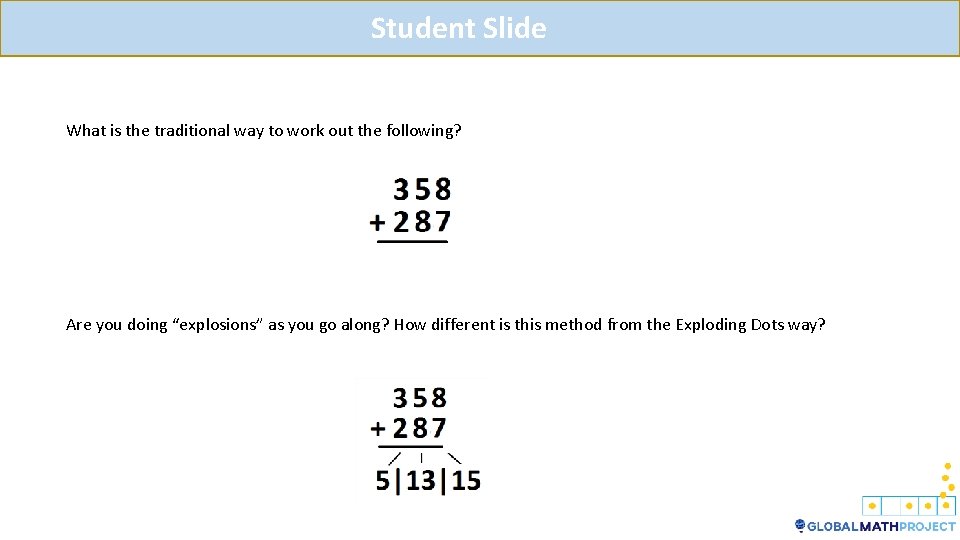
Teacher Notes The traditional algorithm works right to left and does explosions (“carries”) as one goes along. On paper, it is swift and compact, and this might be why it has been the favored way of doing long addition for centuries. The Exploding Dots approach works left to right, just as we are taught to read in English, and leaves all the explosions to the end. It is easy to understand kind of fun. Both approaches, of course, are good and correct. It is just a matter of taste and personal style which one you choose to do. (And feel free to come up with your own new, and correct, approach too!)
Student Slide What is the traditional way to work out the following? Are you doing “explosions” as you go along? How different is this method from the Exploding Dots way?
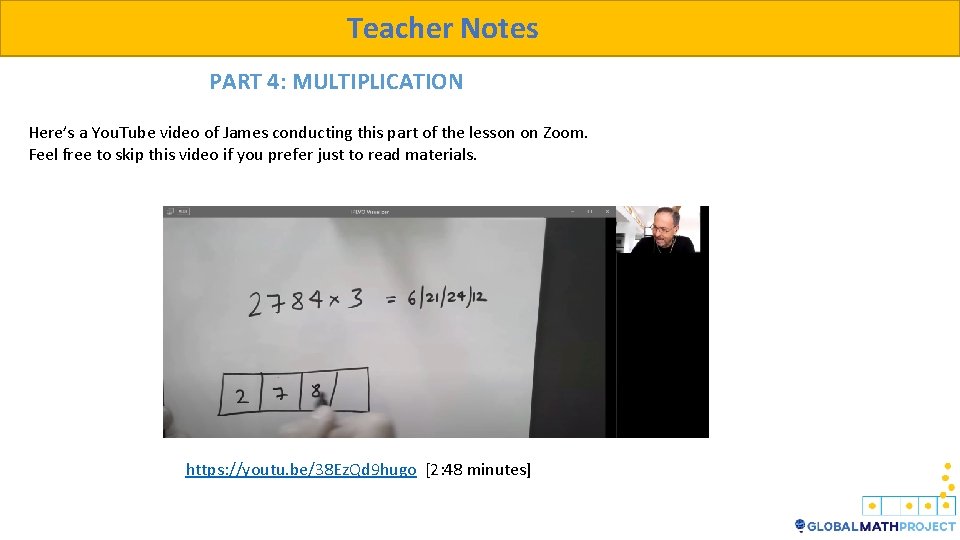
Teacher Notes PART 4: MULTIPLICATION Here’s a You. Tube video of James conducting this part of the lesson on Zoom. Feel free to skip this video if you prefer just to read materials. https: //youtu. be/38 Ez. Qd 9 hugo [2: 48 minutes]
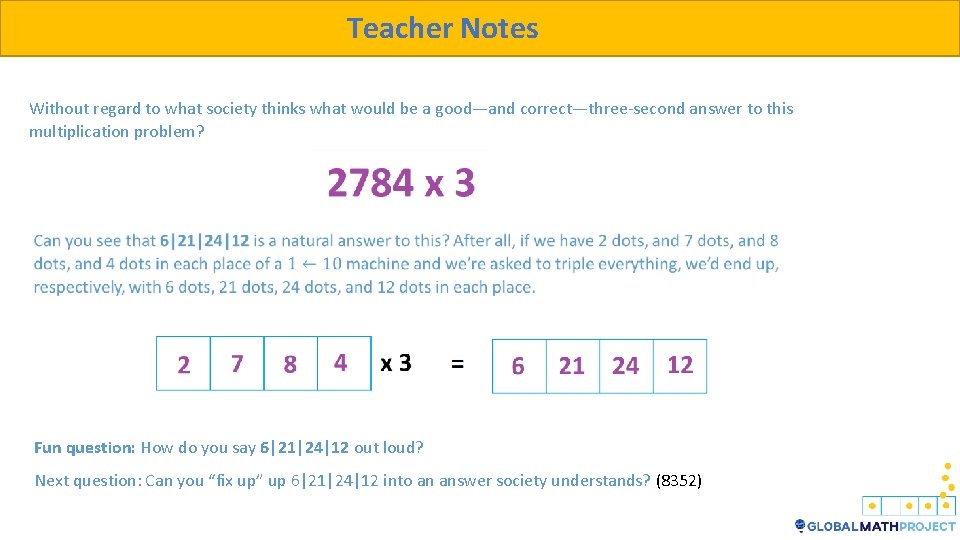
Teacher Notes Without regard to what society thinks what would be a good—and correct—three-second answer to this multiplication problem? Fun question: How do you say 6|21|24|12 out loud? Next question: Can you “fix up” up 6|21|24|12 into an answer society understands? (8352)
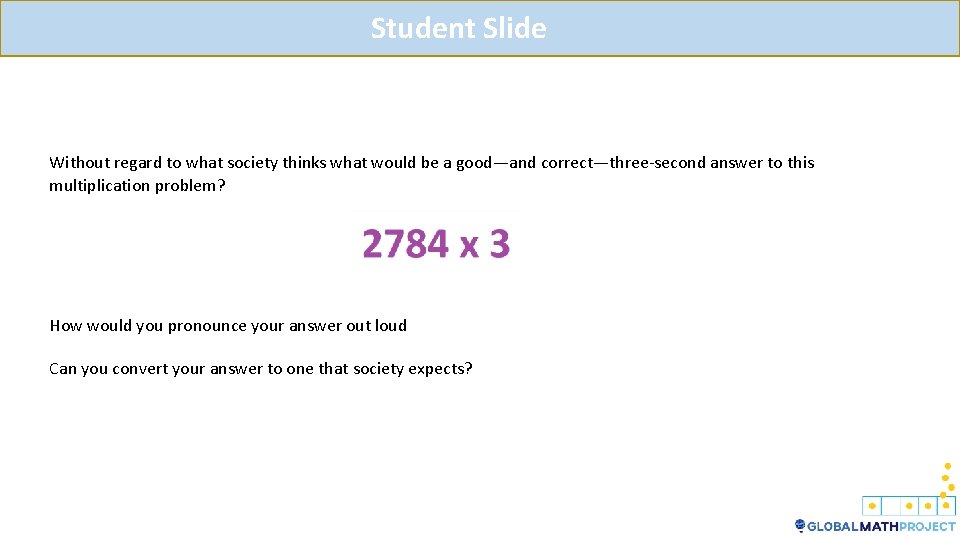
Student Slide Without regard to what society thinks what would be a good—and correct—three-second answer to this multiplication problem? How would you pronounce your answer out loud Can you convert your answer to one that society expects?
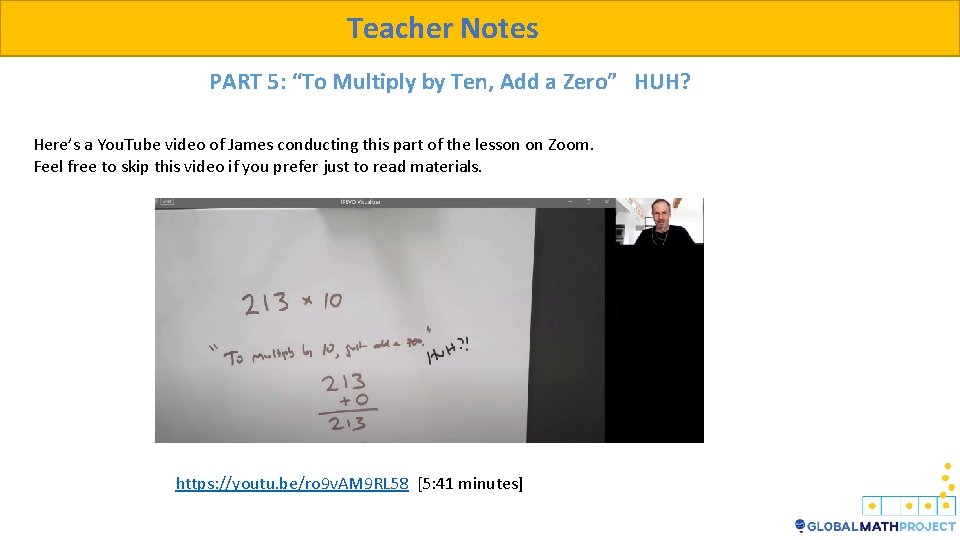
Teacher Notes PART 5: “To Multiply by Ten, Add a Zero” HUH? Here’s a You. Tube video of James conducting this part of the lesson on Zoom. Feel free to skip this video if you prefer just to read materials. https: //youtu. be/ro 9 v. AM 9 RL 58 [5: 41 minutes]
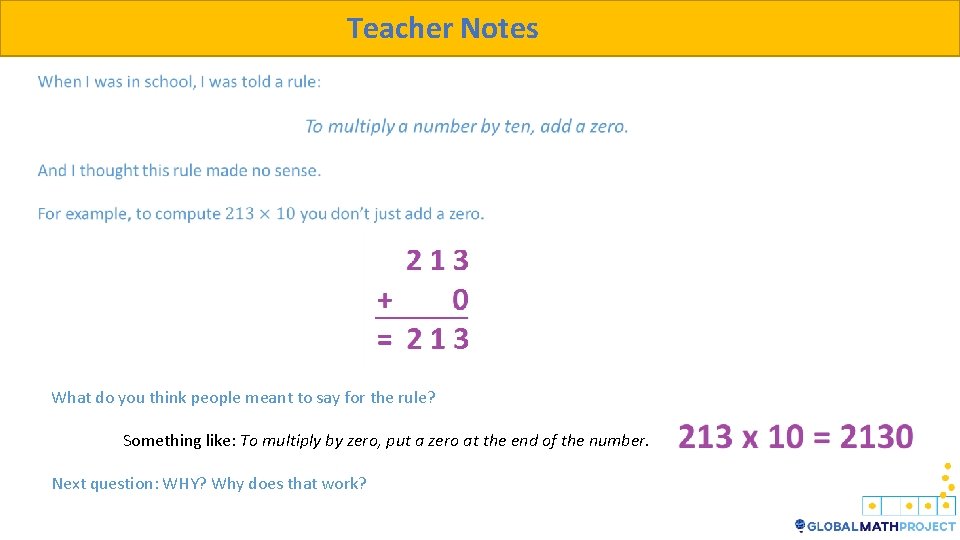
Teacher Notes What do you think people meant to say for the rule? Something like: To multiply by zero, put a zero at the end of the number. Next question: WHY? Why does that work?
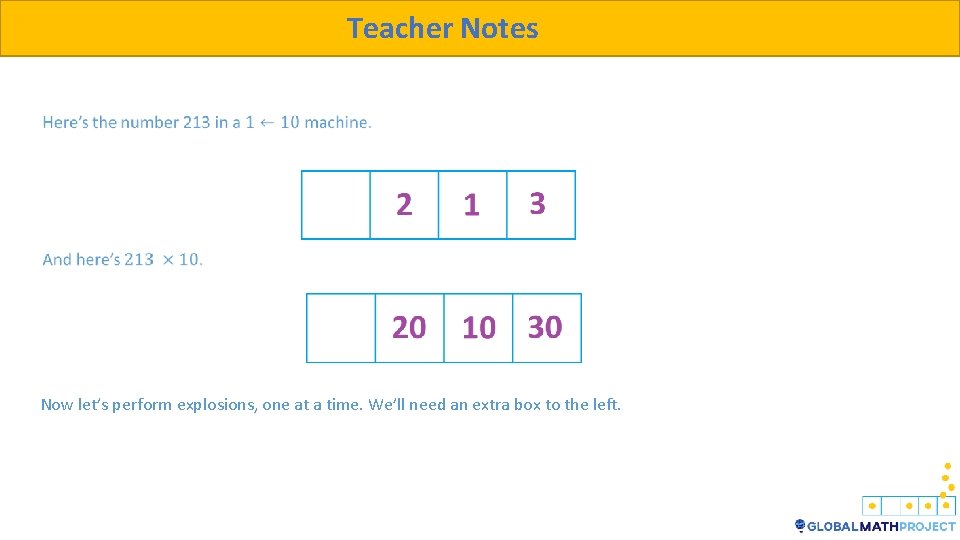
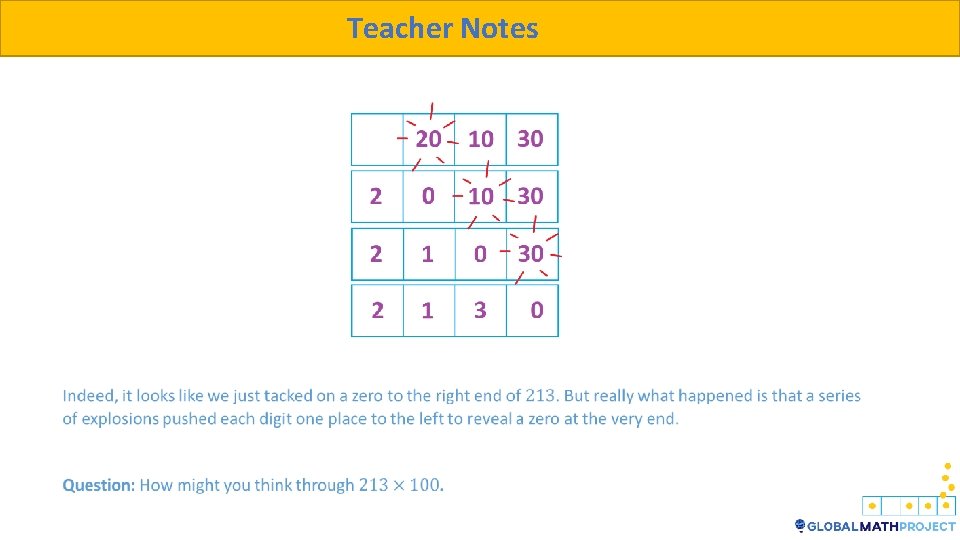
Teacher Notes Now let’s perform explosions, one at a time. We’ll need an extra box to the left.
Teacher Notes
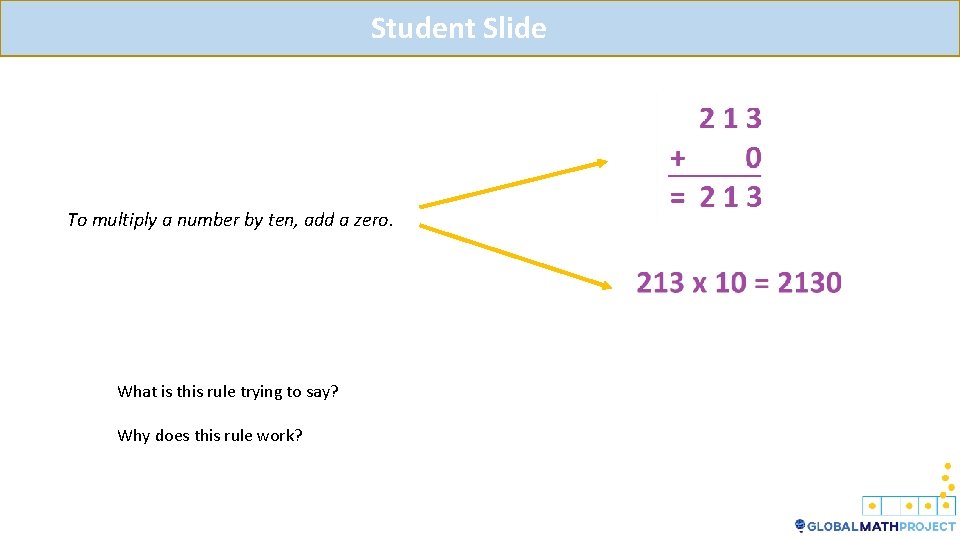
Student Slide To multiply a number by ten, add a zero. What is this rule trying to say? Why does this rule work?
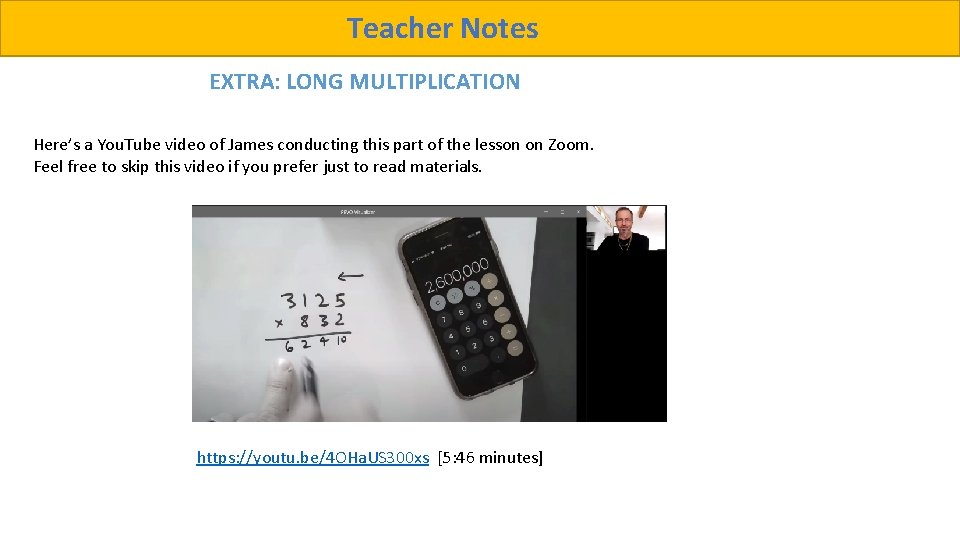
Teacher Notes EXTRA: LONG MULTIPLICATION Here’s a You. Tube video of James conducting this part of the lesson on Zoom. Feel free to skip this video if you prefer just to read materials. https: //youtu. be/4 OHa. US 300 xs [5: 46 minutes]
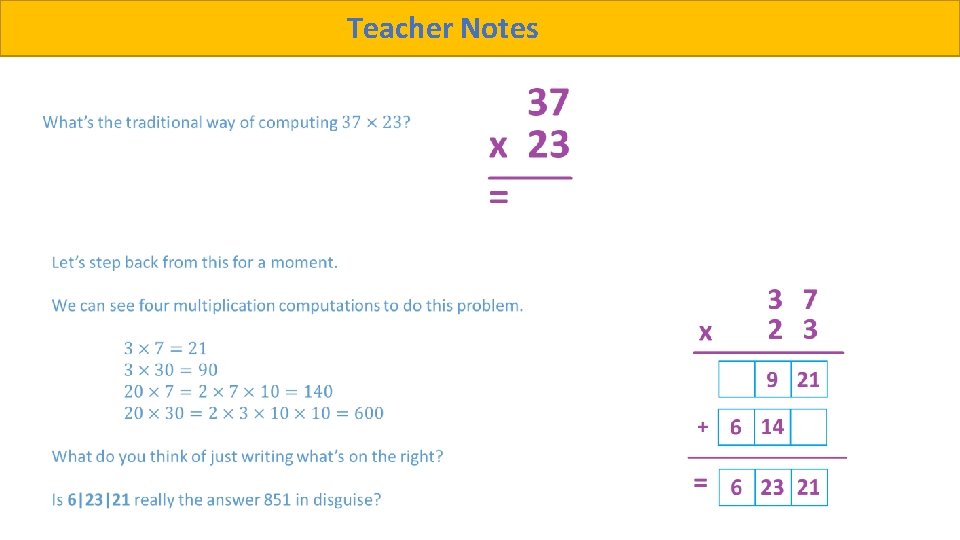
Teacher Notes
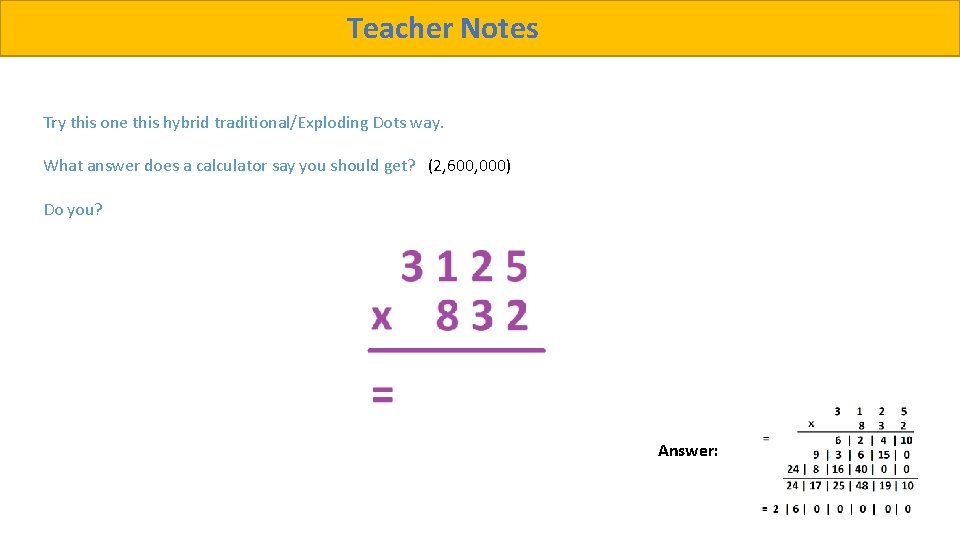
Teacher Notes Try this one this hybrid traditional/Exploding Dots way. What answer does a calculator say you should get? (2, 600, 000) Do you? Answer:
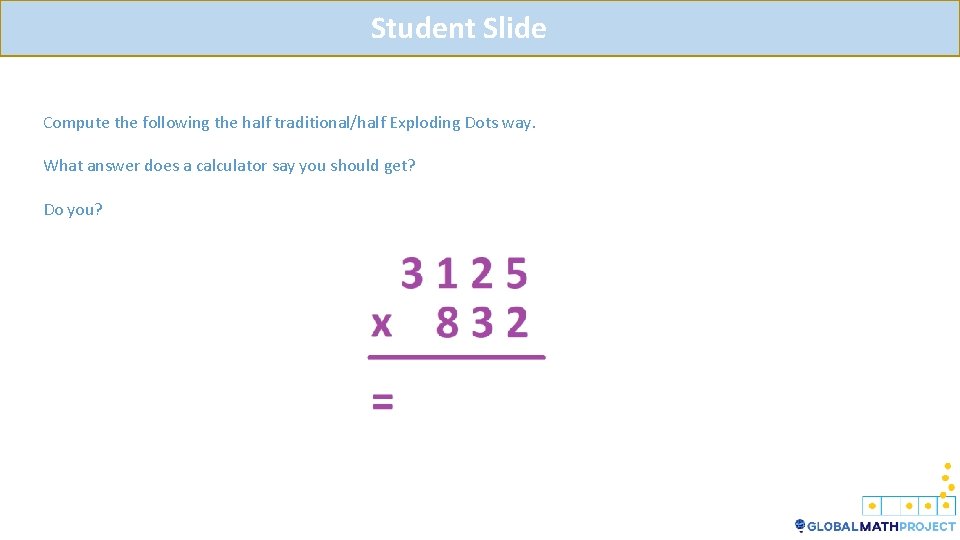
Student Slide Compute the following the half traditional/half Exploding Dots way. What answer does a calculator say you should get? Do you?
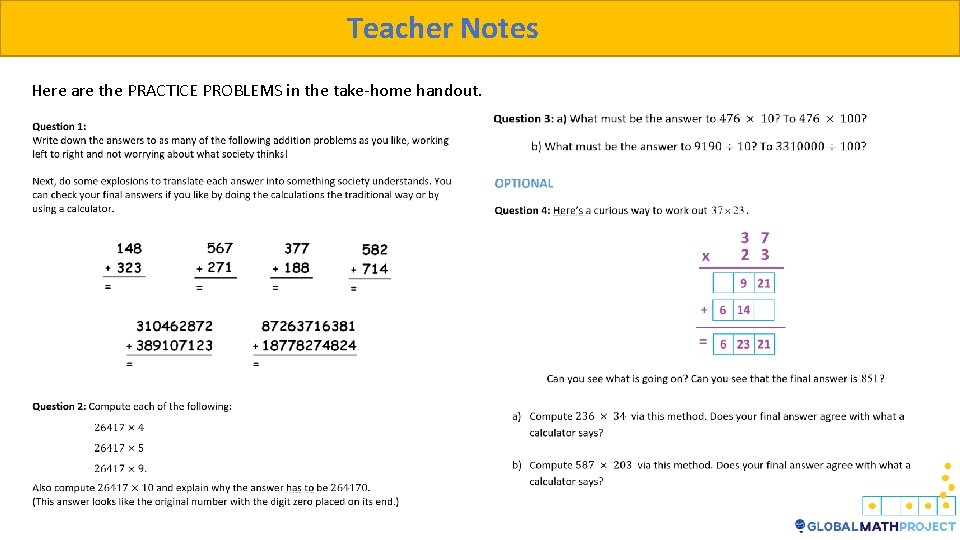
Teacher Notes Here are the PRACTICE PROBLEMS in the take-home handout.