
ADVENTURES IN EXPLODING DOTS Exploration 2 WILD MACHINES
- Slides: 38
ADVENTURES IN EXPLODING DOTS: Exploration 2 WILD MACHINES A focus on base ten and why we humans are drawn to it.
Teacher Notes Now we go beyond the 1 2 machine and discover general dots-and-boxes machine codes. We discover that the 1 10 machine codes are our familiar (base ten) representations of numbers and we discuss why we humans are drawn to the number ten on matters of counting and arithmetic. This exploration comes in three/four parts. PART 1: How high can you count on one hand? PART 2: Going beyond the 1 2 machine. PART 3: Explaining the machines EXTRA: Another Mind Reading Trick Example dialogue appears in blue. This Exploration could be conducted as a single, fast-paced lesson or taken slowly over a several class periods.
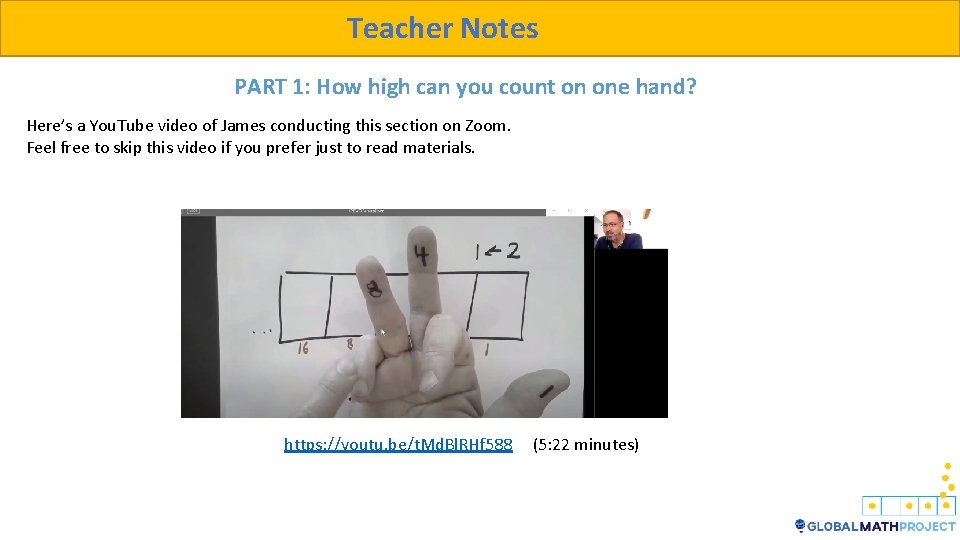
Teacher Notes PART 1: How high can you count on one hand? Here’s a You. Tube video of James conducting this section on Zoom. Feel free to skip this video if you prefer just to read materials. https: //youtu. be/t. Md. Bl. RHf 588 (5: 22 minutes)
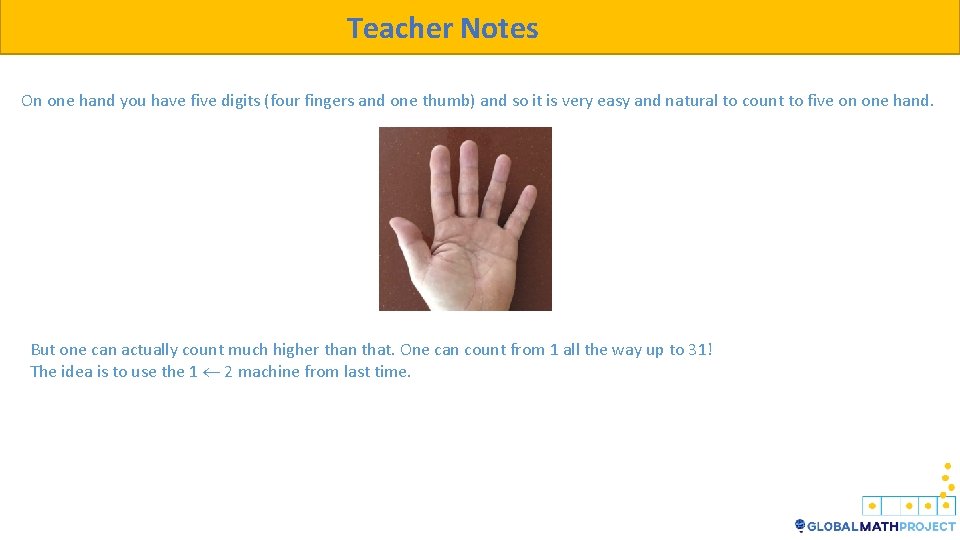
Teacher Notes On one hand you have five digits (four fingers and one thumb) and so it is very easy and natural to count to five on one hand. But one can actually count much higher than that. One can count from 1 all the way up to 31! The idea is to use the 1 2 machine from last time.
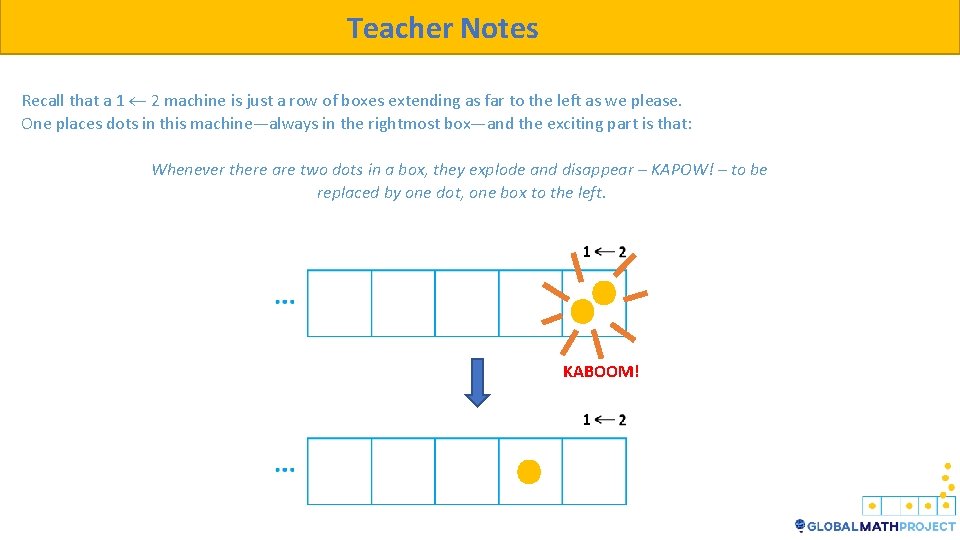
Teacher Notes Recall that a 1 2 machine is just a row of boxes extending as far to the left as we please. One places dots in this machine—always in the rightmost box—and the exciting part is that: Whenever there are two dots in a box, they explode and disappear – KAPOW! – to be replaced by one dot, one box to the left. KABOOM!
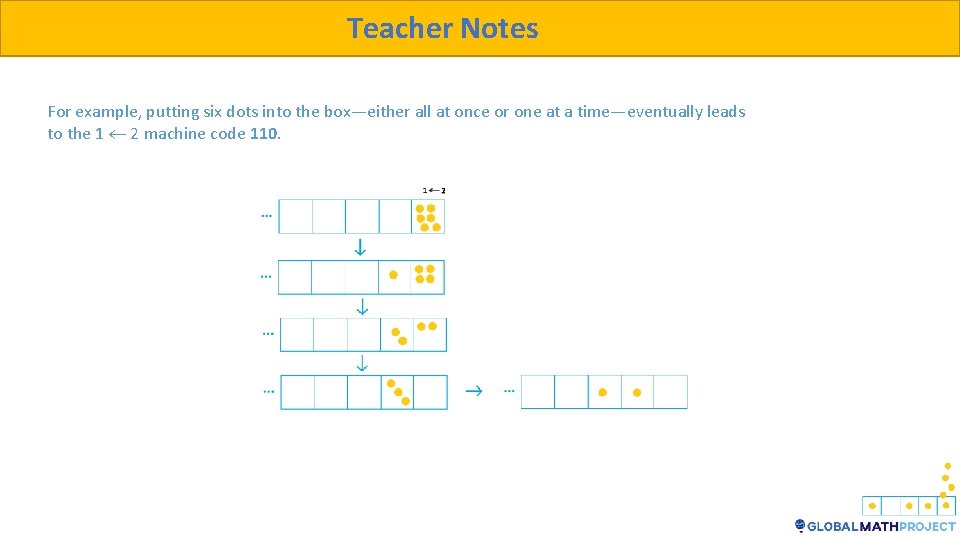
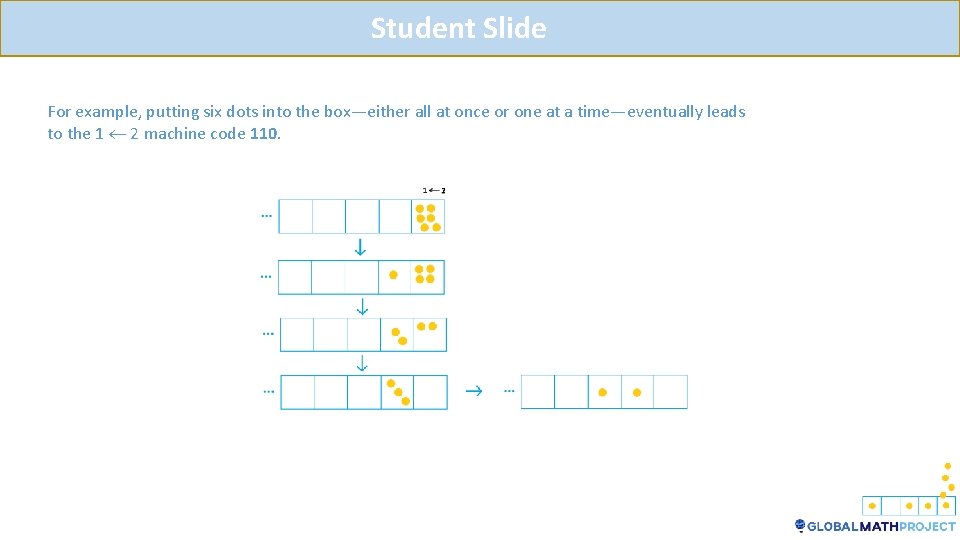
Teacher Notes For example, putting six dots into the box—either all at once or one at a time—eventually leads to the 1 2 machine code 110.
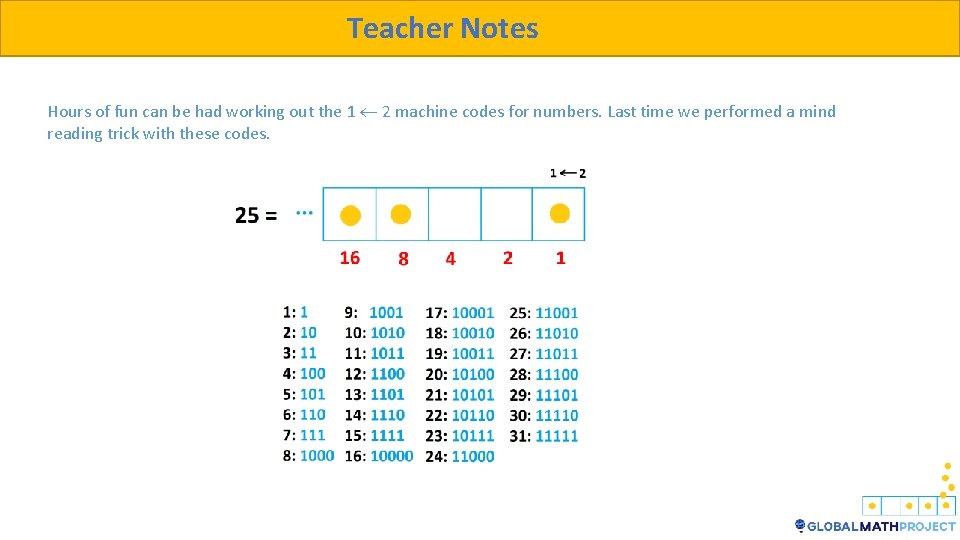
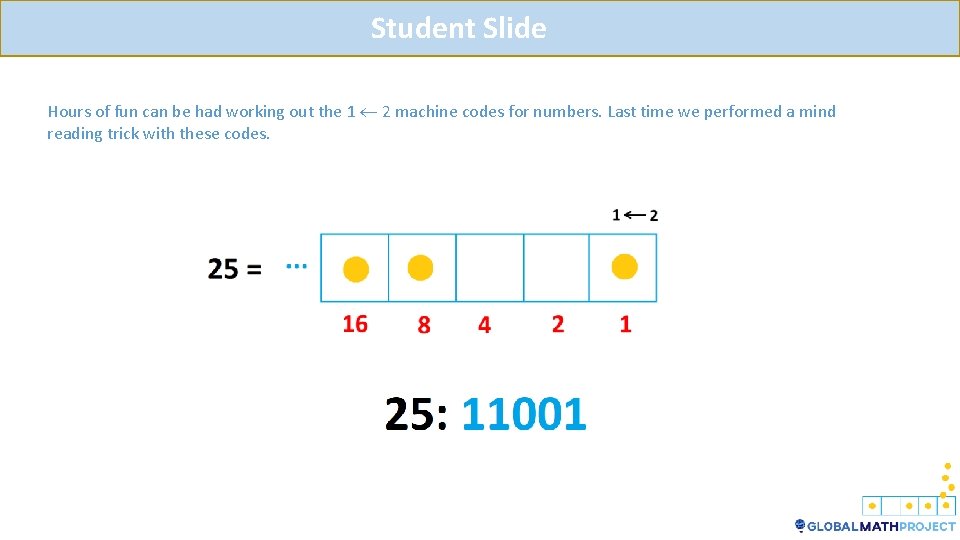
Teacher Notes Hours of fun can be had working out the 1 2 machine codes for numbers. Last time we performed a mind reading trick with these codes.
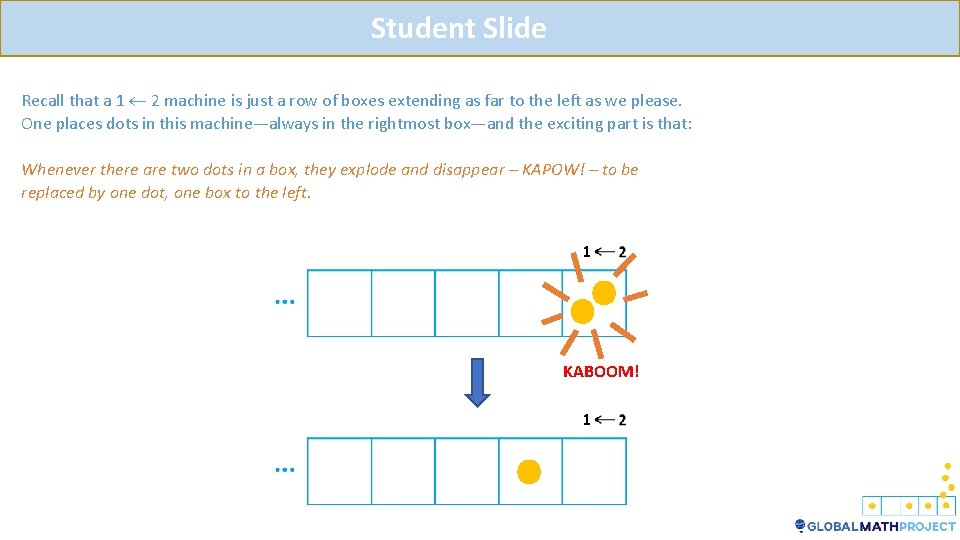
Student Slide Recall that a 1 2 machine is just a row of boxes extending as far to the left as we please. One places dots in this machine—always in the rightmost box—and the exciting part is that: Whenever there are two dots in a box, they explode and disappear – KAPOW! – to be replaced by one dot, one box to the left. KABOOM!
Student Slide For example, putting six dots into the box—either all at once or one at a time—eventually leads to the 1 2 machine code 110.
Student Slide Hours of fun can be had working out the 1 2 machine codes for numbers. Last time we performed a mind reading trick with these codes.
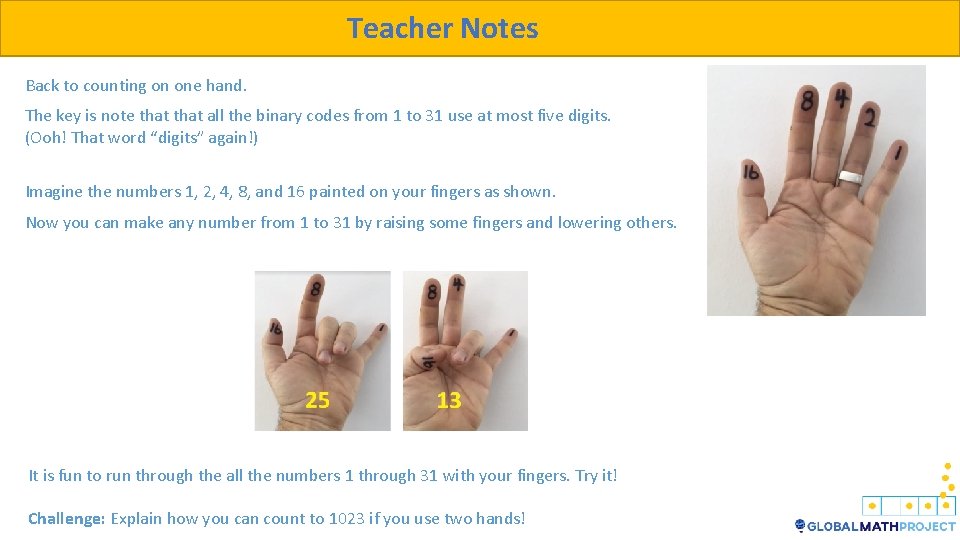
Teacher Notes Back to counting on one hand. The key is note that all the binary codes from 1 to 31 use at most five digits. (Ooh! That word “digits” again!) Imagine the numbers 1, 2, 4, 8, and 16 painted on your fingers as shown. Now you can make any number from 1 to 31 by raising some fingers and lowering others. It is fun to run through the all the numbers 1 through 31 with your fingers. Try it! Challenge: Explain how you can count to 1023 if you use two hands!
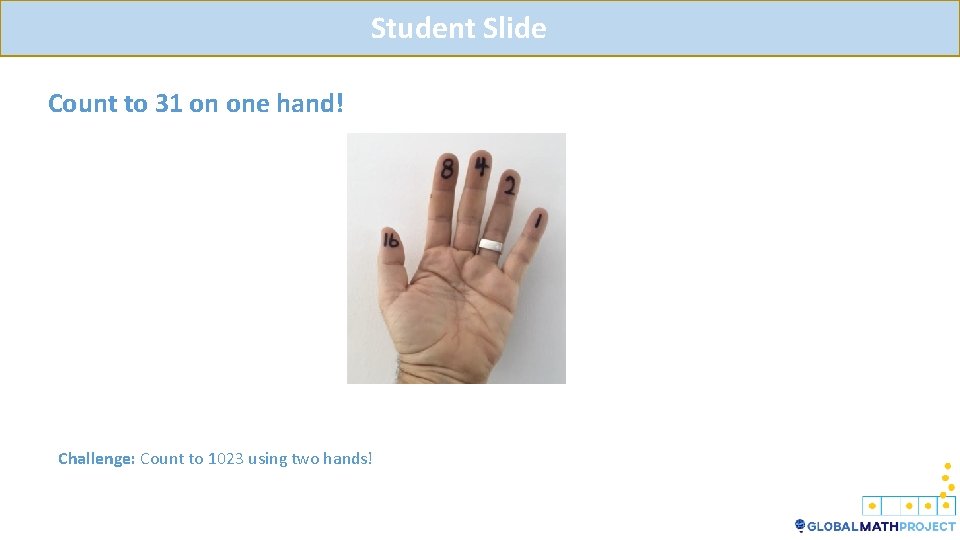
Student Slide Count to 31 on one hand! Challenge: Count to 1023 using two hands!
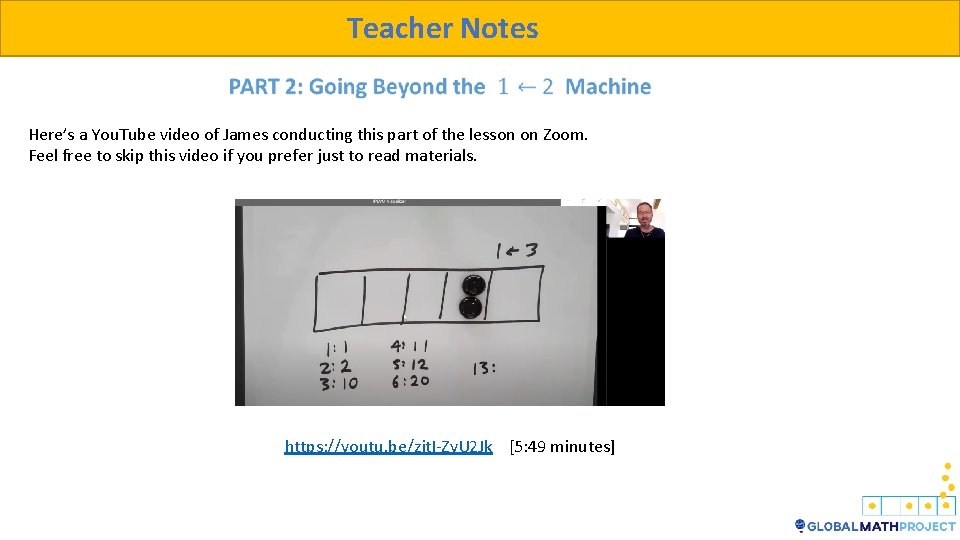
Teacher Notes Here’s a You. Tube video of James conducting this part of the lesson on Zoom. Feel free to skip this video if you prefer just to read materials. https: //youtu. be/zjt. I-Zy. U 2 Jk [5: 49 minutes]
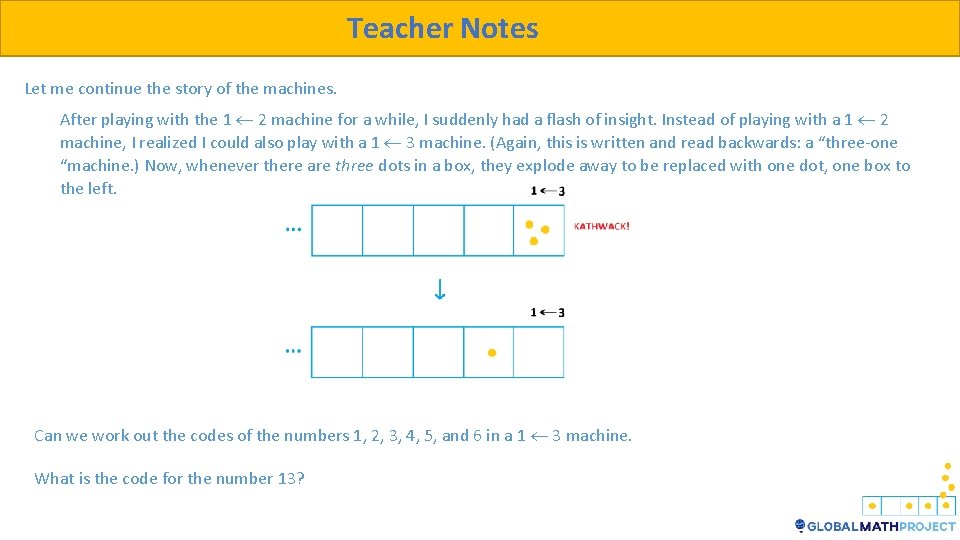
Teacher Notes Let me continue the story of the machines. After playing with the 1 2 machine for a while, I suddenly had a flash of insight. Instead of playing with a 1 2 machine, I realized I could also play with a 1 3 machine. (Again, this is written and read backwards: a “three-one “machine. ) Now, whenever there are three dots in a box, they explode away to be replaced with one dot, one box to the left. Can we work out the codes of the numbers 1, 2, 3, 4, 5, and 6 in a 1 3 machine. What is the code for the number 13?
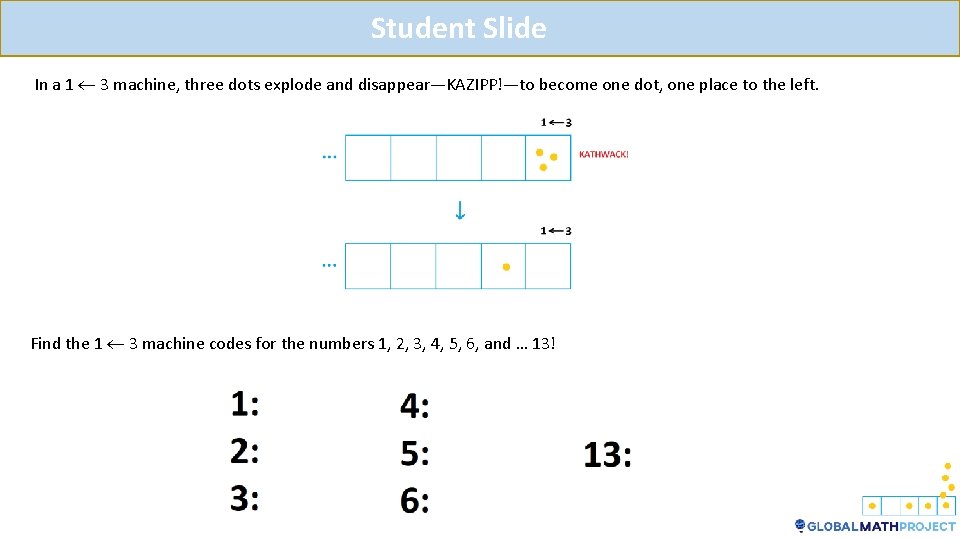
Student Slide In a 1 3 machine, three dots explode and disappear—KAZIPP!—to become one dot, one place to the left. Find the 1 3 machine codes for the numbers 1, 2, 3, 4, 5, 6, and … 13!
Teacher Notes But then …Another flash of insight! Instead of doing a 1 3 machine, I realized I could do a 1 4 machine! And then … Another flash of insight! Instead of doing a 1 4 machine, I could do a 1 5 machine! And then … Another flash of insight! Instead of doing a 1 5 machine, I could do a 1 6 machine! And then … I decided to go wild!
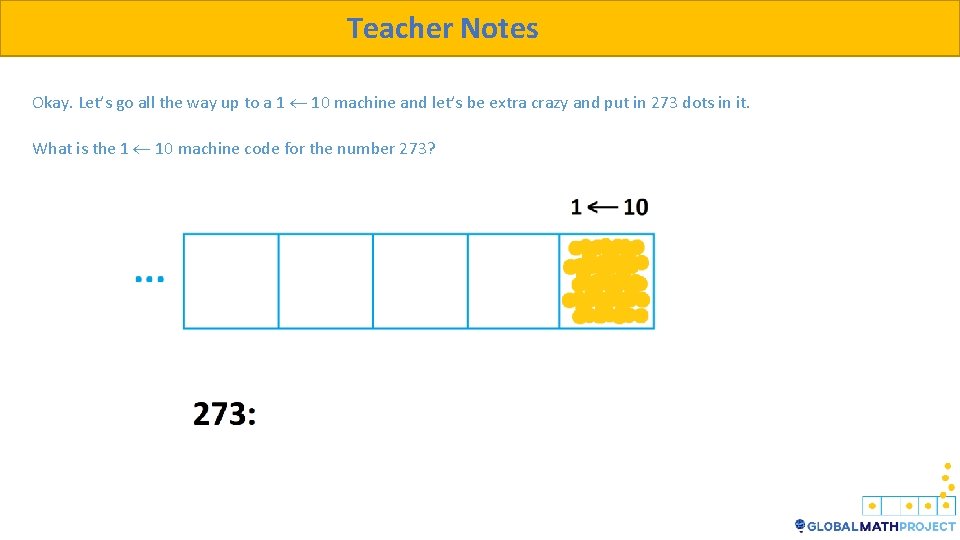
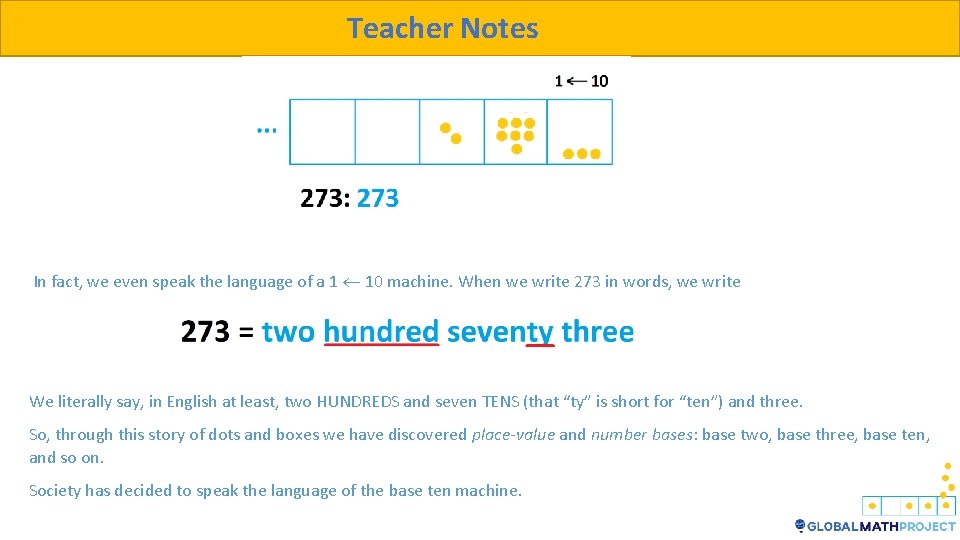
Teacher Notes Okay. Let’s go all the way up to a 1 10 machine and let’s be extra crazy and put in 273 dots in it. What is the 1 10 machine code for the number 273?
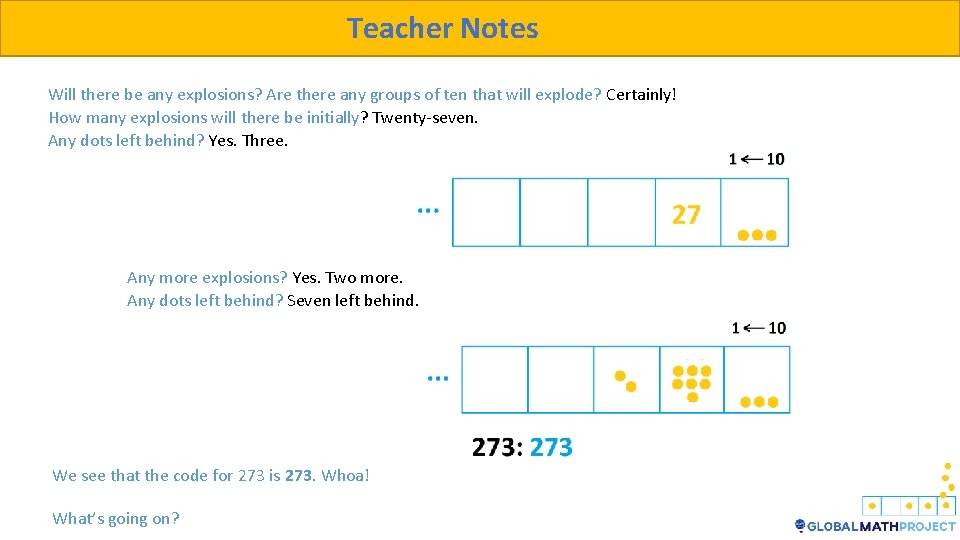
Teacher Notes Will there be any explosions? Are there any groups of ten that will explode? Certainly! How many explosions will there be initially? Twenty-seven. Any dots left behind? Yes. Three. Any more explosions? Yes. Two more. Any dots left behind? Seven left behind. We see that the code for 273 is 273. Whoa! What’s going on?
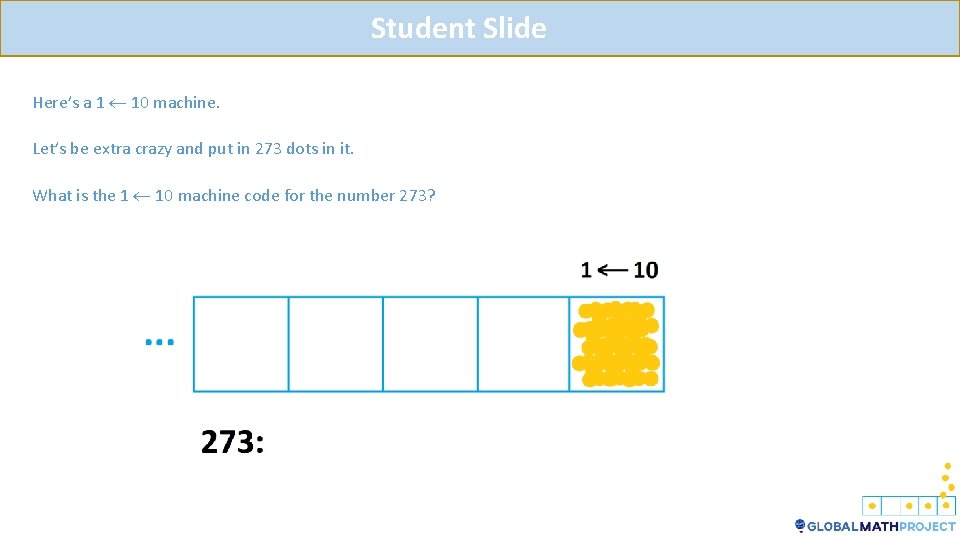
Student Slide Here’s a 1 10 machine. Let’s be extra crazy and put in 273 dots in it. What is the 1 10 machine code for the number 273?
Teacher Notes PART 3: Explaining the Machines Here’s a You. Tube video of James conducting this part of the lesson on Zoom. Feel free to skip this video if you prefer just to read materials. https: //youtu. be/l 6 t. UAcb_e. YA [17: 43 minutes]
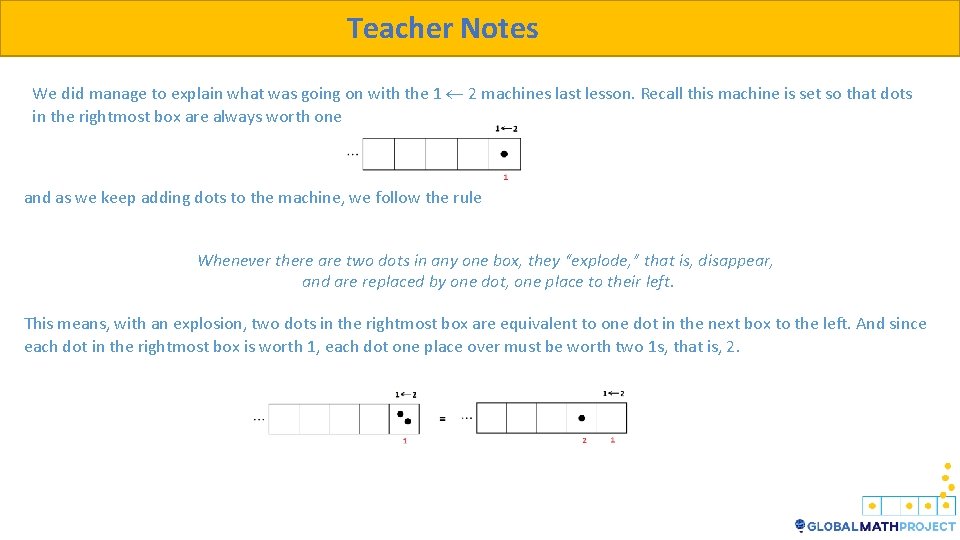
Teacher Notes We did manage to explain what was going on with the 1 2 machines last lesson. Recall this machine is set so that dots in the rightmost box are always worth one and as we keep adding dots to the machine, we follow the rule Whenever there are two dots in any one box, they “explode, ” that is, disappear, and are replaced by one dot, one place to their left. This means, with an explosion, two dots in the rightmost box are equivalent to one dot in the next box to the left. And since each dot in the rightmost box is worth 1, each dot one place over must be worth two 1 s, that is, 2.
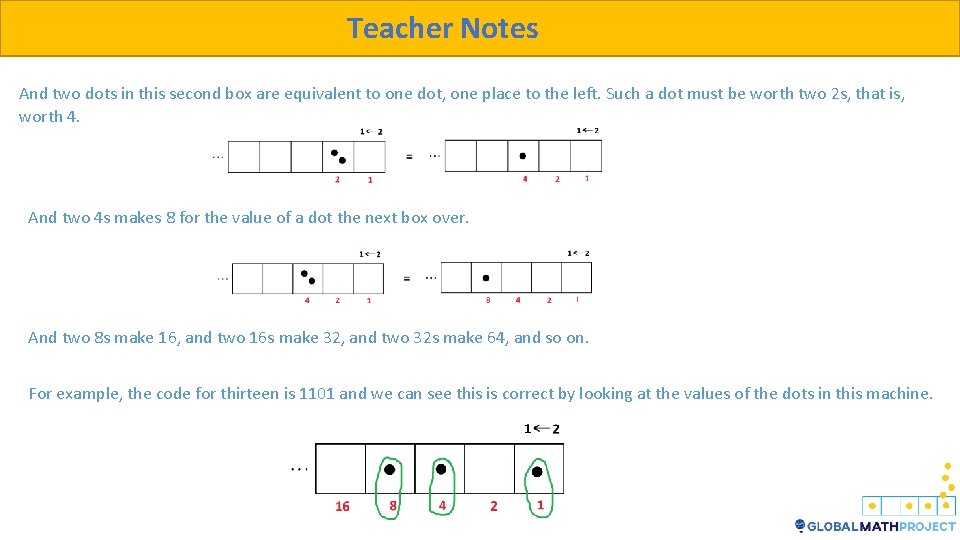
Teacher Notes And two dots in this second box are equivalent to one dot, one place to the left. Such a dot must be worth two 2 s, that is, worth 4. And two 4 s makes 8 for the value of a dot the next box over. And two 8 s make 16, and two 16 s make 32, and two 32 s make 64, and so on. For example, the code for thirteen is 1101 and we can see this is correct by looking at the values of the dots in this machine.
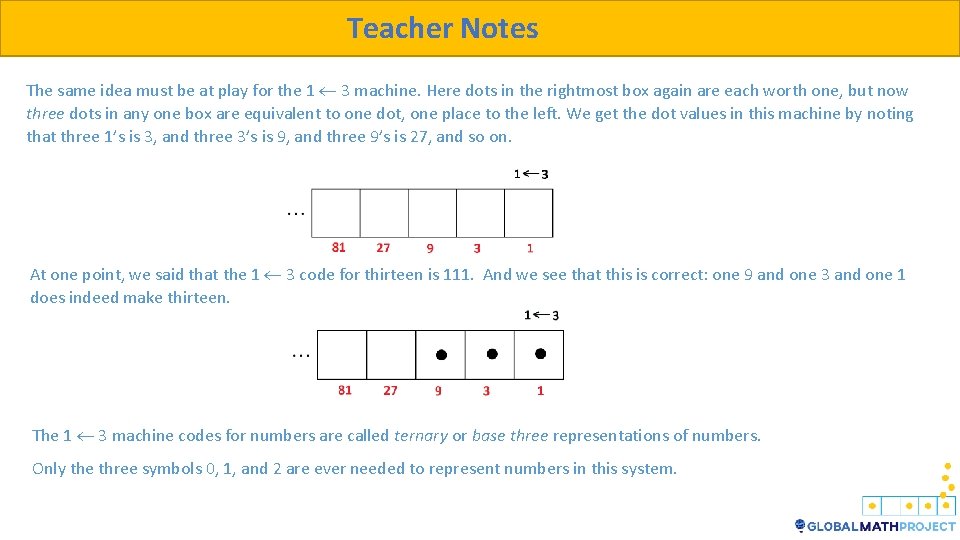
Teacher Notes The same idea must be at play for the 1 3 machine. Here dots in the rightmost box again are each worth one, but now three dots in any one box are equivalent to one dot, one place to the left. We get the dot values in this machine by noting that three 1’s is 3, and three 3’s is 9, and three 9’s is 27, and so on. At one point, we said that the 1 3 code for thirteen is 111. And we see that this is correct: one 9 and one 3 and one 1 does indeed make thirteen. The 1 3 machine codes for numbers are called ternary or base three representations of numbers. Only the three symbols 0, 1, and 2 are ever needed to represent numbers in this system.
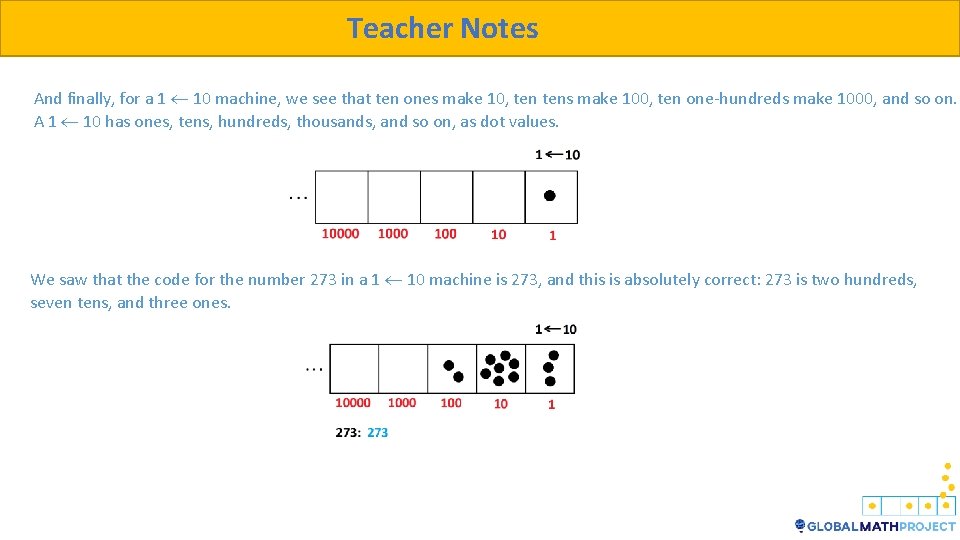
Teacher Notes And finally, for a 1 10 machine, we see that ten ones make 10, tens make 100, ten one-hundreds make 1000, and so on. A 1 10 has ones, tens, hundreds, thousands, and so on, as dot values. We saw that the code for the number 273 in a 1 10 machine is 273, and this is absolutely correct: 273 is two hundreds, seven tens, and three ones.
Teacher Notes In fact, we even speak the language of a 1 10 machine. When we write 273 in words, we write We literally say, in English at least, two HUNDREDS and seven TENS (that “ty” is short for “ten”) and three. So, through this story of dots and boxes we have discovered place-value and number bases: base two, base three, base ten, and so on. Society has decided to speak the language of the base ten machine.
Teacher Notes Why do you think we humans have a predilection for the 1 10 machine? Why do we like the number ten for counting? One answer could be because of our human anatomy: we are born with ten digits on our hands. Many historians do believe this could well be the reason why we humans have favored base ten. There are some cultures on this planet that have used base twenty. Why might they have chosen that number, do you think? In fact, there are vestiges of base twenty thinking in western European culture of today. For example, in French, the number 87 is spoken and written as quatre-vingt-sept, which translates, word for word, as “four twenties seven. ” In the U. S. , the famous Gettysburg address begins: “Four score and seven years ago. ” The word score is an old word for “twenty” and so Abraham Lincoln was saying “four-twenties and seven years ago. ” That’s 87 years. I happen to know that Martians have three fingers on each of two hands. What base do you think they might use in their society? Probably base six.
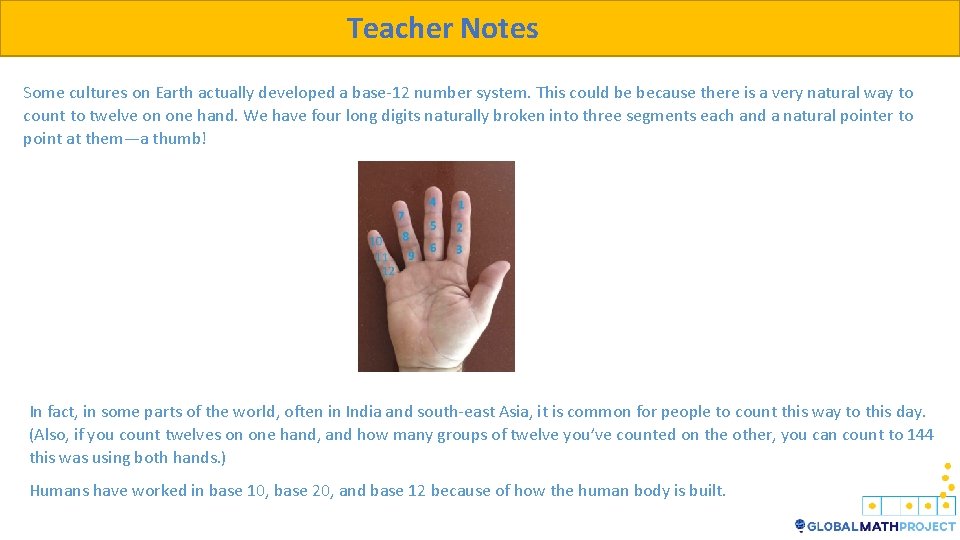
Teacher Notes Some cultures on Earth actually developed a base-12 number system. This could be because there is a very natural way to count to twelve on one hand. We have four long digits naturally broken into three segments each and a natural pointer to point at them—a thumb! In fact, in some parts of the world, often in India and south-east Asia, it is common for people to count this way to this day. (Also, if you count twelves on one hand, and how many groups of twelve you’ve counted on the other, you can count to 144 this was using both hands. ) Humans have worked in base 10, base 20, and base 12 because of how the human body is built.
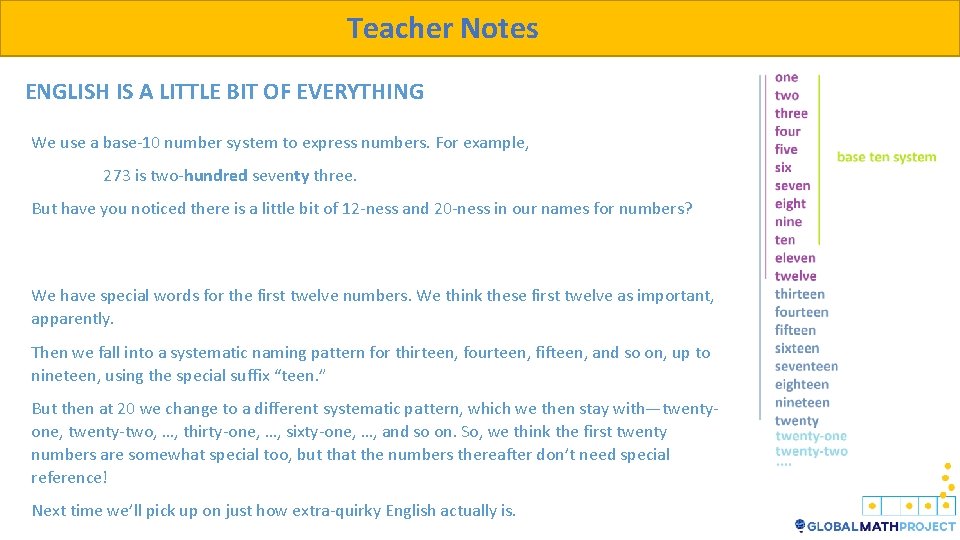
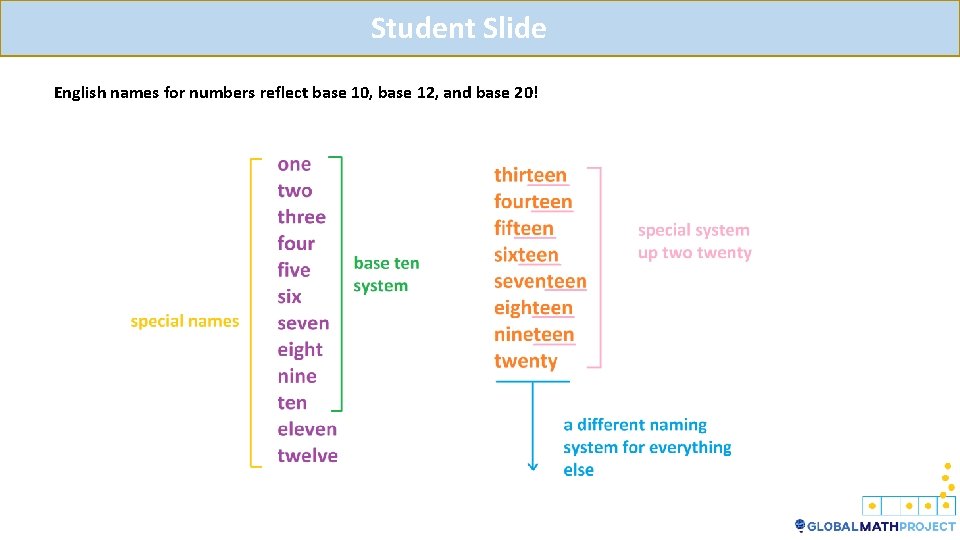
Teacher Notes ENGLISH IS A LITTLE BIT OF EVERYTHING We use a base-10 number system to express numbers. For example, 273 is two-hundred seventy three. But have you noticed there is a little bit of 12 -ness and 20 -ness in our names for numbers? We have special words for the first twelve numbers. We think these first twelve as important, apparently. Then we fall into a systematic naming pattern for thirteen, fourteen, fifteen, and so on, up to nineteen, using the special suffix “teen. ” But then at 20 we change to a different systematic pattern, which we then stay with—twentyone, twenty-two, …, thirty-one, …, sixty-one, …, and so on. So, we think the first twenty numbers are somewhat special too, but that the numbers thereafter don’t need special reference! Next time we’ll pick up on just how extra-quirky English actually is.
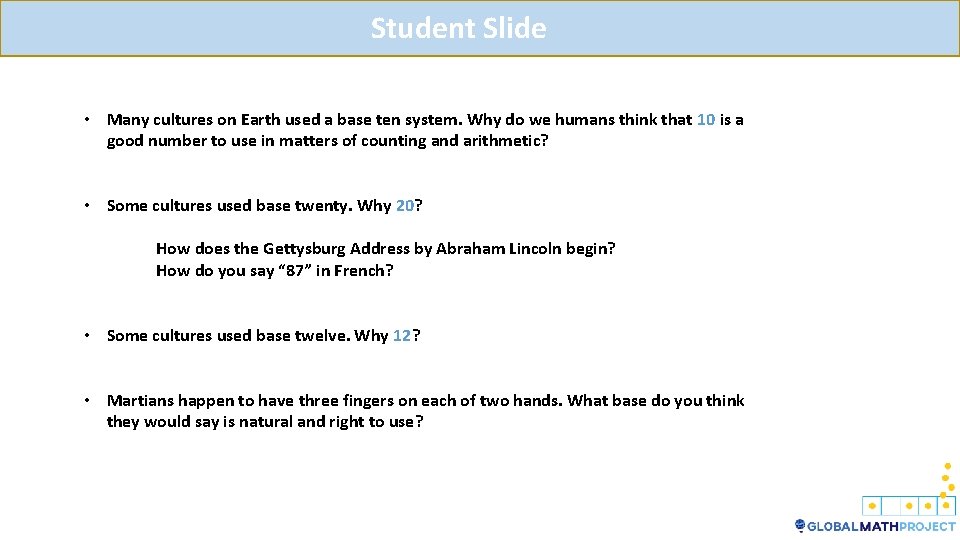
Student Slide • Many cultures on Earth used a base ten system. Why do we humans think that 10 is a good number to use in matters of counting and arithmetic? • Some cultures used base twenty. Why 20? How does the Gettysburg Address by Abraham Lincoln begin? How do you say “ 87” in French? • Some cultures used base twelve. Why 12? • Martians happen to have three fingers on each of two hands. What base do you think they would say is natural and right to use?
Student Slide English names for numbers reflect base 10, base 12, and base 20!
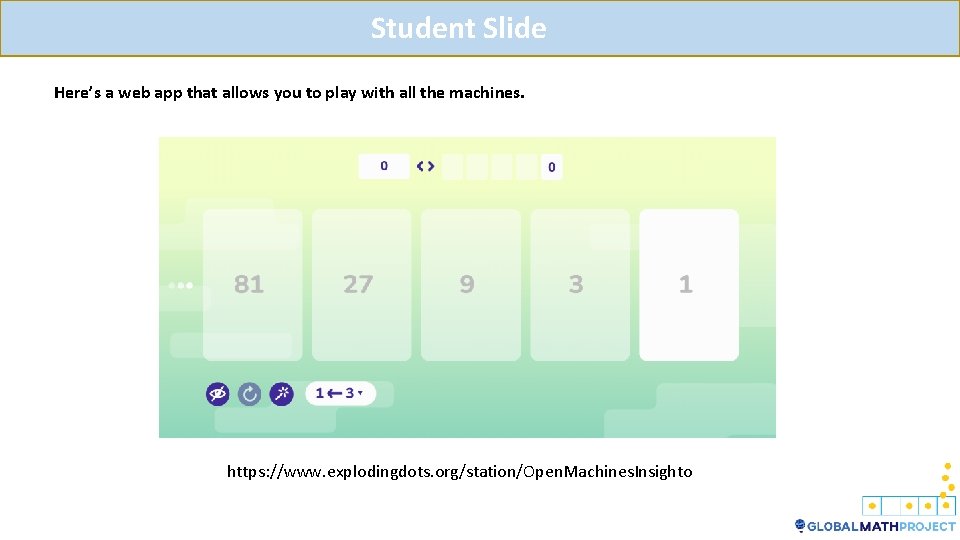
Student Slide Here’s a web app that allows you to play with all the machines. https: //www. explodingdots. org/station/Open. Machines. Insighto
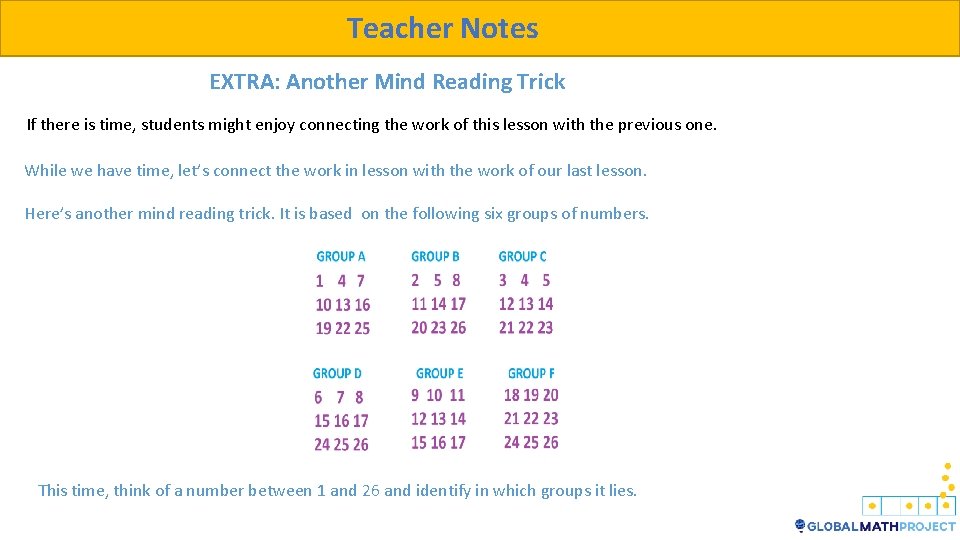
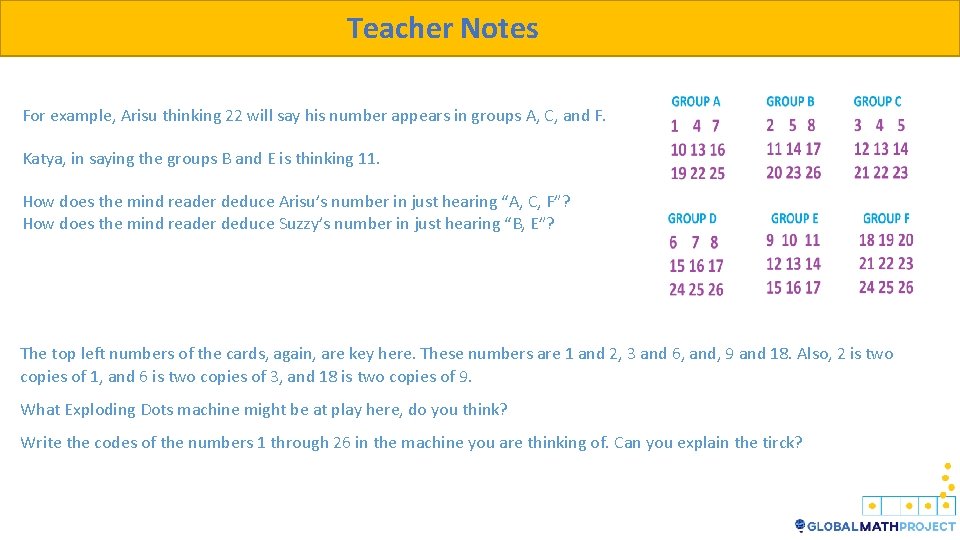
Teacher Notes EXTRA: Another Mind Reading Trick If there is time, students might enjoy connecting the work of this lesson with the previous one. While we have time, let’s connect the work in lesson with the work of our last lesson. Here’s another mind reading trick. It is based on the following six groups of numbers. This time, think of a number between 1 and 26 and identify in which groups it lies.
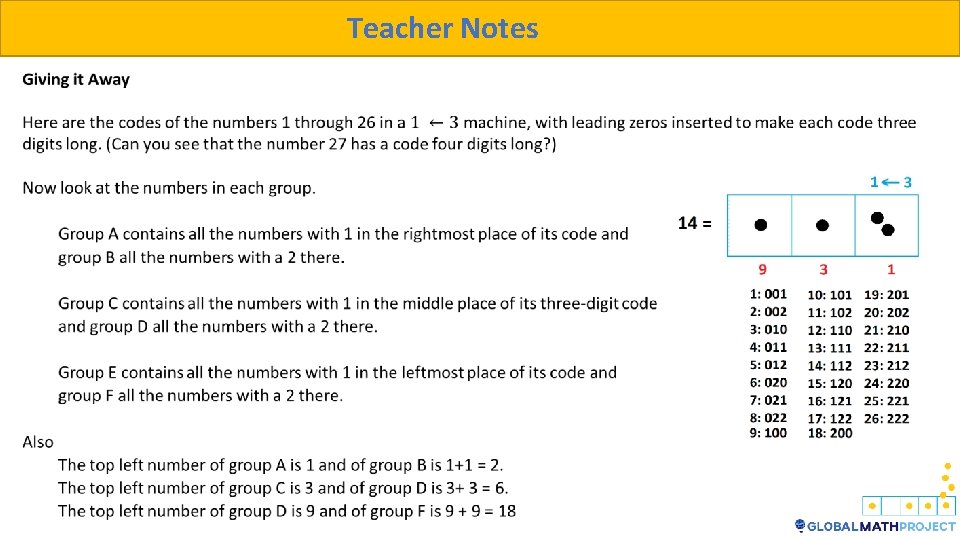
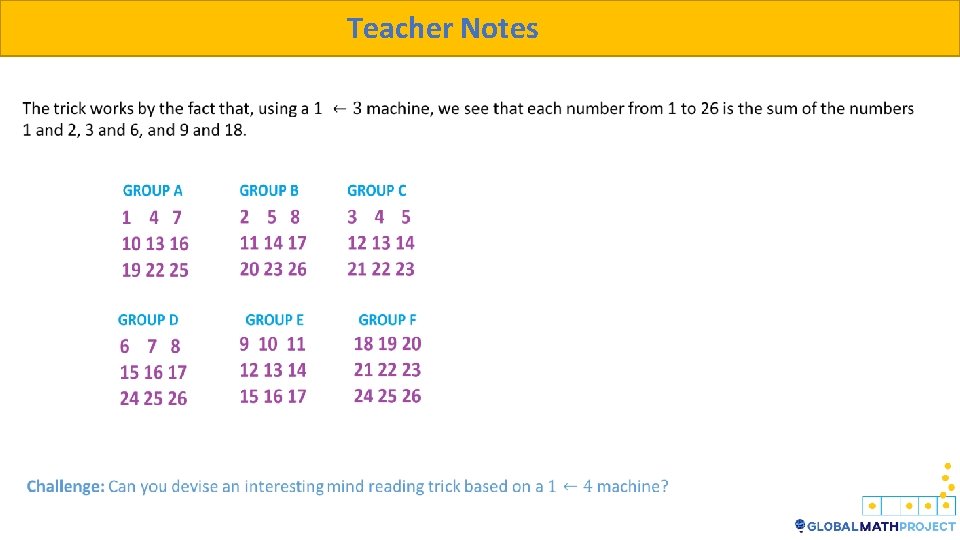
Teacher Notes For example, Arisu thinking 22 will say his number appears in groups A, C, and F. Katya, in saying the groups B and E is thinking 11. How does the mind reader deduce Arisu’s number in just hearing “A, C, F”? How does the mind reader deduce Suzzy’s number in just hearing “B, E”? The top left numbers of the cards, again, are key here. These numbers are 1 and 2, 3 and 6, and, 9 and 18. Also, 2 is two copies of 1, and 6 is two copies of 3, and 18 is two copies of 9. What Exploding Dots machine might be at play here, do you think? Write the codes of the numbers 1 through 26 in the machine you are thinking of. Can you explain the tirck?
Teacher Notes
Teacher Notes
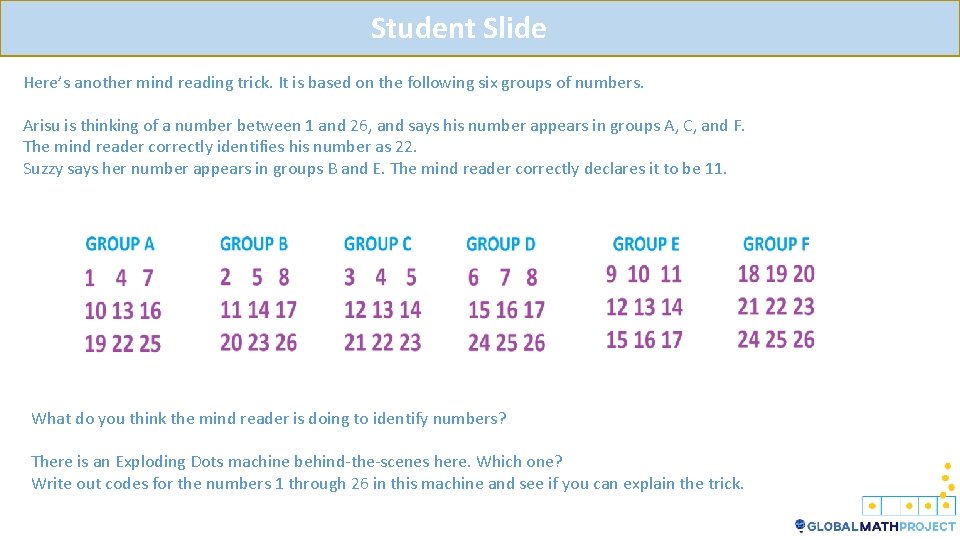
Student Slide Here’s another mind reading trick. It is based on the following six groups of numbers. Arisu is thinking of a number between 1 and 26, and says his number appears in groups A, C, and F. The mind reader correctly identifies his number as 22. Suzzy says her number appears in groups B and E. The mind reader correctly declares it to be 11. What do you think the mind reader is doing to identify numbers? There is an Exploding Dots machine behind-the-scenes here. Which one? Write out codes for the numbers 1 through 26 in this machine and see if you can explain the trick.
Student Slide
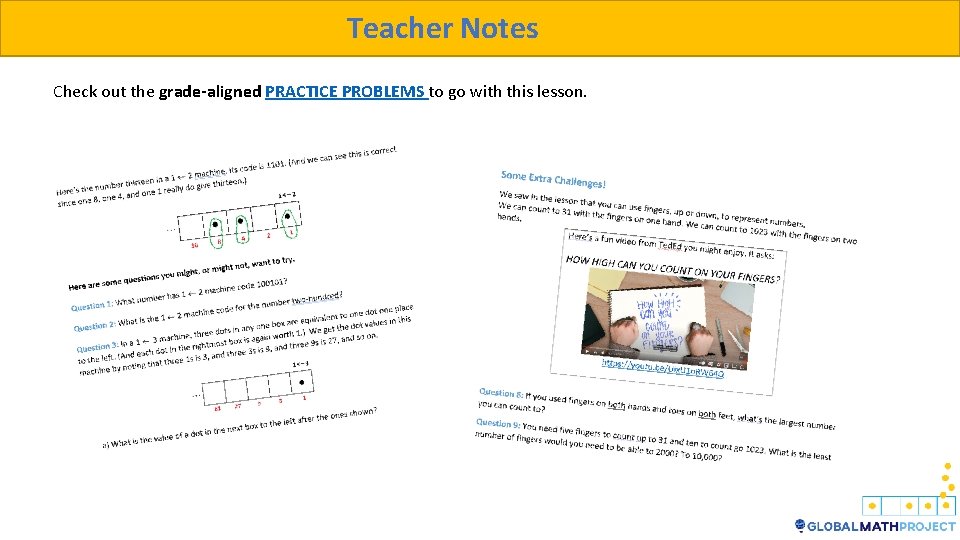
Teacher Notes Check out the grade-aligned PRACTICE PROBLEMS to go with this lesson.