
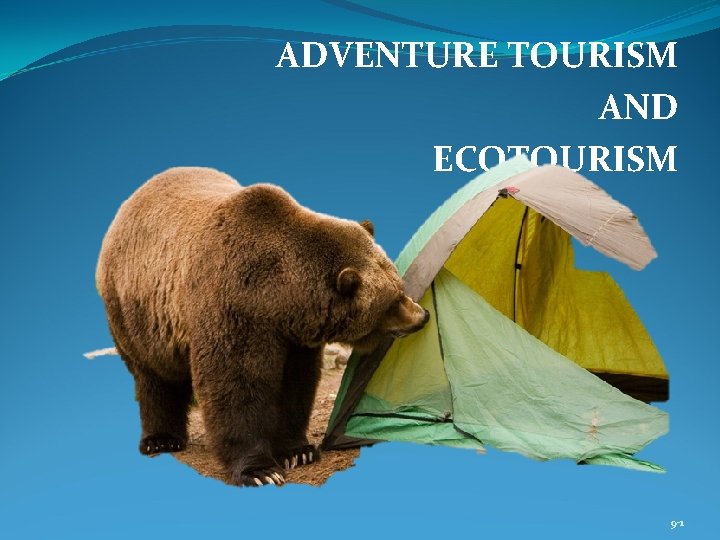
ADVENTURE TOURISM AND ECOTOURISM 9 1 Management Plans




























- Slides: 56
ADVENTURE TOURISM AND ECOTOURISM 9 -1
Management Plans of Parks Canada • Emphasis is moving from use to maintenance and protection • Challenged with maintaining the integrity of parks’ ecosystems which is defined as” – Having their native components intact – Biodiversity – Ecosystem processes
Crown Lands Much of our Canadian wilderness is owned by the federal or provincial governments – known as Crown Land (land owned by the government and eventually the crown) Most adventure tourism occurs on Crown land E. g. province of British Columbia 92% is provincial Crown land 1% is federal Crown land 5% is privately owned 2% covered by water Copyright © 2010 Pearson Education Canada 9 -3
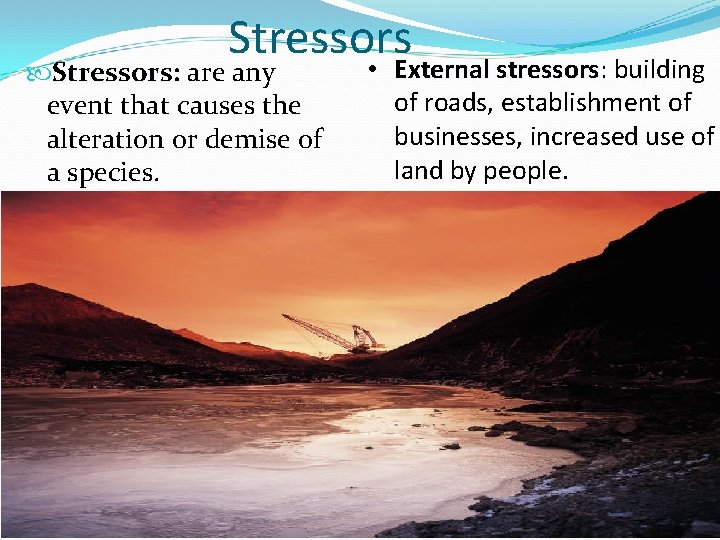
Stressors Stressors: are any event that causes the alteration or demise of a species. • External stressors: stressors building of roads, establishment of businesses, increased use of land by people.
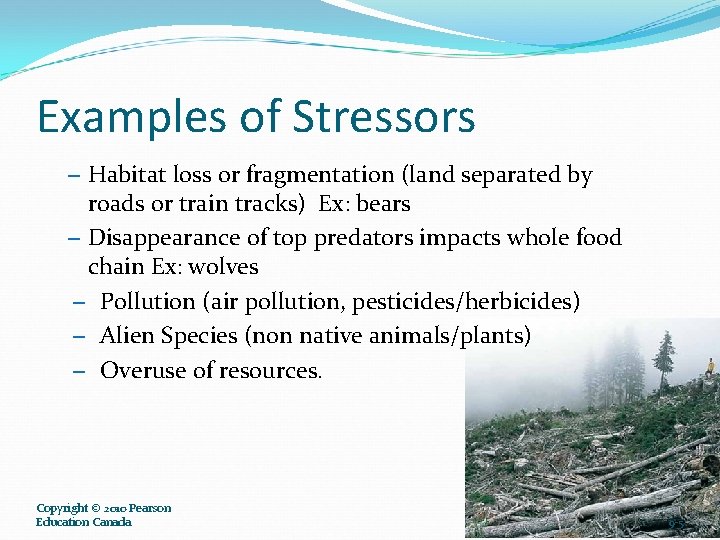
Examples of Stressors – Habitat loss or fragmentation (land separated by roads or train tracks) Ex: bears – Disappearance of top predators impacts whole food chain Ex: wolves – Pollution (air pollution, pesticides/herbicides) – Alien Species (non native animals/plants) – Overuse of resources. Copyright © 2010 Pearson Education Canada 9 -5
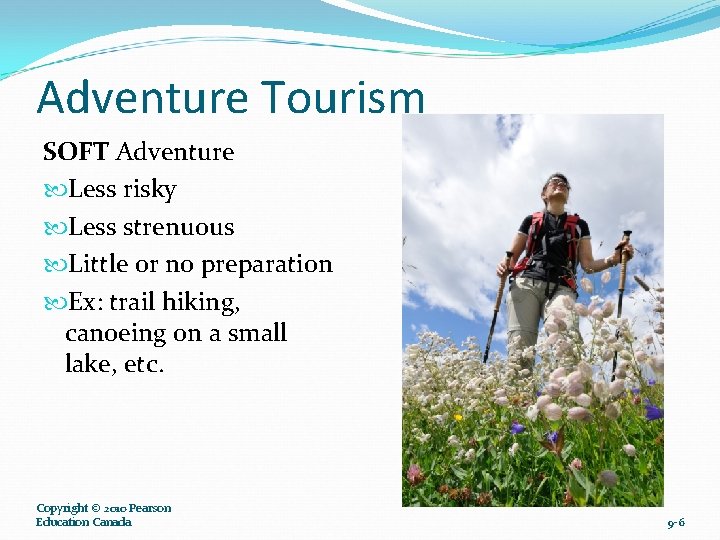
Adventure Tourism SOFT Adventure Less risky Less strenuous Little or no preparation Ex: trail hiking, canoeing on a small lake, etc. Copyright © 2010 Pearson Education Canada 9 -6
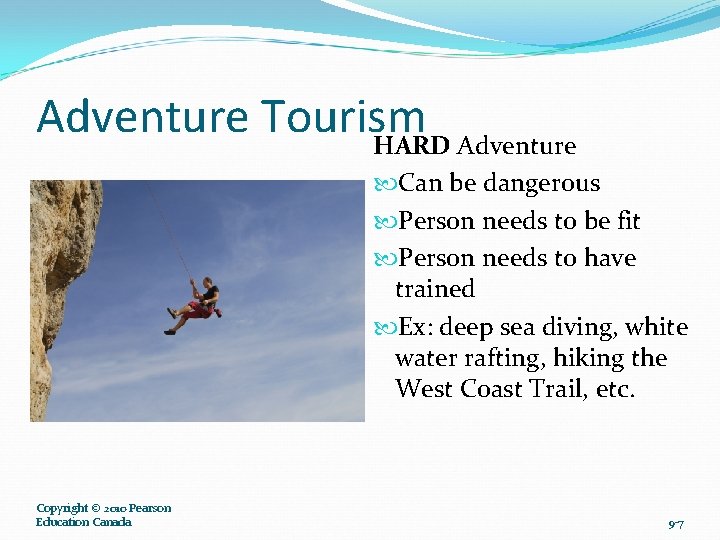
Adventure Tourism HARD Adventure Can be dangerous Person needs to be fit Person needs to have trained Ex: deep sea diving, white water rafting, hiking the West Coast Trail, etc. Copyright © 2010 Pearson Education Canada 9 -7
Ecotourism Responsible travel designed to educate the traveler about interrelationships & physiology (study of characteristics of animals) of organisms & their environment or learning about nature from being in nature. Sustainable Tourism: Tourism that can be continued for long period of time, with minimal damage to the environment. Responsible Tourism: Being responsible about things like your garbage, and activity's.
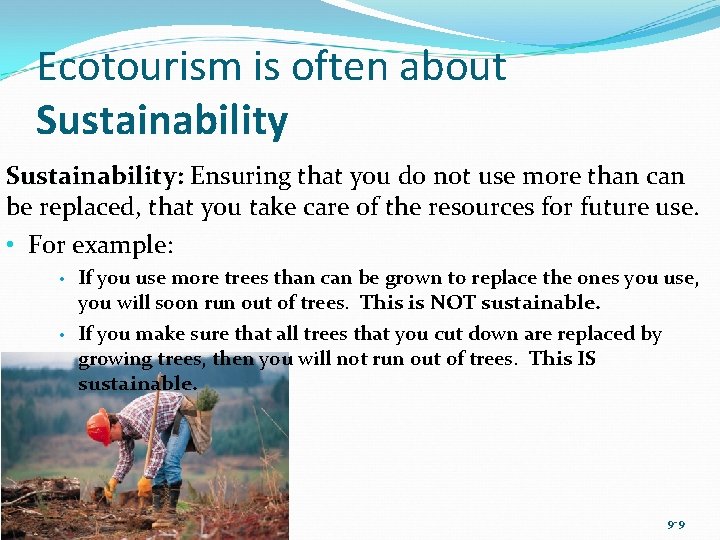
Ecotourism is often about Sustainability: Ensuring that you do not use more than can be replaced, that you take care of the resources for future use. • For example: • • If you use more trees than can be grown to replace the ones you use, you will soon run out of trees. This is NOT sustainable. If you make sure that all trees that you cut down are replaced by growing trees, then you will not run out of trees. This IS sustainable. 9 -9
Ecotourism cont’d Greenwashing – too many tour operators and suppliers using ecotourism to encourage clients, yet NOT doing anything to ensure they are being responsible to our ecosystems. It is your responsibility as a tourist, to make sure the places you are going are not false advertising (or green washing). Copyright © 2010 Pearson Education Canada 9 -10
Ecotourism cont’d Tourism supplier & consumer responsibilities: Minimizing negative economic & environmental impacts Generating greater economic benefits for locals Improving working conditions Involving locals in decisions that affect their lives Providing meaningful connections with local culture for tourists Providing access for physically challenged people Copyright © 2010 Pearson Education Canada 9 -11
The Ecotourism Market Segment Eco-tourists tend to be more mature, have postsecondary education, prefer longer trips, and are often willing to pay more for this type of tourism. Growing areas of interest: cultural and heritage tourism. Culture tourism: Traveling inspired by finding out bout new cultures. Heritage tourism: Traveling to find out about the heritage of your family or others family's. Copyright © 2010 Pearson Education Canada 9 -12
TOURISM’S IMPACT ON THE ENVIRONMENT In some ways, Tourism is viewed as a “user” and “abuser” of the environment We need to limit harm to the environment There are 2 viewpoints: Tourism provides an incentive for the restoration of sites and for the conservation of natural resources Tourism means overcrowding, pollution and maybe even extinction of animal life and vegetation Copyright © 2010 Pearson Education Canada 9 -13
Tourism’s Impact cont’d Views on the environment are holistic and pyramidal Holistic- all natural. Like a hippy. Humans are a part of the environment. Pyramidal- Humans are on top of world. They are not nature they are above nature. Carrying capacity – the maximum # of people who can use a site with only acceptable alteration to the physical environment and only acceptable decline in the quality of the experience for future visitors. Copyright © 2010 Pearson Education Canada 9 -14
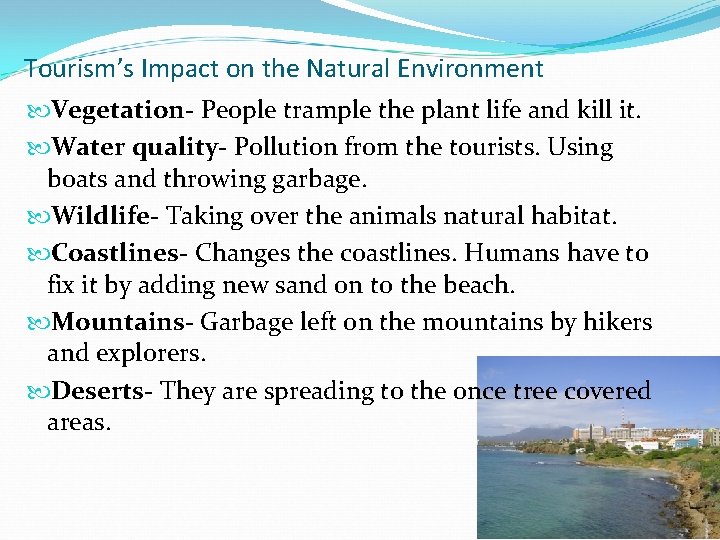
Tourism’s Impact on the Natural Environment Vegetation- People trample the plant life and kill it. Water quality- Pollution from the tourists. Using boats and throwing garbage. Wildlife- Taking over the animals natural habitat. Coastlines- Changes the coastlines. Humans have to fix it by adding new sand on to the beach. Mountains- Garbage left on the mountains by hikers and explorers. Deserts- They are spreading to the once tree covered areas.
Balancing The Negative Environmental Impact Dealing with globalwarming seriously. Reducing carbon dioxide released into the air. Fuel efficient, non-carbon-producing methods of energy. Copyright © 2010 Pearson Education Canada 9 -16
Canada’s Green Plan It is hoped that at least 12% of Canada’s lands become protected spaces Environmental considerations must be a priority Canadians must be educated about conservation Green Committees in Hotels 9 -17
Vocabulary To Be Described Outdoor recreation- Spending leisure time outside. Heritage tourism- A branch of tourism that focuses on the cultural history of the destination. Adventure tourism-is a type of tourism, involving exploration or travel to remote, exotic and possibly hostile areas. Ecotourism- Visiting fragile and usually protected areas for your vacation. Sustainable tourism- Trying to make as small of impact as possible. Copyright © 2010 Pearson Education Canada 9 -18
economic leakage- When money gained from tourism company's is sent out of the country. Community based tourism- A community by definition implies individuals with some kind of collective responsibility. hard adventure- Hard Adventure travel encompasses a higher element of risk. soft adventure- Soft Adventure involves little physical risk. outdoor education- Usually refers to organized learning that takes place in the outdoors. Copyright © 2010 Pearson Education Canada 9 -19
Your Assignment Using the words above (these words are found in the D 2 L shell in Introduction to Adventure and Ecotourism, create a Power. Point quiz using hyperlinks. Copyright © 2010 Pearson Education Canada 9 -20
The definition of ecotourism is: 1. 2. 3. 4. Tourism of the environment Playing with dolphins Travelling to Donald Trump’s hair Visiting the Calgary Tower
Question 2 How many branches are in the tourism sector? A)2 B)3 C)4 D)5
Question 3 What is the most negative serious effect of tourism on the environment? A) People. B) Damage to the natural environment. C) Money. Copyright © 2010 Pearson Education Canada 9 -23
Question 4 What does stewardship mean? A) The responsible management of the environment. B) The responsible management of the tourism sectors. C) Cleaning the house. Copyright © 2010 Pearson Education Canada 9 -24
Question 5 What is environmental tourism? A) Tourism in the environment. B) The quality of the environment is essential to tourism. C) Going to the beach. Copyright © 2010 Pearson Education Canada 9 -25
Question 6 What is Green-washing? A) Putting fresh coat of green paint on a wall. B) Saying that you are a green tourism company when really you are not. C) Turning green. Copyright © 2010 Pearson Education Canada 9 -26
Question 7 What is hard adventure tourism? A) High risk adventure B) Low risk adventure C) No risk adventure Copyright © 2010 Pearson Education Canada 9 -27
Question 8. Which is an example of adventure tourism? A) Rock Climbing B) Relaxing in a Jacuzzi C) Counting stars Copyright © 2010 Pearson Education Canada 9 -28
Question 9 How has tourism benefitted third world countries? A) Economic leakage B) Money C) People learning about cultures Copyright © 2010 Pearson Education Canada 9 -29
Question 10 What is soft tourism A) Chilling in a hotel B) Rock climbing C) Hangliding Copyright © 2010 Pearson Education Canada 9 -30
CORRECT! Click to go to the next question.
CORRECT! Click to go to the next question.
CORRECT! Click to go to the next question.
CORRECT! Click to go to the next question.
CORRECT! Click to go to the next question.
CORRECT! Click to go to the next question.
CORRECT! Click to go to the next question.
CORRECT! Click to go to the next question.
CORRECT! Click to go to the next question.
CORRECT! Click to go to the next question.
CORRECT! Click to go to the next question.
Incorrect! Click to try again.
Incorrect! Click to try again.
Incorrect! Click to try again.
Incorrect! Click to try again.
Incorrect! Click to try again.
Incorrect! Click to try again.
Incorrect! Click to try again.
Incorrect! Click to try again.
Incorrect! Click to try again.
Incorrect! Click to try again.
Incorrect! Click to try again.
Incorrect! Click to try again.
Incorrect! Click to try again.
Incorrect! Click to try again.
Incorrect! Click to try again.