
ADVANTYS Training January 2005 Part 3 Advantys The

- Slides: 23
ADVANTYS Training January 2005 Part 3 Advantys The Application Approach
ADVANTYS Training part 3: the Application Approach Contents 1. 2. 3. 4. Introduction The Machines Selection Guide Examples 2 / 23 P&T / GPS / Training - Stéphane Lagache - 2004 - English
ADVANTYS Training part 3: the Application Approach Section 1. 2. 3. 4. Introduction The Machines Selection Guide Examples 3 / 23 P&T / GPS / Training - Stéphane Lagache - 2004 - English
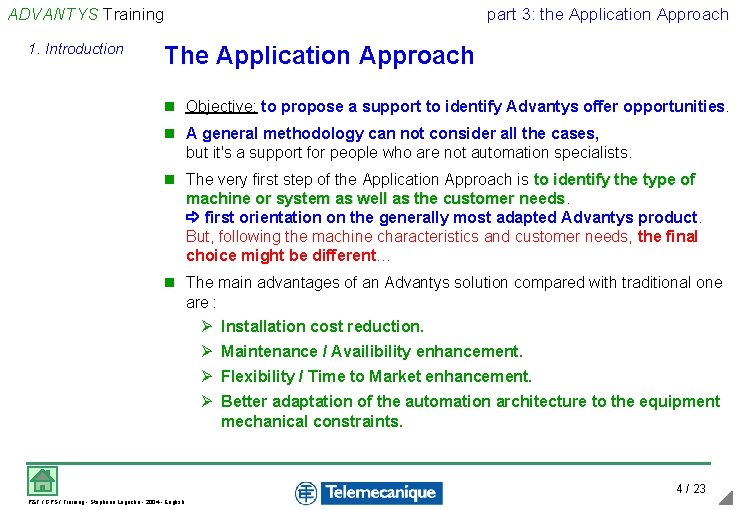
ADVANTYS Training 1. Introduction part 3: the Application Approach The Application Approach n Objective: to propose a support to identify Advantys offer opportunities. n A general methodology can not consider all the cases, but it's a support for people who are not automation specialists. n The very first step of the Application Approach is to identify the type of machine or system as well as the customer needs first orientation on the generally most adapted Advantys product. But, following the machine characteristics and customer needs, the final choice might be different… n The main advantages of an Advantys solution compared with traditional one are : Ø Installation cost reduction. Ø Maintenance / Availibility enhancement. Ø Flexibility / Time to Market enhancement. Ø Better adaptation of the automation architecture to the equipment mechanical constraints. 4 / 23 P&T / GPS / Training - Stéphane Lagache - 2004 - English
ADVANTYS Training part 3: the Application Approach Section 1. 2. 3. 4. Introduction The Machines Selection Guide Examples 5 / 23 P&T / GPS / Training - Stéphane Lagache - 2004 - English
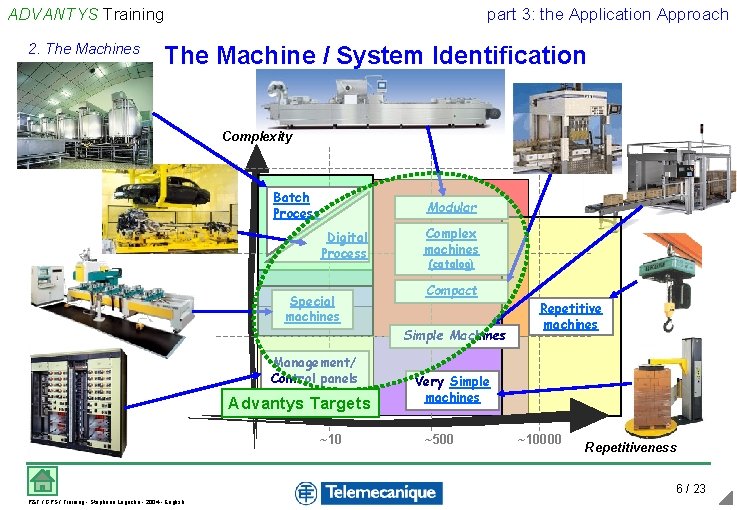
ADVANTYS Training 2. The Machines part 3: the Application Approach The Machine / System Identification Complexity Batch Process Modular Digital Process Special machines Complex machines (catalog) Compact Simple Machines Management/ Control panels Advantys Targets ~10 Repetitive machines Very Simple machines ~500 ~10000 Repetitiveness 6 / 23 P&T / GPS / Training - Stéphane Lagache - 2004 - English
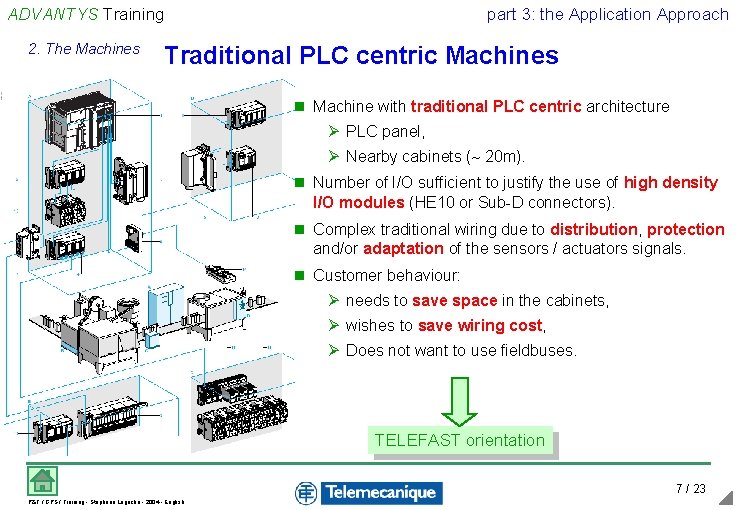
ADVANTYS Training 2. The Machines part 3: the Application Approach Traditional PLC centric Machines n Machine with traditional PLC centric architecture Ø PLC panel, Ø Nearby cabinets ( 20 m). n Number of I/O sufficient to justify the use of high density I/O modules (HE 10 or Sub-D connectors). n Complex traditional wiring due to distribution, protection and/or adaptation of the sensors / actuators signals. n Customer behaviour: Ø needs to save space in the cabinets, Ø wishes to save wiring cost, Ø Does not want to use fieldbuses. TELEFAST orientation 7 / 23 P&T / GPS / Training - Stéphane Lagache - 2004 - English
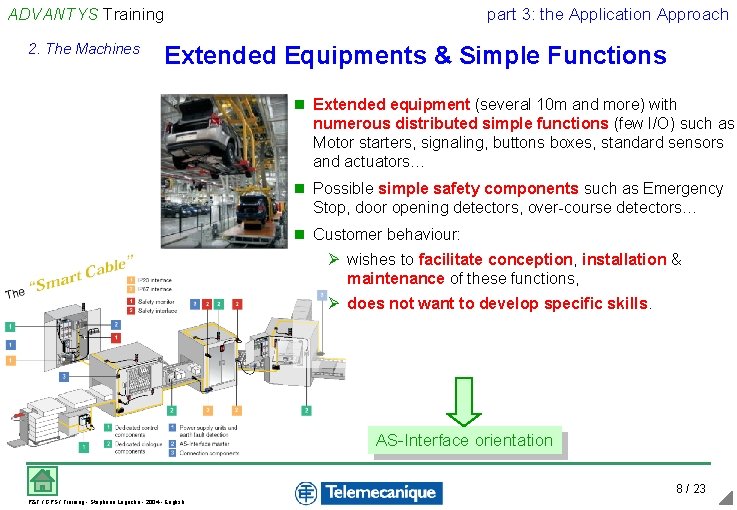
ADVANTYS Training 2. The Machines part 3: the Application Approach Extended Equipments & Simple Functions n Extended equipment (several 10 m and more) with numerous distributed simple functions (few I/O) such as Motor starters, signaling, buttons boxes, standard sensors and actuators… n Possible simple safety components such as Emergency Stop, door opening detectors, over-course detectors… n Customer behaviour: Ø wishes to facilitate conception, installation & maintenance of these functions, Ø does not want to develop specific skills. AS-Interface orientation 8 / 23 P&T / GPS / Training - Stéphane Lagache - 2004 - English
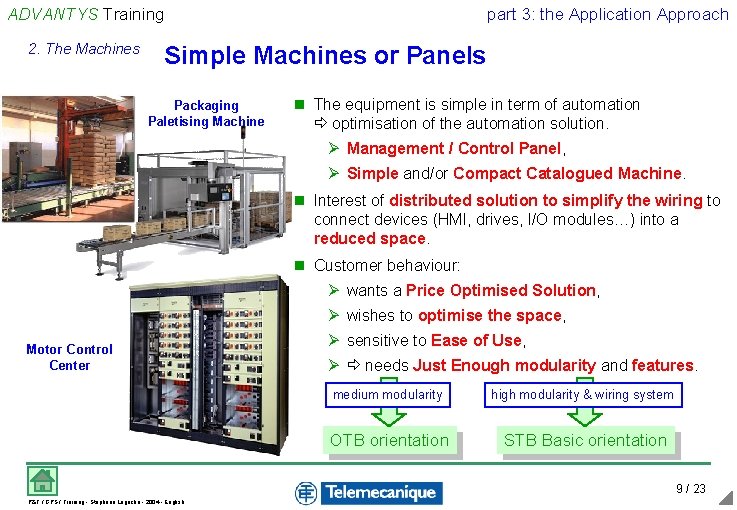
ADVANTYS Training 2. The Machines part 3: the Application Approach Simple Machines or Panels Packaging Paletising Machine n The equipment is simple in term of automation optimisation of the automation solution. Ø Management / Control Panel, Ø Simple and/or Compact Catalogued Machine. n Interest of distributed solution to simplify the wiring to connect devices (HMI, drives, I/O modules…) into a reduced space. n Customer behaviour: Ø wants a Price Optimised Solution, Ø wishes to optimise the space, Motor Control Center Ø sensitive to Ease of Use, Ø needs Just Enough modularity and features. medium modularity high modularity & wiring system OTB orientation STB Basic orientation 9 / 23 P&T / GPS / Training - Stéphane Lagache - 2004 - English
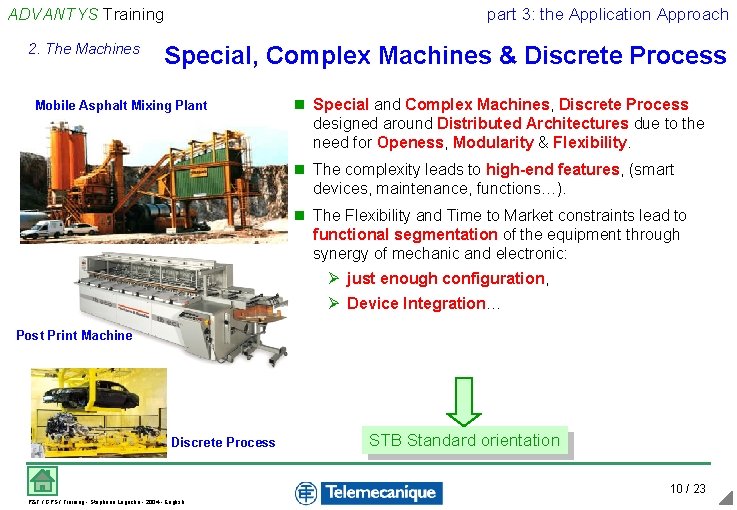
ADVANTYS Training 2. The Machines part 3: the Application Approach Special, Complex Machines & Discrete Process Mobile Asphalt Mixing Plant n Special and Complex Machines, Discrete Process designed around Distributed Architectures due to the need for Openess, Modularity & Flexibility. n The complexity leads to high-end features, (smart devices, maintenance, functions…). n The Flexibility and Time to Market constraints lead to functional segmentation of the equipment through synergy of mechanic and electronic: Ø just enough configuration, Ø Device Integration… Post Print Machine Discrete Process STB Standard orientation 10 / 23 P&T / GPS / Training - Stéphane Lagache - 2004 - English
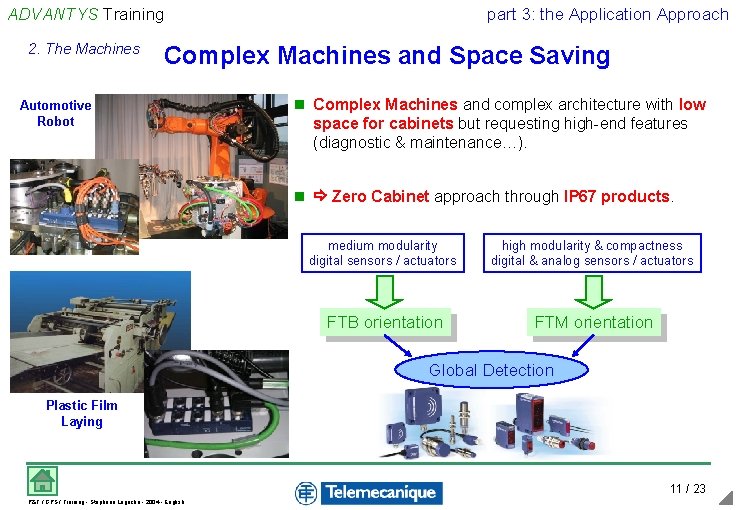
ADVANTYS Training 2. The Machines part 3: the Application Approach Complex Machines and Space Saving Automotive Robot n Complex Machines and complex architecture with low space for cabinets but requesting high-end features (diagnostic & maintenance…). n Zero Cabinet approach through IP 67 products. medium modularity digital sensors / actuators high modularity & compactness digital & analog sensors / actuators FTB orientation FTM orientation Global Detection Plastic Film Laying 11 / 23 P&T / GPS / Training - Stéphane Lagache - 2004 - English
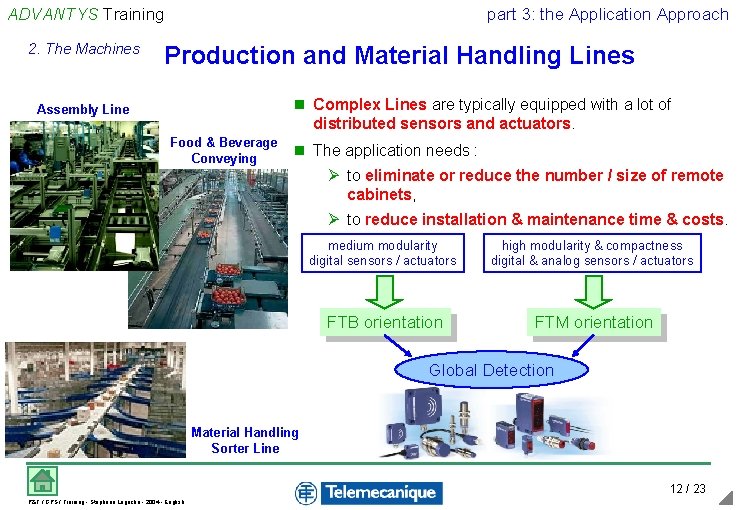
ADVANTYS Training 2. The Machines part 3: the Application Approach Production and Material Handling Lines n Complex Lines are typically equipped with a lot of distributed sensors and actuators. Assembly Line Food & Beverage Conveying n The application needs : Ø to eliminate or reduce the number / size of remote cabinets, Ø to reduce installation & maintenance time & costs. medium modularity digital sensors / actuators high modularity & compactness digital & analog sensors / actuators FTB orientation FTM orientation Global Detection Material Handling Sorter Line 12 / 23 P&T / GPS / Training - Stéphane Lagache - 2004 - English
ADVANTYS Training part 3: the Application Approach Section 1. 2. 3. 4. Introduction The Machines Selection Guide Examples 13 / 23 P&T / GPS / Training - Stéphane Lagache - 2004 - English
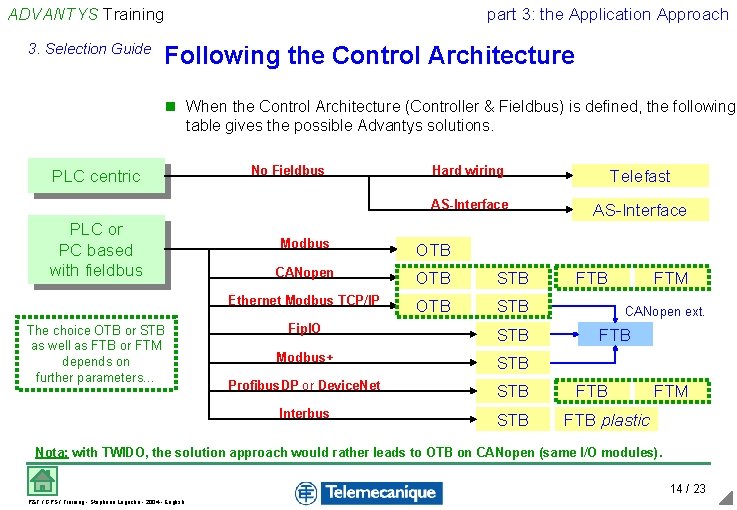
ADVANTYS Training 3. Selection Guide part 3: the Application Approach Following the Control Architecture n When the Control Architecture (Controller & Fieldbus) is defined, the following table gives the possible Advantys solutions. PLC centric PLC or PC based with fieldbus The choice OTB or STB as well as FTB or FTM depends on further parameters… No Fieldbus Hard wiring Telefast AS-Interface Modbus OTB CANopen OTB STB Ethernet Modbus TCP/IP OTB STB Fip. IO STB Modbus+ STB Profibus. DP or Device. Net STB Interbus STB FTM CANopen ext. FTB FTM FTB plastic Nota: with TWIDO, the solution approach would rather leads to OTB on CANopen (same I/O modules). 14 / 23 P&T / GPS / Training - Stéphane Lagache - 2004 - English
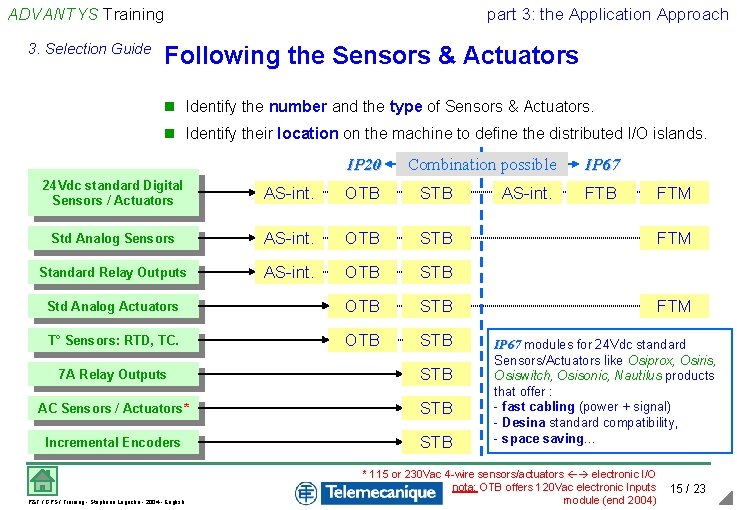
ADVANTYS Training 3. Selection Guide part 3: the Application Approach Following the Sensors & Actuators n Identify the number and the type of Sensors & Actuators. n Identify their location on the machine to define the distributed I/O islands. IP 20 Combination possible 24 Vdc standard Digital Sensors / Actuators AS-int. OTB Std Analog Sensors AS-int. OTB Standard Relay Outputs AS-int. OTB Std Analog Actuators OTB STB T° Sensors: RTD, TC. OTB STB 7 A Relay Outputs STB AC Sensors / Actuators* STB Incremental Encoders STB P&T / GPS / Training - Stéphane Lagache - 2004 - English AS-int. IP 67 FTB FTM FTM IP 67 modules for 24 Vdc standard Sensors/Actuators like Osiprox, Osiris, Osiswitch, Osisonic, Nautilus products that offer : - fast cabling (power + signal) - Desina standard compatibility, - space saving. . . * 115 or 230 Vac 4 -wire sensors/actuators electronic I/O nota: OTB offers 120 Vac electronic Inputs module (end 2004) 15 / 23
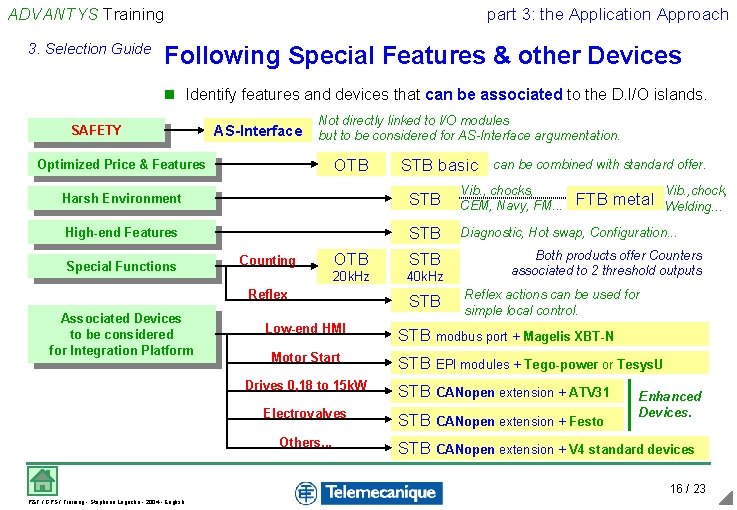
ADVANTYS Training 3. Selection Guide part 3: the Application Approach Following Special Features & other Devices n Identify features and devices that can be associated to the D. I/O islands. SAFETY AS-Interface Not directly linked to I/O modules but to be considered for AS-Interface argumentation. OTB Optimized Price & Features STB basic can be combined with standard offer. Harsh Environment STB Vib. , chocks, CEM, Navy, FM. . . High-end Features STB Diagnostic, Hot swap, Configuration. . . Special Functions Counting OTB STB 20 k. Hz 40 k. Hz Reflex Associated Devices to be considered for Integration Platform Low-end HMI Motor Start STB FTB metal Both products offer Counters associated to 2 threshold outputs Reflex actions can be used for simple local control. STB modbus port + Magelis XBT-N STB EPI modules + Tego-power or Tesys. U Drives 0, 18 to 15 k. W STB CANopen extension + ATV 31 Electrovalves STB CANopen extension + Festo Others. . . Vib. , chock, Welding. . . Enhanced Devices. STB CANopen extension + V 4 standard devices 16 / 23 P&T / GPS / Training - Stéphane Lagache - 2004 - English
ADVANTYS Training part 3: the Application Approach Section 1. 2. 3. 4. Introduction The Machines Selection Guide Examples 17 / 23 P&T / GPS / Training - Stéphane Lagache - 2004 - English
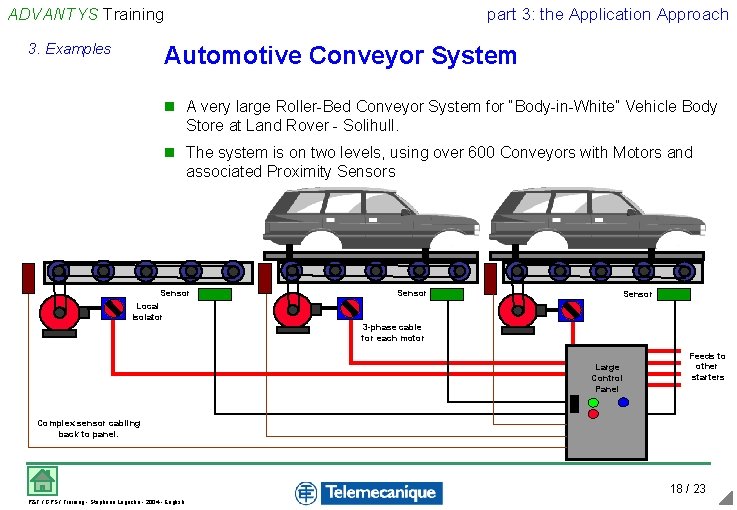
ADVANTYS Training 3. Examples part 3: the Application Approach Automotive Conveyor System n A very large Roller-Bed Conveyor System for “Body-in-White” Vehicle Body Store at Land Rover - Solihull. n The system is on two levels, using over 600 Conveyors with Motors and associated Proximity Sensors Sensor Local Isolator 3 -phase cable for each motor Large Control Panel Feeds to other starters Complex sensor cabling back to panel. 18 / 23 P&T / GPS / Training - Stéphane Lagache - 2004 - English
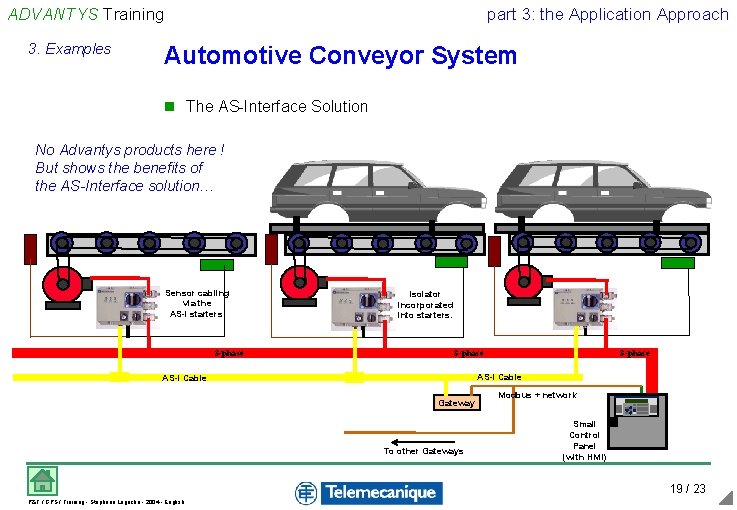
ADVANTYS Training 3. Examples part 3: the Application Approach Automotive Conveyor System n The AS-Interface Solution No Advantys products here ! But shows the benefits of the AS-Interface solution… Sensor cabling via the AS-i starters. 3 -phase Isolator incorporated into starters. 3 -phase AS-i Cable Gateway To other Gateways Modbus + network Small Control Panel (with HMI) 19 / 23 P&T / GPS / Training - Stéphane Lagache - 2004 - English
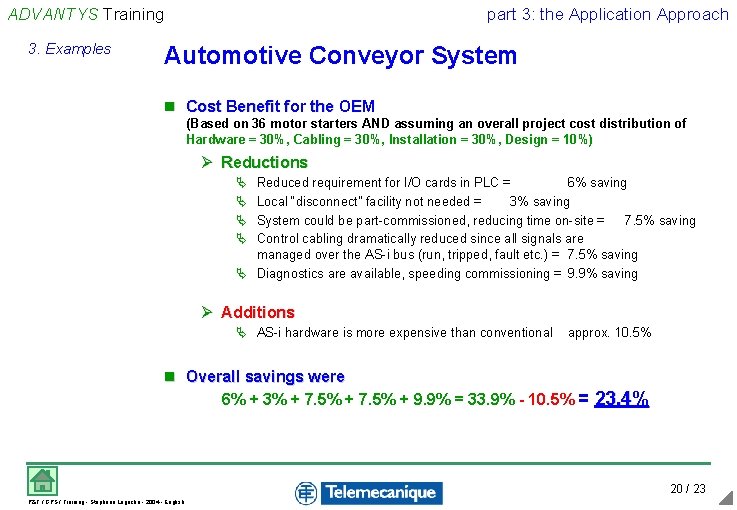
ADVANTYS Training 3. Examples part 3: the Application Approach Automotive Conveyor System n Cost Benefit for the OEM (Based on 36 motor starters AND assuming an overall project cost distribution of Hardware = 30%, Cabling = 30%, Installation = 30%, Design = 10%) Ø Reductions Ä Ä Reduced requirement for I/O cards in PLC = 6% saving Local “disconnect” facility not needed = 3% saving System could be part-commissioned, reducing time on-site = 7. 5% saving Control cabling dramatically reduced since all signals are managed over the AS-i bus (run, tripped, fault etc. ) = 7. 5% saving Ä Diagnostics are available, speeding commissioning = 9. 9% saving Ø Additions Ä AS-i hardware is more expensive than conventional approx. 10. 5% n Overall savings were 6% + 3% + 7. 5% + 9. 9% = 33. 9% - 10. 5% = 23. 4% 20 / 23 P&T / GPS / Training - Stéphane Lagache - 2004 - English
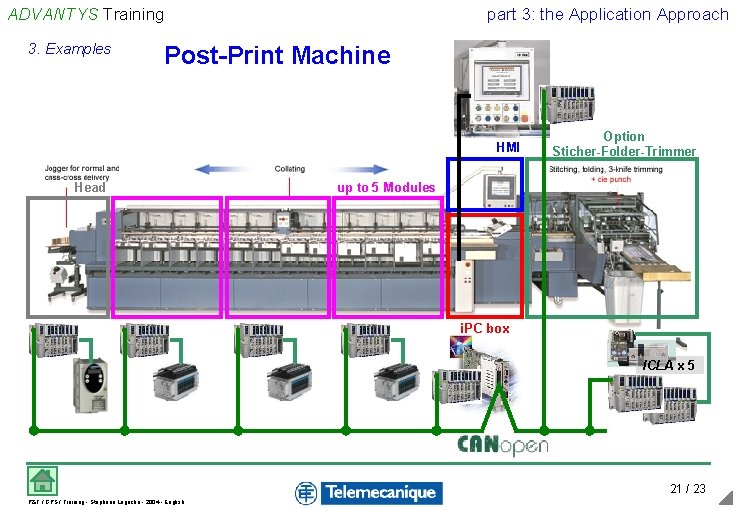
ADVANTYS Training 3. Examples part 3: the Application Approach Post-Print Machine HMI Head Option Sticher-Folder-Trimmer up to 5 Modules i. PC box ICLA x 5 21 / 23 P&T / GPS / Training - Stéphane Lagache - 2004 - English
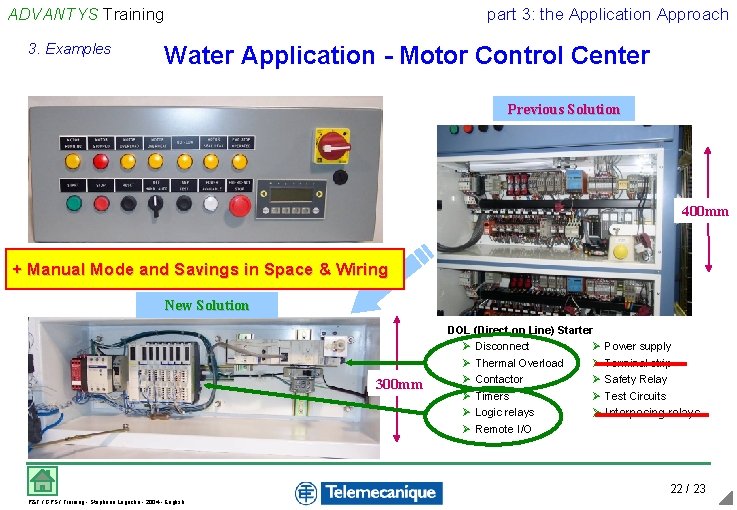
ADVANTYS Training 3. Examples part 3: the Application Approach Water Application - Motor Control Center Previous Solution 400 mm + Manual Mode and Savings in Space & Wiring New Solution 300 mm DOL (Direct on Line) Starter Ø Disconnect Ø Power supply Ø Thermal Overload Ø Terminal strip Ø Contactor Ø Safety Relay Ø Timers Ø Logic relays Ø Remote I/O Ø Test Circuits Ø Interposing relays 22 / 23 P&T / GPS / Training - Stéphane Lagache - 2004 - English
ADVANTYS Training part 3: the Application Approach Q uestions & answers 23 / 23 P&T / GPS / Training - Stéphane Lagache - 2004 - English